
Year: 2019

01 Nov 2019

Hailing a driverless ride in a Waymo

“Congrats! This car is all yours, with no one up front,” the pop-up notification from the Waymo One app reads. “This ride will be different. With no one else in the car, Waymo will do all the driving. Enjoy this free ride on us!”

Moments later, an empty Chrysler Pacifica minivan appears and navigates its way to my location near a park in Chandler, the Phoenix suburb where Waymo has been testing its autonomous vehicles since 2016.

Waymo, the Google self-driving-project-turned-Alphabet unit, has given demos of its autonomous vehicles before. More than a dozen journalists experienced driverless rides in 2017 on a closed course at Waymo’s testing facility in Castle; and Steve Mahan, who is legally blind, took a driverless ride in the company’s Firefly prototype on Austin’s city streets way back in 2015.
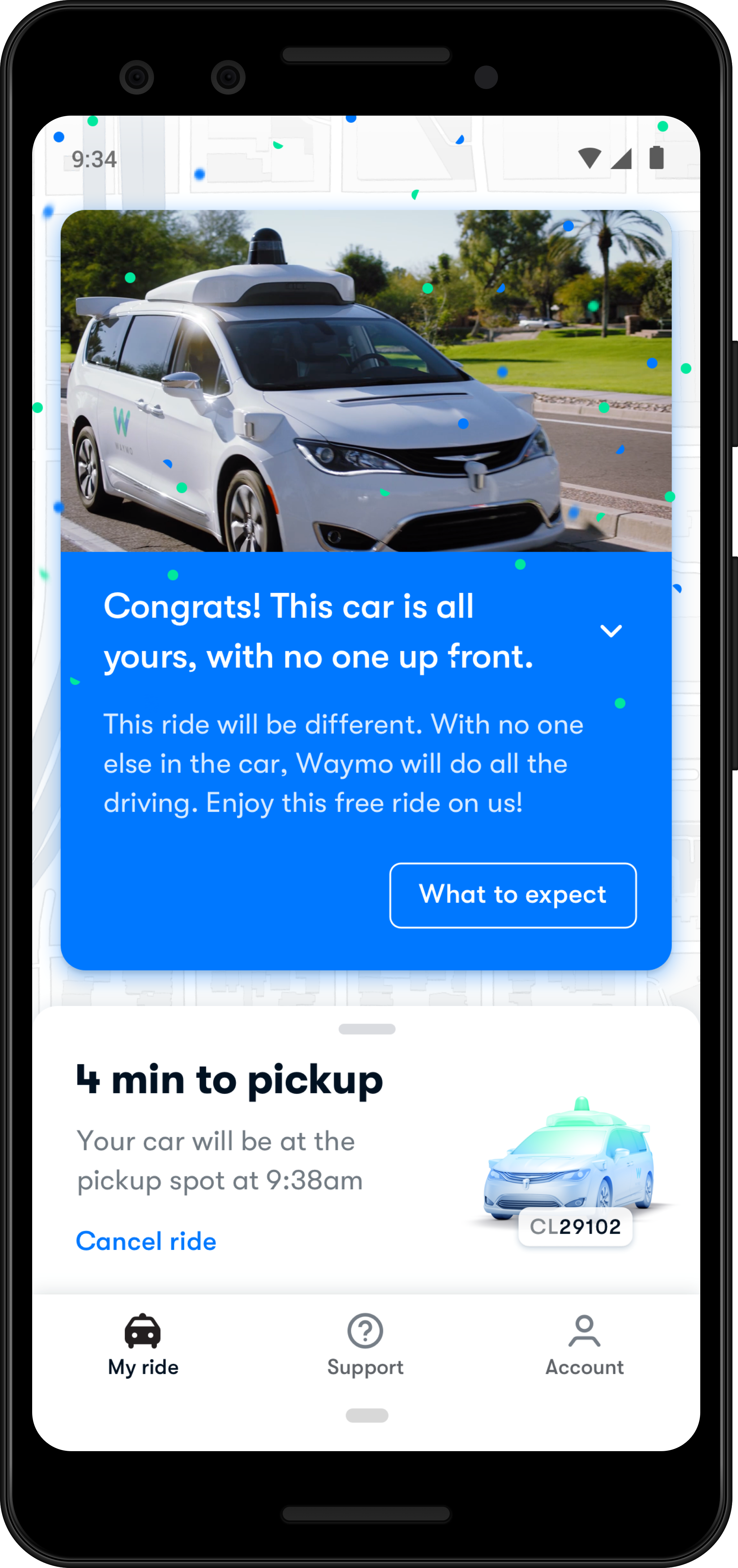
waymo Driverless notificationBut this driverless ride is different — and not just because it involved an unprotected left-hand turn, busy city streets or that the Waymo One app was used to hail the ride. It marks the beginning of a driverless ride-hailing service that is now being used by members of its early rider program and eventually the public.

It’s a milestone that has been promised — and has remained just out of reach — for years.

In 2017, Waymo CEO John Krafcik declared on stage at the Lisbon Web Summit that “fully self-driving cars are here.” Krafcik’s show of confidence and accompanying blog post implied that the “race to autonomy” was almost over. But it wasn’t.

Nearly two years after Krafcik’s comments, vehicles driven by humans — not computers — still clog the roads in Phoenix. The majority of Waymo’s fleet of self-driving Chrysler Pacifica minivans in Arizona have human safety drivers behind the wheel; and the few driverless ones have been limited to testing only.

Despite some progress, Waymo’s promise of a driverless future has seemed destined to be forever overshadowed by stagnation. Until now.

Waymo wouldn’t share specific numbers on just how many driverless rides it would be giving, only saying that it continues to ramp up its operations. Here’s what we do know. There are hundreds of customers in its early rider program, all of whom will have access to this offering. These early riders can’t request a fully driverless ride. Instead, they are matched with a driverless car if it’s nearby.

There are, of course, caveats to this milestone. Waymo is conducting these “completely driverless” rides in a controlled geofenced environment. Early rider program members are people who are selected based on what ZIP code they live in and are required to sign NDAs. And the rides are free, at least for now.waymo VID 20191023 093743

Still, as I buckle my seatbelt and take stock of the empty driver’s seat, it’s hard not to be struck, at least for a fleeting moment, by the achievement.

It would be a mistake to think that the job is done. This moment marks the start of another, potentially lengthy, chapter in the development of driverless mobility rather than a sign that ubiquitous autonomy is finally at hand.

Futuristic joyride   

A driverless ride sounds like a futuristic joyride, but it’s obvious from the outset that the absence of a human touch presents a wealth of practical and psychological challenges.

As soon as I’m seated, belted and underway, the car automatically calls Waymo’s rider assistance team to address any questions or concerns about the driverless ride — bringing a brief human touch to the experience.

I’ve been riding in autonomous vehicles on public roads since late 2016. All of those rides had human safety drivers behind the wheel. Seeing an empty driver’s seat at 45 miles per hour, or a steering wheel spinning in empty space as it navigates suburban traffic, feels inescapably surreal. The sensation is akin to one of those dreams where everything is the picture of normalcy except for that one detail — the clock with a human face or the cat dressed in boots and walking with a cane.

Other than that niggling feeling that I might wake up at any moment, my 10-minute ride from a park to a coffee shop was very much like any other ride in a “self-driving” car. There were moments where the self-driving system’s driving impressed, like the way it caught an unprotected left turn just as the traffic signal turned yellow or how its acceleration matched surrounding traffic. The vehicle seemed to even have mastered the more human-like driving skill of crawling forward at a stop sign to signal its intent.

Only a few typical quirks, like moments of overly cautious traffic spacing and overactive path planning, betrayed the fact that a computer was in control. A more typical rider, specifically one who doesn’t regularly practice their version of the driving Turing Test, might not have even noticed them.

How safe is ‘safe enough’?

Waymo’s decision to put me in a fully driverless car on public roads anywhere speaks to the confidence it puts in its “driver,” but the company was cagey about the specific source of that confidence.

Waymo’s Director of Product Saswat Panigrahi declined to share how many driverless miles Waymo had accumulated in Chandler, or what specific benchmarks proved that its driver was “safe enough” to handle the risk of a fully driverless ride. Citing the firm’s 10 million real-world miles and 10 billion simulation miles, Panigrahi argued that Waymo’s confidence comes from “a holistic picture.”

“Autonomous driving is complex enough not to rely on a singular metric,” Panigrahi said.

It’s a sensible, albeit frustrating, argument, given that the most significant open question hanging over the autonomous drive space is “how safe is safe enough?” Absent more details, it’s hard to say if my driverless ride reflects a significant benchmark in Waymo’s broader technical maturity or simply its confidence in a relatively unchallenging route.

The company’s driverless rides are currently free and only taking place in a geofenced area that includes parts of Chandler, Mesa and Tempe. This driverless territory is smaller than Waymo’s standard domain in the Phoenix suburbs, implying that confidence levels are still highly situational. Even Waymo vehicles with safety drivers don’t yet take riders to one of the most popular ride-hailing destinations: the airport.

The complexities of driverless

Panigrahi deflected questions about the proliferation of driverless rides, saying only that the number has been increasing and will continue to do so. Waymo has about 600 autonomous vehicles in its fleet across all geographies, including Mountain View, Calif. The majority of those vehicles are in Phoenix, according to the company.

However, Panigrahi did reveal that the primary limiting factor is applying what it learned from research into early rider experiences.

“This is an experience that you can’t really learn from someone else,” Panigrahi said. “This is truly new.”

Some of the most difficult challenges of driverless mobility only emerge once riders are combined with the absence of a human behind the wheel. For example, developing the technologies and protocols that allow a driverless Waymo to detect and pull over for emergency response vehicles and even allow emergency services to take over control was a complex task that required extensive testing and collaboration with local authorities.

“This was an entire area that, before doing full driverless, we didn’t have to worry as much about,” Panigrahi said.

The user experience is another crux of driverless ride-hailing. It’s an area to which Waymo has dedicated considerable time and resources — and for good reason. User experience turns out to hold some surprisingly thorny challenges once humans are removed from the equation.

WAYMO 1. edjpg

The everyday interactions between a passenger and an Uber or Lyft driver, such as conversations about pick-up and drop-offs as well as sudden changes in plans, become more complex when the driver is a computer. It’s an area that Waymo’s user experience research (UXR) team admits it is still figuring out.

Computers and sensors may already be better than humans at specific driving capabilities, like staying in lanes or avoiding obstacles (especially over long periods of time), but they lack the human flexibility and adaptability needed to be a good mobility provider.

Learning how to either handle or avoid the complexities that humans accomplish with little effort requires a mix of extensive experience and targeted research into areas like behavioral psychology that tech companies can seem allergic to.

Not just a tech problem

Waymo’s early driverless rides mark the beginning of a new phase of development filled with fresh challenges that can’t be solved with technology alone. Research into human behavior, building up expertise in the stochastic interactions of the modern urban curbside, and developing relationships and protocols with local authorities are all deeply time-consuming efforts. These are not challenges that Waymo can simply throw technology at, but require painstaking work by humans who understand other humans.

Some of these challenges are relatively straightforward. For example, it didn’t take long for Waymo to realize that dropping off riders as close to the entrance of a Walmart was actually less convenient due to the high volume of foot traffic. But understanding that pick-up and drop-off isn’t ruled by a single principle (e.g. closer to the entrance is always better) hints at a hidden wealth of complexity that Waymo’s vehicles need to master.
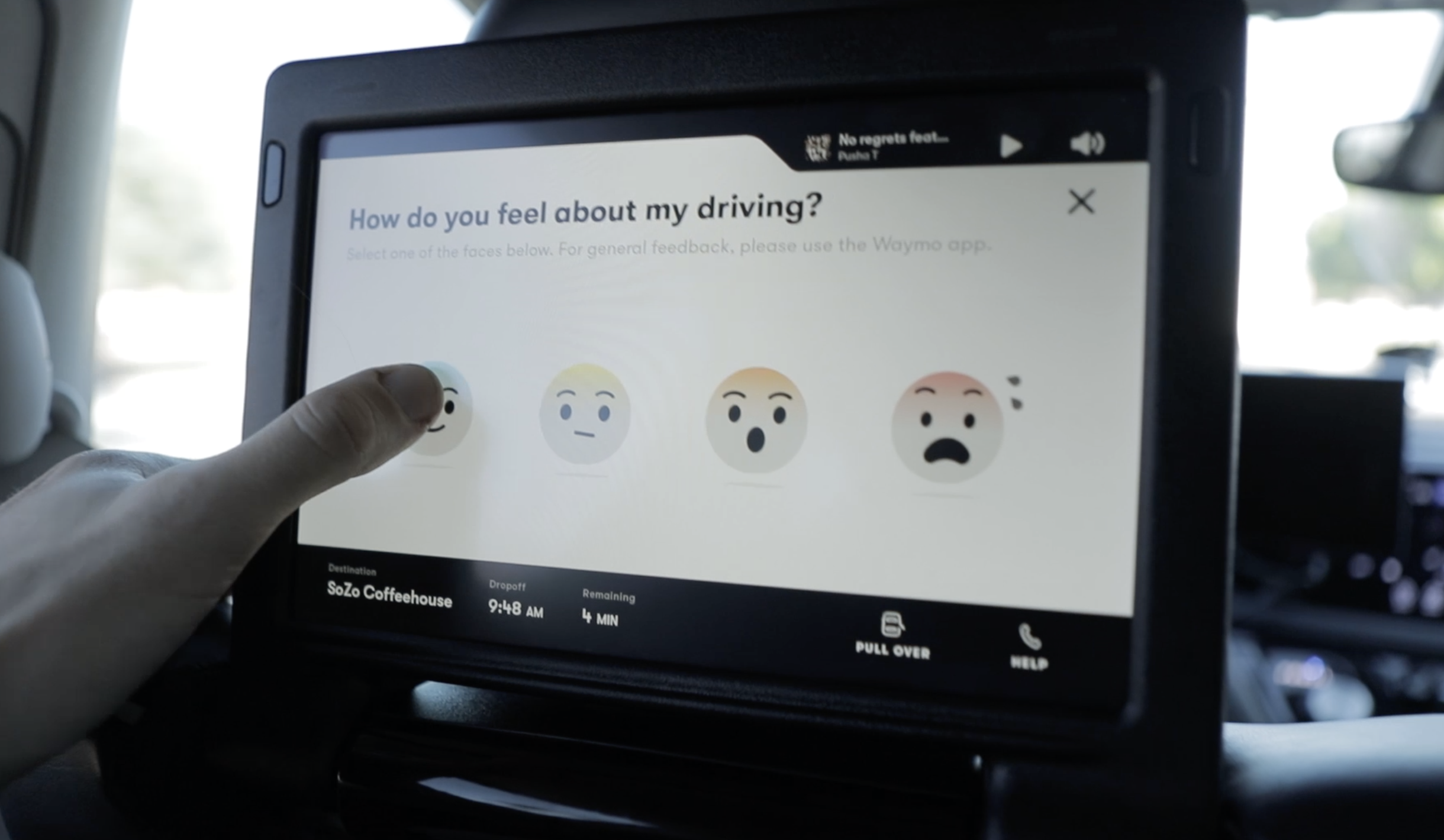
waymo interaction

As frustrating as the slow pace of self-driving proliferation is, the fact that Waymo is embracing these challenges and taking the time to address it is encouraging.

The first chapter of autonomous drive technology development was focused on the purely technical challenge of making computers drive. Weaving Waymo’s computer “driver” into the fabric of society requires an understanding of something even more mysterious and complex: people and how they interact with each other and the environment around them.

Given how fundamentally autonomous mobility could impact our society and cities, it’s reassuring to know that one of the technology’s leading developers is taking the time to understand and adapt to them.

01 Nov 2019

New Relic snags early stage serverless monitoring startup IOpipe

As we move from a world dominated by virtual machines to one of serverless, it changes the nature of monitoring, and vendors like New Relic certainly recognize that. This morning the company announced it was acquiring IOpipe, an early-stage Seattle serverless monitoring startup to help beef up its serverless monitoring chops. Terms of the deal weren’t disclosed.

New Relic gets what it calls “key members of the team,” which at least includes co-founders Erica Windisch and Adam Johnson, along with the IOpipe technology. The new employees will be moving from Seattle to New Relic’s Portland offices.

“This deal allows us to make immediate investments in onboarding that will make it faster and simpler for customers to integrate their [serverless] functions with New Relic and get the most out of our instrumentation and UIs that allow fast troubleshooting of complex issues across the entire application stack,” the company wrote in a blog post announcing the acquisition.

It adds that initially the IOpipe team will concentrate on moving AWS Lambda features like Lambda Layers into the New Relic platform. Over time, the team will work on increasing support for Serverless function monitoring. New Relic is hoping by combining the IOpipe team and solution with its own, it can speed up its serverless monitoring chops .

As TechCrunch’s Frederic Lardinois pointed out in his article about the company’s $2.5 million seed round in 2017, Windisch and Johnson bring impressive credentials.

“IOpipe co-founders Adam Johnson (CEO) and Erica Windisch (CTO), too, are highly experienced in this space, having previously worked at companies like Docker and Midokura (Adam was the first hire at Midokura and Erica founded Docker’s security team). They recently graduated from the Techstars NY program,” Lardinois wrote at the time.

The startup has been helping monitor serverless operations for companies running AWS Lambda. It’s important to understand that serverless doesn’t mean that there are no servers, but the cloud vendor — in this case AWS — provides the exact resources to complete an operation and nothing more.

IOpipe co-founders Erica Windisch and Adam Johnson

Photo: New Relic

Once the operation ends, the resources can simply get redeployed elsewhere. That makes building monitoring tools for such ephemeral resources a huge challenge. New Relic has also been working on the problem and released New Relic Serverless for AWS Lambda offering earlier this year.

IOpipe was founded in 2015, which was just around the time that Amazon was announcing Lambda. At the time of the seed round the company had eight employees. According to Pitchbook data, it currently has between 1 and 10 employees, and has raised $7.07 million since its inception.

New Relic was founded in 2008 and raised over $214 million, according to Crunchbase, before going public in 2014. Its stock price was $65.42 at the time of publication up $1.40.

01 Nov 2019

Manage your angel investors, or they’ll manage you

In 2016, angel investors pumped approximately $24 billion into startups.

It’s almost certain that an angel will play a role in your startup’s journey, but like everything else in a startup’s life, you need to watch out for potential problems. If you don’t manage them properly, these early backers could get in the way of your startup’s success. The advice from investors and founders below will help you navigate the process of raising a successful angel round while avoiding some of the long-term hassles.

James Currier laughs at how little he knew as a first-time founder looking for angel investors in 1999. The more investors the better, he figured — until he had to handle the fallout of an angel round with sixteen backers.

“They want you to talk to their lawyer and their tax accountant and, before you know it, my 16 angels turned into 64 different relationships,” says Currier, a four-time serial entrepreneur and now a managing partner at early-stage venture firm NFX . “It quite quickly became almost a full-time job checking in with them and taking time to hear all their ideas.”

His advice to founders? Keep your circle of investors as small as possible so you can concentrate on what matters. “This is a time to be as focused as you can on product and customers and revenue,” he says. Raising an angel round is a triumphant moment for any fledgling startup. Yet as with every step of a founder’s journey, there are potential landmines along the way. Failing to manage your angels, Currier and others warn, can distract a company and hurt, rather than help, its chances of success. “They can really gum up the works sometimes,” Currier says.

Be selective

The first thing to keep in mind when thinking about raising an angel round is to choose carefully. “I advise clients to be really thoughtful about who they bring into the seed round,” says Ivan Gaviria, a lawyer at Gunderson Dettmer who has been counseling Silicon Valley startups for more than twenty years. “Clients will say to me, ‘Oh, I need this person because they’re connected in this industry and they’re going to get me leads or whatever,’” he says. “But guess what? Everybody’s well-intentioned, but everybody’s also busy.”

In the vast majority of cases, once angels write a check and get their shares, Gaviria says, “they are not going to spend a ton of time adding value to the company.” Yet Gaviria still sees entrepreneurs pursue what he and others call a “party round,” especially when founders have a well-developed network. “I’ve seen 20, 25, 30 parties, all wanting to drop $25,000 or $50,000 in an entrepreneur’s new endeavor,” he says. “They’re trying to do right by their friends and acquaintances and others who want in on the angel round, but they’re also creating headaches for themselves and their lead investors.”

Gaviria gives the example of “pro-rata rights” — the routine guarantee that angel investors can choose to buy a proportionate number of shares in a future round. “Now 20 or 25 or 30 people have to be notified and the paperwork done for each,” he says.

Set expectations and boundaries for communication

An even bigger challenge is time management and navigating relationships with 20 or 30 people to whom you’ll now feel obliged. “There’s a difference with angels between information versus advice and engagement,” Currier says. “As a CEO, you have to explain to angels the difference. Because some angels want to be entertained.” Those investors hope for a financial return, of course, but they also relish the idea of having a front-row seat to your entrepreneurial journey. To make sure that desire doesn’t turn into a burdensome series of check-ins and inopportune “how is it going” calls, NFX gives founders a template for communications with investors. A monthly report helps to set both expectations and boundaries, Currier says.

01 Nov 2019

As sales of smart speakers grow, Soundcheck wants to help make the web more “speakable”

Slowly but surely, smart speakers are taking over. As Amazon builds Alexa into everything from tiny clocks to microwaves and Google wraps Assistant into just about anything it can, it feels like it’ll be no time before the rooms that don’t have some sort of voice-powered device are the exception.

But most people and businesses probably have no idea how to get their content prepped and ready to play friendly with these speakers. That’s the driving force behind Soundcheck, a company opening up its doors this morning.

Soundcheck helps to take your content and package it up in a format these smart speakers and voice assistant devices more readily understand.

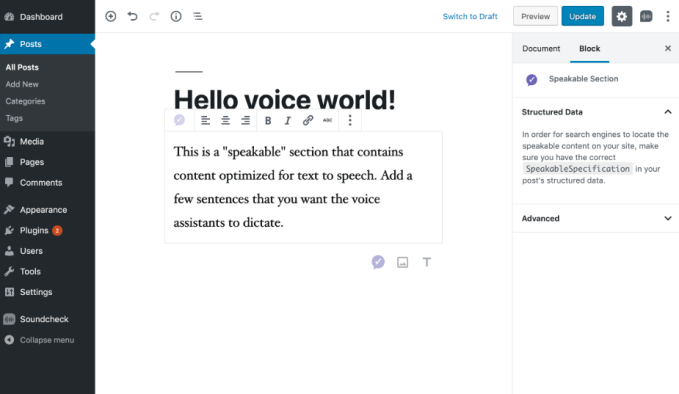
Soundcheck’s primary focus initially is on WordPress -powered sites — not a small target, considering that estimates suggest WordPress powers over 30% of the Internet. They’ve built a plugin that lets you take information on your WordPress site and, in a tap-or-two, wrap up the most important pieces in Google’s “speakable” data format — effectively acting as a highlighter, saying “Hey voice speakers and the search algorithms that power them! This bit of information is meant for you, and answers that question about Topic X”.

soundcheck screen

Getting data into this format usually means writing custom markup for each page in question, which is something that not everyone (like, say, a small business owner using WordPress mostly for the whole simplified WYSIWYG aspect) is prepped to do. Soundcheck boils the process down to a button press, handles the data validation, and provides a preview of how that content might sound when read aloud by a voice assistant.

Soundcheck will be free for users who just want the basic plugin, with support for their 50 latest WordPress posts. If you need support for more posts, or you want to do fancier things like custom API integrations and tying into dedicated Amazon Alexa/Google Assistant apps, they’ll charge somewhere between $20-$79 a month. The company tells me it’s also building out an analytics tool to help publishers better understand where and when its data is being accessed by voice. They also say that support for other content platforms beyond WordPress is on the roadmap.

Soundcheck is founded by Daniel Tyreus and Narendra Rocherolle — the latter of which also co-founded Webshots, the ultra early photo sharing site that sold to Excite@Home for $82.5M in 1999. They originally set out to build Peck, a service founded in 2016 that aimed to figure out the best way to pull in information on a subject and pack it down into its most concise form. They found that one of the toughest parts of that equation was getting data packaged up and ready for smart speakers like Alexa and Google Home — so they pivoted to focus on that.

The team has raised $1.5M to date, backed by True Ventures, Resolute Ventures, Twitter co-founder Biz Stone, and Flickr co-founder Caterina Fake — along with Automattic, the very team behind WordPress.

01 Nov 2019

Google is acquiring Fitbit

The rumors are true. A week after word surfaced that Google planned to buy Fitbit, the companies have confirmed the purchase. The match could ultimately prove beneficial for both parties. Google has struggled to make much of a dent in the wearables category, leading the software giant to purchase a large chunk of IP from watchmaker, Fossil.

Fitbit, meanwhile, has had issues maintaining growth in recent years. The company, which first pioneered and then dominated the wrist-worn tracker space, struggled as smartwatches grew and ultimately dominated the space. While late to the category, the company has had luck with the Versa watch, the result of its own acquisition of Pebble, Vector and Coin, while working to pivot much of its focus into healthcare.

Developing…


01 Nov 2019

Sam Altman’s bet against Slack

Hello and welcome back to Equity, TechCrunch’s venture capital-focused podcast, where we unpack the numbers behind the headlines.

This week Kate and Alex broke the discussion into two main themes. The first dealt with early-stage companies, and the second, as you can imagine, later-stage affairs. Don’t worry, we don’t get to SoftBank for quite some time.

Up top, we dug into Kate’s story about Quill, a formerly stealthy company that could be taking on Slack. That or something similar to Slack . Next, we turned to ManiMe, a startup in the beauty space that raised a smaller $2.6 million to take on a market that is valued in the billions.

After that it was time to leave the auspices of the early-stage market and move to, of all things, a public company. GrubHub reported earnings this week. It went poorly. Alex wanted to riff over the company’s earnings report and what it could mean for startups that are competing with GrubHub, a leader in the food delivery space that DoorDash and Postmates would prefer to lead themselves.

What impact GrubHub may have on the highly-valued on-demand companies isn’t clear yet, but will be pretty damn interesting to see when it does land.

Sticking to the later-stage markets, Alex dug into the problems at Wag which is struggling and looking for a sale despite raising a castle of cash from the Vision Fund. Kate followed that up with notes on problems at Katerra. The Information is reporting this week that the business is going through a number of layoffs and we’re wondering if it will suffer the same fate of some of SoftBank’s other investments.

And, finally, the changing face of things at SoftBank itself. The great money spigot is slowly cutting flow. How many unicorns that will strand isn’t yet clear. But surely it can’t be zero.

Equity drops every Friday at 6:00 am PT, so subscribe to us on Apple PodcastsOvercastSpotify and all the casts.

01 Nov 2019

EHang, maker of autonomous flying shuttles, files for $100 million IPO

Chinese autonomous air mobility company EHang has filed with the SEC the paperwork required to go public in the U.S. on the NASDAQ exchange, with a $100 million initial public offering. The company, which has been flying demonstration flights with passengers on board for a while now, is gearing up to launch its first commercial service in Guangzhou after getting approval from local and national regulators to deploy its drones in the area.

At launch, EHang will be using its two-seater vertical take-off and landing craft (VTOL), which has room for two passengers on board. EHang doesn’t just build the aircraft, though – its goal is to build full, multi-aircraft (as many as ‘thousands,’ according to Forbes) autonomous transportation networks that it hopes will serve to alleviate and avoid congested ground traffic. Guangzhou, with an estimated population of over 13 million, suffers from considerable traffic.

EHang is also building out logistics and cargo transportation capabilities as well as passenger services. The company believes it can offers short designate cross-city transportation that can cut down on time by as much as 40 to 60 percent, and once it achieves scale, it also says that costs have the potential to be reduced by as much as 50 percent.

Founded in 2014, EHang last announced funding in 2015, when It raised $42 million in a Series B round led by GP Capital, with GGV Capital, ZhenFund, Lebox Capital, OFC and PreAngel also participating.

01 Nov 2019

Apple TV+ now live, with one year free for new iOS, Apple TV and Mac purchases

Apple has launched its streaming video subscription service, making available a varied and sizeable library of content immediately for subscribers. To access the service, you do need to sign up for a$4.99 per month subscription, but if you’ve purchased any new iPhone, iPad, iPod touch, Apple TV or Mac since the beginning of September, and you’re signed in to the Apple ID associated with those devices on those devices, the subscribe button should show that you get one full year of free trial service applied automatically.

Apple TV+ content lives in the Apple TV app that’s available across macOS, Apple TV, iOS and iPadOS devices, and which should be pre-installed already unless you’ve deleted it form your device or you’re running an older version of the operating system. Shows from the new program will then show up in a dedicated AppleTV+ row in the app’s home screen, as well as throughout the interface in various places.

At launch, you’ll find ‘The Morning Show,’ ‘See,’ ‘For All Mankind,’ ‘Dickinson,’ ‘Snoopy in Space,’ ‘Ghostwriter,’ ‘Helpsters,’ as well as documentary feature ‘The Elephant Queen’ and talk show ‘Oprah’s Book Club.’ Some of these offer the first three episodes, with others to follow on a staged release schedule, while others include the full season all available to view at launch.

Of course, you can either stream or download these for offline viewing, and AppleTV+ will remember your progress so long as you have an internet connection and then pick up where you left off across your connected devices. All Apple TV+ content is in 4K, and most also offer Dolby Vision and Dolby Atmos support.

I literally just turned on ‘The Morning Show’ for a few seconds to make sure everything was working, so no opinions yet on the quality of the actual content. But if you’ve recently picked up any new Apple hardware, it’s definitely worth checking out for the free trial period, at least.

01 Nov 2019

Get student, nonprofit & govt discounts to Disrupt Berlin 2019

Calling all tech-minded students, nonprofit and government employees — this is your moment. Come and join us at Disrupt Berlin 2019 on 11-12 December at a price you can afford — because great ideas and innovation come from every sector.

Apply for our discounted Innovator passes for students and nonprofit or government employees and enjoy all the early-stage startup goodness of Disrupt Berlin.

Here’s what comes with your Innovator pass: access to the full conference agenda and all stages — including the Startup Battlefield competition. Interactive workshops, more than 400 startups and sponsors in Startup Alley, networking events, access to the full attendee list (via TechCrunch Events Mobile App) and CrunchMatch, the attendee networking platform. You’ll also have access to exclusive video content after the conference ends.

Here’s how the discounts work and what you need to know to qualify.

Discounts for students: You must be enrolled in a grade school, high school, college or university program or have graduated within the last six months. Coding schools don’t qualify for a discount, sorry.

Bring a valid student ID, proof of current enrollment or transcripts at registration, otherwise you’ll pay the full on-site price. Note: if you’re less than 21 years old, you may not have access to some venues. Your reduced Innovator pass costs €135 plus VAT. Tickets are non-refundable.

Discounts for nonprofit and government employees: You must be full-time employees of nonprofit organizations, federal, state or local government agencies, international government agencies or active military employees.

Nonprofit employees — you must provide your email address from your organization during the online registration process. Government and military employees — you must provide your valid .gov email address during the registration process.

At the Disrupt Berlin on-site registration check-in, you must show proof of current employment at your nonprofit (copy of 501c3 documentation) or government organization. Government contractors, including contractors working on government “Cost Reimbursable Contracts,” are not eligible for the government discount.

We accept the following forms of valid government ID:

  • Government-issued Visa, Mastercard or American Express
  • Government picture ID
  • Military picture ID
  • Federally Funded Research Development Corp (FFRDC) ID

If you don’t present valid nonprofit documentation or government ID at registration, you’ll have to pay the full on-site price. The discounted Innovator pass costs €295 + VAT, and tickets are non-refundable.

Students, nonprofits and government employees — Disrupt Berlin 2019 takes place on 11-12 December. Take advantage of these deep discounts and join us to learn, share and experience early-stage startup culture at its best. Apply for a discounted Innovator pass today.

Is your company interested in sponsoring or exhibiting at Disrupt Berlin 2019? Contact our sponsorship sales team by filling out this form.

01 Nov 2019

Accusonus raises $3.3M to use AI to help content creators repair the audio in their videos

Accusonus, the Greece and U.S.-based AI company helping content creators improve the audio in their videos, has raised $3.3 million in Series A funding.

The round is led by Athens-based Venture Friends, with participation from Big Pi, IQBility, PJ Tech, along with a syndicate of U.S.-based investors led by Michael Tzannes, who is actually the co-founder of Accusonus (and the former CEO of Aware Inc.).

Launched in 2014, Accusonus has been using AI for various audio and music applications longer than most. The company’s first product was Drumatom, which allows recording engineers to control microphone leakage (also known as bleed or spill) in drum recordings. In 2017, Accusonus followed up with the release of Regroover, an AI software instrument that un-mixes audio loops into stems so that new beat making workflows are possible.

Its products are said to have been used by engineers working with musicians such as Bob Dylan, Lou Reed, Goo Goo Dolls, Super Furry Animals, Wilco, Jennifer Lopez, and many others.

However, more recently the company has developed a suite of simple-to-use tools aimed at video content and podcast producers that need to repair or “clean up” audio in their creations. With the amount of content being created growing exponentially — often recorded on smartphones and other consumer equipment or turned around quicker than ever — the market beyond music production is huge.

The company’s thinking, explained co-founder and CEO Alex Tsilfidis, is that Accusonus wants to democratise access to high quality audio via AI-driven tools that remove the learning curve required by traditional audio software.

He says that inventing new algorithms and “painstakingly” fine-tuning the UX of Accusonus’ products has enabled it to offer audio tools that provide ease-of-use to entry-level users while simultaneously speeding up the workflows of audio and video professionals.

Specifically, the Accusonus Enhancement and Repair of Audio (ERA) tools are able to clean up audio recordings via turning a single “virtual” knob within the software. The ERA tools work as plugins and are compatible with major video and audio platforms. These include entry level editors, such as Audacity and Garageband, and more high-end offerings, such as Adobe Premiere Pro, Apple Final Cut, Avid Pro Tools, Apple Logic Pro, and Da Vinci Resolve.

Meanwhile, Tsilfidis says there is some advantage to serving both customer groups, too. The company’s professional users often provide feedback which then helps improve its non-professional targeted products (even if there is likely some overlap between the two groups).