Year: 2019

31 Oct 2019

Crunchbase raises $30M more to double down on its ambition to be a ‘LinkedIn for company data’

The internet and search engines like Google have made the world our oyster when it comes to sourcing information, but in the world of business, there remains a persistent need for more targeted market intelligence, a way to get reliable data quickly to get on with your work. Today, one of the startups hoping to build a lucrative operation of its own around that premise is announcing a round of funding to get there.

Crunchbase — a directory and database of company-related information that originally got its start as a part of TechCrunch before being spun off into a separate business several years ago — has raised $30 million, a Series C that it plans to use to continue expanding its base of paid subscribers and expanding its product to include more predictive, personalised information for its users by way more machine learning and other AI-based technology.

CEO Jager McConnell, who has long viewed Crunchbase as the “LinkedIn for company profiles,” said that of the 55 million people who visit the site each year currently, the company currently has “tens of thousands” of subscribers — subscriptions are priced at $29/user/month varying by size of company contract — which works out to less than 1% of its active users. That’s “growing quickly,” he added, speaking to site’s potential.

Indeed, he noted that since its last round in 2017, when it raised $18 million, Crunchbase has tripled its employees to 120 and has ten times more annual revenue run rate. It’s also more doubled its traffic since being spun out.

This latest round was led by Omers Ventures, the prolific investment arm of the giant Canadian pension fund of the same name (which is, incidentally, also now opening an office in Silicon Valley to get even more active with startups there).

Existing backers Emergence, Mayfield, Cowboy Ventures, and Verizon (which still owns TC) also participated. McConnell said Crunchbase is not disclosing its valuation with this round, but he did note that it was “well within the target range” that the startup had set, that it was an oversubscribed upround, and that it was on the more practical than exuberant side.

“I believe we are seeing too many high valuations with low annual revenue rates, and it’s catching up with people, and we were very focused on not hitting that valuation trap in order to be successful in the future,” he said. “This is a good round but not something insane.” Strong logic I suspect could be supported by Crunchbase data. For some context, Crunchbase had a post-money valuation of $70 million in its previous round in 2017 (having raised $26 million), according to PitchBook — ironically, one of Crunchbase’s big competitors (CB Insights, Owler being others.)

With its start as a side project of TechCrunch, the DNA of Crunchbase has always been in tech companies, and that is still very much the heart of the data that is in the system today. The kind of data you can get via the site includes basics on when a company was founded, who the founders are, who the current executive leadership is, how much money it has raised and from whom, what has been written about it in the media. You can also find original content on the site by way of its own team of writers covering funding rounds and other Crunchbase-relevant content.

Then, via a number of third-party integrations with companies like Siftery and SimilarWeb, you can also get deeper data around competitors and more (most of which you can only see if you are a paying, not free, user).

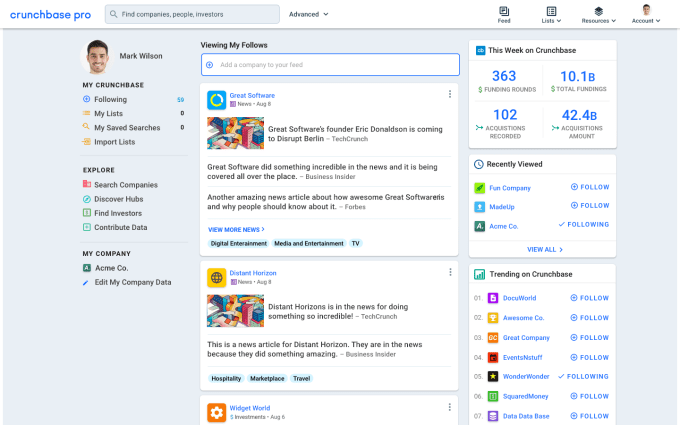
personalized homepage

The company notes that it currently makes 3.9 billion annual updates to its data set — which people upload themselves in the old wiki style, or are manually or automatically uploaded, by way of some 4,000 data partnerships and syndication deals (these include with the likes of Yahoo! Finance, LinkedIn, Business Insider, and Amazon Alexa, which in turn make some 1.6 billion annual calls to the Crunchbase API).

The growth of that information trove, and more interesting ways of parsing it to drive subscriptions and potential licensing revenues, will be of paramount importance to the company’s bottom line. Today there is some advertising on the site, but McConnell confirmed to me that Crunchbase is in the process of winding down advertising on the platform.

“The impact on the business was not material enough to sacrifice the user experience to have ads,” he said.

What’s interesting to me is to see which direction Crunchbase will evolve in in the longer term. As the world has continued to grow into the bigger vision of “every company is a tech company, and every problem has a tech solution” it seems that Crunchbase’s own ambitions have also grown. In the company’s blog post and press release announcing the fundraise, it’s notable to me that technology, or any variation of it, isn’t mentioned even once in the text (only exception being the boilerplate description of Omers). That could point to how — as Crunchbase expands its horizons in terms of the kinds of information on businesses it can provide to users — it might see role for itself not unlike that of LinkedIn, spanning across multiple verticals and the communities of people (or in CB’s case, businesses) that have built around them.

“We are thrilled to partner with Jager and the talented leadership team at Crunchbase,” commented Michael Yang, Managing Partner at OMERS Ventures, in a statement. “Crunchbase continues to show significant traction as the leader in research, information, and prospecting for private companies – an incredibly large and valuable market to address and service. By utilizing and collecting aggregated data, adding tools and apps, and continuing to customize each user experience, the lead generation and deal value Crunchbase can provide is unprecedented, and we are proud to support this next phase of growth.”


31 Oct 2019

Driving license tests just got smarter in India with Microsoft’s AI project

An American giant may have figured out a way to simplify the tedious procedure of issuing driver’s licenses. And an early sneak peek of this solution is now live in parts of India.

Hundreds of people who have taken the driver’s license test in Dehradun, the capital of Indian state Uttarakhand near the Himalayan foothills, in recent weeks haven’t had to sit next to an instructor.

Instead, their cars were affixed with a smartphone that was running HAMS, an AI project developed by Microsoft Research team. HAMS uses a smartphone’s front and rear cameras and other sensors to monitor the driver (their gaze), and the road ahead of them. Microsoft Research team said for driver tests, they customized HAMS to enable precise tracking of a vehicle’s trajectory during test manoeuvres such as parallel parking or negotiating a roundabout.

This AI technology can determine whether the driver performed any action — such as stopping in the middle of a test or course correcting by rolling forward or backward more times than they were allowed — during the test, the team said. Additionally, it also checks things like whether a driver scanned their mirrors before changing the lane.

Shri Shailesh Bagauli, IAS, Secretary of Government of Uttarakhand, said the deployment of HAMS-based driver license testing at the Dehradun RTO is a “significant step towards the Transport Department’s goal of providing efficient, world-leading services to the citizens of Uttarakhand. We are proud to be among the pioneers of the application of AI to enhance road safety.”

HAMS, short for Harnessing AutoMobiles for Safety, was originally developed to monitor drivers and their driving to improve road safety. “Driver training and testing are foundational to this goal, and so the project naturally veered in the direction of helping evaluate drivers during their driving test,” the team said.

Automation is slowly making its way to driver testing across the world, but they still require deployment of extensive infrastructure such as pole-mounted video cameras along the test track. Microsoft’s team said HAMS can bring down the cost of automation while improving test coverage by including a view within the vehicle.

Some surveys (PDF) have shown that a significant number of applicants don’t even show up to give a test to obtain their license because of the “burden” they would have to go through. “Automation using HAMS technology can not only help relieve evaluators of the burden but also make the process objective and transparent for candidates,” says Venkat Padmanabhan, Deputy Managing Director, Microsoft Research India, who started the HAMS project in 2016.

The test venue of this project should not come as a surprise. American technology companies are increasingly expanding their presence in India, one of the last great growth markets with several unique local challenges.

Microsoft, Google, and Amazon have used India a a test bed to build solutions for the local market, some of which eventually make it to other countries. Microsoft has previously developed tools to help farmers in India increase their crop yields and worked with hospitals to prevent avoidable blindness. Last year, the company also worked with cricket legend Anil Kumble to develop a tracking device that helps youngsters analyze their batting performance.

Google has also developed a range of services and tools for India. The company last year launched a tool to help publishers easily bring stories written in local languages to the web. This year, the Android-maker unveiled improvements it has made to its flood prediction tool. And of course, several popular apps such as YouTube Go, and Google Station started as India-only services.

31 Oct 2019

Driving license tests just got smarter in India with Microsoft’s AI project

An American giant may have figured out a way to simplify the tedious procedure of issuing driver’s licenses. And an early sneak peek of this solution is now live in parts of India.

Hundreds of people who have taken the driver’s license test in Dehradun, the capital of Indian state Uttarakhand near the Himalayan foothills, in recent weeks haven’t had to sit next to an instructor.

Instead, their cars were affixed with a smartphone that was running HAMS, an AI project developed by Microsoft Research team. HAMS uses a smartphone’s front and rear cameras and other sensors to monitor the driver (their gaze), and the road ahead of them. Microsoft Research team said for driver tests, they customized HAMS to enable precise tracking of a vehicle’s trajectory during test manoeuvres such as parallel parking or negotiating a roundabout.

This AI technology can determine whether the driver performed any action — such as stopping in the middle of a test or course correcting by rolling forward or backward more times than they were allowed — during the test, the team said. Additionally, it also checks things like whether a driver scanned their mirrors before changing the lane.

Shri Shailesh Bagauli, IAS, Secretary of Government of Uttarakhand, said the deployment of HAMS-based driver license testing at the Dehradun RTO is a “significant step towards the Transport Department’s goal of providing efficient, world-leading services to the citizens of Uttarakhand. We are proud to be among the pioneers of the application of AI to enhance road safety.”

HAMS, short for Harnessing AutoMobiles for Safety, was originally developed to monitor drivers and their driving to improve road safety. “Driver training and testing are foundational to this goal, and so the project naturally veered in the direction of helping evaluate drivers during their driving test,” the team said.

Automation is slowly making its way to driver testing across the world, but they still require deployment of extensive infrastructure such as pole-mounted video cameras along the test track. Microsoft’s team said HAMS can bring down the cost of automation while improving test coverage by including a view within the vehicle.

Some surveys (PDF) have shown that a significant number of applicants don’t even show up to give a test to obtain their license because of the “burden” they would have to go through. “Automation using HAMS technology can not only help relieve evaluators of the burden but also make the process objective and transparent for candidates,” says Venkat Padmanabhan, Deputy Managing Director, Microsoft Research India, who started the HAMS project in 2016.

The test venue of this project should not come as a surprise. American technology companies are increasingly expanding their presence in India, one of the last great growth markets with several unique local challenges.

Microsoft, Google, and Amazon have used India a a test bed to build solutions for the local market, some of which eventually make it to other countries. Microsoft has previously developed tools to help farmers in India increase their crop yields and worked with hospitals to prevent avoidable blindness. Last year, the company also worked with cricket legend Anil Kumble to develop a tracking device that helps youngsters analyze their batting performance.

Google has also developed a range of services and tools for India. The company last year launched a tool to help publishers easily bring stories written in local languages to the web. This year, the Android-maker unveiled improvements it has made to its flood prediction tool. And of course, several popular apps such as YouTube Go, and Google Station started as India-only services.

31 Oct 2019

Namogoo raises $40M to stop unauthorized ad injections and ‘customer journey hijacking’

Namogoo, the Herzliya, Israel-based company that has developed a solution for e-commerce and other online enterprises to prevent “customer journey hijacking,” has raised $40 million in Series C funding.

The round is led by Oak HC/FT, with participation from existing backers GreatPoint Ventures, Blumberg Capital, and Hanaco Ventures. It brings total raised by Namogoo to $69 million, and sees Matt Streisfeld, Partner at Oak HC/FT, join the company’s board.

Founded by Chemi Katz and Ohad Greenshpan in 2014, Namogoo’s platform gives online businesses more control over the customer journey by preventing unauthorized ad injections that attempt to divert customers to competitors. It also helps uncover privacy and compliance risks that can come from the use of 3rd and 4th party ad vendors.

More broadly, Namogoo says that customer journey hijacking is a growing but little-known problem that by some estimates affects 15-25 percent of all user web sessions and therefore costs e-commerce businesses hundreds of millions in lost revenue.

Unauthorized ads are injected into consumer web browsers – on the consumer side, typically via malware the user has unintentionally installed – meaning that e-commerce sites are often unaware that it is even happening. This results in product ads, banners, and pop-ups which appear when visiting an e-commerce site. The ads disrupt the user experience, hoping to send them to competitor sites.

Namogoo says that retailers using its technology see conversion rates increase between 2-5%, which in the first half of 2019 totalled over $575 million in revenue for Namogoo customers. It is used by more than 150 global brands in over 38 countries, including Tumi, Asics, Argos, Dollar Shave Club, Tailored Brands, Upwork, and others.

Meanwhile, Namogoo will use the new funding to further expand its client-side platform offerings, beginning with the launch of its “customer privacy protection solution”. “The solution detects and mitigates against customer privacy risks associated with 3rd- and 4th-party vendors running on company websites and applications,” explains the company.

31 Oct 2019

Femtech startup Inne takes the wraps off a hormone tracker and $8.8M in funding

Berlin-based femtech startup Inne is coming out of stealth to announce an €8 million (~$8.8M) Series A and give the first glimpse of a hormone-tracking subscription product for fertility-tracking and natural contraception that’s slated for launch in Q1 next year.

The Series A is led by led by Blossom Capital, with early Inne backer Monkfish Equity also participating, along with a number of angel investors — including Taavet Hinrikus, co-founder of TransferWise; Tom Stafford, managing partner at DST; and Trivago co-founder Rolf Schromgens.

Women’s health apps have been having a tech-fuelled moment in recent years, with the rise of a femtech category. There are now all sorts of apps for tracking periods and the menstrual cycle, such as Clue and Flo.

Some also try to predict which days a women is fertile and which they’re not — offering digital tools to help women track bodily signals if they’re following a natural family planning method of contraception, or indeed trying to conceive a baby.

Others — such as Natural Cycles — have gone further down that path, branding their approach “digital contraception” and claiming greater sophistication vs traditional natural family planning by applying learning algorithms to cycle data augmented with additional information (typically a daily body temperature measurement). Although there has also been some controversy around aggressive and even misleading marketing tactics targeting young women.

A multi-month investigation by the medical device regulator in Natural Cycles’ home market, instigated after a number of women fell pregnant while using its method, found rates of failure were in line with its small-print promises but concluded with the company agreeing to clarify the risk of the product failing.

At issue is that the notion of “digital contraception” may present as simple and effortless — arriving in handy app form, often boosted by a flotilla of seductive social media lifestyle ads. Yet the reality for the user is the opposite of effortless. Because in fact they are personally taking on all of the risk.

For these products to work the user needs a high level of dedication to stick at it, be consistent and pay close attention to key details in order to achieve the promised rate of protection.

Natural contraception is also what Inne is touting, dangling another enticing promise of hormone-free contraception — its website calls the product “a tool of radical self-knowledge” and claims it “protect[s]… from invasive contraceptive methods”. It’s twist is it’s not using temperature to track fertility; its focus is on hormone-tracking as a fertility measure.

Inne says it’s developed a saliva-based test to measure hormone levels, along with an in vitro diagnostic device (pictured above) that allows data to be extracted from the disposable tests at home and wirelessly logged in the companion app.

Founder Eirini Rapti describes the product as a “mini lab” — saying it’s small and portable enough to fit in a pocket. Her team has been doing the R&D on it since 2017, preferring, she says, to focus on getting the biochemistry right rather than shouting about launching the startup. (It took in seed funding prior to this round but isn’t disclosing how much.)

At this stage Inne has applied for and gained European certification as a medical device. Though it’s not yet been formally announced.

The first product, a natural contraception for adult women — billed as best suited for women aged 28-40, i.e. at a steady relationship time-of-life — will be launching in select European markets (starting in Scandinavia) next year, though initially as a closed beta style launch as they work on iterating the product based on user feedback.

“It basically has three parts,” Rapti says of the proposition. “It has a small reader… It has what we call a little mouth opening in the front. It always gives you a smile. That’s the hardware part of it, so it recognizes the intensity of your hormones. And then there’s a disposable saliva test. You basically collect your saliva by putting it in your mouth for 30 seconds. And then you insert it in the reader and then you go about your day.

“The reader is connected to your phone, either via BlueTooth or wifi, depending on where you are taking the test daily… It takes the reading and it sends it over to your phone. In your phone you can do a couple of things. First of all you look at your hormonal data and you look at how those change throughout the menstrual cycle. So you can see how they grow, how they fall. What that means about your ovulation or your overall female health — like we measure progesterone; that tells you a lot about your lining etc. And then you can also track your fluids… We teach you how to track them, how to understand what they mean.”

As well as a contraception use-case, the fertility tracking element naturally means it could also be used by women wanting to get pregnant. Eirini Rapti

“This product is not a tracker. We’re not looking to gather your data and then tell you next month what you should be feeling — at all,” she adds. “It’s more designed to track your hormones and tell you look this is the most basic change that happens in your body and because of those changes you will feel certain things. So do you feel them or not — and if you don’t, what does it mean? Or if you do what does it mean?

“It builds your own hormonal baseline — so you start measuring your hormones and we go okay so this is your baseline and now let’s look at things that go out of your baseline. And what do they mean?”

Of course the key question is how accurate is a saliva-based test for hormones as a method for predicting fertility? On this Rapti says Inne isn’t ready to share data about the product’s efficacy — but claims it will be publishing details of the various studies it conducted as part of the CE marking process in the next few weeks.

“A couple more weeks and all the hardcore numbers will be out there,” she says.

In terms of how it works in general the hormone measurement is “a combination of a biochemical reaction and the read out of it”, as she puts it — with the test itself being pure chemistry but algorithms then being applied to interpret the hormonal reading, looping in other signals such as the user’s cycle length, age and the time of day of the test.

She claims the biochemical hormone test the product relies on as its baseline for predicting fertility is based on similar principles to standard pregnancy tests — such as those that involve peeing on a stick to get a binary ‘pregnant’ or ‘not pregnant’ result. “We are focused on specifically fertility hormones,” she says.

“Our device is a medical device. It’s CE-certified in Europe and to do that you have to do all kinds of verification and performance evaluation studies. They will be published pretty soon. I cannot tell you too much in detail but to develop something like that we had to do verification studies, performance evaluation studies, so all of that is done.”

While it developed and “validated” the approach in-house, Rapti notes that it also worked with a number of external diagnostic companies to “optimize” the test.

“The science behind it is pretty straightforward,” she adds. “Your hormones behave in a specific way — they go from a low to a high to a low again, and what you’re looking for is building that trend… What we are building is an individual curve per user. The starting and the ending point in terms of values can be different but it is the same across the cycle for one user.”

“When you enter a field like biochemistry as an outsider a lot of the academics will tell you about the incredible things you could do in the future. And there are plenty,” she adds. “But I think what has made a difference to us is we always had this manufacturability in mind. So if you ask me there’s plenty of ways you can detect hormones that are spectacular but need about ten years of development let alone being able to manufacture it at scale. So it was important to me to find a technology that would allow us to do it effectively, repeatedly but also manufacture it at a low cost — so not reinventing the whole wheel.”

Rapti says Inne is controlling for variability in the testing process by controlling when users take the measurement (although that’s clearly not directly within its control, even if it can send an in-app reminder); controlling how much saliva is extracted per test; and controlling how much of the sample is tested — saying “that’s all done mechanically; you don’t do that”.

“The beauty about hormones is they do not get influenced by lack of sleep, they do not get influenced by getting out of your bed — and this is the reason why I wanted to opt to actually measure them,” she adds, saying she came up with the idea for the product as a user of natural contraception searching for a better experience. (Rapti is not herself trained in medical or life sciences.)

“When I started the company I was using the temperature method [of natural contraception] and I thought it cannot be that I have to take this measurement from my bed otherwise my measurement’s invalid,” she adds.

However there are other types of usage restrictions Inne users will need to observe in order to avoid negatively affecting the hormonal measurements.

Firstly they must take the test in the same time window each time — either in the morning or the evening but sticking to one of those choices for good.

They also need to stick to daily testing for at least a full menstrual cycle. Plus there are certain days in the month when testing will always be essential, per Rapti, even as she suggests a “learning element” might allow for the odd missed test day later on, i.e. once enough data has been inputted.

Users also have to avoid drinking and eating for 30 minutes before taking the test. She further specifies this half hour pre-test restriction includes not having oral sex — “because that also affects the measurements”.

“There’s a few indications around it,” she concedes, adding: “The product is super easy to use but it is not for women who want to not think ever about contraception or their bodies. I believe that for these women the IUD would be the perfect solution because they never have to think about it. This product is for women who consciously do not want to take hormones and don’t want invasive devices — either because they’ve been in pain or they’re interested in being natural and not taking hormones.”

At this stage Inne hasn’t performed any comparative studies vs established contraception methods such as the pill. So unless or until it does users won’t be able to assess the relative risk of falling pregnant while using it against more tried and tested contraception methods.

Rapti says the plan is to run more clinical studies in the coming year, helped by the new funding. But these will be more focused on what additional insights can be extracted from the test to feed the product proposition — rather than on further efficacy (or any comparative) tests.

They’ve also started the process of applying for FDA certification to be able to enter the US market in future.

Beyond natural contraception and fertility tracking, Inne is thinking about wider applications for its approach to hormone tracking — such as providing women with information about the menopause, based on longer term tracking of their hormone levels. Or to help manage conditions such as endometriosis, which is one of the areas where it wants to do further research.

The intent is to be the opposite of binary, she suggests, by providing adult women with a versatile tool to help them get closer to and understand changes in their bodies for a range of individual needs and purposes.

“I want to shift the way people perceive our female bodies to be binary,” she adds. “Our bodies are not binary, they change around the month. So maybe this month you want to avoid getting pregnant and maybe next month you actually want to get pregnant. It’s the same body that you need to understand to help you do that.”

Commenting on the Series A in a supporting statement, Louise Samet, partner at Blossom Capital, said: “Inne has a winning combination of scientific validity plus usability that can enable women to better understand their bodies at all stages in their lives. What really impressed us is the team’s meticulous focus on design and easy-of-use together with the scientific validity and clear ambition to impact women all over the world.”


31 Oct 2019

Freetrade, the UK challenger stockbroker, completes $15M Series A

Freetrade, the U.K. challenger stockbroker that offers commission-free investing, has closed $15 million in Series A funding. The round includes a $7.5 million investment from Draper Esprit, the U.K. publicly-listed venture capital firm, along with previously announced equity crowdfunding via Crowdcube.

The funding will be used by Freetrade for further growth and product development, including “doubling down” on engineering hires. The fintech, which claims over 50,000 customers, is also planning to expand to Europe next year.

In addition, Adam Dodds, CEO and founder of Freetrade, tells me there will be a marketing and content push to help reach more of the challenger stockbroker’s target millennial customers and help educate the market as a whole that investing in the stock market doesn’t have to be prohibitively expensive or complicated.

Amongst a number of new stock trading and investment apps in the U.K., London-based Freetrade was first out of the gate as a bona-fide “challenger broker” after deciding early on to build its own brokerage. This included obtaining a full broker license from the FCA, rather than simply partnering with an established broker.

The Freetrade app lets you invest in stocks and ETFs. Trades are “fee-free” if you are happy for your buy or sell trades to execute at the close of business each day. If you want to execute immediately, the startup charges a low £1 per trade. The idea is to put the heat on the larger incumbents that can charge up to £12 per trade, which is off-putting to people wanting to only invest a small amount or regularly refresh a modestly-sized portfolio.

Meanwhile, Dodds says that next on the product roadmap will be a new investment platform that will give users the option to purchase U.K. and European “fractional” shares, not just U.S. ones, which he claims will be a first.

With that said, competition has been steadily increasing since Freetrade set up shop. Silicon Valley’s Robinhood is gearing up for a U.K. launch, having recently got regulatory approval. Bux has also recently launched commission-free trading and now bills itself as a challenger broker just like Freetrade. Then, of course, there’s Revolut, the fast-growing challenger bank that tentatively launched fee-free stock investing in August.

Noteworthy, André Mohamed, previously CTO and a co-founder of Freetrade, joined Revolut as its new Head of Wealth & Trading Product, adding a bit of extra spice to that rivalry. As I wrote at the time, the circumstances that saw Mohamed depart Freetrade remain unclear. According to my sources, his contract was terminated last year and the two parties settled, with Freetrade accepting no liability.

“Freetrade are on a mission to open up investment opportunities for everyone, as are we,” says Simon Cook, CEO of Draper Esprit, in a statement. “In this sense, their mission is totally aligned with our own, as a rare tech-focused VC listed on the stock exchange. The company have shown exceptional growth in the short time since they first launched the platform last year. We could not be more delighted to support Adam, Viktor, Ian and their wider team as they enable Europe’s 100 million millennials to benefit from the world’s economic growth”.

31 Oct 2019

Bosun Tijani talks strategy as CEO of Africa’s new largest tech hub

With CcHub‘s acquisition of iHub in September, Nigerian Bosun Tijani is at the helm of (arguably) the largest tech network in Africa.

He is now CEO of both organizations, including their robust membership rosters, startup incubation programs, global partnerships, and VC activities from Nigeria to Kenya .

One could conclude Tijani has become one of the most powerful figures in African tech with the CcHub iHub merger. But that would be a little shortsighted.

The techie from Lagos still faces plenty of challenges and unknowns in integrating two innovation hubs that lie 3,818 flight kilometers apart. Several sources speaking on background over the last year have indicated iHub was experiencing financial difficulties.

Tijani offered TechCrunch some initial details last month on how the acquisition will fall together.

But more recently he shared greater detail on his strategy for operating the multi-country innovation network. A big test for Tijani will be aligning the organizations on a path to sustainability. The buzzword is usually code for generating consistent operating income beyond expenses.

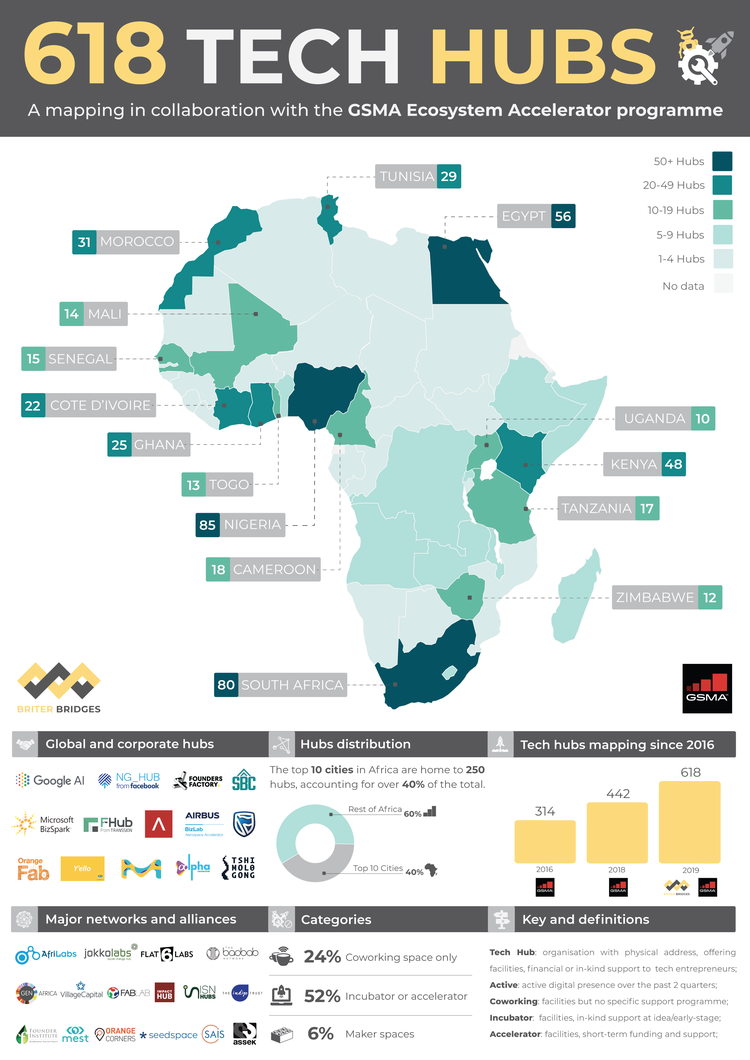
The growth of innovation spaces, accelerators and incubators in Africa — which tally 618 per GSMA stats — is often lauded as an achievement for the continent’s tech ecosystem.

But debate on how these focal points for startup formation, training and IT activity fund themselves is ever-present.

Grant income has served as a dominant revenue source for Africa’s tech hubs — including iHub in its early days — though many have worked to diversify.

TechHubsinAfricain2019 Briter Bridges

That includes CcHub, according to Tijani, who plans to continue the trend across the expanded CcHub, iHub organization.

“When people talk about sustainability, we’ve been in business for 9 years,” he notes of CcHub Nigeria.

“We de-emphasized grant funding six years ago; most of our revenue is actually earned revenue.”

On income sources Tijani looks to foster across both organizations, he named consulting services (for corporates, governments, and development agencies), events services, and generating greater return on investment.

iHub has been active with startup seed-investments and CcHub has a portfolio of companies through its Growth Capital Fund.

“Our size will become a major part of us being able to invest in startups and the longer we stay invested the more we will start to see significant returns and exits,” said Tijani.

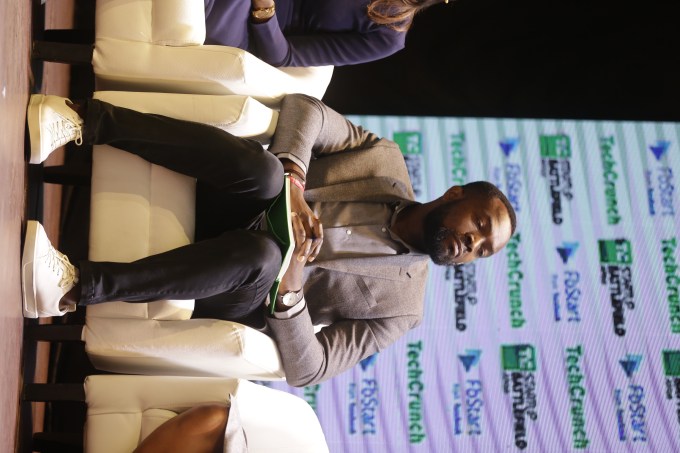
CcHub CEO Bosun Tijani

The CcHub iHub nexus will also use its size to leverage more partnerships. Tijani and team have already mastered gaining collaborations with big African and global tech names, such as MainOne and Facebook.

Tijani will look to connect iHub to CcHub’s Google sponsored Pitch Drive — which has done African startup tours of Asia and Europe — and potentially take the show to the U.S.

“We’re talking about it,” Tijani said, of a U.S. pitch trip. And this could lead to a permanent presence in San Francisco for the new CcHub, iHub entity.

“Beyond just a tour, we want to build strong presence in the Bay Area,” Tijani said, but didn’t offer more specifics on what that could mean.

So on the list of things to emerge from the CcHub-iHub acquisition, African tech planting a big flag in San Francisco is a future possibility.

A more immediate result of the union between the innovation spaces will be Bosun Tijani becoming a regular sight on flights between Lagos and Nairobi.


30 Oct 2019

Deadspin writers quit after being ordered to stick to sports

Writers Laura Wagner, Kelsey McKinney, Tom Ley, Lauren Theisen, Patrick Redford, Albert Burneko and Chris Thompson all tweeted today that they have resigned from Deadspin, the sports-focused site owned by G/O Media.

A quick refresher: G/O Media was formerly known as Gizmodo Media Group, and before that as Gawker Media. It took on its current name and current leadership earlier this year when Univision sold the unit to private equity firm Great Hill Partners, who appointed former Forbes.com CEO Jim Spanfeller as its new chief executive.

Since then, the relationship between G/O Media leadership and the editorial staff has been rocky, as you would have learned by reading Deadspin itself, particularly an in-depth story by Wagner in August about how employees were unhappy with “a lack of communication regarding company goals, seeming disregard for promoting diversity within the top ranks of the company, and by repeated and egregious interference with editorial procedures.”

A few weeks later, Deadspin’s editor in chief Megan Greenwell resigned, saying that G/O Media’s new editorial director Paul Maidment was directing the staff to stick to sports coverage — a decision that she argued wasn’t dictated by traffic, since “posts on The Concourse, Deadspin’s vertical dedicated to politics and culture and other topics that are not sports, outperform posts on the main site by slightly more than two to one.”

Apparently Maidment repeated that edict in a memo earlier this week, which was leaked to The Daily Beast, and in which he said, “Deadspin will write only about sports and that which is relevant to sports in some way.”

The Deadspin homepage was subsequently filled with non-sports content, and editor Barry Petchesky tweeted that he had been “fired from Deadspin for not sticking to sports.”

At the same time, Deadspin also posted a story criticizing auto-playing ads on the site, declaring, “We, the writers, editors, and video producers of Deadspin, are as upset with the current state of our site’s user experience as you are.” The post is no longer live, but the criticism reportedly prompted advertiser Farmers Insurance to pull the campaign.

This all appears to have prompted a mass exodus from Deadspin today. The Gizmodo Media Group union also issued this statement:

Today, a number of our colleagues at Deadspin resigned from their positions. From the outset, CEO Jim Spanfeller has worked to undermine a successful site by curtailing its most well-read coverage because it makes him personally uncomfortable. This is not what journalism looks like and it is not what editorial independence looks like.

“Stick to sports” is and always has been a thinly veiled euphemism for “don’t speak truth to power.” In addition to being bad business, Spanfeller’s actions are morally reprehensible. The GMG Union stands with our current and former Deadspin colleagues and condemns Jim Spanfeller in the strongest possible terms.

We’ve reached out to G/O Media for comment and will update if we hear back.

30 Oct 2019

Turning Google traffic into leads, and what’s new in SEO

We’ve aggregated the world’s best growth marketers into one community. Twice a month, we ask them to share their most effective growth tactics, and we compile them into this Growth Report.

This is how you’re going stay up-to-date on growth marketing tactics — with advice you can’t get elsewhere.

Our community consists of 600 startup founders paired with VP’s of growth from later-stage companies. We have 300 YC founders plus senior marketers from companies including Medium, Docker, Invision, Intuit, Pinterest, Discord, Webflow, Lambda School, Perfect Keto, Typeform, Modern Fertility, Segment, Udemy, Puma, Cameo and Ritual.

You can participate in our community by joining Demand Curve’s marketing webinars, Slack group, or marketing training program. See past growth reports here and here.

Without further ado, onto the advice.


What are some new, advanced SEO strategies?

Our community ran an SEO masterclass in which we discussed Google’s algorithm updates and shared advanced practices for writing blog content in a data-driven manner.

Tactics for turning blog visitors into leads

Based on insights from Nat Eliason from Growth Machine.

SEO traffic can sometimes be a vanity metric if you’re not converting it into lead flow. Here are three ways to convert blog visitors into leads:

  1. Prompt blog readers with quizzes to help them identify the product/plan that’s best suited for them. Then require their email address to see results. Follow up with drip emails.
  2. Create “Buyer’s Guides” — downloadable PDFs with nice visuals that help readers figure out how to accomplish their goals (e.g. “paleo cooking starter kit.”) Again, require an email for them to download the complete guide.
  3. Pixel your blog visitors and retarget them with Facebook ads. Have the ads send visitors to landing pages that match whichever blog content category initially drew them to the site.

How to (re-)target business customers with Facebook ads

Based on insights from Nima Gardideh of Pearmill and Julian Shapiro of Demand Curve.

Most people use their personal email address on their Facebook/Instagram account. So if you’re collecting business emails during your user onboarding process, Facebook can have a hard time matching those emails to the corresponding Facebook profiles when creating custom targeting lists. 

 Here are a few tricks around this:

30 Oct 2019

Twitter banning political ads is the right thing to do, so it will be attacked mercilessly

Twitter founder and CEO Jack Dorsey announced abruptly — though the timing was certainly not accidental — that the platform would soon disallow any and all political advertising. This is the right thing to do, but it’s also going to be hard as hell for a lot of reasons. As usual in tech and politics, no good deed goes unpunished.

Malicious actors state-sponsored and otherwise have and will continue to attempt to influence the outcome of U.S. elections via online means including political ads and astroturfing. Banning such ads outright is an obvious, if rather heavy-handed solution — but given that online platforms seem to have made little progress on more targeted measures, it’s the only one realistically available to deploy now.

“Not allowing for paid disinformation is one of the most basic, ethical decisions a company can make,” wrote Representative Alexandria Ocasio-Cortez (D-NY) in a tweet following the news. “If a company cannot or does not wish to run basic fact-checking on paid political advertising, then they should not run paid political ads at all.”

One of the reasons Facebook has avoided restricting political ads and content is that by doing so it establishes itself as the de facto arbiter between “appropriate” and “inappropriate,” and the fractal-complex landscape that creates across thousands of cultures, languages, and events. Don’t cry for Mark Zuckerberg, though — this is a monster of his own creation. He should have retired when I suggested it.

But Twitter’s decision to use a sledgehammer rather than a scalpel doesn’t remove the inherent difficulties in the process. Twitter is just submitting itself for a different kind of punishment. Because instead of being the arbiter of what is appropriate, it will be the arbiter of what is political.

This is slightly less fraught than Facebook’s task, but Twitter will not be able to avoid accusations — perhaps even true ones — of partisanship and bias.

For instance, the fundamental decision to disallow political advertising seems pretty straightforward and nonpartisan. Incumbents rely on traditional media more and progressives tend to be younger and more social media–savvy. So is this taking away a tool suited to left-leaning challengers? But incumbents tend to have bigger budgets and their spend on social media has been increasing, so could this be considered a way to curb that trend? Who this affects and how is not a clear-cut fact but something campaigns and pundits will squabble about endlessly.

Or consider the announcement Dorsey made right off the bat that “ads in support of voter registration will still be allowed.” Voter registration is a good nonpartisan goal, right? In fact it’s something many conservative lawmakers have consistently opposed, because unregistered voters, for a multitude of reasons, skew toward the liberal side. So this too will be considered a partisan act.

Twitter will put out official guidelines in a few weeks, but it’s hard to see how they can be satisfactory. Will industry groups be able to promote tweets about how their new factory is thriving because of a government grant? Will an advocacy organization be able to promote a tweet about a serious situation on the border? Will news outlets be able to promote a story about the election? What about a profile of a single candidate? What about an op-ed on an issue?

The difference between patrolling the interior of the politics world, and patrolling its borders, so to speak, may appear significant — but it’s really just a different kind of trouble. Twitter is entering a world of pain.

But at least it’s moving forward. It’s the right decision, even if it’s a hard one and could hit the bottom line pretty hard (not that Twitter has ever cared about that). The decision to do this while Facebook is dismantling its credibility with a series of craven, self-interested actions is a canny one. Even if Twitter fails to get this right, it can at least say it’s trying.

And lastly it should be said that it also happens to be a good choice for users and voters, a rare exception to the parade of user-hostile decisions coming out of the big tech and media companies. Going into an election year, we can use all the good news we can get.