Year: 2019

30 Oct 2019

Zuckerberg defends political ads that will be 0.5% of 2020 revenue

As Jack Dorsey announced his company Twitter would drop all political ads, Facebook CEO Zuckerberg doubled-down on his policy of refusing to fact check politicians’ ads. “At times of social tension there has often been an urge to pull back on free expression . . . We will be best served over the long term by resisting this urge and defending free expression.”

Still, Zuckerberg failed to delineate between freedom of expression, and freedom of paid amplification of that expression which inherently favors the rich.

During today’s Q3 2019 earnings call where Facebook beat expectations and grew monthly users 2% to 2.45 billion, Zuckerberg spent his time defending the social network’s lenient political ad policy.

One clear objective was to dispel the idea that Facebook was motivated by greed to keep these ads. Zuckerberg explained “We estimate these ads from politicians will be less than 0.5% of our revenue next year.” For reference, Facebook earned $66 billion in the 12 months ending Q3 2019, so Facebook might earn around $330 million to $400 million in political ads next year.

Zuckerberg also said that given Facebook removed 50 million hours per day of viral video watching from its platform to support well-being which hurt ad viewership and the company’s share price, Facebook clearly doesn’t act solely in pursuit of profit.

Instead of baning political ads, Zuckerberg voiced support for increasing transparency about how ads look, how much is spent on them, and where they’re run. “I believe that the better approach is to work to increase transparency. Ads on Facebook are already more transparent than anywhere else. We have a political ads archive so anyone can scrutinize every ad that’s run.” 

He mentioned that political ads are run by “Google, YouTube, and most internet platforms”, seeming to stumble for a second as he was likely prepared to cite Twitter too until it announced it would drop all political ads an hour earlier.

30 Oct 2019

Apple beats on Q4 earnings after strong quarter for wearables, services

Apple’s iPhone sales are slowly dwindling in importance to the financial success of the company as sales slow and the company’s other divisions pick up speed.

Apple’s stock remained largely unchanged after-hours following the release of its Q4 earnings. The company delivered earnings per share $3.03 versus the street’s estimate of $2.84 Est. on revenue of $64 billion compared with expectation at $62.99 billion.

The big story continues to be major growth in Services, iPad and Wearables while iPhone and Mac sales continue to shrink year-over-year.

As you’ll remember Apple no longer reports unit sales of its iPhone, Mac and iPad lines, something that is largely the result of declining unit sales and higher average selling prices. Services, Wearables and Other, and iPad saw year-over-year gains, while the iPhone and Mac lines are still seeing revenue slumps.

  • iPhone sales were down 9% year-over-year to $33.36 billion
  • Services were up 18% YoY to $12.5 billion
  • Mac sales were down 5% YoY to $6.99 billion
  • “Wearables, Home, and Accessories” were up 54% YoY to $6.52 billion:
  • iPad sales were up 17% YoY to $4.66 billion

The company is continuing to add to some of its highest growth businesses. The company announced the release of a new high-end set of AirPods yesterday which will likely increase average selling prices among its wearables division. The company also has a number of paid services including Apple TV+ that will be launching soon.

30 Oct 2019

Latin America Roundup: Uber acquires Cornershop, Softbank invests in Buser, Olist

Brazil continued to churn out unicorns this month, with Curitiba-based Ebanx becoming the first startup from the southern part of the country to top a $1 billion valuation. U.S.-based FTV Capital provided the investment but did not disclose the amount invested nor the exact valuation of Ebanx after the investment.

Ebanx is an end-to-end payment processor that helps international companies receive payments in the Latin American market, similar to Stripe. Their clients include Airbnb, AliExpress, Pipedrive, Spotify, Uber and Wish, and more than 50 million Latin Americans have conducted transactions with more than 1,000 companies through the Ebanx platform. This investment comes on the heels of exciting partnerships with Uber Pay, Shopify, Spotify and Visa to expand cross-border payment processing across the region.

Ebanx has operations in Brazil, Mexico, Argentina, Colombia, Chile, Peru, Ecuador and Bolivia, and will expand their local payment solution, Ebanx Pay, into Colombia in 2020. The company has grown its user base by offering a full-service product that includes market research, 24/7 customer service and anti-fraud technology.

The Ebanx investment is part of a growing interest in Latin American payments startups. Brazil’s PagSeguro and StoneCo had successful IPOs last year, while Mexico’s Conekta and Ecuador’s Kushki have raised large rounds to try to unite the region under a single processor as Latin America rapidly adopts e-commerce.

Uber acquires Cornershop, takes off where Walmart left off

The acquisition of the Chilean-Mexican grocery delivery startup Cornershop has been an emotional roller coaster for Latin American entrepreneurs and investors throughout 2019. First Walmart announced a $225 million deal that would be one of the bigger exits of the region, then the acquisition was blocked by Mexican antitrust institution COFECE. This announcement dealt a blow to the ecosystem as entrepreneurs and VCs had eagerly awaited this boost in liquidity in the local market.

Last-mile delivery and logistics became a very competitive space in Latin America in 2018.

Then in mid-October 2019, Uber announced it would take a 51% stake in Cornershop for a reported $450 million, quadrupling the startup’s value in the four months since the COFECE decision. This deal will consist of cash, investment in Cornershop’s growth and stock in Uber, which IPO’d earlier this year.

However, this deal must also be approved by the Chilean and Mexican antitrust boards, which are expected to release their decisions within the next two weeks. In the meantime, Cornershop will continue its expansion into the Colombian market after it added Peru and Canada in 2019.

Last-mile delivery and logistics became a very competitive space in Latin America in 2018, and many of the players are sitting on enormous pools of capital. Colombia’s Rappi raised $1 billion from SoftBank in early 2019, breaking records for startup investment for the region. Brazil’s iFood raised $500 million from Naspers at the end of 2018. However, delivery continues to be a cash-intensive business, with many of these companies burning through capital quickly to gain market share. Cornershop was an exception and had raised less than $50 million before the acquisition.

Brazil’s Buser, Olist, raise funding from SoftBank

Despite the WeWork crash, SoftBank has continued investing consistently in Brazilian startups. In early October 2019, the Japanese investor led an undisclosed Series B round for Brazilian collaborative bus chartering startup Buser. Buser’s team will invest more than $73 million in growth over the next 12 months to create new alliances for their network of operating partners.

Buser helps coordinate groups of people to charter buses at convenient times and lower prices, disrupting the bureaucratic, anti-competitive and inefficient bus system. The company has grown 1,500% over the past nine months and serves more than 3,000 people per day. While Buser has been popular with locals, traditional bus drivers are calling for regulation to slow the company’s meteoric growth. Buser plans to add more than 100 direct jobs in 200 cities over the next 12 months, and SoftBank’s most recent investment will help power this growth.

Brazil’s e-commerce marketplace integrator Olist also received investment from SoftBank for its Series C, coming in around $46 million. Redpoint eVentures and Valor Capital also participated in the round. 

This investment signals the increased interest by traditional retailers in startups that are slowly chipping away at their market share across the region.

Olist connects small businesses to larger product marketplaces to help entrepreneurs sell their products to a larger customer base. They will reportedly use this investment to investigate the development of financial products and look for collaboration with SoftBank’s other companies, like Rappi and Loggi. Based in Curitiba, Olist was founded in 2015 to help small merchants gain market share across the country through a SaaS licensing model to small brick and mortar businesses.

Today, Olist has more than 7,000 customers and uses a drop-shipping model to send products directly from stores to clients around the country, allowing them to grow with a capital-light model. They will use the investment to add up to 100 new employees.

Carrefour Brazil acquires 49% of Ewally

Grocery chain Carrefour acquired a large stake in Brazil-based Ewally after it completed Village Capital’s first regional acceleration program.

Ewally improves financial inclusion in Brazil through a mobile wallet app that allows unbanked clients to pay bills and make purchases online through the blockchain. Carrefour will reportedly use the acquisition to accelerate digital transformation and improve online payment mechanisms throughout Brazil.

Carrefour did not disclose the amount invested and the deal is still subject to approval by Brazilian financial regulation authorities. However, this investment signals the increased interest by traditional retailers in startups that are slowly chipping away at their market share across the region.

News and Notes: Early-stage rounds are getting bigger

Startups in Brazil, Colombia and Argentina raised several rounds this month, ranging from $1.5 million to $13 million. Brazil’s Xerpa, Colombia’s Sempli, Brazil’s Gorilla and Argentina’s Bitso and Worcket were among those that raised capital from local and international investors in October 2019.

Brazilian human resource management platform Xerpa raised $13 million from Vostok Emerging Finance to continue to help companies like MercadoLibre, iFood and QuintoAndar provide benefits for their employees. Previous investors include Nubank’s David Velez, Kaszek Ventures and QED Investors.

Sempli, an online lending platform for small businesses in Colombia, raised an $8 million Series A from new investors Oikocredit and Incofin CVSO, as well as previous investors BID LAB, XTPI Fund, Generación Exponencial, and Impulsum Ventures. To date, Sempli has raised more than $24 million in equity funding. The founders will use this round to grow their portfolio and improve their risk assessment technology to provide more small business loans in Colombia.

Brazil’s Quicko, an alternative mobility startup that uses big data, raised $10 million in October from Brazilian transport company CCR. Quicko’s technology integrates all mobility options — from bicycles to Uber and 99 — to help people get where they need to go as quickly and inexpensively as possible.

Also in Brazil, startup Gorilla Invest raised $8.4 million from Ribbit Capital, Monashees and Iporanga. Gorilla aggregates financial assets so that investors can review all their commitments in one place, and currently manages more than $1.2 billion for 40,000 clients.

Mexican cryptocurrency exchange Bitso raised an undisclosed round from Argentine startup Ripple to expand into the Southern Cone, especially Argentina and Brazil. Other investors in the round included Pantera Capital, Digital Currency Group, Jump Capital and Coinbase.

Looking ahead to November, with unsettled politics in several countries across the region, tech startups are growing despite governmental changes. Some of these changes will likely have a positive effect on the regional ecosystem as people push for more sustainable and equal economic growth.

What to watch next? Last year, Q4 was marked by a wave of large investments as funds and startups look to end the year strong. IFood raised its record-breaking $500 million round in December 2018. We may well see a similar uptick this year as mega-funds like SoftBank have been consistently investing multi-million dollar rounds since June. There is no sign international investment in Latin America will slow through the end of the year, so we can likely look forward to several more growth-stage rounds before the year is out.


30 Oct 2019

Facebook shares rise on strong Q3 users up 2% to 2.45B

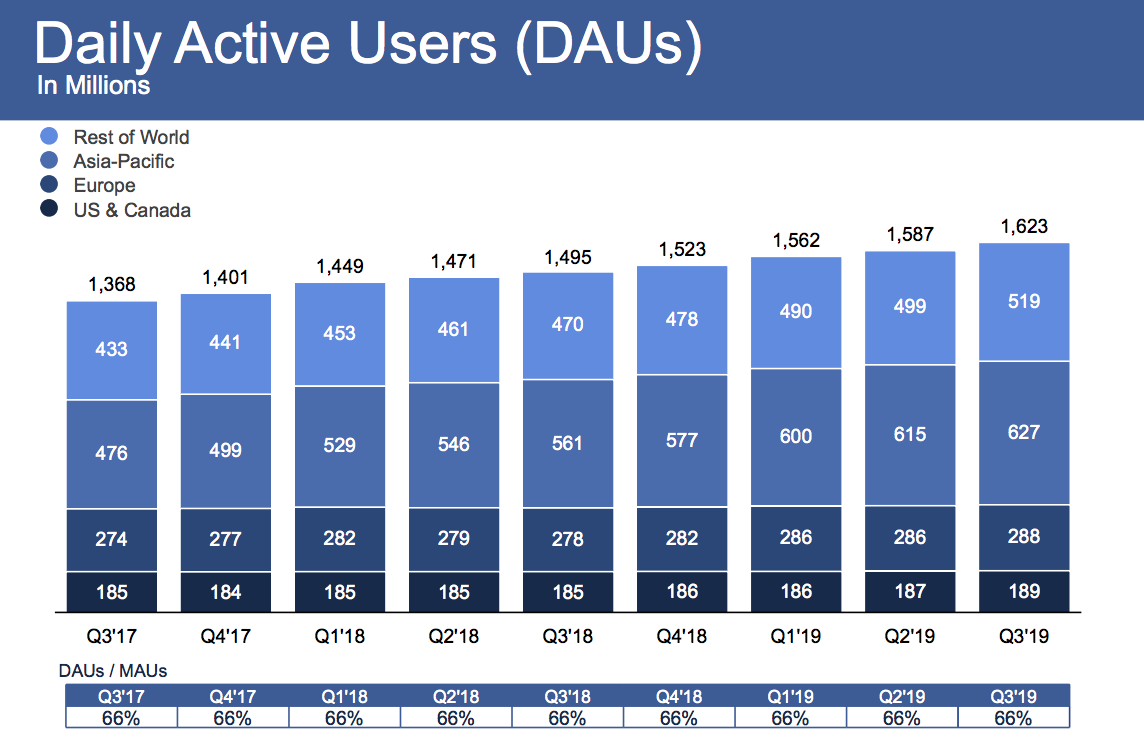
Despite ongoing public relations crises, Facebook kept growing in Q3 2019. Facebook reached 2.45 billion monthly users, up 1.65 percent from 2.41 billion in Q2 2019 when it grew 1.6 percent, and it now has 1.62 billion daily active users, up 2 percent from 1.587 billion last quarter when it grew 1.6 percent. Facebook scored $17.652 billion of revenue, up 29 percent year-over-year.

Facebook’s earnings beat expectations compared to Refinitiv’s consensus estimates of $17.37 billion in revenue and $1.91 earnings per share. Facebook earned $6 billion in profit after only racking up $2.6 billion last quarter due to its SEC settlement.

Facebook shares shot up 3.45% in after hours trading to $194.75 after earnings were announced, following a day where it closed down 0.56% at $188.25.

Facebook Q3 2019 DAU

It was another rough quarter for Facebook’s public perception as it dealt with outages and struggled to get buy-in from regulators for its Libra cryptocurrency project. Former co-founder Chris Hughes (who I’ll be leading a talk with at SXSW) campaigned for the social network to be broken up — a position echoed by Elisabeth Warren and other presidential candidates.

The company did spin up some new revenue sources, including taking a 30% cut of fan patronage subscriptions to content creators. It’s also trying to sell video subscriptions for publishers, and it upped the price of its Workplace collaboration suite. But gains were likely offset as the company continued to rapidly hire to address abusive content on its platform. There are still problems with how it treats content moderators, and Facebook has had to repeatedly remove coordinated misinformation campaigns from abroad. Appearing concerned about its waning brand, Facebook moved to add “from Facebook” to the names of Instagram and WhatsApp.

While it escaped with just a $5 billion fine as part of its FTC settlement that some consider a slap on the wrist, especially since it won’t have to significantly alter its business model. But the company will have to continue to invest and divert product resources to meet its new privacy, security, and transparency requirements. These could slow its response to a growing threat: Chinese tech giant ByteDance’s TikTok.

30 Oct 2019

Jack Dorsey says Twitter will ban all political ads

CEO Jack Dorsey just announced, via tweet, that Twitter will be banning all political advertising — with a few exceptions like voter registration.

“We believe political message reach should be earned, not bought,” Dorsey said.

He also said the company will share the final policy by November 15, and that it will start enforcing the policy on November 22.

Updating

30 Oct 2019

Work permit delays disrupt foreign workers’ career plans

Immigration advocates are rightly fretting over the Trump administration’s new health insurance mandate and efforts to dismantle the asylum system. But away from the spotlight, another crisis is quietly brewing that could affect virtually every foreign-born STEM (science, technology, engineering, and math) student and worker.

The problem lies in Employment Authorization Documents (EADs). These work permits, issued by U.S. Citizenship and Immigration Services (USCIS), authorize international students and green card applicants to take jobs. Requests for EADs, known as I-765s, now account for more than a quarter of all forms USCIS receives. But technological hiccups, staffing shortages, and the pressures of conforming to new immigration policies mean the agency is taking longer and longer to process them. That’s leaving tens of thousands of students and skilled workers unable to work and hundreds of thousands of tech positions unfilled for months, or even years. 

The EAD crisis has been simmering for years but reached a head in early 2017 when officials scrapped a rule requiring USCIS to process I-765s within 90 days. Along with an influx of new EAD requests from DACA and TPS recipients, that’s led to spiraling delays. In 2015, 23 percent of EAD applications took more than three months to process; by 2018, it had doubled to 46 percent. The average processing time today for non-DACA-related EADs is almost five months, with over a third of applications taking significantly longer — last year, over 118,000 applications took more than nine months to process. 

That squares with what we’re seeing at Boundless: our internal data show that average EAD wait times have climbed above five months, with many customers waiting eight months or more for work permits. We’re also seeing an enormous disparity among processing facilities, with some USCIS service centers far more clogged than others. At the time of writing, if your I-765 is processed in Texas, for example, you could get your EAD within three weeks; if in Vermont, you could wait more than 17 months, depending on the immigration status you seek.

That adds up to an unpredictable, unfair, and deeply frustrating situation and one more obstacle for the skilled immigrants that President Donald Trump says he’s trying to attract to the United States. Whether you’re trying to make ends meet while waiting for your green card, seeking a summer job, or hoping to work after graduation, EAD delays can be excruciating — and unless your employer is willing to wait for you, the holdup could cost you your dream job. 

So what could you do if you find yourself stuck in EAD limbo? Fortunately, you have options:

If you already have a visa, hold on to it

Many immigrants file EAD requests as part of their green card applications, even if they’re already authorized to work under visas such as an H-1B or L-1. That’s a smart move: If your current work visa expires, but you’ve been issued an EAD, you’ll be able to keep working until your green card arrives. Still, if your EAD gets delayed, you’ll be glad to know that as long as your original employment-based visa remains valid, you can keep working without a problem. 

Bear in mind, though, that you won’t be able to renew your existing visa after filing a green card application. It’s worth applying for your green card as soon as you’re eligible to give you plenty of time before your existing work visa expires.  

If you’re still waiting, tell USCIS

It’s not impossible for your EAD to slip through the cracks or be sent to the wrong address, so check with USCIS if things are taking too long. Start by checking the processing times for your service center. If you filed your I-765 before the “receipt date for a case inquiry” listed on the USCIS processing times tool, you can file an e-Request or call 1-800-375-5283 for an update. 

In some cases, you can also ask USCIS to expedite your I-765. This is only available in certain circumstances, such as if delays are due to USCIS error or if you or your prospective employer would otherwise suffer major financial losses. Unfortunately, the possibility of losing or delaying acceptance of a job offer isn’t sufficient grounds for expediting an application.

Still stuck in limbo? Ask for help

30 Oct 2019

Forerunner Ventures newest bet is Curated, a marketplace that matches pros with people buying high-ticket items

If you’ve ever tried buying a bike online, or ski equipment, or any number of expensive goods where it would be useful to know a lot more than you do, you might check out Curated, a two-year-old San Francisco-based startup that wants to help busy shoppers who know generally what they want but don’t necessarily have time to visit a specialty store to learn more.

It isn’t the first startup to help with shopping recommendations. Among its predecessors is Hunch, a company that delivered customized recommendations to users based on signals around the web (and sold to eBay in 2011). Another variation on the same theme can be traced back to the dot.com era company Keen.com, a live answer community where people could get answers to their questions over the phone.

Still, the company made enough sense that Forerunner Ventures, which has established a name for itself as the preeminent investor in e-commerce companies, just led its $22 million Series A round. It was the only venture firm in the round by design, says cofounder and CEO Eddie Vivas, who says the funding was filled out by the same friends and family who’d participated in Curated’s $5.5 million seed round.

As part of the deal, Forerunner cofounder Kirsten Green has also joined the board.

It’s easy to appreciate the company’s appeal. Curated works by matching bewildered shoppers with people who are passionate and knowledgeable and “expert” in their fields. Right now, those experts are mostly athletes or coaches as the platform is launching publicly with a handful of verticals, including golf, cycling, and and a few winter sports, though the idea is to launch new sections on the site every six to eight weeks, including fly fishing, kiteboarding, camping and hiking.

How the economics works: Curated strikes deals with manufacturers — say makers of snowboard equipment or mountain bikes — that sell Curated their goods at wholesale prices. Curated can then sell them at retail prices to its customers. (Curated fulfills the order itself.)

Part of that markup is used to pay its experts, who tend to be people who have jobs in related fields but could use more income and who love sharing what they know about a topic, like ski instructors. To ensure that these experts know as much as they claim, they are vetted by other experts on the platform (they have to answer a battery of questions, as part of that process).

The experts are in no way incentivized to recommend anything in particular to a customer, but customers can tip the experts if they wish. (Curated suggests tips of 5%, 7.5%, or 10%, though Vivas says they are sometimes given much more than that by shoppers who are thankful for their time and effort, especially when their interactions end up leading them to products that cost more than they might have paid otherwise. He says in some cases, these can involve tens of email exchanges.)

The end goal — and Vivas says it’s working — is for customers to complete transactions on the platform that they wouldn’t otherwise feel comfortable completing at a site where they aren’t actively educated.

The platform is seizing on a number of trends that make it a smart idea for this day and age. For one thing, it uses artificial intelligence to connect shoppers with the right advisors. Sure, everyone tosses around AI as a competitive advantage, but Curated seemingly has a genuine competitive advantage on this front, owing to the background of Vivas, who sold an earlier company that used AI to automate the recruiting process to LinkedIn.

At the time, in 2014, it was LinkedIn’s biggest acquisition ever. And Vivas stayed at LinkedIn for another 3.5 years as the head of product within its talent solutions business, which is where LinkedIn derives most of its revenue. In fact, it’s where he met some of the 32 people who now work at Curated.

Curated is also smartly putting to work far-flung knowledge workers who, like a lot of Americans, increasingly work for themselves or in part-time roles that they’re looking to supplement with other part-time roles.

But perhaps most meaningfully, Curated is a kind of antidote to Amazon, where shoppers can turn when they need something fast but that’s incredibly limited when it comes to providing the kind of information needed to comfortably make big purchases. (Consumers may pull the trigger on items anyway, but often, they end up with merchandise that they then have to send back or never wind up using.)

The question now is whether the company can scale. To do so, it’ll need to rise above the din of other e-commerce platforms to attract enough customers to support its network of experts (and vice versa), and it’s a pretty crowded landscape out there, even with the magic of search-engine optimization and Facebook ads. It will also need to strike enough deals with goods manufacturers to make the platform compelling for shoppers, and to ensure that the level of the advice that’s provided to those consumers is, and remains, high.

Vivas doesn’t sound concerned. He thinks he’s built a strong team. He’s also excited about the growing network of experts the team has pieced together since founding the company in the summer of 2017

“You take someone who is passionate about something and you let them make money off it, and good things happen,” he says. “In allowing people to monetize their knowledge, the unlock is just unbelievable.”

30 Oct 2019

Walmart now offers alcohol pickup at 2,000 U.S. stores

The online grocery wars continue. Amazon this week just made grocery delivery free, so Walmart is now touting how its grocery service offers the booze. The retailer today announced a new milestone in terms of giving its customers the ability to shop for alcohol online, noting that over 2,000 Walmart locations across 29 states will now let you pick up wine and beer along with your other grocery purchases.

The alcohol pickup service has to abide by local laws, which limits its expansion in some cases.

In addition, Walmart says that now over 200 stores in California and Florida are also offering alcohol delivery. It plans expansions on this front, as well.

Walmart has been slowly ramping up its online alcohol shopping options, in accordance with local, county and state regulations for some time. Its Sam’s Club subsidiary has offered this option, too, by way of Instacart. In the latter case, Sam’s Club has been able to offer delivery of spirits, like Tito’s vodka or those from Sam’s Club own “Member’s Mark” brand, among others.

Today, there are a number of ways to shop alcohol online, depending on where you live.

Target-owned Shipt delivers alcohol from some of its supported retailers (including Target) in some markets. Instacart, BJ’s and Amazon (Prime Now) do as well, in select cities, states and stores. And finally, services like Drizly, Saucey, Postmates and Uber Eats can help fill in the gaps, in some markets.

The problem with all these services is that consumers often don’t know which retailers will offer alcohol delivery, or which app they should use. If you live in a more permissive state, this may not be as big of a problem — you’ll likely encounter an abundance of choice for same-day alcohol delivery. But in a more conservative state, your options may be more limited — or not available at all. And when consumers have to launch a half dozen apps just to figure out how to order booze online, most people will just give up and drive to the store.

That’s in conflict with Walmart’s larger goal, which is to allow shoppers to take advantage of its online grocery shopping to fully replace the traditional grocery shopping trip to the store. After all, if consumers are driving to the store, they’ll likely choose their local grocer, not necessarily Walmart.

To meet the needs of the online shopper, Walmart Grocery has to offer it all — not just food, but also adult beverages.  If successful on speeding this option to market, Walmart’s brand could become known as the place to order everything you need from the grocery store online. And that, in turn, could help boost sales.

Walmart’s alcohol shopping feature works just like shopping for groceries — you just search for what you want, add it to the cart, then check out. The only difference is that, upon pickup or delivery, you’ll be required to show your ID so the Walmart team member can verify your age.

Alcohol pickup is available in big states like California, Florida, and Texas, and dozens of others, while delivery is limited to the first two states, for the time being.

30 Oct 2019

This robot relies on human reflexes to keep its balance

As much as we’d like to think that we’re entering an era of autonomous robots, they’re actually still pretty helpless. To keep them from falling down all the time, a human’s fast reflexes could be the solution. But the human has to feel what the robot is feeling — and that’s just what these researchers are testing.

Bipedal robots are excellent in theory for navigating human environments, but naturally are more prone to falling than quadrupedal or wheeled robots. Although they often have sophisticated algorithms that help keep them upright, in some situations those just might not be enough.

As a way to bridge that gap, researchers at MIT and the University of Illinois-Champaign put together a sort of hybrid human-robot system reminiscent of either Pacific Rim or Evangelion, depending on your nerd alignment (or Robot Jox, if you want to go that way).

Although the references may be sci-fi, the need for this kind of thing is real, explained U of I’s João Ramos, co-creator of the system with MIT’s Sangbae Kim.

“We were motivated by watching the 2011 Tohoku, Japan, earthquake, tsunami and subsequent Fukushima Dai-ichi nuclear plant disaster unfold. We thought that if a robot could have entered the power plant after the disaster, things could have ended differently,” Ramos said in a U of I news release.

The robot they created is a small bipedal one they call Little Hermes, and it is hooked up directly to a human operator, who stands on a pressure-sensing plate and wears a force-feedback vest.

hermes

The robot generally follows the operator’s movements, not in a 1:1 sense (especially since the robot is much smaller than a person), but after interpreting those movements in terms of center of gravity and force vectors, makes a corresponding one almost simultaneously. (The MIT writeup goes into a bit more detail, as does the video below.)

Meanwhile, if the robot were to, say, encounter an unexpected slope or obstacle, those forces are conveyed to the operator via the vest. Feeling pressure indicating a leftward lean, the operator will reflexively take a step in that direction using those excellent instincts we animals have developed. Naturally the robot does the same thing and, hopefully, catches itself.

This feedback loop could make on-site rescue robots and others on uncertain footing more reliable. The technology is not limited to legs, though, or even to Little Hermes. The team wants to set up similar feedback systems for feet and hands, so mobility and grip can be further improved.

The team published their work today in the journal Science Robotics.

30 Oct 2019

Daily Crunch: HBO Max will launch in May

The Daily Crunch is TechCrunch’s roundup of our biggest and most important stories. If you’d like to get this delivered to your inbox every day at around 9am Pacific, you can subscribe here.

1. HBO Max will cost $14.99 per month and launch in May 2020

AT&T and WarnerMedia announced the pricing, launch timetable and content lineup of their HBO Max streaming service. They also revealed that HBO has placed a straight-to-series order for “House of the Dragon,” a spin-off of “Game of Thrones.”

Even though distinguishing between HBO and HBO Max will probably be a bit of a headache over the next few years, this is a service that I’m genuinely excited about, with a rich library of HBO shows and Warner Bros. films at its core. And while the price is high compared to competing services, there’s no additional cost compared to the existing HBO Now.

2. WhatsApp blames — and sues — mobile spyware maker NSO Group over its zero-day calling exploit

WhatsApp has filed a suit in federal court accusing Israeli mobile surveillance software maker NSO Group of creating an exploit that was used hundreds of times to hack into targets’ phones.

3. Tencent leads $111M investment in India’s video streaming service MX Player

Times Internet, which acquired a majority stake in MX Player in late 2017, also participated in the Series A financing round. The post-money valuation was $500 million, according to a source.

4. Spotify launches a dedicated Kids app for Premium Family subscribers

The app allows children three and up to listen to their own music, both online and offline, as well as explore playlists and recommendations picked by experts. The music selection is filtered so songs won’t have explicit content.

5. Slack investor Index Ventures backs Slack competitor Quill

Quill, a startup led by Stripe’s former creative director Ludwig Pettersson, claims to offer “meaningful conversations, without disturbing your team.”

6. Where top VCs are investing in cybersecurity

Many of the rising cybersecurity startups focus on the same or overlapping problems, which could lead to a “cybersecurity consolidation.” (Extra Crunch membership required.)

7. Let’s have a word about what3words with Clare Jones at Disrupt Berlin

What3words wants to map the entire world and overhaul addresses, three words at a time. The startup has divided the world into three-meter squares, each one assigned three words as an identifier.