Year: 2019

30 Oct 2019

Government is a technology, so fix it like one

Just as as tangible as airplanes, computers and contraception, The Roman Empire, the Iroquois Confederacy and the United States of America are also human inventions.

Technology is how we do things, and political institutions are how we collaborate at scale. Government is an immensely powerful innovation through which we take collective action.

Just like any other technology, governments open up new realms of opportunity. These opportunities are morally neutral: humans have leveraged political institutions to provide public education and murder ethnic minorities. Specific features like explicit protections for human rights and civil liberties are designed to help mitigate certain downside risks.

Like any tool, systems of governance require maintenance to keep working. We expect regular software updates, but forget that governance is also in constant flux, and begins to fail when it falls out of sync with the culture. Without preventative maintenance, pressure builds like tectonic forces along a fault line until a new order snaps into place, often violently. Malka Older points out that “democracy is not a unitary state that can be achieved, but a continuous process. We need to keep reinventing and refining government, to keep up with changes in society and technology and to keep it from being too easy for elites with resources to exploit.”

What might the future of governance actually look like?

30 Oct 2019

A week-long iOS App Store bug wiped out over 20M ratings

An accidental sweep of the App Store removed over 20 million ratings from the most popular apps — including from well-known brands like Google, Microsoft, Starbucks, Hulu, Nike, and others — as well as from smaller developers. The issue began on October 23, 2019 and wasn’t resolved until yesterday, October 29. Apple hasn’t yet explained how such a sizable and impactful change to app ratings occurred.

This massive ratings drop was spotted by the mobile app insights platform, Appfigures.

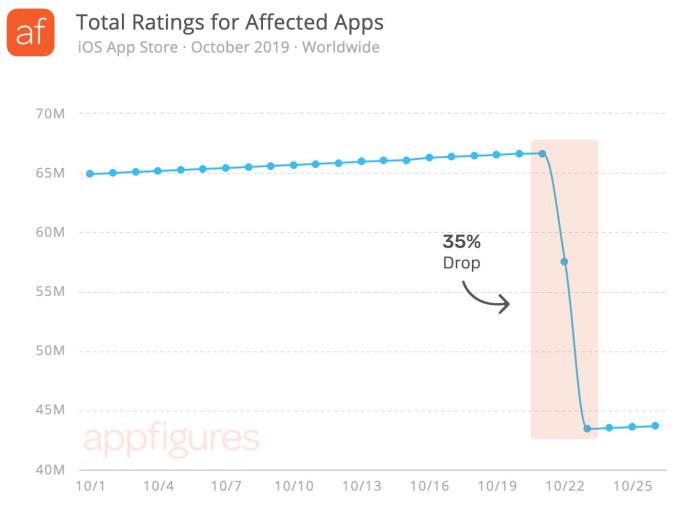
The firm found that more than 300 apps from over 200 developers were affected by the sweep, which wiped out a total of 22 million app reviews from the App Store. On average, apps saw a 50% decrease in ratings in the affected countries, which included the U.S.

total ratings

The U.S. was hit the hardest, however, as some 10 million ratings disappeared. But the sweep was global in nature, hitting all 155 countries Apple supports. China, the U.K., South Korea, Russia, and Australia, also felt a noticeable impact.

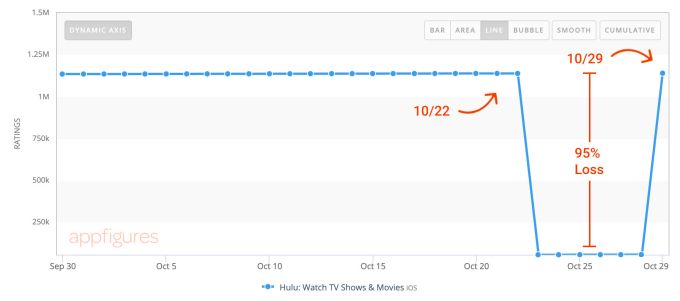
A few apps were hit harder than others. Hulu, for example, lost a whopping 95% of ratings in the U.S., while Dropbox and Chase lost 85%. Several companies affected by the bug declined to comment, but told us that the rating removals weren’t done at their request — they were just as surprised as everyone else.

hulu chart ratings drop

Other big apps that saw their ratings disappear in the U.S. included Chase, Walgreen, Venmo, Amazon Prime Video, Southwest, Hotels.com, Disneyland, Ibotta, ESPN, Amex, Xoom, Fandango, Skyscanner, Google Classroom, Nike SNKRS, My Disney Experience, Old Nav, and others.

Of the over 300 apps that got hit, about half (154) saw a drop of more than 100 ratings, Appfigures said.

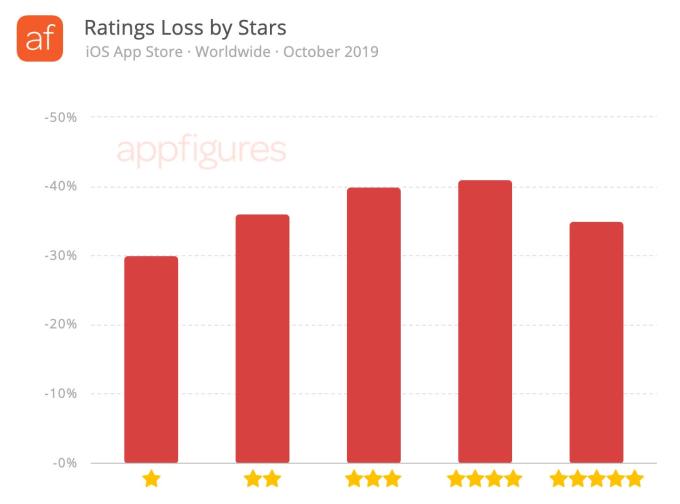
With little information about what happened, developers speculated that Apple was possibly trying to clean up fake app ratings. This theory doesn’t seem that likely, though, because Appfigures found that both positive and negative ratings were removed. Had the sweep been focused on fake ratings, then only the positive (fake) ratings would have been removed.

ratings lost 3

Another theory is that Apple was trying to speed up its ratings system and something just went wrong.

Unfortunately for some of the impacted developers, the bug had a profound effect on their app’s “Overall” rating. Their app may have dropped by several stars as a result of this problem. And that, in turn, could have hurt their ability to get downloads from App Store search results or Search Ads during the week.

Some of the impacted companies (and Appfigures) confirmed to TechCrunch the missing ratings were restored as of yesterday.

Oddly, this isn’t the first time app ratings disappeared nearly overnight.

A similar incident took place last year, when an App Store bug led to thousands of iOS apps losing half their ratings over a weekend. In both cases, Apple quietly resolved the bug, but never offered any statements about what happened.

We reached out to Apple on Tuesday but the company has not yet commented.

However, we hear that Apple spoke directly to some developers to explain the rating removals were done in error and it was working to fix the situation, which now appears resolved.

30 Oct 2019

Samsung ramps up its B2B partner and developer efforts

Chances are you mostly think of Samsung as a consumer-focused electronics company, but it actually has a very sizable B2B business as well, which serves over 50,000 large enterprises and hundreds of thousands of SMB entrepreneurs via its partners. At its developer conference this week, it’s putting the spotlight squarely on this side of its business — with a related hardware launch as well. The focus of today’s news, however, is on Knox, Samsung’s mobile security platform and Project AppStack, which will likely get a different name soon, and which provides B2B customers with a new mechanism to deliver SaaS tools and native apps to their employees’ devices, as well as new tools for developers that make these services more discoverable.

At least in the U.S., Samsung hasn’t really marketed its B2B business all that much. With this event, the company is clearly thinking to change that.

At its core, Samsung is, of course, a hardware company, and as Taher Behbehani, the head of its U.S. mobile B2B division, told me, Samsung’s tablet sales actually doubled in the last year and most of these were for industrial deployments and business-specific solutions. To better serve this market, the company today announced that it is bringing the rugged Tab Active Pro to the U.S. market. Previously, it was only available in Europe.

The Active Pro, with its 10.1″ display, supports Samsung’s S Pen, as well as Dex for using it on the desktop. It’s got all of the dust and water resistance you would expect from a rugged device, is rated to easily support drops from about four feet high, and promises up to 15 hours of battery life. It also features LTE connectivity and has an NFC reader on the back to allow you to badge into a secure application or take contactless payments (which are quite popular in most of the world but are only very slowly becoming a thing in the U.S.), as well a programmable button to allow business users and frontline workers to open up any application they select (like a barcode scanner).

“The traditional rugged devices out there are relatively expensive, relatively heavy to carry around for a full shift,” Samsung’s Chris Briglin told me. “Samsung is growing that market by serving users that traditionally haven’t been able to afford rugged devices or have had to share them between up to four co-workers.”

Today’s event is less about hardware than software and partnerships, though. At the core of the announcements is the new Knox Partner Program, a new way for partners to create and sell applications on Samsung devices. “We work with about 100,000 developers,” said Behbehani. “Some of these are developers are inside companies. Some are outside independent developers and ISVs. And what we hear from these developer communities is when they have a solution or an app, how do I get that to a customer? How do I distribute it more effectively?”

This new partner program is Samsung’s solution for that. It’s a three-tier partner program that’s an evolution of the existing Samsung Enterprise Alliance program. At the most basic level, partners get access to support and marketing assets. At all tiers, partners can also get Knox validation for their applications to highlight that they properly implement all of the Knox APIs.

The free Bronze tier includes access to Knox SDKs and APIs, as well as licensing keys. At the Silver level, partners will get support in their region, while Gold-level members get access to the Samsung Solutions Catalog, as well as the ability to be included in the internal catalog used by Samsung sales teams globally. “This is to enable Samsung teams to find the right solutions to meet customer needs, and promote these solutions to its customers,” the company writes in today’s announcement. Gold-level partners also get access to test devices.

The other new service that will enable developers to reach more enterprises and SMBs is Project Appstack.

“When a new customer buys a Samsung device, no matter if it’s an SMB or an enterprise, depending on the information they provide to us, they get to search for and they get to select a number of different applications specifically designed to help them in their own vertical and for the size of the business,” explained Behbehani. “And once the phone is activated, these apps are downloaded through the ISV or the SaaS player through the back-end delivery mechanism which we are developing.”

For large enterprises, Samsung also runs an algorithm that looks at the size of the business and the vertical it is in to recommend specific applications, too.

Samsung will run a series of hackathons over the course of the next few months to figure out exactly how developers and its customers want to use this service. “It’s a module. It’s a technology backend. It has different components to it,” said Behbehani. “We have a number of tools already in place we have to finetune others and we also, to be honest, want to make sure that we come up with a POC in the marketplace that accurately reflects the requirements and the creativity of what the demand is in the marketplace.”

30 Oct 2019

Google launches TensorFlow Enterprise with long-term support and managed services

Google open-sourced its TensorFlow machine learning framework back in 2015 and it quickly became one of the most popular platforms of its kind. Enterprises that wanted to use it, however, had to either work with third parties or do it themselves. To help these companies — and capture some of this lucrative market itself — Google is launching TensorFlow Enterprise, which includes hands-on, enterprise-grade support and optimized managed services on Google Cloud.

One of the most important features of TensorFlow Enterprise is that it will offer long-term support. For some versions of the framework, Google will offer patches for up to three years. For what looks to be an additional fee, Google will also offer engineering assistance from its Google Cloud and TensorFlow teams to companies that are building AI models.

All of this, of course, is deeply integrated with Google’s own cloud services. “Because Google created and open-sourced TensorFlow, Google Cloud is uniquely positioned to offer support and insights directly from the TensorFlow team itself,” the company writes in today’s announcement. “Combined with our deep expertise in AI and machine learning, this makes TensorFlow Enterprise the best way to run TensorFlow.”

Google also includes Deep Learning VMs and Deep Learning Containers to make getting started with TensorFlow easier and the company has optimized the enterprise version for Nvidia GPUs and Google’s own Cloud TPUs.

Today’s launch is yet another example of Google Cloud’s focus on enterprises, a move the company accelerated when it hired Thomas Kurian to run the Cloud businesses. After years of mostly ignoring the enterprise, the company is now clearly looking at what enterprises are struggling with and how it can adapt its products for them.

30 Oct 2019

Muy raises $15M to grow its new cloud kitchen concept

The cloud kitchen craze has reached Latin America. Food tech startup called Muy landed a fresh $15 million Series B to expand into Mexico and soon Brazil. The service is currently operative in Colombia. 

Muy is a “cloud kitchen meets Chipotle,” says one investor. The company describes itself as a virtual kitchen and smart chef system that uses AI to produce food based on forecasts of demand, which can help to reduce food waste. Muy, translated from Spanish to English as “very,” allows users to place personalized orders in one of Muy’s physical restaurants or through a mobile app. Muy’s concept also exists as 20 physical dining locations offering what it says are quick, fresh and personalized dishes. Founder Jose Calderon says Muy is serving more than 200,000 dishes per month. 

The round was led by Mexico-based investor ALLVP, with previous investor Seaya returning. The $15 million Series B brings MUY’s total funding to $20.5 million.

Calderon is no newcomer to the takeaway experience space. He previously raised $47.7 million for a Colombian online food ordering startup called Domicilios, which he exited to Delivery Hero

The explosion of delivery apps has kept options competitive for customers not only in the U.S. but across Latin America. The congested highways of São Paulo, Mexico City, Bogotá and beyond are filled with motor couriers running deliveries with Rappi, UberEATS and the like.  

Calderon notes that cloud kitchens are poised to make on demand ordering and delivery more efficient in these high-density cities due to the long commute times that keep the growing middle class out of their homes for extended periods of 12 hours or more.  

VAS2539

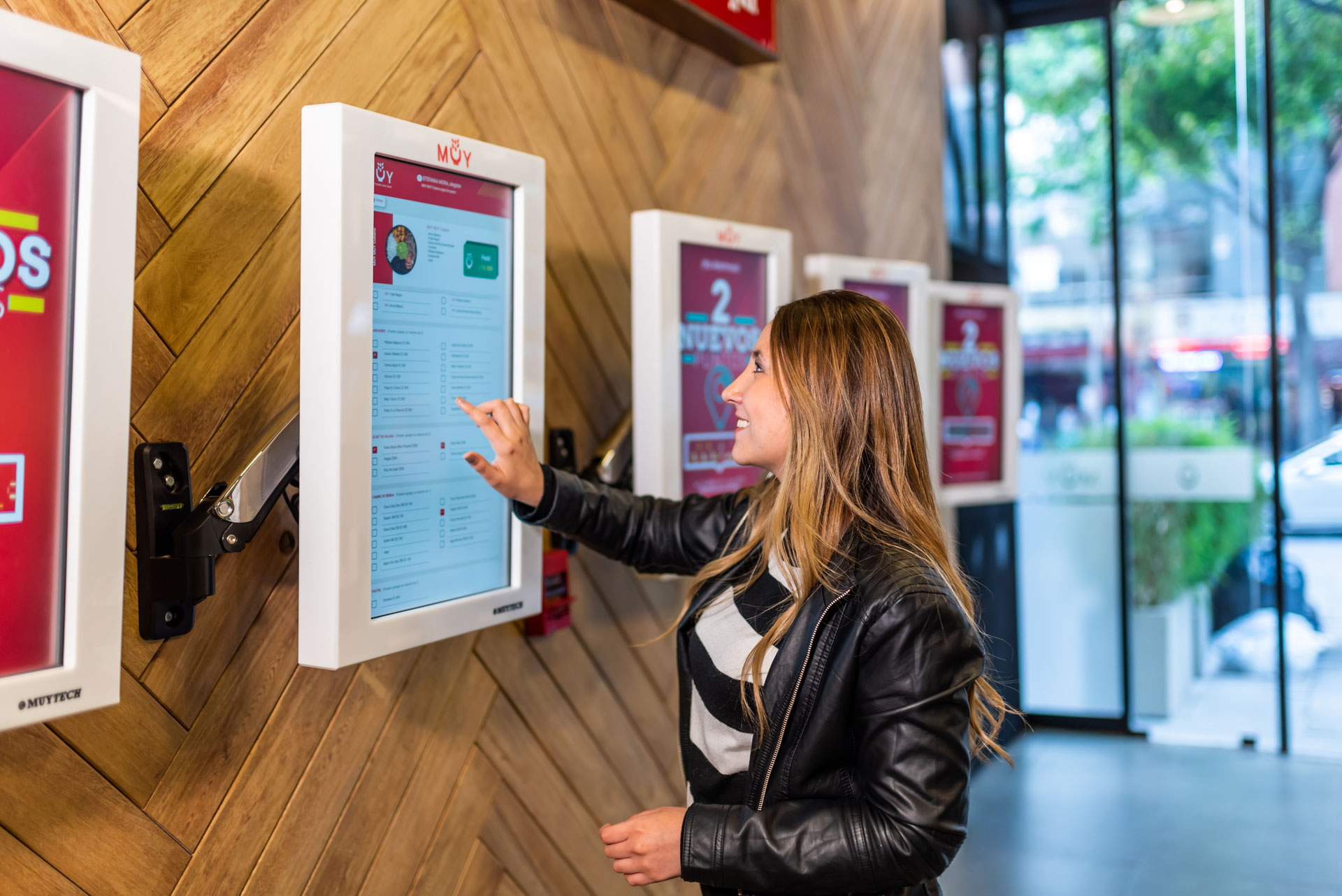
A MUY customer orders at one of the company’s physical locations in Colombia.

Alternatives like full service restaurants can be prohibitively expensive and time consuming, and traditional casual restaurants don’t meet quality standards. A large part of the market, around 40%, brings a lunch to work, says Calderon. But as disposable income increases, he predicts that more people will avoid cooking at home and will opt for faster and higher-quality options like Muy.

Cloud kitchens – the fully equipped, shared, commercial grade spaces for restaurant owners – have left U.S. investors balking. Journalists have described these virtual spaces as “ghost kitchens” and many have noted the threat they pose to independently owned restaurants. My colleague Danny Crichton wrote that “cloud kitchens are the WeWork for restaurant kitchens,” adding that suddenly sharable kitchen space will lead to bidding wars between these virtual food brands.  

This rhetoric isn’t hindering the rise of cloud kitchens and the services that support them from launching in the U.S. and down to Latin America. According to Calderon, the food service market opportunity in Latin America will reach $270 billion by 2021.

The founder also notes that the Latin America market is highly fragmented; the top 10 chains only hold around 5% of market share in comparison to countries like the U.S. where this figure reaches 24%. “Large players will consolidate and win, and small ones will face pressure,” he says. 

Larger incumbents have already begun to dip into the cloud kitchen opportunity. Earlier this year, Amazon took a $575 million bite into Deliveroo, which opened up its first shared kitchen in Paris in 2018. City Storage Systems, the holding company of CloudKitchens, was backed with a $150 million controlling stake from Uber founder and ex-CEO Travis Kalanick. 

For better or worse, delivery apps and cloud kitchens are revolutionizing the way we eat in the U.S., Asia and now in Latin America. The winners among the various global delivery apps, cloud kitchens and controlling incumbents have yet to emerge, but what we do know is that everyone needs to eat lunch.

30 Oct 2019

Facebook agrees to pay UK data watchdog’s Cambridge Analytica fine but settles without admitting liability

Facebook has reached a settlement with the UK’s data protection watchdog, the ICO, agreeing to pay in full a £500,000 (~$643k) fine following the latter’s investigating into the Cambridge Analytica data misuse scandal.

As part of the arrangement Facebook has agreed to drop its legal appeal against the penalty. But under the terms of the settlement it has not admitted any liability in relation to paying the fine, which is the maximum possible monetary penalty under the applicable UK data protection law. (The Cambridge Analytica scandal predates Europe’s GDPR framework coming into force.)

Facebook’s appeal against the ICO’s penalty was focused on a claim that there was no evidence that U.K. Facebook users’ data had being mis-used by Cambridge Analytica .

But there’s a further twist here in that the company had secured a win, from a first tier legal tribunal — which held in June that “procedural fairness and allegations of bias” on the part of the ICO should be considered as part of its appeal.

The decision required the ICO to disclose materials relating to its decision-making process regarding the Facebook fine. The ICO, evidently less than keen for its emails to be trawled through, appealed last month. It’s now withdrawing the action as part of the settlement, Facebook having dropped its legal action.

In a statement laying out the bare bones of the settlement reached, the ICO writes: “The Commissioner considers that this agreement best serves the interests of all UK data subjects who are Facebook users. Both Facebook and the ICO are committed to continuing to work to ensure compliance with applicable data protection laws.”

An ICO spokeswoman did not respond to additional questions — telling us it does not have anything further to add than its public statement.

As part of the settlement, the ICO writes that Facebook is being allowed to retain some (unspecified) “documents” that the ICO had disclosed during the appeal process — to use for “other purposes”, including for furthering its own investigation into issues around Cambridge Analytica.

“Parts of this investigation had previously been put on hold at the ICO’s direction and can now resume,” the ICO adds.

Under the terms of the settlement the ICO and Facebook each pay their own legal costs. While the £500k fine is not kept by the ICO but paid to HM Treasury’s consolidated fund.

Commenting in a statement, deputy commissioner, James Dipple-Johnstone, said:

The ICO welcomes the agreement reached with Facebook for the withdrawal of their appeal against our Monetary Penalty Notice and agreement to pay the fine. The ICO’s main concern was that UK citizen data was exposed to a serious risk of harm. Protection of personal information and personal privacy is of fundamental importance, not only for the rights of individuals, but also as we now know, for the preservation of a strong democracy. We are pleased to hear that Facebook has taken, and will continue to take, significant steps to comply with the fundamental principles of data protection. With this strong commitment to protecting people’s personal information and privacy, we expect that Facebook will be able to move forward and learn from the events of this case.

In its own supporting statement, attached to the ICO’s remarks, Harry Kinmonth, director and associate general counsel at Facebook, added:

We are pleased to have reached a settlement with the ICO. As we have said before, we wish we had done more to investigate claims about Cambridge Analytica in 2015. We made major changes to our platform back then, significantly restricting the information which app developers could access. Protecting people’s information and privacy is a top priority for Facebook, and we are continuing to build new controls to help people protect and manage their information. The ICO has stated that it has not discovered evidence that the data of Facebook users in the EU was transferred to Cambridge Analytica by Dr Kogan. However, we look forward to continuing to cooperate with the ICO’s wider and ongoing investigation into the use of data analytics for political purposes.

A charitable interpretation of what’s gone on here is that both Facebook and the ICO have reached a stalemate where their interests are better served by taking a quick win that puts the issue to bed, rather than dragging on with legal appeals that might also have raised fresh embarrassments. 

That’s quick wins in terms of PR (a paid fine for the ICO; and drawing a line under the issue for Facebook), as well as (potentially) useful data to further Facebook’s internal investigation of the Cambridge Analytica scandal.

We don’t know exactly it’s getting from the ICO’s document stash. But we do know it’s facing a number of lawsuits and legal challenges over the scandal in the US. 

The ICO announced its intention to fine Facebook over the Cambridge Analytica scandal just over a year ago.

In March 2018 it had raided the UK offices of the now defunct data company, after obtaining a warrant, taking away hard drives and computers for analysis. It had also earlier ordered Facebook to withdraw its own investigators from the company’s offices.

Speaking to a UK parliamentary committee a year ago the information commissioner, Elizabeth Denham, and deputy Dipple-Johnstone, discussed their (then) ongoing investigation of data seized from Cambridge Analytica — saying they believed the Facebook user data-set the company had misappropriated could have been passed to more entities than were publicly known.

The ICO said at that point it was looking into “about half a dozen” entities.

It also told the committee it had evidence that, even as recently as early 2018, Cambridge Analytica might have retained some of the Facebook data — despite having claimed it had deleted everything.

“The follow up was less than robust. And that’s one of the reasons that we fined Facebook £500,000,” Denham also said at the time. 

Some of this evidence will likely be very useful for Facebook as it prepares to defend itself in legal challenges related to Cambridge Analytica. As well as aiding its claimed platform audit — when, in the wake of the scandal, Facebook said it would run a historical app audit and challenge all developers who it determined had downloaded large amounts of user data.

The audit, which it announced in March 2018, apparently remains ongoing.

30 Oct 2019

IoT security startup Particle raises $40M in Series C

Particle, a platform for Internet of Things devices, has raised $40 million in its latest round of funding.

Qualcomm Ventures and Energy Impact Partners led the Series C raise, with backing from existing investors including Root Ventures, Bonfire Ventures, Industry Ventures, Spark Capital, Green D Ventures, Counterpart Ventures, and SOSV.

With its latest round of funding, Particle has raised comes to $81 million to date.

The San Francisco-based startup provides the back-end for its customers to bring Internet of Things devices to market without having to shell out for their own software infrastructure. The platform aims to be the all-in-one solution for IoT devices, with encryption and security, as well as data autonomy and scalability.

That means more traditional businesses can buy a fleet of sensors and other monitoring devices, hook them up to their own machines, and use Particle’s infrastructure for monitoring.

That’s a common theme that Particle sees, according to Zach Supalla, the company’s chief executive.

“More and more of our customers are in old-fashioned, even unglamorous, businesses like stormwater management, industrial equipment, shipping, or monitoring any number of compressors, pumps, and valves,” he said in remarks. “These businesses are diverse, but the common thread is that they need to monitor and control mission-critical machines, and we see it as our mission to help bring their machines, vehicles, and devices into the 21st century.”

Particle said the funding round follows “significant growth” for its enterprise platform, seeing 150 percent year-over-year growth in revenue.

The company currently has 100 staff working to support 85 enterprise clients across agriculture, automotive, smart city and other industries.

30 Oct 2019

Apple TV+ will be free with an Apple Music student subscription

Ahead of Friday’s launch of Apple’s new streaming service, Apple TV+, the company announced an Apple Music/Apple TV+ bundle deal specifically aimed at making the service more affordable for younger subscribers. According to an Instagram Story published by Hailee Steinfeld, star of Apple TV+’s first potential hit series, Dickison, Apple Music student subscribers will be able to stream Apple TV+ for free.

The announcement was spotted earlier by 9to5Mac.

After a series of Instagram-hosted Q&A’s meant to stoke excitement for the show among her fans, Steinfeld announced the bundle deal by saying that: “for those of you who are students with an Apple Music student subscription, you can now get Apple TV+ for free.”

steinfeld announcementShe noted this means student subscribers will not only be able to watch her new show on Friday, November 1st, they can also check out her new single “Afterlife” with the same subscription.
The Apple Music student subscription is currently $4.99 per month, which provides full access to Apple Music’s catalog of 50 million songs, live local radio stations, curated playlists, and other original content.

An Apple Music-Apple TV+ bundle had been rumored to be in the works, prompting rival Spotify to team up with Hulu to pre-emptively strike with a bundle deal of their own.

But when Apple formally announced its TV streaming service, it instead surprised everyone by offering the service for free with the purchase of a new Apple device.

Of course, students are less likely to upgrade their phones and tablets as often as working adults, given the costs. That means they would have missed out on the “new device” deal, and would have instead had to pay the $4.99 per month subscription for the TV service. 

Meanwhile, Apple TV+’s debut shows have received mixed reviews from critics ahead of launch — with the star-powered The Morning Show featuring Jennifer Aniston, Reese Whitherspoon, and Steve Carell even being called “dull” and “underwhelming.” Dickison, however, has been a bright spot, with some even saying the show is set to be Apple TV+’s breakout series. It would make sense for Apple to capitalize on that attention — as well as on Steinfeld’s 12.4 million Instagram followers — to get more people watching.

Apple didn’t share any additional information about the Music/TV+ bundle beyond what Steinfeld announced. There was no related press release or even a tweet posted to the Apple TV Twitter account. In other words, Apple was narrowly targeting Steinfeld’s built-in fan base with the news.

It appears this is not a limited-time deal with an expiration date attached, just an ongoing benefit of a student Music subscription.


30 Oct 2019

Wearable spending forecasted to increase 27% in 2020

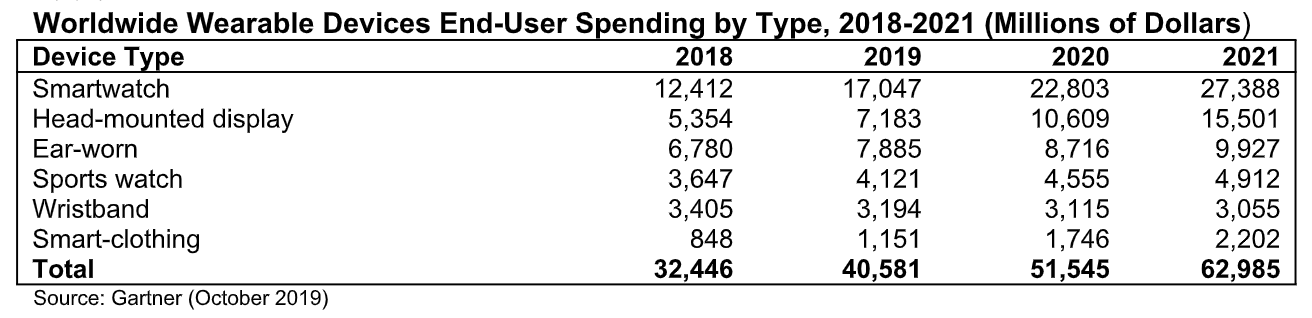
New numbers from Gartner mark another major increase for global wearable spending in 2020. The analyst firm forecasts a 27% jump in end-user spending over this year, from $40.5 billion to $51.5 billion. Once again, the pack is lead by smartwatches, which continue to burn the hottest among in the space.

Interestingly, the increase on smartwatch spending from $17 billion to $22.8 billion will be lead by decreasing prices (a 4.5% decrease in average selling prices in 2021). Those are, in turn, the result of a combination of increased competition from Samsung and some external pressure from Fitbit, which has found a sweet spot at around $200 a unit. Chinese manufacturers like Xiaomi have also gone a ways toward decreasing the price on the low end of the market. 

Screen Shot 2019 10 30 at 10.06.47 AM

Apple, in turn, has responded by keeping the two-year-old Series 3 on the market at the $200 price point. It’s a sign of a maturing category that no longer commands as much of a premium pricing in past generations. Google, meanwhile, recently bought a fair chunk of IP from Fossil and has reportedly been eyeing a Fitbit acquisition after years of struggling to crack the category.

Headphones have continued steady growth, as well, thanks to an explosion in fully wireless earbuds, lead by Apple and Samsung, with the recent lower cost addition of Amazon. Google, too, has been eying a reentry into the category next year with the return of its much panned Pixel Buds. Even Microsoft plans to enter the category with its unique Surface Buds.

Gartner predicts continued spending growth in wearables for 2021, with spending hitting $62.9 billion.

30 Oct 2019

Stampli raises $25 million in Series B to bring AI to invoice management

Stampli, the Mountain View-based company looking to automate invoice management, has today announced the close of a $25 million Series B round. The funding round was led by SignalFire, with participation from existing investors such as Hillsven Capital, Bloomberg Beta, as well as new investors such as NextWorld Capital.

Stampli launched in 2015 to build software specifically focused on invoice management. Part of the problem with invoice management is that many people in the organization procure services and contract vendors, but the people who deal with the majority of the paperwork are siloed off from that process. This means the folks in the finance department are often tasked with chasing down coworkers from other departments to resolve their issues.

With Stampli, the entire procure to pay process happens in a collaborative software suite. Each invoice is turned into its own communications hub, allowing people across departments to fill in the blanks and answer questions so that payments are handled as efficiently as possible. Moreover, Stampli uses machine learning to recognize patterns around how the organization allocates cost, manages approval workflows and what data is extracted from invoices.

In other words, over time, Stampli gets better and better for each individual organization.

Stampli charges based on the amount of transactions an organization has in the system, as well as how many ‘advanced users’ are taking part in that action. Stampli recognizes the difference between users in the finance department, making high-level decisions, and other users from the organization who are simply collaborating on the platform much more infrequently.

Cofounder and CEO Eyal Feldman believes that another big differentiator for the company is that it has specifically decided to be payments agnostic, letting customers choose their payments provider and maintain control of that part of the system.

As of right now, Stampli is processing more than $12 billion in invoices annually, with more than 1,900 businesses and 40,000 users on the platform.

This new round comes on the heels of a $6.7 million Series A round from August 2018, also led by SignalFire with participation from UpWest Labs, Bloomberg Beta, and Hillsven Capital. This brings Stampli’s total funding to $34.7 million.