Year: 2019

30 Oct 2019

Github removes Tsunami Democràtic’s APK after a takedown order from Spain

Microsoft-owned Github has removed the APK of an app for organizing political protests in the autonomous community of Catalonia — acting on a takedown request from Spain’s military police (aka the Guardia Civil).

As we reported earlier this month supporters of independence for Catalonia have regrouped under a new banner — calling itself Tsunami Democràtic — with the aim of rebooting the political movement and campaigning for self-determination by mobilizing street protests and peaceful civil disobedience.

The group has also been developing bespoke technology tools to coordinate protest action. It’s one of these tools, the Tsunami Democràtic app, which was being hosted as an APK on Github and has now been taken down.

The app registers supporters of independence by asking them to communicate their availability and resources for taking part in local protest actions across Catalonia. Users are also asked to register for protest actions and check-in when they get there — at which point the app asks them to abide by a promise of non-violence (see point 3 in this sample screengrab):

image1 2 1

Users of the app see only upcoming protests relevant to their location and availability — making it different to the one-to-many broadcasts that Tsunami Democràtic also puts out via its channel on the Telegram messaging app.

Essentially, it’s a decentalized tool for mobilizing smaller, localized protest actions vs the largest demos which continue to be organized via Telegram broadcasts (such as a mass blockade of Barcelona airport, earlier this month).

A source with knowledge of Tsunami Democràtic previously told us the sorts of protests intended to be coordinated via the app could include actions such as go-slows to disrupt traffic on local roads and fake shopping sprees in supermarkets, with protestors abandoning carts filled with products in the store.

In a section of Github’s site detailing government takedowns the request from the Spanish state to remove the Tsunami Democràtic app sits alongside folders containing historical takedown requests from China and Russia.

“There is an ongoing investigation being carried out by the National High Court where the movement Tsunami Democràtic has been confirmed as a criminal organization driving people to commit terrorist attacks. Tsunami Democràtic’s main goal is coordinating these riots and terrorist actions by using any possible mean,” Spain’s military police write in the letter sent to Github.

We’ve reached out to Microsoft for comment on Github’s decision to remove the app APK.

In a note about government takedowns on Github’s website it writes:

From time to time, GitHub receives requests from governments to remove content that has been declared unlawful in their local jurisdiction. Although we may not always agree with those laws, we may need to block content if we receive a valid request from a government official so that our users in that jurisdiction may continue to have access to GitHub to collaborate and build software.

“GitHub does not endorse or adopt any assertion contained in the following notices,” it adds in a further caveat on the page.

The trigger for the latest wave of street demonstrations in Catalonia were lengthy jail sentences handed down to a number of Catalan political and cultural leaders by Spain’s Supreme Court earlier this month.

These were people involved in organizing an illegal independence referendum two years ago. The majority of these Catalan leaders were convicted for sedition. None were found guilty of the more serious charge of rebellion — but sentences ran as long as 13 years nonetheless.

This month Spanish judges also reissued a European arrest warrant seeking to extradite the former leader of the Catalan government, Carles Puigdemont, from Brussels to Spain to face trial.  Last year a court in Germany refused his extradition to Spain on charges of rebellion or sedition — only allowing it on lesser grounds of misuse of public funds. A charge which Spain did not pursue.

Puigdemont fled Catalonia in the wake of the failed 2017 independence bid and has remained living in exile in Brussels. He has also since been elected as an MEP but has been unable to take up his seat in the EU parliament after the Spanish state moved to block him from being recognized as a parliamentarian.

Shortly after the latest wave of pro-independence demonstrations took off in Catalonia the Tsunami Democràtic movement’s website was taken offline — also as a result of a takedown request by the Spanish state.

The website remains offline at the time of writing.

While the Tsunami Democràtic app could be accused of encouraging disruption, the charge of “terrorism” is clearly overblown. Unless your definition of terrorism extends to harnessing the power of peaceful civil resistance to generate momentum for political change. 

And while there has been unrest on the streets of Barcelona and other Catalan towns and cities this month, with fires being lit and projectiles thrown at police, there are conflicting reports about what has triggered these clashes between police and protestors — including criticism of the police response as overly aggressive vs what has been, in the main, large but peaceful crowds of pro-democracy demonstrators.

The police response on the day of the 2017 referendum was also widely condemned as violently disproportionate, with scenes of riot gear clad police officers beating up people as they tried to cast a vote.

Local press in Catalonia has reported the European Commission response to Spain’s takedown of the Tsunami Democràtic website — saying the pan-EU body said Spain has a responsibility to find “the right balance between guaranteeing freedom of expression and upholding public order and ensuring security, as well as protecting [citizens] from illegal content”.

Asked what impact the Github takedown of the Tsunami Democràtic app’s APK will have on the app, a source with knowledge of the movement suggested very little — pointing out that the APK is now being hosted on Telegram.

Similarly, the content that was available on the movement’s website is being posted to its 380,000+ subscribers on Telegram — a messaging platform that’s itself been targeted for blocks by authoritarian states in various locations around the world. (Though not, so far, in Spain.)

Another protest support tool that’s been in the works in Catalonia — a live-map for crowdsourcing information about street protests which looks similar to the HKlive.maps app used by pro-democracy campaigners in Hong Kong — is still in testing but expected to launch soon, per the source.
30 Oct 2019

Prosus Ventures leads $40M investment in Indian logistics startup ElasticRun

Millions of neighborhood stores that dot large and small cities, towns, and villages in India and have proven tough to beat for e-commerce giants and super-chain retailers are at the center of a new play in the country. A score of e-commerce companies, offline retail chains, and fintech startups are now racing to work with these mom and pop stores as they look to tap a massive untapped opportunity.

A Pune-based startup with an idea to build a logistics network using these kirana stores said today it has won the backing of a major international investor. Three-and-a-half-year old ElasticRun said it has raised $40 million in a Series C financing round led by Prosus Ventures (formerly Naspers Ventures). Existing investors Avataar Ventures and Kalaari Capital also participated in the round.

The startup has raised $55.5 to date, Sandeep Deshmukh, co-founder and CEO of ElasticRun, told TechCrunch in an interview.

Most of these kirana stores each day go through hours of down time — when the footfall is low and the business is slow. ElasticRun works with hundreds of thousands of these stores across 200 Indian cities to have them deliver goods to other kirana stores and consumers. Deshmukh said the startup today works with more than nearly every top FMCG (fast moving consumer goods) brand to help them reach the last mile in the nation.

Screen Shot 2019 10 30 at 2.18.53 PM

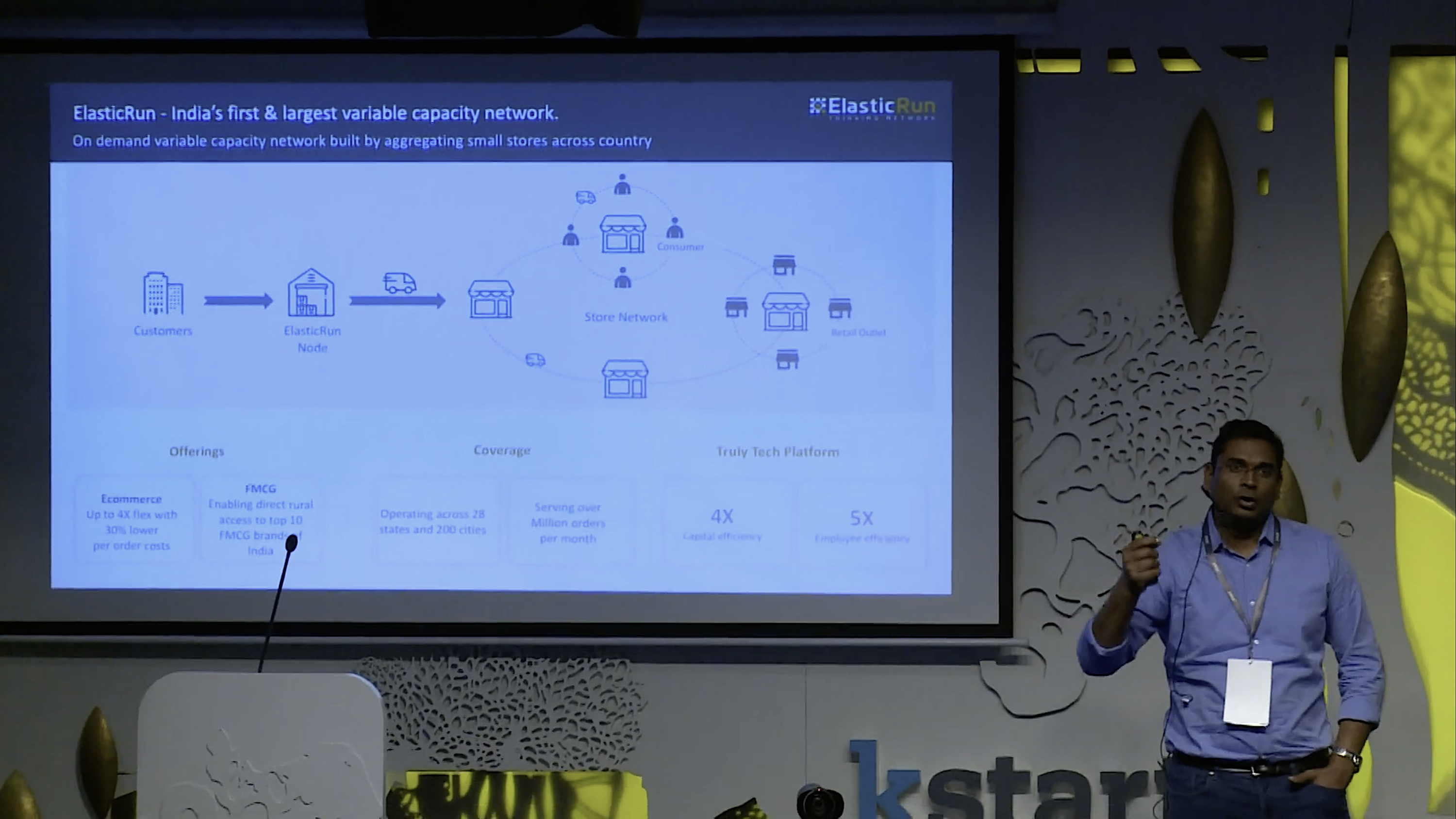
Deshmukh, co-founder and CEO of ElasticRun, talking about the startup’s business at a recent conference

It’s a win-win scenario for every stakeholder, Deshmukh said. Stores are getting access to more goods than ever, and also getting the opportunity to increase their business in slow hours. And for brands and e-commerce companies, access to such a wide-reaching delivery pool has never been easier, he said.

Since there is a digital log of each transaction, Deshmukh said the startup has an idea about the financial capacity of these kirana stores. This has enabled it to connect them with relevant financial partners to access working capital, he said.

Deshmukh said the startup will use the fresh capital to on-board more neighborhood stores in the country. ElasticRun is also working on new products to expand its offerings to brands and kirana stores.

“By working with the network of small stores across the country, we solve that problem while helping the store owners grow their businesses at the same time. In addition, offering a flexible logistics extension to consumer goods companies to directly reach these small retail shops is a huge advantage over traditional distribution networks,” he said.

In a statement, Ashutosh Sharma, Head of Investments for India, Prosus Ventures, said, “ElasticRun is one of those rare businesses that identified a massive need in the market, matched it with a local solution paired with technology, for the benefit of all parties involved. Consumers get faster deliveries and greater choice of goods, store owners realize increased revenues and touchpoints with their customers, and consumer goods companies get better access and insight into their target audiences.”

30 Oct 2019

Want a free Innovator pass to Disrupt Berlin 2019? Apply to volunteer

If your budget simply can’t manage a line item for a ticket to Disrupt Berlin 2019, we have exciting news for you. Volunteer for our work exchange program, and we’ll give you a free Innovator pass good for both days of the show (11-12 December). We have a limited number of volunteer positions, and applications close Thursday, 31 October.

Don’t wait — apply to our volunteer work exchange and attend Disrupt Berlin for free.

It takes a lot of hands and a lot of work to produce a world-class tech event, and you’ll have a front row seat to how it all gets done. You’ll also be a big part of making Disrupt an outstanding experience for all attendees.

We might ask you to wrangle speakers, register attendees, scan tickets, stuff goodie bags, assist with other marketing activities, direct attendees, place signage or something else entirely. You’ll work hard, but you’ll also have plenty of time to enjoy that Innovator pass access.

Ready for the fine print? Here’s what you need to know. The Disrupt Berlin volunteer dates are 10-12 December. To be considered, all volunteers must

  • Be at least 18 years old
  • Submit an application by Thursday, October 31
  • Attend a mandatory orientation training on Tuesday, 10 December at Arena Berlin
  • Be available for a total of 10 hours over the course of all three days Shifts range between 2 to 5 hours and may start as early as 6 a.m. or end as late as 11 p.m.
  • Provide your own travel, lodging and meals

We’ll assign volunteer schedules 2-3 weeks before the event, and we’ll notify you — whether we accept your application or not — by Wednesday, 6 November.

We keep dangling the free Innovator pass and for good reason. With it, volunteers have access to the full Disrupt agenda, all stages — including the Startup Battlefield competition — exclusive video content access after the event ends, interactive workshops, more than 400 startups and sponsors in Startup Alley, networking events, the full attendee list via Disrupt Mobile App and CrunchMatch, the attendee networking platform.

As a volunteer at Disrupt Berlin 2019, you’ll see everything that goes into producing a large-scale tech event, meet great people and still have time to explore and network. Applications close on 31 October, so apply to volunteer today!

Is your company interested in sponsoring or exhibiting at Disrupt Berlin 2019? Contact our sponsorship sales team by filling out this form.

30 Oct 2019

NHS pagers are leaking medical data

An amateur radio rig exposed to the internet and discovered by a security researcher was collecting real-time of medical data and health information broadcast by hospitals and ambulances across U.K. towns and cities.

The rig, operated out of a house in North London, was picking up radio waves from over the air and translating them into readable text. The hobbyist’s computer display was filling up with messages about real-time medical emergencies from across the region. For some reason, the hobbyist had set up an internet-connected webcam pointed at the display. But because there was no password on the webcam, anyone who knew where to look could also see what was on the rig’s computer display.

Daley Borda, a security researcher and bug bounty hunter, was at home in Florida when he stumbled upon the exposed webcam. The live stream was grainy, and the quality of the images so poor that it was just possible to make out the text on the display.

“You can see details of calls coming in — their name, address, and injury,” he told TechCrunch.

TechCrunch verified his findings. Messages spilling across the screen appeared to direct nearby ambulances where to go following calls to the 999 emergency services.

One message said a 98-year-old man had fallen at his home address. A few moments later, another message said 49-year-old male was complaining of chest pains at a nearby residence. One after the other, messages were flooding in, describing accidents, incidents, medical emergencies, often including their home addresses.

benz app 2 2

Several screenshots of the amateur radio decoding software, revealing unencrypted pager messages from nearby NHS trusts. (Image: TechCrunch)

Borda spends much of his time scouring the internet for things that shouldn’t be online. He looks for exposed databases and devices and, like most other security researchers, privately reports them to their owners. If he’s lucky, the owner takes action. Better yet, they pay out a bug bounty for his efforts.

But he could not figure out who the rig belonged to. TechCrunch contacted the hobbyist’s internet provider to warn of the data exposure.

“Last night we contacted the customer to make them aware that there was a live webcam broadcasting on the open web from their household,” said a spokesperson from the internet provider. “The customer was unaware of the nature of the information being shown so has said that they will stop the feed on that particular camera.”

The hobbyist was picking up and decoding pager communications from a nearby regional National Health Service trust.

“With some cheap, relatively basic, software it is possible for hobbyists to access these frequencies and decode the information being sent, which appears is what has occurred here,” the spokesperson said.

Old but reliable

Pagers — or beepers — may be a relic of the past, but remain a fixture in U.K. hospitals.

These traditionally one-way communication devices allow anyone to send messages to one or many pagers at once by calling a dedicated phone number, often manned by an operator, which are then broadcast as radio waves over the pager network. But pagers still offer benefits where newer technologies, like cell phones, fall down. Because they work a low frequency, pager radio waves are able to travel further and deeper inside large buildings — particularly hospitals — which have thickened walls to protect others from X-rays and other radiation. Pagers also work across long distances, including in cell service dead-spots.

But few were thinking about message security when pager use was at its peak.

“They aren’t secure,” Andy Keck, an electronics and amateur radio hobbyist, told TechCrunch. Keck said messages sent over the pager network are encoded when they are converted into a burst of radio waves and broadcast over the air.

“But people don’t necessarily understand the difference between encryption and encoding,” he said.

Because the two widely used pager protocols — POCSAG and FLEX — are not encrypted, it’s easy to understand what messages are broadcast over the airwaves using free and open-source software.

For years one of the largest barriers to intercepting and decoding pager messages — or any other radio waves — was that hobbyists needed custom, often expensive hardware. But with the advent of software-defined radios, most hobbyists can get by with a $20 plug-in dongle and an antenna.

“It’s just enter the command to start the application, sit back, and start decoding in real time on the screen,” he said.

130,000 NHS pagers

Although the number of pagers has dropped to near-zero from their height in the 1980s, pagers still carry a considerable amount of information every day.

Pager messages can travel over a large distance, said Keck, depending on how high the transmitter is located. Most major cities are covered with some pager service. Given the geography of the U.K., amateur radio hobbyists can often pick up pager messages from different sources.

The NHS still uses about 130,000 pagers, according to the U.K. government’s latest count, or about 10 percent of the world’s current pagers in use. But the NHS has been told to stop using pagers altogether by 2021.

But it’s not clear how many trusts are exposing medical information — if at all.  According to NHS spokesperson Oliver Michelson, “each NHS organization is responsible for its own IT equipment and security.”

GettyImages 128243077

Pagers receive encoded, but not encrypted messages. (Image: Getty Images)

One NHS trust we spoke to said they had around 1,600 pagers and are managed by the trust. (We are not naming the trust, as it would expose their communications.) When asked if the trust was aware that pager messages are not encrypted and can be intercepted by amateur radio hobbyists, the spokesperson responded: “Yes.”

Another trust we spoke to said they were “aware” that the handful of pagers it operates do not encrypt their messages. The trust said their pagers were managed by a third-party.

PageOne, the last remaining pager network in the U.K., says in a brochure that its pager service can deliver “real-time messaging cost effectively and securely to their staff.”

But a spokesperson told TechCrunch: “PageOne ensures customers are aware of the ability to intercept messages in its terms and conditions” and that encrypted services “are available if required.”

The company said the majority of NHS pagers are operated on private pager networks operated by the trusts themselves.

‘Trivially interceptable’

Amateur radio hobbyists know all too well the risks posed by unencrypted pagers.

Over the years there have been numerous headlines of hobbyists picking up signals from nearby hospitals, including patients’ names and medical information. Some have even turned eavesdropping on hospital pagers into an art project.

Last month, hospitals in Vancouver were found broadcasting unencrypted patient medical data across the city.

Sarah Jamie Lewis, executive director at Open Privacy, who first revealed the issue, said the hospital pager messages were “trivially interceptable” by anyone nearby.

“It tends to be pretty common knowledge in the amateur radio community that these kind of broadcasts are going on but it’s only recently that we started seeing a culture of disclosure,” said Lewis.

In the U.K., it’s legal for amateur radio hobbyists to scan the airwaves but unlawful to disclose the contents of messages. That’s put some security-focused hobbyists who disclose exposed sensitive messages in a tough legal spot.

“You get this horrible situation where not disclosing is bad, but people have a right to know that their health data is being breached,” said Lewis.

But the penalties could be far steeper for organizations that expose sensitive health data. Exposing personally identifiable and health information violates GDPR, the Europe-wide data protection laws that came into force last year. Organizations can be fined heavily for breaching the rules.

With more than a year on the clock before the NHS pager ban comes into effect, it’s not a problem that can be easily fixed.

The obvious solution would be not to send sensitive health or medical data over pager messages. Clearly, as seen by the amateur hobbyist’s radio rig, that message isn’t getting through.


Got a tip? You can send tips securely over Signal and WhatsApp to +1 646-755-8849. You can also send PGP email with the fingerprint: 4D0E 92F2 E36A EC51 DAAE 5D97 CB8C 15FA EB6C EEA5.

30 Oct 2019

Let’s have a word about what3words with Clare Jones at Disrupt Berlin

Addresses are ambiguous, not precise enough or don’t even exist in some places. what3words wants to map the entire world and overhaul addresses three words at a time. That’s why I’m excited to announce that what3words Chief Commercial Officer Clare Jones is joining us at TechCrunch Disrupt Berlin.

The startup has divided the world in 3 meter squares. Each square has been assigned three words. This way, it’s easy to read, easy to write and even easy to say. And more importantly, it’s unique.

And sometimes, simple ideas can be incredibly powerful. For instance, if you’re driving, it’s much faster to say three words to define an address on your navigation system than a full address.

It’s also more precise. If you’re heading to a huge building, you want to arrive at the entrance of the building, not on the other side. It’s incredibly frustrating when it happens — I nearly missed a train when a GPS navigation system led me to the wrong side of the tracks. This could be particularly useful for ride-hailing apps for instance, as they usually only let you enter an address.

And then, there are countries that never had a good address system in the first place. For instance, Lonely Planet added what3words addresses to its Mongolia travel guide. It is much easier to read three words in a book and type them on your phone, instead of tapping GPS coordinates for instance.

It also opens up a lot of new markets for e-commerce companies. In some countries, customers don’t have a good way to indicate where they live. An e-commerce website can add what3words support to add new delivery locations.

There are many other use cases. Emergency services, governments and humanitarian projects could also leverage what3words to improve communication and become more efficient. And I can’t wait to hear Clare Jones describe how people have been using what3words.

Buy your ticket to Disrupt Berlin to listen to this discussion — and many others. The conference will take place December 11-12.

In addition to panels and fireside chats, like this one, new startups will participate in the Startup Battlefield to compete for the highly coveted Battlefield Cup.

what3words is the world's first addressing system designed for voice – every 3m x 3m square in the world has been assigned an address made of just three words from the dictionary. These 3 word addresses can be used to route cars or drones, used as an address when ordering online, or simply given as a meeting point for a picnic in the park. what3words is used in 170 countries and is being adopted by governments all around the world as an official addressing system. Its investors include Daimler, Intel Capital, Aramex and Deutsche Bahn.

Clare is the Chief Commercial Officer of what3words; prior to this, her background was in the development and growth of social enterprises and in impact investment. Clare was featured in the 2019 Forbes 30 under 30 list for technology and is involved with London companies tackling social/environmental challenges. Clare also volunteers with the Streetlink project, doing health outreach work with vulnerable women in South London.

30 Oct 2019

ShareGrid acquires UK peer-to-peer film and camera rental community BorrowFox

ShareGrid, the U.S.-based marketplace for sharing, buying and selling film and photography equipment, has acquired the U.K’s BorrowFox as part of its international expansion plans.

BorrowFox operates a “peer-to-peer” film and camera rental community that lets people rent out their under-utilised gear. ShareGrid says it expects to launch in the U.K. in 2020 (where it will compete with the likes of Fat Lama).

Terms of deal remain undisclosed, although I understand ShareGrid is acquiring all of BorrowFox’s assets outright. The two companies aren’t disclosing if it was a cash or stock deal or mixture of the two, or who BorrowFox’s investors were.

Meanwhile, I’m told that BorrowFox’s founders, Arthur Pierse and Alastair Woods, won’t be joining ShareGrid.

In the U.S. ShareGrid lets users rent film and camera equipment from each other, including cinema cameras, still cameras, lenses, audio equipment, drones, lighting equipment, gimbals and other accessories, as well as studio spaces, locations and production vehicles.

The idea behind the service is to help creatives access world-class equipment at lower rental fees, and earn an income from their unused gear. The company also offers a buy-and-sell service, custom production quotes, and instant insurance, acting as a “one-stop shop” for filmmakers, photographers and production professionals.

Following the acquisition, ShareGrid says it will host over 100,000 users, with more than $1 billion worth of film and camera equipment available on its combined platform. Once the acquisition complete and ShareGrid has launched in the U.K., existing BorrowFox members will be asked to transfer their account to ShareGrid.

“At ShareGrid, our mission is to enable all filmmakers and photographers, regardless of background, budget or location, to have access to cutting-edge and affordable equipment,” says Marius Ciocirlan, co-founder and CEO of ShareGrid in a statement. “We see the acquisition of BorrowFox as an exciting opportunity to enter the U.K. market, and build on a company that has had a similar vision from the start”.

30 Oct 2019

As Juul announces mass layoffs, a new lawsuit alleges it shipped a million contaminated pods

A lawsuit filed a by former Juul executive alleges that the company knew a batch of contaminated e-liquid had been used in about one million pods shipped to retailers earlier this year, but did not inform customers. The lawsuit, first reported by BuzzFeed, was brought by Siddharth Breja, former senior vice president of global finance at Juul from May 2018 to March 2019, who alleges he was fired after complaining about the contaminated pods.

News of the lawsuit comes the same day as Juul’s announcement it will lay off about 500 people, or 10% to 15% of its workforce, and the departure of four executives, including chief financial officer Tim Danaher. Juul is currently under scrutiny by the Food and Drug Administration, which claims the startup made misleading statements about its product and targeting of teens.

In the lawsuit, Breja claims that during a meeting on March 12, he learned a contaminated batch of mint e-liquid was used to make 250,000 refill kits, or a total of one million pods, that had already been shipped to retailers.

Breja alleges that when he complained about Juul’s refusal to issue a product recall or health and safety notice, Danaher said doing so would cost the company billions of dollars in lost sales, hurting its then-$38 billion valuation. About a week later, Breja says the company fired him, telling him that it was because he had misrepresented himself as former chief financial officer at Uber. In the lawsuit, Breja says the claim was “preposterous,” and that he had accurately represented his former position as a chief financial officer of a division at Uber.

In the lawsuit, Breja also claims that Juul wanted to sell pods that were almost a year old and when he asked the company to include an expiration or best by date, or a date of manufacture on the packaging, he was told by former CEO Kevin Burns that “half our customers are drunk and vaping like mo-fos, who the fuck is going to notice the quality of our pods?”

TechCrunch has contacted Juul and the law firm representing Breja for comment. In a statement to BuzzFeed, Breja’s attorney Harmeet Dhillon said “Mr. Breja became aware of very concerning actions at the company, and he performed his duty to shareholders and to the board by reporting these issues internally. In exchange for doing that, he was inappropriatey terminated. This is very concerning, particularly since some of the issues he raised concerned matters of public safety.”

Burns was replaced in September by K.C. Crosthwaite, a former executive at Juul’s largest shareholder Altria . A replacement for Danaher has not been announced yet.

30 Oct 2019

Slack investor Index Ventures backs Slack competitor Quill

Slack created a new solution for workplace communication, one copied by many, even Microsoft. But the product, which is meant to help individuals and businesses collaborate, has been critiqued for sending too many notifications, with some claiming it’s sabotaged workplace productivity.

Quill, a startup led by Ludwig Pettersson, Stripe’s former creative director and design aficionado, claims to offer “meaningful conversations, without disturbing your team.” The company has raised a $2 million seed round led by Sam Altman with participation from General Catalyst, followed by a $12.5 million Series A at a $62.5 million valuation led by Index Ventures partner and former Slack board observer Sarah Cannon, TechCrunch has learned.

Quill and Cannon declined to comment.

The company, based in San Francisco, has created a no-frills messaging product. Still in beta, Quill plans to encourage fewer, more focused conversations with a heavy emphasis on threads, sources tell TechCrunch . The product is less of a firehose than Slack, says former Y Combinator president Altman, where one can get stuck for extended periods of time filtering through direct messages, threads and channels.

“It’s relentlessly focused on increasing the bandwidth and efficiency of communication,” Altman tells TechCrunch. “The product technically works super well–it surfaces the right information in the feed and it’s pretty intelligent about how it brings the right people into conversations.”

Pettersson previously worked with Altman at his current venture, OpenAI, a research-driven business focused on development that steers artificial intelligence in a “friendlier” direction. Pettersson was a member of the company’s technical staff in 2016 and 2017, creating OpenAI’s initial design.

Index Ventures, for its part, appears to be doubling down on the growing workplace communications software category. The firm first invested in Slack, which completed its highly-anticipated direct listing earlier this year, in 2015. Slack went on to raise hundred millions more, reaching a valuation of over $7 billion in 2018.

Since going public, Slack has struggled to find its footing on the public markets, in large part due to the growing threat of Microsoft Teams, the software giant’s Slack-like product that debuted in 2016. Quickly, Microsoft has gobbled up market share, offering convenient product packages including beloved tools used by most businesses. As of July, Teams had 13 million daily active users and the title of Microsoft’s fastest-growing application in its history. Slack reported 12 million daily active users earlier this month.

Startups like Quill pose a threat to Slack, too. It created the playbook for workplace chat software and proved the massive appetite for such tools; companies are bound to iterate on the model for years to come.

Quill is also backed by OpenAI’s chairman and chief technology officer Greg Brockman and Elad Gil, a former Twitter executive and co-founder of Color Genomics.

30 Oct 2019

HBO Max will cost $14.99 per month and will launch in May 2020

AT&T and WarnerMedia just announced the pricing of its HBO Max streaming service, along sharing more details about the timing and content lineup.

The service will cost $14.99 per month — the same price as HBO Now. WarnerMedia also says it will be free for HBO Now subscribers and for viewers who subscribe to HBO via AT&T. And it will launch in May of next year.

At the event, HBO’s Casey Bloys also announced that HBO has greenlit a Game of Thrones spinoff called House of the Dragon, based on George R.R. Martin’s book of Westerosi history, Fire and Blood (perhaps explaining why a previously announced spin-off that was recently canceled).

The company also revealed that HBO Max will be the exclusive streaming home of South Park. Plus, Elizabeth Banks, Issa Rae and Mindy Kaling are all developing new shows for the service — and Arrow and Riverdale producer Greg Berlanti announced that he’s working on the new DC Comics-related titles Green Lantern and Strange Adventures.

Today’s presentation for media and investors began with lots of commentary about all the corporate synergies between AT&T, WarnerMedia (which AT&T acquired last year) and the service’s namesake HBO.

WarnerMedia’s entertainment and direct-to-consumer chairman Bob Greenblatt said HBO Max will have 10,000 hours of content at launch, including the HBO library, films from Warner Bros. and original content “appealing to all the younger demos.” Ten thousand hours sounds like a lot, but Greenblatt acknowledge it’s less than some competitors (presumably Netflix): “We actually think our value proposition improves when we narrow some of the options.”

Screen Shot 2019 10 29 at 7.43.07 PM

HBO Max Chief Content Officer Kevin Reilly made a similar point, noting that on average, half of the usage on subscription streaming services comes from the top 100 titles, so “quality over quantity” is important. To illustrate that quality, he pointed to titles like Sesame Street, as well as the Lord of the Rings movies, The Hobbit movies, The Matrix trilogy and The Conjuring films, plus every Superman and Batman movie from the past 40 years.

“We’re all-in with DC and the associated brand-love that DC generates,” Reilly said.

He also noted the service will also stream the 90’s classic Friends, as well as The Big Bang Theory, for which it reportedly paid over $1 billion.

As for originals, Reilly said the company plans to launch 31 Max Originals series (combined with HBO series, that makes for 69 original shows on HBO Max in its first year). Half of them, apparently, will be targeted at a young adult audience, and with most of the episodes released on a weekly basis — Reilly argued that this allows for more cultural impact, “rather than fading quickly after a binge and burn.”

In terms of the product itself, WarnerMedia’s Executive Vice President Andy Forssell argued that “despite a decade of SVOD evolution, it’s still too hard to find something to watch,” and said HBO Max will “blend the smart use of data with real human touch, and present them via novel product experiences.”

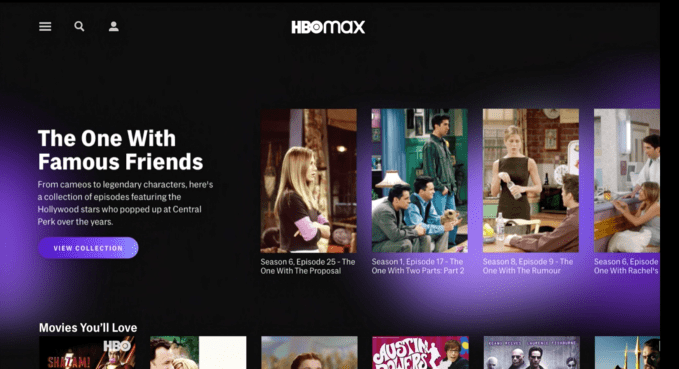
He then showed off how the service will include curated highlights sections focusing on things like Friends episodes with high-profile guest stars. Forssell acknowledged that this might not seem revolutionary, but he argued that it offers a “significant deviation from how SVOD services have used screen real estate.”

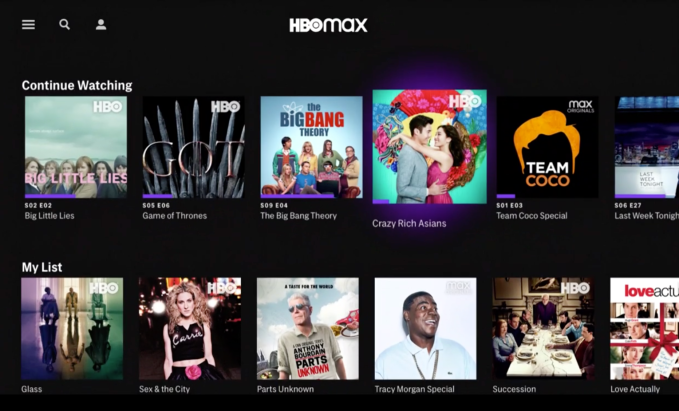
It will also expand HBO’s Recommended by Humans feature, where celebrities and other real people can recommend their favorite movies and TV shows. And there will be kids’ profiles and shared profiles — so that the watching you do with others won’t interfere with the progress and recommendations from your own solo viewing.

Screen Shot 2019 10 29 at 7.42.30 PM

In July, AT&T first announced its plans for HBO Max, but the details around launch and pricing weren’t yet known. Instead, the attention so far has been on HBO Max’s content lineup.

The service aims to capitalize on HBO’s reputation for premium fare to attract consumers — many of whom already pay $15 per month for HBO Now. But it will pad that HBO library with a combination of programming from other WarnerMedia properties like Cinemax, New Line, DC Entertainment, Warner Bros., The CW, CNN, TNT, TBS, TruTV, Turner Classic Movies, Crunchyroll, Adult Swim, Cartoon Network, Rooster Teeth, Looney Tunes, and others.

We now know HBO Max will be home to Game of Thrones and its upcoming spin-offs, plus favorite HBO series like The Sopranos, Sex and the City, Deadwood, Westworld, and others.

It’s also bringing back Gossip Girl, rebooting Grease, making a Dune TV show, and streaming all 21 Studio Ghibli films.

Other HBO Max shows will include a Riverdale spin-off Katy Keene; Search Party; Batwoman; Adventure Time; Stephen King’s The Outsider; Jordan Peele and J.J. Abrams’ horror series Lovecraft Country; Joss Whedon’s The Nevers; Julian Fellowes’ (Downton Abbey) The Gilded Age; David E. Kelley’s The Undoing; Rules of Magic, a prequel to Alice Hoffman’s Practical Magic; The Boondocks; and Gremlins: Secrets of the Mogwai; plus back catalog content like Fresh Prince of Bel-Air, Pretty Little Liars, Doctor Who (2005 and onward), The West Wing, Top Gear, The Office (original version), and others.

Upcoming literary adaptions include Tokyo Vice, The Flight Attendant, CirceMade for LoveStation Eleven, and Anna K: A Love Story. 

More recently, HBO Max has announced a new documentary on Anthony Bourdain, an overall deal with Lisa Ling, a documentary about Amy Schumer, a Melissa McCarthy comedy film, a documentary with Monica Lewinsky, and a new deal with J.J. Abrams’ Bad Robot (the deal allows Bad Robot to make TV under the WarnerMedia umbrella and then sell it to other streaming services).

Abrams was part of today’s event. He said it’s too early to announce any specific programming under the new deal — Bad Robot already works with HBO on titles like Westworld, and Abrams has a new show in the works called Demimonde — but he declared, “There’s no company that values storytelling more than WarnerMedia.”

And for classic movie lovers who mourn the loss of FilmStruck, Warner Bros. CEO Ann Sarnoff, said the service will offer a rich library of films from the Warner Bros. and MGM library, curated titles from Turner Classic Movies, as well as “decades and decades of more great titles from The Criterion Collection.”

AT&T said on Monday it plans to spend about $2 billion on the service over the next two years and aims to sign up some 50 million subscribers by 2025.

The service will arrive at a time when competition in the streaming market is heating up. Netflix, Hulu and Amazon Prime Video’s successes have paved the way for new entrants like Apple TV+, which launches Friday, and Disney+, which arrives mid-November. NBCU is also joining next year with its streaming service Peacock, which will offer The Office and other classic shows, alongside new originals, like a Battlestar Galactica reboot.

These streamers are gaining at the expense of traditional TV, which has impacted other parts of AT&T’s business.

In the third quarter, it lost another 1.2 million satellite and fiber-optic-TV customers as well as 195,000 AT&T TV Now (previously DirecTV Now) subscribers. AT&T’s profit was down 22% year-over-year to $3.7 billion and revenue had fallen 2.5% to $44.6 billion.

Eventually, AT&T’s plan is to merge its AT&T TV Now live TV service into HBO Max and add on a discounted ad-supported tier to HBO Max to make it more affordable.

29 Oct 2019

Tencent leads $111M investment in India’s video streaming service MX Player

MX Player, a popular video app that offers both local playback and streaming services, said on Wednesday that it has raised $110.8 million in a new financing round led by Chinese internet giant Tencent as the video app looks to expand its business in India and other international markets.

Times Internet, which acquired a majority stake in MX Player in late 2017 for $140 million, also participated in the Series A financing round. The post-money valuation of MX Player was $500 million, a person familiar with the matter told TechCrunch.

The addition of Tencent — which has invested in a handful of Indian startups including Times Internet-owned Gaana, ride-hailing giant Ola, ed tech startup Byju’s, B2B e-commerce startup Udaan and a bookkeeping service for merchants, Khatabook — “is a great sign of confidence,” said Satyan Gajwani, vice chairman of Times Internet. “Tencent is a leading global force in music and video, and there’s a lot for us to learn and leverage from their capabilities,” he added.

Karan Bedi, CEO of MX Player, said in an interview that the video app will use the fresh capital to double down on producing original TV shows and broadening its catalog of licensed content. The firm, which has so far added 15 original shows to its platform, has already commissioned production of another 20 by year-end, he said.

The Singapore-headquartered firm’s push into original shows and licensed content underscores one of the strangest evolution for a video app. MX Player originated in Korea as an app that could run video files in a wide-range of formats locally stored on a phone.

The app did all of this while consuming little resources, an ability that helped it win tens of millions of users with low-cost Android smartphones in emerging markets such as India. In fact, India is MX Player’s largest market, with 175 million monthly active users, Bedi said. Globally, the app has amassed more than 280 million users.

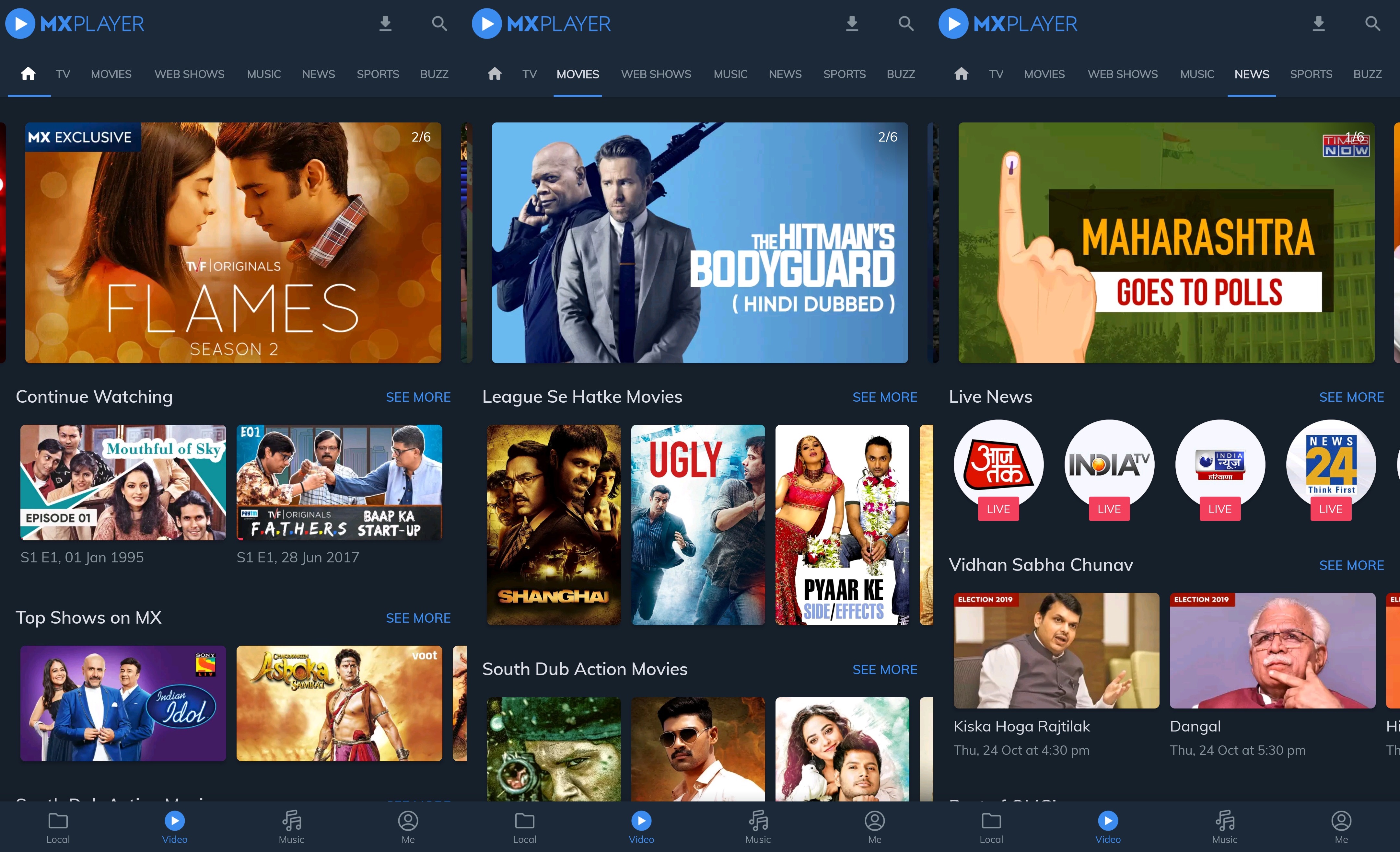
MX Player is ad-supported and does not charge users any monthly subscription fee. The service, which introduced movies and shows streaming in mid-2018, today also offers access to about 200 TV channels, their current and back catalog of shows, and a music streaming feature through an integration with Gaana.

mxplayer tc

Bedi said the company has tied up with all-web show producers such as HoiChoi in India and three of the top five TV local cable networks, including Sony and Sun. Missing from the list is Star India, the largest TV network in the country.

Thanks to the acquisition of 21st Century Fox, Disney now owns Star India. Star India has emerged as one of the gems in Disney’s new portfolio. The firm, which runs dozens of TV channels in India, operates Hotstar, the market-leading video streaming service.

Hotstar reported 300 million monthly active users and 100 million daily active users during the ICC Cricket World Cup tournament. The service has cashed in on the popularity of cricket to boost its numbers.

Bedi said MX Player is working on building new entertainment experiences, but sports content is not something it is exploring. The reason is simple: Cricket drives most of the sports streaming in India and Star India has secured rights to most of such content. (Facebook recently grabbed a slice of it, too.)

But cricket alone can’t help a streaming service win and sustain customers. Even Hotstar’s monthly user base plummets below 60 million in the months following the cricketing season, people familiar with Hotstar’s internal figures have told TechCrunch.

Figuring out what exactly resonates with the users in India, the world’s second largest internet market, is the billion-dollar question. The video streaming market in India is on track to be worth $1.7 billion in the next four years, according to PricewaterhouseCoopers.

Bedi, who spearheaded Eros Now’s India business before joining MX Player, said users are increasingly enjoying the original shows. Most of the shows that MX Player has produced so far, such as “Hey Prabhu,” “Thinkistan” and “Immature,” are largely targeted at college students and those who have just joined the work force. But the company is slowly populating the platform with shows such as “Queen” that appeal “universally,” he said.

image5

MX Player today competes with more than three dozen local and international players, nearly all of which offer their services at dirt-cheap prices in India. Even Netflix, which launched in India with a $8 plan in 2016, this year introduced a $2.8 monthly tier. In recent months, several more firms including e-commerce giant Flipkart and food delivery startup Zomato have launched their video streaming services in the country.

Tencent-rival Alibaba announced earlier this year that it would invest $100 million to expand social video app Vmate in India.

Once cautious about each megabyte they spent consuming internet services, Indians are now spending about 10GB of data on their smartphones each month as data prices crash in the country, according to an Ericsson report. Indian billionaire Mukesh Ambani disrupted the local telecom market in 2016 when he launched Reliance Jio. The 4G-only carrier undercut the market by first offering bulk of mobile data at no cost, and then charging very little fee.

An analyst TechCrunch spoke with said it’s only a matter of time before India’s video market begins to see some consolidation and pull back. “You have to offer something appealing that none of your rivals have,” he said, requesting anonymity as he advises many of these businesses.

For MX Player, its odd evolution story may be its biggest advantage. The app’s local video playback feature continues to draw many to it, and keeps the app among the top rated in Google’s Play Store. Bedi said the startup, which today employs about 300 people, maintains a large team that continues to improve the tech stacks to improve video playback support.

Moving forward, MX Player will also look into expanding to some international markets. It recently started beta testing the video streaming service in the U.S., Canada, Australia and New Zealand. Eventually, the startup hopes to make original shows for these markets that are relevant to the local audience there.

MX Player maintains a premium app on Google Play Store that strips ads for $5. But the app continues to mostly rely on revenue it generates from ads. Times Internet’s Gajwani said that at some point in the future, the video service will expand monetization beyond pure advertising. “That said, MX is consumed daily as much as the leading TV channel in India, so there’s significant headroom to capture larger advertising spends as well,” he added.

Paytm, a leading financial services firm in India, was also in talks with MX Player to invest in this financial round. It may invest in the video streaming services app at a later stage, a person familiar with the talks said.