Year: 2019

29 Oct 2019

Founded by a former Uber exec, Oliver Space wants to design and furnish apartments for busy professionals

Chan Park feels like “an eternal nomad.” It all started at age 12, when he moved from Korea to the U.S., where he attended middle school in Minnesota, followed by high school in New Jersey, followed by college in New Hampshire.

Then he really began to bounce around, working as a trader in New York, embracing the life of a ski bum in Utah, then heading to Asia in the service of Uber, where he spent six years, running its expansion team at first, then managing its entire Southeast Asia business out of Singapore. More specifically, he was responsible for eight countries across the region, and 350 people, which didn’t give him a lot of time to organize his home.

It was something to which he was very accustomed — living in chaos — except something interesting happened in Singapore. “There’s this huge culture of landlords furnishing space to attract expats,” says Park. “The furnishings aren’t super high-end, but they’re well-designed and well put together and it enabled me to be basically be moved in as soon as I put my clothes in the closet.” He also enjoyed being home a lot more. “For the first time, I was proud to host friends for dinners and barbecues and to just open the door and relax. ”

Before long, he was talking with his Dartmouth classmate turned product and industrial designer Christian Talmage about forming their own company, and thus was born Oliver Space, which provides a lot of what that Singaporean landlord delivered to Park: it furnishes places for busy professionals, making moving into a new home as easy as hanging up their clothes.

The service is available in the Bay Area only. And Oliver Space employs just a dozen people so far. But the company has already gained enough traction to attract $6.8 million in seed funding from an interesting array of investors, including Mayfield, Abstract Ventures, operators turned investors Jana Messerschmidt and April Underwood, OpenDoor founder Eric Wu, and Kevin and Julia Hartz of Eventbrite, among others.

Now, Oliver Space just has to grow as quickly, or more so, than two other furniture-as-service startups to recently attract funding. Fernish, a two-year-old, L.A.-based startup that helps people rent from brands like Crate & Barrel, Floyd, and Campaign, attracted $30 million in funding earlier this year led by Real Estate Technology Ventures, with participation from Intuit’s founder Scott Cook and Amazon’s head of global consumer, Jeff Wilke. Feather, a two-year-old, New York-based furniture rental startup that similarly works with known brands like West Elm and Pottery Barn, meanwhile closed a $12 million round a few months ago led by Spark Capital. (It has raised $16 million altogether.)

Park, who as an Uber alum is very attuned to the competition, knows his own startup isn’t the first out of the gate. He thinks it can win on a few fronts, however. For one thing, while Oliver Space uses traditional retailers for some of the items it’s renting, it is also making Oliver Space-branded furnishings — from sectionals to dining tables to beds —  with the help of “dozens” of manufacturers in China and elsewhere, says Park.

Park also stresses design, saying that Oliver Space wants to replace that friend with the great taste to whom a college graduate or busy young professional might otherwise turn for help. Indeed, the company puts together “mood boards” for customers, featuring everything from the loveseat to plants to pillows to candles, all of which it will happily rent to them on a monthly or even yearly basis.

The longer a customer commits to rent items, the less they pay. If they decide eventually to buy the items, Oliver Space will sell them at their retail price, deducting all of their previous rental payments and considering them instead down payments on the furnishings.

Not last, Park says Oliver Park aims to move quickly. In fact, part of why it is having its own furniture made is so that it can be assembled, and later disassembled, fast, so that when a customer walks into his or her home, everything is picture perfect. (If you’ve ordered furniture any time recently and been confronted with wait times of weeks or months, you start to appreciate this part of the pitch, particularly for someone who is new to a city.)

As for what happens when that furniture isn’t brand-new, Park says Oliver Space has plans to inspect, clean, and repair pieces as needed. He likens the opportunity to that of the car market, where pre-owned, certified cars are another source of revenue. “In furniture, used means Craiglist, and you have no idea where a sofa or a rug has been. As our business grows, we’ll be creating that pre-owned concept with our brand’s stamp of approval.”

Maybe so. It’s early to know if these differentiators are enough to make the company stand out. A lot depends on execution as Oliver Space grows out of the Bay Area and into other markets. (Park won’t yet say where these will be.)

In the meantime, it’s easy to understand the appeal of the company and its rivals. Beyond making consumers’ lives easier in numerous ways, they’re presumably better for the environment. At least, with a reported  9.8 million tons of furniture that is thrown into a landfill every year in the U.S. alone, it seems worth seeing whether their way works better.
29 Oct 2019

Apple’s AirPods Pro set a pricey new standard for earbuds

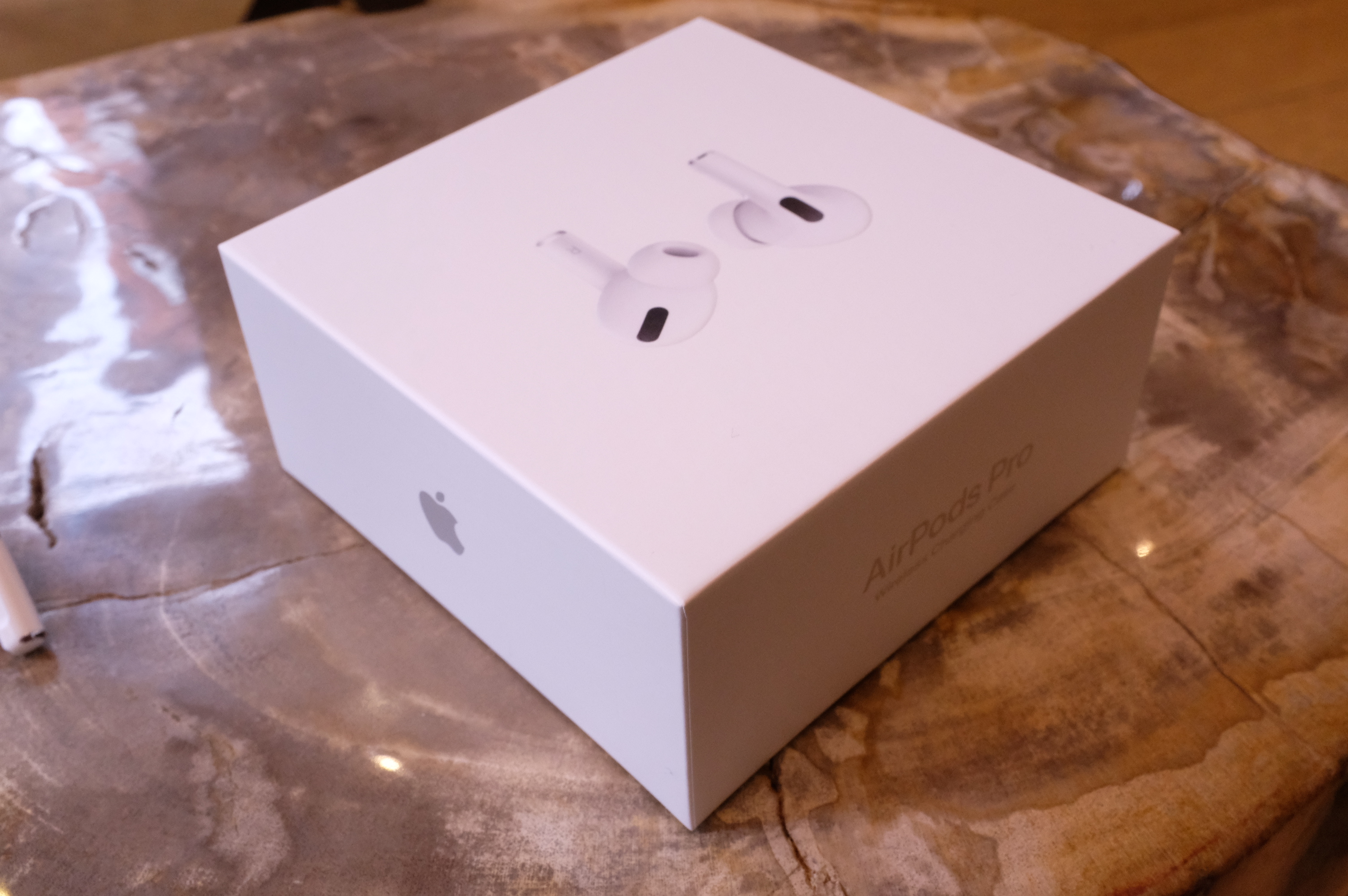
“These $250 earbuds are nice.” That’s the first thing I wrote to a co-worker after unboxing and trying on the new AirPods. After wearing them around the New York City streets, the subway and into a couple of cafes, that pithy review stands.

Here are a few more words: They’re super comfortable. I’ve used a lot of different Bluetooth earbuds. It’s a weird perk of my job. The AirPods Pro (baffling pluralization aside) are probably the most comfortable, with the possible exception of the Powerbeats Pro, another Apple-manufactured joint venture. That one, however, relies on a lot more plastic to get the job done, with a full over-the-ear hook system.

The new AirPods, on the other hand, just hang comfortably. This is a big win for those who’ve experienced ear discomfort from all sort of different designs. [Sheepishly raises hand.] Granted, every ear is like a beautiful, unique snowflake, and not everyone will have the same experience. That said, the company’s clearly done a lot to correct for the complaints about the original AirPods, using both a more ergonomic design and finally giving in to the sway of silicone tips.

Airpods Pro

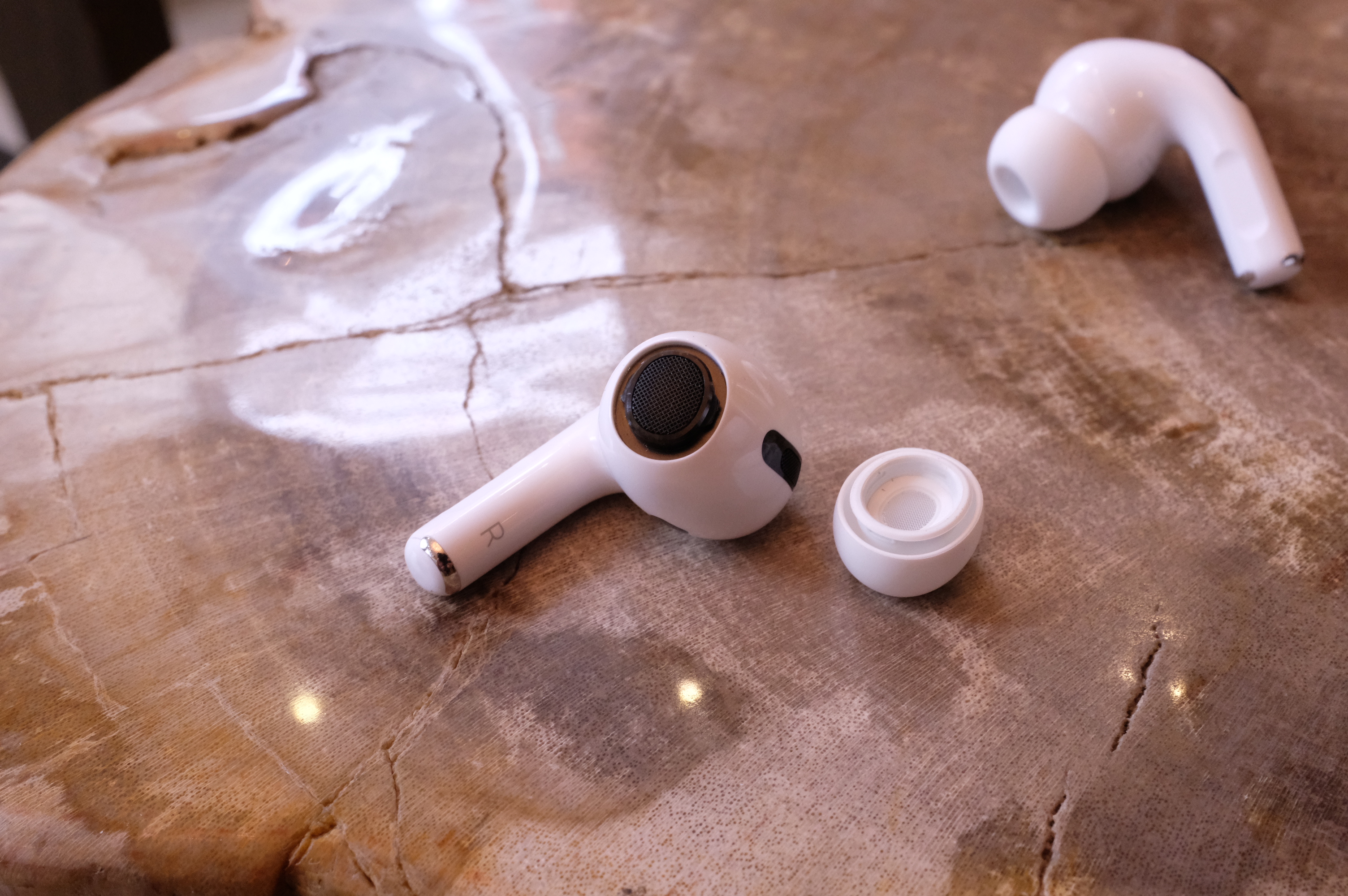
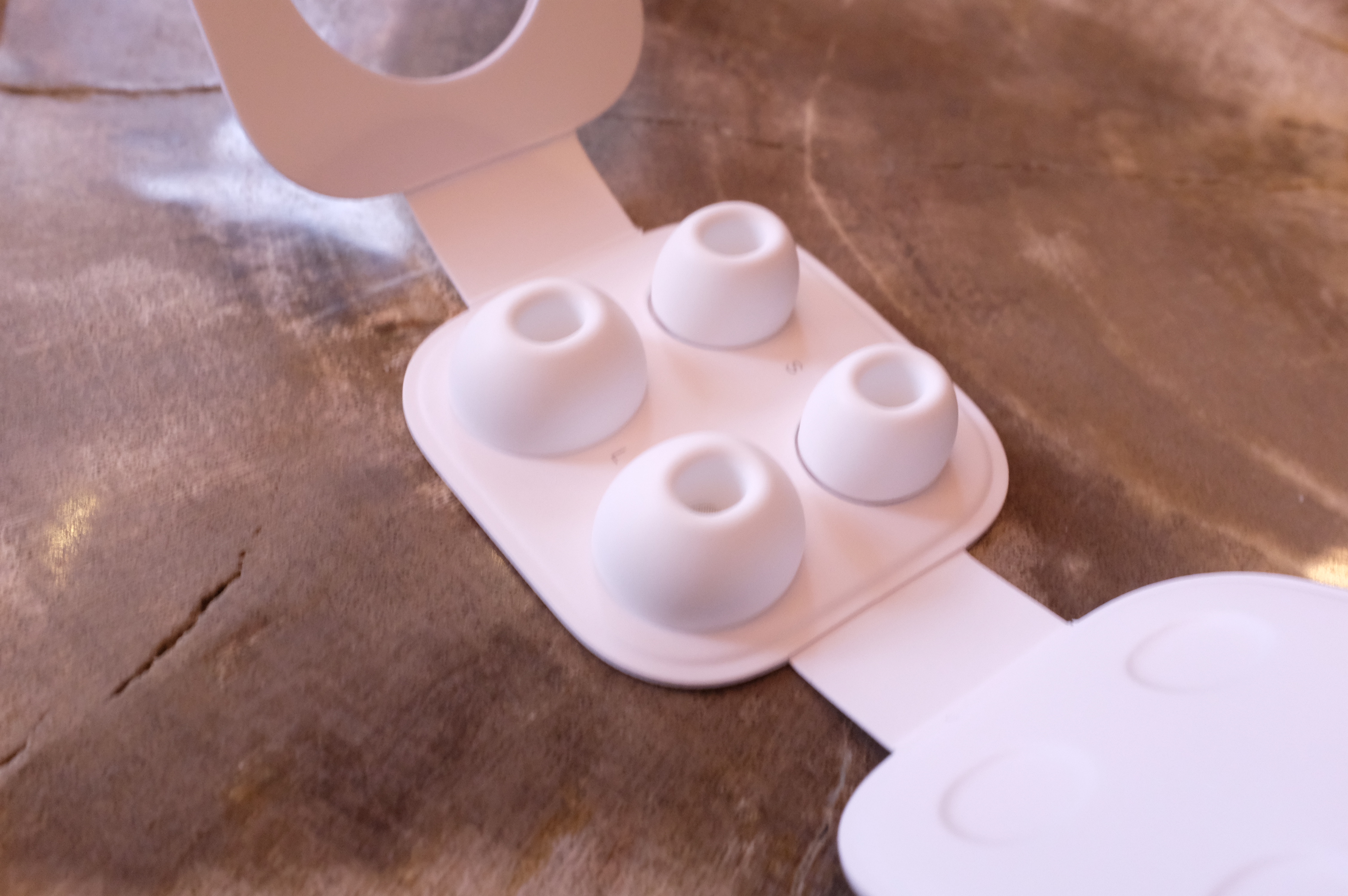
Why Apple waited this long on the latter bit is beyond me, but the company has finally done so on its own terms. Each Pro box ships with a total of six tips (a right and left in small, medium and large), with the medium on by default. These, however, are not your standard, run of the mill silicone tips. A firm yank will pull them off to reveal a hard outer edge that snaps into the bud [picture above].

The company says this is part of ensuring a better fit. Another benefit is that the attachment is much more secure. This is a definite plus, speaking as someone who has accidentally littered the streets of New York with earbud tips. These are far less likely to fall off while getting them out of your pocket. If you do lose one, Apple will be selling replacements for probably a buck or so.

Along with an enlarged body, you’ve no doubt noticed that the stems are notably shorter. That’s because the company has been able to consolidate more of the electronics into the top. The stem remains as a way of handling the earbuds. It also now houses a haptic button that replaces the standard AirPod tap interaction. Instead, you give the stem a squeeze, triggering a subtle clicking sound in the process.

Airpods Pro

By default, a single squeeze pauses and plays a track, whereas a squeeze and hold cycles between noise cancellation and transparent modes. All of this can be adjusted in iOS, once you’ve downloaded version 13.2. Setup on iOS is as easy as ever, requiring you to simply open the case near an iPhone or iPad. Android and desktop pairing, meanwhile, involves the more standard Bluetooth setup.

IMG 4958

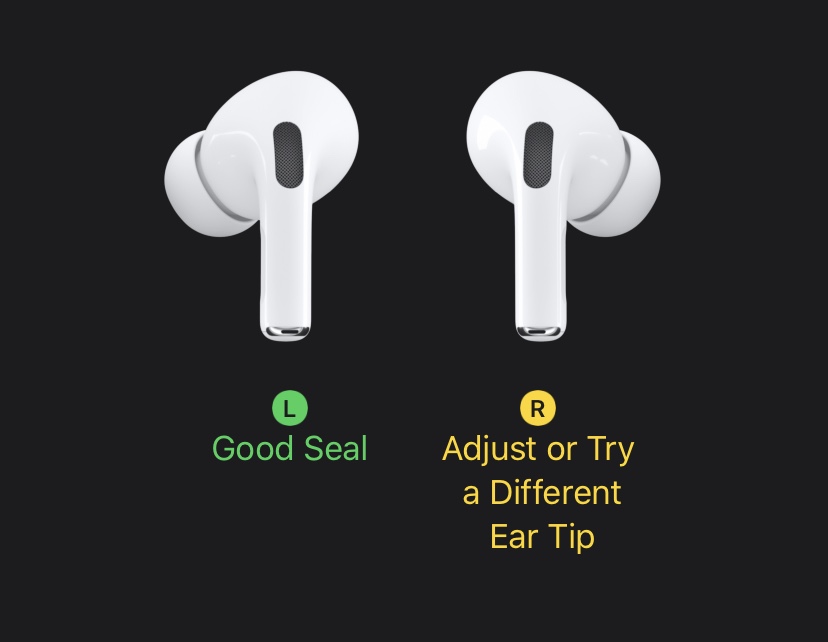
From there, click into Settings > Bluetooth > and then tap the “i” next to AirPods Pro. From here you switch between noise control modes, assign different functions to the button on the individual AirPods and fire up the Ear Tip Fit Test. Hit “play” and it will start a quick snippet of a song used to test the fit. If you have the right tip on, it will display “good seal.” If something is wrong, it recommends trying a different tip or adjusting the bud in ear.

Not only is every ear different, but some folks have a deal of differentiation between right and left. The mediums worked well for me, right out of the box. That’s me, Mr. Average Ears. Results may very.

The Pros sound great. They’re among the best-sounding earbuds I’ve tried, up there with the similarly priced Sony WF-1000XM3. As such, they’re in pretty rare air. Unlike the Echo Buds, you can’t adjust the levels in settings, but Apple’s buds are tuned well out of the box for a wide range of genres. So far, I’ve listened to Ryuichi Sakamoto, Danny Brown, The Hold Steady, Electric Youth and Sunn 0))), for a pretty diverse sampling. It all comes across rich and full — much as one would expect/hope from a $250 pair of earbuds.

Airpods Pro

The noise canceling, too, is up there with Sony’s. Apple’s works adaptively, similar to what it offers on its over-ear Beats headphones. That means the microphones are constantly listening to your surroundings and adjusting accordingly. It’s not quite a full immersion, like you would get from over-ear headphones, but with a tight seal, it does a pretty terrific job drowning out your surroundings when needed.

For those times you need to be more alert, there’s transparency mode, which uses the on-board mics to beam in ambience. Once again, it’s a good mix, letting in sound without completely overwhelming the music. That was one of my issues with the Echo Buds, which tended to overamplify things like an air conditioning unit. Though again, unlike the Echo Buds, you can turn transparency on an off, versus adjusting levels.

Bit of a side note here, but like their predecessors, these new models will probably go a ways toward shifting societal norms in terms of keeping your headphones in while engaging with others. These are the sorts of things that make me want to go all Andy Rooney on kids today, etc., etc.

Airpods Pro

Noise canceling and transparency have similar impacts on battery, knocking about half an hour off of the Pods’ built-in five hours. With the charging case factored in, total listening time should be about 24 hours in standard mode, per Apple’s estimates. I’m excited to push that to the limit as I board a plane to Asia early next week. Ditto for the comfort level — but after several hours today, all is still well.

The case is a little larger than the original AirPods, but is still carried comfortably in a pocket, unlike, say, the Beats or Sony models. The orientation has shifted, as well. It’s not wider than it is long, owing to the shortening of the AirPods’ stems. The new design means they’re slightly more difficult to maneuver into the case, but you’ll get the hang of that after a couple of tries.

Airpods Pro

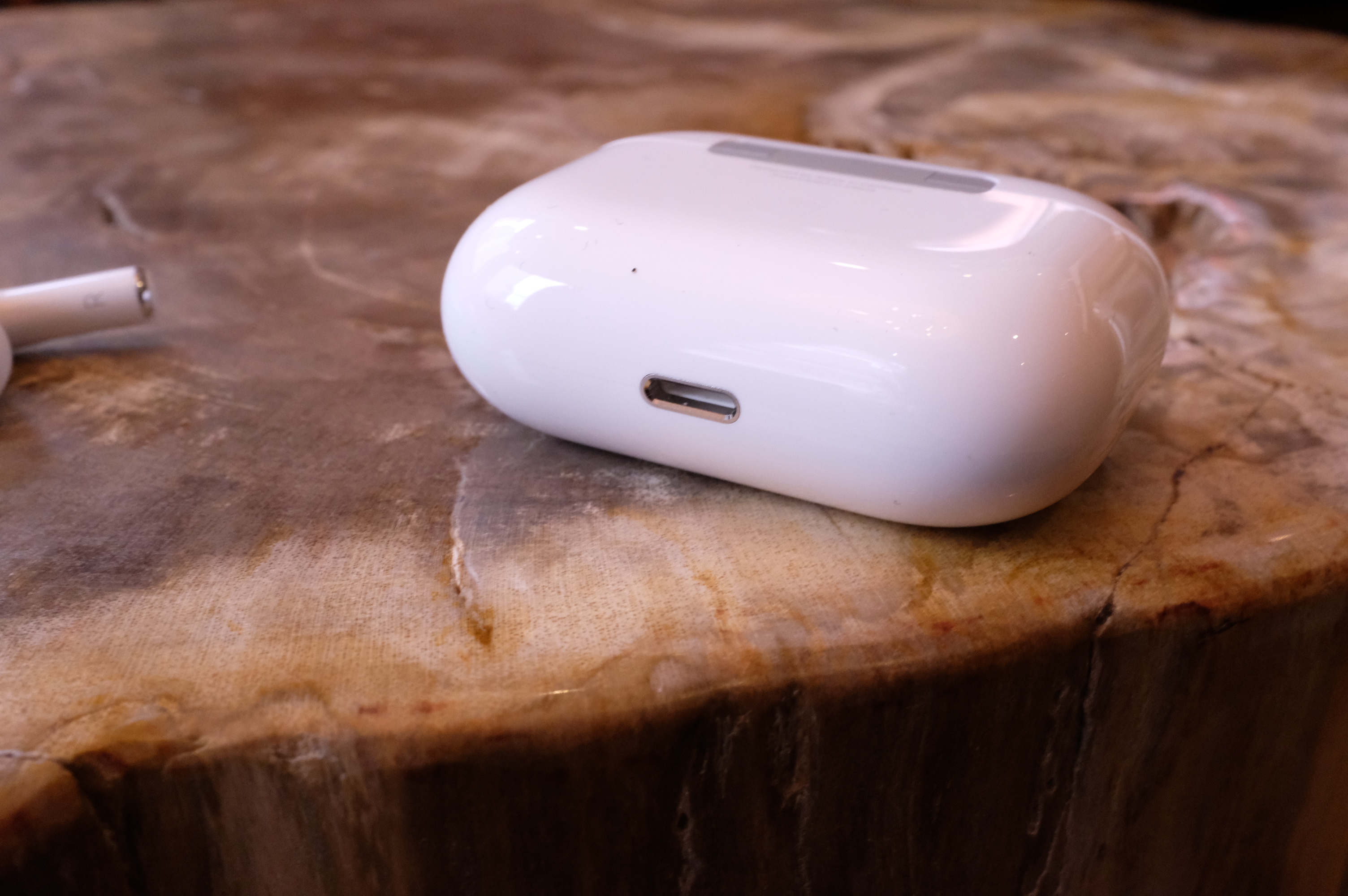
Like the AirPods 2, the case can be charged both through the Lightning port or wirelessly. Tapping the case while charging will light up the LED, which will display as either yellow or green to let you know how far along your are.

So, yeah, thumbs up after half a day. No surprise there, of course. The $250 price tag will almost certainly make these cost-prohibitive for many, but after a few hours, it’s going to be hard to go back.

Look for a longer write up soon.

29 Oct 2019

The slow death of Flash continues as Google begins to remove it from search

The death of Flash has been a long time coming… and a long time going on, too. For years we’ve heard that it’s on its way out, but who among us has not found an errant Flash video or widget in the last month or two? To hasten its demise Google is taking the understandable step of… pretending it doesn’t exist.

Yes, Google Search will stop indexing Flash content starting later this year. Why was it even doing so today, years after any sane webmaster stopped using it? Well, there’s a lot of legacy content out there. Probably Google wanted to give the long tail a chance to curl up.

Deindexing Flash doesn’t mean if you have website that serves it, it’ll be ignored entirely. But any information accessed through that Flash container, like a storefront, video description, game, or what have you will be skipped over by Google’s crawlers.

And if we’re honest, you’ll probably get demoted pretty hard by the algorithm too.

Most people probably won’t notice any change, partly because Flash-serving websites aren’t often very high on the list anyway, and of course the major browsers all block Flash by default. Even Adobe is giving it up.

If you want to play some of those old Flash games, and really some of them were pretty awesome, you’ll still be able to find them if you search directly for them — there are sites collecting them that will want to show up for Google and as such will work to appear prominently in search results for things like “cool old flash games” and the like.

So is Flash dead now? Probably not, but I wouldn’t call what it’s doing living, either. Still, I imagine we’ll get a few more uses out of that top image.

29 Oct 2019

With Sean Rad signed on as co-founder, Good Today launches new tool for company-wide donations

Good Today offers a simple way for people to support a variety of charity organizations: By donating as little as 25 cents a day, supporters get a daily email allowing them to vote for one of two charity organizations, with the day’s donations split based on the votes.

The nonprofit organization, previously known as Good St., has been around for years — I wrote back it back in 2015 — but co-founder Joe Teplow said he’s refocused on it since selling his startup Rebel to Salesforce last year.

This week, Good Today is announcing its new branding, a new product designed specifically for companies and a number of notable figures who have signed up as co-founders/founding board members: Joe Benun, Jeff Dobrinsky, Sean Rad (co-founder and former CEO at Tinder), Guy Oseary (the talent manager who co-founded Sound Ventures with Ashton Kutcher) and Molly Swenson (the RYOT co-founder who’s now chief impact officer at Live nation’s Maverick).

“Generosity is a learned behavior,” Rad told me. “If you think about the importance of waking up every single day, opening that email and learning about another cause, getting out of your own little bubble … very quickly it becomes an addictive habit.”

Rad also noted that these small donations can lead to a deeper engagement over time, as people discover organizations that they might want to support with larger donations or in other ways.

“Over time, we’re going to be more than giving 25 cents a day,” he added. “The idea here is that if we could build a way to donate every single day, you sort of solve the biggest problem in charity as a whole, which is engagement. Once you get engagement loop going, we’re going to be introducing other experiences.”

Good Today has experimented with company-wide giving before, but Teplow said that the product has been designed largely for consumers, and that until now, “If you wanted to bring your company onto the platform, it was a little bit hacky.”

Good Today for Teams is supposed to change that, allowing companies to sponsor their employees’ donations, along with integrating into Slack (where employees can vote for their preferred charity) and providing a dashboard with administrators can track the team’s votes and giving. It’s already being used by more than 20 companies including Shutterstock, Jeffries, Splash and Maverick.

29 Oct 2019

In-space manufacturing could prompt more startups to reach for the stars

Depending on who you ask, space-based technology is past peak hype, at the beginning of its investment growth curve, or in an infrastructure-building phase akin to the railway industry in 1800s America. One emerging technology could change everything for startups and aerospace giants, however — in-space manufacturing.

One of the hard limits of building businesses in space is launching things to space. It’s a difficult problem to overcome, and the cost realities of making it happen are bound to some extent by physics, even with efficiencies made possible by new approaches from companies like SpaceX, Rocket Lab and Blue Origin.

Launching objects from Earth to space doesn’t just carry a financial burden; escaping our gravity and atmosphere is not a gentle process, and there are limits to the fragility, shape and materials that can be used in payloads delivered to orbit on a rocket, even when covered by a protective fairing.

Innovative designs like the spring-style expanding antenna developed by NSLComm for geocommunications satellites can provide workarounds for some of these limitations, but not all. But in-space manufacturing technology currently in development may have the potential to obviate both hard design and launch cost limits.

A number of companies are already developing the capability to build spacecraft, research equipment and advanced hardware in space using components and base materials transferred from Earth (much easier than transporting complex devices) and, potentially, mined locally from asteroids, planetary bodies or even decommissioned and non-functional older satellites.

“We think that in-space manufacturing, specifically, married with lower-cost access to space, along with modern electronics and computing, is the killer foundation that enables us to really break some of the constraints that we put on everything we’ve ever sent to space,” is how Made In Space CEO and President Andrew Rush put it, speaking on stage last week at annual space industry symposium the International Astronautical Congress.

Made In Space, a Mountain View-based company founded in 2010, develops and deploys in-space manufacturing technologies. In 2013, it sent the first-even 3D printer to space to demonstrate the viability of its technology, leveraging that early success into a deal with legacy space giant Northrop Grumman to develop the Archinaut, an in-space, high-precision robotic manufacturing platform which can take on tasks like building complex and highly sensitive telescopes or modify and enhance spacecraft already in orbit.

29 Oct 2019

Big 3 cloud infrastructure earnings reach almost $22B this quarter

Amazon, Microsoft and Google are often referred to as the Big 3 in the cloud infrastructure market, and if you had any doubt about the growth potential of the cloud, take a look at this quarter’s eye-popping revenue numbers from these three companies, which reached almost $22 billion this earnings’s season.

Before we get into each company’s specific numbers, it’s important to note that it’s difficult to get a firm grip on what the cloud numbers actually mean and what each company includes in that cloud revenue category. What’s more, this quarter Google didn’t even report specific cloud revenue, so we are left to rely on comments from July.

It’s also important to note that we are talking about the cloud infrastructure, not SaaS revenue, so Microsoft earned additional money from their SaaS business, but Google combines SaaS and infrastructure into a single number.

That said, we have a rough idea and we know the market is growing. Consider that based on last year’s earnings reports that revenue has grown from around $16 billion to around $22 billion in just one year for these Big 3. In fact, Synergy Research reports that the entire market is on $100 billion run rate for the first time this month.

AWS

GettyImages 1134206845

Photo: Budrul Chukrut/SOPA Images/LightRocket via Getty Images

Let’s start with AWS. They have the purest numbers when it comes to the cloud market, and they have the largest chunk of marketshare by far. Most analysts peg them at around 33 percent or so, well ahead of any other player on the market.

Amazon reported revenue of almost $9 billion this month, putting it on a run rate of almost $36 billion. Not bad for a side business for the main Amazon e-commerce site. Amazon’s overall growth rate dropped from around 45% to around 35%, but as John Dinsdale from Synergy Research points out, that’s still a good rate, and it becomes much harder to sustain large growth numbers the bigger you get.

Microsoft

GettyImages 1134203505

Photo: Budrul Chukrut/SOPA Images/LightRocket via Getty Images

Microsoft had a good week. It reported Intelligent Cloud earnings of around $11 billion, and it was awarded the Pentagon’s $10 billion, decade long JEDI cloud contract. The company is in second place in terms of marketshare with around 16%.

Like Amazon, Microsoft saw its cloud growth slow a bit, down to 59% compared with 76% a year ago, but it faces a similar challenge to Amazon, even though it has half the marketshare. It’s scaling so quickly that it can’t really maintain that growth pace it’s been on, according to Dinsdale. “To be at the scale that Azure has achieved and to be still growing at around 60% per year is impressive. Sure the growth rate is nudging down but that is entirely to be expected for a business that has rapidly grown,” he told TechCrunch.

It’s important to point out that Intelligent Cloud includes much more than Azure including SQL Server, Windows Server, Visual Studio, consulting and support.

Google

GettyImages 1133079209

Photo: Budrul Chukrut/SOPA Images/LightRocket via Getty Images

Finally we have Google. It has far less marketshare than Amazon or Microsoft, somewhere around 8%, still in the single digits, but growing fast. The company brought on former Oracle executive Thomas Kurian to replace Diane Greene at the end of last year to help drive growth at the cloud division.

In July, at the company’s earnings report, Google CEO Sundar Pichai reported that the company was on an $8 billion run rate, or $2 billion a quarter. To put that into perspective, the company’s cloud revenue had doubled in 18 months. It’s important to note however that figure includes both Google’s infrastructure services and its commercial SaaS tools like G Suite. It probably ticked up this week, but Google wasn’t sharing specific numbers this time.

While it’s always been difficult to compare cloud numbers, we have a good sense of how each of the Big 3 is doing overall. One thing is clear: this is not a fixed pie. The cloud market is still growing rapidly, and all three companies are taking advantage.

29 Oct 2019

Samsung teases a clamshell foldable form factor

Last year at its developer conference, Samsung showed off an early glimpse of its upcoming foldable. In hindsight, the Galaxy Fold’s roll out could have gone more smoothly, but sometimes first gen products go that way, I suppose. At very least, it’s clear that the company won’t let a rocky start stand between it and broader foldable phone ambitions.

On stage at this year’s event, the company showed off another take on the foldable display. A video shows the Galaxy Fold form factor morphing into a clamshell more akin to traditional dumb phones.

Unlike last year’s event, this one shouldn’t be taken as a pre-product announcement. Rather, the company says it’s “explor[ing] a range of new form factors in the foldable category.” It’s something that’s been pretty clear from the outset: these earliest days of foldable are very much about seeing which form factors click. Samsung is currently working with developers to explore these concepts.

This latest is more in line with leaks we’ve seen of the rumored Motorola Razr reboot, with an elongated screen that can easily be folded up and stashed away in a pocket. Perhaps we’ll get more insight into the company’s plans as CES or MWC.

Perhaps.

29 Oct 2019

Samsung teases a clamshell foldable form factor

Last year at its developer conference, Samsung showed off an early glimpse of its upcoming foldable. In hindsight, the Galaxy Fold’s roll out could have gone more smoothly, but sometimes first gen products go that way, I suppose. At very least, it’s clear that the company won’t let a rocky start stand between it and broader foldable phone ambitions.

On stage at this year’s event, the company showed off another take on the foldable display. A video shows the Galaxy Fold form factor morphing into a clamshell more akin to traditional dumb phones.

Unlike last year’s event, this one shouldn’t be taken as a pre-product announcement. Rather, the company says it’s “explor[ing] a range of new form factors in the foldable category.” It’s something that’s been pretty clear from the outset: these earliest days of foldable are very much about seeing which form factors click. Samsung is currently working with developers to explore these concepts.

This latest is more in line with leaks we’ve seen of the rumored Motorola Razr reboot, with an elongated screen that can easily be folded up and stashed away in a pocket. Perhaps we’ll get more insight into the company’s plans as CES or MWC.

Perhaps.

29 Oct 2019

Walmart and Green Dot to jointly establish a new fintech accelerator, Tailfin Labs

Walmart announced today an expansion of its existing relationship with financial services provider Green Dot, which will continue to serve as the issuing bank and program manager for the Walmart MoneyCard program for another seven years. The two companies also agreed to partner on the creation of a new fintech accelerator which focuses on the intersection of retail and consumer financial services.

The accelerator, called Tailfin Labs, will help startups develop solutions that integrate omni-channel shopping and fintech, which can be aimed either at consumers or businesses. These may involve products built on top of Green Dot’s “Banking-as-a-Service” (BaaS) platform.

“Green Dot is extremely proud and honored to both extend our MoneyCard partnership for many years and to additionally enter into an entirely new equity partnership with Walmart in the creation of a fintech accelerator,” said Steve Streit, Founder and CEO, Green Dot, in a statement. “We believe the combination of Walmart’s unmatched retail ecosystem with Green Dot’s innovative and highly flexible BaaS platform, which enables the world’s largest technology and consumer brands to address their consumers with bespoke financial products and services, has the opportunity to create and bring to market many new and exciting innovations over the years to come.”

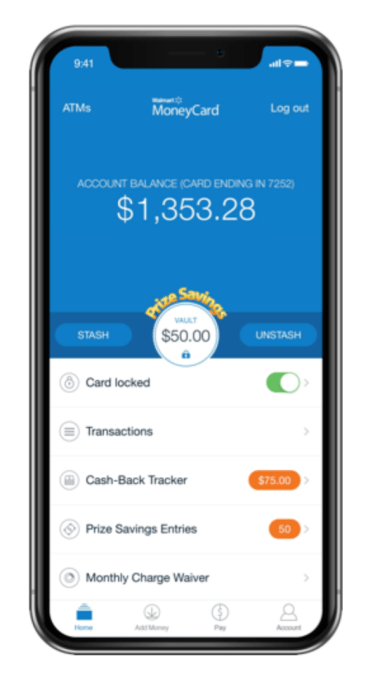
walmart money cardWalmart partnered with Green Dot in 2006 to create the Walmart MoneyCard which offers FDIC-insured accounts and cash-back rewards on Walmart purchases, alongside other features like early direct deposit, online bill pay, prize savings entries, and more — as well as the usual set of features you’d have in a personal checking account, but without the fees. It’s now the largest retailer exclusive prepaid account program in the U.S.

In many ways, it was also a precursor to the sort of mobile banking startups seen today, which directly target consumers with similar products.

This is a busy space these days, as more companies go after the growing market of millennials (and even their younger Gen Z counterparts) who don’t want a traditional bank. Instead, they want banking services in a modern, easy-to-use mobile interface, where innovative features help them to better save and manage their money.

Just last week, for example, mobile banking app Current just snagged $20 million more in funding for its service, now used by half a million users. Others in the space include Step, Cleo, N26, Chime, Simple, and Stash, to name a few.

The new accelerator is seemingly poised to capitalize on this trend, while also giving Walmart and Green Dot a new foothold in the market.

“Over the years, Walmart has brought to market many innovative industry-defining financial services offerings to serve our customers – including several introduced through the Walmart MoneyCard program managed by Green Dot,” noted Daniel Eckert, Senior Vice President, Walmart Services and Digital Acceleration, in an announcement. “With this expanded relationship, and by leveraging Walmart’s footprint and existing offerings with Green Dot’s cutting-edge capabilities, we’ll be uniquely positioned to offer an unmatched set of customer experiences that sit at the nexus of omni-channel retail and tech-enabled financial services,” he said.

The new agreement between Green Dot and Walmart begins Jan. 1, 2020 and will replace the agreement that would have otherwise expired in May 2020.


29 Oct 2019

Registration is open for TC Sessions: Robotics + AI 2020

It’s time to get your robotics fix, startup fans. That’s right, TC Sessions: Robotics & AI returns to UC Berkeley’s Zellerbach Hall on March 3, 2020. Join us for a day-long deep-dive focused on the intersection of robotics and AI — arguably two of the most exciting and world-changing technologies.

Registration is now open. Save the date and save $100 when you buy an early bird ticket to TC Sessions: Robotics & AI 2020. Want to save even more? Buy in bulk. You’ll save an extra 18% when you purchase four or more tickets at once.

This is our fourth year hosting this event and last year, 1,500 founders, technologists, engineering students and investors heard TechCrunch editors interview top leaders in AI and robotics, participated in workshops, watched live demos, attended speaker Q&As and enjoyed world-class networking. With so many advances in a range of technologies like AI, GPUs, sensors (to name just a few), it’s an exciting time to be part of this rapidly evolving space.

We’re building out the speaker roster and agenda, so keep checking back. In the meantime, take a look at last year’s agenda to get a sense of the quality programming you can expect.

Boston Dynamics founder Marc Raibert, a perennial favorite at TC Sessions: Robotics & AI, offers this perspective on the conference. It “blends the best of thoughtful, research-focused robotics with a unique business in technology focus.”

TC Sessions: Robotics & AI takes place on March 3, 2020 at UC Berkeley’s Zellerbach Hall. It’s not too early to save the date, and it’s never too early to save $100 on the price of admission. Join the top people in robotics and AI for a full day devoted to world-changing technologies.

Is your company interested in sponsoring or exhibiting at TC Sessions: Robotics & AI 2020? Contact our sponsorship sales team by filling out this form.