Year: 2019

29 Oct 2019

This is the gig worker ballot initiative Uber, Lyft and DoorDash are backing

A group of Lyft, Uber and DoorDash drivers are announcing a statewide ballot measure for the November 2020 ballot this morning in Sacramento. Called the Protect App-Based Drivers & Services Act — funded by Uber, Lyft and DoorDash — the measure aims to ensure drivers and couriers can continue to be independent contractors with flexible work hours.

The ballot measure looks to implement an earnings guarantee of at least 120% of minimum wage while on the job, 30 cents per mile for expenses, a healthcare stipend, occupational accident insurance for on-the-job injuries, protection against discrimination and sexual harassment, and automobile accident and liability insurance.

This initiative is a direct response to the legalization of AB-5, the gig worker bill that will make it harder for the likes of Uber, Lyft, DoorDash and other gig economy companies to classify their workers as 1099 independent contractors.

“The new law could take this flexibility away – potentially eliminating hundreds of thousands of work opportunities and forcing app-based drivers into rigid employment schedules whether they prefer it or not,” the group wrote in a Q&A. “Furthermore, if rideshare and delivery drivers are forced to be classified as employees with set shifts, it could significantly limit the availability and affordability of these on-demand services that benefit consumers, small businesses and our economy.”

However, as driver and protest organizer Annette Rivero previously told TechCrunch’s Greg Epstein, “AB5 doesn’t take away anybody’s flexibility, it’s the companies that take away the flexibility. Because I know that that’s something that everyone’s stuck on right now, and it’s a lie. There’s no truth to it.”

In August, Uber, Lyft and DoorDash each put $30 million toward this ballot initiative. Following the passage of AB-5, Uber Chief Legal Officer Tony West said Uber would be willing to put additional money toward the initiative, and plans to keep defending its worker model.

On the other side of this battle is Gig Workers Rising, an organization with hundreds of gig workers who have consistently demanded better pay, workplace protections and driver-led unions.

“This is yet another example of corporations and billionaires trying to exempt themselves from the democratic process by using wealth and fear tactics,” Gig Workers Rising organizer and driver Edan Alva said in a statement. “For years, these companies have refused to pay drivers fairly or treat us with respect. After working 80 hour weeks, sleeping in our cars and surviving on poverty wages, drivers organized and won support for AB5 from both the public and lawmakers. Now, instead of obeying the law, Uber, Lyft and Doordash want to spend $90 million to avoid accountability – all while claiming it will “protect” drivers. Uber and Lyft were nowhere to be found for the past many years when drivers like me needed healthcare or basic labor protections. We call on the people of California to resist the corporate lies, to stand with drivers and against the billionaires.”

Coming up next week, Gig Workers Rising along with other organizations are protesting outside the homes of those who will cash out from Uber’s IPO.

I’ve reached out to Uber, Lyft and DoorDash and will update this story if I hear back.
29 Oct 2019

Google brings its ‘.new’ domains to the rest of the web, including to Spotify, Microsoft & others

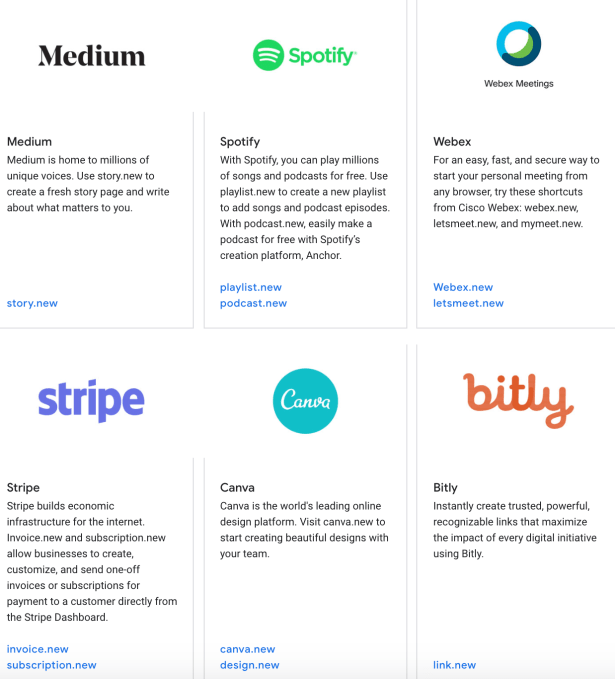
A year ago, Google rolled out “.new” links that worked like shortcuts to instantly create new Google documents. For example, you could type “doc.new” (without the quotes) to create a new Google Doc or “sheet.new” to create a new spreadsheet. Today, Google is bringing the .new shortcuts to the rest of the web. Now, any company or organization can register their own .new domain to generate a .new shortcut that works with their own web app. Several have already done so, including Microsoft, which now has “word.new” to start a new word document, or Spotify, who has “playlist.new” to start adding songs to a new playlist on its streaming app.

Screen Shot 2019 10 29 at 10.24.01 AMThe domains are designed to get users straight the action. That is, instead of having to visit a service, sign in, then find the right menu or function, they could just start creating.



However, some of today’s new domains aren’t quite as seamless as Google’s own. Because most Google Docs users are already signed into to Google, it’s easy to jump right to creating a new online document.

But other services aren’t used as often. That means Medium’s “story.new” doesn’t let you immediately start writing your blog post, unless you’re already signed in to Medium. If not, it drops you on a “Join Medium” sign-up page instead. This doesn’t make it necessarily any easier to use Medium — a better use case would have allowed the user to just start writing, saving their text under a temporary account, then prompt them to join Medium upon exit or clicking “publish.”

Meanwhile, Microsoft’s Word.new, a direct rival to Google’s own doc.new, isn’t yet resolving.

Other participants include sell.new (eBay), canva.new and design.new (Canva), reservation.new (OpenTable), webex.new and letsmeet.new (Cisco WebEx meeting room creation), link.new (Bit.ly), invoice.new (Stripe’s dashboard), api.new (launch new Node.js API endpoints from RunKit), Coda.new (Coda), music.new (create personalized song artwork for OVO Sound artist releases and more), and repo.new (GitHub.)

Spotify also picked up podcast.new, which takes you to Anchor, in addition to playlist.new.

Considering the lineup, it’s clear that there’s not as much of a gold rush for these action-based domains as they are for other top-level domains. There are some fun use cases, like Spotify’s, and practical ones like Word.new, but others are less compelling because they drop you on sign up/sign in pages as they’re not everyday services.

And some are just odd land grabs. Like Ovo Sound, the record label founded by Drake, which snagged “music.new” — a domain that you would think would go to a larger streaming service. (In fact, it’s somewhat surprising that Google’s own music service, YouTube Music, didn’t grab that one for itself.)

Screen Shot 2019 10 29 at 10.31.11 AM

Google says any company can register these domains, all of which are secured over HTTPS connections like .app, .page., and .dev domains are.

Through January 14, 2020, trademark owners can register their trademarked .new domains. Starting December 2, 2019, anyone can apply for a .new domain during the Limited Registration Period.

29 Oct 2019

LA-based gaming studio Scopely raises $200 million at a $1.4 billion valuation

The Los Angeles-based mobile game development studio Scopely has become America’s newest unicorn thanks to a $200 million financing which values the company at a whopping $1.4 billion.

Scopely said it would use the capital to continue its strategy of developing and acquiring new games as it looks to continue its run of six consecutive mobile games that will gross $100 million or more in lifetime revenue.

The new investment follows Scopely’s milestone of achieving more than $1 billion in lifetime revenue. Games in the company’s portfolio include: Looney Tunes World of Mayhem and Star Trek Fleet Command, created with the recently acquired DIGIT Game Studios.

Indeed, part of the reason for the financing is to accelerate the pace of its acquisitions and investments into new game development studios, according to chief executive, Walter Driver .

“The barrier to entry from independent studios is to find product-market fit,” says Driver. “Increasingly, it’s helpful for them to have publishing capabilities that are more global in nature and more scaled.”

The unicorn gaming company has amassed increasingly larger rounds over the past three years on a nearly annual basis. The company raised a $55 million round of financing in 2016, $60 million in 2017 and $100 million in 2018.

For investors, what makes the company compelling (beyond its string of successful games) is the technology platform that undergirds its popular mobile gaming titles. “What the company allows you to do is look at engagement and alter a game midstream to tailor the experience,” says Ravi Viswanathan, the founder and managing partner of NewView Capital .

NewView, a growth stage venture capital firm spun out of the multibillion dollar investment firm NEA, led the most recent $200 million round for Scopely.

Scopely is the firm’s first major investment in a gaming company and was part of a portfolio of investments that NewView took over when it spun off from NEA.

For Scopely, the latest capital infusion is just more money in the bank to invest in or acquire budding game studios and give them access to the technology stack that has made Scopely so compelling, according to Driver.

“Our technology platform is about optimizing free digital experiences for the largest amount of players possible,” Driver says. “We’re primarily focused on finding the most passionate and talented game developers that want to specialize in making the kind of game design and might have the kind of specialized expertise that we admire.”

In the eight years since Scopely first launched the gaming industry has been transformed by the opportunities that exist in the mobile market — and both Scopely and companies like Jam City have capitalized on the new platform.

“We see the future of gaming as free live services that give users choice and agency of how they want to play,” says Driver. “Being able to refine those live services over time and react to the data that you’re seeing and optimize those products,” has been at the core of Scopely’s technology stack.

The company is already raking in more than $400 million in annualized revenue and it was that growth that convinced NewView and investors like the Canadian Pension Plan Investment Board to commit capital as part of this latest round.

Scopely has already made a few select minority investments in gaming studios and with the new cash, Driver hopes to roll up more independent game developers.


29 Oct 2019

Datameer announces $40M investment as it pivots away from Hadoop roots

Datameer, the company that was born as a data prep startup on top of the open source Hadoop project, announced a $40 million investment and a big pivot away from Hadoop, while staying true to its big data roots.

The investment was led by existing investor ST Telemedia . Other existing investors including Redpoint Ventures, Kleiner Perkins, Nextworld Capital, Citi Ventures and Top Tier Capital Partners also participated. Today’s investment brings the total raised to almost $140 million, according to Crunchbase data.

Company CEO Christian Rodatus says the company’s original mission was about making Hadoop easier to use for data scientists, business analysts and engineers. In the last year, the three biggest commercial Hadoop vendors — Cloudera, Hortonworks and MapR — fell on hard times. Cloudera and Hortonworks merged and MapR was sold to HPE in a fire sale.

Starting almost two years ago, Datameer recognized that against this backdrop, it was time for a change. It began developing a couple of new products. It didn’t want to abandon its existing customer base entirely of course, so it began rebuilding its Hadoop product and is now calling it Datameer X. It is a modern cloud-native product built to run on Kubernetes, the popular open source container orchestration tool. Instead of Hadoop, it will be based on Spark. He reports they are about two-thirds done with this pivot, but the product has been in the hands of customers.

The company also announced Neebo, an entirely new SaaS tool to give data scientists the ability to process data in whatever form it takes. Rodatus sees a world coming where data will take many forms from traditional data to Python code from data analysts or data scientists to SaaS vendor dashboards. He sees Neebo bringing all of this together in a managed service with the hope that it will free data scientists to concentrate on getting insight from the data. It will work with data visualization tools like Tableau and Looker, and should be generally available in the coming weeks.

The money should help them get through this pivot, hire more engineers to continue the process and build a go-to-market team for the new products. It’s never easy pivoting like this, but the investors are hoping that the company can build on its existing customer base, while taking advantage of the market need for data science processing tools. Time will tell if it works.

29 Oct 2019

WeFarm rakes in $13M to grow its marketplace and network for independent farmers

Huge networks like Facebook and LinkedIn have a huge gravitational force in the world of social media — the size of their audiences make them important platforms for advertising and those who want information (for better or worse) to reach as many people as possible. But alongside their growth, we’re seeing a lasting role for platforms and networks focused on more narrow special interests, and today one of them — focused on farmers, of all communities — is picking up a round of funding to propel its growth.

WeFarm, a marketplace and networking site for small-holder farmers (that is, farms not controlled by large agribusinesses), has raised $13 million in a Series A round of funding, with plans to use the money to continue adding more users — farmers — and more services geared to their needs.

The round, which brings the total raised by the company to a modest $20 million, is being led by True Ventures, with AgFunder, June Fund; previous investors LocalGlobe, ADV and Norrsken Foundation; and others also participating.

WeFarm today has around 1.9 million registered users, and its early moves into providing a marketplace — helping to put farmers in touch with local suppliers of goods and gear such as seed and fertilizers — generated $1 million in sales in its first eight months of operations, a sign that there is business to be had here. The startup points out that this growth has been, in fact, “faster… than both Amazon and eBay in their early stages.”

WeFarm is based out of London, but while the startup does have users out of the UK and the rest of Europe, Kenny Ewan, the company’s founder and CEO, said in an interview that it is seeing much more robust activity and growth out of developing economies, where small-scale agriculture reigns supreme, but those working the farms have been massively underserved when it comes to new, digital services.

“We are building an ecosystem for global small scale agriculture, on behalf of farmers,” Ewan said, noting that there are roughly 500 million small scale farms globally, with some 1 billion people working those holdings, which typically extend 1.5-2 hectares and often are focused around staple commercial crops like rice, coffee, cattle or vegetables. “This is probably the biggest industry on Earth, accounting for some 75-80% of the global supply chain, and yet no one has built anything for them. This is significant on many levels.”

The service that WeFarm provides, in turn, is two-fold. The network, which is free to join, first of all serves as sounding board, where farmers — who might live in a community with other farmers, but might also be quite solitary — can ask each other questions or get advice on agricultural or smallholding matters. Think less Facebook and more Stack Exchange here.

That provided a natural progression to WeFarm’s second utility track: a marketplace. Initially Ewan said that it’s been working with — and importantly, vetting — local suppliers to help them connect with farmers and the wider ecosystem for goods and services that they might need

Longer term, the aim will be to provide a place where smallholding famers might be able to exchange goods with each other, or sell on what they are producing.

In addition to providing access to goods for sale, WeFarm is helping to manage the e-commerce process behind it. For example, in regions like Africa, mobile wallets have become de facto bank accounts and proxies for payment cards, so one of the key ways that people can pay for items is via SMS.

“For 90% of our users, we are the only digital service they use, so we have to make sure we can fulfil their trust,” Ewan said. “This is a network of trust for the biggest industry on earth and we have to make sure it works well.”

For True and other investors, this is a long-term play, where financial returns might not be as obvious as moral ones.

“We are enormously inspired by how Kenny and the Wefarm team have empowered the world’s farmers, and we see great potential for their future,” said Jon Callaghan, co-founder of True Ventures, in a statement. “The company is not only impact-driven, but the impressive growth of the Wefarm Marketplace demonstrates exciting commercial opportunities that will connect those farmers to more of what they need to the benefit of all, across the food supply chain. This is a big, global business.”

Still, given the bigger size of the long tail, the company that can consolidate and manage that community potentially has a very valuable business on its hands, too.

29 Oct 2019

Venmo launches a rewards program offering up to 5% back at Target, Sephora, Dunkin’ & Wendy’s

Amid increased competition in the digital payments space, Venmo today announced its first-ever rewards program, Venmo Rewards, which will allow users to earn automatic cash back on purchases when they pay with their Venmo card at select retailers. The company is kicking off the program with limited-time cash back deals, including 5% back at Target, 5% back at Sephora, 4% back at Dunkin’, 5% back and Wendy’s and more.

The cash back earned through the program is deposited directly into your Venmo account, so you can use the funds to pay friends through the Venmo app, make Venmo card purchases, pay merchants that accept Venmo, or you can transfer the money to your linked bank account or debit card.

Users will also be able to track their Rewards in a dedicated section of the Venmo mobile app, where they can see what they’ve earned on each of their eligible purchases. They then can opt to share their rewards earned in the Venmo feed.

Similar to how credit card offers come and go, Venmo Rewards cash back deals will also expire at some point, as new ones arrive to take their place. Venmo cardholders will be able to check in on the current offers available to them at any time by visiting their card settings in the Venmo app.

The launch of a Rewards program comes at a time when Venmo is facing increased competition in the digital payments space. Though originally a peer-to-peer money transfer service, Venmo added a debit card last year that allows users to spend their Venmo balance out in the real world, while still taking advantage of features like splitting bills and the social feed, which helped popularize the service among a younger demographic. Recently, Venmo announced plans to offer a credit card, as well.

Today, users don’t necessarily reach for a Venmo card at point-of-sale, however.

They may prefer to use a card where they’ll get airline miles or a retailer’s store card, where they get a discount on the sale itself and/or loyalty points. Apple’s new credit card is also growing in popularity for those who like a cash back option, as it offers up to 3% back which is then stored directly on your Apple Cash card — the seamless transfer between the two made possible by the deep integration Apple allows for its own products.

In order to keep users participating in the Venmo ecosystem, the company needs to find new ways to encourage the use of its card, too.

Venmo Rewards will begin to roll out starting next week, Venmo says.

29 Oct 2019

Amazon Echo Buds review

It’s a wonder that Echo Buds didn’t arrive sooner. Earbuds (I still can’t write “hearables” without cringing a bit) are the clearest path to making Alexa work outside of the home. Amazon, after all, has been unable to crack the smartphone category. Half a decade later, the Fire Phone is little more than a historical curiosity, while Google and Apple have had massive mobile footprints to spread their smart assistants. 

Amazon has dabbled in mobile, with a downloadable Alexa app and Fire Tablet functionality. Last year, the company announced the Alexa Mobile Accessory Kit, which is designed to bring the AI to more devices. Certainly it makes sense as a third-party partner for companies that don’t have the resources or desire to develop their own assistant. The latest Fitbit Versa might be the best example of such an alliance.

From a pure user experience standpoint, however, headphones are the most logical conduit. They’re positioned closest to the mouth for voice commands via microphone and, obviously, offer a direct route into the ear for Alexa responses. In waiting to see how the market shakes out, the company has ceded potential market share.

DSCF8408

There’s a lot about the Echo Buds that would have made them an excellent addition to the category two or three years ago. But the category is among the fastest moving in consumer electronics. Samsung, Sony and Apple/Beats all have excellent offerings, and Amazon opening up Alexa to hardware companies has all but assured that third-party products from companies will eclipse the Echo Buds shortly.

The company does get some things right on its first go. If there’s one thing the Echo Buds really have going for them, it’s customization. For the earbuds themselves, that means not only the customary replaceable silicone tips, but also wings to help them stay in place in the ear. I’ve never been a fan of the hard plastic wings, but the soft silicone covers that slip over the buds are a nice touch.

They’re available in three sizes, so you should be able to find a decent fit. Once everything is in place, the buds should form a nice seal to keep sound in and unwanted ambient noise out. For my money, though, the PowerBeats Pro are still the best on the market when it comes to fit. The over-the-ear design keeps them from straining your ears after an extended period. Amazon’s solution is fairly elegant, as well.

The rest of the customization — and just about everything else, for that matter — is done in the app. Without its own operating system, the Echo Buds don’t have quite the same out of the box pairing experience as first-party Apple or Android headphones. That said, once you’ve downloaded the app, pairing is painless. For those who have other Echo devices, there’s probably something to be said for having all of your Echo devices in a single spot.

DSCF8411

From here, you can customize the touch gestures. By default, a double tap on the left or right ear toggles between active noise reduction (not full-on cancelation) and pass-through modes, while pressing and holding fires up Alexa. The nice thing about this is the ability to reduce accidental triggers. That’s probably my biggest complaint with the Galaxy Buds — the slightest adjustment triggers the touch. The app also offers a built-in equalizer, with sliders for bass, mid and treble, along with a five-level slider for the pass-through ambient mode.

The sound isn’t bad for the price, once you’ve got a nice seal and a the settings to your liking. Sony’s spring to mind both for the quality of the audio and the active noise canceling, but they’re priced at nearly double Amazon’s. I suppose we’ll be able to compare it to Apple’s in the near future, but again, pricing is a major consideration. I like the idea of pass through mode more than the actual implementation. The concept is a nice one — the ability to let in your surroundings. The ambient sound feature leans a little too heavily on the microphones. I wouldn’t recommend having it anywhere above a one out of four. Things like an AC unit were amplified to a point that was overwhelming.

DSCF8414

Alexa, meanwhile, is still very much a home assistant, but Amazon should be building upon that as it makes a more aggressive push. This early implementation was a little buggy in the first go. Asking for the news, Alexa had trouble connecting to NPR, and instead just gave me the weather. Trying to get the assistant to fire up noise reduction with my took a couple of goes, but in both cases, I eventually got them to work. On a whole, however, the microphone did a good job recognizing commands. 

The design of the buds themselves is fairly generic, but that’s perfectly fine. The charging case, meanwhile, is a pretty reasonable size, somewhere between the AirPods’ little dental floss case and the massive PowerBeats Pros. It’s small enough to carry around in your pocket — one of my biggest issues with Beats’ otherwise terrific earbuds. The materials are certainly on the cheap size, and the inclusion of a microUSB slot in 2019 certainly gives the industry of a company working hard to keep prices down. 

At $130, they’re priced $30 less than the standard AirPods 2. Amazon would have done well to go all in on pricing here — $99 would have been a really solid sweet spot for the company — well below other premium earbuds. That’s still a decent premium over off-brand buds, but a familiar name — and assistant — would surely carry some weight with Amazon shoppers. And given that much of the market has settled at between $150 and $250, they’re a downright deal by comparison. 

DSCF8416

Amazon will almost certainly sell plenty, and knowing Amazon, we may see some decent discounts around the holidays. And hey, with Apple’s recent announcement of $249 AirPod Pros, that $130 price tag just got a whole lot more appealing.

29 Oct 2019

CampusReel uses GenZ’s obsession with video to help them choose a college

One of the toughest and earliest decisions many people make as an adult is where to spend thousands of dollars on a degree. Identifying a college or university with the right culture, campus, community and course of study for you can be a lot, especially with the resources provided on most University websites. The alternative is to spend even more to go visit those colleges IRL.

That’s where CampusReel comes in.

CampusReel quietly went live last year with a plan to deliver a real campus tour experience to applicants right from their computer or phone. The platform lets student ambassador create their own tour videos, which are then vetted and uploaded to CampusReel for consumption by applicants.

At launch, CampusReel was paying out ambassadors for their videos. But as the platform has grown, the company has shifted from paid content to a model that relies on the popularity of the platform to attract content creators, rather than cash.

Meanwhile, the startup has developed an API that can be used by other organizations, such as test prep companies, college counseling companies, and the colleges themselves.

Since launch, CampusReel users have generated a library of more than 17,000 searchable videos across 350 colleges and universities. On the applicant side, CampusReel has been used by more than 4,000 high schools and college counselors.

But the API above all represents CampusReel’s growth opportunity. It powers video within eight top college search tools and receives more than 1 million content requests per month.

The founders say one of the greatest challenges to the company is balancing the speed of their relatively lean startup — there are seven people working on the team full time — with the pace of bigger, less agile organizations like universities.

“The biggest challenge is dealing with the sales cycles on the B2B side, especially with colleges who tend to be very slow,” said cofounder and CEO Nick Freud. “We pride ourselves on how quickly we’re able to move, and the organizations we work with are super liberal and forward thinking in the values they promote, but that’s not how they conduct business.”

CampusReel has raised a small amount from a dedicated group of friends and family, and does not have interest in taking traditional VC money. The company declined to disclose their total amount of funding.

29 Oct 2019

Webiny announces $347K seed to build open source serverless CMS

Webiny, a London startup developing a serverless content management system, announced a $347,000 (£247,000) seed round today led by EU investment firm Episode 1.

Webiny founder Sven Al Hamad says that Webiny is the first full-feature content management built for a serverless environment. “That means that we built Webiny from the ground up, and architected it so it works only inside serverless functions,” he said.

The company saw a need for a serverless web development tool, and decided to build it. “We believe that centralized is going to be the future of web development, and to help out the community and advance that thought, we built the first serverless content management system — and open sourced it,” Al Hamad said.

Serverless doesn’t mean there are no servers. What it means is that developers don’t have to worry about the infrastructure resources. The cloud provider takes care of all that based on whatever is required, scaling up and down automatically.

As Al Hamad sees it, web sites are a perfect use case for this. He uses the classic Black Friday e-commerce scenario as an example. On Black Friday, commerce websites get inundated with traffic as people try to take advantage of the big sales. In this case, the cloud service just continues to add server capacity automatically based on the needs, rather than having to provision extra servers manually, and they go away automatically when the demand is gone.

He says this has a couple of advantages. It reduces the need for a big DevOps team to manage the operations side of things to provision all those virtual machines, and it frees up developers to concentrate on building a great website instead of worrying about the resources to run it.

“At the end of the day developers can build new things much, much faster like building the website or adding new features because he or she doesn’t need to waste time on spinning up servers just to test things or worrying about networking, load balances and all those complexities,” he said.

For now, the company is concentrating on building a community of users, but eventually the business will provide consulting and support services for companies who need it.

The content management system is the underlying software that manages a website. Some popular open source examples include WordPress and Drupal.

Al Hamad says the idea for his company sprang up out of a need. He was running a web design and development agency. He said he tried every web CMS under the sun and he just never found one that met all of his requirements. So he closed the shop and decided to build his own and Webiny was born.

29 Oct 2019

Lyft replaces pricey All-Access monthly plan with Lyft Pink

When Lyft unveiled its All-Access plan in last year, many were taken aback by the hefty price of $299 per month. Now, Lyft is ditching that plan and replacing it with Lyft Pink, which costs just $19.99. The perks of the membership differ, but this lower price point will likely prove to be much more of a win-win for Lyft and its riders.

Lyft Pink gets you 15% off on all car rides, three free bike or scooter rides per month, priority airpot pickups, surprise offers and upgrades, relaxed cancellations, waived lost and found fees and other exclusive partnership benefits.

The All-Access plan took a different approach, offering 30 rides — up to $15 per ride — per month. Those who subscribed to All-Access will soon receive an enrollment offer for Lyft Pink.

Uber also offers a couple of subscriptions — Eats Pass for unlimited free Eats deliveries and Uber Pass for discounted and surge-free rides, free Eats deliveries, as well as free bike and scooter rides. Uber Pass costs $24.99 per month.

Lyft is taking names via its waitlist today and plans to start rolling out the memberships until it’s fully available throughout the U.S. later this year.