Year: 2019

29 Oct 2019

Become scores $12.5M Series A for its business lending marketplace

Become, the Israeli startup that operates a business lending marketplace to give SMBs more funding options, has closed $10 million in Series A investment. In addition, the company — formerly known has Lending Express — has raised $2.5 million in venture debt.

The round is led by Benson Oak Ventures and Magenta Venture, with participation from RIO Ventures Holdings, iAngels, and Entrée Capital. The debt funding is provided by Viola Credit.

Claiming that the small business lending landscape is “fundamentally flawed,” with 58% of SMBs denied access to funding, Become’s platform uses technology to give each business a “LendingScore” based on how fundable its algorithms think it is. This is supported by a personalised plan and monitoring system to help SMBs become more transparent and therefore viable to lenders.

The Become marketplace then allows multiple lenders to offer tailored offers to the businesses registered on the platform and compete for an SMB’s custom. “This gives each SMB the power to compare and choose the loan that’s right for them, directly from Become’s platform,” says the fintech.

“The lending sector is fundamentally flawed, with many SMBs unable to get loans,” explains Become founder and CEO Eden Amirav. “The process of applying for a loan is often time consuming and confusing, and big bank approval rating sits at just 27.5%”.

To compound this, he says that the lending market is fragmented, consisting of hundreds of alternative lenders, and SMBs don’t know which to choose. “Without the tools to navigate, many end up contacting the wrong lender. There may be some lenders, for example, that have a better loan product or rate that better suits their business.
Finally, the lack of transparency throughout the process leaves SMBs completely in the dark. If denied funding, SMBs don’t know exactly why or how to qualify”.

To remedy this, Become lets SMBs view all of funding options in a single place so that they can make a “financially savvy” decision after careful comparison. The entire process is online from start to finish, with Amirav claiming that funding is made possible in as little as 3 hours. “Become’s LendingScore improves business’s fundability in order to help them qualify for more and better funding options,” he adds.

With regards to competitors, Become competes with both lending marketplaces and business profiling products. The former includes Fundera and Lendio, while Nav is a competitor in the business credit profiling space.

“What sets Become apart is that [we are the] only truly online marketplace from start to finish,” says Amirav. “For the first time, the whole process from application to funding can be completed entirely online, using [our] API, and without the need for offline activity. Become’s technology continues to search for optimal funding options and notifies customers if more suitable, better options are available”.

Meanwhile, Become says it will use the funds to scale its operations in the U.S. and Australia.

It claims 200,000 business owners registered on its platform, supported by an ecosystem of more than 50 lenders and partners including Paypal, OnDeck and Kabbage. The fintech, which has offices in San Francisco and Tel Aviv, has facilitated over $165 million in business loans to date.

29 Oct 2019

Using 3D imaging, ManiMe sells custom-fit stick-on nails

A startup that’s created high-tech stick-on nails has just launched with $2.6 million in venture capital funding.

The round was led by Canaan Partners’ Maha Ibrahim, who’s other early investments include The RealReal and luxury e-commerce site Cuyana. Her latest bet, ManiMe, says it uses machine learning to produce a unique 3D model of each of your nails then laser cuts gels to create a perfectly tailored stick-on nail. The nails are delivered directly to consumers for “the easiest manicure from inside your home,” says co-founder and chief executive officer Jooyeon Song.

ManiMe founders

ManiMe co-founders David Miro Llopis (left) and Jooyeon Song.

ManiMe, which began selling nails last week, has adopted a subscription business model to keep the nails arriving at your doorstep. They cost between $10 to $25 per set, depending on the complexity of the design, and last between 10 to 14 days (no, they can’t be reapplied). ManiMe’s nail sets won’t necessarily save you money–the average manicure is about $20–but the product will save you time, considering a trip to the nail salon takes about an hour twice per month and a ManiMe application should take only five minutes.

Song co-founded ManiMe alongside David Miro Llopis, the startup’s chief operating officer. The pair met during Stanford University’s MBA program and spent the last two years developing the proprietary 3D technology behind ManiMe. Nail innovation isn’t something VCs typically invest in, despite the fact that roughly $8.5 billion was spent on U.S. nail salon services in 2018, according to data collected by Statista.

We’ve yet to try out ManiMe’s faux-nails, but if they’re as good as the founders suggest, the company has a real opportunity to alter the American nail market. Song says they while they have aspirations to be a “category killer,” they ultimately think ManiMe will be complementary to existing nail salons, who could apply ManiMe nails to customers who might not wish to do it themselves.

“Our company’s mission is to make women’s life easier using our technology,” Song tells TechCrunch.

To secure a set of ManiMe nails, a customer needs to send five images of their nails on top of a card, select art from the company’s gallery, then wait three to four days for delivery. Using gel sourced from Korea, ManiMe’s nails are free of harmful chemicals, a real differentiator considering many nail salons are packed with hazardous chemicals–an issue that has caused illness among nail technicians across the U.S. and documented by The New York Times.

The business plans to partner with nail influencers, allowing them to display their nail art on ManiMe’s marketplace. If a customer selects an influencer’s design, ManiMe will give the artist a cut via a previously agreed upon revenue share agreement. The alliance gives nail influencers, of which there are many, an opportunity to monetize their work and promote ManiMe via their social media platforms.

ManiMe is also backed by Trinity Ventures, Techstars and NFX.

29 Oct 2019

Shadow announces new plans for its cloud gaming platform

Blade, the French startup behind Shadow, held a press conference this morning to announce some product news as well as some corporate changes.

Shadow is a cloud computing service for gamers. For a monthly subscription fee, you can access a gaming PC in a data center near you. Compared to other cloud gaming services, Shadow provides a full Windows 10 instance. You can install anything you want, Steam, Photoshop or Word.

Right now, the company offers a single configuration for $35 per month with eight threads on an Intel Xeon 2620 processor, an Nvidia Quadro P5000 GPU that performs more or less as well as an Nvidia GeForce GTX 1080, 12GB of RAM and 256GB of storage.

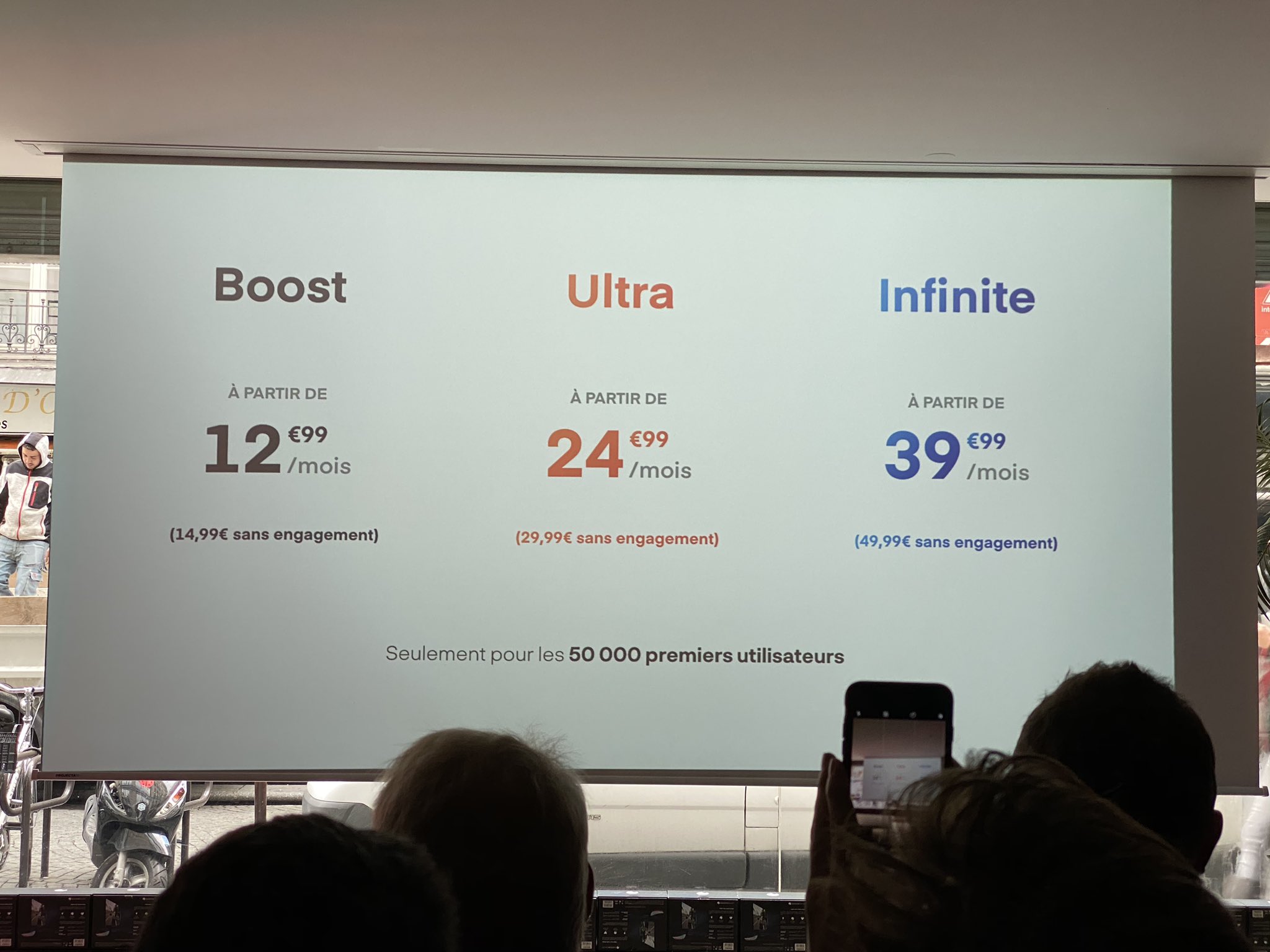
The startup is moving away from a single configuration to offer three different plans. On February 2020, customers will be able to chose between three plans — Boost, Ultra or Infinite.

  • Boost: Nvidia GTX 1080 GPU, 3.4GHz with 4 cores CPU, 12GB of RAM, 256GB of storage
  • Ultra: Nvidia RTX 2080 GPU, 4GHz with 4 cores CPU, 16GB of RAM , 512GB of storage
  • Infinite: Nvidia Titan RTX GPU, 4 GHz with 6 cores CPU, 32GB of RAM, 1TB of storage

In the U.K., Boost costs £12.99/£14.99 per month, Ultra costs £24.99/£29.99 and Infinite costs £39.99/£49.99 per month. You get the lower price with yearly subscriptions.

In France, Germany, Belgium and Luxembourg, plans cost €12.99/€14.99, €24.99/€29.99 and €39.99/€49.99 respectively. Plans will become more expensive after the first 50,000 customers — pre-orders start today. New plans aren’t available in the U.S. for now.

It’s worth noting that you’ll be able to add an option to get more storage with any plan. Storage plans include 256GB of SSD performance — anything above that will perform like a more traditional HDD. Shadow is using Intel Xeon W3200 CPUs on the new configurations.

cQHGO38N.jpg large

OVH founder and chairman Octave Klaba also announced a new partnership with Shadow. OVH is going to take care of Shadow’s infrastructure and become the cloud hosting partner going forward. The new servers will be rolled out in OVH data centers.

In other news, Shadow is launching a new interface specifically designed for TVs and mobile devices. The launcher now lists all your games. You can tap on a game to launch the game directly without going through the regular Windows interface. The update is available on Android TV, iOS and Android. The tvOS update should land next week.

IMG 0206

Competition is heating up

Google is about to launch Stadia on November 19th. Microsoft is working on Project xCloud. Nvidia has its own cloud gaming service. In other words, cloud gaming has become an incredibly crowded market.

Shadow has been around for a few years now. In addition to refining its streaming technology, the company emphasizes everything you can do with Shadow that you can’t do with a more limited cloud gaming service.

“We’re the only one to offer a full PC. You can stream, work, do some Photoshop, do some SolidWorks,” Shadow co-founder Emmanuel Freund said. “We’re the only one to offer 244Hz monitor support, we’re the only one to adapt to all screens.”

As a pure cloud gaming company, Shadow wants to be available on any platform. You don’t have to buy a Google Pixel phone or a PlayStation to access the service. You can launch your Shadow instance on Windows, macOS, Linux, Android, iOS, tvOS and Android TV.

And now, you can even imagine using Shadow with a mobile VR headset. After installing the Android app, you can launch VR games on your Shadow instance and access demanding games without a gaming PC.

Some corporate news

Shadow has raised another $33 million in October (€30 million) — it’s unclear who invested in this round. The company also raised some money from Western Digital and Charter Communications earlier this year. Overall, the startup has now raised $111 million since launch (€100 million).

There are now 70,000 Shadow customers across 8 countries. At $35 per month, the company is generation some significant monthly recurring revenue.

And Shadow has a new CEO. Co-founder Emmanuel Freund is stepping aside as CEO — he’s now in charge of strategy. Jérôme Arnaud is taking over as CEO. The company was probably looking for a more senior business profile for the next step of the company.

29 Oct 2019

Quip wants to help you floss

Quip, the dental care startup that first went to market with electric toothbrushes, has launched its first product outside of brushes. Called Strand, the product is a floss applicator with a refillable canister.

Strand costs $20 for the metallic applicator and refills cost $5. Each string is pre-marked at every 18-inches to help guide people to use that amount for each tooth. Strand has been in the works since before Quip officially launched its toothbrush, Quip CEO Simon Enever told TechCrunch.

“As we’ve talked about a lot, our mission is very much to help with all of the fundamentals of oral care and floss has been that next natural chapter for us on the personal care side of the business,” he said. “There are all of these bad habits people exhibit or don’t exhibit in flossing. There are massive numbers of people who don’t get the basics right and even fewer people are bothering to floss even once a day. For us, it’s paired so closely with brushing itself. The only true way to get proper results in oral care is to both floss and brush.”

With Strand, the hope is to make flossing something people actually want to do. To help with that, Quip designed Strand to be easily fit inside your pocket so that you can easily take it on the go.

“A big insight from our research is that people want to floss on the go,” Enever said. “That’s the time when people want to floss but no one brings their floss with them. We tried to create something that slips comfortably into your pocket.”

To date, Quip has raised more than $60 million in funding from Sherpa Capital, TriplePoint Capital, NFP Ventures and others.

29 Oct 2019

Amazon axes $14.99 Amazon Fresh fee, making grocery delivery free for Prime members to boost use

Amazon is turning up the heat once again in the world of groceries, and specifically grocery delivery, to make its service more enticing in face of competition from Walmart, as well as a host of delivery companies like Postmates. Today, the company announced that it would make Amazon Fresh — the fresh food delivery service it now offers in some 2,000 cities in the US and elsewhere — free to use for Prime members, removing the $14.99/month fee that it was charging for the service up to now.

Alongside free delivery, Amazon is giving users one and two-hour delivery options for quicker turnarounds, and it’s making users’ local Whole Foods inventory available online and through the Amazon app.

Prime members who were already using Amazon’s grocery delivery services — either for Amazon’s own-branded service or to get Amazon-owned Whole Foods shopping delivered — will continue to get these, now free. Those who might be interested in trying this out for the first time will have to sign up here and wait for an invite. (“Given the rapid growth of grocery delivery we expect this will be a popular benefit,” Amazon explained about the waitlist.)

“Prime members love the convenience of free grocery delivery on Amazon, which is why we’ve made Amazon Fresh a free benefit of Prime, saving customers $14.99 per month,” said Stephenie Landry, VP of Grocery Delivery, in a statement. “Grocery delivery is one of the fastest growing businesses at Amazon, and we think this will be one of the most-loved Prime benefits.”

Making Amazon Fresh free is the latest price tinkering (and reduction) that Amazon has made to drive more usage of the service. The $14.99 fee was introduced back in 2016, itself a reduction on a $299/year fee that Amazon previously charged Amazon Fresh customers. Before that, Amazon charged a $99/year subscription plus separate delivery fees to use the service.

It’s not clear how many customers are already using Amazon Fresh. Analysts earlier this year estimated that while the company was still seeing its grocery service growing, that growth was slowing. The company has made fast and free delivery one of the major cornerstones of its business, and so it makes sense that it would invest in ways of trying to boost that service in the a bigger economy of scale play to bring in more users buying more groceries, making up the margins in the latter to offset potential losses in the former.

But the move to make it “free” — free, that is, for those who are already paying $12.99/month or $119/year for Amazon Prime — is a classic Amazon move not just to boost its own usage numbers of the service.

The company is facing persistent competition from a number of other companies also providing online grocery shopping and delivery. In the UK, just about every large grocery chain offers this service directly (or through another non-Amazon partner). In the US, Walmart announced last month that it would be expanding its $98/year Delivery Unlimited service, which up until today would have been a cheaper deal than Amazon’s. Both Postmates and Doordash are among the delivery hopefuls who also have ambitions to make a dent in this area.

29 Oct 2019

Grab a seat while you can: Apply to TC Hackathon @ Disrupt Berlin 2019

Think you have what it takes to be a TechCrunch hackathon champion? It’s time to put your creative code and confidence where your mouth is, my friends. Come to Disrupt Berlin 2019 on 11-12 December and pit your skills, tenacity and endurance against some of the best creators from around the world.

We’re limiting participation to 500 people, and seats are filling fast. Get yours before they’re gone. Apply to compete in the TC Hackathon today!

Why submit an application? For starters, it doesn’t cost a thing to apply or to compete. In fact, if you make the grade, you’ll receive a free Innovator pass to Disrupt Berlin and have access to everything Disrupt has to offer. But wait, as they say, there’s more.

The Hackathon is not only a great opportunity to build a working prototype that addresses real-world problems, it’s the chance to showcase your talent and creativity in front of people who have the potential move your ideas, career or startup forward. Each sponsored challenge comes with its own set of prizes, which typically includes cash and/or related products. On top of any sponsor prizes you might win, TechCrunch will award a $5,000 prize to the best over-all hack.

We’ll announce the sponsors in the coming weeks. But for now, the sponsored contests, prizes and winners from the Hackathon at Disrupt SF 2018 will give you an idea of what you can expect.

Teams will choose a project to hack, and they’ll have less than 24 hours to design, build and present their product. If you arrive solo, you can find a team onsite. It’s a pressure-cooker situation that requires focus, coding and problem-solving skills and perseverance. Here’s the good news. We’ll have plenty of food, water and lots of caffeine to help you go the distance.

The first round of judging takes place science-fair style. The judges will review all completed projects and then select only 10 teams to move on to the finals. The finals take place on day two, and teams have just two minutes to step onto the Extra Crunch Stage to present and pitch their work.

Sponsors will award prizes to the team(s) for their specific project, and then TechCrunch will choose one finalist as the best over-all hack. That team earns the championship title and $5,000 cash. Sweet!

TC Hackathon takes place during Disrupt Berlin 2019 on 11-12 December. There are so many great reasons to apply, but seats are going fast. Grab this opportunity for all it’s worth and apply to the Hackathon today.

Is your company interested in sponsoring or exhibiting at Disrupt Berlin 2019? Contact our sponsorship sales team by filling out this form.

29 Oct 2019

TrueLayer, the open banking API provider, discloses investment and partnership with Visa

TrueLayer, the London startup that’s built a developer API platform for fintechs and other adjacent companies to utilise open banking, has agreed a strategic and commercial relationship with Visa. The partnership sees Visa also take a minority stake in TrueLayer as part of the company’s $35 million Series C funding announced in June.

The round was led by Tencent and Temasek, with participation from previous investors Northzone and Anthemis, while we now know that Visa was on-board too. TrueLayer has raised $47 million to date.

Francesco Simoneschi, CEO and co-founder of TrueLayer tells me the Visa partnership will enable the fintech to work with a “huge network” of businesses and banks to help them to develop open banking services and applications that will “provide tangible benefits” to customers.

“We want to scale open banking to a level where it manifestly impacts every aspect of financial services for consumers,” he says. “[This] requires large, established players to come on board and work with startups like us. Visa has been one of the most successful ‘fintech’ companies ever created, [and] we ultimately have a lot to learn from them”.

Furthermore, Simoneschi says the partnership is a key part of TrueLayer’s twin goals of becoming a global platform and growing the open banking economy. The fintech is already open for business in the U.K., Germany, France, Italy and Spain, and recently expanded to Australia. It works with companies such as Revolut, Zopa, ClearScore, Plum, Emma, CreditLadder, Canopy, and ANNA Money.

“Our view is that any initiative that enables more businesses to embrace open banking is good for everybody involved — from fintechs to consumers,” says the TrueLayer CEO.

Visa’s SVP of Open Banking, Mark Nelsen, says that working with TrueLayer will enable Visa with to explore new opportunities for its clients and for the Visa network. “Our partnership with TrueLayer is another example of how we’re investing in companies that offer next generation services, enabling innovation and convenience for clients and consumers alike,” he says.

“I wouldn’t want to speak for Visa, but I believe that TrueLayer has a combination of factors that are appealing,” says Simoneschi. “We were one of the first movers in the U.K. for open banking which enabled us to develop our solution in line with the needs of our clients and subsequently quickly grow our customer base. We now are responsible for about 65% of all open banking traffic in the U.K. This gave us the launchpad to scale across Europe — and most recently to become the first European open banking specialist to launch in Australia. Throughout this process, we’ve developed a reputation for working in partnership with businesses of every size, from banks down to early-stage startups. It really is these partnerships, aligned with our experience, that I think makes us different”.

With that said, Simoneschi stresses that he doesn’t see the industry as a “zero sum game” and that there is a huge opportunity for scores of businesses to do well. “If we can collaborate to get more people to embrace open banking, everyone wins,” he adds. “It is perhaps this mentality that was an important factor for Visa.”

29 Oct 2019

Market research platform Milieu Insight raises $2.4 million to launch in more Southeast Asian countries

Milieu Insight, a Singapore-based market research and data platform, announced today that it has raised $2.4 million in pre-A funding. The round, led by MassMutual Ventures Southeast Asia, will be used on product development and to launch in four new Southeast Asian countries, Malaysia, Indonesia, the Philippines and Vietnam. The startup’s platform, called Milieu Surveys, is already available in Singapore and Thailand and has signed more than 45 clients.

This brings Milieu Insight’s total funding so far to $3.15 million, including a seed round announced in November 2018. Founded in December 2016 by CEO Gerald Ang, who previously worked at global research firms including GfK and YouGov, Milieu Insight seeks to make market research and data analysis accessible to smaller businesses and organizations. Milieu Portraits, its consumer segmentation tool, returns insights about specific demographics, including what products, media and brands they prefer, while Milieu Studies allows companies to create their own studies.

[gallery ids="1904986,1904985,1904984"]

COO Stephen Tracy told TechCrunch in an email that the startups’ four new markets were picked because “they are in high demand among existing research buyers who want to study consumer trends, particularly because the market dynamics in these countries are evolving fast.” Milieu focuses exclusively on mobile data since smartphone penetration is still growing quickly in many Southeast Asian markets.

He added “one other dynamic that makes us particularly excited about expanding across Southeast Asia is that, through our investment in tech and automation, we’re able to sell market research solutions at considerably more affordable price points (i.e. research studies as low as US$350). Meaning our platform can also activate new spending among businesses/organizations who couldn’t previously afford it, such as charities/non-profits, academic institutions and startups.”

Milieu Insight’s competitors include traditional research firms like Kantar and YouGov for Milieu Studies and Global Web Index for Milieu Portraits. Tracy says the startup’s competitive edge is its end-to-end solution. “That is, there’s no other company that offers a single platform that connects an audience (i.e. our managed consumer panel) with a SaaS service that allows you to access consumer profiling data on-demand as well as launch bespoke consumer studies and get results in just a few hours, all within a self-serve environment.”

In a press statement, MassMutual Ventures managing director Anvesh Ramineni said “Milieu’s impressive team has built a world-class product, making market research services affordable, accessible and more relevant in today’s mobile first landscape. We are pleased to lead Milieu’s current round and look forward to supporting the company as it scales across the region.”

29 Oct 2019

ByteDance denies it will go public in Hong Kong next quarter

ByteDance has responded to a report in the Financial Times that said the Chinese Internet startup plans to go public in Hong Kong as early as the first quarter of next year. “There is absolutely zero truth to the rumors that we plan to list in Hong Kong in Q1,” said a spokesperson for the company, the owner of TikTok.

The Financial Times reported that ByteDance, which was founded in 2012 and is backed by investors including SoftBank, is preparing for a public listing by retaining law firm K&L Gates and hiring a chief legal officer and former U.S. officials to help address concerns by U.S. lawmakers that TikTok can pose “national security risks,” such as being compelled to turn over data from American users to Chinese authorities.

Speculation that ByteDance is gearing up for an IPO started last year when it closed a $3 billion funding round that put its valuation between $75 billion to $78 billion, making it the world’s most valuable startup.

ByteDance’s apps also include Douyin, the Chinese version of TikTok, news app Toutiao and TopBuzz, a news aggregation app for the U.S. market that the Financial Times reports it is planning to sell as it prepares for an IPO.

In September, Reuters reported that ByteDance had made between $7 billion and $8.4 billion in revenue for the first half of the year and had posted a profit in June.

29 Oct 2019

ByteDance denies it will go public in Hong Kong next quarter

ByteDance has responded to a report in the Financial Times that said the Chinese Internet startup plans to go public in Hong Kong as early as the first quarter of next year. “There is absolutely zero truth to the rumors that we plan to list in Hong Kong in Q1,” said a spokesperson for the company, the owner of TikTok.

The Financial Times reported that ByteDance, which was founded in 2012 and is backed by investors including SoftBank, is preparing for a public listing by retaining law firm K&L Gates and hiring a chief legal officer and former U.S. officials to help address concerns by U.S. lawmakers that TikTok can pose “national security risks,” such as being compelled to turn over data from American users to Chinese authorities.

Speculation that ByteDance is gearing up for an IPO started last year when it closed a $3 billion funding round that put its valuation between $75 billion to $78 billion, making it the world’s most valuable startup.

ByteDance’s apps also include Douyin, the Chinese version of TikTok, news app Toutiao and TopBuzz, a news aggregation app for the U.S. market that the Financial Times reports it is planning to sell as it prepares for an IPO.

In September, Reuters reported that ByteDance had made between $7 billion and $8.4 billion in revenue for the first half of the year and had posted a profit in June.