Year: 2019

28 Oct 2019

Instagram expands ban on suicide content to cover cartoons and memes

Instagram has expanded a ban on graphical self-harm imagery to include a broader range of content depicting suicide, including fictional illustrations of self-harm and suicide methods such as drawings, cartoons and memes.

“This past month, we further expanded our policies to prohibit more types of self-harm and suicide content. We will no longer allow fictional depictions of self-harm or suicide on Instagram, such as drawings or memes or content from films or comics that use graphic imagery,” writes Instagram boss, Adam Mosseri, explaining the latest policy shift. “We will also remove other imagery that may not show self-harm or suicide, but does include associated materials or methods.”

Earlier this year Mosseri, met with the UK’s health secretary to discuss the platform’s policy towards self-harm content. The company has faced high level pressure in the country following a public outcry after the family of Molly Russell, a 14-year-old UK schoolgirl who killed herself after viewing suicide content on Instagram, went public with the tragedy by talking to the BBC.

In February the Facebook-owned social media platform announced that it would prohibit graphic images of self-harm, such as cutting, and restrict access to non-graphic self-harm content, such as images of healed scars — by not recommending it in searches.

At the time it also suggested it was toying with the idea of using sensitive screens to blur non-graphical suicide content, saying it was consulting with experts. In the event it appears to have decided to go further — by now saying it will also remove fictional content related to self-harm, as well as anything that depicts methods of suicide or self-harm.

Instagram says it’s doubled the amount of self-harm content it has acted on following the earlier policy change — with Mosseri writing that in the three months following the ban on graphic images of cutting it “removed, reduced the visibility of, or added sensitivity screens to more than 834,000 pieces of content”.

While more than 77% of this content was identified by the platform prior to it being reported, he adds.

A spokesperson for Instagram confirmed to us that the latest policy shift is in effect.

Although it’s not clear how long it could take for it to be effectively enforced. Mosseri told BBC News: “It will take time to fully implement,” adding that: “It’s not going to be the last step we take.”

In his blog post about the policy change, the Instagram boss writes that the new policy is “based on expert advice from academics and mental health organisations like the Samaritans in the UK and National Suicide Prevention Line in the US”, saying: “We aim to strike the difficult balance between allowing people to share their mental health experiences while also protecting others from being exposed to potentially harmful content.”

“Accounts sharing this type of content will also not be recommended in search or in our discovery surfaces, like Explore. And we’ll send more people more resources with localized helplines like the Samaritans and PAPYRUS in the UK or the National Suicide Prevention Lifeline and The Trevor Project in the United States,” he adds.

He goes on to argue that the issues involved are complex and “no single company or set of policies and practices alone can solve”, while defending continuing to allow some suicide and self-harm content on Instagram by saying “experts tell us that giving people a chance to share their most difficult moments and their stories of recovery can be a vital means of support” and that “preventing people from sharing this type of content could not only stigmatize these types of mental health issues, but might hinder loved ones from identifying and responding to a cry for help”.

“But getting our approach right requires more than a single change to our policies or a one-time update to our technology. Our work here is never done. Our policies and technology have to evolve as new trends emerge and behaviors change,” he adds.


28 Oct 2019

Duffel raises $30M led by Index Ventures to disintermediate legacy travel platforms

Huge travel platforms that run airline booking systems like Sabre and Amadeus were invented eons ago and are so large and cumbersome that innovating with them is no easy feat. In the same way that challenger banks have come along to re-invent the banking software Starck, UK startup Duffel has done the same in the travel market, linking up airlines directly with travel agents with a 21st Century platform.

Today it’s announced a $30m Series B funding round from investors Index Ventures, and they were joined by existing investors Benchmark Capital and Blossom Capital . Its airline partners already include American Airlines, British Airways, Lufthansa Group, Aegean Airlines, Vueling, and Iberia.

Duffel will use the new funds to hire more engineers and increase its broader team. It is focusing on expanding in North America and Europe, with its first customers drawn from the US, UK, Canada, France, Germany and Spain.

Duffel enables travel agencies to plug in directly to airlines’ reservation systems via an API so that they can pull real-time flight offers, make bookings, access live seat availability, and buy extra services. This means new digital and mobile app-based travel agencies – Duffel’s target market – can bypass the long lead times and high costs associated with the legacy flight booking systems. They are then able to see live seat availability from some of the world’s biggest airlines, as well as additional offers on in-flight meals or luggage allocations.

Steve Domin, co-founder and CEO of Duffel, said: “A new breed of online agencies want to access reservation systems quickly and seamlessly. By reinventing the underwiring between online agents and airlines we can transform the world of travel booking and reduce barriers to entry for innovative new companies that are offering travelers a whole new way of creating a holiday or trip.”

In the same way that banking systems have been opened up by deregulation, the International Air Transport Association (IATA) created a new industry standard, known as New Distribution Capability (NDC), which transformed the way air products are retailed through the use of modern XML technology. The problem was, the legacy platforms didn’t take much interest. Duffel has obviously come along to take advantage of that.

Jan Hammer, partner at Index Ventures, said: “We are incredibly impressed by the Duffel team, who we have supported since the days of their seed funding. There is an opportunity here to transform the booking experience for travelers and ease many of the pain points in the industry. From the launch of budget airlines to sharing economy businesses like Airbnb, travel has changed and Duffel will provide the tools, built from the ground up, that make the next wave of innovation possible.”

Speaking to TechCrunch, Domin said: “Historically it’s been very hard to sell travel products to agencies. Integrations are hard. There is too much complexity. We are bundling it all into a very simple API and 2 hours later you can have it running on a site or a mobile app.”

“We are connecting directly to airlines’ reservation systems. If you go on a site that uses Duffel, we will forward – to the airline – the right search request, and the airline generates the offer in real-time.”

“Airlines were trying to modernize their booking systems with Amadeus and Sabre but they have not moved quickly on adapting to what the airlines wanted. When the IATA came up with its new XML platform, no-one wanted to use it. So we did.”

Is Duffel a threat to the legacy platforms? “Potentially,” he says, “but I don’t think they see it that way. They don’t see the benefit of engineering and developer experience. In a way, I hope we will be a threat but I don’t think we are right now.”

He said Duffel has future plans to expand to other products like trains and hotels.

28 Oct 2019

Kenya’s Twiga Foods eyes West Africa after $30M raise led by Goldman

Kenya’s Twiga Foods has raised a total of $30 million from lenders and investors led by Goldman Sachs.

The B2B food distribution company financed $6.25 million of the funding in convertible debt and $23.75 million in equity, classified as a Series B round. IFC, TLcom Capital, and Creadev joined Goldman on the VC side.

Twiga will use the funds to set up a distribution center in Nairobi and deepen its conversion to offering supply chain services for both agricultural and FMCG products.

The Nairobi based company will invest in expanding into more cities in Kenya, including Mombasa. Twiga is also targeting Pan-African expansion by third quarter 2020.

“We’re working on French West Africa…we see significant opportunity in those markets,” Twiga CEO Peter Njonjo told TechCrunch. The company will name the new country (or countries) in the following year, he added.Peter Njongo Twiga Foods CEO

Goldman Sachs confirmed to TechCrunch its lead on Twiga’s Series B funding. The U.S. based finance firm has backed several African startups, including e-commerce venture Jumia and South African fintech startup Jumo.

Twiga’s financing comes 11 months after a $10 million raise and announcement it would create additional revenue streams by moving into B2B supply chain for FMCG and other consumer products.

Prior to this, Twiga focused primarily on agricultural goods and connecting the product of farmers more efficiently to marketplaces.

The venture has moved quickly on diversifying its supply-chain product mix. “We’re not just doing fruits and vegetables…I’d say we’re at 50/50 now between FMCG and fresh,” said Njonjo.

“We’ve pivoted a bit as a company…we see our purpose as an organization around what I would call aggregating the informal retail, then using technology, and then using that buying power to essentially provide lower, better cost goods across cities,” he said.

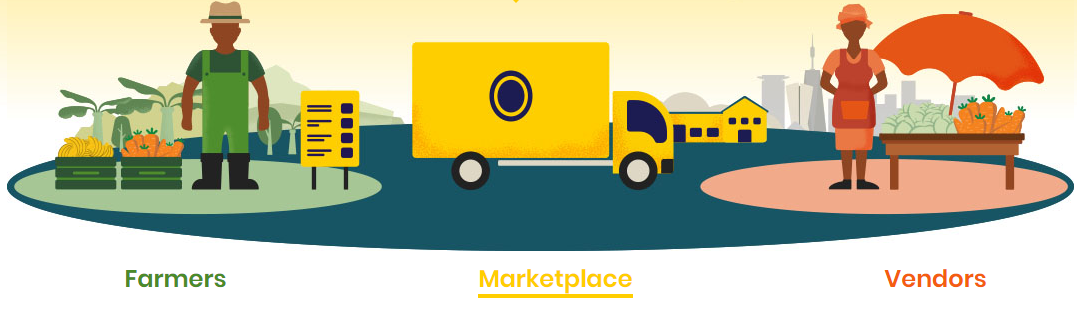
Co-founded in Nairobi in 2014 by Njonjo and Grant Brooke, Twiga Foods serves around 3,000 outlets a day with produce through a network of 17,000 farmers and 8,000 vendors. Parties can coordinate goods exchanges via mobile app using M-Pesa mobile money for payment.

The company has reduced typical post-harvest losses in Kenya from 30% to 4% for produce brought to market on the Twiga network, according to Njonjo.

Transferring these gains from improved supply-chain to a wider variety of food products has upside for economies and and consumers, he believes.

“[If you] get farmers now producing at large scale and supplying into you, and manufacturers that don’t need to invest in distribution systems, it has huge benefit,” said Njonjo.

“Think about in some of these economies, if you’re spending 55% of disposable income on food, if that number were to go down to 40% — because of…gaining efficiency — what you’ve done is to release 15% for consumers to spend for other things.”

As TechCrunch reported in November, Twiga Foods’ consistent volume and revenue flow from agricultural goods provides a foundation to add other product categories to its B2B network.

“If we can build a business around fresh fruit and vegetables…It’s now much easier to lay things over that would have been very expensive to get to end retailers,” Twiga co-founder Grant Brooke said.

This could put the startup in a position to enter or supply B2C e-commerce with more favorable margins than existing players, i.e., online retailer Jumia — with high fulfillment expenses.

On that prospect, “It’s not something we”re thinking about from a strategic standpoint,” said CEO Njonjo.

But Twiga has factored for its advantages in the B2C e-commerce space. “Let me put it this way, if you’re able to serve Nairobi’s 180,000 retailers, it means that the furthest customer would be less than 2 kilometers away from any shop. That’s the power of building a B2C business on top of a B2B platform. So definitely, the potential is there,” said Njonjo.

That leaves some room for conjecture that Twiga Foods could pivot toward supplying or entering online retail in Africa.

For now the company will focus on performance metrics around its current model.

“We’re not sharing data around revenue and profitability. But…over the next 12 months as we scale, our unit economics is front and center to ensure we’re growing our margins faster than our costs,” said Njonjo.


28 Oct 2019

Koyo raises $4.9M in equity and debt to use open banking to offer loans to people with ‘thin’ credit files

Koyo, a fintech startup using open banking to offer loans to people with “thin” credit files and currently poorly served by the market, has closed $4.9 million in funding.

The round — a mixture of debt and equity funding — is led by Forward Partners, with participation from Seedcamp. Other investors include Christian Faes (founder and CEO of LendInvest), and Charlie Delingpole (founder and CEO of ComplyAdvantage).

Founded in late 2018 by ex-Frontline Ventures VC Thomas Olszewski, and launching later this year, Koyo is attempting to tackle the problem whereby people without much of a credit history, such as migrants or those who have never taken credit or aren’t the main bill payer, aren’t able to secure a loan.

And even if they are, the financial products they’ll typically get access to often charge excessive fees and have an extremely high interest rate.

By using open banking data to better assess risk based on a person’s up-to-date transaction history, the company thinks it can offer something a lot more competitive.

“If someone is new to the country or otherwise has a thin credit file it can be difficult for that person to access credit,” says Olszewski. “For example, if you’ve been in the country for a year or two and you’d like to get a personal loan, the types of loans that would be offered to you would be payday loans (1,000%+ APRs) or longer term loans in the 50-99% APR range that may require a guarantor”.

The reason is because these types of customer have little or no information in their credit file, and the vast majority of lenders rely on the three main bureaus (Equifax, Experian, Transunion) to make a credit decision.

“We estimate 15-20% of the population are not captured by bureau data,” explains Olszewski. “Koyo is unique in that we require all customers to connect their current account to our platform using open banking, and we make a lending decision based on the transactions in that customers account, rather than just looking at the credit score. So, if we see the customer has regular income, has a reasonable expenditure relative to the size of their income, that customer may be eligible for a loan from us”.

With regards to competitors, Olszewski says that if you have a thin credit file (or have no file at all) and are unable to get a loan from a bank, there are providers such as Amigo Loans, and 118 Money or Sunny. However, he claims that Koyo will usually work out 50-90% cheaper on an APR basis.

“We expect our representative APR to be in the c35% range. While this may be expensive to people who have access to high street bank loans, it is a really exciting proposition for this market segment,” he adds. In addition, Koyo won’t charge late fees, early repayment fees, loan originations fees “or fees of any sort other than interest”.

Meanwhile, I’m told that Koyo is currently a “nimble” team of just 6, with 4 people in the management team. Along with Olszewski, they are CTO Guy Evans (former CTO of LendInvest), Head of Risk Kevin Allen (former CRO of Ratesetter) and Head of Marketing Peter Kent.

28 Oct 2019

Welcome to the Jungle raises $22.3 million to make recruitment easier

French startup Welcome to the Jungle has raised a new $22.3 million funding round (€20 million). The startup is both a media company and a tech startup that wants to empower tech companies when it comes to recruitment. It doesn’t find the right candidate for you, it helps you get exposure, track application and facilitate onboarding.

Gaia Capital Partners is leading the round with existing investors Bpifance, XAnge and Jean-Paul Guisset also participating. With today’s funding round, the company wants to expand to more countries and develop new products.

This is also Gaia Capital Partners’ first investment. The firm raised a $110 million fund (€100 million) with around 40 limited partners, such as Sycomore Asset Management, Generali Investments and Bpifrance. The growth fund headed by Alice Albizzati and Elina Berrebi is going to focus on companies that have a positive environmental or societal impact at Series B stage and above.

Welcome to the Jungle is currently available in France, Spain and Czech Republic. Up next, the company is going to open offices in Germany and the U.K.

The company works with photographers and a video crew to create high quality profiles of other companies that are actively recruiting. This way, potential candidates can browse those profiles, learn more about companies and make up their mind.

Companies pay for those profiles to improve their branding, especially when it comes to recruitment. And it seems to be working well as there are now over 2,500 clients, including 250 in Spain and 100 in Czech Republic.

More recently, Welcome to the Jungle has started to expand beyond those showcases to tackle the recruitment process at large. The startup launched Welcome Kit, an applicant tracking system to manage job offers and take care of job applications.

With Welcome Kit, you can design a career site, write job postings and create application forms. Your recruitment team then receives applications, comments and collaborates with the rest of the team, sends emails using templates and more.

4,000 companies are using Welcome Kit. Collectively, they have posted about 150,000 job offers and received 2.5 million applications.

And now, Welcome to the Jungle is about to launch Welcome Home, the startup’s take on the good old intranet. The company realized that too many people who join a company don’t feel at home right away. And some people will even quit just a couple of months after joining a company.

You will be able to create an employee directory, post company-wide announcements and get information using Welcome Home. All of this should help create a more welcoming environment for newcomers.

[gallery ids="1903323,1903324,1903325,1903328"]

28 Oct 2019

Stochastic disaster

As I write this, massive fires are erupting all over California, and massive protests are erupting all over the world. Is the former a facet of the climate crisis? Is the latter a symptom of hyperpolarization caused by hyperconnectivity? Yes, I mean no, I mean it’s impossible to say. That’s what it means to live in a stochastic age.

This is an era of stochastic terrorism: “The use of mass public communication, usually against a particular individual or group, which incites or inspires acts of terrorism which are statistically probable but happen seemingly at random.” It is also an era of climate crisis as a stochastic disaster, causing a whole spectrum of ‘random’ natural disasters to become ever more probable and terrible.

Is ours also an era of stochastic political strife? Does the world’s increased connectivity, aided by social media’s inherent amplification of outrage, have second-, third-, or fourth-order effects which heat rhetoric and protest, triggering secession movements and massive rejection of the status quo? Is our hyperconnectivity the political equivalent of global warming?

If so, it would explain a lot. The baffling and horrifying rise of neo-Nazis and white supremacy around the world. The increasing political polarization of seemingly every polity. The growing dearth of anything like a political middle ground. The huge protests scattered across the globe, against almost every form of government.

But let’s not be too quick to diagnose this. This might be somehow periodic: terrorism and protests were both more common (per capita) in the late 60s and early 70s than they are today. It might just be a symptom of, and backlash against, a global trend of neoliberalism-morphing-towards-antidemocratic-oligarchy, which, sadly, is the recent economic / political history of much of the world.

The hypothesis is that this stochastic strife has something to do with technology and hyperconnectivity, that across the world we’re experiencing the political equivalent of global warming. Intriguing, but far from proven. How might we test or measure it?

The obvious test is to introduce a control group, A/B across a representative slice of the planet — but that seems pretty unlikely, and I’m not aware of any reliable quantitative measures of political strife, and either way it suffers from the inevitable problem that it’s impossible to tease out just one of the myriad factors which accumulate (or not) into political fury and protest.

— At least it’s impossible at any given moment. But we do know that connectivity is likely to just keep increasing, especially across the developing world, and that averaged across nations it is likely to change faster than almost any other factor at play.

So if this hypothesis is correct, we ain’t seen nothin’ yet. Political outrage, massive protests, and secession movements will continue to grow worldwide, eventually at a pace which makes California wildfires seem leisurely.

Let’s hope that either the hypothesis is proved wrong, or that we find a new way, transcending traditional nation-states, to distribute political power … before all those eruptions turn into conflagrations.

27 Oct 2019

China Roundup: Xi’s power on bitcoin, the rise of Alibaba’s new rival

Welcome back to TechCrunch’s China roundup, a digest of the latest events that happened at major Chinese tech companies and what they mean to tech founders and executives around the world.

Alibaba’s nemesis

Alibaba’s new rival is shaking up China’s internet landscape.

This week, four-year-old e-commerce upstart Pinduoduo displaced JD.com to be the fourth-most valuable internet company in the country. Its market capitalization of $47.6 billion on Friday put it just behind e-commerce leader Alibaba, social networking behemoth Tencent and food delivery titan Meituan in China. Baidu, the search equivalent of Google in China, has fallen off the top-three club, ending a decade of unshakable dominance of Baidu, Alibaba, and Tencent (the “BAT”) on the Chinese internet.

The story of Pinduoduo comes down to growing internet penetration and the rise of social commerce. Pinduoduo, which is known for selling ultra-cheap products, is particularly popular with price-sensitive residents in small towns and rural regions, a market relatively underserved by online retail pioneers Alibaba and JD.com . However, Pinduoduo has set about targeting more urban consumers by heavily subsidizing big-ticket items such as iPhones.

Its seamless integration with WeChat, the ubiquitous messaging app owned by Pinduoduo investor Tencent, contributes to adaptability among a less tech-savvy population. WeChat users can access Pinduoduo via the messenger’s built-in lite app, skipping app downloads; they also get deals from group-buying, thus the name Pinduoduo, which means “shop more together” in Chinese.

Earlier this month, Pinduoduo founder and chief executive Colin Huang, a 39-year-old former Google engineer of few words, gave a 45-minute speech at the company’s anniversary, according to a summary published by local tech media Late News. He announced that Pinduoduo has surpassed JD.com in gross merchandise volume, or the total dollar value of goods sold. It’s unclear whether the companies use the same set of metrics for GMV, for instance, whether the figure includes refunded items.

While its rivalry with JD.com is nuanced as both companies are backed by Tencent, Pinduoduo’s competition against Alibaba is more blatant. In his missive to staff, Huang acknowledged that Pinduoduo is “standing on a giant’s shoulders,” hinting at Alibaba’s sheer size. When it comes to fighting the impending battle during the upcoming Single’s Day shopping festival (11/11), the founder sounded poised. “Pinduoduo should not feel pressured. The one who should is our peer.”

Also worth your attention

  • 82% of Chinese adults used digital payments in 2018, up about 5%; among those living in rural China, 72% made transactions via online banking, telephone banking, the point-of-sale system, ATM or other digital channels, said a new report released by the People’s Bank of China. Beijing’s push for rural areas to go cash-free is in part what gives rise to such flourishing e-commerce businesses as Pinduoduo.
  • Few things move the bitcoin market like President Xi Jinping’s endorsement of blockchain. Speaking at a politburo meeting on Thursday, Xi called for China to “take blockchain as an important breakthrough to achieve independence of core technologies” (in Chinese). Bitcoin price soared more than 10% in response. But as industry experts cautioned, when China, where crypto exchanges are banned, speaks of “blockchain” it usually means the encrypted technology that not only undergirds cryptocurrencies but can revolutionize a whole range of sectors like finance, manufacturing and agriculture. Expect all corners of Chinese society to capitalize on the blockchain concept with even greater force.

  • One of China’s most prominent venture investors just closed $352 million for the first fund of his new financial vehicle. JP Gan, a former managing partner at Qiming Venture Partners, recently started Ince Capital Partners with internet veteran and venture investor Steven Hu. Having backed noted companies including Xiaomi, Meituan, Ctrip, Musical.ly, to name just a few, Gan will continue to fund early to growth-stage startups in China’s internet, consumer and artificial intelligence sectors.
  • Smartphone maker Xiaomi hired leading voice recognition expert Daniel Povey. The researcher who was part of the team to develop the widely used open-source speech recognition toolkit Kaldi announced his next move on Twitter. Before this, Povey declined an offer from Facebook after he was fired by John Hopkins University for attempting to break up a student sit-in. He told The Baltimore Sun earlier that he intended to join a Chinese company because “they don’t have American-style social justice warriors” and he would feel “more relaxed among the Chinese.” Many Chinese tech companies have research and development operations in the U.S. including Xiaomi, which set up a U.S. R&D center in 2017 (in Chinese) to deepen collaboration with chipmaking giant Qualcomm.
  • NetEase’s e-learning unit Youdao began trading at $13.50 per ADS in the U.S. on Friday amid increased regulatory scrutiny on Chinese IPOs. Youdao, which operates a suite of popular online educational products from dictionaries to MOOC-style courses, had over 100 million monthly active users by the first half of 2019, shows its prospectus. It’s one of the many attempts by NetEase founder Ding Lei, once China’s richest man back in 2003, to add momentum to his 22-year-old company. These days NetEase makes the bulk of its revenue from video games and ranks only behind Tencent in China’s booming gaming sector. In September, it sold its once-hopeful cross-border e-commerce business Kaola to Alibaba for $2 billion. 

27 Oct 2019

Meet Utah’s next unicorn

Weave, a developer of patient communications software focused on the dental and optometry market, was the first Utah-headquartered company to graduate from Y Combinator in 2014. Now, it’s poised to enter a small but growing class startups in the ‘Silicon Slopes’ to garner ‘unicorn’ status.

The business announced a $70 million Series D last week at a valuation of $970 million. Tiger Global Management led the round, with participation from existing backers Catalyst Investors, Bessemer Venture Partners, Crosslink Capital, Pelion Venture Partners and LeadEdge Capital.

The company was founded in 2011 and fully bootstrapped until enrolling in the Silicon Valley accelerator program five years ago. Since then, it’s raised a total of $156 million in private funding, tripling its valuation with the latest infusion of capital.

Weave

“Our aim with this funding round is to exceed our customers’ expectations at every touchpoint, investing heavily in the products we create, the markets we serve and the overall customer experience we provide,” Weave co-founder and chief executive officer Brandon Rodman said in a statement. “We will continue to invest in our customers, our products and our people to build a solid, sustainable, and scalable business.”

Weave charges its customers, small and medium-sized businesses, upwards of $500 per month for access to its Voice Over IP-based unified communications service. Rodman previously launched a scheduling service for dentists and realized the opportunity to integrate texting, phone service, fax and reviews to facilitate the patient-provider relationship.

While his second effort, Weave, has long been targeting the dentistry and optometry market, Rodman told Venture Beat last year the opportunities for the company are endless: “Ultimately, if a business needs to communicate with their customer, we see that as a possible future customer of Weave.”

Based in Lehi, Weave added 250 employees this year with total headcount now reaching 550. The company claims to have doubled its revenue in 2018, too. While we don’t have any real insight into its financials, given the interest it’s garnered amongst Bay Area investors, we’re guessings it’s posting some pretty attractive numbers.

“Weave has some of the best retention numbers we’ve ever seen for an SMB SaaS company,” Catalyst partner Tyler Newton said in a statement. “We’re continually impressed by their accelerated growth and results.”

27 Oct 2019

Week in Review: You break it, you buy it

Hey everyone. Thank you for welcoming me into you inbox yet again.

Last week, I talked about Zuckerberg’s quest to tell us that Facebook has governing principles when he’s really just building the stairs one step at a time.

If you’re reading this on the TechCrunch site, you can get this in your inbox here, and follow my tweets here.


The big story

Plenty of ink has been spilled on WeWork and SoftBank and WeWork’s Adam Neumann, and yet it still feels like not nearly enough people are talking about it.

The startup’s post-S1 saga has just been just so messy that it’s understandable one could only grab a sneaking glance of headlines before having to look way.

One reason everyone is talking about it because Neumann’s maneuverings have created an anthology of sketchy founder dealings that’s nearly cartoon villain worthy. He’s got the eccentricities of Jack Dorsey, the frattiness of Evan Spiegel and the “change the world” delusions of Elizabeth Holmes. Critiques of WeWork weren’t all that sparse preceding its S-1, and yet many of venture capital’s talking heads had some kind of founder-friendly admiration for someone that seemed to had bent the world’s heftiest venture capital fund to his will.

It’s far beyond the pleasantries now, what happens to WeWork could deeply shape how late-stage venture capital operates. SoftBank was raising the second vision fund just as WeWork’s shit hit the fan and now it’s the fund’s deepest embarrassment and a financial commitment they’ve poured $18.5 billion into. If WeWork craters, that second vision could fall far short of its aspirations. Plenty of Silicon Valley’s investors would be happy to see control shift to more even-handed institutional forces who did not have capital commands that could set terms with a glance. Nevertheless, there are an awful lot of unicorns that have depended on SoftBank’s growth capital up to this point who would be in danger of being left high and dry.

At this point, SoftBank’s sunk costs have led the desperate fund to go all-in on a sans-Neumann WeWork. They will have to shape the business on their own. They enabled Neumann and now they are left with the task of reverse engineering a disaster into a great turnaround story.

Send me feedback
on Twitter @lucasmtny or email
lucas@techcrunch.com

On to the rest of the week’s news.

Facebook CEO Mark Zuckerberg Testifies Before The House Financial Services Committee

(Photo by Chip Somodevilla/Getty Images)

Trends of the week

Here are a few big news items from big companies, with green links to all the sweet, sweet added context:

  • Extra! Extra!
    Facebook is getting into the news game once again, paying publishers and building an Apple News-like product called Facebook News that is determined to give America access to trusted news. Facebook is doing great fresh out of the gate by giving Breitbart the distinction as a trusted news source. Kudos, Mark. What could go wrong?
  • Netflix keeps racking up the bills
    Hit TV shows don’t feel like they should be as expensive as building a quantum computer and yet Netflix’s hefty original content spending is still chugging along. The streaming company announced this week they’re raising $2 billion in debt to fund its next efforts, which may or may not include another 14 seasons of Stranger Things.
  • Antitrust attorneys general
    This week was another rough one for Facebook, a New York antitrust investigation picked up the support of a whole lot of other states as the probe seeks out anticompetitive practices. There are now 47 attorneys general taking part.

facebook newspaper dollars

GAFA Gaffes

How did the top tech companies screw up this week? This clearly needs its own section, in order of badness:

  1. Facebook is still publisher enemy #1:
    [Why the Facebook News Tab shouldn’t be trusted]
  2. Google’s emoji puritanism:
    [Google’s Play Store is giving an age rating finger to Fleksy, a Gboard rival]

Disrupt Berlin

DISRUPT SF 530X350 V2 berlin

It’s hard to believe it’s already that time of the year again, but we just announced the agenda for Disrupt Berlin and we’ve got some all-stars making their way to the stage. I’ll be there this year, get some tickets and come say hey!

Sign up for more newsletters in your inbox (including this one) here.

26 Oct 2019

Zamna raises $5M to automate airport security checks between agencies using blockchain

Zamna — which uses a blockchain to securely share and verify data between airlines and travel authorities to check passenger identities — has raised a $5m seed funding round led by VC firms LocalGlobe and Oxford Capital, alongside Seedcamp, the London Co-Investment Fund (LCIF), Telefonica, and a number of angel investors.

Participation has also come from existing investor IAG (International Airlines Group), which is now its first commercial client. The company is also changed its name from VChain Technology to Zamna.

When VChain-now-Zamna first appeared, I must admit I was confused. Using blockchain to verify passenger data seemed like a hammer to crack a nut. But it turns out to have some surprisingly useful applications.

The idea is to use it to verify and connect the passenger data sets which are currently silo-ed between airlines, governments and security agencies. By doing this, says Zamna, you can reduce the need for manual or other checks by up to 90 percent. If that’s the case, then it’s quite a leap in efficiency.

In theory, as more passenger identities are verified digitally over time and shared securely between parties, using a blockchain in the middle to maintain data security and passenger privacy, the airport security process could become virtually seamless and allow passengers to sail through airports without needing physical documentation or repeated ID checks. Sounds good to me.

Zamna says its proprietary Advance Passenger Information (API) validation platform for biographic and biometric data, is already being deployed by some airlines and immigration authorities. It recently started working with Emirates Airline and the UAE’s General Directorate of Residency and Foreigners (GDRFA) to deliver check-in and transit checks.

Here’s how it works: Zamna’s platform is built on algorithms that check the accuracy of Advanced Passenger Information or biometric data, without having to share any of that data with third parties, because it attaches an anonymous token to the already verified data. Airlines, airports and governments can then access that secure, immutable and distributed network of validated tokens without having actually needing to ‘see’ the data an agency, or competing airline, holds. Zamna’s technology can then be used by any of these parties to validate passengers’ biographic and biometric data, using cryptography to check you are who you say you are.

So, what was wrong with the previous security measures in airports for airlines and border control that Zamna might be fixing?

Speaking to TechCrunch, Irra Ariella Khi, co-founder and CEO of Zamna, says: “There is a preconception that when you arrive at the airport somehow – as if by magic – the airline knows who you are, the security agencies know who you are, and the governments of departure and destination both know that you are flying between their countries and have established that it is both legitimate and secure for you to do so. You may even assume that the respective security authorities have exchanged some intelligence about you as a passenger, to establish that both you and your fellow passengers are safe to board the same plane.”

“However,” she says, “the reality is far from this. There is no easy and secure way for airlines and government agencies to share or cross-reference your data – which remains siloed (for valid data protection reasons). They must, therefore, repeat manual one-off data checks each time you travel. Even if you have provided your identity data and checked in advance, and if you travel from the same airport on the same airline many times over, you will find that you are still subject to the same one-off passenger processing (which you have probably already experienced many times before). Importantly, there is an ‘identity verification event’, whereby the airline must check both the document of identity which you carry, as well as establish that it belongs to your physical identity.”

There are three main trends in this space. Governments are demanding more accurate passenger data from airlines (for both departure and destination) – and increasing the regulatory fines imposed for incorrect data provided to them by the airlines. Secondly, Airlines also have to manage the repatriation of passengers and luggage if they are refused entry by a government due to incorrect data, which is costly. And thirdly, ETA (electronic transit authorizations, such as eVisas) are on the rise, and governments and airlines will need to satisfy themselves that a passenger’s data matches exactly that of their relevant ETA in order to establish that they have correct status to travel. This is the case with ESTAs for all US-bound travelers. Many other countries have similar requirements. Critically for UK travelers – this will also be the case for all passengers traveling into Europe under the incoming ETIAS regulations.

The upshot is that airlines are imposing increased document and identity checks at the airports – regardless of whether the passenger has been a regular flier, and irrespective of whether they have checked-in in advance.

Zamna’s data verification platform pulls together multiple stakeholders (airlines, governments, security agencies) with a way to validate and revalidate passenger identity and data (both biographic and biometric), and to securely establish data ownership – before passengers arrive at the airport.

It doesn’t require any new infrastructure at the airport, and none of these entities have to share data, because the ‘sharing without sharing’ is performed by Zamna’s blockchain platform in the middle of all the data sources.

Remus Brett, Partner at LocalGlobe, says: “With passenger numbers expected to double in the next 20 years, new technology-driven solutions are the only way airlines, airports and governments will be able to cope. We’re delighted to be working with the Zamna team and believe they can play a key role in addressing these challenges.” Dupsy Abiola, Global Head of Innovation at International Airlines Group, adds: “Zamna is working with IAG on a digital transformation project involving British Airways and the other IAG carriers. It’s very exciting.”

Zamna is a strategic partner to the International Air Transport Association (IATA) and an active member of IATA’s “One ID” working group.