Year: 2019

23 Oct 2019

Founder-investor Natalie Massenet on how new brands win

Natalie Massenet, the fashion entrepreneur who founded the designer fashion portal Net-a-Porter, chaired the British Fashion Council for four years and is today runs Imaginary Ventures, a venture firm that’s focused on consumer startups, took the stage a bit ago at Vanity Fair’s New Establishment Summit. There, she was asked why Imaginary has funded more women founders than men (it’s just happened that way, suggested Massenet). She was also asked about starting a brand, and enumerated the ways that it has become dead simple to do it, from services like Shopify that make launching a storefront easy, to third party logistics companies that make shipping product a cinch, to services like Affirm that make it easier to get paid.

Massenet, of course, noted the challenges of operating in a sea of other brands, many of which are inclined to copy one another. In fact, she recounted that when Net-a-Porter launched, it did so, to her great aggravation, with copy published sideways and upside down on its website — a move that was then replicated by rivals that believe the mistake was by design.

But she also underscored the reasons that direct-to-consumer brands should, if they can swing it, set up actual brick-and-mortar spaces, which she noted that many are already doing.

23 Oct 2019

Legged lunar rover startup Spacebit taps Latin American partners for Moon mission

UK-based lunar rover startup Spacebit, a company developing robotic exploration hardware for use on the Moon, announced two new partners that will help it develop and finalize its technology ahead of its target mission date of 2021. The Ecuadorian Civilian Space Agency (EXA) and Mexico’s Dereum will be providing the technology that Spacebit will employ on both its deployer and the robot rover it’s preparing for use on the Moon.

This marks the first time that Latin American companies will participate in a mission to the lunar surface, and Spacebit CEO Pavlo Tanasyuk was joined by Dereum CEO Carlos Mariscal and EXA COO Ronnie Nader to talk about the news at the International Astronautical Congress in Washington, D.C.

“We have Ecuador, and Mexico as our technical partners,” Tanasyuk said. “So in addition to this being the first lunar mission from the UK, it also is the first Latin American mission with a consortium of Latin American countries participating along with the UK.”

Both the EXA and Dereum have strong technical chops when it comes to spacecraft and space-based robotics, with the EXA sousing on developing technology that is “efficient, cheap and reliable,” according to Nader, while Dereum’s Mariscal said that his organization is well-known globally for its work on building robots for use in space, with an extensive track record. Their expertise should help a lot in Spacebit’s efforts to build, test and validate its robotic lunar rover, which employs a novel walking system for getting around, whereas all rovers to date have used wheels for transportation.

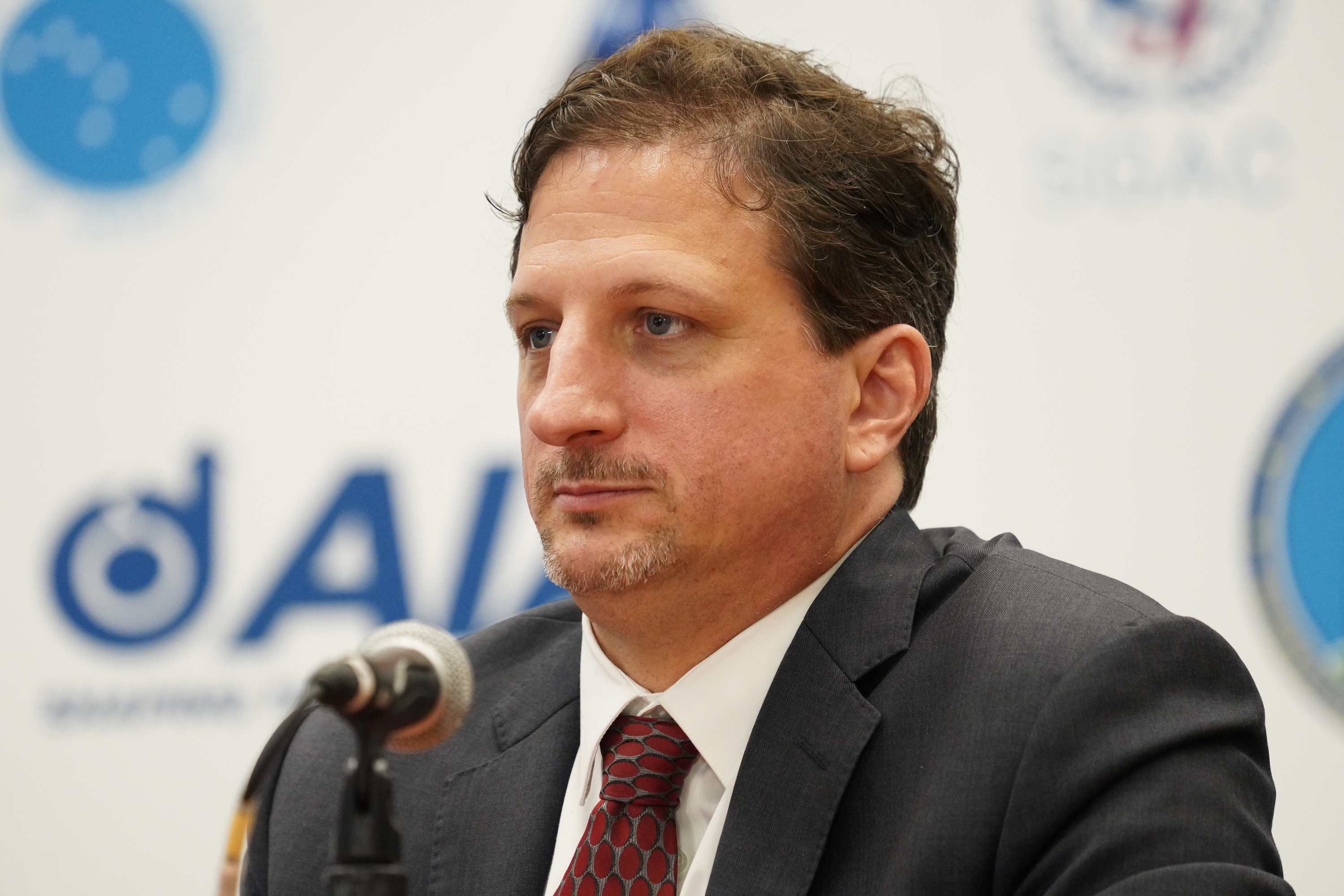
Spacebit CEO Pavlo Tanasyuk

Spacebit CEO Pavlo Tanasyuk

“We are planning on doing a swarm technology exploration plan, where we have multiple small spider walking rovers deployed from a wheeled mothership, along with being able to have some redundancy and the ability to do 3D LIDAR scanning of the interior  lunar caves and lava tubes,” Tanasyuk said.

“It’s essentially a data as a service business model,” he added, explaining how they’ll seek to monetize the business. “Our primary focus for early missions are to do exploration and mapping of lunar lava tubes to be able to characterize the lunar subsurface environment for potential suitability for future human habitation.”

Spacebit, founded in 2014, is funded privately via Tanasyuk himself, along with a couple of other private investors. He said that his company is fully funded through its first mission, a berth aboard the Peregrine Moon lander being launched by Astrobotic in 2021 (which itself has a price tag of $1.7 million he said). The first mission won’t be an entire swarm, but a single rover sent up as a demonstration unit to prove out its technology.

23 Oct 2019

Vendr, already profitable, raises $2M to replace your enterprise sales team

Vendr has developed an enterprise SaaS solution for managing enterprise SaaS.

The new startup, founded by InVision’s former head of enterprise sales Ryan Neu, is another standout from Y Combinator’s latest batch. Contrary to the majority of those businesses, however, Vendr is already profitable.

In classic YC fashion, the company has created software to sell to other startups and as such, it was quick to gain the confidence of top venture capital investors. Headquartered in Boston, Vendr has raised a $2 million round led by F-Prime Capital, with participation from Ashton Kutcher’s Sound Ventures, Joe Montana’s Liquid2 Ventures, Garage VC and angel investors including Canva co-founder & chief operating officer Cliff Obrecht and HubSpot COO JD Sherman.

The company offers subscription-based software, priced depending on company headcount, that helps fast-growing businesses buy and manage enterprise SaaS. In short, the product cuts the human out of the sales process, allowing companies to purchase or upgrade software using software. The goal isn’t to eliminate the sales profession, rather to put an end to “persuasion driven” sales, Neu explains, and to make enterprise software purchases as easy as consumer product purchases.

Vendr 1

Boston-based Vendr graduated from the Y Combinator startup accelerator earlier this year.

“We see software sales actually going away because most people are tired of being sold to, they are tired of being persuaded, they want to transact,” Neu, who previously led sales at HubSpot, tells TechCruch. “Vendr was created to allow people to transact software without actually having to talk to people.”

Founded 14 months ago, Vendr has reached $1 million in annual recurring revenue, which, for context, has historically been amongst the benchmarks necessary for a SaaS startup to raise its Series A. Neu says the company is growing 15% month-over-month with monthly recurring revenue currently sitting at $96,500. Already profitable, Neu says they want to put themselves in a position in which they don’t have to raise any additional outside capital.

“I can’t imagine looking at the bank account every month and watching it deplete,” Neu said. “We want to be in a position where we can control our own destiny.”

Vendr currently operates with a team of six employees and 19 customers including Canva, Grammarly, GitLab, Brex, HubSpot and InVision. The company is also backed by Okta’s general counsel Jon Runyan, AppDynamics’ COO Dan Wright and YC partner Aaron Epstein.

23 Oct 2019

A scalable plan for onboarding your first 500 employees

Employee onboarding isn’t all desk balloons and company T-shirts — it’s a critical moment when new hires begin integrating into the culture and workflows of their new company. So, it’s no surprise that one of the most frequently-asked questions among first-time founders is how to run a successful onboarding process.

It’s a delicate balance. Founders don’t want to immediately throw new employees into the deep end. But, at the same time, they must help recent hires develop an understanding of the company’s history, vision, structure and goals, as well as introduce them to all the tools, processes, projects and information they’ll need to get started. When it’s done well, employees should find the process professional, rewarding and motivating.

Research shows that 28% of turnover happens during the first 90 days of employment and that structured onboarding programs increase retention by 82%. In my own experience working in recruiting at tech companies Twilio and AirBnb and in talent for venture firms Andreessen Horowitz and Lerer Hippeau, I’ve seen this to be true first-hand.

Onboarding looks different at each stage of a growing startup and responsibilities change hands over time. Here’s a breakdown of who’s typically in charge of the process at each phase of growth in a startup’s journey, as well as a pro tip from a company currently operating at that stage.

0-10 employees

In the very early days, the founder or CEO is the appropriate person to lead employee onboarding. It’s usually she or he that gave the employee the initial offer. This person should make sure that new employees have guidance regarding how to find their place within the lean team. The new hire should be introduced to everyone, shown how employees communicate within the company, be given the rundown on policies, shown where to sit and helped with their computer and benefits setup. Plus, they should receive a personalized, warm welcome that makes them excited to be part of the brand-new venture.

“The little things matter: the welcome email, the Slack announcement that it’s their first day, bios including fun facts about them, the company swag on their desk, buying their favorite snack for the office and more all help to make them feel welcomed, which helps support a successful onboarding process,” says Florent Peyre, cofounder of Small Door, a tech-enabled veterinary practice.

10-50 employees

At this stage, a startup is adding real headcount and its leadership team should be thinking about hiring its first dedicated HR or People person. After the company brings on a recruiter or HR manager, she or he can take over the bulk of the onboarding responsibilities, which should begin before new staffers’ official start dates.

“One typical mistake is thinking that onboarding starts on someone’s first day,” says Nora Apsel, co-founder of online mortgage broker Morty. “In the week prior to starting, we send new teammates an onboarding document customized to their role which includes everything from resources on the finance and mortgage industry to the services that we use at Morty, what their first week will look like and who on the team they’ll be working with.”

50-100 employees

Once a company starts approaching 100 employees, its HR leader will likely need additional support. That’s when it’s time to make a second HR hire—typically an HR assistant or coordinator. She or he will handle administrative tasks such as managing the HRIS (Human Resource Information System), filing paperwork, helping run onboarding for all new hires and assisting with recruiting efforts, such as posting open roles.

23 Oct 2019

Substance abuse affects about 15% of American employees, Path wants to ensure they get help

America has an addiction problem.

It’s a problem that serial entrepreneur Josh Bruno has seen first hand. And it’s why he’s launched a new company called Path, which pitches access to specialized substance addiction treatment professionals as an employee health benefit, to do something about it.

I have unfortunately lost five friends now to alcohol and opioid overdoses. I want to five funerals in three years,” says Bruno. “Every time I would end up talking to friends and family afterwards… and everyone would ask, ‘What could we have done?'”

Now Bruno is doing something. 

While Alcoholics Anonymous and rehabilitation facilities provide one solution, Bruno says that neither one has the scope to address the enormity of the problem. 

Bruno things Path may be the avenue to best address the issue. The idea is to provide near-instant access to specialized providers of substance abuse treatment as a benefit that employers can offer to their staff.

As the founder of HomeTeam, which provided in-home senior care and a software toolkit to manage that care, Bruno already has an understanding of the healthcare marketplace.

“We plug in to an employer and provide a holistic solution for the employees. We bring a doctor, a therapy, and a coach,” says Bruno of the new service he’s launching. “We’re not a provider ourselves and we bring a network of providers.”

The business model evolved as Bruno began researching how things are currently done. “I have volunteered at AA and rehab facilities [and] I talked to labor union leaders across the country,” says Bruno. He also reached out to the nation’s 23 largest employers and shadowed treatment specialists to see how substance abuse treatment is currently handled.

“The first thing I saw is that 10% — or one in ten adults across the U.S. — have a substa”nce abuse disorder,” says Bruno. “That shocked people because it’s more than diabetes.”

What’s more, about 33% of mental health issues are actually addiction related, which can add additional stress on an employers’ healthcare costs.

The founding team at Path, which includes Bruno and Gabriel Diop, who heads partnerships; and Greg Moore, who leads product development all think of substance abuse treatment as an access issue. People looking for treatment simply don’t know where to go to get the most effective and afforda

“Today the health insurance company would give a  list of in network providers and it’s up to the patient to figure out where to go [and] 50% of time  they go out of network,” says Bruno. 

When Path works with a large employer, a phone call is made directly to the company and that call goes to a clinical social worker, who handles the intake of a prospective patient. The company has deals with addiction doctors in the geographies where it operates and can ensure that an assessment can be done within 48 hours.

After the assessment, a treatment plan is drawn up and the company will manage that process for the employer and the physician as well.

Path is already talking to two Fortune 100 companies about deploying its service. “It’s a targeted, regional service,” says Bruno. “Not a national service.”

The Los Angeles-based company has raised $5.35 million to date in a round of funding led by Upfront Ventures, with participation from Sequoia Benefits, Radian Street Capital, and angel investors including Barbara Wachsman, the former head of benefits at Disney; Amy Shannon the former head of benefits at Chevron, and Howard Cherny, the former head of benefits at Cisco.

“Put simply, Path plans to work with the best addiction treatment providers across the continuum in the US, which is exactly what is needed. Finally, a team is focusing on core issue of quality and cost-effective treatment,” said Kelly Clark, a member of the Path Clinical Advisory Board, and the former President of the American Society of Addiction Medicine.   

Not only can Path help to roll out access to treatment at scale, but the company can also reduce healthcare costs for companies, according to Bruno.

“It will lower the expense to the plan,” he says. “Approximately 30% to 50% of employees are going out of network for addiction treatment… that’s $25,000 to $50,000 per month.”

Path’s costs are substantially lower, and the company is only paid if members use the network, he said.

“Employers have made a commitment to the health and wellbeing of their employees. If mental health is a top priority for your organization, you can’t ignore [substance use disorders],” said Wachsman,  in a statement.


23 Oct 2019

Just 6% of U.S. adults on Twitter account for 73% of political tweets…and they disapprove of Trump

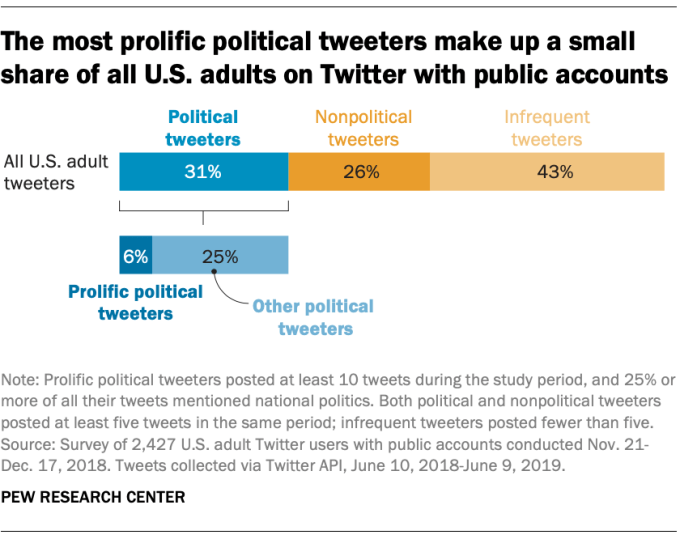
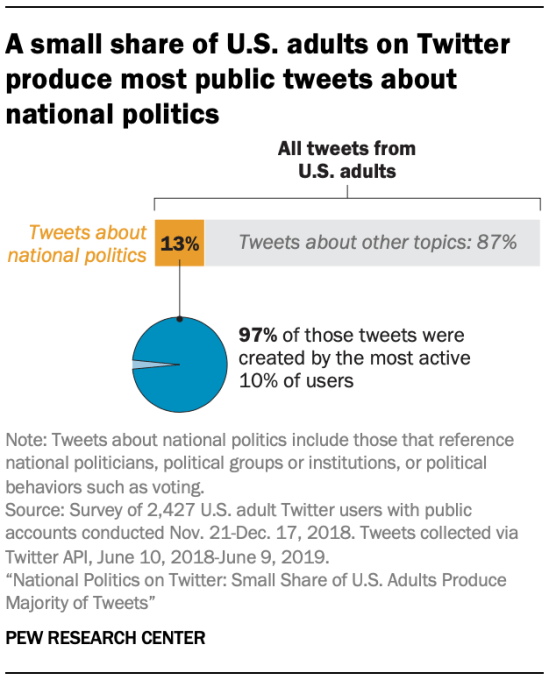
A small number of prolific U.S. Twitter users create the majority of tweets, and that extends to Twitter discussions around politics, according to a new report from the Pew Research Center out today. Building on an earlier study which discovered that 10% of users created 80% of tweets from U.S. adults, the organization today says that just 6% of U.S. adults on Twitter account for 73% of tweets about national politics.

Though your experience on Twitter may differ, based on who you follow, the majority of Twitter users don’t mention politics in their tweets.

FT 19.10.23 PoliticsTwitter Most prolific political tweeters make up small share US adults Twitter public accounts

In fact, Pew found that 69% never tweeted about politics or tweeted about the topic just once. Meanwhile, across all tweets from U.S. adults, only 13% of tweets were focused on national politics.


The study was based on 1.1 million public tweets from June 2018 to June 2019, Pew says. 2,427 users participated.

DL 2019.10.23 politics on twitter 0 01

Similar to its earlier report about how prolific users dominate the overall conversation, Pew found there’s also a small group of very active Twitter users dominating the conversation about national politics — and they all tend to be heavy news consumers and more polarized in their viewpoints.

Only 22% of U.S. adults even have a Twitter account, and of those, only 31% are defined as “political tweeters” — that is, they’ve posted at least 5 tweets and have posted at least twice about politics during the study period.

Within this broader group of political tweeters, just 6% are defined as “prolific” — meaning they’ve posted at least 10 tweets and at least 25% of their tweets mention national politics.

This small subset then goes on to create 73% of all tweets from U.S. adults on the subject of national politics.

What’s concerning about the data is that it’s those who are either far to the left or far to the right who are the ones dominating the political conversation on Twitter’s platform. A majority of the prolific political tweeters (55%) say they identify as either “very liberal” or “very conservative.” Among the non-political tweeting crowd, only 28% chose a more polarized label for themselves.

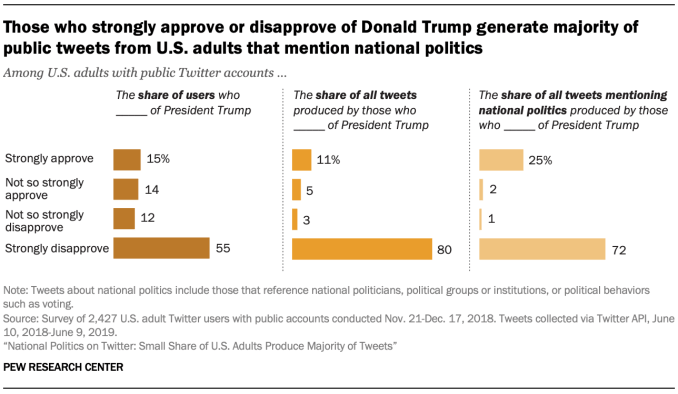
This polarized subgroup also heavily leans left. For example, those who strongly approve of President Trump generated 25% of all tweets mentioning national politics. But those who strongly disapprove of Trump generated 72% of all tweets mentioning national politics. (They’re also responsible for 80% of all tweets from U.S. adults on the platform.)

DL 2019.10.23 politics on twitter 0 02

This isn’t a fully representative picture of U.S. politics. The share of U.S. adults on Twitter who strongly disapprove of Trump (55%) is 7 percentage points higher than the share of the general public that holds this view (48%).

Trump supporters, as a result, are under-represented on Twitter. Perhaps this is because they’ve flocked to alternate platforms; or because don’t tweet their views as often in public; or because they violate Twitter’s policies more often, resulting in bans. Or as is likely, it’s a combination of factors. In any event, the reasoning was beyond the scope of this study.

The study also found the prolific tweeters are highly engaged with the news cycle. 92% follow the news “most of the time,” compared to 58% of non-prolific political tweeters and 53% of non-political tweeters. They’re also civically engaged, as 34% have attended a political rally or event, 57% have contacted an elected official, and 38% have donated to campaigns.

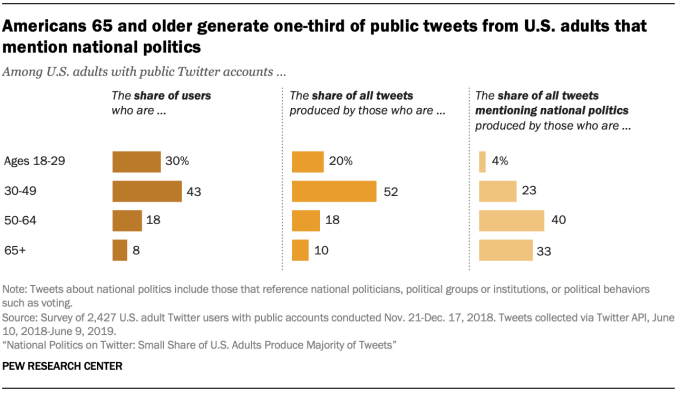
Also of note, the political tweets are more likely to come from older users. Those ages 65 and older produce only 10% of all tweets from U.S. adults, but they contribute 33% of tweets related to national politics. And those 50 and older produce 29% of all tweets but contribute 73% of tweets mentioning national politics.

DL 2019.10.23 politics on twitter 0 04

These political tweeters also create so-called “filter bubbles” where they mostly follow people who think the same as they do. 45% of Democrats said they did this, compared with 25% of Republicans. Across all U.S. adults, 31% of Democrats said they did this, versus 15% of Republicans.

But there is one thing a majority of U.S. Twitter users can agree on: most (57%) believe any news they see on social media is “largely inaccurate.”

The full report is available here.

23 Oct 2019

Small rocket launch startup Firefly teams up with Aerojet Rocketdyne

In a perfect example of a small, new space startup teaming up with a legacy industry heavyweight with plenty of experience, Firefly is teaming up with Aerojet Rocketdyne. Firefly Aerospace was founded in 2013, and has raised $21.6 million so far to bring its first product, the Alpha small satellite launch vehicle, to market.

Firefly is on track to make its crucial first launch in time for the February to March timeframe next year, according to Firefly founder and CEO Dr. Tom Markusic, who spoke at the International Astronautical Congress this year in Washington, D.C., to provide an update on his company’s progress and talk about the newly formed partnership between Firefly and Aerojet Rocketdyne.

Firefly Space Systems CEO Tom Markusic

Firefly founder and CEO Tom Markusic

Markusic was joined by Aerojet Rocketdyne SVP of Space Business Jim Maser, and the two executives explained how Aerojet will provide engines for Firefly to use on its next-generation launch vehicle, aptly named ‘Beta,’ the full development of which will follow once Alpha has launched and enters into regular commercial service.

Beta will be a medium launch vehicle, with greater cargo capacity compared to Alpha and a maxim load of around 8.5 metric tons. Alpha, the startup’s first rocket, will be able to take 1 metric ton to orbit, which Markusic said his company has identified as the “sweet spot” for current unaddressed demand.

That medium band is also underserved, Markusic said, and since it’ll need a bigger booster to transport that larger cargo capacity to orbit, they looked around for solutions and found that Aerojet Rocketdyne’s AR-1 Engine, which can produce 500,000 lbs of thrust, was the perfect solution.

In general Markusic and Maser both expressed the opinion that startup and younger companies just getting into the industry are prime partners for older companies like Aerojet, which was founded in 1942 and has been serving the rocket and missile industry ever since.

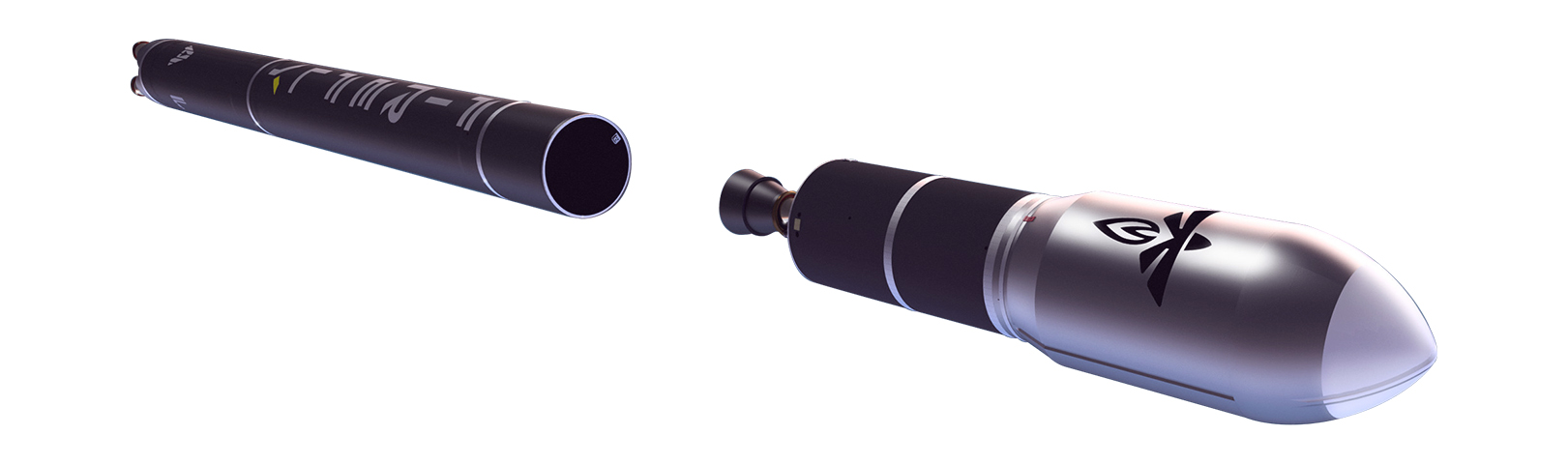
firefly alpha

Firefly’s Alpha launch vehicle

“It’s okay to move fast and it’s okay to make mistakes, but let’s not make other peoples’ mistakes and let’s not make our own mistakes twice,” Markusic said, characterizing the benefits of teaming up with someone with lots more experience. This partnership goes beyond just the engine supply arrangement, Markusic said, and will provide more far ranging benefits for the startup.

“Aerojet Rocketdyne has a whole corral of amazing in space propulsion options for example the XR-5,” Markusic said. “Which is a five kilowatt hull thruster that can be utilized on our OTV (orbital transfer vehicle), and advanced OTV, we could do some heavier missions in cis-lunar space, and they also have a large corral of flight proven by proposed chemical thrusters that can be used on these other stages as well.”

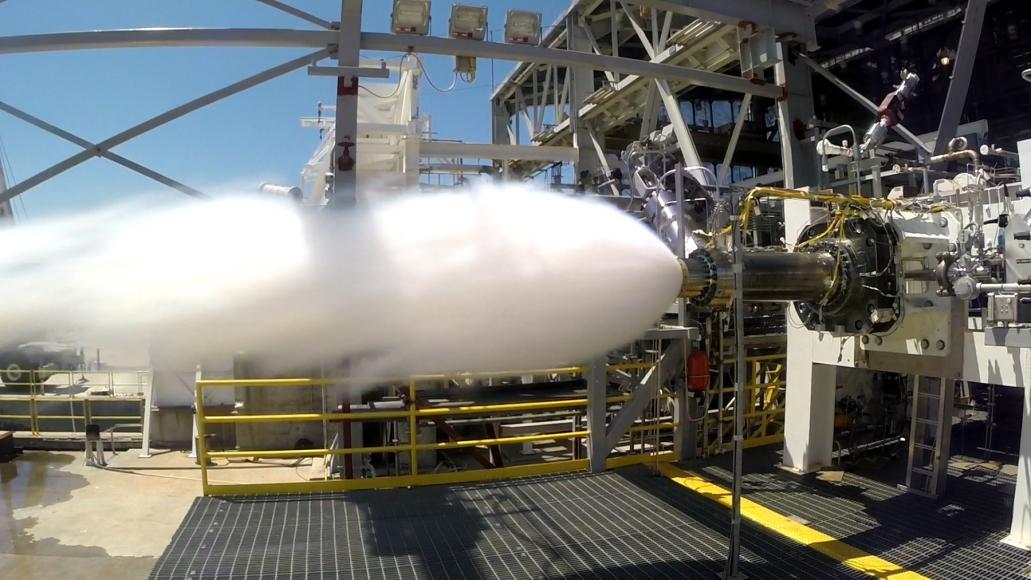
AR1 Successful Engine Preburner Test min

Aerojet Rocketdyne’s AR-1 engine undergoing a preburner test

Firefly plans to do an orbital transfer vehicle to provide more advanced launch capabilities, and its ambitions extend even beyond launchers and to in-space manufacturing, which Markusic said is attractive to the company since the ultimate way to reduce launch costs is to obviate the need for launch costs altogether, and the company’s ultimate goal is to get more commercial satellites into orbit, regardless of method. Still, there’s plenty of opportunity bu Markusic says ultimate, the company’s biggest challenge right now is remaining focused on their most immediate, and most important goal.

“Their are at least 100 companies like Firefly talking about going to space,” he said. “We’re in that crowd of talkers right now, and it is my focus with this company to get us out of that crowd of people talking about it as soon as possible, and into the elite crowd of people that are actually flying a spacecraft to space.”

23 Oct 2019

Daily Crunch: SoftBank throws WeWork a lifeline

The Daily Crunch is TechCrunch’s roundup of our biggest and most important stories. If you’d like to get this delivered to your inbox every day at around 9am Pacific, you can subscribe here.

1. WeWork confirms an up to $8 billion lifeline from SoftBank Group; names new executive chairman

Confirming earlier reports, The We Company and SoftBank Group have agreed to a new capital infusion, which will see SoftBank committing $5 billion in new financing and issuing a tender offer for another $3 billion in buybacks for shareholders.

After the closing and the tender offer, SoftBank will own approximately 80% of The We Company, according to a statement. However, it will not hold a majority of voting rights, thanks to WeWork’s convoluted ownership structure.

2. Former SAP CEO Bill McDermott taking over as ServiceNow CEO

When Bill McDermott announced he was stepping down as CEO at SAP a couple of weeks ago, it certainly felt like a curious move — but he landed on his feet pretty quickly.

3. Fabric raises $110 million Series B to expand its network of automated fulfillment centers in the US

Last October, Fabric opened its first micro-fulfillment center in Tel Aviv, giving an inside look into how the company’s system works: Robots move around the warehouse, picking up inventory so human workers can stay at a scanning station.

4. Snapchat beats in Q3, adding 7M users & revenue up 50%

The Snap-back continues.

5. Google’s Play Store is giving an age-rating finger to Fleksy, a Gboard rival

Do a search on Google’s Play Store in Europe and you’ll find the company’s own Gboard app has an age rating of PEGI 3. But if you do a similar search for the rival Fleksy keyboard app, you’ll find it has a PEGI 12 age rating.

6. How tech companies measure ‘legal’

Interviews with tech company general counsels — and a survey conducted by TechGC — reveal how innovative in-house attorneys measure both productivity and quality, and position their teams as central to advancing enterprise-wide goals. (Extra Crunch membership required.)

7. Somehow, ‘Dark Fate’ got me excited about the Terminator again

The new Terminator movie — in which Linda Hamilton returns to the role of Sarah Connor — is surprisingly good.

23 Oct 2019

Tesla third-quarter earnings: What to expect and what we’re watching for

Tesla is scheduled to report its third-quarter earnings after the market closes today. The earnings report comes at a critical time for Tesla as it prepares to begin production of the Model 3 at its new China factory.

This earnings report, its first without co-founder and CTO JB Straubel on the job, is particularly important because it could be the first time that the company experiences a year-over-year decline in quarterly revenue growth.

There are some important matters — namely numbers — to watch for in the automaker’s actual earnings report. Before getting into which indicators to pay attention to here’s a quick recap of what happened in the last quarter.

Tesla reported wider-than-expected loss of $408 million, or $2.31 per share, and generated $6.3 billion in revenue in the second quarter despite record deliveries of its electric vehicles. The company delivered 95,200 of its electric vehicles in the second quarter, a dramatic reversal from a disappointing first period. Those numbers were later since adjusted to 95,356 vehicles. The record-breaking figures in the second quarter stood in stark contrast to the company’s first quarter delivery numbers when it reported deliveries of 63,000 vehicles, nearly a one-third drop from the previous period.

What to expect

Analysts are expecting a loss of 46 cents per share and revenue of $6.42 billion, according to data compiled by FactSet. If analysts are correct, revenue would be down from $6.82 billion a year ago.

We already know that Tesla fell short of its third-quarter delivery goals. Tesla CEO Elon Musk wanted, and pushed for, deliveries to hit 100,000 vehicles for the quarter. Instead, Tesla reported earlier this month that it delivered a record 97,000 electric vehicles in the third quarter, a nearly 2% increase from the previous period, but still short of analysts’ expectations.

Tesla produced 96,155 vehicles in the third quarter, a 10% increase from the previous period.

Expect Tesla to provide updates on its China factory and give forecasts for the fourth quarter. The earnings call with analysts, which begins at 3:30 pm PT, will likely provide plenty of other headlines. Musk has a tendency to drop all kinds of news in these calls.

Among the items we’ll be watching for is any discussion on Autopilot and its “FSD” (full self-driving) program, the company’s energy business, production plans for the Model Y, status of the Tesla Semi and other often teased future models such as the Roadster and the yet-to-be-unveiled pickup truck.

Analysts will likely be hunting for any information on automotive gross margins. In the past, Tesla has said it is targeting 25% automotive gross margins for Model S, Model X and Model 3. That didn’t happen in the first or second quarter. Instead, automotive gross margins, excluding certain items, shrank to 20.3% from 24.7% in the fourth quarter of 2018. They narrowed even further to 18.9% in the second quarter.

Tesla’s margins were buffeted in the past by sales of the higher-priced (and better margin per vehicle) Model S and X. Now Tesla is in an awkward spot where demand for the Model 3 hasn’t been enough to stave off contracting margins caused by a decline in Model S and X sales. Model 3s have a lower profit margin per vehicle than the S or X.

23 Oct 2019

OnePlus’ second 5G phone will be a T-Mobile exclusive

OnePlus’ 5G strategy has marked something of a shift for a company that has traditionally prided itself in a slow and steady approach to new features. Following the arrival of the OnePlus 7 Pro 5G this summer, the company is announcing its second 5G device for the U.S. market.

This time, it’s opted for its longer-time carrier partner, T-Mobile. Though soon enough, the distinction between the U.S.’s third and fourth place wireless carriers may be moot. For now, however, the OnePlus 7T Pro McLaren Edition is a T-Mobile exclusive here in the States.

For the record, the 7T Pro and the new McLaren Edition are pretty similar, though the latter gets a flashier color scheme and some pretty beefy specs, including an extremely generous 12GB of RAM.

Along with being OnePlus’ second 5G handset, it’s also the second T-Mobile device to support the next-gen network, following the already announced (but not yet released) Galaxy Note 10 Plus 5G. As for the state of T-Mobile’s 5G roll out, the company promises to “cover 200 million people nationwide this year.”