Year: 2019

21 Oct 2019

Microsoft acquires Mover to help with Microsoft 365 cloud migration

Microsoft wants to make it as easy as possible to migrate to Microsoft 365, and today the company announced it had purchased a Canadian startup called Mover to help. The companies did not reveal the acquisition price.

Microsoft 365 is the company’s bundle that includes Office 365, Microsoft Teams, security tools and workflow. The idea is to provide customers with a soup-to-nuts, cloud-based productivity package. Mover helps customers get files from another service into the Microsoft 365 cloud.

As Jeff Tepper wrote in a post on the Official Microsoft Blog announcing the acquisition, this about helping customers get to the Microsoft cloud as quickly and smoothly as possible. “Today, Mover supports migration from over a dozen cloud service providers — including Box, Dropbox, Egnyte, and Google Drive — into OneDrive and SharePoint, enabling seamless file collaboration across Microsoft 365 apps and services, including the Office apps and Microsoft Teams,” Tepper wrote.

Tepper also points out that they will be gaining the expertise of the Mover team as it moves to Microsoft and helps add to the migration tools already in place.

Tony Byrne, founder and principal analyst at Real Story Group, says that moving files from one system to another like this can be extremely challenging regardless of how you do it, and the file transfer mechanism is only part of it. “The transition to 365 from an on-prem system or competing cloud supplier is never a migration, per se. It’s a rebuild, with a completely different UX, admin model, set of services, and operational assumptions all built into the Microsoft cloud offering,” Byrne explained.

Mover is based in Calgary, Canada. It was founded in 2012 and raised $1 million, according to Crunchbase data. It counts some big clients as customers including AutoDesk, Symantec and BuzzFeed.

21 Oct 2019

Shine Bathroom raises $750K for a smart home add-on that flushes away your toilet doldrums

One ongoing theme in the world of smart homes has been the emergence of gadgets and other tools that can turn “ordinary” objects and systems into “connected” ones — removing the need to replace things wholesale that still essentially work, while still applying technology to improve the ways that they can be used.

In the latest development, a smart home startup from Santa Barbara called Shine Bathroom has raised $750,000 in seed funding to help build and distribute its first product: an accessory that you attach to an existing toilet to make it a “smart toilet.”

It’s a dirty business, but someone had to do it.

Shine’s immediate goal is to flush away the old, ecologically unfriendly way of cleaning toilets; and to provide the tools to detect when something is not working right in the plumbing, even helping you fix it without calling out a plumber.

The longer-term vision is to apply technology and science to rethink the whole bathroom to put less strain on our natural resources, and to use it in a way that lines up with what we want to do as consumers, using this first product to test that market.

“Bathrooms are evolving from places where we practice basic hygiene to where we prepare ourselves for the day,” said Chris Herbert, the founder and CEO of Shine. “Wellness and self care will be happening more in the home, and this is a big opportunity.”

Intro

Shine’s first injection of money is coming from two VCs also based in Southern California: Entrada Ventures (like Shine also in Santa Barbara), and Mucker Capital, an LA fund specifically backing startups not based in Silicon Valley (others in its current porfolio include Naritiv, Everipedia and Next Trucking).

The Shine Bathroom Assistant, as the first product is called, is currently being sold via Indiegogo starting at $99, with the first products expected to ship in February 2020.

It’s a fitting challenge for a hardware entrepreneur: toilets are a necessary part of our modern lives, but they are unloved, and they haven’t really been innovated for a long time.

Herbert admitted to me (and I’m sure Freud would have something to say here, too) that this has been something of a years-long obsession, stretching back to when he made a trip to Japan as a sophomore in high school and was struck by how companies like Toto were innovating in the business, with fancy, all-cleaning (and all-singing and dancing) loos.

“We thought to ourselves, how could we make a better bathroom?” he said. “We decided that the answer was through software. When you take a thesis like that, you can see lots of opportunity.”

Sized similar to an Amazon Echo or other connected home speaker, Shine’s toilet attachment is battery operated and comes in three parts: a water vessel, a sensor and spraying nozzle that you place inside your toilet bowl, and a third sensor fitted with an accelerometer that you attach to the main line that fills up the toilet’s tank. The vessel is filled with tap water (which you replace periodically).

That water is passed through a special filter that electrolyzes it (by sending a current through the water) and then sprays it with every flush to clean and deodarize. Shine claims this spraying technique is five times as powerful as traditional deodarizing spray, and as powerful as bleach, but without the harsh chemicals: the water converts back into saline after it does its work. (And to be clear, there are no soaps or other detergents involved.)

Alongside the cleaning features, the second part of the bathroom assistant is Sam, an AI on your phone. Linked up to the hardware and sensors, Sam identifies common toilet problems, such as leaks that trickle out hundreds of gallons of water, by measuring variations in vibrations, and when it does, it sends out a free repair kit to fix it yourself.

Users can also link up Sam to work with Alexa to order the machine to clean, check water levels, and do more in future.

AlexaAskSam

The solution of monitoring vibrations is notable for how it links up with a past entrepreneurial life for Herbert and some of his team.

Herbert was one of two co-founders of Trackr, a Tile-like product that also played on the idea of making “dumb” objects smart: Trackr’s basic product was a small fob with Bluetooth inside it that could be attached to keys, wallets, bags and more to find their location when they were misplaced.

The company’s longer term goals extended into the area of IoT and how “dumb” machines could be made smarter by attaching sensors to them to monitor vibrations and sounds to determine how they were working — concepts that never materialised at Trackr but have found a new life at Shine.

On the other hand, Trackr is a cautionary tale about how a good idea can be inspiring, but not always enough.

The startup in its time raised more than $70 million, from a set of investors that included Amazon, Revolution, NTT, the Foundry Group and more. Ultimately, the basic concept was too commoditized (trackers are a dime a dozen on Amazon), Tile emerged as the market leader among the independents — a position it’s used to evolve its product — but even so, that’s before we’ve even determined if there really is a profitable business to be had here, and if platform companies potentially make their move to upset it in a different way.

Eventually, Trackr’s team (including Herbert) scattered and a new leadership team came in and rebranded to Adero . Now, even that team is gone, with the CEO Nate Kelly and others decamping to Glowforge. Multiple attempts to contact the company have been unanswered, although from what we understand, it’s not down for the count just yet. (Watch this space.)

“There is still something there, and I hope they can do something,” Herbert said of his previous startup.  

Meanwhile, he and several of his ex-Trackr colleagues have now turned their attention to a new shiny challenge, the toilet and the bigger bathroom where it sits, and investors want in.

“We were impressed by Shine’s vision for a bathroom to better prepare us for our day head and saw a massively overlooked opportunity in the bathroom space” said Taylor Tyng from Entrada Ventures.


21 Oct 2019

Africa: more gazelles at home than unicorn IPOs abroad

At the recent TechCrunch Disrupt SF, Senegalese VC investor Marieme Diop suggested that Silicon Valley’s unicorn IPO model might not be right for African startups.

The is largely because the continent’s startups face a vastly different macro business environment, Diop explained during a discussion of investing in Africa with 500 Startups’ Sheel Mohnot and IFC’s Wale Ayeni. In a subsequent conversation, she clarified an alternative approach for African startups to raise capital from public listings.

“It might be a better option to set lower revenue expectations and have startups list on local exchanges to raise capital from IPOs when they’re ready,” said Diop. “We may be able to create more gazelles at home than unicorns abroad,”

Disrupt SF 2019 Africa Investing Session Diop Mohnot Ayeni

A gazelle at home could be a company valued at a $100 million or more and generating revenues of $15 to $50 million, according to Diop.

“We should have a discussion of setting a right valuation, a valuation that is more appropriate to African startups,” she said.

A VC investor at Orange Digital Ventures and co-founder of Dakar Angels Network, Diop’s perspective comes in the wake of Jumia’s going public on the New York Stock Exchange this April.

The e-commerce venture became the first VC-funded digital company operating in Africa to list on a major global exchange, a fact that may have raised expectations for additional $100 million revenue tech firms creating unicorns and IPOs in Africa.

The $100 million revenue point has served as the unofficial IPO benchmark for startups and investors; after reaching unicorn status in 2014, Jumia achieved it last year (with big losses in tow).

But as I mentioned in a previous Extra Crunch piece, it will be difficult for startups operating in Africa to hit that revenue mark, even with all the leaps and bounds occurring in the continent’s economies and tech sector. The overall operating environment is still fairly costly and challenging, compared to other regions.

21 Oct 2019

YouTube founder secretly building sports fan game GreenPark

Chad Hurley is hunting for what comes after fantasy sports. He envisions a new way for fans to play by watching live and cheering for the athletes they love. Beyond a few scraps of info the YouTube co-founder would share and his new startup’s job listings revealed, we don’t know what Hurley’s game will feel like. But the company is called GreenPark Sports, and it’s launching in Spring 2020.

“There is an absence of compelling, inclusive ways for large masses of sports fans to compete together” Hurley tells me. “The idea of a ‘sports fan’ has evolved – it is now more a social behavior than ever before. We’re looking at a much bigger, inclusive way for all fans of sports and esports teams to play.”

GreenPark Sports Chad Hurley


Hurley already has an all-star team. One of GreenPark’s co-founders Nick Swinmurn helped start Zappos, while another Ken Martin created marketing agency Blitz. Together they’ve raised an $8.5 million seed round led by SignalFire and joined by Sapphire Sports and Founders Fund. “With this team’s impeccable track record and vision for the future of fandom, this was an investment we had to make,” said Chris Farmer, founder and CEO of SignalFire.

It all comes down to allegiance — something Hurley, Swinmurn, and Martin truly understand. Everyone is seeking ways to belong and emblems to represent them. In an age when many of our most prized possessions from photographs to record collections have been digitized, we lack tangible objects that center our individuality. Culture increasingly centers around landmark events, with what we’ve done mattering more than what we own.

GreenPark could seize upon this moment by helping us to align our identities with a team. This instantly unlocks a likeminded community, a recurrent activity, and a unified aesthetic. And when reality gets heavy, people can lose themselves by hitching their spirits to the scoreboard.

Rather than just tabulating results after the match like in fantasy sports, GreenPark wants to be entwined with the spectacle as it happens. “We’re going to be working with a mix of ways to visualize the live game – from unique gamecast-like data to highlight clips. The social viewing experience can be much more than just the straight live video” Hurley explains.

GreenPark Sports Logo

He came up with GreenPark after selling assets of his video editing app Mixbit to BlueJeans a year ago. Hurley already had an interactive relationship with sports…though one that’s reserved for the rich: he’s part owner of the Golden State Warriors and Los Angeles Football Club. Meanwhile, Swinmurn co-founded the Burlingame Dragons Football Club affiliated with San Jose’s team, and is on the board of Denmark’s FC Helsingør.

Those experiences taught them the satisfaction that comes from a deeper sense of ownership or allegiance with a team. GreenPark will give an opportunity for anyone to turn fandom into its own sport. “We shared a love of sports and set out to look into opportunities around legalized sports betting in the US” Hurley tells me.” But quickly they found “it was obvious the regulated space wouldn’t allow us to innovate as quickly as we wanted” and they saw a more opportunity amidst a younger mainstream audience.

“We’re not ready to disclose publicly the exact detailed gameplay yet” Hurley says. But here’s what we could cobble together from around the web.

GreenPark Sports lets you “Destroy the other teams’ fans” to “climb the leaderboards”, its site says cryptically. According to job listings, it will pipe in live game data, starting with the NBA and expanding to other leagues, and offer cartoon characters with facial expressions and full-body gestures to let users live out the highs and lows of matches. Don’t expect trivia questions or player stat memorization. It almost sounds like a massively multiplayer online fan arena. 

As with blockbuster games Fortnite or League Of Legends, GreenPark is free-to-play. But a mention of virtual clothing hints at monetization, where you could spruce up avatars with digital team apparel. Hurley tells me “We are in the perfect storm of the thirst for innovation at the traditional league level, the next level of maturing for esports, investment in sports betting and overall dire need to better understand today’s largest populace of sports fans – Millenial / Gen Z.” The closed beta launches in the Spring.

Screen Shot 2019 10 21 at 9.45.29 AM

There’s a massive hole to fill in the wake of the Draft Kings / FanDuel marketing sure a few years ago. Most apps in the space just carry scores or analysis, rather than community. “What’s amazing about being a fan of a team or player is the common bond you have with other fans” Hurley explains, “where even if you don’t know the other fans of your team – you are all in it to win it – together.”

Publications like The Athletic have proven there are plenty of fans willing to pay to feel closer to their favorite teams. The most direct competitor for GreenPark might be Strafe, that lets you track and predict the winners of esports matches.

People already spend tons of time on building fictional worlds like Minecraft and money outfitting their Fortnite avatar with the coolest clothes. If GreenPark can create a space for sports’ fan self-expression, it could create the online destination for legions of IRL enthusiasts that see who they root for as core to who they are.

21 Oct 2019

Sydney’s AirTree Ventures closes $275M fund as Aussie unicorns gather pace

The Australian scene industry has, in the last few years, started to generate a swathe of startups that have broken through internationally. Prior to this current era, Australia was scene has very much a local market in tech terms, with only occasional breakouts, like Atlassian . In fact, it’s now gaining a reputation as a serial producer of high-quality tech platforms, the hottest of which right now is Canva, which recently raised an additional $85 million to bring its valuation to $3.2 billion, up from $2.5 billion in May. Investors in the company include Bond, General Catalyst, Bessemer Venture Partners, Blackbird and Sequoia China. Notably, Sydney-based AirTree Ventures also invested early.

So that momentum is further confirmed by the news that Airtree has closed its 3rd fund of $275m. This new fund comes after AirTree’s $250m fund in 2016 and a $60m fund in 2014. You can clearly see the buildup in these numbers.

John Henderson, Partner said: “The interest from investors in our fund is a stunning reflection on the performance of the entrepreneurs we’ve been lucky enough to back. We were humbled by overwhelming demand, but felt it was the right thing for our investors to maintain discipline and a consistent fund size across vintages.”

Australian venture capital was less than fashionable after the dotcom boom and bust, and local institutional capital in Australia and New Zealand all but disappeared, hence why we saw so few startups form the region.

AirTree’s $60m fund in 2014, broke that drought and Australia now boasts over 50 tech startups valued at $100 million, 14 over $500 million and produces one ‘unicorn’ per year on average.

Airtree has gone on to invest in Australian and Kiwi startups like Canva, Prospa, Secure Code Warrior, Athena, Flurosat, Brighte, Joyous, Thematic and A Cloud Guru. Prospa, Australia’s main online lender to small businesses, IPO’ed on the Australian Stock Exchange in June 2019.

Airtree can invest as little as $200k, but now has the firepower to own the pipeline all the way up the investment stack.

Craig Blair, Managing Partner commented: “As ex-founders, we have experienced the tough, lonely road ourselves. This empathy with the founder journey helps us focus on when to provide support and when to get out of the way. In our next fund, we’ll be expanding our suite of services and our network of connections, all designed to give our founders an unfair advantage.”

The VC also announced two promotions and a new executive hire:

• Elicia McDonald promoted to Principal, with a mandate to lead new investments
• Emily Close joining the investment team, promoted to Associate
• Melissa Ran leading AirTree’s Community and Advocacy efforts

AirTree’s latest fund is backed by six institutional investors from Australia including AustralianSuper, SunSuper and Statewide. The rest of the new fund comes from a range of successful entrepreneurs and family offices.

Henderson added: “An important portion of our portfolio is already in New Zealand and we remain very focused on supporting that market. We’ve been investing meaningful resources and funds in New Zealand since 2014 and we’ll have more Kiwi news to share soon.”

The fund raise follows news that AirTree portfolio company Property-tech start-up :Different has raised a second round of capital from AirTree, alongside Brisbane-based real estate fund PieLAB, as it expands into Queensland.

21 Oct 2019

Moon’s browser extension lets you pay with bitcoin on Amazon

Meet Moon, a three-person startup that lets you pay for stuff on Amazon using bitcoin via the Lightning Network, bitcoin, Litecoin or Ether. The company has released a desktop browser extension for Google Chrome, Brave and Opera.

While some e-commerce retailers let you pay with cryptocurrencies, the biggest e-commerce platforms have yet to accept cryptocurrencies. Moon doesn’t want to wait and wants to make it possible to pay with cryptocurrencies using current payment methods.

After installing the extension, Moon automatically recognizes when you’re on an Amazon checkout page and inserts the company’s own payment widget. You can see how much you’re going to pay in cryptocurrencies before accepting the transaction.

Right now, Moon lets you pay using two different ways. You can pay with any bitcoin wallet that works on top of the Lightning Network. Normal bitcoin transactions can take minutes to be confirmed on the bitcoin blockchain. The Lightning Network lets you open a payment channel between Lightning nodes to enable fast transactions.

Moon also lets you pay with your crypto balance on your Coinbase account. This way, if you hold bitcoin, Litecoin, Ether, etc. on your Coinbase account, you can also pay in seconds by leveraging Coinbase’s API.

Behind the scene, Moon uses prepaid value on Amazon. When you pay with Moon, the service automatically converts your cryptocurrencies, tops up your Amazon account and pays with your Amazon balance. Moon doesn’t charge additional fees.

In the future, Moon plans to expand beyond the U.S. and Canada and let customers in Europe use the browser extension. Similarly, Moon wants to expand to other e-commerce websites. Moon participated in the Entrepreneurs Roundtable Accelerator.

21 Oct 2019

Nielsen says it can now measure Amazon Prime Video

Nielsen announced this morning it will now be able to measure the viewing taking place on Amazon Prime Video, through its Subscription Video on Demand Content Ratings solution. This product, first launched two years ago, was originally focused on measuring Netflix’s viewing numbers with promises to add support for measuring Prime Video in 2018.

Though delayed by a year, that Prime Video measurement is now available.

Through Nielsen’s service, clients will have access to the measurement data for their own content, as well as the total content lifecycle for competitive media — whether it’s live, content-shifted viewing, steamed or available through video-on-demand, Nielsen says.

As with Netflix, however, Nielsen is able to measure only the Amazon Prime Video streams taking place in the U.S. via TVs. This includes through connected and smart devices — like streaming media players, for example.

That limitation has been a point of criticism from Netflix, which routinely dismisses Nielsen’s accuracy because it misses streams coming from mobile devices and PCs. But insiders now say Nielsen’s numbers are fairly close, according to a Variety report from earlier this year, which detailed how Nielsen’s numbers backed up Netflix’s claims about its hit movie “Bird Box.”

Plus, those missing mobile and PCs streams may not be as important in terms of U.S. viewership as you may think. Although many U.S. consumers are cutting the cord with traditional linear TV, they still often watch their streamed shows on the TV’s big screen. Hulu, for example, said last year that as much as 78% of its viewing takes place on a TV, to give you an idea.

For networks and studios, Nielsen’s SVOD measurement numbers help provide insight into what otherwise can be a bit of a black box. Although Netflix argued during its Q3 earnings last week that it does now share some viewing data with producers, it can be hard for studios and networks to put those numbers in context.

“Nielsen’s measurement in the SVOD space is invaluable for our studio to understand how our programs perform on these platforms and the audiences they attract,” said James Petretti, SVP, U.S. Research and Analytics at Sony Pictures Television, in a statement. “It becomes even more exciting for us, because Nielsen has the ability to help us understand what these audiences are doing outside of those platforms as well— how and what they are watching on other on-demand and linear services,” he continued.

“We are also able to understand the impact of traditional linear advertising driving viewers to these SVOD programs so what Nielsen is providing is extraordinarily compelling,” said Petretti.

To kick off its news of new capabilities, Nielsen also offered a few examples of what sort of data its Prime Video measurements can deliver.

The company says the Amazon Prime Video show “The Boys” averaged 4.1 million viewers per episode, with its premier averaging a little over 6 million. The largest share (39%) of viewers aged 35 to 49, it also said. And within the first 10 days, the show had reached nearly 8 million viewers across its 8-episode season.

“This is a significant milestone for Nielsen, especially considering the upcoming high-profile streaming service launches,” said  Brian Fuhrer, SVP Product Leadership, Nielsen, in a statement. “We think the addition of Amazon Prime Video will allow rights owners an added ability to understand both the size, as well as the composition, of their streaming audiences relative to other platforms or programs. Beyond that, making this enhancement re-affirms our commitment to continuous improvement and to being the one media truth of an increasingly-fragmented video landscape,” he added.

We’ve reached out to Amazon for comment and will update if one is provided.


21 Oct 2019

Apple’s control over the App Store is no longer sustainable

Last week, Apple caved to the Chinese government and pulled an app called HKmap.live that was being used by Hong Kong protestors to crowdsource the location of police forces.

While Apple CEO Tim Cook defended Apple’s stance, the move is a reminder that Apple is the only judge and jury regarding what’s acceptable in the App Store — but as mobile devices are integrated into more aspects of our lives, it’s getting harder to justify such tight control over their software.

The current state of the App Store is a great example of the risks of running a marketplace that becomes too big. It also shows that we can expect wide-ranging marketplace regulation in the near future.

The App Store as video game console

Before Apple introduced the App Store in 2008, companies could distribute third-party apps and web services without oversight; consumers could buy floppy disks, download software from the internet or connect to any website.

But with the App Store, Apple decided to control the user experience from approval to distribution. And it has been a massive economic success. There are more than 2.2 million apps in the App Store that have generated over 130 billion downloads.

In many ways, the iOS app ecosystem works more like a video game console than a computer — developers submit games and apps to the maker of the platform, which starts a review process to see if third-party content complies with guidelines. If so, developers may list their game or app on the platform.

The PlayStation 4 has been around for six years and Sony has approved 2,294 games in total, around 380 games per year. Due to the sheer size of the App Store, Apple has faced challenges that console manufacturers have never faced.

Review guidelines are poorly enforced

Apple has written the App Store Review Guidelines, a lengthy document intended to answer all questions about what’s acceptable — but those rules are not enforced consistently, and the App Store isn’t a level playing field, discrepancies I’ve pointed out in the past.

As an example: rule 4.3, titled “Spam:”

Don’t create multiple Bundle IDs of the same app. If your app has different versions for specific locations, sports teams, universities, etc., consider submitting a single app and provide the variations using in-app purchase. Also avoid piling on to a category that is already saturated; the App Store has enough fart, burp, flashlight, and Kama Sutra apps already. Spamming the store may lead to your removal from the Developer Program.

And yet, customers can find plenty of categories with app duplicates and companies trying to game the App Store. For example, I found 13 different VoIP apps released by four companies. Each company had multiple versions of the same app in order to pick different names, keywords and categories to optimize search results.

When I pointed this out to Apple, they removed most of the duplicates in less than 24 hours, but it can’t remain the single source of truth if it doesn’t enforce its own rules properly.

Similarly, as Under the Radar recently pointed out, some developers will always find ways to abuse the App Store. For instance, shady developers acquire apps with a lot of positive ratings, transfer those apps to their own developer account, push updates with expensive weekly recurring subscriptions and take advantage of Apple’s obscure process to cancel subscriptions.

Economic interests first

In its most recent earnings release, Apple reported that Greater China represented 17% of the company’s revenue. The company also manufactures the vast majority of its products in Chinese factories. Apple has a lot to lose in China.

That’s why Apple’s actions in China don’t reflect the company’s principles. Cupertino claims to care deeply about privacy, but it uploads iCloud user data to a state-owned mobile operator in China.

The company says that it cares deeply about privacy but uploads iCloud user data to a state-owned mobile operator in China

Apple first removed HKmap.live from the App Store, then authorized the app again before removing it one more time. The only thing that changed between the first second removal is that the Chinese government started openly criticizing Apple about that specific case.

21 Oct 2019

Digital ad spend reached $57.9B in the first half of 2019, but growth has slowed (IAB report)

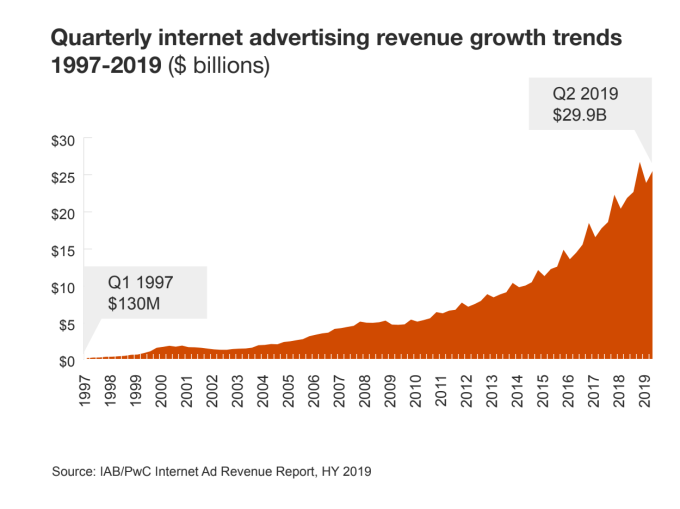
During the first six months of 2019, advertisers spent $57.9 billion on U.S. digital advertising, according to the latest report prepared by PwC for the Interactive Advertising Bureau (an online advertising trade group).

That’s a 17% increase compared to the same period in 2018, and the most spending IAB has ever seen in the first half of the year.

However, PwC’s David Silverman noted that it’s actually “a touch lower” compared to the second six months of last year, marking the first time we haven’t seen continual growth since 2009.

Silverman suggested that one factor contributing to this is slowing growth in mobile and social advertising. To be clear, both sectors are up year-over-year: Mobile ads grew 29% to $30.9 billion, while social media spending increased 26% to $16.5 billion.

But he said, “Those sectors of the industry are likely maturing” — so we’re not seeing the growth levels that we have in recent years.

IAB report

Meanwhile, the IAB’s senior vice president of research and analytics Sue Hogan noted that the dropoff between the end of 2018 and beginning of 2019 amounts to “a rounding error” (in fact, the report puts spending during both periods at $57.9 billion).

Overall, she argued that every category remains “healthy,” and that the big story is the growth in video advertising, which was up 36% to $9.5 billion.

The report also includes numbers around revenue concentration, specifically the amount of ad spend going to the top 10 digital ad companies. It doesn’t name specific companies (Google and Facebook are widely seen as the two giants dominating this space), but it says that revenue concentration in the top 10 has fluctuated between 69% and 77% over the past decade.

During the second quarter of 2019, revenue concentration remained at the top end of that range, specifically 76%. Meanwhile, companies 11 through 25 only accounted for 7%.

21 Oct 2019

EU contracts with Microsoft raising “serious” data concerns, says watchdog

Europe’s chief data protection watchdog has raised concerns over contractual arrangements between Microsoft and the European Union institutions which are making use of its software products and services.

The European Data Protection Supervisor (EDPS) opened an enquiry into the contractual arrangements between EU institutions and the tech giant this April, following changes to rules governing EU outsourcing.

Today it writes [with emphasis]: “Though the investigation is still ongoing, preliminary results reveal serious concerns over the compliance of the relevant contractual terms with data protection rules and the role of Microsoft as a processor for EU institutions using its products and services.”

We’ve reached out to Microsoft for comment.

A spokesperson for the company told Reuters: “We are committed to helping our customers comply with GDPR [General Data Protection Regulation], Regulation 2018/1725 and other applicable laws. We are in discussions with our customers in the EU institutions and will soon announce contractual changes that will address concerns such as those raised by the EDPS.”

The preliminary finding follows risk assessments carried out by the Dutch Ministry of Justice and Security, published this summer, which also found similar issues, per the EDPS.

At issue is whether contractual terms are compatible with EU data protection laws intended to protect individual rights across the region.

“Amended contractual terms, technical safeguards and settings agreed between the Dutch Ministry of Justice and Security and Microsoft to better protect the rights of individuals shows that there is significant scope for improvement in the development of contracts between public administration and the most powerful software developers and online service outsourcers,” the watchdog writes today.

“The EDPS is of the opinion that such solutions should be extended not only to all public and private bodies in the EU, which is our short-term expectation, but also to individuals.”

A conference, jointly organized by the EDPS and the Dutch Ministry, which was held in August, brought together EU customers of cloud giants to work on a joint response to tackle regulatory risks related to cloud software provision. The event agenda included a debate on what was billed as “Strategic Vendor Management with respect to hyperscalers such as Microsoft, Amazon Web Services and Google”.

The EDPS says the idea for The Hague Forum — as it’s been named — is to develop a common strategy to “take back control” over IT services and products sold to the public sector by cloud giants.

Such as by creating standard contracts with fair terms for public administration, instead of the EU’s various public bodies feeling forced into accepting T&Cs as written by the same few powerful providers.

Commenting in a statement today, assistant EDPS, Wojciech Wiewiórowski, said: “We expect that the creation of The Hague Forum and the results of our investigation will help improve the data protection compliance of all EU institutions, but we are also committed to driving positive change outside the EU institutions, in order to ensure maximum benefit for as many people as possible. The agreement reached between the Dutch Ministry of Justice and Security and Microsoft on appropriate contractual and technical safeguards and measures to mitigate risks to individuals is a positive step forward. Through The Hague Forum and by reinforcing regulatory cooperation, we aim to ensure that these safeguards and measures apply to all consumers and public authorities living and operating in the EEA.”

EU data protection law means data controllers who make use of third parties to process personal data on their behalf remain accountable for what’s done with the data — meaning EU public institutions have a responsibility to assess risks around cloud provision, and have appropriate contractual and technical safeguards in place to mitigate risks. So there’s a legal imperative to dial up scrutiny of cloud contracts.

In parallel, the EDPS has been pushing for greater transparency in consumer agreements too.

On the latter front Microsoft’s arrangements with consumers using its desktop OS remain under scrutiny in the EU. Earlier this year the Dutch data protection agency referred privacy concerns about how Windows 10 gathers user data to the company’s lead regulator in Europe.

While this summer the company made changes to its privacy policy for its VoIP product Skype and AI assistant Cortana after media reports revealed it employed contractors who could listen in to audio snippets to improve automated translation and inferences.

The French government, meanwhile, has been loudly pursuing a strategy of digital sovereignty to reduce the state’s reliance on foreign tech providers. Though kicking the cloud giant habit may prove harder than ditching Google search.