Year: 2019

21 Oct 2019

Netflix to raise $2 billion in debt to fund more content spending

For the second time this year, Netflix is offering $2 billion in debt to fund its investment in content, including original programming, content acquisitions, investments, and more. The news was announced on Monday morning, and was followed by a slight dip in Netflix’s stock price.

The decision to increase its investment in content production follows Netflix’s well-received earnings beat last week, when it reported revenues of $5.24 billion versus the $5.25 billion expected, and EPS of $1.47 versus the $1.07 expected. Despite missing on subscriber numbers in Q3, Netflix’s stock quickly surged on the news.

However, the streaming service is not out of the woods just yet. It will soon face significant competition — especially among families with children — when Disney+ launches next month. Apple is also poised to launch Apple TV+, NBCU is bringing us Peacock, AT&T’s TimeWarner is debuting HBO Max, and Jeffrey Katzenberg is launching a mobile-only service called Quibi with big-name talent attached.

On their own, each of the new services wouldn’t be likely to unseat Netflix as a top streamer. But combined, they can chip away at Netflix’s user base if consumers decide to ditch and switch, instead of adding on yet another subscription.

On Netflix’s Q3 earnings call, Netflix CEO Reed Hastings even admitted that Disney is going to be “a great competitor.” However, he pointed out that all of the services — including Hulu, YouTube and Amazon Prime –have been competing more with linear TV than with each other.

That said, Netflix still needs to up its content game to keep customers subscribed. And that can be expensive.

“We don’t shy away from taking bold swings if we think the business impact will also be amazing. We don’t close every deal we chase and we don’t chase every deal on the table,” said Hastings, in Netflix’s Q3 letter to shareholders. He added that while not all Netflix’s projects work out, the large and growing subscriber base lets its experiment. And the size of its content budget — $10 billion on P&L spend and $15 billion in cash content spend — helps Netflix from getting too dependent on any single hit show.

The company also said its growing revenue base and expanding margins would allow it to fund more content spending internally, with cash flow freeing up further in 2020 and beyond.

In the meantime, however, Netflix is taking on debt.

In today’s announcement, Netflix says it intends to use the net proceeds from this offering “for general corporate purposes, which may include content acquisitions, production and development, capital expenditures, investments, working capital and potential acquisitions and strategic transactions.”

21 Oct 2019

NordVPN confirms it was hacked

NordVPN, a virtual private network provider that promises to “protect your privacy online,” has confirmed it was hacked.

The admission comes following rumors that the company had been breached. It first emerged that NordVPN had an expired internal private keys exposed, potentially allowing anyone to spin out their own servers imitating NordVPN.

VPN providers are increasingly popular as they ostensibly provide privacy from your internet provider and visiting sites about your internet browsing traffic. That’s why journalists and activists often use these services, particularly when they’re working in hostile states. These providers channel all of your internet traffic through one encrypted pipe, making it more difficult for anyone on the internet to see which sites you are visiting or which apps you are using. But often that means displacing your browsing history from your internet provider to your VPN provider. That’s left many providers open to scrutiny, as often it’s not clear if each provider is logging every site a user visits.

For its part, NordVPN has claimed a “zero logs” policy. “We don’t track, collect, or share your private data,” the company says.

But the breach is likely to cause alarm that hackers may have been in a position to access some user data.

NordVPN told TechCrunch that one of its datacenters was accessed in March 2018. “One of the datacenters in Finland we are renting our servers from was accessed with no authorization,” said NordVPN spokesperson Laura Tyrell.

The attacker gained access to the server — which had been active for about a month — by exploiting an insecure remote management system left by the datacenter provider, which NordVPN said they were unaware that such a system existed.

NordVPN did not name the datacenter provider.

“The server itself did not contain any user activity logs; none of our applications send user-created credentials for authentication, so usernames and passwords couldn’t have been intercepted either,” said the spokesperson. “On the same note, the only possible way to abuse the website traffic was by performing a personalized and complicated man-in-the-middle attack to intercept a single connection that tried to access NordVPN.”

According to the spokesperson, the expired private key could not have been used to decrypt the VPN traffic on any other server.

NordVPN said it found out about the breach a “few months ago,” but the spokesperson said the breach was not disclosed until today because the company wanted to be “100% sure that each component within our infrastructure is secure.”

A senior security researcher we spoke to who reviewed the statement and other published evidence, but asked not to be named as they work for a company that requires authorization to speak to the press, called these findings “troubling.”

“While this is unconfirmed and we await further forensic evidence, this is an indication of a full remote compromise of this provider’s systems,” the security researcher said. “That should be deeply concerning to anyone who uses or promotes these particular services.”

NordVPN said “no other server on our network has been affected.”

But the security researcher warned that NordVPN was ignoring the larger issue of the attacker’s possible access across the network. “Your car was just stolen and taken on a joy ride and you’re quibbling about which buttons were pushed on the radio?” the researcher said.

The company confirmed it had installed intrusion detection systems, a popular technology that companies use to detect early breaches, but “no-one could know about an undisclosed remote management system left by the [datacenter] provider,” said the spokesperson.

It’s also believed several other VPN providers may have been breached around the same time. Similar records posted online — and seen by TechCrunch — suggest that TorGuard and VikingVPN may have also been compromised, but spokespeople did not return a request for comment.


Got a tip? You can send tips securely over Signal and WhatsApp to +1 646-755-8849. You can also send PGP email with the fingerprint: 4D0E 92F2 E36A EC51 DAAE 5D97 CB8C 15FA EB6C EEA5.

21 Oct 2019

Veteran enterprise exec Bob Stutz is heading back to SAP

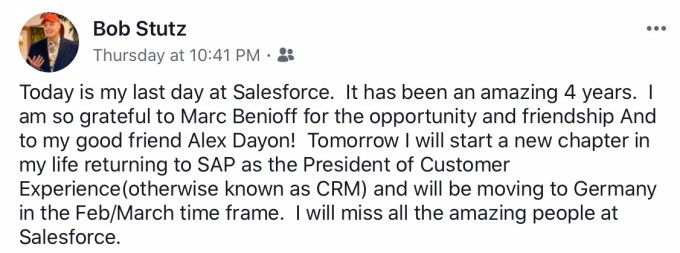
Bob Stutz has had a storied career with enterprise software companies including stints at Siebel Systems, SAP, Microsoft and Salesforce. He announced on Facebook last week that he’s leaving his job as head of the Salesforce Marketing Cloud and heading back to SAP as president of customer experience.

Bob Stutz Facebook announcement

Bob Stutz Facebook announcement

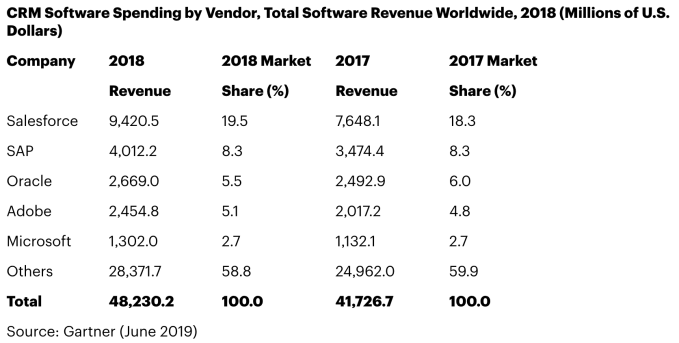
Constellation Research founder and principal analyst Ray Wang says that Stutz has a reputation for taking companies to the next level. He helped put Microsoft CRM on the map (although it still had just 2.7% marketshare in 2018, according to Gartner) and he helped move the needle at Salesforce Marketing Cloud.

Bob Stutz

Bob Stutz, SAP’s new president of customer experience. Photo: Salesforce

“Stutz was the reason Salesforce could grow in the Marketing Cloud and analytics areas. He fixed a lot of the fundamental architectural and development issues at Salesforce, and he did most of the big work in the first 12 months. He got the acquisitions going, as well,” Wang told TechCrunch. He added, “SAP has a big portfolio from CallidusCloud to Hybris to Qualtrics to put together. Bob is the guy you bring in to take a team to the next level.”

Brent Leary, who is a long-time CRM industry watcher, says the move makes a lot of sense for SAP. “Having Bob return to head up their Customer Experience business is a huge win for SAP. He’s been everywhere, and everywhere he’s been was better for it. And going back to SAP at this particular time may be his biggest challenge, but he’s the right person for this particular challenge,” Leary said.

Screenshot 2019 10 21 09.15.45

The move comes against the backdrop of lots of changes going on at the German software giant. Just last week, long-time CEO Bill McDermott announced he was stepping down, and that Jennifer Morgan and Christian Klein would be replacing him as co-CEOs. Earlier this year, the company saw a line of other long-time executives and board members head out the door including including SAP SuccessFactors COO Brigette McInnis-Day, Robert Enslin, president of its cloud business and a board member, CTO Björn Goerke and Bernd Leukert, a member of the executive board.

Having Stutz on board could help stabilize the situation somewhat, as he brings more than 25 years of solid software company experience to bear on the company.

21 Oct 2019

AT&T TV Now streaming service gets yet another price hike

AT&T’s streaming service is again raising prices. AT&T’s TV Now, the service previously known as DirecTV Now, is bumping up its prices yet again — by as much as 30%, Bloomberg reported and AT&T confirmed. Subscribers who were on the $50 Plus tier will now have to pay $65, while those on the $70 Max tier will pay $80 per month.

The prices will go into effect for both new and existing customers — meaning, no one is getting grandfathered into their current pricing, this time around.

The company had previously revamped its plans earlier this year, where it introduced the new Plus and Max tiers, and had raised rates. However, at that time, existing subscribers were able to stay on their current plans.

The company’s goal with the continual price hikes is to make its service more profitable even as its subscribers continue to defect. The streaming service ended 2018 with fewer customers (1.6 million) than it had in Q2 2018 (1.8m). It has now dropped even further to 1.3 million, as of Q2 2019 — a net loss of 168,000 subscribers. Meanwhile, AT&T’s pay TV subscribers are also bailing at rapid rates. In Q2 2019, AT&T reported a net loss of 778,000 premium TV subscribers, for example.

AT&T had originally lured in customers for its over-the-top streaming service with promotional discounts that weren’t sustainable. And, according to a new lawsuit, it allegedly faked some of its user growth, as well.

But for customers who originally signed up in 2016 for $35 per month, being slowed bumped up to now $65+ feels like a bait-and-switch. On Reddit, many are complaining about this second price hike of the year. Several are indicating they’ll switch to YouTube TV as a result. However, the one thing that’s helping to stem the tide of cancellations is the fact that AT&T TV Now’s new plans bundle in HBO. That makes AT&T’s service still more of a deal than competitive streamers who are cheaper, but don’t include HBO — elsewhere, the HBO add-on is typically in the range of $15/month.

AT&T isn’t the only live TV streaming to have raised pricing after launch. Hulu with Live TV, YouTube TV, Sling TV, and PlayStation Vue have all done so at various points, in order to cover rising programming costs. As a result, cord cutters who believed they could save money over cable or satellite TV by switching to over-the-top streams, are quickly finding out there’s not as much savings as they previously thought.

AT&T confirmed the price changes, adding that the changes go into effect on November 19th and impact customers with the legacy plans (who are also bumped up $10 per month), and the newer Plus and Max plans. Customers with Entertainment to Optimo Mas packages are not currently impacted.

“We’re adjusting our pricing to reflect the cost to deliver content to our customers. Customers can contact us at any time to review their plans or make account changes,” a spokesperson said.


21 Oct 2019

Don’t miss out: Apply for the TC Hackathon at Disrupt Berlin 2019

The popular TC Hackathon is back in action at Disrupt Berlin 2019 on 11-12 December. We’re limiting the competition to 500 participants and seats are going fast. Don’t miss your chance to put your creative skills to the test and compete against some of the world’s top code poets.

Oh, you’ll love this part — it won’t cost you anything to apply or to participate. Who doesn’t love free? Apply to the TC Hackathon today.

Our Hackathon will push you to be your very best. Here’s how it works. The event takes place during the Disrupt conference in a dedicated section of Arena Berlin and — how cool is this — all participants receive a free Innovator pass to the show.

You and your team (either the one you bring or the one you find onsite) will choose from a series of sponsored challenges (more on that in a minute). Then buckle up and get ready to buckle down, because you’ll have less than 24 hours to design, build and present something great. We’re talking working prototypes that address real-world problems.

Don’t worry, we’ll keep you fed and caffeinated throughout the competition so you can focus on building a product with the potential to change the way we live, work and play — and thus dazzle the judges with your skill and creativity.

The Hackathon judges review every completed project, and they’ll pick only 10 teams to move into the finals. That final round takes place on day two, and each team gets a mere two minutes to pitch and impress — in front of judges and an appreciative crowd — on the Extra Crunch stage.

Sponsors present a variety of prizes (including cash) to the winners of their specific challenges, and then TechCrunch chooses one team as the best over-all hack — and awards them a $5,000 prize.

We’ll announce the sponsors, challenges and prizes in the coming weeks. But for now, the sponsored contests, prizes and winners from the Hackathon at Disrupt SF 2018 will give you an idea of what you can expect. You can also check out Quick Insurance — the overall winner at the Disrupt Berlin 2017 Hackathon.

The TC Hackathon takes place during Disrupt Berlin 2019 on 11-12 December. Only 500 people will make the cut and seats are filling quickly. Come show us your tech skills and build something awesome. Apply to the Hackathon today.

Is your company interested in sponsoring or exhibiting at Disrupt Berlin 2019? Contact our sponsorship sales team by filling out this form.

21 Oct 2019

Pixel 4 review: Google ups its camera game

Google’s first-party hardware has always been a drop in the bucket of global smartphone sales. Pixel devices have managed to crack the top five in the U.S. and Western Europe, but otherwise represent less than 1% of the overall market. It’s true, of course, that the company got a late start, largely watching on the sidelines as companies like Samsung and Huawei shipped millions of Android devices.

Earlier this year, Google admitted that it was feeling the squeeze of slowing smartphone sales along with the rest of the industry. During Alphabet’s Q1 earnings call, CEO Sundar Pichai noted that poor hardware numbers were a reflection of “pressure in the premium smartphone industry.”

Introduced at I/O, the Pixel 3a was an attempt to augment disappointing sales numbers with the introduction of a budget-tier device. With a starting price of $399, the device seemingly went over as intended. The 3a, coupled with more carrier partners, helped effectively double year over year growth for the line. Given all of this, it seems like a pretty safe bet that the six-month Pixel/Pixela cycle will continue, going forward.

Of course, the addition of a mid-range device adds more onus for the company to differentiate the flagship. With a starting price of $799, the Pixel 4 certainly isn’t expensive by modern flagship standards. But Google certainly needs to present enough distinguishing features to justify a $400 price gulf between devices — especially as the company disclosed software upgrades introduced on flagship devices will soon make their way onto their cheaper counterparts.

Indeed, the much-rumored and oft-leaked devices bring some key changes to the line. The company has finally given in and added a dual-camera setup to both premium models, along with an upgraded 90Hz display, face unlock, radar-based gestures and a whole bunch of additional software features.

The truth is that the Pixel has always occupied a strange place in the smartphone world. As the successor to Google’s Nexus partnerships, the product can be regarded as a showcase for Android’s most compelling features. But gone are the days of leading the pack with the latest version of the operating system. The fact that OnePlus devices already have Android 10 means Google’s going head to head against another reasonably price manufacturer of quality handsets.
google pixel 4 009

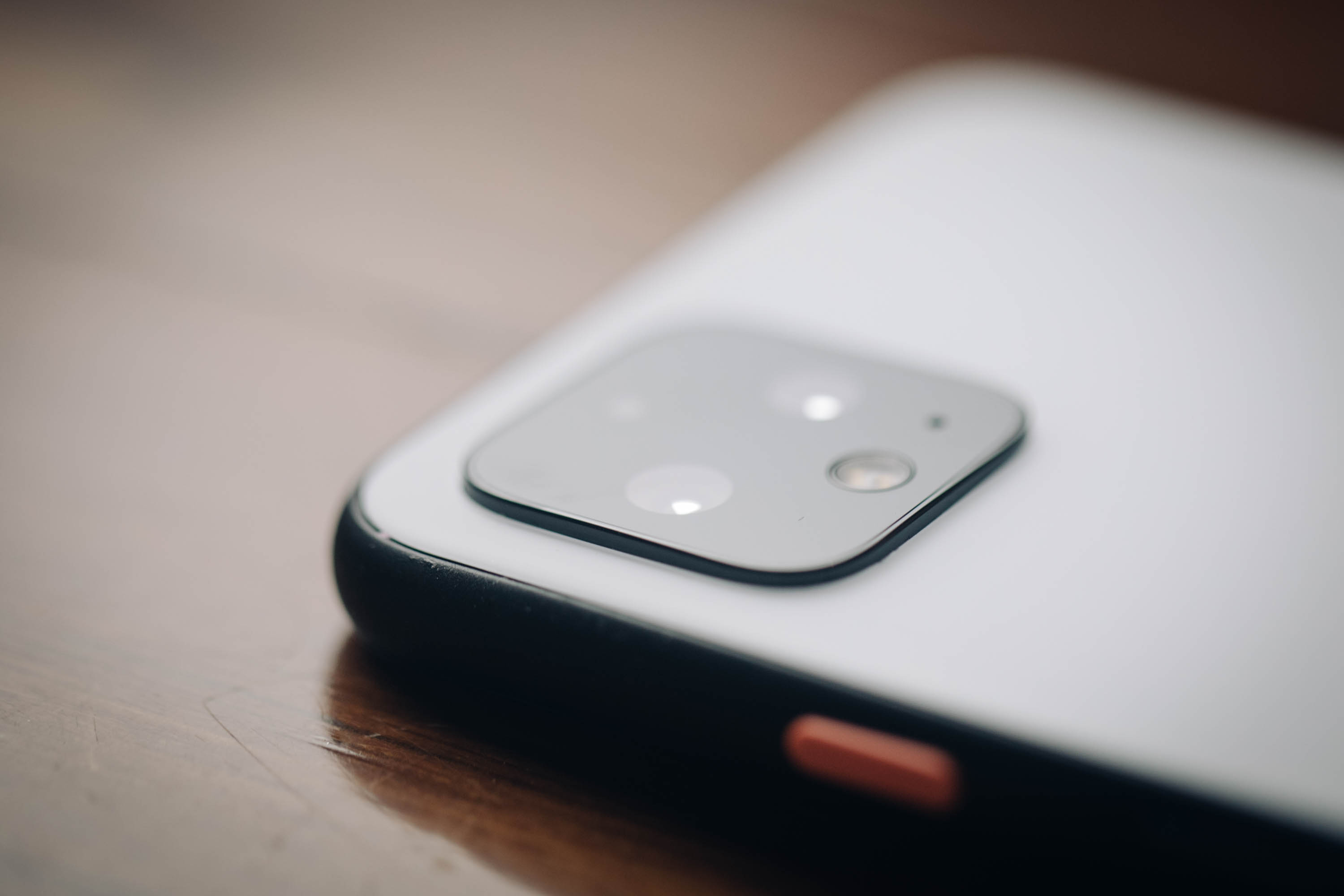
The Pixel line steps up a bit on the design side to distinguish the product from the “a” line. Google’s phones have never been as flashy as Samsung’s or Apple’s, and that’s still the case here, but a new dual-sided glass design (Gorilla Glass 5 on both), coupled with a metal band, does step up the premium feel a bit. The product is also a bit heavier and thicker than the 3, lending some heft to the device.

There are three colors now: black, white and a poppy “Oh So Orange,” which is available in limited quantities here in the U.S. The color power button continues to be a nice touch, lending a little character to the staid black and white devices. While the screen gets a nice update to 90Hz OLED, Google still has no interest in the world of notches or hole punches. Rather, it’s keeping pretty sizable bezels on the top and bottom.

The Pixel 4 gets a bit of a screen size boost from 5.5 to 5.7 inches, with an increase of a single pixel per inch, while the Pixel 4 XL stays put at 6.4 inches (with a PPI increase of 522 to 537). The dual front-facing camera has been ditched this time out, instead opting for the single eight megapixel, similar to what you’ll find on the 3a.

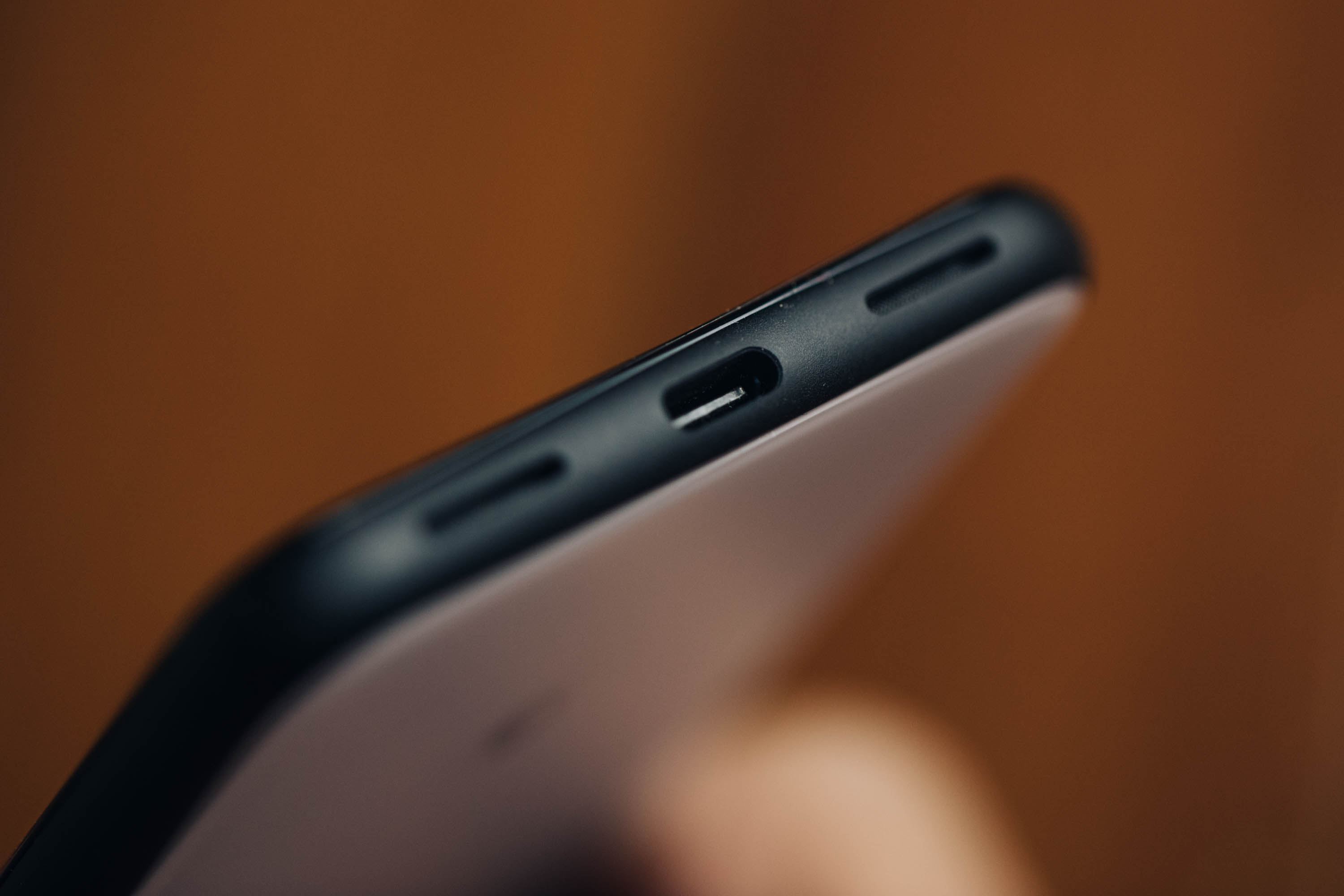
Storage hasn’t changed, with both 64 and 128GB options for both models; RAM has been bumped up to a default 6GB from 4GB last time out. The processor, too, is the latest and greatest from Qualcomm, bumping from a Snapdragon 845 to an 855. Interestingly, however, the batteries have actually been downgraded.
google pixel 4 013

The 4 and 4 XL sport a 2,800 and 3,700mAh, respectively. That should be augmented a bit by new battery-saving features introduced in Android 10, but even still, that’s not the direction you want to see these things going.

The camera is, in a word, great. Truth be told, I’ve been using it to shoot photos for the site since I got the phone last week. This Google Nest Mini review, Amazon Echo review and Virgin Galactic space suit news were all shot on the Pixel 4. The phone isn’t yet a “leave your DSLR at home” proposition, of course, but damn if it can’t take a fantastic photo in less than ideal and mixed light with minimal futzing around.

There’s no doubt that this represents a small but important shift in philosophy for Google. After multiple generations of suggesting that software solutions could do more than enough heavy lifting on image processing, the company’s finally bit the bullet and embraced a second camera. Sometimes forward progress means abandoning past stances. Remember when the company dug its heels in on keeping the headphone jack, only to drop it the following year?
google pixel 4 010

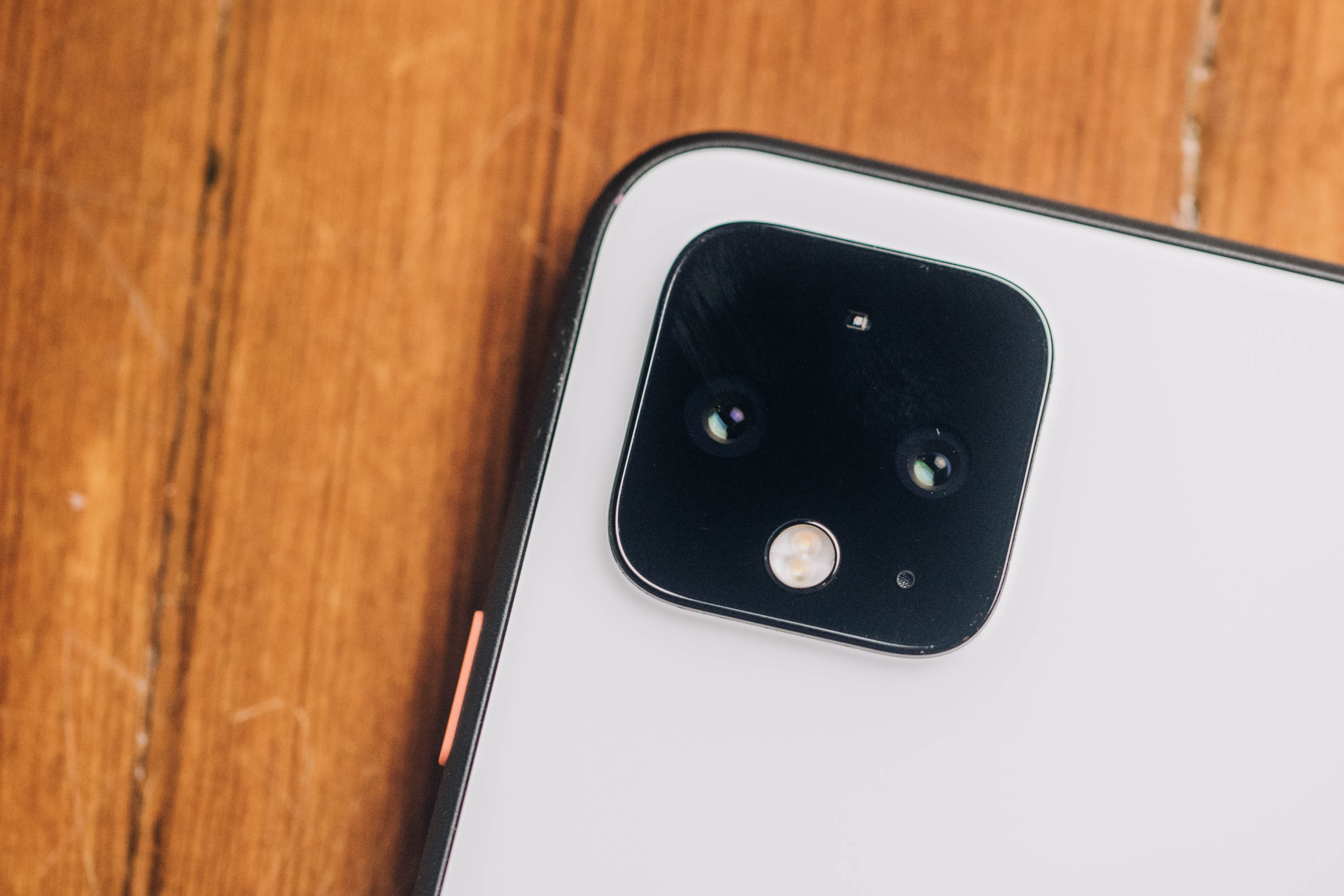
The addition of a second camera isn’t subtle, either. In fact, it’s hard to miss. Google’s adopted a familiar square configuration on the rear of the device. That’s just how phones look now, I suppose. Honestly, it’s fine once you conquer a bit of trypophobia, with a pair of lenses aligned horizontally and a sensor up top and flash on bottom — as one of last week’s presenters half joked, “we hope you’ll use it as a flash light.”

google pixel 4 008

That, of course, is a reference to the Pixel’s stellar low-light capabilities. It’s been a welcome feature, in an age where most smartphone users continue to overuse their flashes, completely throwing off the photo in the process. Perhaps the continued improvements will finally break that impulse in people — though I’m not really getting my hopes up on that front. Old habits, etc.

The 4 and 4 XL have the same camera set up, adopting the 12.2-megapixel (wide angle) lens from their predecessors and adding a 16-megapixel (telephoto) into the mix. I noted some excitement about the setup in my write-up. That’s not because the two-camera setup presents anything remarkable — certainly not in this area of three, four and five-camera flagships. It’s more about the groundwork that Google has laid out in the generations leading up to this device.

00100trPORTRAIT 00100 BURST20191016105119747 COVER 1

Essentially it comes down to this: Look at what the company has been able to accomplish using software and machine learning with a single camera setup. Now add a second telephoto camera into the mix. See, Super High Res Zoom is pretty impressive, all told. But if you really want a tighter shot without degrading the image in the process, optical zoom is still very much the way to go.

There’s a strong case to be made that the Pixel 4’s camera is the best in class. The pictures speak for themselves. The aforementioned TechCrunch shots were done with little or no manual adjustments or post-processing. Google offers on-screen adjustments, like the new dual-exposure control, which lets you manually adjust brightness and shadow brightness on the fly. Honestly, though, I find the best way to test these cameras is to use them the way most buyers will: by pointing and shooting.

[gallery ids="1900084,1900086,1900087,1900088,1900090,1900091,1900092"]

The fact is that a majority of people who buy these handsets won’t be doing much fiddling with the settings. As such, it’s very much on handset makers to ensure that users get the best photograph by default, regardless of conditions. Once again, software is doing much of the heavy lifting. Super Res Zoom works well in tandem with the new lens, while Live HDR+ does a better job approximating how the image will ultimately look once fully processed. Portrait mode shots look great, and the device is capable of capturing them at variable depths, meaning you don’t have to stand a specific distance from the subject to take advantage of the well-done artificial bokeh.

Our video producer, Veanne, who is admittedly a far better photographer than I can ever hope to be, tested out the camera for the weekend. 

[gallery ids="1900045,1900046,1900047,1900048,1900049,1900050,1900051,1900052"]

Although Veanne was mostly impressed by the Pixel 4’s camera and photo editing capabilities, here are three major gripes.

“Digital zoom is garbage.”

Google Pixel 4 digital zoom is garbage


“In low lighting situations, you lose ambiance. Saturday evening’s intimate, warmly lit dinner looked like a cafeteria meal.”

Pixel 4 camera sample


“Bright images in low lighting gives you the impression that the moving objects would be in focus as well. That is not the case.”


Other additions round out the experience, including “Frequent Faces,” which learns the faces of subjects you frequently photograph. Once again, the company is quick to point out that the feature is both off by default and all of the processing happens on the device. Turning it off also deletes all of the saved information. Social features have been improved, as well, with quick access to third-party platforms like Snapchat and Instagram.

Google keeps pushing out improvements to Lens, as well. This time out, language translation, document scanning and text copy and pasting can be performed with a quick tap. Currently the language translation is still a bit limited, with only support for English, Spanish, German, Hindi and Japanese. More will be “rolling out soon,” per the company.
google pixel 4 003

Gestures is a strange one. I’m far from the first to note that Google is far from the first to attempt the feature. The LG G8 ThinQ is probably the most recent prominent example of a company attempting to use gestures as a way to differentiate themselves. To date, I’ve not seen a good implementation of the technology — certainly not one I could ever see myself actually using day to day.

The truth is, no matter how interesting or innovative a feature is, people aren’t going to adopt it if it doesn’t work as advertised. LG’s implementation was a pretty big disappointment.

Simply put, the Pixel’s gestures are not that. They’re better in that, well, they work, pretty much as advertised. This is because the underlying technology is different. Rather than relying on cameras like other systems, the handset uses Project Soli, a long-promised system that utilizes a miniature radar chip to detect far more precise movement.

Soli does, indeed work, but the precision is going to vary a good deal from user to user. The thing is, simply detecting movement isn’t enough. Soli also needs to distinguish intention. That means the system is designed to weed out accidental gestures of the manner we’re likely making all the time around our phones. That means the system appears to be calibrated to bigger, intentional movements.
picka 2

That can be a little annoying for things like advancing tracks. I don’t think there are all that many instances where waving one’s hands across a device Obi-Wan Kenobi-style is really saving all that much time or effort versus touching a screen. If, however, Google was able to customize the experience to the individual over time using machine learning, it could be a legitimately handy feature.

That brings us to the next important point: functionality. So you’ve got this neat new piece of tiny radar that you’re sticking inside your phone. You say it’s low energy and more private than a camera. Awesome! So, how do you suggest I, you know, use it?

There are three key ways, at the moment:

  • Music playback
  • Alarm Silencing
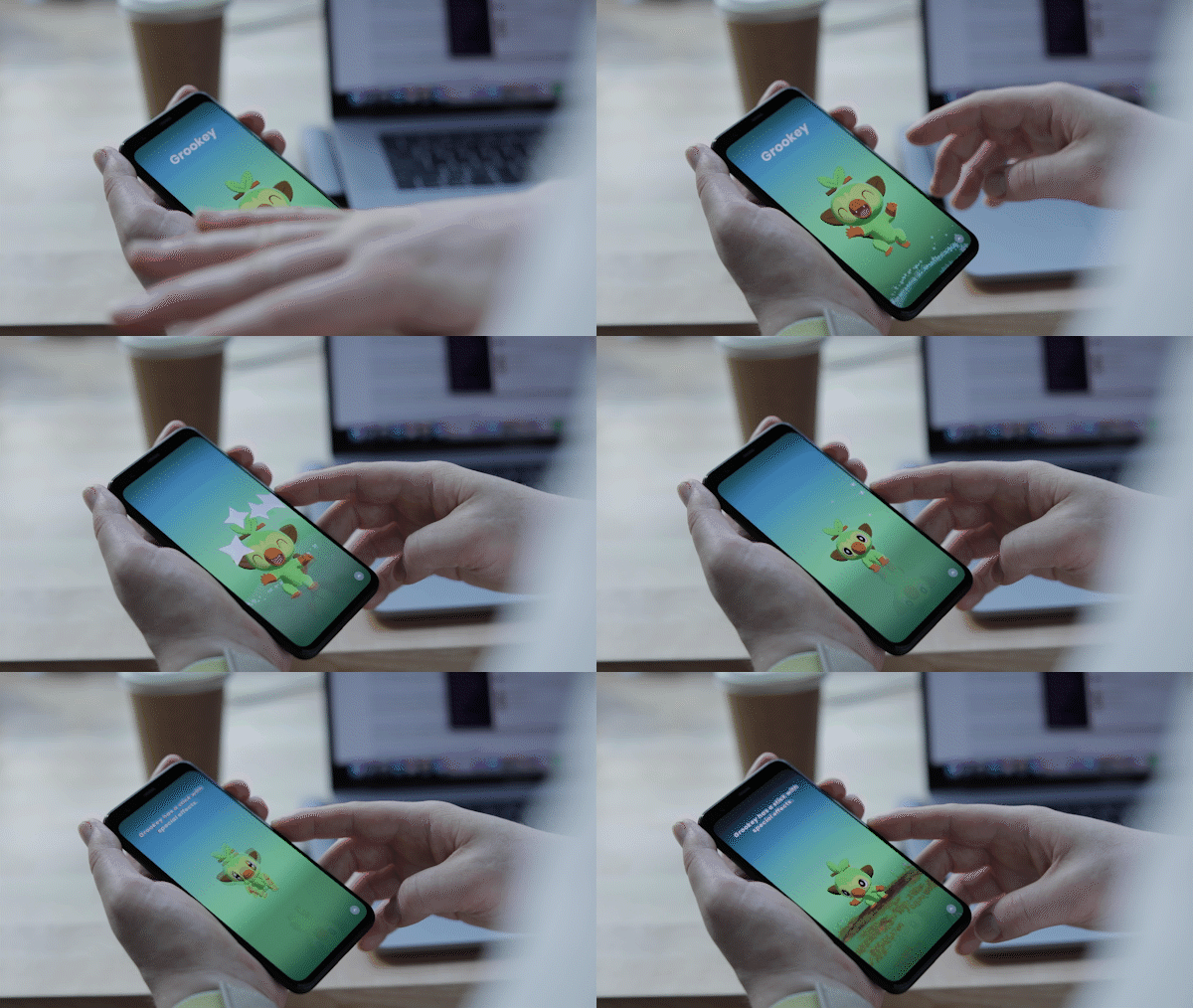
  • Waving at Pokémon

The first two are reasonably useful. The primary use case I can think of are when, say, your phone is sitting in front of you at your desk. Like mine is, with me, right now. Swiping my hand left to right a few inches above the device advances the track. Right to left goes a track back. The movements need to be deliberate, from one end of the device to the other.

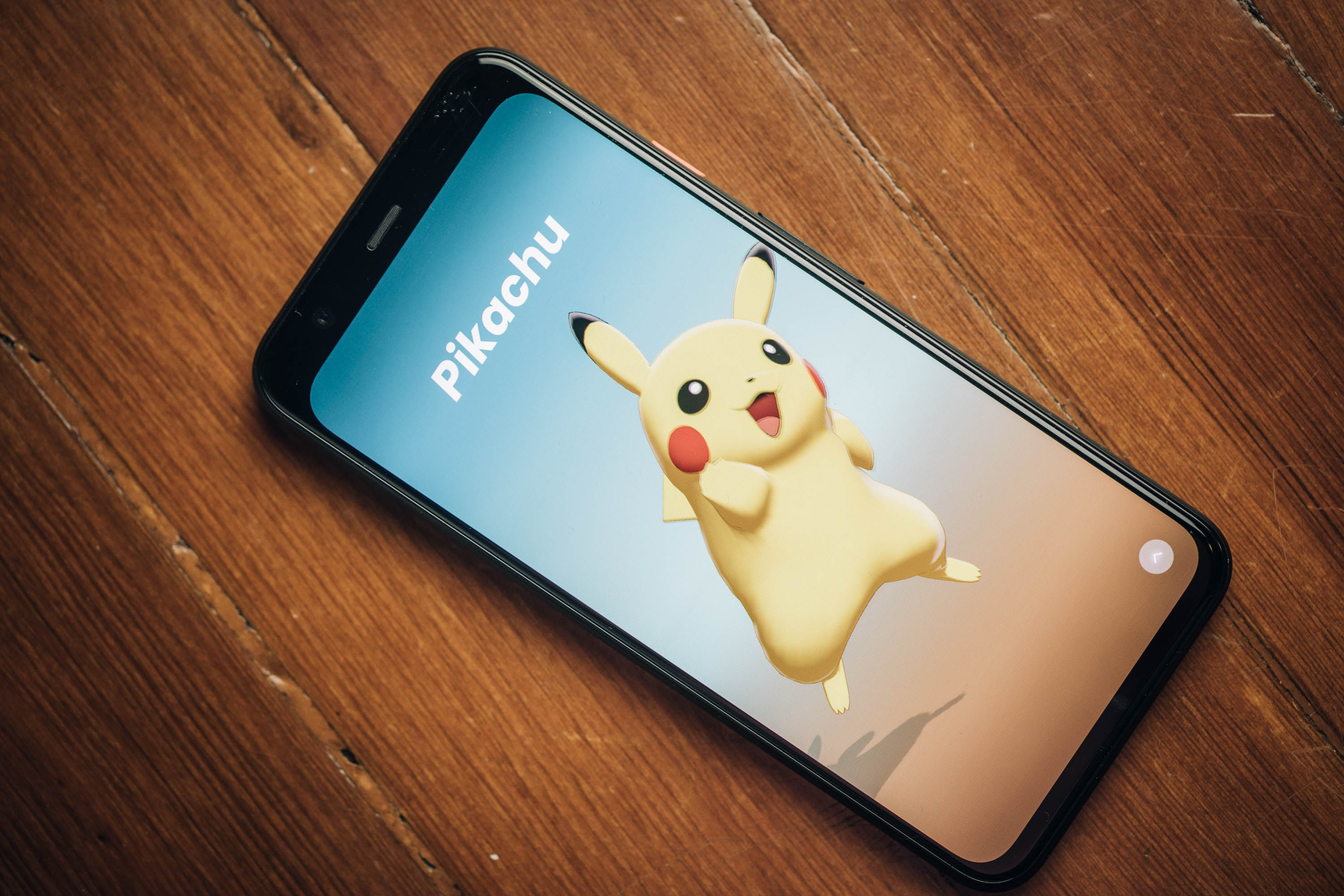
And then there’s the phenomenon of “Pokémon Wave Hello.” It’s not really correct to call the title a game, exactly. It’s little more than a way of showcasing Motion Sense — albeit an extremely delightful way.

You might have caught a glimpse of it at the keynote the other day. It came and went pretty quickly. Suddenly Pikachu was waving at the audience, appearing out of nowhere like so many wild Snorlaxes. Just as quickly, he was gone.

[gallery ids="1900104,1900106,1900107,1900108,1900109,1900110,1900111,1900112,1900113,1900114,1900115,1900116,1900117"]

More than anything, it’s a showcase title for the technology. A series of five Pokémon, beginning with Pikachu, appear demanding you interact with them through a series of waves. It’s simple, it’s silly and you’ll finish the whole thing in about three minutes. That’s not really the point, though. Pokémon Wave Hello exists to:

  1. Get you used to gestures.
  2. Demonstrate functionality beyond simple features. Gaming, AR — down the road, these things could ultimately find fun and innovative ways to integrate Soli.

For now, however, use is extremely limited. There are some fun little bits, including dynamic wallpaper that reacts to movement. The screen also glows subtly when detecting you — a nice little touch (there’s a similar effect for Assistant, as well).

Perhaps most practical, however, is the fact that the phone can detect when you’re reaching for it and begin the unlocking process. That makes the already fast new Face Unlock feature ever faster. Google ditched the fingerprint reader this time around, opting for neither a physical sensor nor in-screen reader. Probably for the best on the latter front, given the pretty glaring security woes Samsung experienced last week when a British woman accidentally spoofed the reader with a $3 screen protector. Yeeesh.

There are some nice security precautions on here. Chief among them is the fact that the unlock is done entirely on-device. All of the info is saved and processed on the phone’s Titan M chip, meaning it doesn’t get sent up to the cloud. That both makes it a speedier process and means Google won’t be sharing your face data with its other services — a fact Google felt necessary to point out, for obvious reasons.

For a select few of us, at least, Recorder feels like a legitimate game changer. And its ease of use and efficacy should be leaving startups like Otter.ai quaking at its potential, especially if/when Google opts to bring it to other Android handsets and iOS.

I was initially unimpressed by the app upon trying it out at last week’s launch event. It struggles to isolate audio in noisy environments — likely as much of a hardware as software constraint. One on one and it’s far better, though attempting to, say, record audio from a computer can still use some work.
google pixel 4 004

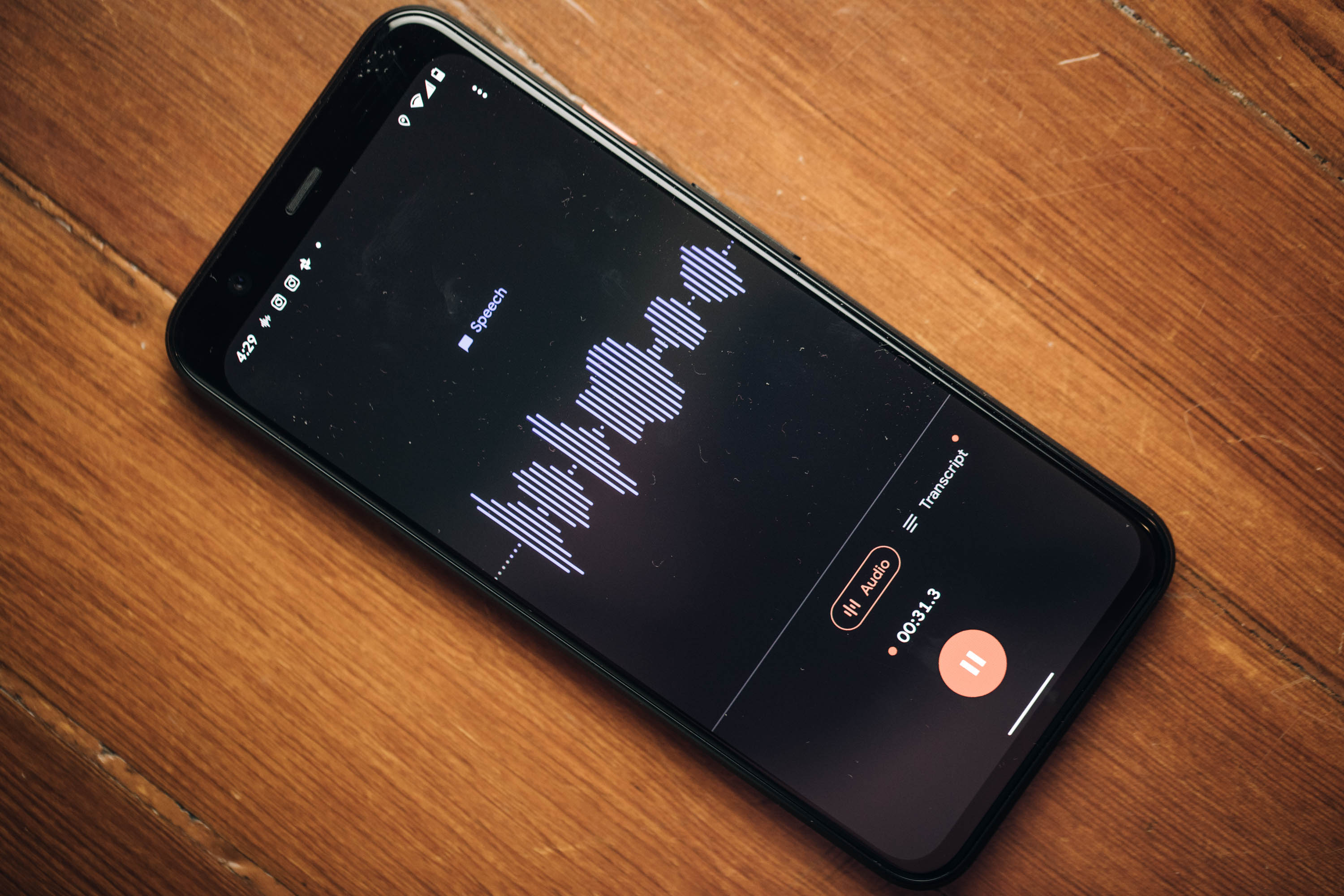
Open the app and hit record and you’ll see a waveform pop up. The line is blue when detecting speech and gray when hearing other sounds. Tap the Transcript button and you’ll see the speech populate the page in real time. From there you can save it with a title and tag the location.

The app will automatically tag keywords and make everything else searchable for easy access. In its first version, it already completely blows Apple’s Voice Memos out of the water. There’s no comparison, really. It’s in a different league. Ditto for other apps I’ve used over the years, like Voice Record.

Speaking to the product, the recording was still a little hit or miss. It’s not perfect — no AI I’ve encountered is. But it’s pretty good. I’d certainly recommend going back over the text before doing anything with it. Like Otter and other voice apps, you can play back the audio as it highlights words, karaoke-style.

The text can be saved to Google Drive, but can’t be edited in app yet. Audio can be exported, but not as a combined file. The punctuation leaves something to be desired and Recorder is not yet able to distinguish individual voices. These are all things a number of standalone services offer, along with a web-based platform. That means that none of them are out of business yet, but if I was running any of them, I’d be pretty nervous right about now.

As someone who does interviews for a living, however, I’m pretty excited by the potential here. I can definitely see Recorder become one of my most used work apps, especially after some of the aforementioned kinks get ironed out in the next version. As for those who don’t do this for a living, usefulness is probably a bit limited, though there are plenty of other potential uses, like school lecturers.
google pixel 4 005

The Pixel continues to distinguish itself through software updates and camera features. There are nice additions throughout that set it apart from the six-month-old 3a, as well, including a more premium design and new 90Hz display. At $799, the price is definitely a vast improvement over competitors like Samsung and Apple, while retaining flagship specs.

The Pixel 4 doesn’t exactly address what Google wants the Pixel to be, going forward. The Pixel 3a was confirmation that users were looking for a far cheaper barrier of entry. The Pixel 4, on the other hand, is priced above OnePlus’s excellent devices. Nor is the product truly premium from a design perspective.

It’s unclear what the future will look like as Google works to address the shifting smartphone landscape. In the meantime, however, the future looks bright for camera imaging, and Google remains a driving force on that front.

21 Oct 2019

The Surface Pro 7 is a competent upgrade with USB-C, refreshed processors, but little else that’s new

I’ll be the first to admit that when the first generation Surface two-in-one launched, I wasn’t sure this was a device that people actually wanted to use. But Microsoft was clearly on to something, as the proliferation of Surface Pro’s among coffee shop dwellers clearly shows. Earlier this month, Microsoft announced both the seventh generation Surface Pro 7 and the Surface Pro X. The X is probably the most interesting update in the Surface Pro’s recent history, with a slimmer profile, larger screen, thinner bezels and plenty of new internals. But the Pro 7, which is going on sale today, starting at $749, is a competent upgrade that gives Surface Pro users exactly what they want – even if it sticks to a tried and tested formula.

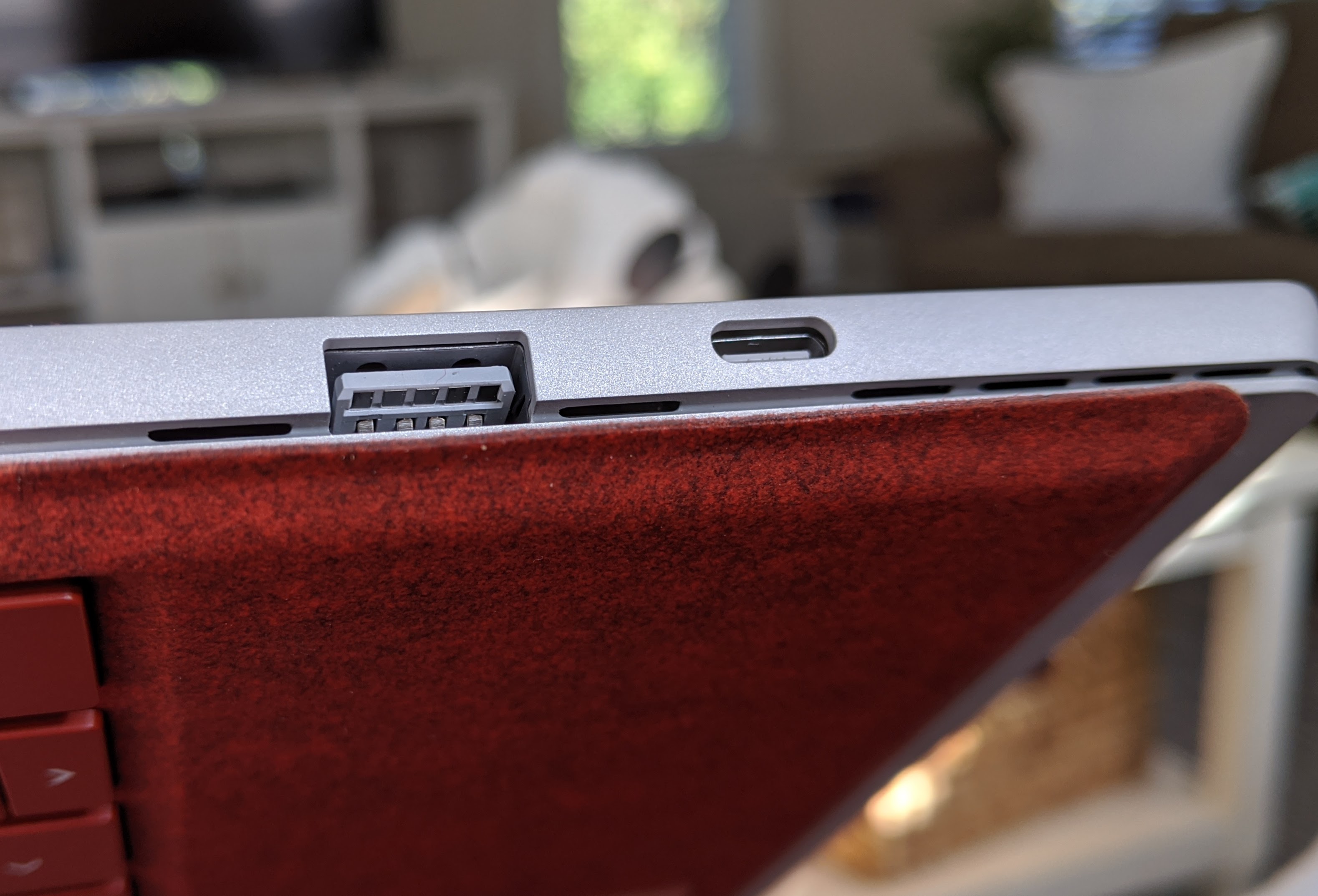
surface pro 7 usb c

It’s pretty easy to sum up what’s new in the Surface Pro 7. There’s the new 10th-generation Intel chips and a USB-C port for both charging and attaching accessories. The Surface Pen and detachable keyboard remain optional — and somewhat pricey — accessories, though Microsoft tells me that a large percentage opt to get the type cover keyboard, with fewer opting for the pen. There are new colors for the accessories, though: poppy red (which is what Microsoft provided me with my test device and which is indeed very red) and ice blue. The type cover also feels a little bit stiffer, but that’s hard to quantify.

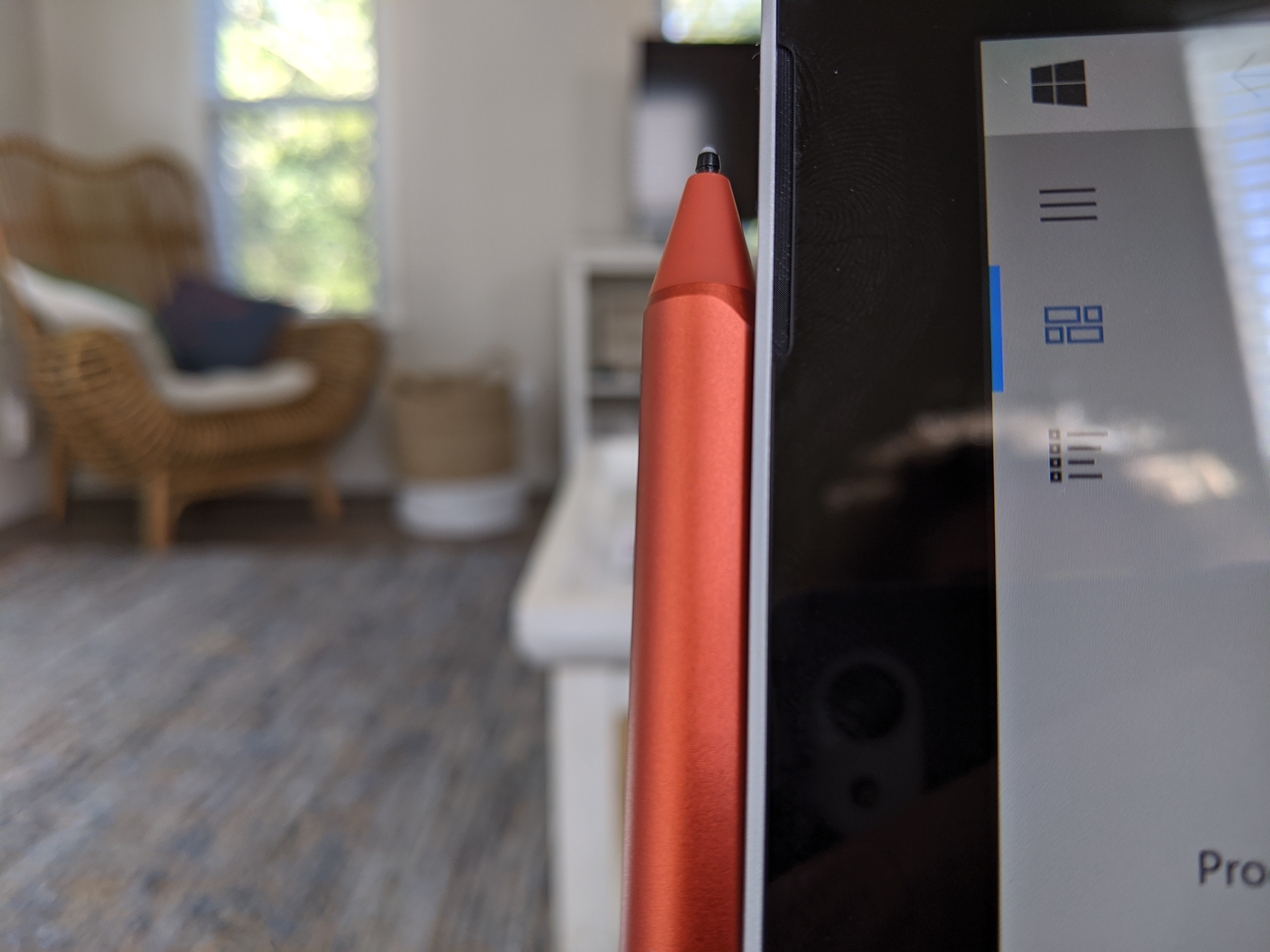
surface pro 7 red pen

The versions with Intel’s newest i3 and i5 chips are fanless, while the i7 version does have a fan.

And that’s pretty much it. The overall design remains the same, with its bezels that are starting to feel a bit too thick these days, and a thin strip of air vents around the sides. The kickstand is something Microsoft has pretty much perfected at this time, so it’s no surprise that it remains virtually unchanged. While Microsoft added a single USB-C port, the plug for the Surface connector is also still there to help you charge your Surface or connect it to a docking station.

Since you’re mostly going to use a Pro on the go, I don’t think only having a single USB-A and USB-C port is a major issue. If you’re using it at home, then getting the $199 Surface Dock is likely the way to go anyway.

As for the design, if it wasn’t for that USB-C port, you’d have a hard time telling the Pro 7 from the recent Surface Pros. Everything else looks pretty much identical to last couple of iterations.

I’ve used the i5-powered Pro 7 while I was travelling over the course of the last few days. Microsoft promises that the new Intel chips are up to twice as fast as their predecessors. I’m sure those numbers work out in artificial benchmarks. In daily use, I noticed that using the device did indeed feel a bit smoother than the last few Surfaces I tested that fell into the same price range as this machine. I’m among those that barely use the pen, but when I do, the experience feels seamless with no noticeable lag in most circumstances.

surface pro 7 red keyboard

Microsoft promises full-day battery life and that’s pretty much what I got, too, using the Surface to write for a few hours on the plane, surfing the web during a layover and watching Netflix in the evening.

If you’re in the market for a Surface Pro, this is obviously the one to get. If you own a Pro 5 or 6 and you’re still happy with their performance, then there’s no real reason to upgrade. Depending on your use case, the Surface Pro X may be the one to get anyway, but that’s still two weeks out and we’ll have to say how well it performs in the real world and if it’s worth the higher starting price of $999. Come back in two weeks and we’ll let you know.

21 Oct 2019

Rocket Lab aims to deliver small satellites to the Moon and beyond

Rocket Lab kicked off the International Astronautical Congress with the news that it’ll begin offering small satellite delivery service to orbits beyond low Earth orbit, where it currently operates – including delivering payloads all the way to the Moon. The longer-range service will be provided via its Photon spacecraft, which it’ll pair with a new additional stage to add range to the vehicle. The company expects to be able to begin serving customers with this new combined, longer range spacecraft possibly as early as Q4 2020.

This will extends significantly the launch startup’s effective operating range, which since it began serving customers last year has been entirely focused on the LEO range (from between around 200 miles and 1,200 miles above the surface of the Earth). Rocket Lab CEO and founder Peter Beck said in a press release announcing the news that this is in response to additional inbound interest in reaching these orbits, from both government and private sector clients.

Beck notes that this demand will only grow as we look to put more investment into human exploration and infrastructure establishing on and around the Moon (NASA’s Artemis program will involve both an Lunar Gateway orbital station with international cooperation and eventually establishment of a base on the Moon’s surface). Small satellites, he argues, will be instrumental in providing low-risk advance scouting and establishing the necessary advance infrastructure for establishing a larger, more permanent presence.

There’s existing demand, he says, too, with a lot of research equipment and “full satellites” already “on shelves” just waiting for a ride to deeper space than is currently available. In other words, Rocket Lab is very eager to point out that this move isn’t just predicting future demand, but addressing a current unmet need that already exists in the market.

Photon, the spacecraft Rocket Lab will use to accomplish this goal, is a an evolved version of the Kick Stage of Electron . Combining it with Electron will provide Rocket Lab’s customers with a “complete solution” for missions anywhere from LEO, to further out Earth orbits, all the way to covering anything between here and the Moon, the company says.

21 Oct 2019

Spiff pitches a way to automate sales commissions calculations

Spiff, a Salt Lake City-based company pitching a new service for calculating sales commissions for salespeople around the world, has raised $6 million in funding to sell its own product to the millions of Willie Lohman’s looking for an end to needless paperwork.

Spiff’s management team kicked in $500,000 for the new round, which also included commitments from Peak Ventures, Kickstart Seed Fund, Peterson Partners, and Pipeline Capital.

“Amazing as it may seem, there isn’t an effective, modern SaaS solution for managing incentive compensation,” said Jeron Paul, Spiff’s founder and chief executive. “Most companies use Excel or decades-old tech that’s really just professional services masquerading as software.”

Spiff’s own data indicates that 90% of businesses rely on spreadsheets alone to calculate commissions and it can take up to one month for sales representatives to learn about their commissions after they’ve closed deals.

Spiff already processes $4 million in calculations every month through thousands of deals working with software as a service vendors like Podium, Weave, Bitglass, Workato, Sendoso, HireVue, and Lucid

Paul has had a long career starting and selling businesses before he launched Spiff in 2018. The serial entrepreneur previously sold Capshare to a subsidiary of Morgan Stanley; launched and sold Scalar Analytics, and Boardlink, which was bought by ThomsonReuters, according to the company.

Spiff projects that the market for sales commissions in the U.S. is roughly $800 billion, with the incentive compensation market numbering in the trillions of dollars. It’s a big, niche, problem for customers that the company thinks its solution can address.

21 Oct 2019

Spiff pitches a way to automate sales commissions calculations

Spiff, a Salt Lake City-based company pitching a new service for calculating sales commissions for salespeople around the world, has raised $6 million in funding to sell its own product to the millions of Willie Lohman’s looking for an end to needless paperwork.

Spiff’s management team kicked in $500,000 for the new round, which also included commitments from Peak Ventures, Kickstart Seed Fund, Peterson Partners, and Pipeline Capital.

“Amazing as it may seem, there isn’t an effective, modern SaaS solution for managing incentive compensation,” said Jeron Paul, Spiff’s founder and chief executive. “Most companies use Excel or decades-old tech that’s really just professional services masquerading as software.”

Spiff’s own data indicates that 90% of businesses rely on spreadsheets alone to calculate commissions and it can take up to one month for sales representatives to learn about their commissions after they’ve closed deals.

Spiff already processes $4 million in calculations every month through thousands of deals working with software as a service vendors like Podium, Weave, Bitglass, Workato, Sendoso, HireVue, and Lucid

Paul has had a long career starting and selling businesses before he launched Spiff in 2018. The serial entrepreneur previously sold Capshare to a subsidiary of Morgan Stanley; launched and sold Scalar Analytics, and Boardlink, which was bought by ThomsonReuters, according to the company.

Spiff projects that the market for sales commissions in the U.S. is roughly $800 billion, with the incentive compensation market numbering in the trillions of dollars. It’s a big, niche, problem for customers that the company thinks its solution can address.