Year: 2019

18 Oct 2019

Adam Neumann planned for his children and grandchildren to control WeWork

WeWork cofounder Adam Neumann didn’t plan for his family’s control of WeWork to end at his death but he expected it be controlled by future generations of Neumanns, too. According to Business Insider,

The outlet reports that in a  speech Neumann gave to employees in January of this year, footage of which it says it has viewed but it has not published online, Neumann is seen saying that WeWork isn’t “just controlled — we’re generationally controlled.” He reportedly goes on to say that while the five children he shares with wife Rebekah Neumann “don’t have to run the company,” they “do have to stay the moral compass of the company.”

According to BI, Neumann even invoked his future grandchildren, telling those gathered: “It’s important that one day, maybe in 100 years, maybe in 300 years, a great-great-granddaughter of mine will walk into that room and say, ‘Hey, you don’t know me; I actually control the place. The way you’re acting is not how we built it,'” he said.

“If we do this right, over the years different CEOs will come, but we will keep an eye on these basic values and basic moral standards and not allow them to shift,” he’s quoted by BI as saying.

It may sound like yet another outlandish proclamation from Neumann, who has a flair for the dramatic. (Talking to Fast Company earlier this year, for example, he compared WeWork to a rare jewel, asking, “Do you know how long it takes a diamond to be created?”)

But before WeWork began coming apart at the seams, Neumann had every reason to believe that he could pass power down to his heirs. Though many public shareholders may not realize as much, a growing number of tech founders enjoy the kind of dual-class shares that Neumann had extracted from investors, shares that don’t merely give founders more voting power for a while after their companies go public or or even throughout their lifetimes, but whose power can be passed down to their children, too.

We wrote about this very issue as a kind of hypothetical last month, quoting SEC Commissioner Robert Jackson, a longtime legal scholar and law professor, who told an audience last year that nearly half of companies that went public with dual-class shares between 2004 and 2018, gave corporate insiders “outsized voting rights in perpetuity.”

Warned Jackson, “Those companies are asking shareholders to trust management’s business judgment — not just for five years, or 10 years, or even 50 years.” It asks them to trust that founder’s kids. And their kids’ kids. And their grandkid’s kids . . . It raises the prospect that control over our public companies, and ultimately of Main Street’s retirement savings, will be forever held by a small, elite group of corporate insiders — who will pass that power down to their heirs.”

The market spoke in WeWork’s case, but not every company has such apparent flaws, and Neumann could have made himself a lot harder to shake than he did. In fact, the broader question the video raises is whether anyone will step in to stop the broader trend, or public market investors be living the consequences down the road instead. (When Jackson delivered his talk, as tried teasingly baiting his SEC colleagues into taking action.)

Neumann wasn’t insane to imagine the scenario that he did. That doesn’t mean it’s rational. Giving founders super-voting shares for some period after transitioning onto the public market, we can understand. Giving founders so much power that their kids call the shots? That is crazy.
18 Oct 2019

Adam Neumann planned for his children and grandchildren to control WeWork

WeWork cofounder Adam Neumann didn’t plan for his family’s control of WeWork to end at his death but he expected it be controlled by future generations of Neumanns, too. According to Business Insider,

The outlet reports that in a  speech Neumann gave to employees in January of this year, footage of which it says it has viewed but it has not published online, Neumann is seen saying that WeWork isn’t “just controlled — we’re generationally controlled.” He reportedly goes on to say that while the five children he shares with wife Rebekah Neumann “don’t have to run the company,” they “do have to stay the moral compass of the company.”

According to BI, Neumann even invoked his future grandchildren, telling those gathered: “It’s important that one day, maybe in 100 years, maybe in 300 years, a great-great-granddaughter of mine will walk into that room and say, ‘Hey, you don’t know me; I actually control the place. The way you’re acting is not how we built it,'” he said.

“If we do this right, over the years different CEOs will come, but we will keep an eye on these basic values and basic moral standards and not allow them to shift,” he’s quoted by BI as saying.

It may sound like yet another outlandish proclamation from Neumann, who has a flair for the dramatic. (Talking to Fast Company earlier this year, for example, he compared WeWork to a rare jewel, asking, “Do you know how long it takes a diamond to be created?”)

But before WeWork began coming apart at the seams, Neumann had every reason to believe that he could pass power down to his heirs. Though many public shareholders may not realize as much, a growing number of tech founders enjoy the kind of dual-class shares that Neumann had extracted from investors, shares that don’t merely give founders more voting power for a while after their companies go public or or even throughout their lifetimes, but whose power can be passed down to their children, too.

We wrote about this very issue as a kind of hypothetical last month, quoting SEC Commissioner Robert Jackson, a longtime legal scholar and law professor, who told an audience last year that nearly half of companies that went public with dual-class shares between 2004 and 2018, gave corporate insiders “outsized voting rights in perpetuity.”

Warned Jackson, “Those companies are asking shareholders to trust management’s business judgment — not just for five years, or 10 years, or even 50 years.” It asks them to trust that founder’s kids. And their kids’ kids. And their grandkid’s kids . . . It raises the prospect that control over our public companies, and ultimately of Main Street’s retirement savings, will be forever held by a small, elite group of corporate insiders — who will pass that power down to their heirs.”

The market spoke in WeWork’s case, but not every company has such apparent flaws, and Neumann could have made himself a lot harder to shake than he did. In fact, the broader question the video raises is whether anyone will step in to stop the broader trend, or public market investors be living the consequences down the road instead. (When Jackson delivered his talk, as tried teasingly baiting his SEC colleagues into taking action.)

Neumann wasn’t insane to imagine the scenario that he did. That doesn’t mean it’s rational. Giving founders super-voting shares for some period after transitioning onto the public market, we can understand. Giving founders so much power that their kids call the shots? That is crazy.
18 Oct 2019

VR/AR startup valuations reach $45 billion (on paper)

Despite early-stage virtual reality market and augmented reality market valuations softening in a transitional period, total global AR/VR startup valuations are now at $45 billion globally — include non-pure play AR/VR startups discussed below, and that amount exceeds $67 billion. More than $8 billion has been returned to investors through M&A already, with the remaining augmented and virtual reality startups carrying more than $36 billion valuations on paper. Only time will tell how much of this value gets realized for investors.

(Note: this analysis is of AR/VR startup valuations only, excluding internal investment by large corporates like Facebook . Again, this analysis is of valuation, not revenue.)

Digi-Capital AR/VR Analytics Platform

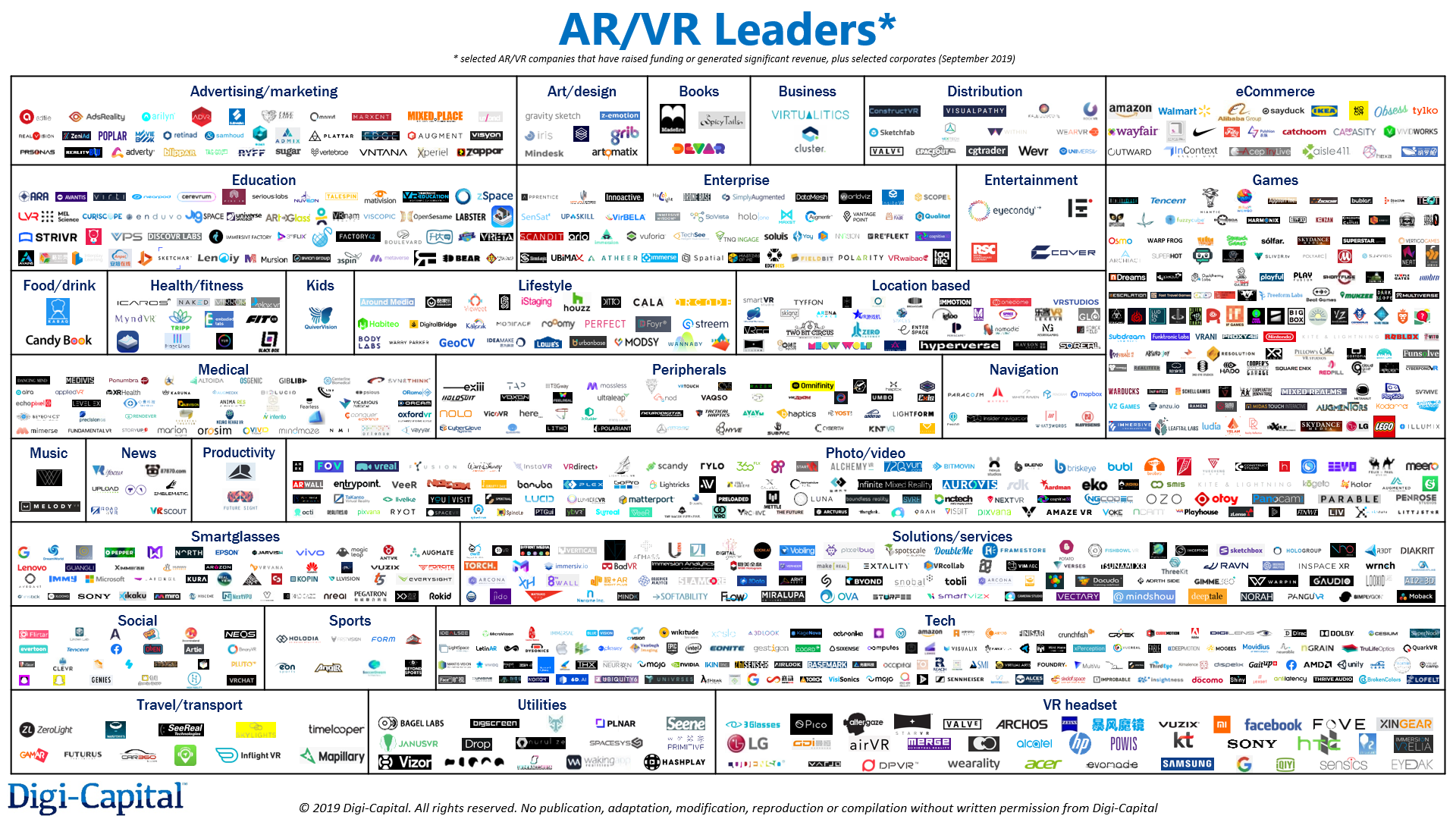
Selected AR/VR companies that have raised funding or generated significant revenue, plus selected corporates as of September 2019.

There is significant value concentration, with just 18 AR/VR pure plays accounting for half of the $45 billion global figure. Some of the large valuations are for Magic Leap (well over $6 billion), Niantic (nearly $4 billion), Oculus ($3 billion from exit to Facebook), Beijing Moviebook Technology ($1 billion+) and Lightricks ($1 billion). While there are unicorns, the market hasn’t seen an AR/VR decacorn yet.

Across all industries — not just AR/VR — around 60% of VC-backed startups fail, not 90% as often quoted. That doesn’t mean this many startups crash and burn, but that 60% of startups deliver less than 1x return on investment (ROI) to investors (i.e. investors get less back than they put in). To better understand what’s happening in AR/VR, let’s analyze the thousands of startup valuations in Digi-Capital’s AR/VR Analytics Platform to see where the smart money is by sector, stage and country.

Do what you can, with what you have, where you are

Digi Capital AR VR Valuation Sectors Q4 2019

Free charts do not include numbers, axes and data from subscriber version, with underlying hard data sourced directly from companies and reliable secondary sources. Methodology in Digi-Capital’s companion Augmented/Virtual Reality Report Q4 2019

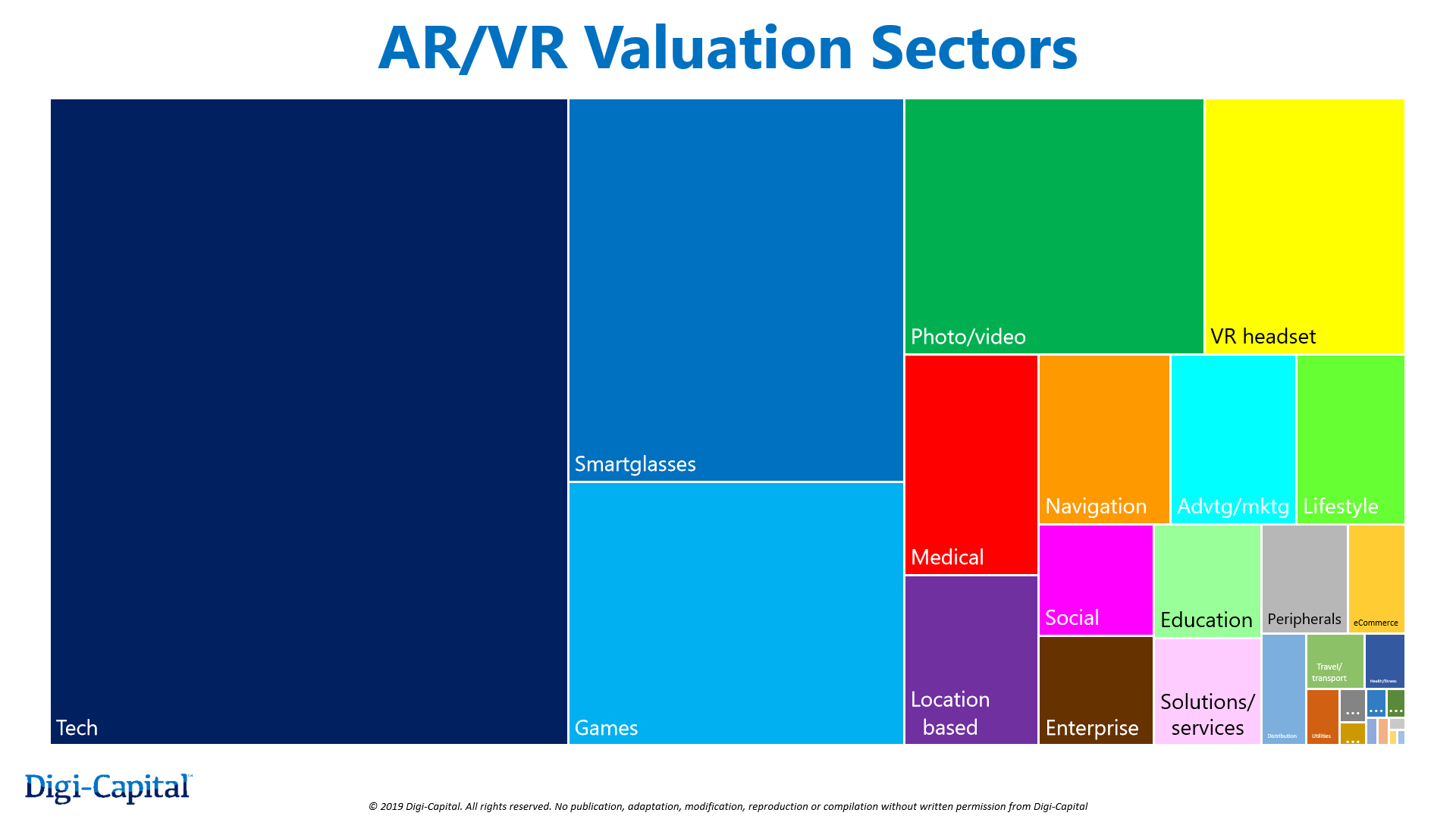
A rising tide lifts all boats, while an ebb tide reveals the rocks beneath the waves. Similarly, the AR/VR industry sectors in which startups operate have a big impact on how they deliver value. Across the 30+ AR/VR sectors that Digi-Capital tracks, some sectors appear to be more equal than others.

Core AR/VR tech startups have delivered the most value to date, with “picks and shovels” businesses supporting the entire market while avoiding customer risk in any one sector. The largest valuations are for core tech companies that operate across either augmented reality and computer vision markets (particularly in China), or games and AR/VR markets. These startups are not AR/VR pure plays, showing how revenue diversification can be highly valuable in early stage markets.

Smartglasses make up the next AR/VR sector in terms of valuation, with around two-thirds of that locked up in smartglasses platform company Magic Leap (again, this analysis is of startups only, excluding internal corporate investment like Microsoft mixed reality).

VR headsets come in at number three, due to Facebook’s acquisition of Oculus back in 2014. While that deal was arguably the catalyst for the current wave of AR/VR, other VR headset startups haven’t delivered similar levels of value to investors yet.

AR/VR games follow, with startup valuations dominated by Pokémon Go developer Niantic and smaller exits like Osmo. AR/VR photo/video is next, with a large chunk of that value having been realized for investors through exits such as Shenzhen Lianmeng Technology, Replay Technology and Magic Pony Technology. There are also ongoing startups like Goldman Sachs-backed Lightricks.

The long tail of 25 other AR/VR market sectors each make up a decreasing proportion of remaining startup valuations today. There are individual later-stage startups such as Beijing Moviebook Technology in AR/VR categories like social, but these are in the minority today (Note: this does not mean there isn’t significant value across remaining sectors or companies within them, but that value has not been quantified by exit value or investment round valuations yet).

All the world’s a stage

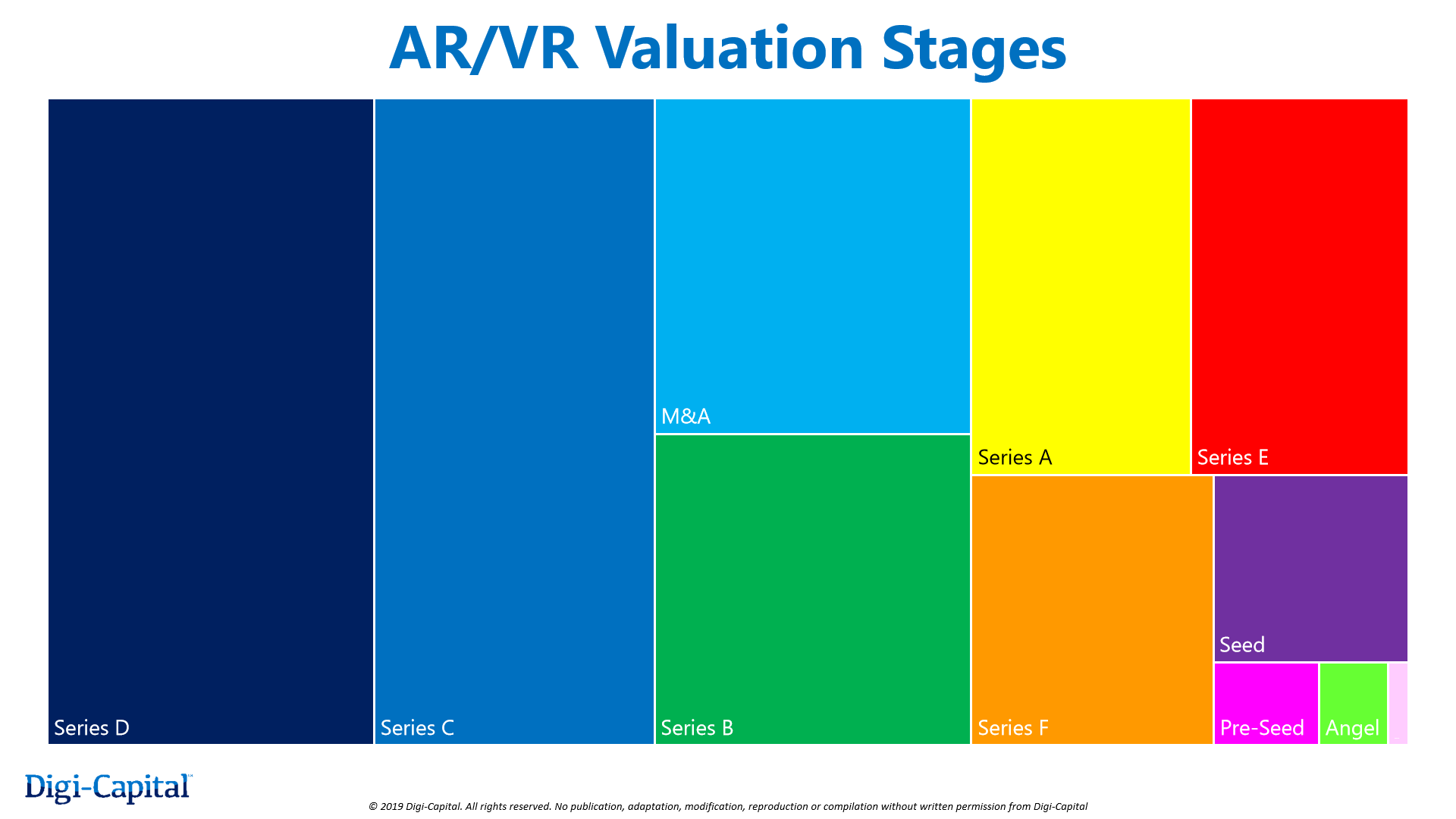
Digi Capital AR VR Valuation Stages Q4 2019

Source: Digi-Capital AR/VR Analytics Platform

The highest valuations on paper tend to be in later-stage startups for most tech markets, so it’s no surprise that companies at Series D and Series C stage in China and the USA make up around 45% of valuations in today’s AR/VR market. In terms of realized returns to investors, M&A has delivered over 12% of total global value. While the $3 billion Oculus exit to Facebook back in 2014 stands out, there have been a significant number of exits over the $100 million mark since that time.

When looking at all the different investment stages from Angel through to Series F, their valuation order is slightly jumbled. Series B, A, E and F (in that order) are a similar order of magnitude, followed by Seed, Pre-Seed, Angel and Accelerator at a much lower level. This is a product of the number and valuation of individual startups in each of these stages.

It’s a small world after all

Digi-Capital AR/VR Analytics Platform

Source: Digi-Capital AR/VR Analytics Platform

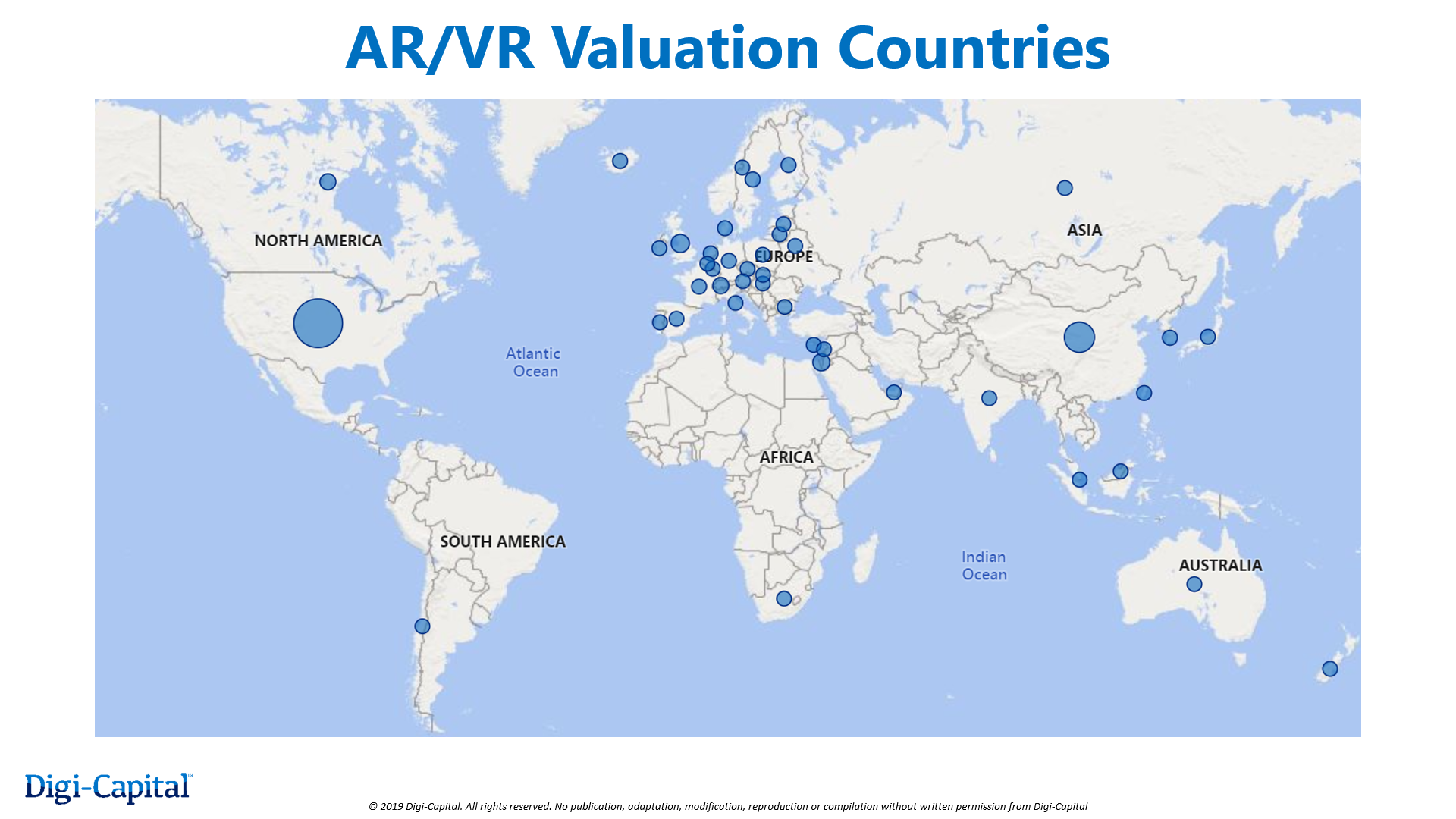
The geographic distribution of value in AR/VR is extreme, with the USA and China accounting for more than 80% of all AR/VR startup valuations worldwide. These are followed at a much lower level by the UK, Israel, Switzerland and Canada, with a long tail of around 50 other countries. At the regional level, the running order is North America, Asia and Europe, with Latin America and MEA making up the balance. It’s worth noting that while a lot of stored valuation has been in US startups historically, Chinese AR/VR startups have raised far more money in recent years. However, Chinese VC investment dropped dramatically this year across sectors — not AR/VR specifically.

A journey of a thousand miles begins with a single step

Augmented reality, virtual reality and mixed reality (XR) remain early stage, with both consumer and enterprise markets looking for an inflection point to help them truly scale. During a transitional period with many VC and corporate investors taking a wait-and-see approach, startups might need to focus on generating revenue and controlling costs rather than seeing VC funding rounds and exits delivering valuation/value increases. This could end up being a good thing in the long run, as the strongest AR/VR startups rise to the top. For those that do, there’s a lot more value to come.

Tim Merel is Managing Director of AR/VR adviser Digi-Capital, and is a software engineer, investment banker, lawyer and founder.

18 Oct 2019

Tilting Point acquires game monetization startup Gondola

Tilting Point announced yesterday that it has acquired Gondola, a company that aims to increase to improve game monetization by optimizing in-game offers and video ads.

Tilting Point CEO Kevin Segalla described his company’s model as “progressive publishing” — usually, mobile game developers starting working with Tilting Point because they need help with user acquisition, and then develop a deeper publishing relationship over time.

“With a select group of our development partners, we’ll acquire an IP, and we’ll … have them take the engine that they already have and create a whole new game,” Segalla said. “It’s really a dual effort between us and the developer.”

To accomplish all this, the company has built artificial intelligence tools to improve user acquisition. But the other side of that equation, in Segalla’s view, is increasing the lifetime value of the users acquired.

“At the end of the day, scaling a game boils down to two simple things, [cost per install] and LTV,” he said. “Strong developers are working to improve the LTV of their players, but there’s a lot of low-hanging fruit that with the right toolset you can use to improve the lifetime values. That’s what Gondola is about … We’ve been following for years, and we said, ‘Let’s bring this in-house.'”

Gondola currently offers four modules: Target Optimization (choosing the best offer for a player), Rewarded Video Ad Optimization (choosing the right amount of virtual currency to reward a player for watching a video ad), Store Optimization (choosing the right store items to show a player) and Currency Optimization (choosing the best virtual currency amounts for offers and promotions).

The financial terms of the acquisition — Tilting Point’s first — were not disclosed. As part of the deal, Gondola CTO André Cohen is joining Tilting Point as its head of data science, while his co-founder and CEO Niklas Herriger remains involved as an executive advisor.

18 Oct 2019

Where are US fintech’s next billion-dollar startups?

As fintech investments soar to new heights, investors are looking at the bottom and top levels of the services stack to find the next billion-dollar startups.

That’s the word from seasoned investors like Andreessen Horowitz’s managing director, Angela Strange, who has invested in a number of successful financial services technology companies. For Strange and Chris Britt, co-founder and chief executive of financial services startup Chime Bank, the best opportunities are in customer-facing financial services and specific infrastructure opportunities that can support those  businesses.

For many large companies, financial services are already entering a twilight period. Markets like consumer and student lending, banking and financial management and business lending are becoming more crowded, and companies like Affirm, Betterment, Brex, Chime Bank, CommonBond, Kabbage, Robinhood, SoFi, Wealthfront and many others have raised hundreds of millions so they can take on established players in banking and finance.

Investments into financial technology companies in the U.S. exploded in 2019 with at least $12.7 billion flowing in the first half of the year alone. That figure — a 60% jump in dollars committed — came even as the number of deals remained relatively steady, according to data from Accenture.

Increasing capital commitments were even more pronounced in Europe and the United Kingdom, where a fintech boom has nearly doubled the amount of money committed to startups over the first half of 2019 from a year-ago period.

18 Oct 2019

Alphabet’s Wing begins making first commercial drone deliveries in the U.S.

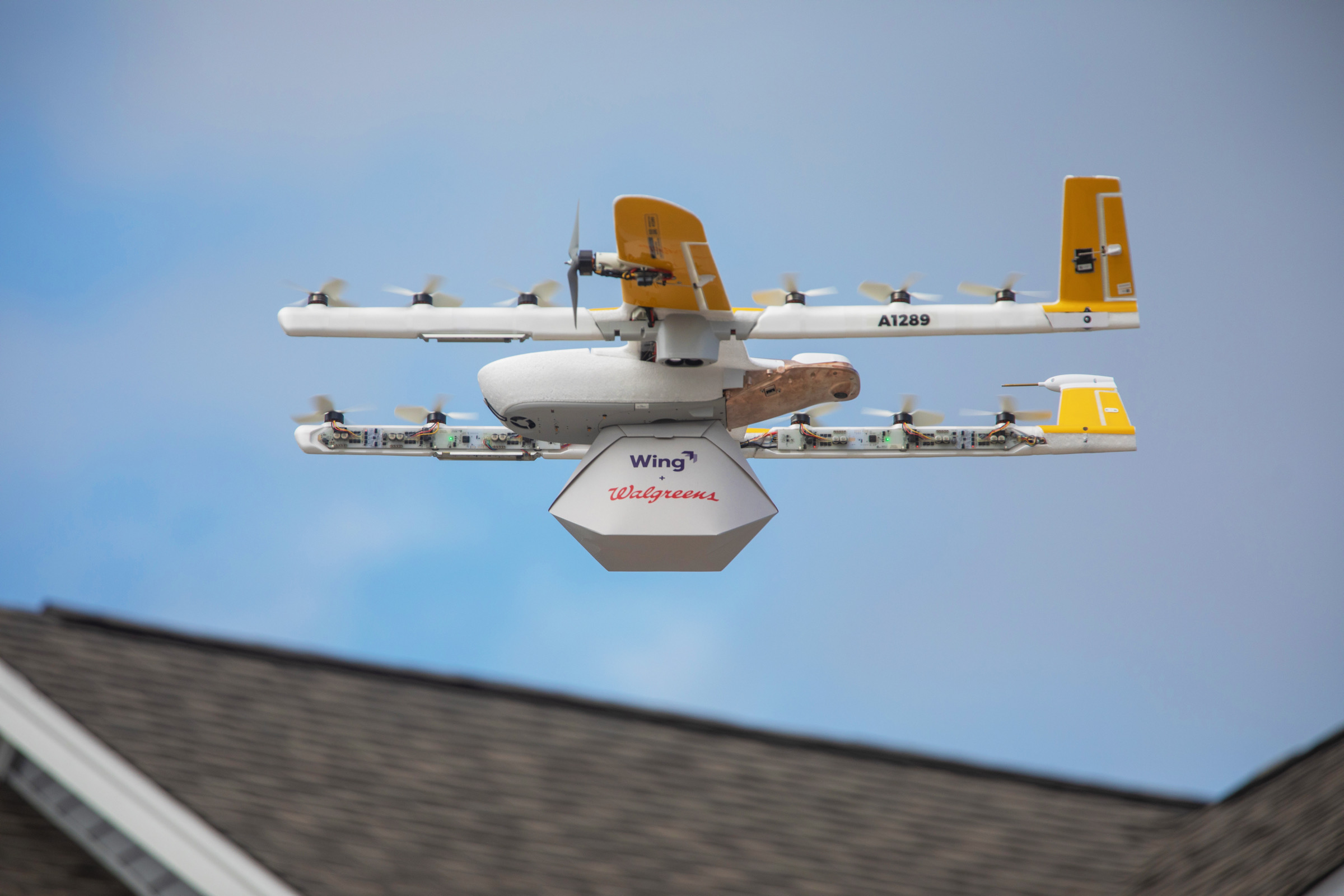
Alphabet -owned drone delivery spin-out Wing is starting to service U.S. customers, after becoming the first drone delivery company to get the federal go-ahead to do so earlier this year. Wing is working with FedEx Express and Walgreens on this pilot, and their first customers are Michael and Kelly Collver, who will get a “cough and cold pack,” which includes Tylenol, cough drops, facial tissues, Emergen-C and bottled water (do people who have colds need bottled water?).

The Collvers are receiving their package in Christianburg, Virginia, which is where Wing and Walgreens will run this inaugural pilot fo the drone delivery service. Walgreens gets a noteworthy credit in the bargain, becoming the first U.S. retailer to do a store-to-customer doorstep delivery via drone, while FedEx will be the first logistics provider to delivery a e-commerce drone delivery with a separate shipment.

Wing is also working with Virginia’s Sugar Magnolia, a retailer local to the state, and that part of the equation is focused on proving out how Wing and drone delivery can service last-mile e-commerce customers at their homes. Sugar Magnolia customers can get small items, including chocolates and paper goods, delivered directly to them via drone through the new pilot.

Wing drone delivery 3

Wing was able to do this with a new Air Carrier Certificate from the FAA that clears it for expanded service, specifically allowing Wing’s pilots to manage multiple aircraft flying without any human pilot on board at the same time, while providing service to the public.

It’s a big milestone when it comes to U.S.-based drone delivery, and another sign that people should get ready for these services to start to be a more regular fixture. Earlier this month, UPS also secured FAA approval to operate a commercial drone delivery service, so the trials will probably come fast and furious at this point – though widespread service is probably still quite a ways off as both regulators and operators look to learn from their first limited deployments.

18 Oct 2019

Daily Crunch: Zuckerberg has thoughts on free speech

The Daily Crunch is TechCrunch’s roundup of our biggest and most important stories. If you’d like to get this delivered to your inbox every day at around 9am Pacific, you can subscribe here.

1. Zuckerberg on Chinese censorship: Is that the internet we want?

The Facebook CEO spoke yesterday at Georgetown University, sharing his thoughts on speech and “how we might address the challenges that more voice and the internet introduce, and the major threats to free expression around the world.”

Among his arguments: China is exporting its social values, political ads are an important part of free expression and the definition of dangerous speech must be kept in check.

2. Atlassian acquires Code Barrel, makers of Automation for Jira

Sydney-based Code Barrel was founded by two of the first engineers who built Jira at Atlassian, Nick Menere and Andreas Knecht. With this acquisition, they are returning to Atlassian after four years in startup land.

3. Swarm gets green light from FCC for its 150-satellite constellation

Swarm Technologies aims to connect smart devices around the world with a low-bandwidth but ever-present network provided by satellites — and it just got approval from the FCC to do so. Apparently the agency is no longer worried that Swarm’s sandwich-sized satellites are too small to be tracked.

4. Nintendo Switch hits another sales milestone

Nintendo’s North American Switch unit sales have already surpassed the lifetime worldwide unit sales of the Wii U. The company announced Thursday that they had sold 15 million units of the popular handheld console in North America.

5. HBO Max scores all 21 Studio Ghibli films

WarnerMedia has been on a shopping spree for its HBO Max service. It bought the rights to “Friends” and “The Big Bang Theory,” and now it’s using its outsized checkbook to bring beloved Japanese animation group Studio Ghibli’s films onto the web exclusively on its platform for U.S. subscribers.

6. Volvo creates a dedicated business for autonomous industrial and commercial transport

The vehicle-maker has already been active in putting autonomous technology to work in various industries, with self-driving projects at quarries and mines, and in the busy port located at Gothenburg, Sweden.

7. How Unity built the world’s most popular game engine

Unity’s growth is a case study of Clayton Christensen’s theory of disruptive innovation. While other game engines targeted the big AAA game makers at the top of the console and PC markets, Unity went after independent developers with a less robust product that was better suited to their needs and budget. (Extra Crunch membership required.)

18 Oct 2019

Harley-Davidson has resumed production of the LiveWire

Harley-Davidson has resumed production and deliveries of its electric LiveWire motorcycle after determining an issue with charging was isolated to a single vehicle.

HD halted production and delivery of its first electric motorcycle earlier this week after discovering what it described at the time as a “non-standard condition.” Harley-Davidson didn’t recall any of the LiveWire motorcycles already on the road. But it did stop production and deliveries and began additional testing and analysis.

At the time, HD didn’t explain what the non-standard issue was, but TechCrunch has since learned that it was a charging-related problem on one motorcycle.

“After completing rigorous analysis this week, we have resumed LiveWire production and deliveries,” Harley-Davidson said in a comment emailed to TechCrunch. “Customers may continue riding their LiveWire motorcycle and are able to charge the motorcycle through all methods. Temporarily stopping LiveWire production allowed us to confirm that the non-standard condition identified on one motorcycle was a singular occurrence.”

The company added that this incident shows that its quality assurance measures are working as designed.

The production stoppage put a damper on Harley-Davidson’s first foray into electrification just weeks after deliveries of LiveWire began to ramp up. The $29,799, 105 horsepower electric motorcycle was to be the first of a future line-up of EVs from Harley-Davidson spanning motorcycles, bicycles and scooters.

The LiveWire, which is meant to complement, not replace, Harley-Davidson’s premium internal-combustion cruiser motorcycles, went into production in 2019. Delivery to dealers began September 27.

18 Oct 2019

Who will own the future of transportation?

Autonomous vehicles are often painted as a utopian-like technology that will transform parking lots into parks and eliminate traffic fatalities — a number that reached 1.35 million globally in 2018.

Even if, as many predict, autonomous vehicles are deployed en masse, the road to that future promises to be long, chaotic and complex. The emergence of ride-hailing, car-sharing and micromobility hints at some of the speed bumps between today’s modes of transportation and more futuristic means, like AVs and flying cars. Entire industries face disruption in this new mobility world, perhaps none so thoroughly as automotive.

Autonomous-vehicle ubiquity may be decades away, but automakers, startups and tech companies are already clambering to be king of the ‘future of transportation’ hill.

How does a company, city or country “own” this future of transportation? While there’s no clear winner today, companies as well as local and federal governments can take actions and make investments today to make sure they’re not left behind, according to Zoox CEO Aicha Evans and former Michigan Gov. Jennifer Granholm, who spoke about the future of cities on stage this month at Disrupt SF. 

Local = opportunity

Evolution in mobility is occurring at a global scale, but transportation is also very local, Evans said. Because every local transit system is tailored to the geography and the needs of its residents, these unique requirements create opportunities at a local level and encourages partnerships between different companies.

This is no longer just a Silicon Valley versus Detroit story; Europe, China, Singapore have all piled in as well. Instead of one mobility company that will rule them all, Evans and Granholm predict more partnerships between companies, governments and even economic and tech strongholds like Silicon Valley.

We’re already seeing examples of this in the world of autonomous vehicles. For instance, Ford invested $1 billion into AV startup Argo AI in 2017. Two years later, VW Group announced a partnership with Ford that covers a number of areas, including autonomy (via a new investment by VW in Argo AI) and collaboration on development of electric vehicles.

BMW and Daimler, which agreed in 2018 to merge their urban mobility services into a single holding company, announced in February plans to unify these services and sink $1.1 billion into the effort. The two companies are also part of a consortium that includes Audi, Intel, Continental and Bosch, that owns mapping and location data service company HERE.

There are numerous other examples of companies collaborating after concluding that going it alone wasn’t as feasible as they once thought.

18 Oct 2019

$35B face data lawsuit against Facebook will proceed

Facebook just lost a battle in its war to stop a $35 billion class action lawsuit regarding alleged misuse of facial recognition data in Illinois. Today it was denied its request for an en banc hearing before the full slate of ninth circuit judges that could have halted the case. Now the case will go to trial unless the Supreme Court intercedes.

The suit alleges that Illinois citizens didn’t consent to having their uploaded photos scanned with facial recognition and weren’t informed of how long the data would be saved. Facebook could face $1000 to $5000 in penalties per user for 7 million people, which could sum to a maximum of $35 billion.

A three-judge panel of ninth circuit judges rejected Facebook’s motion to dismiss the case and its appeal of the class certification of the plaintiffs back in August. One of those judges said that it “seems likely” that the Facebook facial recognition data could be used to identify them in surveillance footage or even unlock a biometrically secured cell phone.

Nicholas Iovino spotted the announcement today that we’ve attained and embedded below. When asked for comment, a Facebook spokesperson responded “Facebook has always told people about its use of face recognition technology and given them control over whether it’s used for them. We are reviewing our options and will continue to defend ourselves vigorously.”

[Image Credit: Mike MacKenzie]