Year: 2019

17 Oct 2019

The battle to become the Mexican Nubank just started

Banks in Latin America have long dominated the market as oligopolies, becoming highly profitable but not serving well the population.

In the region, Brazil was the first market to have the banks’ oligopoly challenged by neobanks, with Nubank proving that it was possible to break them up. Providing a superior product and exceptional customer support, it was able to attract more than 15 million customers, valuing the company at an astonishing US$10 billion in its latest round.

Although Brazil has been the center of the neobanks’ emergence in Latin America, attention has been shifting toward another country in the region.

The Mexican opportunity

Mexico, the second-largest economy in the region, has become a relevant market for the fintechs in the region.

The reason is not exactly the most flattering; Mexico is a large country with almost 130 million population, but a large share are still unbanked. Indeed, 63% of the adult population still doesn’t have access to financial services, according to the Global Findex database, and banks haven’t been able (or are not interested) to serve them.

Furthermore, Mexicans are very suspicious of banks because of their lack of transparency, as well as recent financial crises.

Because of this skepticism toward banks, together with a cash-based economy, 90% of all consumer transactions are still made in cash, which prompts a rather peculiar situation — twice a month (quincena) there are long lines at ATMs all across the country with people withdrawing all their wages.

On the other hand, Mexico has a digitally engaged population (Mexico is the fifth largest market for Facebook, ninth for YouTube and the third for Uber), with high smartphone penetration (85.8% according to The Competitive Intelligence Unit).

All these elements put together create a rather attractive opportunity for the emergence of neobanks.

Mexico becomes the next battleground

Mexico had a few neobank pioneers in the past couple of years; Bankaool launched its services in 2015, but was too early in the market; later on came Broxel and Albo in 2016 followed by Flink in 2018.

However, the market started to garner more attention in April 2018 when the Iranian Matin Tamizi raised US$2 million from Andreessen Horowitz (a16z) and Kaszek Ventures to create a neobank in Mexico (Cuenca). It is interesting to note that Matin, at that time, had never been to Mexico and only had a slide deck to demonstrate the opportunity.

Neobanks aren’t the only ones trying to get a share of the Mexican wallets.

This event, together with the success of neobanks in Brazil, sparked attention for the potential of the market.

A couple of months after, Albo announced a Series A, raising US$7.4 million. It is currently the leading player in the market, with 150,000 customers and the third debit card issuer in Mexico.

Shortly thereafter, Fondeadora raised a US$1.5 million seed round to enter the neobank market, pivoting from a crowdfunding platform.

Late in September, a new entrant closed a relevant round; Klar raised US$7.5 million in equity and US$50 million in debt financing with the goal to become the “Chime of Mexico.”

Vexi is another player in the market, though it is focused on providing credit cards to people at the base of the pyramid. It has issued, so far, more than 20,000 credit cards and, recently, raised US$2 million in equity and US$1 million in debt financing.

Regional and international players are also becoming interested in the opportunity. The Brazilian giant Nubank announced this year officially that it would be expanding there. From overseas, the leading Spanish neobank, Bnext, announced it would be entering the Mexican market, fueled by a fresh new round of €22.5 million. Different from other neobanks, Bnext partners with fintechs and financial institutions to provide services to its customers via a marketplace.

Nonetheless, there are rumors that other heavyweights, such as the Europeans Revolut and N26, are planning to enter the market, as well as the Argentinian Ualá.

Neobanks aren’t the only ones trying to get a share of the Mexican wallets. Many tech companies such as Cabify, Weex and Rappi are launching digital wallets and issuing debit cards, leveraging their large user base.

To add a final spice to the market, traditional banks are making a significant effort to improve their digital offers — some even going as far as launching digital branchless initiatives. The Spanish Banco Sabadell entered the Mexican market with a full digital strategy, while Banregio (a local medium-sized bank) launched Hey Banco, a new digital account.

On the sidelines, there also are a few neobanks focusing on a different segment. Oyster and Evva are targeting the unattended market of freelancers, startups and SMEs, long neglected by the incumbents.

The stage is set for an upcoming battle

Although the market is still in its early stage with just a handful of neobanks with running services, the stage is set for an amusing upcoming battle. Most players will be launching in the next couple of months, which will trigger a race for acquiring customers and raising more money.

This competition will definitely change the landscape of the financial industry in Mexico, bringing better and more affordable services to its population.

It will be indubitably interesting to watch how the market will unfold in the following years, and the prize for the winners can be quite attractive, as Nubank proved in Brazil.


17 Oct 2019

Atlassian acquires Code Barrel, makers of Automation for Jira

Atlassian today announced that it has acquired Code Barrel, the makers of Automation for Jira, a low-code tool for easily automating many aspects of Jira that’s also one of the most popular add-ons for Jira Software and Jira Service Desk in Atlassian’s marketplace. The two companies did not disclose the price of the acquisition.

Sydney-based Code Barrel was founded by two of the first engineers who built Jira at Atlassian, Nick Menere and Andreas Knecht. With this acquisition, they are returning to Atlassian after four years in startup land.

“For me and Andreas, it’s almost like coming home,” said Menere, who joined the Jira team in 2005 when there were only a handful of developers working on the product. “It’s the place where we pretty much learned how to develop software and how to develop product. For us, this was the only company we would ever go back to.”

As the name implies, Automation for Jira makes it easy to automate recurring tasks in Atlassian’s issue and project tracking service. “Increasingly, [our customers] are having to spend a lot of time on the mundane,” Noah Wasmer, the VP of Product for Tech Teams at Atlassian, told me. “What we’re seeing is that with Jira as the backbone, they are interacting with a lot of systems, are duplicating work, are manually entering work into different systems. And so what we’re finding is that they’re spending an inordinate amount of time doing things that aren’t actually helping them build and create those next-generation things that help change our world.”

75b265bf f670 4b9e a26e 946cca1ff466

If you want to reduce this kind of duplication of work, then automation is the obvious thing to look at. And with more than 6,000 companies that found Code Barrel’s solution in Atlassian’s marketplace, plus the founders’ obvious connection to the company, Automation for Jira must have been an obvious candidate for an acquisition.

Wasmer also stressed that the fact that they built a no-code tool will allow anybody who uses Jira to create scripts without having to be a programmer. Automation for Jira allows users to set up time-based rules or those that run based on triggers inside of Jira. It also features third-party integrations with SMS, Slack and Microsoft Teams, among others.

For the time being, Automation for Jira will remain in the Atlassian Marketplace and will continue to sell at the same price of $5/user/month for teams with up to 10 users and $2.5/user/month for teams between 11 and 100 users, with prices going down from there for larger enterprises. Surely, Atlassian will start integrating some of the tool’s features into Jira, but for the time being the company doesn’t have anything to announce on that front.

17 Oct 2019

Bosch’s new ‘ear’ for the Space Station’s Astrobee robot will let it ‘hear’ potential mechanical issues

Bosch is set to launch a new AI-based sensor system to the International Space Station that could change the way astronauts and ground crew monitor the ISS’s continued healthy operation. The so-called “SoundSee” module will be roughly the size of a lunch box, and will make its way to the ISS via Northrop Grumman’s forthcoming CRS-12 resupply mission, which is currently set for a November 2 launch.

The SoundSee module combines microphones with machine learning to perform analysis of sounds it picks up from the station, which it can use to effectively establish a healthy baseline, and then continually use new audio data to compare in order to get advance notice of potential mechanical issues via changes that could signal problems.

SoundSee will be mobile via installation on Astrobee, an autonomous floating cube-shaped robot that took its first totally self-guided flight in reduced gravity in June this year. Astrobee’s roving role is a perfect way for Bosch’s SoundSee tech, which it developed in partnership with Astrobotic and NASA, to work on and develop its autonomous sensing tech which it will eventually use to provide info about how systems are currently performing on the ISS, and when specific systems might need maintenance or repairs – ideally before it becomes an issue.

The first autonomous flight of Astrobee took place in June, 2019 on the ISS.

As with other things that Astrobee is designed to help with, SoundSee’s ultimate aim is to automate things that the astronaut crew of the ISS currently have to do manually. Already, SoundSee has been undergoing extensive ground testing here on Earth in a simulated environment similar to what it will experience on the ISS, but once in space, it’ll face the real test of its intended use scenario.

17 Oct 2019

How Unity built the world’s most popular game engine

What do BMW, Tencent, Pokémon Go creator Niantic, movie director Jon Favreau and construction giant Skanska have in common? They’re all using the same platform to create their products.

Founded in a small Copenhagen apartment in 2004, Unity Technologies’ makes a game engine — a software platform for building video games. But the company, which was recently valued around $6 billion and could be headed toward an IPO, is becoming much more than that.

“Unity wants to be the 3D operating system of the world,” says Sylvio Drouin, VP of the Unity Labs R&D team.

Customers can design, buy, or import digital assets like forests, sound effects, and aliens and create the logic guiding how all these elements interact with players. Nearly half of the world’s games are built with Unity, which is particularly popular among mobile game developers. 

And in the fourteen years since Unity’s engine launched, the size of the global gaming market has exploded from $27 billion to $135 billion, driven by the rise of mobile gaming, which now comprises the majority of the market.

Unity is increasingly used for 3D design and simulations across other industries like film, automotive, and architecture and is now used to create 60% of all augmented and virtual reality experiences. That positions Unity — as Facebook CEO Mark Zuckerburg argued in a 2015 memo in favor of acquiring it — as a key platform for the next wave of consumer technology after mobile.

Unity’s growth is a case study of Clayton Christensen’s theory of disruptive innovation. While other game engines targeted the big AAA game makers at the top of the console and PC markets, Unity went after independent developers with a less robust product that was better suited to their needs and budget. 

As it gained popularity, the company captured growth in frontier market segments and also expanded upmarket to meet the needs of higher-performance game makers. Today, it’s making a push to become the top engine for building anything in interactive 3D.

This article is part of my ongoing research into the future of interactive media experiences. This research has included interviews with dozens of developers, executives, and investors in gaming and other industries, including interviews with over 20 Unity executives.

Founding

Unity was founded in Copenhagen by Nicholas Francis, Joachim Ante, and David Helgason. Its story began on an OpenGL forum in May 2002, where Francis posted a call for collaborators on an open source shader-compiler (graphics tool) for the niche population of Mac-based game developers like himself. It was Ante, then a high school student in Berlin, who responded. 

Ante complemented Francis’ focus on graphics and gameplay with an intuitive sense for back-end architecture. Because the game he was working on with another team wasn’t going anywhere, they collaborated on the shader part-time while each pursued their own game engine projects, but decided to combine forces upon meeting in-person. In a sprint to merge the codebases of their engines, they camped out in Helgason’s apartment for several days while he was out of town. The plan was to start a game studio grounded in robust tech infrastructure that could be licensed as well.

Helgason and Francis had worked together since high school, working on various web development ventures and even short-lived attempts at film production. Helgason dropped in and out of the University of Copenhagen while working as a freelance web developer. He provided help where he could and joined full-time after several months, selling his small stake in a web development firm to his partners. 

According to Ante, Helgason was “good with people” and more business-oriented, so he took the CEO title after the trio failed to find a more experienced person for the role. (It would be two years before Ante and Francis extended the co-founder title and a corresponding amount of equity to Helgason.)

They recruited a rotating cast to help them for free while prototyping a wide range of ideas. The diversity of ideas they pursued resulted in an engine that could handle a broad range of use cases. Commercializing the engine became a focus, as was coming up with a hit game that would show the engine off to its best advantage; for indie developers, having to reconstruct an engine with every new game idea was a pain point that, if solved, would enable more creative output. 

Supported by their savings, a €25,000 investment from Ante’s father, and Helgason’s part-time job at a café, they pressed on for three years, incorporating in the second year (2004) with the name Over The Edge Entertainment.

The game they ultimately committed to launching in spring 2005, GooBall, was “way too hard to play,” says Ante and didn’t gain much traction. Recognizing that they were better at building development tools and prototypes than commercially-viable games, they bet their company on the goal of releasing a game engine for the small Mac-based developer community. Linking the connotations of collaboration and cross-compatibility, they named the engine Unity.

17 Oct 2019

Zubale, founded in Mexico City last year by two HBS grads, just raised $4.4 million to put locals to work over their smart phones

A year ago, at a demo day south of San Francisco, we watched a number of recently formed startups pitch investors on their companies. One that stood out to us at the time was Zubale, a Mexico City-based outfit whose founders were looking to connect big corporations with Latin Americans eager to address tasks on their behalf. A person could conduct on-the-ground market research for a brand, for example, then earn mobile phone credits or other redeemable digital rewards.

Fast forward and Zubale, which had 10 employees at the time, now has 40 full time employees, and it has completed 170,000 tasks on behalf of the consumer brands on which it is squarely focused — and for two reasons.

First, according to Zubale cofounder Allison Campbell, the retail industry across Latin America is a generating $2 trillion per year, but companies are also shelling out $40 billion on “super painful and high spend” that includes employees who complete in-store tasks like stocking shelves, checking prices, and building displays.

Campbell says Zubale can save — even make — these companies money by crowdsourcing the same tasks to independent contractors who can choose from an inventory of jobs near them that they want to complete.

Campell and her cofounder, Sebastian Monroy, also know a few things about retail in emerging markets. Before heading to HBS, Campbell spent nearly eight years with Walmart, as a merchandise manager, then as a  director of international strategic initiatives, roles that placed her in Gurgaon India, then Shanghai and Shenzhen, China. Monroy’s path has been a similar one; he spent more than seven years working in a variety of sales roles for Proctor & Gamble in Mexico before heading to Harvard, where he met Campbell on their first day of business school. (“We realized we were wearing the same exactly glasses and took a picture together,” she says with a laugh. They decided to team up on Zubale a a year later.)

Indeed, though one could see Zubale using its platform to crowdsource any number of tasks, a la TaskRabbit, the opportunity is so massive in catering to retailers that the startup plans to stay in its lane for the foreseeable future.

If anything, says Campell, Zubale — which plans to eventually expand from Mexico into other countries, including Brazil, Chile, and Peru — may end up offering the contractors more in the way of financial services products, given that there remains a dearth of these and that these individuals are constantly checking the app anyway.

It makes sense. While 85 percent of Mexico’s population of 125 million now has a smart phone — giving rise to more app-driven startups like Zubale — only 10 percent have a credit card, and only 35 percent have a checking account. It’s for that reason that many of the people who work for Zubale still choose to earn mobile phone credit and other digital rewards that they can redeem through making online purchases.

They “love us,” too, says Campbell, because they can “increase their income by 40 percent” by performing work for Zubale. In fact, she suggests Zubale hasn’t had to do much in the way of marketing, thanks to Facebook Groups where the company is discussed, as well as through other word of mouth, including workers’ friends who want more jobs and find it easier to find and complete jobs in 30-minute increments at the same store location rather than run from store to store or job to job. (On average, she adds, they complete 20 jobs for the company per week.)

Certainly, investors like the company. Campell and Monroy say they had a lot of inbound interest when they began seeking seed funding more recently. They chose the venture firm NFX to lead the $4.4 million round, given its expertise in marketplaces and network-effects driven businesses. Other participants in the round include Industry Ventures, Joe Montana’s Liquid 2 Ventures, and XFactor Fund, along with individual investors Jonathan Swanson (who is the chairman of Thumbtack), Sergio Romo (the CEO of Grow Mobility), and Bob White (the founder and a former managing director of Bain Capital).

Meanwhile, the company’s very first check came from the seed-stage firm Pear, which had hosted that demo day.

17 Oct 2019

New NVIDIA Shield Android TV streaming device leaks via Amazon listing

The fact that NVIDIA is updating its Shield TV hardware has already been telegraphed via FCC filing, but a leak earlier today paints much more of a detailed picture. An Amazon listing for a new NVIDIA Shield Pro set-top streaming device went live briefly before being taken down, showing a familiar hardware design, a new remote control, and listing some of the forthcoming feature updates new to this generation of hardware.

The listing, captured by the eagle-eyed Android TV Rumors and shared via Twitter, includes a $199.99 price point, specs that include 3GB of RAM, 2x USB ports, a new Nvidia Tegra X1+ chip and 16GB of onboard storage. In addition to the price, the Amazon listing had a release date for the new hardware of October 28.

If this Amazon page is accurate (and it looks indeed like an official product page that one would expect from NVIDIA), the new Shield TV’s processor will be “up to 25% faster than the previous generation,” and will offer “next-generation AI upscaling” for improving the quality of HD video on 4K-capable displays.

It’ll offer support for Dolby Vision HDR, plus surround sound with Dolby Atmos support, and provide “the most 4K HDR content of any streaming media player.” There’s also built-in Google Assistant support, which was offered on the existing hardware, and it’ll work with Alexa for hands-free control.

The feature photos for the listing show a new remote control, which has a pyramid-like design, as well as a lot more dedicated buttons on the face. There’s backlighting, and an IR blaster for TV control, as well as a “built-in lost remote locator” according to the now-removed Amazon page.

This Amazon page certainly paints a comprehensive picture of what to expect, and it looks like a compelling update to be sure. The listing is gone now, however, so stay tuned to find out if this is indeed the real thing, and if this updated streamer will indeed be available soon.

17 Oct 2019

HBO Max scores all 21 Studio Ghibli films

HBO’s streaming services have long succeeded on the strength of original programming, but in a post AT&T acquisition world, the company is having to create a streaming service supergroup of exceptional content to lure consumers into coughing up more cash.

HBO has been on a shopping spree for its HBO Max service. It bought right to Friends and The Big Bang Theory, and now it’s using its outsized checkbook to bring beloved Japanese animation group Studio Ghibli’s films onto the web exclusively on its platform for U.S. subscribers.

All 21 films from the studio, including classics like Princess Mononoke, Spirited Away, My Neighbor Totoro and Howl’s Moving Castle will be coming in 2020. The Wind Rises will be coming to the service in fall of 2020, the rest will come earlier in the spring.

This deal is hugely noteworthy for Studio Ghibli, as their classic films weren’t available to watch or download online legally in any capacity. It also seems that much of that was on purpose, and it seems that this long-held belief was changed with some of that HBO moola.

Terms of the deal weren’t disclosed, but here’s what a representative told Polygon this year.

“Studio Ghibli does not make their films available digitally, whether for download or streaming, anywhere in the world… They continue to believe that presentation is vital and particularly appreciate opportunities for audiences to experience the films together in a theatrical setting.”

This is a big win for HBO because anyone would’ve assumed that Studio Ghibli would’ve partnered with Disney, if anyone, for a streaming deal given their long-term relationship, but HBO Max seems to be keeping the checkbook handy and won this deal because of it.

17 Oct 2019

Zuckerberg on Chinese censorship: Is that the internet we want?

China is exporting its social values, political ads are an important part of free expression, and the definition of dangerous speech must be kept in check, Facebook’s CEO Mark Zuckerberg argued today.

He criticized how American companies that do business with China were becoming influenced by the country’s values. “While our services like WhatsApp are used by protestors and activists everywhere due to strong encryption and privacy practices, on TikTok, the Chinese app growing quickly around the world, mentions of these same protests are censored, even here in the US!” Zuckerberg said. “Is that the Internet that we want?”

Because Facebook couldn’t come to an agreement with Chinese censors and thereby doesn’t operate in the nation, “Now, we have more freedom to speak out and stand up for the values that we believe in and fight for free expression around the world.”

Zuckerberg Georgetown Speech

Zuckerberg spoke today at Georgetown University to share his thoughts on speech and “how we might address the challenges that more voice and the internet introduce, and the major threats to free expression around the world.” He discussed how “We want to the progress of free expression without the tension” leading people to advocate for pulling back on free expression. “Where do you draw the line?”

Zuckerberg says that Facebook now has 35,000 people working on security, and the company’s security budget is higher now than the whole revenue of the company when it IPO’d, which was $5 billion in 2012. Facebook removes or downranks content that is objectively dangerous. Still, he says that he doesn’t want to “let the definition of what is dangerous to expand beyond what’s absolutely necessary.”

17 Oct 2019

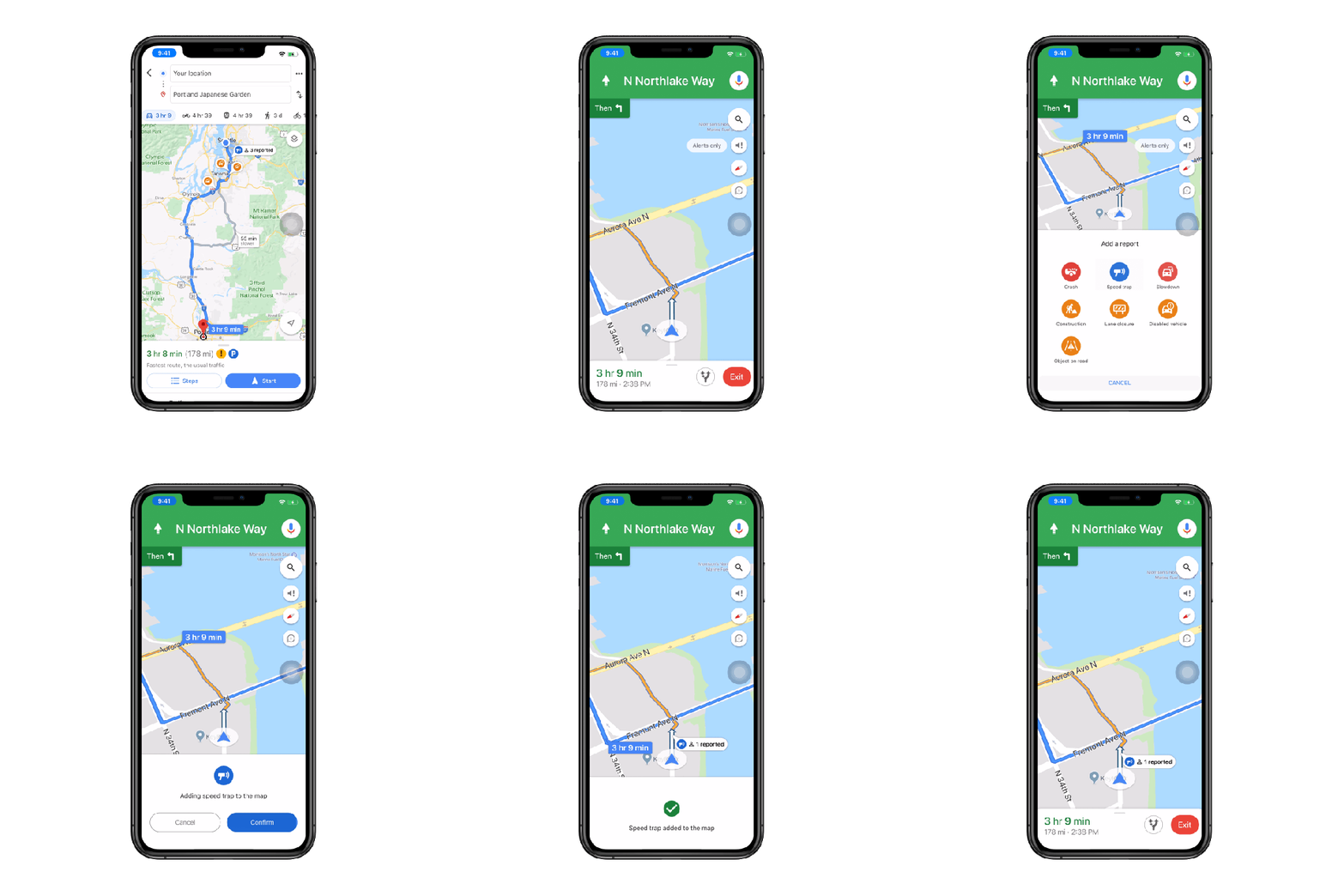
Google Maps adds more Waze-like features, including driving incident reports

Google Maps is starting to look a lot more like Waze. Google today announced a series of new features that will allow drivers using the Maps app on iOS to report accidents, speed traps, and traffic jams. And on both iOS and Android, users will be able to report other driving hazards and incidents, like road construction, lane closures, disabled vehicles, and objects in the road — like debris. These are all core Waze features and among the primary reasons why many users opt for Waze over Google Maps.

Google had already offered accident, speed traps, and traffic slowdown reports on Android before today.

The new updates follow a steady launch of Waze-like additions to the Google Maps app.

For example, Google launched speed limits and speed trap alerts in over 40 countries in Google Maps back in May. And it had been testing various driving hazard alerts before now. Google Maps had also previously adopted other Waze features, like the ability to add a stop to your route while in navigation mode, or the ability to view nearby gas prices.

Mid trip UGC Report

When you’re navigating your route in Google Maps, you can tap to add a report then choose from a long list that now includes: Crash, Speed Trap, Slowdown, Construction, Lane Closure, Disabled vehicle, and Object on Road.

With the additions, Google is chipping away at the many reasons why people still turn to Waze.

However, Waze is still better for planning a trip by connecting to your personal calendar or Facebook events, while Google Maps has instead focused more on helping users plan their commutes. Waze also is more social and includes a carpooling service.

The benefit of more users switching to Maps means more aggregate data to help power Google’s other products. Data collection from Google Maps is behind features like those that show the wait times, popular times and visit duration at local businesses, for example. Plus, Google Maps is a jumping off point for Google’s My Business platform, which has more recently been challenging Facebook Pages by allowing Maps users to follow their favorite businesses to track promotions and events, and even message the businesses directly.

Google says the new Google Maps features start rolling out globally on Android and iOS this week.


17 Oct 2019

Juul will stop selling mango, creme, fruit and cucumber pod flavors in the U.S.

Juul has stopped selling a number of its flavored nicotine products — mango, creme, fruit and cucumber — in the U.S., pending a review by the U.S. Food and Drug Administration. Now, the vaping company will only sell the flavors that taste like tobacco, mint or menthol in the U.S., the company announced today.

“We must reset the vapor category by earning the trust of society and working cooperatively with regulators, policymakers, and stakeholders to combat underage use while providing an alternative to adult smokers,” Juul CEO K.C. Crosthwaite said in a statement.

This comes after Juul stopped actively supporting San Francisco’s Proposition C, ceased its advertising campaigns in the U.S and stopped lobbying the FDA on its draft flavor guidance.

But this doesn’t mean Juul is giving up on selling these flavors in the future. The company said it will continue to try to develop scientific evidence to support the use of those flavored products, as well as develop stricter measures to combat underage usage. Meanwhile, Juul is still selling all of its flavors outside of the U.S.

Earlier this week, a parent who lost her child filed a wrongful lawsuit against Juul. That suit is just one of several lawsuits Juul faces.