Year: 2019

17 Oct 2019

Luna Display now supports older Macs as a secondary screen

Secondary display companies are among the latest to get a taste of Sherlocking, after Apple introduced Sidecar as part of the recent Catalina update. Honestly, the feature is far and away the best thing about the latest version of MacOS and as a number of third-party app developers have discovered over the decades, it’s hard to compete with native support.

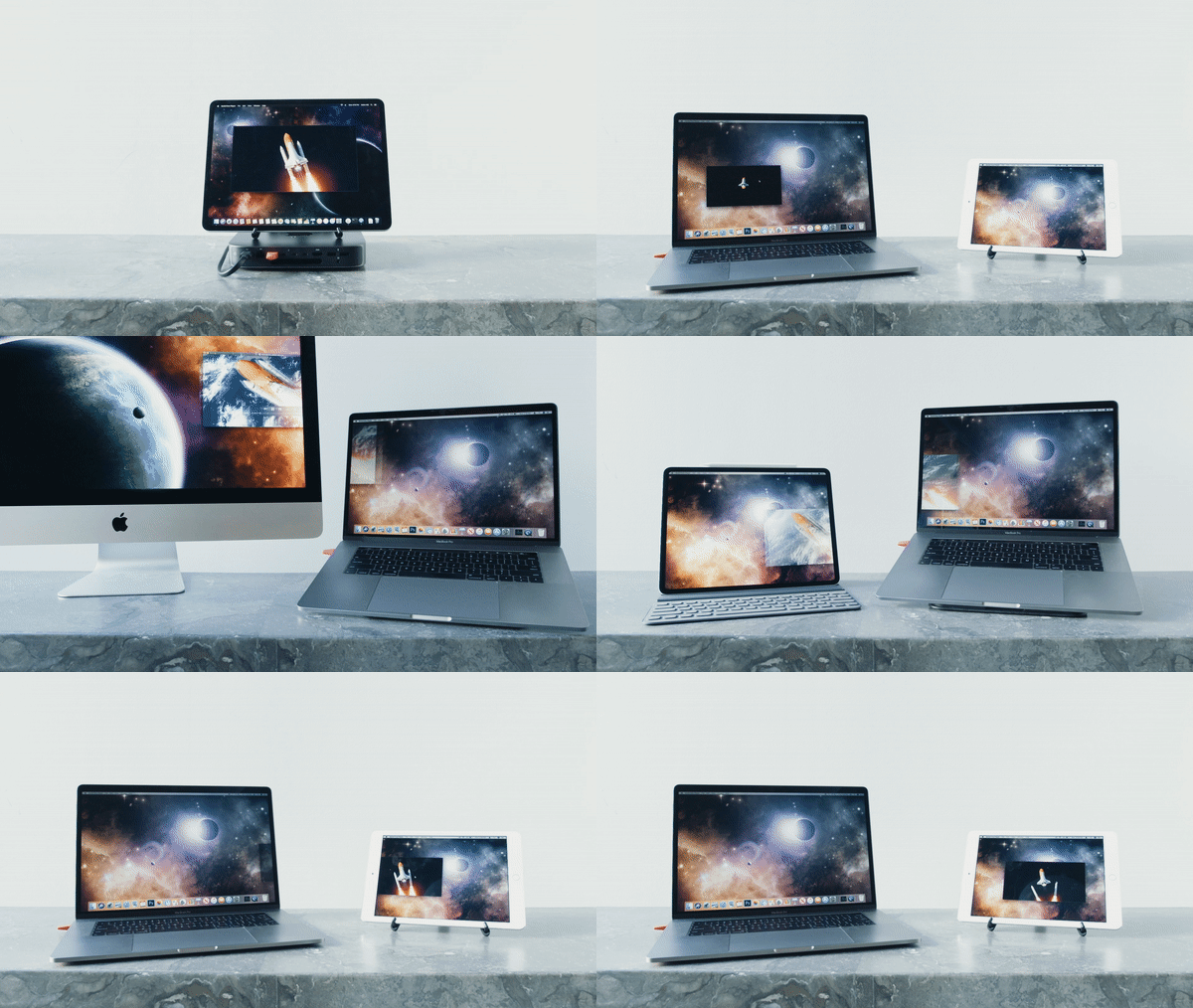
For Duet Display, staying relevant meant adding Android tablet support. For Luna Display makers Astropad, it’s finding a way for users to dust off their old Macs. An update being released today brings the feature to the dongle-based technology.

ezgif.com video to gif

Mac-to-Mac lets Luna users use older Mac models as second screens, so you can, say, wireless connect a MacBook to, say, a Mac mini, iMac or even another MacBook. It’s probably less handy for most users than simple iPad connectivity, but there’s something to be said for something that puts old systems to use. For Astropad’s sake, hopefully Apple doesn’t feel the same way for its next update. 

Per Astropad,

For example, if you have an iMac at your office, and a laptop that moves with you between work and home, pair your laptop with your iMac when in the office to make use of both devices. Or if you’re just working from home, pair your laptop to your iMac or Mac Mini and harness the power of those super computers from your comfy sofa. Get yourself a snack in the kitchen without having to miss a beat when your co-worker sends you a funny dog GIF! The possibilities are endless!

The primary system needs to run El Capitan or later and the second needs to be on Mountain or newer. The connection works tethered or over WiFi. The company’s also offering a 25% discount on Luna for the next couple of days. 

17 Oct 2019

Tesla gets green light to start producing EVs in China

China’s industry ministry has add Tesla to a government list of approved automotive manufacturers, a designation that allows the electric automaker to begin producing vehicles in the country.

Tesla’s inclusion on the list published by the Ministry of Industry and Information Technology was reported by Reuters. A Chinese tech site also reported the news and provided a screenshot of MIIT’s approved automakers. Tesla is the first automaker listed.

TechCrunch has reached out to Tesla and will update when the company responds.

Tesla is building a $2 billion factory in Shanghai, its first manufacturing facility outside the United States.

In July, Tesla wrote in its quarterly earnings letter to shareholders that Model 3 production was on track to begin at its Shanghai factory by the end of the year. Starting production by November would be a critical milestone for the automaker if it hopes to continue to increase sales and avoid the high cost of shipping and tariffs.

Tesla wrote at the time that machinery was moved into the factory during the second quarter in preparation for the first phase of production.

The company also said in July that “depending on the timing of the Gigafactory Shanghai ramp, we continue to target production of over 500,000 vehicles globally in the 12-month period ending June 30, 2020.”

Tesla has said the production line at the factory in China will have a capacity of 150,000 units annually and will be a simplified, more cost-effective version of the Model 3 line at its Fremont, Calif. factory. Tesla has also said this second-generation Model 3 line will be at least 50% cheaper per unit of capacity than its Model 3-related lines in Fremont and at its Gigafactory in Sparks, Nev.

17 Oct 2019

The Information will launch Ticker, a tech news app that costs $29 per year

Since it was founded by journalist Jessica Lessin in 2013, The Information has stood out in the tech news landscape for its focus on an ad-free, subscription-driven business model (a focus that seems increasingly prescient).

Now, the upcoming launch of an app called Ticker suggests that the company is looking to expand its audience while maintaining that subscription model.

The Information describes Ticker as its first consumer app. The assumption is that anyone who’s currently paying the $399 annual fee for an Information subscription needs it for their job — whether they’re an investor, entrepreneur or some other professional in the tech industry.

The new app, meanwhile, is designed for anyone who might be interested in keeping up-to-date with the latest tech news, and it’s priced much more affordably, at $29 per year. (Information subscribers will get access as well.)

The Information ticker app

Apparently the app was inspired by the Briefing section of The Information website, which offers quick summaries (usually drawn from reporting by other publications) of major tech news.

Ticker, meanwhile, will include a section called Today with summaries of the day’s tech headlines — similar to Briefing, but written for a consumer audience. It will also include a calendar highlighting upcoming IPOs, conferences and other events that readers might want to know about. (Not included: The Information’s full articles and original reporting.)

“More and more, we’ve been hearing from readers who don’t have a business reason to follow tech but are finding it more and more central to their lives,” Lessin said in a statement. “We are launching Ticker for them — giving them access to the best summaries of the most significant news, written by our team at The Information.”

The company plans to launch Ticker later this fall. In the meantime, you can sign up here.

17 Oct 2019

‘Cloud kitchens’ is an oxymoron

The biggest wave in consumer products right now has all the hallmarks of another bubble of misplaced investor expectations and sadly lower margins.

Cloud kitchens (the category, and not just CloudKitchens the startup service) is essentially WeWork for restaurant kitchens. Instead of buying an expensive restaurant site on a heavily-walked street, a cloud kitchen is developed in a cheaper locale (an industrial district perhaps), with dozens of kitchen stations that are individually rentable for short periods of time by chefs and restaurant proprietors.

It’s a market that has exploded this year. CloudKitchens, which has been funded by former Uber founder and CEO Travis Kalanick, is perhaps the most well-known example, but others are competing, and none more so than meal delivery companies. DoorDash announced that it was opening a shared kitchen in Redwood City just this week, Amazon has announced it is getting in the game, and around the world, companies like India-based transportation network Ola are building out their own shared kitchens.

That has led to laudatory headlines galore. Mike Isaac and David Yaffe-Bellany talk about “the rise of the virtual restaurant” at the New York Times, while Douglas Bell, contributing to Forbes, wrote that “Deliveroo’s Virtual Restaurant Model Will Eat The Food Service Industry.”

And there are not just headlines, but predictions of doom as well for millions of small-business restaurant owners. Mike Moritz, the famed partner at Sequoia, wrote in the Financial Times earlier this year that:

The large chain restaurants that operate pick-up locations will be insulated from many of these services, as will the high-end restaurants that offer memorable experiences. But the local trattoria, taqueria, curry shop and sushi bar will be pressed to stay in business.

Latent in these pieces (there are dozens of them published on the web) lies a superficial storyline that’s appealing to the bright but not detail-oriented: that there are high software margins (or ‘cloud’ margins if you will) to come from a world in which kitchen space is suddenly shareable, and that’s going to lead to a complete disruption of restaurants as we know them.

It’s the same sort of storyline that propelled WeWork to meteoric heights before eventually crashing the last few weeks back down to reality. As Jesse Hempel wrote in Wired a few years ago about the shareable office startup: “Over time, this could be a much bigger opportunity than coworking spaces, one in which everything WeWork has built so far will simply feed an algorithm that will design a perfectly efficient approach to office space.”

Clearly, the AI algorithm for office efficiency (“WeWork Brain”?) wasn’t as profitable as hoped, with WeWork expected to lay off 500 software engineers in the coming weeks.

And yet despite the seeming collapse of WeWork and the destruction of its narrative, we still haven’t learned our lesson. As Isaac and Yaffe-Bellany discuss in their NYT piece, “No longer must restaurateurs rent space for a dining room. All they need is a kitchen — or even just part of one.” Now I know what the two mean here, but let’s be uncharitable for a moment: you can’t rent a part of a kitchen. No one rents the stovetop and not the prep area.

But it is that quickly slippery logic that can cause an entire industry to rise and eventually crumble. Just as with the whole “WeWork should really be valued as a software company” meme, the term ‘cloud kitchens’ implies the flexibility (and I guess margins?) of data centers, when in reality, they couldn’t be further away in practice from them. Commercial kitchens require regulatory licenses and inspections, constant monitoring and maintenance, not to mention massive kitchen staffs (they aren’t automated kitchens!).

So let’s look at how margins and leverage play out for the different players. If you are the owner of one of these cloud kitchens, how exactly do you get any pricing leverage in the marketplace? Isaac and Yaffe-Bellany again write, “Diners who order from the apps may have no idea that the restaurant doesn’t physically exist.”

That sounds plausible, but if consumers don’t know where these restaurants physically are, what is stopping an owner from switching its kitchen to another ‘cloud’? In fact, why not just switch regularly and force a constant bidding war between different clouds? Unlike actual cloud infrastructure, where switching costs are often extremely prohibitive, the switching costs in kitchens seems rather minimal, perhaps as simple as packing up a box or two of ingredients and walking down the street.

That’s why we are seeing almost no innovation coming from early-stage startups in this space. Deliveroo, Uber Eats, DoorDash, Ola, and more — let alone Amazon — are hardly under-funded startups.

In fact, this supposed rise of the cloud kitchen gets at the real crux of the matter: the true ‘expense’ of restaurants isn’t rent or labor, but in fact is really marketing: how do you acquire and retain customers in one of the most competitive industries around?

Isaac and Yaffe-Bellany argue that restaurants will join these meal delivery platforms to market their foods. “…[T]hey can hang a shingle inside a meal-delivery app and market their food to the app’s customers, without the hassle and expense of hiring waiters or paying for furniture and tablecloths.”

Let me tell you from the world of media: relying on other platforms to own your customers on your behalf and wait for ‘traffic’ is a losing proposition, and one that I expect the vast majority of restaurant entrepreneurs to grok pretty quickly.

Instead, it’s the meal delivery companies themselves that will take advantage of this infrastructure, an admission that actually says something provocative about their business models: that they are essentially inter-changeable, and the only way to get margin leverage in the industry is to market and sell their own private-label brands.

For example, I get the same food delivered from the same restaurants regularly, but change the service based on which coupon is best this week (for me, that’s Uber Eats, which offered me $100 if I spent it by Friday). That inter-changeability makes it hard to build a durable, profitable business. Uber Eats, for instance, is expected to be unprofitable for another half decade or more, while GrubHub’s profit margins remain mired in the single digits.

The great hope for these companies is that cloud kitchens can fill the hole in the accounting math. Private brands drive large profits to grocery stores due to their higher margins, and the hope is that an Uber Burger or a DoorDash Pizza might do the same.

The question, of course, is whether consumers “just want food” or whether they specifically want the pad thai from that restaurant down the street they love because it is raining and they don’t want to walk to it. Food brands have a prodigiously long gestation period, since food choices are deeply personal and take time to shift. Just because these meal delivery platforms start offering a burger or a rice bowl doesn’t suddenly mean that consumers are going to flock to those options.

All of which takes us back to those misplaced investor expectations. Cloud kitchens is an interesting concept, and I have no doubt that we will see these sorts of business models for kitchens sprout up across urban cities as an option for some restaurant owners. I’m also sure that there will be at least one digital-only brand that becomes successful and is mentioned in every virtual restaurant article going forward as proof that this model is going to upend the restaurant industry.

But the reality is that none of the players here — not the cloud kitchen owners themselves, not the restaurant owners, and not the meal delivery platforms — are going to transform their margin structures with this approach. Cloud kitchens is just adding more competition to one of most competitive industries in the world, and that isn’t a path to leverage.


17 Oct 2019

MIT develops a way for robots to grasp and manipulate objects much faster

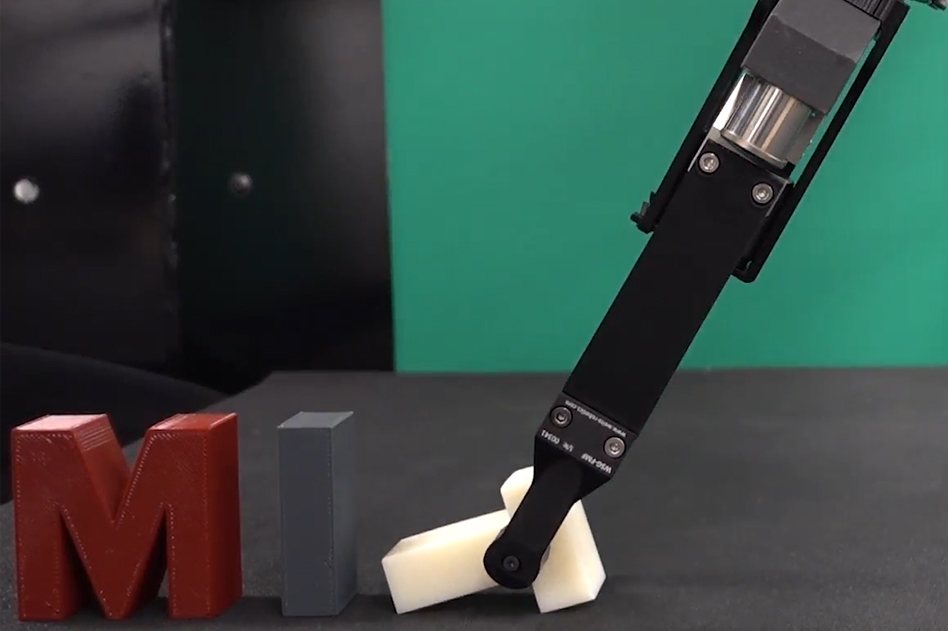
MIT Robot Gripper 0Picking stuff up seems easy, right? It is – for humans with powerful brain computers that instantly and intuitively figure out everything needed to get the job done. But for robots, even advanced robots, the compute required is surprisingly complex, especially if you want the robot to not, you know, break the thing it’s grabbing.

MIT has developed a new way to speed up the planning involved in a robot grasping an object, making it “significantly” faster – reducing the total time from as much as ten or more minutes, to under a second. That’s many orders of magnitude better, bringing it closer to the realm of human reaction and response time.

This could have big practical benefits to setting where robotics are already in use, including in industrial environments. The research team’s method involves having the robot push the object against a surface that doesn’t move, which allows it to shortcut a bunch of the decision-making process about how to manipulate it. That could be applied in picking and sorting applications, which is a common enough use for robots on factory floors and in warehouses.

MIT says this could even be used to improve robotic manipulation of “intricate tools,” and that it can be applied even in the case of simple robotic grippers, rather than just being useful for advanced, highly articulated robotic manipulators.

To prove the validity of its model, the team built an experiment in which a robot gripper held a t-shaped block and pushed it against a fixed, vertically oriented bar. The results mirrored what happened in their virtual models, with the robot being able to plan out control of the gripped block through a maneuver to place it upright on the tablet’s surface in less than a second, whereas it had taken over 500 seconds using traditional methods.

17 Oct 2019

Venmo to launch its first credit card in 2020

Venmo announced today its plans to launch its first-ever credit card. The card is being issued partnership with Synchrony, already the issuer behind Venmo parent company PayPal’s Extras Mastercard and Cashback Mastercard, in an expanded relationship. The move is meant to help Venmo, a still unprofitable arm of PayPal’s larger business, generate more revenue.

PayPal’s plans in this space were reported in April of this year by The WSJ, which said the company had been taking meetings with various banks since late 2018 to discuss a Venmo-branded credit card. The report said PayPal was then close to selecting Synchrony as its issuer and would likley announce the card sometime later in 2019, as it now has.

Synchrony is known for powering a number of store cards, including those from Amazon, eBay, JCPenney, TJX, Stein Mart, American Eagle, Gap, Old Navy, Rooms to Go, Lowe’s, and many others — around 100 cards, in total. The company says it has financed over $140 billion in sales and has 80.3 million active accounts.

While this is Venmo’s first credit card, it’s not its first physical card.

The company also offers a Mastercard-branded debit card, launched in July 2018, which lets users tap into their Venmo account balance out in the real world, where you can’t pay digitally.

This launch allowed Venmo to generate revenue from interchange fees, in addition to its investments made with customer balances, as is typical in this space.

Venmo had also looked to better monetize its sizable user base of 40 million+ with other small fees — like the 1% fee to move Venmo balances instantly to a user’s bank account, for example. But Venmo has yet to turn a profit, despite its widespread adoption.

Once the new card is available, Venmo credit cardholders will be able to both apply for the card in the Venmo app and then manage their account from there, if approved. They’ll also receive real-time alerts, and will be able to split purchases using the card.

“For 15 years, Synchrony has been a strategic partner in offering credit cards that enable greater purchasing power and rewards for PayPal consumers,” said Dan Schulman, CEO, PayPal, in a statement. “We are pleased to deepen our relationship with Synchrony to bring groundbreaking new credit experiences to the Venmo community through a desirable credit card and a seamless in-app experience,” he said.

The launch follows the much-anticipated launch of Apple Card as well as a larger shift in how younger consumers are using payment cards and banking services. They’re often opting to forgo traditional brick-and-mortar banks to instead use modern banking apps, where the focus is on providing mobile-friendly tools and reduced fees.

If Venmo further moves into this space, it will have competition from the likes of Varo, Simple, Chime, Current, Cleo, N26, Step, Stash, and others.

The new co-branded credit card will be launched to U.S. Venmo users in the second half of 2020, the company says. More details about the card, including other perks it may offer, will be available later on.

PayPal is set to announce its Q3 2019 earnings on Oct. 23. Wall St. is expecting it will announce growth, with EPS of $0.69, a year-over-year change of +19%.

17 Oct 2019

Latest IBM partnership looks to improve seafood safety with blockchain

IBM has been working with a number of different industries to help improve food safety with the help of blockchain technology. Today it announced its latest effort, a partnership with Massachusetts firm, Raw Seafoods, Inc, to bring this approach to seafood starting with scallops.

While business blockchain buzz has quieted recently, the supply chain still seems like a solid use case, allowing various stakeholders to trace a shipment from farm, factory or fishing boat to market. The challenge has been getting suppliers to participate, especially when there is such a wide range of technological abilities along the chain.

In this case, IBM is working with a fleet of scallop boats out of New Bedford, MA, which will be sharing data about their catches, enabling all the stakeholders in the supply chain to know where and when the catch happened. As IBM describes it, “The platform will also track when the boat landed portside, and when each scallop lot was hand graded, selected, packed and shipped to its final destination.” It will also include pictures and video before the boat reaches the dock.

Anyone with permission will be able to access the information on the blockchain by simply clicking a node to see where the scallops were at any given point in its journey from boat to market. Without digitization, tracking any food has been a time-consuming process. With blockchain, tracking happens instantly.

“Traditionally, tracing the origin of a given food product could take days, if it was possible at all, especially for wild caught sea scallops. By reducing that time frame to a matter of seconds, we’re able to solve three of the core consumer concerns that deter them from enjoying seafood: safety, sustainability and authenticity,” Rajendra Rao, General Manager of IBM Food Trust.

Raw Seafood, Inc. also plans to build an app, connected to the platform, that would allow consumers at a restaurant to scan a QR code on the menu to get detailed information about the scallops before they order it.

Last year, IBM announced a similar partnership with Walmart to track leafy green vegetables from farm to shelf.

17 Oct 2019

Popular app Snaptube caught serving invisible ads and charging users for premium purchases they haven’t made

A popular video downloader app for Android has been found generating fake ad clicks and unauthorized premium purchases from its users, according to a security firm.

Snaptube, which boasts some 40 million users, allows users to download videos and music from YouTube, Facebook, and other major video sites. The app, developed in China, is not on Google Play because the app maker claims Google will not allow video downloader apps on the store. Some third-party app stores estimate Snaptube has been downloaded over a billion times to date. The app’s developer says that the app is “safe” to use.

But researchers at London-based security firm Upstream, which shared its findings exclusively with TechCrunch, said the free app ends up costing consumers.

Upstream’s chief executive Guy Krief said users are served invisible ads without their knowledge that run silently on the device, allowing the app maker to generate ad revenue at the expense of churning up a user’s mobile data and battery power. The app also uses the same background click technique to rack up premium purchases charges that the user never asked for.

Krief said the only indication that a user’s device might be used in this way is if their mobile data usage increases, their device gets warm, and the battery runs out faster than usual.

The company pinned the blame on a third-party software development kit (SDK) code, known as Mango, embedded inside Snaptube’s app. Mango was also used in Vidmate, a similar video downloader app also accused of ad fraud behavior; as well as 4shared, a cloud storage app.

According to Uptream, this third-party code kit downloads additional components from a central server in order to engage in this fraudulent ad activity, and uses chains of redirection and obfuscation to hide its activity.

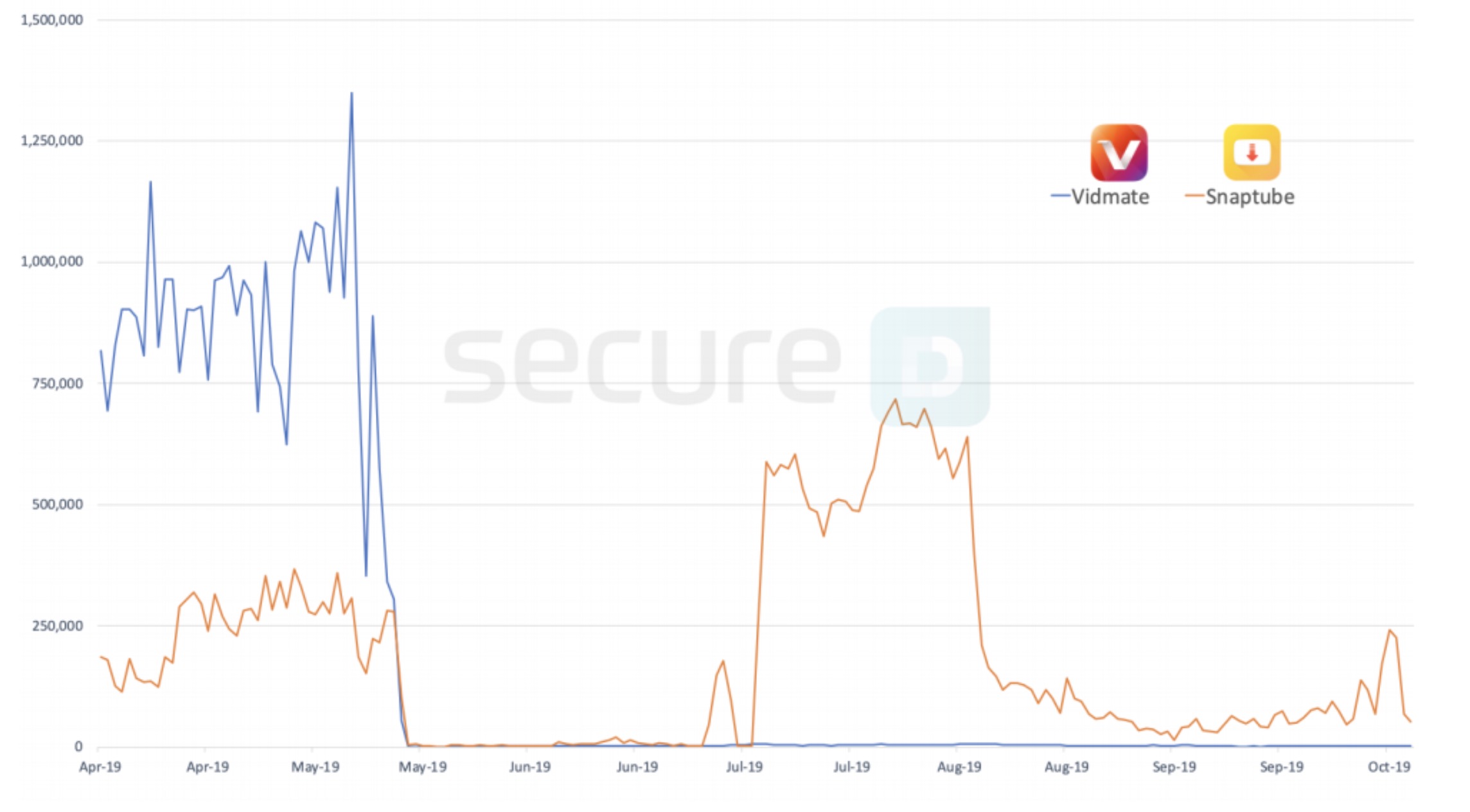
Mango is particularly sneaky, said Krief. Within hours of the news breaking that Vidmate’s app was engaged in similar suspicious behavior, his company saw a Snaptube’s suspicious activity drop almost immediately. “Our assumption back then was they’re probably also using similar code and they went silent because of all the publicity,” he said in a phone call.

Two months later, the same suspicious activity in Snaptube’s app resumed.

A graph showing Snaptube’s suspicious activity dropping as soon as the Vidmate story is published. (Image: Upstream)

Krief said it was “very common” to see apps engaging in ad fraud to go through bursts of high levels of activity, followed by periods of quiet.

In recent weeks Upstream said it’s blocked more than 70 million suspicious transactions originating from four million devices, according to data from its proprietary security platform. The company said consumers could have been charged tens of millions of dollars in unwanted premium charges had those clicks not been blocked.

Snaptube said in a statement: “We didn’t realize the Mango SDK was exercising advertising fraud activities, which brought us major loss in brand reputation.”

“After the user complained about the malicious behavior of the Mango SDK, we quickly responded and terminated all cooperations with them,” a spokesperson said. “The versions on our official site as well as our maintained distribution channels are free of this issue already.”

Snaptube said it was “considering” legal action against the Mango developers.

It’s not the first time Snaptube has been caught out engaging in potentially fraudulent activity. In February, security firm Sophos found the app engaging in similar fraudulent behavior — generating and reporting fake ad clicks and racking up costs for the user. Later in the year, Snaptube responded to reports that Android devices were warning users that the app contained the suspicious third-party code, noting that it would “terminate” using the code “as soon as possible.”

That promise was made in August. Yet, some three months later, the code remains in the app.

17 Oct 2019

Logitech’s MX Master 3 mouse and MX Keys keyboard should be your setup of choice

Logitech recently introduced a new mouse and keyboard, the MX Master 3 ($99.99) and MX Keys ($99.99) respectively. Both devices borrow a lot from other, older hardware in Logitech’s lineup – but they build on what the company has gotten really right with input devices, and add some great new features to make these easily the best option out there when it comes to this category of peripherals.

Logitech MX Keys

This new keyboard from Logitech inherits a lot from the company’s previous top-of-the-line keyboard aimed at creatives, the Logitech Craft keyboard. It looks and feels a lot like the premium Craft – minus the dial that Logitech placed at the top of that keyboard, which worked with companion software to offer a variety of different controls for a number of different applications.

The Craft’s dial was always a bit of a curiosity, and while probably extremely useful for certain creative workflows where having a tactile dial control makes a lot of sense (for scrubbing a video timeline during editing, for instance), in general the average user probably isn’t going to need or use it much.

Logitech MX Keys MX Master 3 5The MX Keys doesn’t have the Craft’s dial, and it takes up less space on your desk as a result. It also costs $70 less than the Craft, which is probably something most people would rather have than the unique controller. The MX Keys still have excellent key travel and typing feel, like its bigger sibling, and it also has smart backlighting that turns on automatically when your hand approaches the keys – and which you can adjust or turn off to suit your preference, and extend battery life.

MX Keys has a built-in battery that chargers via USB-C, and provides up to 10 days of use on a full charge when using the backlight, or for up to 5 months if you disable the backlight entirely. For connectivity, you get both Bluetooth and Logitech’s USB receiver, which can also connect to other Logitech devices like the MX Master series of mice.

Logitech MX Keys MX Master 3 3The keyboard can connect to up to three devices at once, with dedicated buttons to switch between them. It supports Windows, Mac, Linux, Android and iOS out of the box, and has multi-marked keys to make it easier to transition between operating systems. Plus, when you’re using the MX Keys in tandem with the MX Master 3 or other Logitech mice that support its Flow software, you can transition seamlessly between computers and even operating systems, for doing things like copying and pasting files.

AT $99.99, the MX Keys feels like an incredible value, since it offers very premium-feeling hardware in an attractive package, with a suite of features that’s hard to match in a keyboard from anyone else – including first-party peripherals from Microsoft and Apple .

Logitech MX Master 3

When it comes to mice, there are few companies that can match Logitech’s reputation or record. The MX Master series in particular has won plenty of fans – and for good reason.

Logitech MX Keys MX Master 3 9The MX Master 3 doesn’t re-invent the wheel – except that it literally does, in the case of the scroll wheel. Logitech has introduced a new school wheel with ‘MagSpeed’ technology, that switches automatically between fluid scrolling and more fine-grained, pixel-precise control. The company claims the new design is 90 percent faster and 87 percent more precise than its previous scroll wheel, which is pretty much an impossible claim to verify through standard use. That said, it does feel like a better overall scrolling experience, and the claim that it’s now ‘ultra quiet’ is easy to confirm.

Logitech has also tweaked the shape of the mouse, with a new silhouette it says is better suited to matching the shape of your palm. That new shape is complimented with a new thumb scroll wheel, which has always been a stellar feature of the Master series and which again, does feel better in actual use though it’s difficult to put your finger on exactly why. Regardless, it feels better than the Master 2S, and that’s all that really matters.

Logitech MX Keys MX Master 3 10In terms of tracking, Logitech’s Darkfield technology is here to provide effective tracking on virtually all surfaces. It tracks at 4,000 DPI, which is industry-leading for accuracy, and you can adjust sensitivity, scroll direction and other features in Logitech’s desktop software. The MX Master 3 also supports up to three devices at once, and works with Flow to copy and past between different operating systems.

One of the most noteworthy changes on the MX Master 3 is that it gains USB-C for charging, replacing Micro USB, which is fantastic news for owners of modern Macs who want to simplify their cable lives and just stick with one standard where possible. Since that matches up with the USB-C used on the MX Keys, that means you can just use one cable for charging both when needed. The MX Master 3 gets up to 70 days on a full charge, and you can gain 3 hours of use from a fully exhausted battery with just one minute of charging.

Logitech MX Keys MX Master 3 7Bottom line

Logitech has long been a leader in keyboard and mice for very good reason, and the company’s ability to iterate on its existing successes with improvements that are smart and make sense is impressive. The MX Keys is probably the best keyboard within its price range that you can get right now – and better than a lot of more premium-priced hardware. The MX Master 3 is without a doubt the only mouse I’d recommend for most people, especially now that it offers USB-C charging alongside its terrific feature set. Combined, they’re a powerful desktop pair for work, creative and general use.

17 Oct 2019

Farewell, Google Clips

Amid a slew of updated hardware, Clips has gone missing from Google’s online store. Odds are you probably don’t remember what Clips is. If you do, odds are you’re not surprised by this turn of events.

We’ve reached out to company to confirm whether this is, indeed, definitively the end for the niche device. All I can say for now is that the future doesn’t look bright for a product neither reviewers, consumers nor Google itself figured out. One the company knew for sure what that the Clips was unequivocally not a life-logging camera. The answer of what it was, however, was a far more difficult one.

The device was a kind of showcase for the company’s AI technologies, designed to capture candid life moments, so users weren’t stuck behind their cameras. I reviewed it and if nothing else got this fun Gif of my rabbit, Lucy:

unnamed 1

So not a total loss, I guess. Certainly not enough to justify paying $249, however. One colleague jokingly asking me ahead of this week’s Pixel event whether a Clips 2 was on the way. I suppose we know the answer now.

The discovery follows news that the company has discontinued its Daydream View, VR headset. Such is the Google circle of life. The lukewarmly reviewed first-gen Pixel Buds have been pulled from the store, as well. That line, at least, still has a future