Year: 2019

16 Oct 2019

Shoe companies Rothy’s and Steve Madden are at each other’s throats

In August, after receiving a cease-and-desist letter from the venture-backed shoe startup Rothy’s, shoe giant Steven Madden filed a pre-emptive lawsuit asking a federal court to rule that its Rosy Flat shoes don’t copy design elements of the Point ballet flat that Rothy’s began selling soon after its 2016 launch. More, it asked that seven related patents that Rothy’s has been issued — and that Rothy’s accused Madden of infringing — be declared invalid.

Now, Rothy’s is batting back again, today filing counterclaims of design patent and trade dress infringement, trademark dilution, and unfair competition while also managing to get in a sick burn, writing in its filing that instead of “pursuing independent product development, Madden has chosen to slavishly copy Rothy’s product design in violation of Rothy’s valuable intellectual property rights.”

It’s hard to argue they aren’t copycats once you see both shoes. Nearly as galling to Rothy’s, Steve Madden’s shoes retail for half the price. (Rothy’s charges $145 for its shoes. Steve Madden sells its version for $70, and unlike Rothy’s, which are never discounted, Steve Madden’s version of the show is currently for sale at Nordstrom Rack for $39.99.)

Steve Madden — now a 29-year-old company that’s publicly traded, valued by investors at $3 billion, and largely still run by Steve Madden himself (he’s its creative and design chief) — is known for finding inspiration in the work of other brands that wish it would not. Among a handful of companies to tangle legally with the shoe titan in recent years is venture-backed Allbirds, which accused Steve Madden of copying its wool trainer in 2017.

AllBirds soon settled its lawsuit with the company. Alas, now AllBirds is reportedly fighting an Austrian footwear company, Giesswein Walkwaren, for making and selling sneakers that are “identical in all material respects” to Allbirds’s wool runners.

Meanwhile, Rothy’s just last month settled with a company, OESH, against which it had separately filed a patent and trade dress infringement lawsuit alleging its round-toe ballet flats are too similar to Rothy’s own.

Neither is an uncommon situation. Instead, both underscore that for young retail brands, fending off competitors both big and small can prove both expensive and distracting. Indeed, the question begged is whether it’s worth engaging.

While that’s something that usually be determined only in hindsight, not everyone thinks it makes sense to spend the time and resources battling knock-offs. When we talked earlier this year with the venture-backed slipper-shoe startup Birdies, cofounder Bianca Gates noted that Target had already begun offering a similar slipper at a cheaper price point. “Everybody copies everybody,” she said.

The company could have used some of its funding to wage war, but she thought focusing on the company’s product made more sense. “It’s our job to create a brand beyond the silhouette of a slipper, because that can be knocked off, it’s not defensible. What is defensible is why [a customer] is buying Birdies, and why she is telling her friends to shop us.”

16 Oct 2019

MyGate raises $56M to bring its security management service to more gated communities in India

MyGate, a Bangalore-based startup that offers security management and convenience service for guard-gated premises, said today it has bagged over $50 million in a new financing round as it looks to expand its footprint in the nation.

Chinese internet giant Tencent, Tiger Global, JS Capital, and existing investor Prime Venture Partners funded the three-year-old startup’s $56 million Series B financing round. The new round pushes MyGate’s total fundraise to-date to $67.5 million.

MyGate offers an eponymous mobile app that allows home residents to approve entries and exits, communicate with their neighbors, log attendance, pay society maintenance bills and daily help workers.

The startup says it is operational in 11 cities in India and has amassed over 1.2 million home customers. Its customer base is increasing by 20% each month, it claimed. The service is handling 60,000 requests each minute and clocking over 45 million check-in requests each month.

The idea of MyGate came after its co-founder and CEO, Vijay Arisetty left Indian armed force. In an interview with TechCrunch, he said his family was appalled to learn about the poor state of security across societies in India.

“This was also when e-commerce companies and food delivery firms were beginning to gain strong foothold in the nation. This meant that many people were entering a gated community each day,” he said.

MyGate has inked partnerships with many e-commerce players to create a system to offer a silent and secure delivery experience for its users. The startup also trains guards to understand the system.

According to industry estimates, more than 4.5 million people in India today live in gated communities, and that figure is growing by 13% each year. The private security industry in the country is a $15 billion market.

Arisetty says he believes the startup could significantly accelerate its growth as its solution understands the price sensitive market. Using MyGate costs an apartment about Rs 20 (28 cents) per month. Even at that price, the startup says it is making a profit. “Today, we are seeing more demand than we can handle,” he said.

That’s where the new funding would come into play for the startup, which today employs about 700 people.

The startup plans to use the fresh capital to expand its technology infrastructure, its marketing and operations teams and build new features. The startup aims to reach 15 million homes in 40 Indian cities in the next 18 months.

In a statement, Sanjay Swamy, Managing Partner at Prime Venture Partners, said, “it’s been great to see a fledgling startup execute consistently and holistically, and grow into a category-creating market-leader.”

16 Oct 2019

Labor leaders and startup founders talk how to build a sustainable gig economy

Over the past few years, gig economy companies and the treatment of their labor force has become a hot button issue for public and private sector debate.

At our recent annual Disrupt event in San Francisco, we dug into how founders, companies and the broader community can play a positive role in the gig economy, with help from Derecka Mehrens, an executive director at Working Partnerships USA and co-founder of Silicon Valley Rising — an advocacy campaign focused on fighting for tech worker rights and creating an inclusive tech economy — and Amanda de Cadenet, founder of Girlgaze, a platform that connects advertisers with a network of 200,000 female-identifying and non-binary creatives.

Derecka and Amanda dove deep into where incumbent gig companies have fallen short, what they’re doing to right the ship, whether VC and hyper-growth mentalities fit into a sustainable gig economy, as well as thoughts on Uber’s new ‘Uber Works’ platform and CA AB-5. The following has been lightly edited for length and clarity.

Where current gig companies are failing

Arman Tabatabai: What was the original promise and value proposition of the gig economy? What went wrong?

Derecka Mehrens: The gig economy exists in a larger context, which is one in which neoliberalism is failing, trickle-down economics is proven wrong, and every day working people aren’t surviving and are looking for something more.

And so you have a situation in which the system we put together to create employment, to create our communities, to build our housing, to give us jobs is dysfunctional. And within that, folks are going to come up with disruptive solutions to pieces of it with a promise in mind to solve a problem. But without a larger solution, that will end up, in our view, exacerbating existing inequalities.

16 Oct 2019

Amazon’s Echo gets a decent-sounding refresh

Amazon seemingly didn’t realize what it had on its hands with the original Echo. Released five and a half years back for a select number of Amazon Prime users, the first Alexa device ushered in a consumer electronics revolution.

According to numbers from Canalys, 26.1 million smart speakers were shipped in Q2 2019. That’s a hefty 55.4% growth from the year prior, with Amazon capturing just over a quarter of the total global market. Much of Amazon’s growth (up 61% y-o-y) is courtesy of its rapidly growing line, which now ranges from the $50 Echo Dot to the $200 Echo Studio.

At $100, the Echo sits right in the middle. And unlike Google, which has left the Home largely unchanged during its two-year existence, Amazon’s now on the third generation for its own base-level device.

The latest version of the device, announced at an Alexa event at Amazon HQ in Seattle earlier this month, ditches the swappable face gimmick of the previous generation. Instead, the company has focused on the speaker part of the smart speaker. It was something that was too often neglected by earlier devices, which were primarily viewed as a conduit for voice assistants.

amazon echo 2019

Of course, if someone is simply looking for a cheap and easy way to introduce a smart assistant into their home, they can pick up an Echo Dot or Nest Mini for a fraction of the price — or, for that matter, the $25 Echo Flex wall plug.

The new Echo slots pretty nicely between the Dot and Studio, Amazon’s new HomePod competitor. It’s probably not where you want to do all of your music listening, but it’s a nice addition to a desk at home or work, or a room like the kitchen where music listening is secondary. More importantly, software updates like stereo pairing with two Echo devices and multi-room music, paired with hardware add-ons like Echo Sub, Link and Input, have made the $99 product a potential addition to a larger, better sound system.

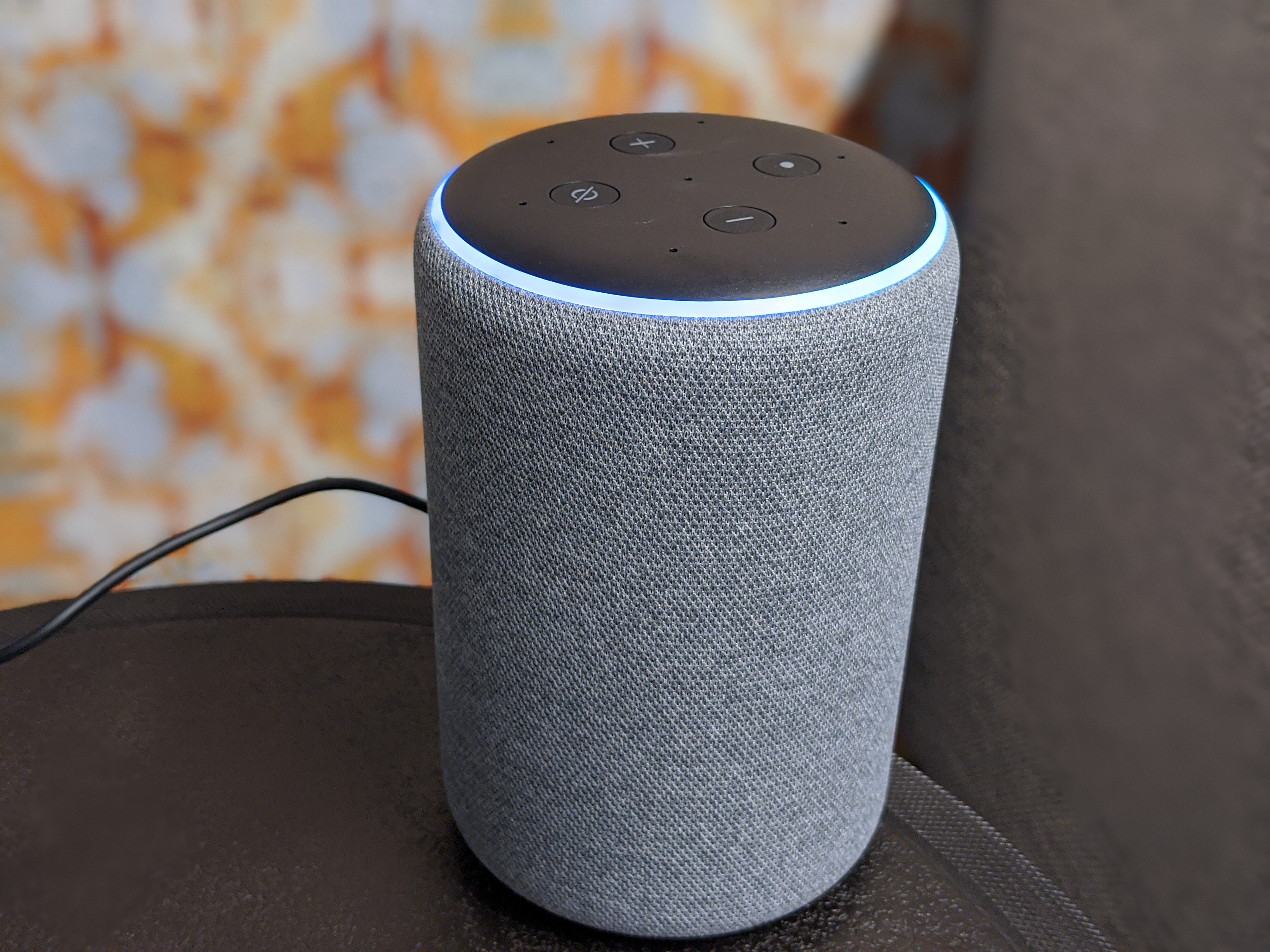
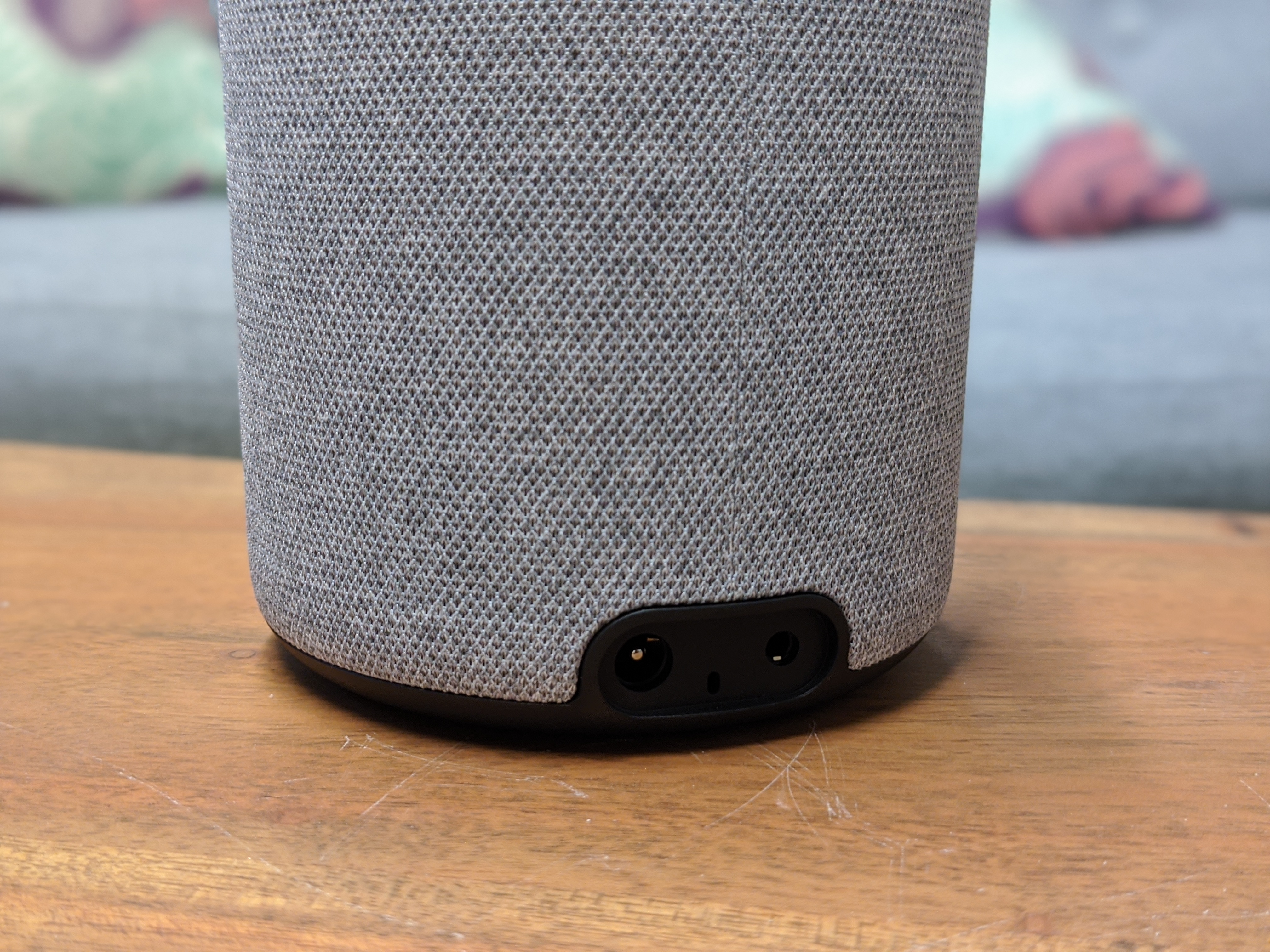
The third-generation Echo certainly marks an improvement sound-wise over earlier models. It offers decent 360 sound and surprisingly heavy bass, courtesy of a 3.0-inch woofer and 0.8-inch tweeter. There’s also a 3.5-inch audio jack for inputting or outputting sound. The setup is essentially the same as last year’s Echo Plus, only without the increasingly less important smart home hub functionality.

In fact, the device looks almost identical to the second-gen Echo Plus, leaving many wondering if the product is long for this world. I wouldn’t be surprised to see the company phase out the product entirely after selling through this batch during the holiday season.

amazon echo 2019

With four different colors, the Echo should fit in well with most surroundings. The rounded, fabric-covered model is a far cry from the early days of hard plastic. There is a prominent light ring up top to let you know when the Echo is listening, along with a quartet of buttons: volume up/down, microphone and the action button, which performs a variety of tasks, including firing up Alexa and turning off timers.

Maybe it’s the fact that I just reviewed the Nest Mini, but touch functionality would be a nice addition here. When you move your hand toward the speaker while it’s playing music, a pair of lights illuminate for volume. Tapping the middle of the device would play or pause music. It’s a simple but handy addition.

All in all, solid additions on the hardware front, coupled with the continued addition of things like selectable music services make for a solid upgrade to the company’s base smart speaker.

16 Oct 2019

Feast your eyes on the first interstellar comet ever directly observed

The solar system has another interstellar visitor, but there’s no question of this one being an alien spacecraft. It’s a true comet and the first we’ve ever confirmed comes from interstellar space, and the Hubble Space Telescope captured some amazing imagery of it. Good thing, too — because it’s never coming back.

You probably remember ‘Oumuamua as the interstellar object that launched a thousand headlines — mostly around the idea that it could be an alien ship of some kind. Needless to say that hypothesis didn’t really pan out, but honestly the object was interesting enough without being an emissary from another world.

This new comet, called 2I/Borisov (not as catchy), was first identified in August by an amateur astronomer named Gennady Borisov, who lives in Crimea. Studies by other near-Earth object authorities observed its trajectory and concluded that it did indeed come from interstellar space?

How do they know? Well, for one thing, it’s going 110,000 miles per hour, or 177,000 kph. “It’s traveling so fast it almost doesn’t care that the Sun is there,” said UCLA’s David Jewitt, who leads the Hubble team watching 2I/Borisov. (Note that in the gif above, the streaks don’t indicate its speed — those are from the Earth spinning.)

stsci h p1953a f 1106x1106

Basically the angle it’s coming in, plus the speed at which it’s traveling, mean it can’t possibly be in even a super-wide orbit of the sun. It’s just passing through — and in early December will be less than 200 million miles from the Sun. It’s not on track to hit anything, fortunately, which would be a truly cosmic coincidence, so in a couple months it’ll be gone again.

But its short visit is ample opportunity to study its makeup, which appears to be very similar to our own “local” comets. Although it would be cool for 2I/Borisov to be super weird, its similarity is interesting in itself — it suggests that comet formation in other solar systems is not necessarily different.

trajectory

2I/Borisov is passing through the ecliptic at a pretty steep angle and traveling at great speed, more or less ruling out the idea that it’s orbiting the Sun.

It is, however, very different from ‘Oumuamua, which appeared to be an inert, oblong rock. Interesting in its own way, but comets are so dynamic: clouds of dust and ice surrounding a much smaller core. Very picturesque, even if the tails don’t always point the way you think they should.

Hubble will continue observing 2I/Borisov through January and perhaps beyond. If it’s never going to return, we want to gather as much data as possible while we can.

16 Oct 2019

The FrankOne is a simple and portable coffee brewing gadget

The FrankOne coffee maker, fresh off a successful crowdfunding campaign, is now available for purchase, and I got a chance to test out one of the first run of these funky little gadgets. While it won’t replace my normal pourover or a larger coffee machine, it’s a clever, quick, and portable way to make a cup.

Designer Eduardo Umaña pitched me the device a little more than a year ago, and I was taken by the possibility of vacuum brewing — and the fact that, amazingly, until now no one from Colombia had made a coffee maker (it’s named after Frank de Paula Santander, who kicked off the coffee trade there). But would the thing actually work?

In a word, yes. I’ve tested the FrankOne a few times in my home and while I have a couple reservations, it’s a coffee making device that I can see myself actually using in a number of circumstances.

PA150003

The device works quite simply. Ground coffee goes in the top, and then you pour in the hot (not boiling!) water and stir it a bit. 30-50 seconds later, depending on how you like it, you hit the button and a pump draws the liquid down through a mesh filter and into the carafe below. It’s quick and almost impossible to mess up.

The resulting coffee is good — a little bit light, I’d say, but you can adjust the body with the size of the grounds and the steeping time. I tend to find a small amount of sediment at the bottom, but less than you’d get in a cup of French press.

Because it’s battery powered (it should last for ~200 cups and is easily recharged) and totally waterproof, cleaning it is a snap, especially if you have a garbage disposal. Just dump it and rinse it, give it a quick wipe and it’s good to go. It gets a bit more fussy if you don’t have a disposal, but what doesn’t?

PA150010

I can see this being a nice way to quickly and simply make coffee while camping — I usually do a French press, but sometimes drip, and both have their qualities and limitations. The FrankOne would be for making a single cup when I don’t want to have to stand by the pourover cone or deal with disassembling the French press for cleaning.

It’s also, I am told by Umaña, great for cold brew. I didn’t have the heart to tell him that I don’t really like cold brew, but I know many do, and Umaña promises the FrankOne works wonders in a very short time — four minutes rather than an hour. I haven’t tested that, since cold brew tastes like bitter chocolate milk to me, but I sincerely doubt he would mention it as many times as he did if it didn’t do what he said.

There are, I feel, three downsides. First, you’re pretty much stuck with using the included glass carafe, because the device has to create a seal around the edge with its silicone ring. It didn’t fit in my biggest mug, but you might find an alternative should the carafe (which I have no complaints about — it’s attractive and sturdy) crack or get lost.

PA150017

Second, it doesn’t produce a lot of coffee. The top line as indicated in the reservoir is probably about 10-12 ounces — about the size of a “tall” at a coffee shop. Usually that’s a perfect amount for me, but it definitely means this is a single-serving device, not for making a pot to share.

And third, for the amount of coffee it produces, I feel like it uses a lot of grounds. Not a crazy amount, but maybe 1.5-2x what goes into my little Kalita dripper — which is admittedly pretty economical. But it’s just something to be aware of. Maybe I’m using too much, though.

I reviewed the Geesaa a little while back, and while it’s a cool device, it was really complex and takes up a lot of space. If I wanted to give it to a friend I’d have to make them download the app, teach them about what I’d learned worked best, share my “recipes,” and so on. There was basically a whole social network attached to that thing.

This is much, much easier to use and compact to boot. It’s a good alternative to classic methods that doesn’t try to be more than a coffee maker. At $120 it’s a bit expensive, but hey, maybe you spend that on coffee in a month.

And by the way, you can use the discount code “TC” at checkout to get 10 percent off — this isn’t a paid post or anything, Umaña’s just a nice guy!

16 Oct 2019

Inside the shutdown of the ‘world’s largest’ child sex abuse website

This morning, the Justice Department announced that it had brought charges against the administrator and hundreds of users of the “world’s largest” child sexual exploitation marketplace on the dark web.

For me, it marked the end of a story I’ve wanted to write for two years.

In November 2017, I was working for CBS as the security editor at ZDNet. A hacker group reached out to me over an encrypted chat claiming to have broken into a dark web site running a massive child sexual exploitation operation. I was stunned. I had previous interactions with the hacker group, but nothing like this.

The group claimed it broke into the dark web site, which it said was titled “Welcome to Video,” and identified four real-world IP addresses of the site, said to be different servers running this supposedly behemoth child abuse site. They also provided me with a text file containing a sample of a thousand IP addresses of individuals who they said had logged in to the site. The hackers boasted about how they siphoned off the list as users logged in, without the users’ knowledge, and had over a hundred thousand more — but they would not share them.

If proven true, the hackers would have made a major breakthrough in not only discovering a major dark web child abuse site, but could potentially identify the owners — and the visitors to the site.

But at the time, we could not prove it.

My then editor-in-chief and I discussed how we could approach the story. A primary concern was that the dark web site was already under federal investigation, and writing about it could jeopardize that effort.

But we also faced another headache: there was no legal way we could access the site to verify it was what the hackers claimed.

“Children around the world are safer because of the actions taken by U.S. and foreign law enforcement to prosecute this case and recover funds for victims.”
Jessie K. Liu, U.S. Attorney for the District of Columbia

The hackers gave me a username and password for the site, which they said they had created just for me to verify their claims. But we could not access the site for any reason — even for journalistic reasons and in a controlled environment — for fear that the site may display child abuse imagery. Only federal agents working an investigation are allowed to access sites that contain illegal content. While journalists have a lot of flexibility and freedoms, this was not one of them.

After a call with several CBS lawyers, we decided that there was no legal way to write the story without verifying the site’s contents, something we legally weren’t able to do.

The story was dead, but the site wasn’t.

One thing the lawyers couldn’t tell me is if I should report the findings to the government. It’s a bizarre situation to be in. As a cybersecurity and national security reporter, the government all too often is “the nemesis,” often a target of journalistic inquisitions and investigations. But while journalists are told to report and observe and not get involved, there are exceptions. Risk to life and child exploitation are top of the list. A journalist cannot idly stand by knowing that there could be a car bomb sitting outside a building, ready to detonate. Nor can one dismiss the idea of a child abuse site continuing to operate on the dark web.

I spoke with a well-known journalist to ask for ethical advice. We agreed to speak on background, from reporter to reporter. Having never faced a situation like this, my primary concern was to ensure I was on the right moral, ethical and legal side of things. Was it right to report this to the feds?

The answer was simple and expected: Yes, it was right to report the information to the authorities, so long as I protected my source. Protecting your sources is one of the cardinal rules of journalism, but my source was a hacker group — it was not the dark web site itself. After all, I was working under the assumption that the authorities would not care much for the source information anyway.

I reached out to a contact at the FBI, who passed me onto a special agent at a field office. After a brief phone call, I emailed the four IP addresses slated to be the dark web site’s real-world location, and the list of the thousand alleged users of the site.

And then silence. I heard nothing back. I followed up and asked, but the agent warned that if the site became — or was already — subject to investigation, there was little, if anything, they could say.

I recall the hackers were frustrated. After I told them I wouldn’t be writing the story, we are no longer communicating.

Weeks went by. I felt just as frustrated at the lack of insight into what I had only guessed or hoped was progress by the federal agents.

I recall running the list of IP addresses that the hackers gave me through a resolver, which provided some limited insight into who might be visiting the dark web site. We found individuals access the dark web site from the networks of the U.S. Army Intelligence, the U.S. Senate, the U.S. Air Force, and the Department of Veterans Affairs, as well as Apple, Microsoft, Google, Samsung, and several universities around the world. We could not identify, however, specific individuals who accessed the site. And because the dark web is anonymized, it’s likely that not even companies knew their staff were accessing this site.

How could they possibly let this go, I thought to myself, wondering whether the FBI agent had acted on the information I handed over. If there was an investigation it would take time and effort, and the wheels of government seldom move quickly. Would I ever know whether the perpetrators would ever be caught?

Today, two years later, I got my answer.
dark web site

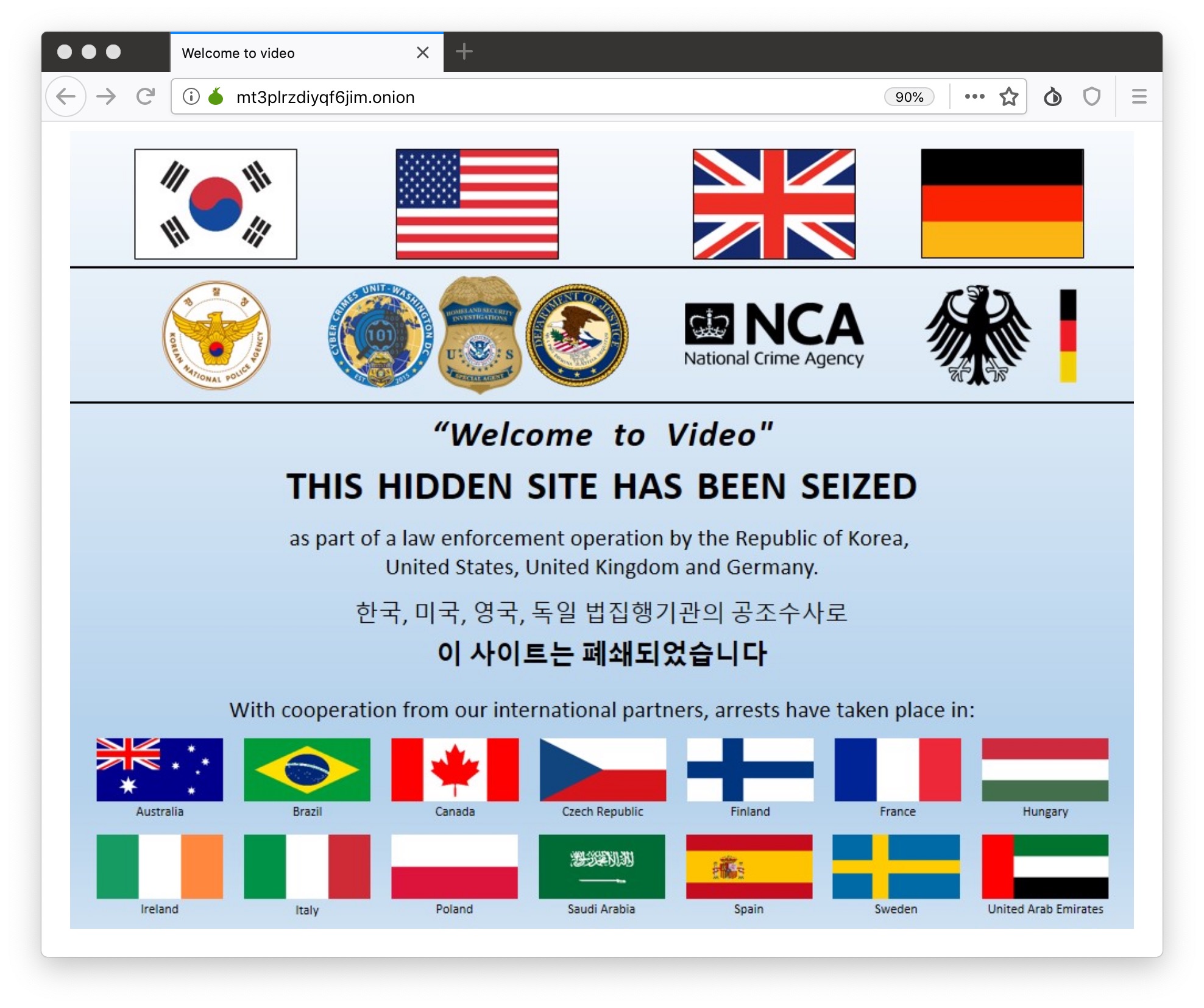
The seized dark web marketplace, containing 250,000 child sexual exploitation videos and images. The site was shut down following a government investigation.

U.S. prosecutors said in the indictment, filed in August 2018 but unsealed Wednesday, that the dark web site — confirmed as “Welcome to Video” — had some 250,000 user-uploaded graphic images and videos of children who were being sexually abused. The government called it the “largest darknet child pornography website” in a press release.

This morning, after news of the site’s removal had been reported, I rifled through the documents posted on the Justice Department’s website and found a screenshot of the site, with the full web address in the address bar. It was a match. For the first time since the hackers told me of the dark web site, I went to the Tor browser and pasted in the address. It loaded — with the government’s “website seized” notice staring back at me.

According to the indictment, federal agents began investigating the site in September 2017, two months before the hackers breached the site. The site’s administrator, Jong Woo Son, had been running the operation from his residence in South Korea since 2015. The indictment said the main landing page to the site contained a security flaw that let investigators discover some of the IP addresses of the dark web site — simply by right-clicking the page and viewing the source of the website.

It was a major error, one that would trigger a chain of events that would ensnare the entire site and its users.

Prosecutors said in the indictment that they found several IP addresses: 121.185.153.64 and 121.185.153.45. One of the IP addresses the hackers gave me was 121.185.153.114 — an address on the same network subnet as the dark web site.

It was long-awaited confirmation that the hackers were telling the truth. They did in fact breach the site. But whether or not the government knew about the breach remains a mystery.
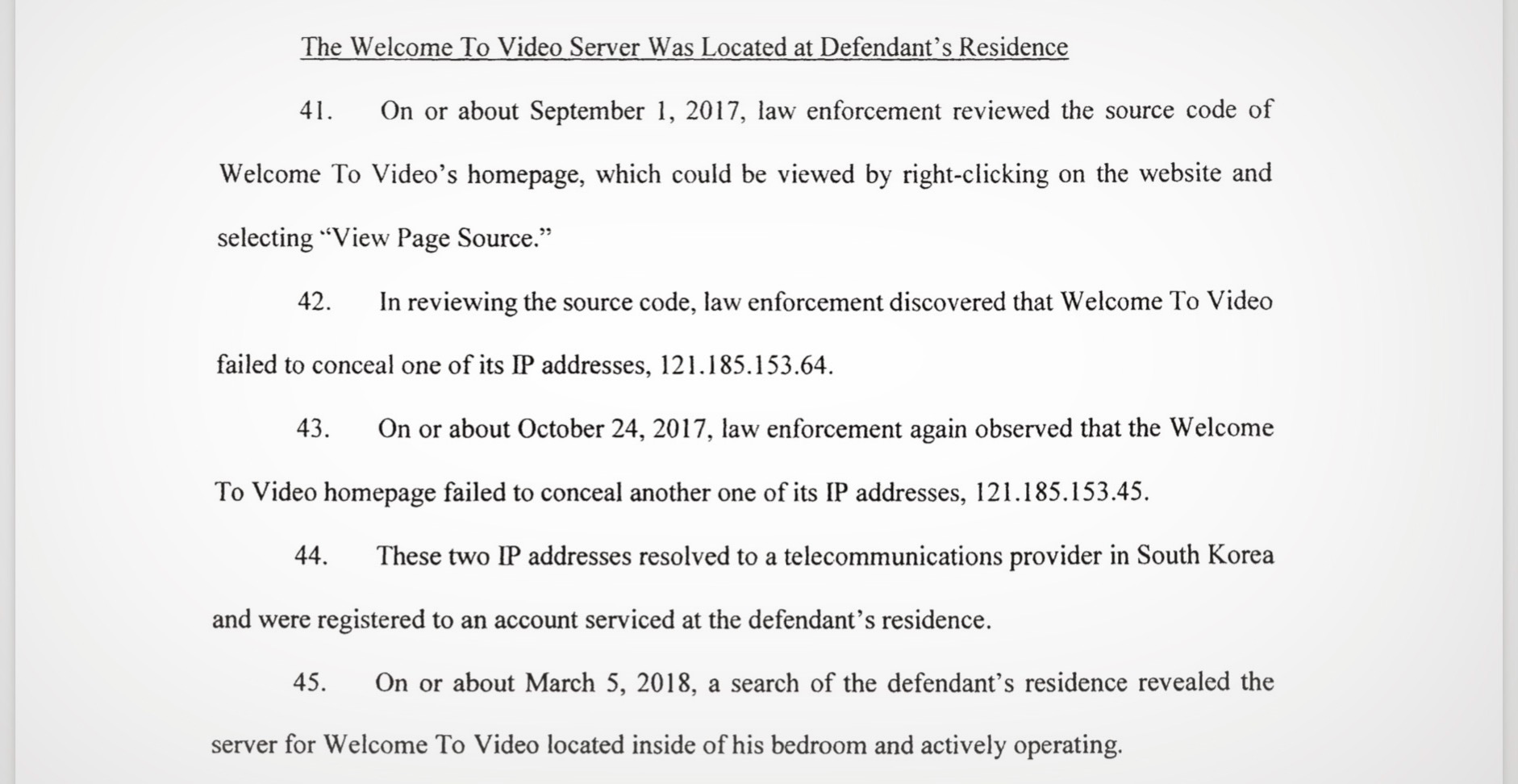
The IP addresses in the recently-unsealed indictment were on the same network as the IP address provided by the hackers. (Image: TechCrunch)

Some five months after I contacted the FBI, the government had obtained a warrant to seize and dismantle the dark web site. It’s believed the indictment was kept under seal until today in order to arrest, charge and prosecute individuals suspected of being involved in the site.

In total, there were 337 arrests, including a former Homeland Security special agent and a Border Patrol officer.

Authorities were able to rescue 23 children who were being actively abused.

I reached out to the federal agent this morning, and was told the FBI was not involved in the investigation. The Internal Revenue Service’s Criminal Investigation division, which investigates and prosecutes financial crimes, and the Homeland Security Investigations unit, which largely deals with human smuggling, child trafficking and related computer crimes, were credited with the work.

While authorities from the U.K. and South Korea contributed to the investigation, sources say the IRS received an anonymous tip that kickstarted it.

From there, the IRS used technology to trace bitcoin transactions, which the dark web site used to profit from the child exploitation videos. Users would have to pay in bitcoin to download content or upload their own child exploitation videos. The government also launched a civil forfeiture case to seize the bitcoins allegedly used by 24 individuals in five countries who are accused of funding the site.

The hacker group has not been in touch since we broke off communications. Publishing a story about the hack two years ago may have caused irreparable harm to the government’s investigation, potentially sinking it entirely. It was a frustrating time, not least being in the dark and not knowing if anyone was doing anything.

I’ve never been so glad to walk away from a story.

16 Oct 2019

Tivo’s CEO explains how the company ‘fully embraces’ streaming

Does TiVo has a future beyond the DVR?

Dave Shull certainly hopes so. The former Weather Channel CEO joined the company as president and CEO back in May, and when I spoke to him last month, he insisted that he’s excited and optimistic about the company’s prospects.

In fact, he said the DVR business “is not really TiVo” anymore. And the proliferation of streaming services is exactly what’s creating a big new opportunity for the company, one where it can help consumers navigate the seemingly overwhelming streaming landscape.

“Let’s embrace the chaos,” Shull told me. “The more streaming, the better.”

In the interview below — which has been edited and condensed for clarity — we discuss why he took on the job, how he plans to split TiVo into two companies and his plans for TiVo+, the company’s ad-supported streaming service (which launched earlier this week.)

TechCrunch: It seems like part of the goal with you coming on as CEO is this idea of reinventing the company for the world of streaming.

Dave Shull: We fully embrace the streaming wars at TiVo, is what I would say.

A little bit of context. I’ve known the company for years, because I’ve been familiar with some of the technology pieces that they had in the IP portfolio. But before I took the job, I talked to CTOs at some of the major operators around the world and said, “TiVo, right? I mean this is a company I’ve heard of, but are they still around?” And the answer consistently was, “Yeah, it’s actually the best technology out there.”

So I started talking to the board and eventually I get the job offer. I walk into a Best Buy and I pick up a Roku box and a TiVo box. I install the Roku box. It’s a brilliant installation process, absolutely brilliant. But then what it gives you is a bunch of different tiles for each of the apps. And so you have to figure out, okay, was that show on Netflix or Hulu?

The TiVo experience was a little bit — it needed some more work, is the polite way to say it. But once I had it installed, it’s taken my live TV and my on-demand Prime, Netflix, Hulu and some digital content and pulled it all together. That’s pretty cool because it’s allowing me to find the entertainment that I want to watch tonight, right?

And so we’re betting on this chaos of applications that are out there with the streaming wars, saying people are having fatigue from subscriptions and they are desperate to find an amazing way to go back to enjoying watching their TV again. They want someone who can bring all this entertainment together — on-demand, live, digital — and make it fun to find, to watch TV again. So that’s our mission. Very simple.

I came in three months ago. The first mandate is, we’ve decided to split the company. So about half of the company is an IP portfolio, 5,000 patents. Then we have the TiVo product base — and everyone thinks of TiVo as this DVR that you buy at Best Buy. That’s really not TiVo, that’s a tiny fraction of our customers. We have 22 million households around the world that use TiVo to provide exactly what I just said, which is this amazing ability to find entertainment.

16 Oct 2019

Netflix Q3 earnings exceed estimates, despite disappointing US subscriber growth

Netflix’s Q3 financial report has given the company’s stock a boost in after-hours trading, with profits significantly exceeding analyst expectations.

The streaming giant reported revenue of $5.24 billion revenue, up 31% year-over-year and more-or-less in line with predictions of $5.25 billion. More impressively, it reported GAAP earnings of $1.47 per share, compared to analyst estimates of $1.05 per share.

Subscriber growth, meanwhile, was a mixed bag. Netflix reported 500,000 paid net additions of in the United States, falling far short of its forecast of 800,000. Conversely, international growth exceeded expectations, with 6.3 million net adds compared to a forecast of 6.2 million.

U.S. subscriber growth looks particularly weak when you compare it to 2018 — Netflix has only seen 2.1 million net additions domestically in the first nine months of 2019, compared to 4.1 million in the same period of 2018. Netflix’s investor letter seems to blame this on price hikes earlier this year.

“Since our US price increase earlier this year, retention has not yet fully returned on a sustained basis to pre-price-change levels, which has led to slower US membership growth,” the company says. “On a member base of more than 60m, very small movements in churn can have a meaningful impact on paid net adds.”

The company also noted that its average revenue per user is up 16.5% year-over-year in the US. (I assume it can thank to those same price hikes.)

Overall, Netflix said it now has more than 158 million members. It’s projecting 26.7 million net adds for the entirety of 2019, down from 28.6 million net adds last year.

“While we had previously expected 2019 paid net adds to be up year over year, our current forecast reflects several factors including less precision in our ability to forecast the impact of our Q4 content slate, which consists of several new big IP launches (as opposed to returning seasons), the minor elevated churn in response to some price changes, and new forthcoming competition,” Netflix says.

Netflix’s stock is up 7.6% in after-hours trading (as of 4:39pm Eastern).

However, those subscriber numbers are certainly going to provide more fuel to skeptics. For example, eMarketer analyst Eric Haggstrom said in a statement that “the fact that Netflix has shown disappointing growth without the new competition present, is a negative omen for Netflix in 2020 and beyond.”

The investor letter also includes an extended discussion of that competition, acknowledging the upcoming launch of Disney+ and Apple+ next month, and HBO Max and Peacock next year.

“Many are focused on the ‘streaming wars,’ but we’ve been competing with streamers (Amazon, YouTube, Hulu) as well as linear TV for over a decade,” the letter says. It goes on to acknowledge that these upcoming launches will be “noisy” and could create “some modest headwind in our near-term growth,” but it adds, “In the long-term, though, we expect we’ll continue to grow nicely given the strength of our service and the large market opportunity.”

Updating

16 Oct 2019

The comic book ‘Bone’ is getting an animated Netflix series


Bone, one of the finest comic series to ever hit the shelves, is getting a Netflix series.

Word of the project comes from Netflix’s official “See What’s Next” account:

Sadly, just about all of the details surrounding the project — who’s involved, when it’ll arrive, etc — are still under wraps.

For the unfamiliar, Bone is a comic series by Jeff Smith, released bit by bit from 1991 to 2004. It tells the story of the Bone cousins (Fone Bone, Phoney Bone, and Smiley Bone) as they’re run out of their hometown of Boneville and into a mysterious (and dangerous!) Valley.

Bone holds a special place in a lot of hearts (a copy of volume one my older brother left in the living room is one of the first comics I remember reading) — so getting this one just right will be tough. Hell… after decades of existing purely on the page, just finding the “right” voices for the Bone cousins seems like quite the task. Studios have been trying since the late 90s to adapt Bone for the screen, only for efforts to fall apart over the years. Hopefully Netflix is the one to actually get it done.