Year: 2019

17 Oct 2019

How to radically change finance through startups at TechCrunch Disrupt Berlin

Fintech has been a very popular area for venture investment, and this is particularly true in Europe. Dozens of high-growth fintech startups have launched over the past decade, from challenger banks and neobanks to new payment services and better ways to save and invest wealth.

On the Extra Crunch stage at TechCrunch Disrupt Berlin, we wanted to dive deeper into what it takes to build a great fintech startup, and also radically reshape finance along the way. That’s why we invited two deep thinkers — Yoni Assia of eToro and Charlie Delingpole of ComplyAdvantage — to discuss how entrepreneurs today can affect the future of finance in the years to come, as well as the lessons learned from building their own successful fintech startups.

Assia has been a lifelong finance geek, day trading in his youth while learning computer science before eventually founding eToro in 2006. eToro’s social trading platform allows investors to follow peer investors and mirror their trades, all the while creating a hub for analysis and discussion around investment opportunities. The company has raised nearly a quarter billion dollars in venture capital according to Crunchbase.

Over the past few years, Assia has dived head first into the crypto world, and eToro now supports crypto trading in addition to more traditional public equities. Assia’s ambition has been to make eToro the single largest crypto trading platform in the world. Despite its popularity and success, eToro has almost always focused its efforts on the European and nearby market, and only this year officially launched its trading features in the U.S.

Delingpole has also had the entrepreneurial bug his entire life, and ComplyAdvantage is his third startup. ComplyAdvantage is an API-based know-your-customer/anti-money-laundering (KYC/AML) service for identifying the actors behind financial transactions. More than five years into the company, it has raised tens of millions in venture capital from the likes of Index Ventures and Balderton Capital to grow, and works with hundreds of customers processing data on tens of millions of names per day.

ComplyAdvantage’s product challenge is combining structured, semi-structured, and unstructured data in real-time to provide banks and other clients with risk assessments that are attuned to the changing nature of geopolitics every day. As such, Delingpole has had to work with everyone from financial asset control regulators to banking procurement directors to integrate his product into their workflows.

Together, Assia and Delingpole will discuss the changing landscape for fintech and how founders today can tackle the space.

Buy your ticket to Disrupt Berlin and join us on the Extra Crunch stage for an in-depth look at this white hot market.


17 Oct 2019

TruTag raises $7.5 million Series C for tiny, edible barcodes that can be placed on pills, food and vaping systems

TruTag Technologies, a company that creates microscopic, edible barcodes to authenticate medications, food, vaping pods and other products, has raised a $7.5 million Series C. The funding, led by Pangaea Ventures and Happiness Capital, will be used to further commercialize its technology and develop new solutions.

Along with earlier rounds, this brings TruTag’s total funding to $25 million. Its clients include PwC, which uses the company’s technology in its Food Trust Platform quality assurance program for Australian beef exports.

A high magnification of TruTag particles, each of is an edible “chip” that authenticates the product it is applied to.

A high magnification of TruTag particles, each of is an edible “chip” that authenticates the product it is applied to.

Called TruTags, the company’s tiny barcodes are made out of nano-porous silica, a material that has received GRAS (generally recognized as safe) notice from the U.S Food and Drug Administration, and can be placed directly on products or in packaging to track it through the supply and logistics chain.

TruTags are used with hyperspectral imaging technology, which is able to process much more wavelengths than other imaging methods, so it can collect more precise and detailed data from an image. When scanned, the barcodes provide information about where a product was manufactured, lot numbers, authorized distributors and safe use.

In email, TruTag chief executive officer Michael Bartholomeusz, who holds a PhD in materials engineering from the University of Virginia, told TechCrunch that the company sees the most growth opportunities in industries, such as pharmaceuticals, nutraceutical foods and cannabis, that deal with counterfeit products from the black market or the “grey market,” including products from unauthorized suppliers.

A conceptual photo of TruTags' technology.

A conceptual photo of TruTags’ technology.

“TruTags material is an already approved excipient in pills by the FDA. Pharmaceuticals and food comprise a very large portion of the global counterfeiting problem, and given the very unique edible feature of TruTag’s solution, this is a core area of focus for the company,” he says.

For example, the technology can be used to lock vaping systems so they only work with authentic vaping pods, helping reduce the number of counterfeit pods on the market. Bartholomeusz adds that TruTags is close to coming to market in the CBD space.

TruTags’ ability to be placed directly on products, its edibility and instant authentication in one to five seconds differentiates it from other solutions. Bartholomeusz notes that other quality assurance tech include specialized symbols, inks and holograms, though many of those products have the disadvantages of being replicable by high-quality printers or relying on consumers’ ability to recognize them.

In a press statement, Matthew Cohen, director of technology at Pangaea, which focuses on investing in advanced materials technology, said “Pangaea is excited to partner with TruTag and help the company expand its team and product portfolio. We believe TruTag’s edible barcode technology will help increase consumer confidence and ultimately save lives. TruTag is making our world better by utilizing compelling advanced materials and advanced material process innovations to combat rising problems such as drug counterfeiting.”

17 Oct 2019

TikTok makes education push in India

China’s TikTok today launched an education program in India as the popular short-video app looks to expand its offering and assuage local authority in one of its biggest markets.

TkTok, owned by the world’s most valued startup Bytedance, said it’s working with a number of content creators and firms to populate the platform with educational videos. These bite-sized videos cover a range of topics from school-level science and math concepts, languages, and life tips, motivation, and even reviews of gadgets.

The social platform, which is used by more than 120 million users in India each month, said its education program is aimed at “democratizing learning for the Indian digital community on the platform.”

It has partnered with social enterprise Josh Talks and The /Nudge Foundation, and edtech startups Vedantu, Toppr, Made Easy, GradeUp that will produce content for TikTok.

tiktok edutok

More to follow…

17 Oct 2019

Winnow raises $12M Series B for its food waste solution for commercial kitchens

Winnow, the U.K. startup that has developed smart kitchen tech to help commercial kitchens reduce food waste, is disclosing $12 million in Series B funding.

Backing the round is Ingka Group (a strategic partner to the IKEA franchisee system), Mustard Seed, Circularity Capital, D: Ax and The Ingenious Group. It follows a recent $8 million loan from The European Investment Bank (EIB), meaning that Winnow has added $20 million of capital in the last month.

Counting global clients such as IKEA and the Armani Hotel in Dubai, Winnow is on a mission to offer the hospitality industry technology to help cut down on food waste by making commercial kitchens ‘smarter.’ Its latest Winnow Vision product automates waste tracking by using computer vision to track what food is being discarded and therefore enabling kitchens to make better inventory decisions.

Notably, the Winnow system claims to have already reached and surpassed human levels of accuracy in identifying food being thrown away. “This means for clients, over time, these systems will enable their kitchens to automatically register food waste without any human interaction. Food will be thrown in the bin and the data will be captured automatically,” says the company.

More broadly, the idea, as Winnow founder and CEO Marc Zornes likes to put it, is that what gets measured, gets managed. The startups says that kitchens using Winnow tend to see a 40-70% reduction in food waste within 6-12 months, driving food cost savings between 2-8% in total.

Citing its main costs as “hardware and service delivery for each unit deployed,” Zornes says Winnow will use the new cash injection to further improve its technology and focus on “doubling down” on product development. This will include investing in new QA engineers to enhance development, through to front end developers to improve its reporting features.

17 Oct 2019

Proportunity raises £2M seed for its ‘help to buy’-style property lending

Proportunity, the startup that provides “help to buy”-style equity loans primarily for first time property buyers, has raised £2 million in additional funding.

Billed as a seed round, backing comes from Anthemis, the fintech investor, and Axel Springer Digital Ventures, the early stage venture arm of European digital publisher Axel Springer. The startup and Entrepreneur First alumni had previously raised £1.7 million in equity and a credit line of debt financing.

Previous investors include Global Founders Capital, Concrete VC (backed by Starwood Capital Group), Savills, EF, Trusted Insights, and Le Studio VC, along with angel investors Matt Robinson (Nested), Chris Mairs (EF) , Charlie Songhurst, Nicolas Berggruen, and Julian Critchlow.

Founded in 2016 by Vadim Toader and Stefan Boronea, Proportunity wants to help first time buyers purchase a home that is more suited to their needs than a mortgage alone might afford.

It does this by providing an equity loan of up to 15% of a property’s value to enable the home buyer to effectively put down a bigger deposit and therefore secure a more competitive mortgage. This, claims the startup, also enables the home buyer to potentially purchase a larger or better located property, and reduce the amount of interest charged by the mortgage lender in the long term.

The way it works, therefore, is quite similar to the U.K. government’s “Help To Buy” scheme, except it isn’t restricted to a new build and you have to pay monthly interest on the loan from the get-go. Like Help To Buy, when you sell the house or remortgage it in five years time, you have to repay the Proportunity equity loan at 15 percent of the current market price.

Therefore, if the price of the house has gone up, the amount you pay back will have also increased. In the event that the price has gone down, the startup loses money.

All of this is backed up by Proportunity’s machine learning-based forecasting technology, which claims to be able to identify good value properties in up-and-coming areas. The idea is that better use of data — from crime and school ratings to broadband speeds and pollution — can help reduce the risk of equity-based property loans both for the lender and borrower.

With regards to how many homes Proportunity has helped finance, the startup isn’t breaking out the exact numbers. However, co-founder Vadim Toader tells me it is “more than 20 and less than 100”.

He also says that 2 of the top 5 high-street lenders in the U.K. have lent alongside Proportunity on multiple homes, proving that the model can be made to work (a year ago it wasn’t clear how the market would respond to Proportunity’s equity loan offer). The company is currently working with 12 mortgage brokers in total.

“We’ve made partnerships with real estate agencies, and their mortgage broker arms, so they can refer the first time buyers that come to them directly,” says Toader.

Meanwhile, I asked Toader to run through what assumptions have proven true so far or haven’t panned out.

He says that the team thought it would prove to be a complicated proposition to explain to customers, but actually they tend to get it quickly due to awareness of the U.K. government’s Help to Buy scheme.

He also thought Proportunity could help speed up the home-buying process, but a few parts, such as conveyancing, can still take a few months.

And despite Proportunity’s data play, “people do get emotionally attached to properties. Data helps them detach a bit, but not that much”.

17 Oct 2019

Nigeria’s #StopRobbingUs campaign could spur tech advocacy group, CEOs say

Nigeria’s #StopRobbingUs campaign to curb police harassment of techies could grow into a formal lobbying group for the country’s tech sector, according to founders Bosun Tijani and Jason Njoku.

Tijani, the CEO of Lagos based innovation center CcHub and now Kenya’s iHub, helped spearhead the movement last month in response to detainment and extortion of tech workers by local authorities.

He joined Njoku — CEO of Nollywood VOD venture IROKO — and 29 other Nigerians to release a statement condemning police abuse of the country’s tech workers.

The language called for “an end to the common practice where Nigerian police stop young people with laptops and unlawfully arrest, attack or, in extreme circumstances, kidnap them, forcing them to withdraw funds from their bank accounts in order to regain their freedom.”

The campaign coined the #StopRobbingUs hashtag as a digital rallying point.

The statement went on to say the #StopRobbingUs movement would “consider a Class Action Lawsuit on police brutality.”

Energy for the campaign reached critical mass after Toni Astro, a Lagos-based software engineer, was reportedly beaten, arrested, detained and then extorted out of money by Nigeria’s Special Anti-Robbery Squad [SARS] the last week of September. He tweeted about the ordeal.

Stoprobbingus Nigeria

On the impetus for forming #StopRobbingUs, “We just got tired of [the harassment]. I personally got tired of it, which is why I spoke out and with other people decided to take action,” Tijani told TechCrunch on a call.

He described the shakedown of techies as the best and worst of Nigeria colliding, when it comes to shifting perceptions and stereotypes of the country.

“They’re taking one of the most positive things that’s happening on the continent, but also Nigeria in the last 10 years, and turning it into self-destruction,” Tijani said of the law enforcement maltreatment of tech sector workers.

“It’s a gross abuse of police stop and search…The people that are supposed to protect use are ultimately harassing us and robbing us,” iRoko CEO Jason Njoku said of the profiling and extortion of young Nigerians with laptops and smartphones.

He characterized the theft of laptops as taking away the means for techies to earn a living.

“A lot of people can work around not having a laptop, but if you’re a developer, how do you code without a laptop,” he said.

Njoku, Tijani and members of #StopRobbingUs have been talking to senior members of Nigerian President Muhammadu Buhari’s Enabling Business Environment task force and the Governor of Lagos State — the geographic district in Nigeria where much of the country’s tech activity takes place.

“We’re looking to set up some kind of fund, which does advocacy and…also lines up lawsuits…to force the issue in a more formal way,” said Njoku.

“It’s also an education thing. We’re reaching out to the powers that be, to engage and educate them to find some kind of solution to this.”

Both Njoku and Tijani see the #StopRobbingUs movement as a forerunner to an innovation industry advocacy group in Nigeria to speak to the broader needs of the country’s tech community.

The West African country is home to the continent’s largest economy and largest population of 200 million.

In addition to still being known for large-scale and petty corruption, Nigeria has made strides in improving infrastructure and governance and has one of Africa’s strongest tech scenes.

The country is now a focal point for VC, startup formation, and the entry of big global tech companies in Africa.

“I still see a bright future for fintech and internet companies in Nigeria. I think it makes sense for use to be much more vocal on the things that may or may not make sense to us. Technology, media, and entertainment right now is the hope for a lot of young people in this country,” Njoku said.

He added his company, IROKO, and startups he’s invested in account for roughly 1000 jobs.

“We’ll get to the point where tech will become one of the biggest drivers of employment in this country,” Njoku said.  “It makes sense for us to demand the respect and recognition from government to…do the right thing to give us that fertile ground to keep building these companies.”

CcHub’s Bosun Tijani is in accord with Njoku on the necessity of an tech industry advocacy group in Nigeria.

“We do need a voice at the table, a voice that can contribute to getting what we need from government…and the #StopRobbingUs campaign may be the trigger,” he said.


17 Oct 2019

Zoho launches Catalyst, a new developer platform with a focus on microservices

Zoho may be one of the most underrated tech companies. The 23-year-old company, which at this point offers more than 45 products, has never taken outside funding and has no ambition to go public, yet it’s highly profitable and runs its own data centers around the world. And today, it’s launching Catalyst, a cloud-based developer platform with a focus on microservices that it hopes can challenge those of many of its larger competitors.

The company already offered a low-code tool for building business apps. But Catalyst is different. Zoho isn’t following in the footsteps of Google or Amazon here and offering a relatively unopinionated platform for running virtual machines and containers. Indeed, it does nothing of the sort. The company is 100% betting on serverless as the next major technology for building enterprise apps and the whole platform has been tuned for this purpose.

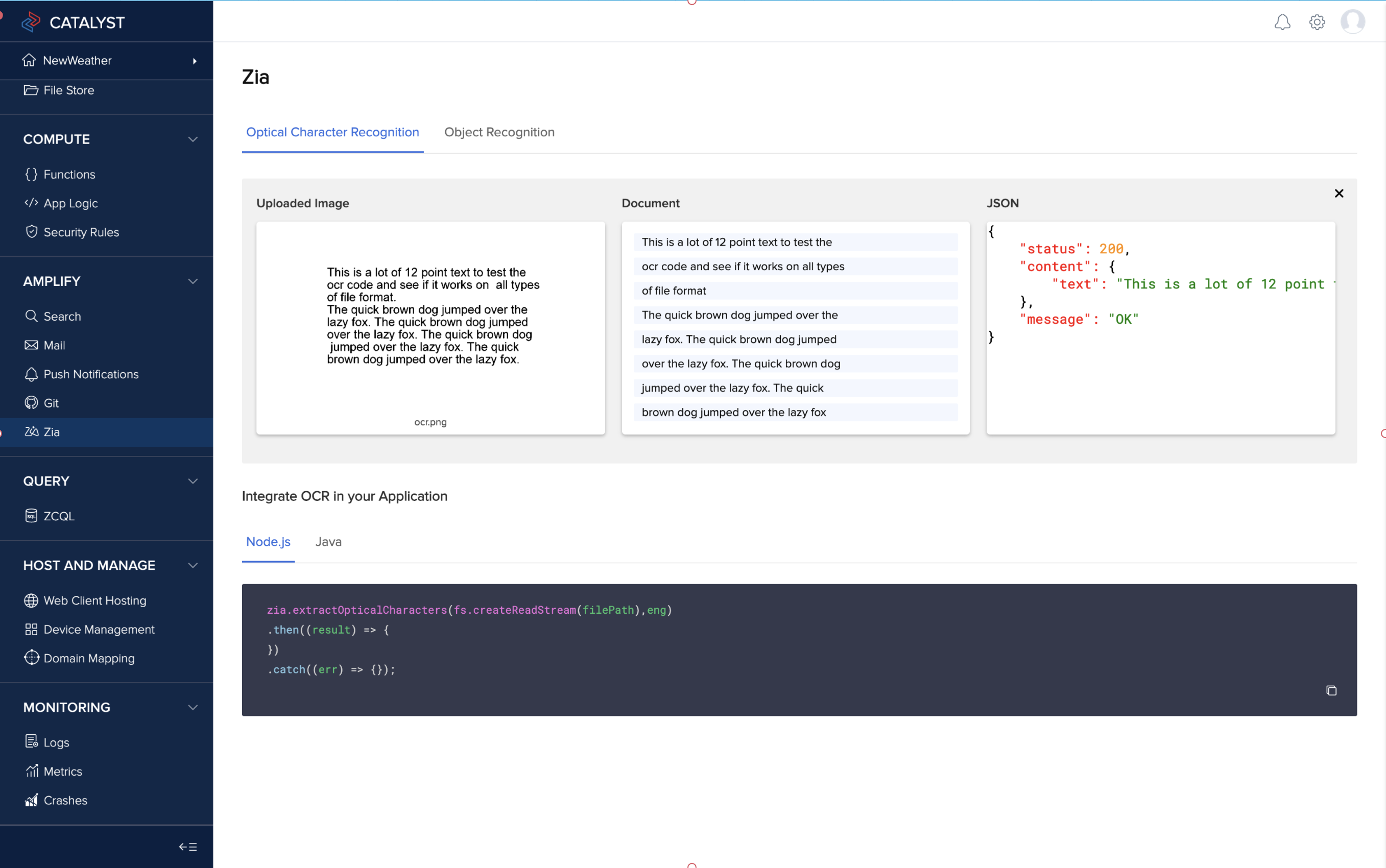
Catalyst Zia AI

“Historically, when you look at cloud computing, when you look at any public clouds, they pretty much range from virtualizing your servers and renting our virtual servers all the way up the stack,” Raju Vegesna, Zoho’s chief evangelist, said when I asked him about this decision to bet on serverless. “But when you look at it from a developer’s point of view, you still have to deal with a lot of baggage. You still have to figure out the operating system, you still have to figure out the database. And then you have to scale and manage the updates. All of that has to be done at the application infrastructure level.” In recent years, though, said Vegesna, the focus has shifted to the app logic side, with databases and file servers being abstracted away. And that’s the trend Zoho is hoping to capitalize on with Catalyst.

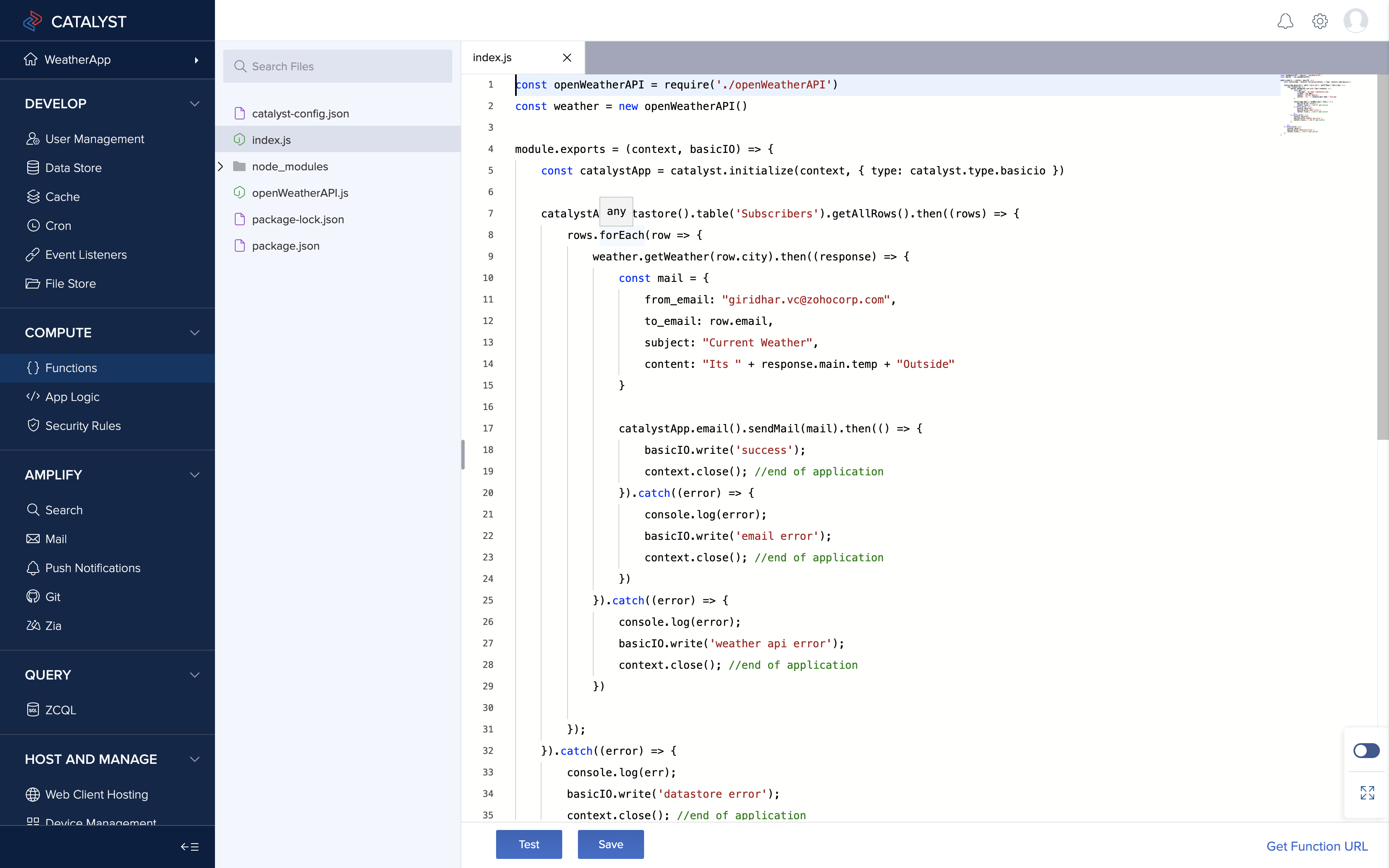
What Catalyst does do is give advanced developers a platform to build, run and manage event-driven microservice-based applications that can, among other things, also tap into many of the tools that Zoho built for running its own applications, like a grammar checker for Zoho Writer, document previews for Zoho Drive or access to its Zia AI tools for OCR, sentiment analysis and predictions. The platform gives developers tools to orchestrate the various microservices, which obviously means it’ll make it easy to scale applications as needed, too. It integrates with existing CI/CD pipelines and IDEs.

Catalyst Functions

Catalyst also complies with the SOC Type II and ISO 27001 certifications, as well as GDPR. It also offers developers the ability to access data from Zoho’s own applications, as well as third-party tools, all backed by Zoho’s Unified Data Model, a relational datastore for server-side and client deployment.

“The infrastructure that we built over the last several years is now being exposed,” said Vegesna. He also stressed that Zoho is launching the complete platform in one go (though it will obviously add to it over time). “We are bringing everything together so that you can develop a mobile or web app from a single interface,” he said. “We are not just throwing 50 different disparate services out there.” At the same time, though, the company is also opting for a very deliberate approach here with its focus on serverless. That, Vegesna believes, will allow Zoho Catalyst to compete with its larger competitors.

It’s also worth noting that Zoho knows that it’s playing the long-game here, something it is familiar with, given that it launched its first product, Zoho Writer, back in 2005 before Google had launched its productivity suite.

Catalyst Homepage


17 Oct 2019

Edge computing startup Pensando comes out of stealth mode with a total of $278 million in funding

Pensando, an edge computing startup founded by former Cisco engineers, came out of stealth mode today with an announcement that it has raised a $145 million Series C. The company’s software and hardware technology, created to give data centers more of the flexibility of cloud computing servers, is being positioned as a competitor to Amazon Web Services Nitro.

The round was led by Hewlett Packard Enterprise and Lightspeed Venture Partners and brings Pensando’s total raised so far to $278 million. HPE chief technology officer Mark Potter and Lightspeed Venture partner Barry Eggers will join Pensando’s board of directors. The company’s chairman is former Cisco CEO John Chambers, who is also one of Pensando’s investors through JC2 Ventures.

Pensando was founded in 2017 by Mario Mazzola, Prem Jain, Luca Cafiero and Soni Jiandani, a team of engineers who spearheaded the development of several of Cisco’s key technologies, and founded four startups that were acquired by Cisco, including Insieme Networks. (In an interview with Reuters, Pensando chief financial offier Randy Pond, a former Cisco executive vice president, said it isn’t clear if Cisco is interested in acquiring the startup, adding “our aspirations at this point would be to IPO. But, you know, there’s always other possibilities for monetization events.”)

The startup claims its edge computing platform performs five to nine times better than AWS Nitro, in terms of productivity and scale. Pensando prepares data center infrastructure for edge computing, better equipping them to handle data from 5G, artificial intelligence and Internet of Things applications. While in stealth mode, Pensando acquired customers including HPE, Goldman Sachs, NetApp and Equinix.

In a press statement, Potter said “Today’s rapidly transforming, hyper-connected world requires enterprises to operate with even greater flexibility and choices than ever before. HPE’s expanding relationship with Pensando Systems stems from our shared understanding of enterprises and the cloud. We are proud to announce our investment and solution partnership with Pensando and will continue to drive solutions that anticipate our customers’ needs together.”

17 Oct 2019

Rocket Lab successfully launches fifth Electron rocket this year

Rocket Lab has added another successful commercial launch to its track record: The rocket startup’s ‘As The Crow Flies’ mission took off today from its LC-1 launch site in New Zealand as planned. The rocket took off at 9:22 PM ET (6:22 PM PT), during its second launch opportunity of the day after the first window was pushed due to high altitude winds.

This is the ninth Electron launch for the company thus far, and the eighth mission for a commercial customer (the first was a test mission in 2017) since it began ferrying payloads for paying clients in 2018. Today’s launch carried a satellite called ‘Palisade’ for client Astro Digital, which is a technology demonstrator that will test the company’s next-generation geocommunications satellite design.

This mission was a late-stage substitute, swapping in for another Rocket Lab client who had to delay their own launch. Rocket Lab founder and CEO Peter Beck told TechCrunch that “Electron is a launch on demand service — we’re ready when the launch customer is,” highlighting the flexibility of the launch service they offer to adapt to the needs of their customers.

electron 9

After successful launch and kick stage separation, the Astro Digital satellite now awaits its final deployment into its target orbit, which should happen in the next few hours. We’ll update with the results of that maneuver.

16 Oct 2019

Watch Rocket Lab’s next Electron rocket launch live

Rocket Lab is launching its ninth Electron rocket today, with the launch set for 00:41 UTC (8:41 ET/5:41 PT). The mission, called “As The Crow Flies,” will be taking off from the company’s LC-1 launchpad in New Zealand, carrying a payload from Astro Digital to orbit.

The launch was actually supposed to take a different spacecraft up to low Earth Orbit, but the payload was swapped late last month – an unusual move for a rocket launch, and one that Rocket Lab is using to demonstrate the flexibility of its commercial service model. Rocket Lab’s other customer had a delay, and Astro Digital was ready to send up one of its ‘Corvus’ imaging satellites, so it got to move up the timing of its launch as a result.

Rocket Lab is currently on track to launch as planned, and the launch stream for the mission will be live above starting at around 20 minutes out from the T-0 launch window.