Year: 2019

16 Oct 2019

All Raise expands to new geos, launches ‘VC Cohorts’

Dozens of impeccably dressed women outfitted in jumpsuits and Rothy’s gathered at the Greylock offices last week for a “structured networking” session hosted by All Raise, an 18-month-old nonprofit organization that seeks to amplify the voices of and support women in tech.

The organization, active in the Bay Area and New York City, is announcing new chapters in Los Angeles and Boston this week, as well as a new director of engagement, Domonique Fines, formerly of Y Combinator, and a new chief of staff, Jack Dorsey’s former chief of staff at Square, Alicia Burt.

All Raise chief executive officer Pam Kostka, who joined the business earlier this year, says demand for an All Raise presence in local geographies continues to increase: “Women are hungry for the support and guidance we provide,” Kostka tells TechCrunch. “I think the movement is just gathering momentum.

With a focus on female venture capitalists and founders, All Raise hosts an annual conference, several in-person and virtual fundraising workshops and networking sessions and, recently, the group began creating curated peer groups for investors. Called VC Cohorts, All Raise is for the first time speaking publicly about how these 12-person subgroups will give their members career guidance and, perhaps more importantly, the ability to share deals.

“The idea was how do we hack the old boys’ network? said Elisa Schreiber, Greylock’s vice president of marketing and a member of All Raise’s advisory committee. “We have to force this familiarity, connectivity among women in venture so that people are helping each other.”

Currently, All Raise manages 14 active cohorts made up of 175 women. The idea is to put women with check-writing abilities, typically partners and general partners, together in groups with newer VCs, typically with an associate or principal title, paired together. These groups are expected to meet every six to eight weeks to talk shop.

“It’s basically like having 12 coffee chats in one evening,” Impact Capital managing partner Heidi Patel, who helps oversee the VC Cohorts program, tells TechCrunch. “It’s highly concentrated. It’s highly efficient and everyone walks out of there feeling like they’ve got a new tool in their tool kit.”

All Raise members

The new program has already proven an effective avenue for deal sourcing. During the first VC Cohorts meeting, NEA partner Vanessa Larco found an investor to lead the Series B of one of her existing portfolio companies, an Atlanta identity and credential verification startup called Evident. That Series B lead was Aspect Ventures partner (now a founding partner at aCrew Capital) Lauren Kolodny. The two All Raise members now sit on the company’s board of directors.

“Our cohort meetings always end with talking about portfolio companies that are currently raising,” Larco said in a statement. “I didn’t expect to share a deal with someone in my cohort, but she was an ideal investor for one of my portfolio companies.”

Male VCs have always had cross-firm relationships that facilitate deal-making. Women, who are much less represented — occupying only 11% of investment partner roles, according to Crunchbase News — have historically had fewer resources available to develop these critical relationships.

Moving forward, All Raise will continue building and launching new products tailored for women in tech, add additional folks to the small but growing All Raise team and determine how they can better reach women outside of VC hubs.

“Just because you’re sitting in Oklahoma doesn’t mean you don’t have the most amazing idea that can disrupt an entire category,” Kostka said.

16 Oct 2019

Autonomous ‘Mayflower’ research ship will use IBM AI tech to cross the Atlantic in 2020

A fully autonomous ship called the ‘Mayflower’ will make its voyage across the Atlantic Ocean next September, to mark the 400-year anniversary of the trip of the first Mayflower, which was very much not autonomous. It’s a stark way to dive home just how much technology has advanced in the last four centuries, but also a key demonstration of autonomous seafaring technology, put together by marine research and exploration organization ProMare and powered by IBM technology.

The autonomous Mayflower will be decked out with solar panels, as well as diesel and wind turbines to provide it with its propulsion power, as it attempts the 3,220 mile journey from Plymouth in England, to Plymouth in Massachusetts in the U.S. The trip, if successful, will be among the first for full-size seafaring vessels navigation the Atlantic on their own, which ProMare is opening will open the doors to other research-focused applications of autonomous seagoing ships.

To support that use case, it’ll have research pods on board while it makes its trip. Three to bed specific, developed by academics and researchers at the University of Plymouth, who will aim to run experiments in areas including maritime cybersecurity, seam mammal monitoring and even addressing the challenges of ocean-borne microplastics.

IBM has provided technical support for both the research and the navigation aspects of the mission, including providing its PowerAI vision technology backed by its Power Systems severs, which will work with deep leearing models that it’s developing in partnership with ProMare to help with avoidance of obstacles and hazards at sea. It’ll use RADAR, as well as LIDAR and optical cameras to accomplish all this.

The system is designed to use both local and remote processing, meaning devices on the ship will be able to operate without connection at the edge, and then check back in periodically with HQ when conditions allow for processing via nodes located at either shore.

This is a super cool project that could change the way we research the ocean, deep lakes and other aquatic environments. The plan is to also build VR and AR tools for essentially ‘boarding’ the autonomous Mayflower while it’s on its trip, so stay tuned for more on how you can get a closer look at the project as it prepares for its run next year.

16 Oct 2019

Amazon Pay users in India can now pay their utility, mobile and cable bills with Alexa

Amazon Pay users in India can now use voice command with Alexa to pay their utility, internet, mobile, and satellite cable TV bills, the e-commerce giant said on Wednesday. This is the first time, the company said, it is pairing these functionalities with Amazon Pay in any market.

The e-commerce giant, which competes with Walmart’s Flipkart in India, said any Alexa-enabled device such as the Echo Dot smart speaker, the Fire TV Stick dongle, or headphones from third-party vendors will support the aforementioned feature in India.

To be sure, Amazon has long allowed users in many markets to purchase items using voice command with Alexa. But this is the first time the American company is letting users pay their electricity, water, cooking gas, broadband, and satellite TV bills with voice and Amazon Pay.

Amazon Pay is available in many markets, but the service has become especially popular in India, where the concept of parking money to a digital wallet skyrocketed in usage in late 2016 after the Indian government invalidated much of the paper bills in circulation in the country.

Without disclosing specific figures, Amazon said “3X more customers” compared to last year’s event used Amazon Pay service to pay during the recent six-day festive sales. It said a quarter of all digital transactions during the event was carried out on its Pay service.

To boost Amazon Pay engagements in India, the company has offered lofty cashback on Pay on a number of purchases over the years. Users can also enjoy hefty discount if they use Amazon Pay to pay for their food, tickets, and other things on select popular third-party services.

During the holiday season, the company said, “customers booked flight tickets worth 300 trips around the earth.”

Amazon Pay makes it much more convenient for users to pay their digital purchases especially those that are recurring in nature, said Puneesh Kumar, country manager of Alexa Experiences and Devices.

The company says users can engage with Pay through voice commands like “Alexa, what’s my balance,” which will reveal the amount they have available for purchase in their Amazon Pay wallet. Users can also initiate the process of topping money to their mobile wallet using a voice command. They can say something like, “Alexa, add Rs 1000 to my Amazon Pay balance,” which will send a link as a text on their phones to complete the transaction.

16 Oct 2019

Founders, get advice from top experts at Disrupt Berlin this Dec. 11-12

What are the best strategies today for raising your startup’s first funding round, finding users and building your team? How can you best handle major new challenges like Brexit and global trade wars? These are the some of the key questions we will be answering this year at TechCrunch Disrupt Berlin, as part of a new feature at TechCrunch’s Disrupt shows — the Extra Crunch stage.

We launched the new stage at Disrupt SF last month, and the results were tremendous. Founders jammed the seating area to hear from speakers including Ray Dalio, Cyan Banister and Andrew Chen on topics ranging from fundraising tips to where you can find new users today. The traditional main stage was busy too, as usual, because who does not want to hear from Marc Benioff and Evan Spiegel, as well as watch the Startup Battlefield.

At Berlin, we’re bringing in the experts, including successful founders and investors from across Europe, Silicon Valley and around the world to sit on panels with TechCrunch’s editors panels to get into the how-to analysis of what great companies are doing to succeed today.

We’ve already announced Asher King Abramson of top growth marketing startup Demand Curve for Berlin. He gave a packed workshop at the San Francisco event, where he provided teardowns of marketing assets starting with top companies all the way down to those submitted by attendees. Now, if you’re attending Berlin, you can sign up have him consider your assets for the stage in December.

That’s not all!

Like in SF, we’ll also be doing a pitchdeck teardown with investors. You can submit your deck for consideration here.

We’ll also have immigration experts on-hand. If you want help with tricky immigration problems, you can tell us more here.

Buy your ticket to Disrupt Berlin right now. Any questions? You can reach the Extra Crunch editorial staff at ec_editors@techcrunch.com

16 Oct 2019

Only 3 days left: Apply to TC Top Picks @ Disrupt Berlin 2019

Deadline countdowns are relentless, and the application window to our TC Top Picks program is rapidly shrinking. The countdown ends and the window slams shut in just three days on 18 October at 12 p.m. (PT). If you want a shot at winning a free Startup Alley Exhibitor Package at Disrupt Berlin 2019, then take just a few moments and apply to be a TC Top Pick right now.

Attending a TechCrunch Disrupt conference as a TC Top Pick is one of the best ways to expose your early-stage startup to global media, eager investors and a VIP networking experience. How does it all work? Read on, founders…read on!

TC Top Picks is a pre-Disrupt competition, and we will accept applications from any early-stage startups that fit into one of these tech categories: AI/Machine Learning, Biotech/Healthtech, Blockchain, Fintech, Mobility, Privacy/Security, Retail/E-commerce, Robotics/IoT/Hardware, CRM/Enterprise and Education.

Our highly discerning TechCrunch editors review every application with a sharp eye for potential success, and they’ll select up to five startups they feel represent the best in each category. The Startup Alley Exhibitor Package that each TC Top Pick receives (at no cost) includes three Founder passes and one full day to exhibit in a prime spot within Startup Alley.

You’ll also have access to all of the Disrupt stages (including the Startup Battlefield competition), the complete attendee list, the list of attending press, use of the Startup Alley Exhibitor Lounge and CrunchMatch — our business networking platform.

We promote the heck out of the TC Top Picks and, as a result, everyone wants to see who made the grade. That means plenty of people stopping by your booth — it’s a golden networking opportunity that could take your startup in a whole new and improved direction.

TC Top Picks also benefit from an interview with a TechCrunch editor that takes place live on the Showcase Stage. We video record the interview and promote it across our social media platforms, and you’ll be able to use it as an effective marketing tool long after Disrupt Berlin ends.

One more very cool item. Every exhibiting startup is eligible to be chosen by TechCrunch as a Wild Card. Why does that matter? The Wild Card gets to compete in the Startup Battlefield, which has a $50,000 prize. Last year, Legacy earned the Wild Card slot, and then went on to win the Startup Battlefield competition.

Disrupt Berlin 2019 takes place on 11-12 December. Why not take a shot to showcase your company in Startup Alley for free? Your window of opportunity closes in just three days. Beat the 18 October 12 p.m. (PT) deadline, and apply to be a TC Top Pick today.

Is your company interested in sponsoring or exhibiting at Disrupt Berlin 2019? Contact our sponsorship sales team by filling out this form.

16 Oct 2019

Booqed, a Hong Kong-based platform for on-demand work spaces, raises $1.675 million in seed funding

Booqed, a Hong Kong-based platform for booking short-term work spaces, announced today that it has raised $1.675 million in seed funding. Participants included Colliers International, the commercial real-estate management company, Techstars and Lazard Korea.

The company participated in Proptech Accelerator, the Toronto-based accelerator program for property and real estate startups run by Colliers and Techstars, in 2018.

Launched in September 2016, Booqed currently has 1,600 listings for spaces in Hong Kong, Shenzhen and Singapore. It will use its seed round on product roll-outs, marketing and hiring. The platform differentiates from co-working spaces and companies like WeWork because its inventory consists of underused spaces in existing commercial properties, giving property owners and managers to way to make money instead of letting them sit empty.

Booking times can be as short as an hour or as long as several months, and listings include offices and meeting rooms, event spaces, retail stores and studios. Most of the startup’s customers are corporate clients that need to book venues or work spaces for traveling employees.

16 Oct 2019

Healx raises $56M Series B to use AI to find treatments for rare diseases

Healx, a Cambridge, U.K.-based startup using AI to help discover new treatments for rare diseases, has raised $56 million in Series B funding.

Leading the round is London-base VC firm Atomico, with participation by Intel Capital, Global Brain and btov Partners. All previous investors, including Balderton Capital, Amadeus Capital Partners, and Jonathan Milner have also followed on.

Healx says the new financing will be used to develop the company’s “therapeutic pipeline” and to launch its global Rare Treatment Accelerator programme, which will partner with patient groups in an attempt to make rare desease drug discovery much more efficient.

More broadly, the aim is to discover new treatments and move them towards clinic “within 24 months,” which is significantly faster than the status quo. Meanwhile, many rare conditions aren’t currently the focus of new treatments at all.

“There are over 7,000 rare diseases affecting 400 million people worldwide (50% of these are children). Of these diseases, 95% still lack an approved treatment today,” Healx co-founder and CEO Dr Tim Guilliams tells TechCrunch.

“The traditional model of discovery and clinical development of new medicines is very expensive in terms of costs, timelines and efficacy. To bring a new drug to market typically costs $2-3 billion, takes 12-14 years to develop and has a 95% failure rate”.

Specifically, Guilliams says that the current model doesn’t work for diseases which have a small patient population as the return on investment from drug sales simply won’t work with the discovery and development costs being so high. What’s needed is a “radical change of course” by using AI to discover alternative uses for existing drugs.

“By focusing on approved drugs and harnessing the power of AI we’ve been able to make the rare disease drug discovery process a faster and more efficient one,” he claims. “We’ve since made it our mission to progress 100 rare disease treatments towards the clinic by 2025”.

Of course, applying AI technology to drug discovery isn’t unique to Healx and nor are the challenges in doing so. BenevolentAI, for example, has grabbed lots of headlines, most recently reportedly having its valuation cut. However, Guilliams says Healx is taking a different approach to other companies in the space, which also includes Recursion Pharmaceuticals and Insilico Medicine.

“Our focus and approach is quite different. We focus on rare genetic diseases and have the world’s leading biomedical knowledge graph for rare diseases… [and] we don’t develop new molecules, we maximise the value of already-approved drugs”.

In addition, Guilliams says that Healx’s technology is data-driven and “hypothesis-free,” which is very different from traditional target-based drug discovery. “We are able to predict drug combinations and translate them very fast in the clinic… [and] we work extremely closely with patient groups, as strategic partners and disease experts,” he adds.

It’s also worth mentioning that Healx co-founder, Dr David Brown, has invented several drugs that have made it to market (including being one of Viagra’s inventors). These have turned over $40 billion in revenue, apparently. “We know how to do this,” says Guilliams.

Healx claims to have validated its innovative model with the FRAXA Research Foundation. “Fragile X syndrome” is the leading genetic cause of autism and I’m told there are currently no approved treatments for the disease. That could be about to change with Healx and FRAXA set to soon launch early clinical trials to test multiple treatment combinations. Further clinical programmes for other rare diseases will begin later in 2020.

IrinaH 600x400

Atomico’s Irina Haivas

Meanwhile, I asked Atomico Principle Irina Haivas, who led on behalf of the firm, what attracted her to the investment and how she views the risks associated with backing a company like Healx, given it is trying to find a needle in a haystack (drug discovery) and also needs to commercialise those discoveries. In other words, there are a lot of unknowns and a very long time to market.

“One of the reasons I chose to join Atomico is precisely because they are not afraid to make these sorts of bold, long term bets knowing that if it works then Healx will dramatically improve the lives of 400 million people living with a rare disease,” she tells me.

“Obviously, such ambitious bets also come with a certain degree of risk but I would say that in the case of Healx all the early signs are there that we can use AI to solve this “big search” problem better than humans traditionally did. However, the ultimate proof will be getting treatment to market of course”.

With that said, she also cautions that startups like Healx are creating a new category of companies. That’s because they are neither traditional tech nor traditional biopharma.

“They will need a different framework from an investor perspective, some investors will take time to get comfortable with that,” adds the surgeon-turned-VC.

16 Oct 2019

Databricks brings its Delta Lake project to the Linux Foundation

Databricks, the big data analytics service founded by the original developers of Apache Spark, today announced that it is bringing its Delta Lake open-source project for building data lakes to the Linux Foundation and under an open governance model. The company announced the launch of Delta Lake earlier this year and even though it’s still a relatively new project, it has already been adopted by many organizations and has found backing from companies like Intel, Alibaba and Booz Allen Hamilton.

“In 2013, we had a small project where we added SQL to Spark at Databricks […] and donated it to the Apache Foundation,” Databricks CEO and co-founder Ali Ghodsi told me. “Over the years, slowly people have changed how they actually leverage Spark and only in the last year or so it really started to dawn upon us that there’s a new pattern that’s emerging and Spark is being used in a completely different way than maybe we had planned initially.”

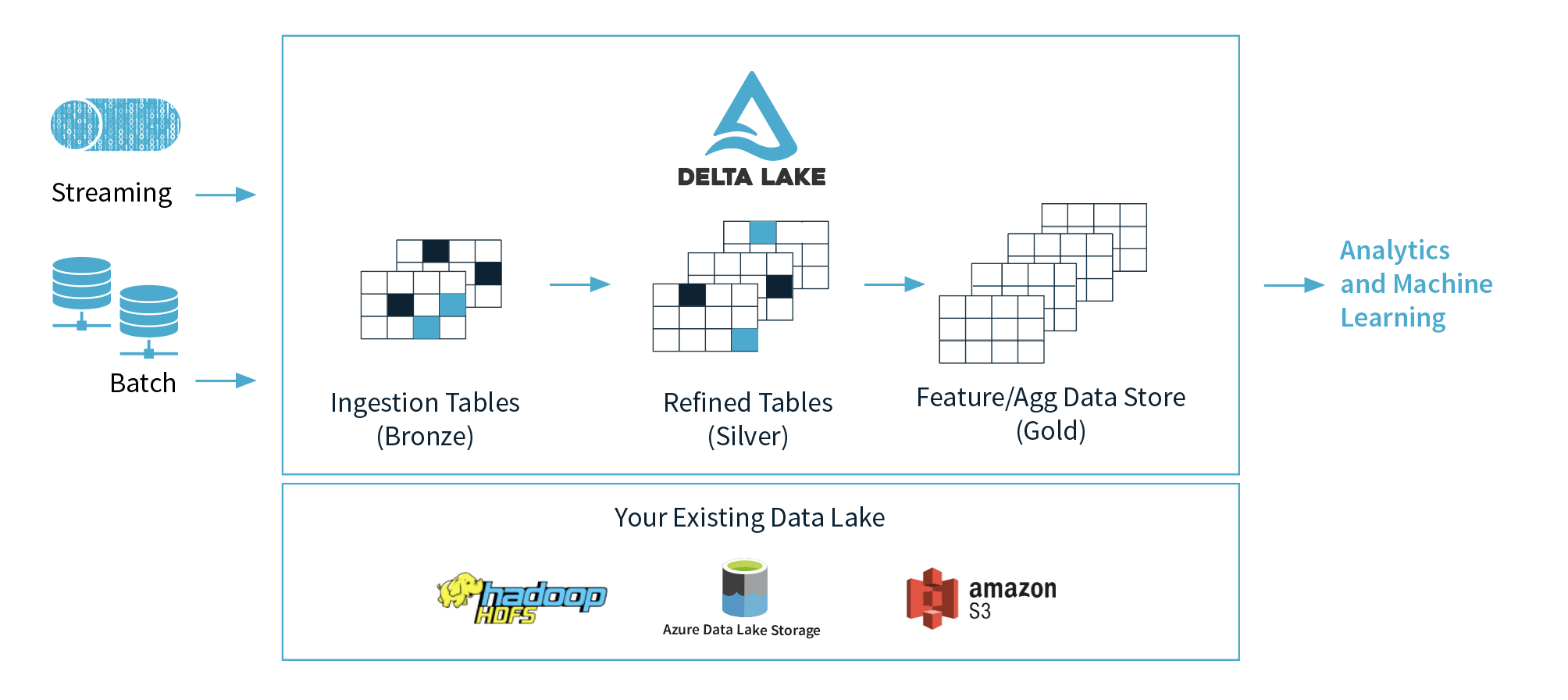
This pattern, he said, is that companies are taking all of their data and putting it into data lakes and then do a couple of things with this data, machine learning and data science being the obvious ones. But they are also doing things that are more traditionally associated with data warehouses, like business intelligence and reporting. The term Ghodsi uses for this kind of usage is ‘Lake House.’ More and more, Databricks is seeing that Spark is being used for this purpose and not just to replace Hadoop and doing ETL (extract, transform, load). “This kind of Lake House patterns we’ve seen emerge more and more and we wanted to double down on it.”

Spark 3.0, which is launching today, enables more of these use cases and speeds them up significantly, in addition to the launch of a new feature that enables you to add a pluggable data catalog to Spark.

Data Lake, Ghodsi said, is essentially the data layer of the Lake House pattern. It brings support for ACID transactions to data lakes, scalable metadata handling, and data versioning, for example. All the data is stored in the Apache Parquet format and users can enforce schemas (and change them with relative ease if necessary).

It’s interesting to see Databricks choose the Linux Foundation for this project, given that its roots are in the Apache Foundation. “We’re super excited to partner with them,” Ghodsi said about why the company chose the Linux Foundation. “They run the biggest projects on the planet, including the Linux project but also a lot of cloud projects. The cloud-native stuff is all in the Linux Foundation.”

“Bringing Delta Lake under the neutral home of the Linux Foundation will help the open source community dependent on the project develop the technology addressing how big data is stored and processed, both on-prem and in the cloud,” said Michael Dolan, VP of Strategic Programs at the Linux Foundation. “The Linux Foundation helps open source communities leverage an open governance model to enable broad industry contribution and consensus building, which will improve the state of the art for data storage and reliability.”

15 Oct 2019

Brazilian unicorn Ebanx will hit $2 billion in payments processed by the end of the year

Ebanx, the newly minted Brazilian financial services unicorn, expects to process $2 billion in payments by the end of the year and is looking to expand its offerings into domestic payments as it grows.

Since its launch in 2012, Ebanx has primarily focused on helping international merchants sell locally in Brazil. The Brazilian business accounts for nearly 90% of the company’s revenue, but as it expands into other markets the company is also broadening its suite of services.

The company moved into local payment processing in Brazil in April of this year, and recently closed on a new financing round from previous investors FTV and Endeavor Catalyst that values the company north of $1 billion, according to chief executive Alphonse Voigt. 

The money will be used to continue an aggressive hiring push in new markets and the launch of the company’s local payment services in other geographies, beginning with Colombia in the new year.

As credit cards penetrate the Latin American market, approval rates for local companies are increasing, which represents an attractive new source of revenue, Voigt says.

In addition to the local payment processing, Ebanx recently announced that it became a payment partner for the Uber Pay ecosystem in Latin America and would start processing cash voucher and bank transfer payments for Uber in Brazil and across Latin America. The company also inked deals with Coursera, Scribd, Trip.com and Shopify throughout Latin America. Finally, the company partnered with Visa* on an initiative to increase electronic payments in the Brazilian state of Parana.

*This story has been updated to reflect that Ebanx is partnering with Visa in Parana.

15 Oct 2019

Google Nest Mini hands-on

Two years after the release of the Home Mini, Google’s back with the sequel. Well, “sequel” might be a bit strong. The Nest Mini is more like one of those 1.5 movies they release on home video with a little extra footage than the theatrical release.

That’s not a compliant, exactly. The truth is there are some improvements here, but honestly, Google didn’t really need to do much. The $49 Home Mini sold like hot cakes and is a big part of the company’s rapid growth in the smart home space.

google nest mini

It was a low barrier of entry for those who were curious, but perhaps not fully on-board. And, like the Echo Dot before, it’s been an inexpensive way to outfit an entire home with smart speaker functionality.

Google has smartly kept the price the same with the Nest Hub. The device may not be a loss leader, exactly, but it’s the easiest and cheapest way of hooking users into the Assistant ecosystem — one that will theoretically lead to more smart home purchases, and, perhaps mobile device decisions.

The Nest is nearly identical to its predecessor. That, too, is fine. It’s simple and with a choice of four pastel colors (Chalk, Charcoal, Coral and Sky), it should fit most interior designs reasonably well. Bonus points for the new fabric covering, which is made entirely from recycled plastic bottles. Google says one half-liter bottle will cover two Minis. Interestingly the new cloth doesn’t negatively impact the sound.

google nest mini

Speaking of, that’s the biggest upgrade on-board. Sound has been improved over the original with a louder max volume and twice the bass. I’ve been listening to music at home on the new device, and while it gets pretty loud, I can’t recommend it as a standalone speaker. There are much better options for that. It serves Assistant and voice playback pretty well, but it gets a bit distorted at louder volumes.

I do quite like the music playback controls, however. Tap the center to play or pause music and either side to increase and decrease volume. When your hand approaches the speaker, two dots will illuminate on the edges to show you where to touch. Paired in stereo mode with another, better speaker (like, say, the Home Max) and it serves as a cool little touch control. The recent addition of stream transfer, meanwhile, makes it easier to keep listening to music as you change rooms.

Another interesting tidbit that didn’t get a lot of mention at today’s event is dynamic volume adjustment, which adjusts the sound based on background noise. It’s similar to the feature the company teased with today’s Pixel Buds reveal and could come in handy if you happen to live or work in a loud environment. Take that, neighbors.

google nest mini

The new Mini presents one of the more compelling use cases I’ve seen for Duo thus far (and honestly, I haven’t seen a ton). You can use the device as a kind of speakerphone with the app. I can certainly see this coming in handy for things like work calls at home. If you’ve got a big home, you can also use it as an intercom to communicate with other Home/Nest devices.

One other bit worth mentioning is the smart addition of a wall mount on the bottom of the device. It’s something small, but handy. Using a nail or thumbtack (well, probably just a nail, given the size/weight), you can now hang the Mini on a wall. Apparently this was a pretty heavily requested feature for those with limited shelf space. I could certainly imagine sticking it in my kitchen, where counter space is at an extreme premium — though dealing with the cord is another question entirely.

The Nest Mini arrives on retail shelves and walls October 22.