Year: 2019

15 Oct 2019

Headless CMS company Strapi raises $4 million

French startup Strapi has raised a $4 million seed round led by Accel and Stride.vc. The company has been working on an open-source Node.js headless content management system.

That’s a lot of technical words in a row, but it’s not that hard to understand what Strapi is. Content management systems, or CMS, are web applications that let you publish and manage content on a website. It can be a blog, a corporate websites with multiple pages, a portfolio, etc. The most popular CMS in the world is WordPress.

Over the past few years, many companies and developers have started to separate the CMS back end (the administration pages where you write and upload content) and the front end (the public website accessible to anyone).

This way, you can run a CMS in the back end, and develop your own custom front end that queries the back end using API calls — this is what’s called a headless CMS. It provides a ton of flexibility and should make your website faster. This is how TechCrunch.com works for instance, with WordPress running as a headless CMS.

Strapi has become quite popular in the headless CMS space with 500,000 downloads and 250 contributors to the open-source project. The first version was released on GitHub in 2015.

Anybody can download Strapi and run it on their own server. You can then develop your front end, fetch content in your mobile app using the Strapi API and more. Strapi lets you customize the admin panel so that you only see the fields you need when you add content. It works with SQLite, MongoDB, MySQL and Postgres databases.

The company plans to build an ecosystem of plugins to expand the features of your CMS installation. Eventually, the startup could launch a hosted version of Strapi so that you don’t have to manage the server infrastructure yourself.

Solomon Hykes, Guillermo Rauch and Eli Collins are also participating in today’s round. Existing investors include Bpifrance, SGPA, François-Charles Debeunne, Jean-Philippe Bellaiche, Kima Ventures, Nicolas Debock, Patrick Dalsace and Nicolas Rosset.
15 Oct 2019

Google Pixel 4, Pixel 4 XL not launching in India

The Google Pixel 4 and Pixel XL smartphones, that Google just unveiled at a press conference in New York, won’t launch in India, one of the company’s most important overseas markets, the Android-maker said on Tuesday.

The bottleneck lies with Project Soli, a radar-based motion-sensing technology baked into the new Pixel smartphones that relies on using certain frequency bandwidth — 60GHz mmWave. The company failed to secure permission from the local authority in India to use this frequency range, a person familiar with the matter told TechCrunch. You may remember that in the U.S., the FCC approved the commercial usage of Soli earlier this year.

“Google has a wide range of products that we make available in different regions around the world. We determine availability based on a variety of factors, including local trends, and product features. We decided not to make Pixel 4 available in India. We remain committed to our current Pixel phones and look forward to bringing future Pixel devices to India,” a Google spokesperson said in a statement.

The radar sensors on the new Pixel smartphones enable a number of human interactions, Sabrina Ellis, VP of Product Management at Google, said at the event. “For instance, Pixel 4 has the fastest secure face unlock on a smartphone, because the process starts before you have even picked up the smartphone,” she claimed. “Motion sense prepares the camera when you reach for your Pixel 4, so you don’t need to tap the screen,” she added.

The radar sensor also enables other applications such as rejecting a call by just gesturing at the phone, Ellis said.

This is the first time Google has had to skip the launch of a phone in India, the second largest smartphone market and where all the Nexus and Pixel smartphones have launched a few days after their global unveiling.

Not launching the new Pixel smartphones won’t really hurt the company… at least financially speaking. The Pixel smartphones have failed to receive any substantial acceptance in the Indian marker, especially as their prices increased over the years.

Even as 99% of smartphones shipped in India last year ran Android mobile operating system, the vast majority of handsets carried a price tag of $200 or lower, research firm Counterpoint told TechCrunch.

15 Oct 2019

Google’s new voice recorder app transcribes in real-time, even when offline

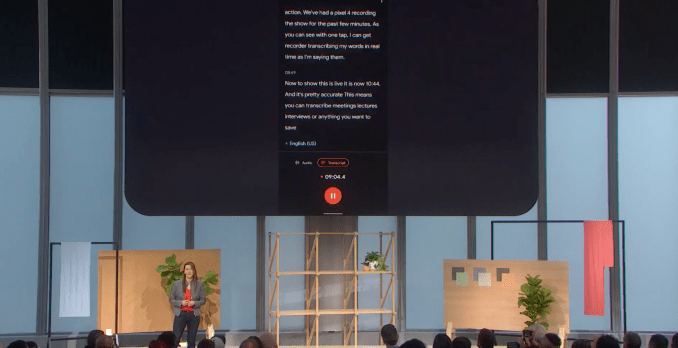
At Google’s Pixel 4 hardware event this morning, the company introduced a new voice recorder app for Android devices which will tap into advances in real-time speech processing, speech recognition and A.I. to automatically transcribe recordings in real-time as the person is speaking. The improvements will allow users to take better advantage of the phone’s voice recording functionality, as it will be able to turn the recordings into text even when there’s no internet connectivity.

This presents a new competitor to others in voice transcriptions that are leveraging similar A.I. advances, like Otter.ai, Reason8, Trint, and others, for example.

As Google explained, all the recorder functionality happens directly on the device — meaning you can use the phone while in airplane mode and still have accurate recordings.

“This means you can transcribe meetings, lectures, interviews, or anything you want to save,” said Sabrina Ellis, VP of Product Management at Google.

voice recorder

The Recorder app was demonstrated on stage during the event, live, and was offering — from what was shown — an error-free transcription. In real-world environments, voice transcription apps often fail because of background noise or bandwidth issues. It’s unclear how well the Recorder app will fare when it’s not hooked up directly to an audio source, as it likely was for this event, but rather placed on a tabletop or used in a noisier environment.

pixel voice recorder

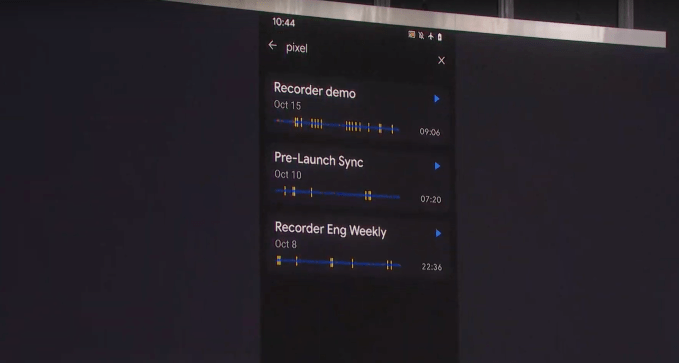
The app also offers an advanced search functionality where you’ll be able to search for sounds, words, or phrases. In the search results, everywhere the search term was spoken are highlighted in the playback bar so you can tap to go right to the part of the recording you need.

15 Oct 2019

Google overhauls Nest Aware cloud recording plan

Google is updating the Nest Mini today, the device formerly known as Google Home Mini. And the company used this opportunity to announce an update to its home awareness product, Nest Aware.

If you have Nest security cameras, you can subscribe to a Nest Aware plan. It currently costs $5 a month for 5-day video history, $10 per month for 10-day history and $30 per month for 30-day history. All plans include continuous recording, intelligence alerts, clips and more.

But it can get complicated when you have multiple cameras. Additional cameras require their own subscription plan, but those additional plans are a bit cheaper.

Google is going to simplify all that with plans that cover your whole home. New plans will cost $6 per month for 30-day event history and $12 per month for 60-day event history as well as 10-day 24/7 video history.

As you can see, you now have to pay $12 per month for continuous recording as the basic plan doesn’t include continuous recording anymore. But if you have 8 cameras, you’ll only have to play for a single subscription.

New plans will roll out in early 2020 with the option to switch to the new plans.

And now, Nest Mini and Nest Hubs integrate with Nest Aware. For instance, when your non-connected smoke detector is triggered by a fire, your Nest Mini will notice the alarm and send you a push notification.

You can listen live to confirm that it is a smoke alarm. You can confirm the alarm and the Home app then calls 911 or your local emergency service directly.

15 Oct 2019

Google launches Nest Wifi mesh router and extender with built-in Google Assistant

Today at its Google hardware event, Google introduced new mesh routers called Nest Wifi. This is a successor tot he Google Wifi product it introduced a couple of years ago, but with a number of improvements. The new Nest Wifi consists of two types of devices, one a router that plugs into your modem, and one ‘point’ amplifies the signal and extends the network, and it’s more powerful so you only need these two things.

It’s available to pre-order, and will ship on November 4. It comes in a 2-pack or a 3-pack variant, for $249 or $349 respectively, and will be available in eight countries at launch.

Google says that Nest Wifi offers 2x better speed than Google Wifi, with up to 25% better coverage. That’s from the two-piece system, which Google says is probably enough to cover the same space as the three-puck Google Wifi original system.

The hardware is designed to be placed out in the open – Google paid attention to design here to make sure it looks good enough to keep it where it’ll work best to provide signal. And the ‘point’ has a built-in speaker and microphone array, with onboard Google Assistant support, making it double as a smart speaker – which really does add to the overall value in terms of what you’re getting for the money.

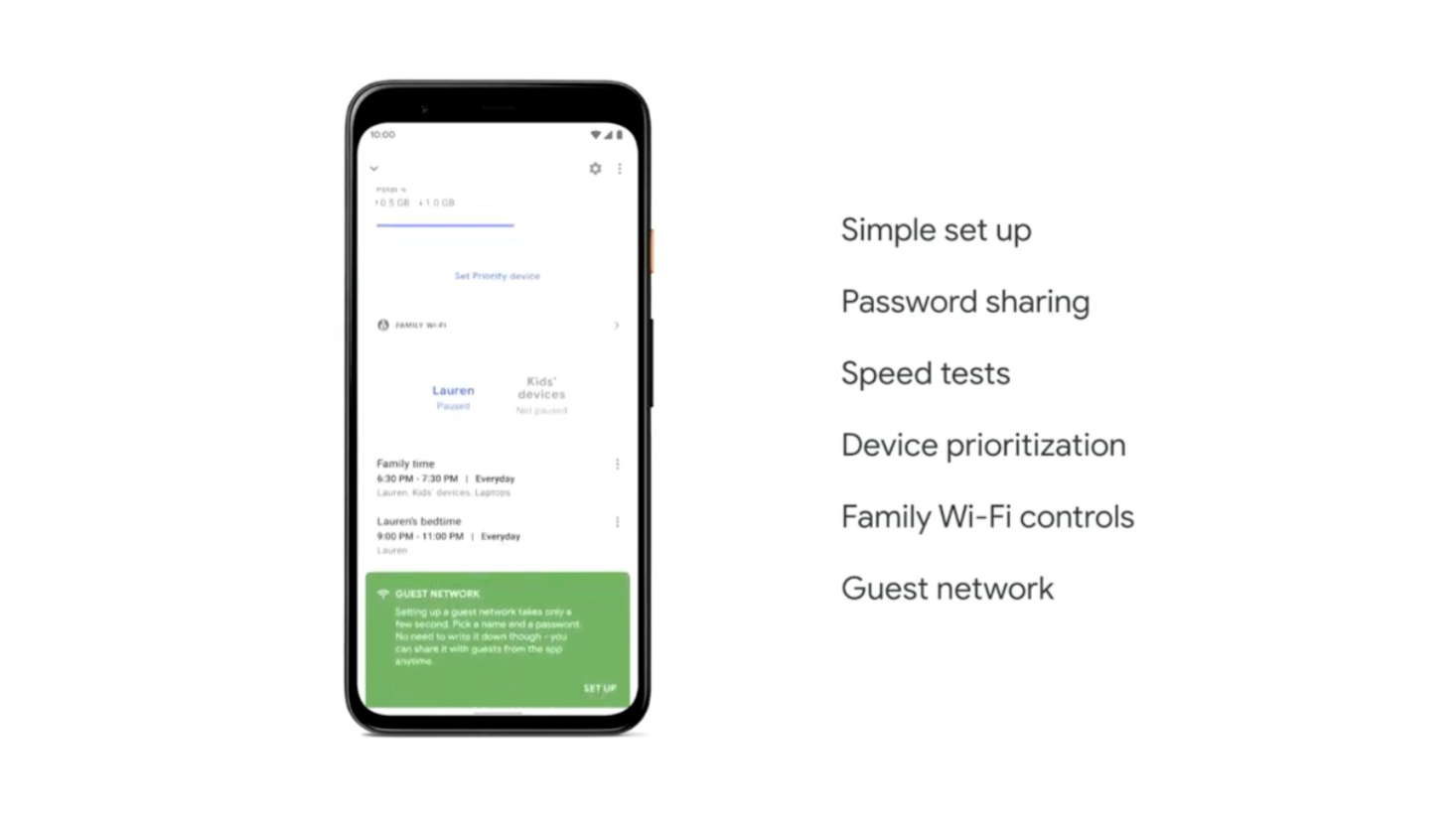
Like Google Wifi, it offers simple set-up, parental and guest controls, as well as “seamless setup” for smart home devices rom within the Google Home app.

Screen Shot 2019 10 15 at 10.36.01 AM
Interestingly, Google said that Google Wifi has been the top-selling mesh Wifi system in both the U.S. and Canada since its launch, so it’s clearly seeing a lot of success in this category. The company was also quick to point out that it has provided 15 updates to the original hardware since its launch, adding new features and improving performance, so expect a similar slew of post-purchase updates for Nest Wifi, too.

15 Oct 2019

Google’s Pixel 4 is official

The rumors and leaks have been pretty relentless. In fact, over the past three days, the Pixel 4 and Pixel 4 XL have gone up for preorder on at least two different sites. While it’s true that Google’s never been particularly great at keeping this stuff under wraps, this was pretty silly.

Anyway, the Pixel 4 is finally official, and it’s basically exactly what we were expecting from this year’s Google flagship. The device now features face unlock, another addition that brings Pixels in line with the competition, though Google claims it’s the fastest available. Using a new radar chip, the device is able to start the unlock when you reach for the phone and then fully unlock when it sees your face.

Radar also gives the device gesture recognition, via Motion Sense The concept is similar to what you’ll find on other Android handsets, but it’s significantly more sophisticated, distinguishing accidental gestures from intentional ones Use these, this can do things like skipping songs, turn the screen on and wave to your animated Pikachu wallpaper (actual example). All of the processing is done on device and users can turn it off for privacy.

The 4 maintains the familiar Active Edge squeeze, which launches a newly upgraded Google Assistant. As rumored, there’s a new recording app, which is capable of transcribing conversations in real-time. From the demo, at least, the feature is pretty impressive, with a more accurate transcript than I’ve seen from most AI software. Interestingly, it all works on-device, meaning that you can use it in airplane mode — and that that conversations aren’t automatically uploaded to the cloud

15 Oct 2019

The Apple TV app arrives on Roku, ahead of Apple TV+ streaming service launch

Ahead of the arrival of Apple TV+, the brand-new Apple TV app is launching on Roku devices, starting today. The app currently allows Apple customers to access their iTunes video library and subscribe to Apple TV channels directly from Roku devices. And, on November 1, it will also be home to the Apple TV+ streaming service, featuring Apple’s own original programming like The Morning Show, See, Dickinson, For All Mankind, Truth be Told, and others.

The new app will authenticate users with their Apple ID, so they can access their purchased content, get personalized recommendations, subscribe to paid channels (e.g. HBO, Starz, Showtime, etc.), and buy and rent over 100,000 movies and TV shows from iTunes. Additionally, Roku users will soon be able to subscribe to Apple TV+ right in the app for $4.99 per month.

Typically, Roku would take a cut of subscription revenue generated on its platform, but it’s not clear what sort of deal it may have with Apple.

The Apple TV+ streaming service is free for the first year with the purchase of a new Apple device, but it’s not limited to only those who own Apple hardware.

With Apple’s further expansion into services, it’s been learning to embrace third-party platforms. That’s especially true for its streaming services, like Apple Music and Apple TV+.

The TV streaming service, for example, is being made available on 2018, 2019 and newer Samsung smart TVs, Amazon Fire TV, LG, Roku, Sony and VIZIO platforms, in addition to AirPlay 2-enabled Samsung, LG and VIZIO smart TVs. And it will stream on the web through tv.apple.com.

The Apple TV app will be available on most streaming devices from Roku, including Roku TV models, streaming sticks, and streaming media players, both new and old. (A full list is here). However, select older model media players won’t offer the app.

The app will offer Apple TV+ in the U.S., Argentina, Canada, Chile, Colombia, Costa Rica, El Salvador, France, Guatemala, Honduras, Mexico, Nicaragua, Panama, Peru, Republic of Ireland and the United Kingdom.

“With the Apple TV app coming to Roku, our customers will enjoy an even broader range of exciting entertainment, including the highly anticipated Apple TV+ service,” said Scott Rosenberg, Roku Senior Vice President and General Manager of Platform Business, in a statement. “Roku is a valuable partner for content providers looking to reach a large and engaged audience, and we’re looking forward to bringing this new option to Roku users.”

15 Oct 2019

Google Home Mini is now Nest Mini

Google this morning unveiled the long awaited follow up to the Home Mini. The latest version of the company’s wildly popular entry-level smart speaker has been rebranded the Nest Home Mini, in keeping with the branding refresh of its smart home offerings. The new version of the device looks a lot like its predecessor, but features a number of internal upgrades.

Chief among the changes are improved sound and built-in machine learning that lets the device adapt power based on usage. The new version of the Mini smart speaker also doubles as an intercom and a conferencing speaker, so users can call the device directly, using Duo.

The most fun addition here, however, is the wall mount. With it, users can move the device from the shelf to the wall, giving it a greater flexibility for in-home placement. The Nest Mini’s familiar fabric covering is made using recycled bottles, as noted earlier in today’s event, in keeping with the company’s increased focus on sustainability.

The new Mini arrives October 22, priced at tempting $49 — same as its briskly selling predecessor. Along with the new Mini, Google’s also adding smart speaker functionality into the new Nest Wifi, which arrives early next month

15 Oct 2019

Google launches the $649 Pixelbook Go Chromebook

At its annual hardware event, Google today announced the launch of the Pixelbook Go, the latest iteration of its first-party Chromebook lineup. Starting at $649, the Pixelbook Go marks a return to the standard laptop format after last year’s Pixelbook with a 180-degree hinge and the Pixel Slate 2-in-1.

The Go will come with a 16:9 13.3-inch touch screen and either an HD or 4K display, a built-in Titan-C security chip, up to 16GB of RAM and up to 256GB of storage. It’s powered by Intel Core CPUs, starting with an m3 chip at the low end and an i7 at the top end. Available colors are black and “just pink” and pre-orders start now, but only for the black version. “Just pink” is coming soon.

Screen Shot 2019 10 15 at 10.25.38 AM

It has a rippled bottom, “that’s easy to grip” and a “Hush Keys,” which are supposedly quieter than the keys on previous Pixelbooks.

We wanted to create a thin and light laptop. That was really fast, and also have it last all day. And of course, we wanted it to look and feel beautiful,” Google’s Ivy Ross said in today’s announcement. Ross also stressed that the Pixelbook Go has a larger battery, yet is still lighter, thanks to its magnesium body.

Screen Shot 2019 10 15 at 10.24.49 AM

Unlike Microsoft, with its Surface line, Google’s laptops always seemed more like aspirational devices that defined the high end of the Chromebook spectrum. At $649, the Pixelbook Go is clearly more affordable than many of Google’s previous efforts in this area and the company clearly hopes to sell a few more of them.

EG7RBskXkAE9e6k

15 Oct 2019

For $164, Jaguar will let you co-pilot its I-Pace race taxi around the Nürburgring 

The Green Hell, as the famed Nürburgring Nordschleife was nicknamed back in the late 1960s, is a 73-corner nearly 13-mile track in Germany that can challenge even the most accomplished professional race car drivers.

Now, for about $164, thrill seekers can be a passenger for one lap. Jaguar announced a RACE eTAXI promotion that customers can buy a ride around the Nürburgring in an all-electric I-Pace vehicle piloted by a professional race car driver.

The promotion lasts through the end of November. The automaker also has a regular ol’ race taxi program that for about $274 gives customers a ride in the Jaguar XE SV Project 8.

The Nürburgring has become the place for automakers such as Volkswagen, Nio and Porsche to compete for “fastest electric car” bragging rights. Even Tesla CEO Elon Musk has said the company plans to put its Model S to test on the ‘ring.’

In August, the Porsche Taycan completed the course in 7 minutes and 42 seconds, which the German automaker said is the fastest lap for a four-door electric vehicle.

But it’s not the fastest lap for any electric vehicle. That honor goes to Volkswagen’s ID R electric race car, which completed the course in 6:05.336 minutes. The previous record was set in 2017 by Peter Dumbreck, who was driving a Nio electric vehicle.