Year: 2019

15 Oct 2019

Facebook’s new Portal increases privacy, but is still searching for a reason to exist

The timing of the original Portal’s launch was less than ideal. The company reportedly pushed things back as the Cambridge Analytica scandal hit full broil, only to be hit with another data breach disclosure. If there’s a lesson to be learned with this year’s sequel, it’s that there may just not be a good time for the company to release a camera-mounted piece of home hardware.

If nothing else, the seemingly endless parade of bad publicity has had the knock-on effect of making the company particularly proactive about privacy in a way the competition lacks. One of my main complaints about Google’s Nest Hub Max is the lack of a physical camera shutter. The original Portal, meanwhile, came with a small piece of plastic that clipped over the camera.

“It was a nice thought, but, practically, users might lose that, and it’s not always visible and available for users who want to cover the camera gracefully,” Facebook Director, Product Management Micah Collins told TechCrunch. “So we wanted to make sure that was a very integral and communicative part of the design.”
Portal Call 1

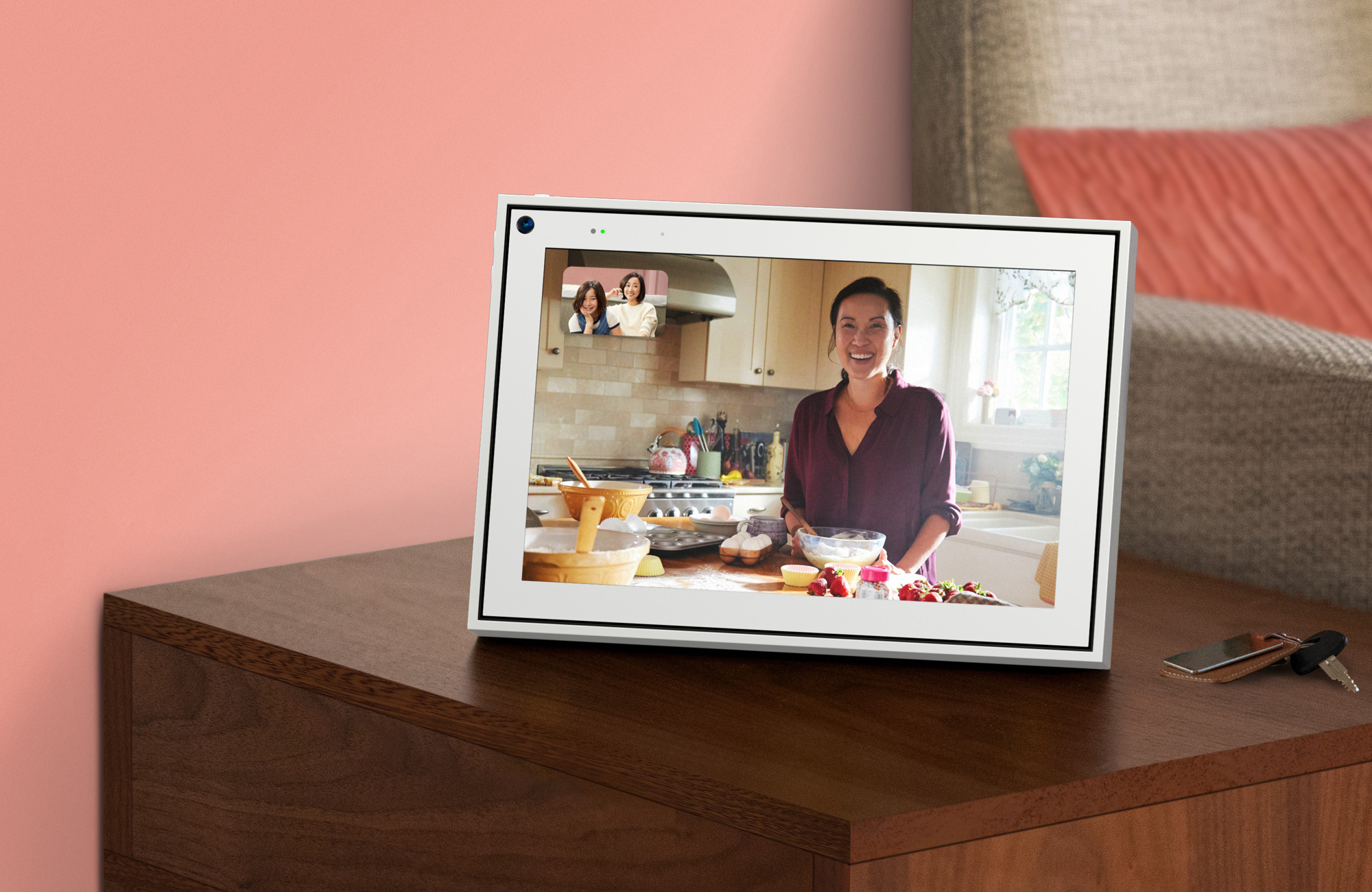
The new version of the device swaps that in-box piece of plastic for a three-position physical button. All the way to right is open and ready for business. The middle covers the camera with a built-in physical shutter while keeping the mic on. Going all the way to the left disconnects both the camera and microphone. That also turns on a red LED, letting you know definitely both are off. For my own purposes, that middle setting is getting the most use. I suspect I won’t be alone on that front, either.

Of course, disabling the camera sort of defeats the primary purpose of the device. At its heart, the Portal is a home video conferencing product. The inclusion of things like Alexa smart display functionality and music services like Spotify and Pandora are nice, but they’re kind of bonuses. No one is buying a Portal because it’s a more compelling smart screen than an Echo Show or Google Nest Hub Max.

Facebook’s value proposition is its own ecosystem. It’s the implicit understanding that, if you’re a person who is on the internet, odds are you’ve already opted in to Facebook, Facebook Messenger and now WhatsApp. That’s where the device attempts to set itself apart.

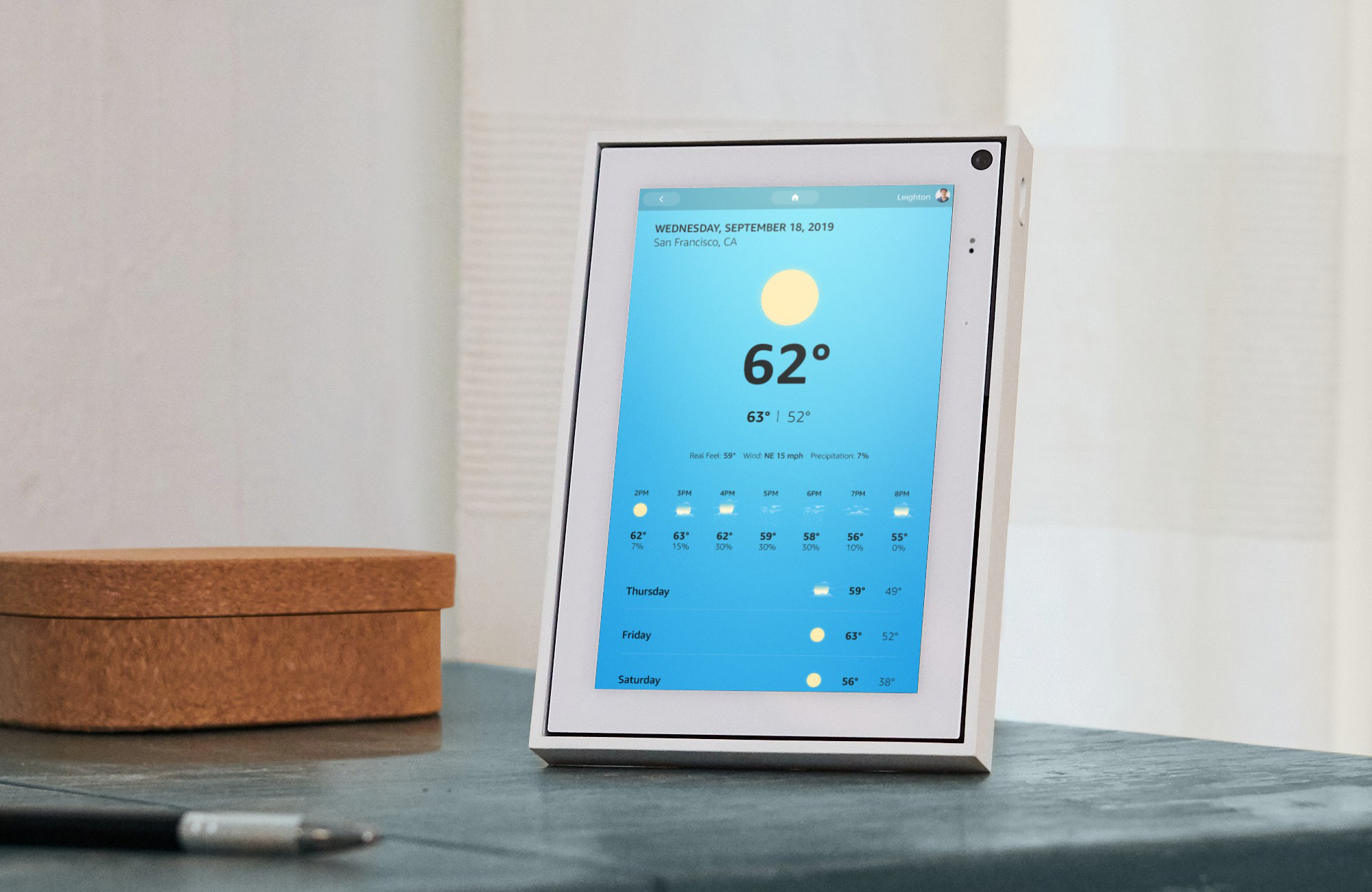
The first generation did get a leg up with some very clever AI camera panning, zooming and framing. It was a great feature and one it would be nice to see incorporated into devices like the Echo Show, where the video chat experience leaves something to be desired. Google, meanwhile, adopted something similar for the Nest Hub Max (while the original, smaller device still lacks a camera), which surely has taken some of the wind out of Facebook’s sails here.
Alexa B

“Nest has done a fine job,” Collins says, diplomatically. “We’re really happy they followed our lead in that sense of trying to deliver a richer calling experience.”

One gets the feeling Facebook is very much trying to wrap its brain around what its differentiator is here, and the new version of the Portal doesn’t do much to clarify that mission statement. While the company insisted to me that the growing family of devices are a play in and of themselves, it’s hard to shake the notion that the Portal family operates better as a kind of reference design for how third-party hardware manufacturers might better integrate its services into their own designs.

I’m not suggesting, of course, that Facebook can’t break away from this paradigm. The Microsoft Surface line presents a model for moving from reference to viable product. At the moment, however, there’s not a lot to recommend Facebook’s offerings, particularly with the external cloud of privacy offerings.

That said, there are things that can be taken away from this generation. The picture frame design, while far less interesting and aesthetically pleasing than its predecessor, does point to what is likely the future of these devices: a push to more seamlessly blend in with their surroundings. As the novelty of the category begins to wear off, more users are likely to choose function over form.

There’s also the clever kickstand. I’ll admit, I was a little baffled when I took the plug out of the box, but the rigid bit jutting from the back allows you to flip between portrait and landscape mode, depending on the source on the other end (mobile versus another Portal device), which would otherwise appear with letterboxing on the sides.
Alexa A

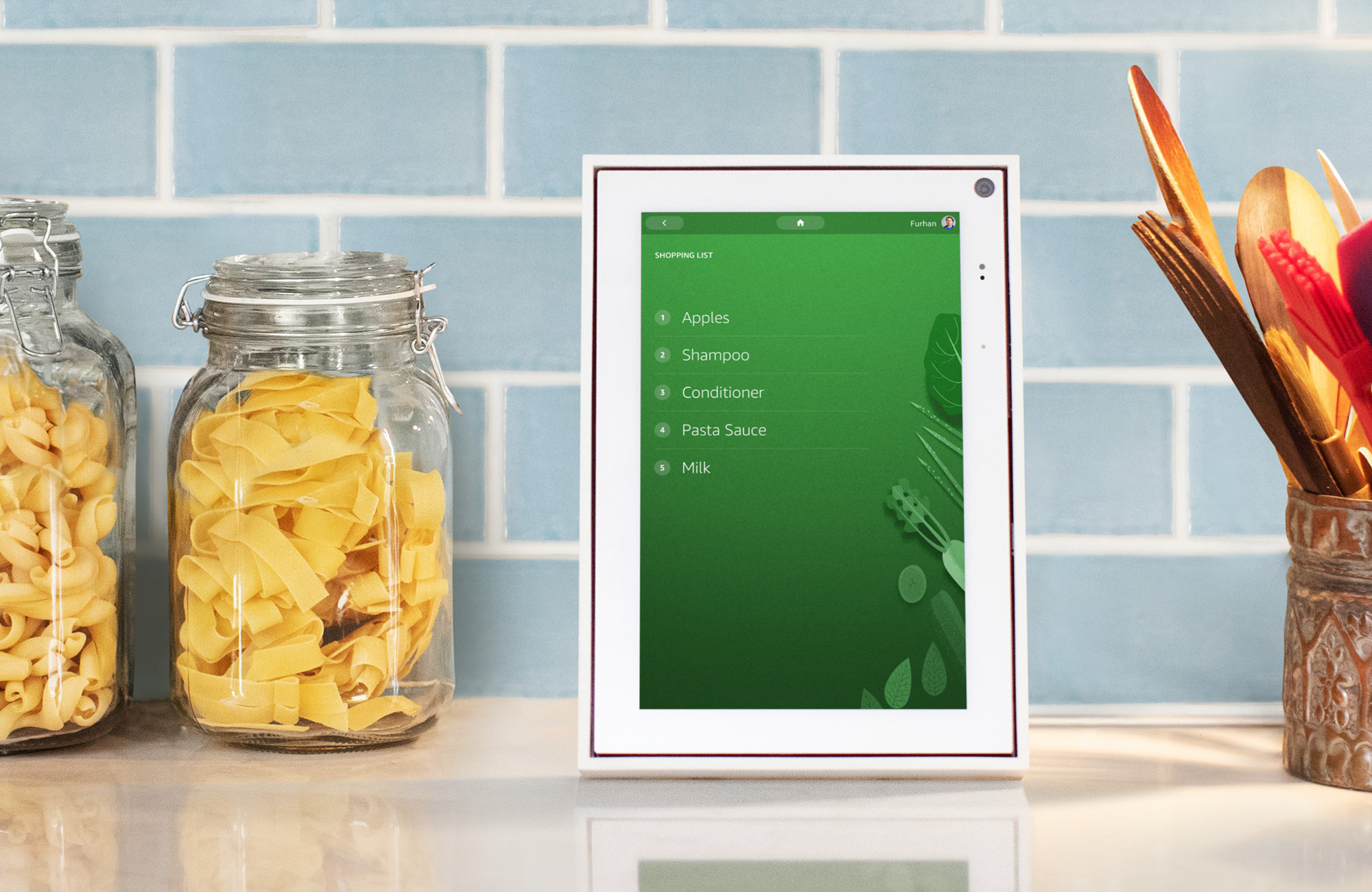
The Portal includes some other nice touches. The company’s adding additional AR Effects and Story Time stories. Like the rest of the Alexa-powered smart displays, Portal lacks a YouTube app, though you can access that through the built-in browser. It’s an inconvenient workaround, but good to have nonetheless, given how key a service like YouTube feels to a smart display like this.

Otherwise, the less universal Facebook Watch is your primary video source here. There are 14 apps currently listed in the onboard store, including those that are already pre-installed. The list includes big names like CNN, Food Network, Pandora, Spotify and iHeartRadio. Beyond that, you’re going to be relying on the built-in browser, requiring a lot of typing on an upright screen.

The price is certainly decent. At $179, I can’t imagine Facebook is making a ton of money on these. In fact, it’s not entirely clear why Facebook is making the Portal at all, outside of the stock line of “want[ing] to connect the world.” Perhaps once it figures out that, it will have a reason why the rest of us should get on board.

15 Oct 2019

Algolia finds $110M from Accel and Salesforce for its search-as-a-service, used by Slack, Twitch and 8K others

Algolia, one of the group of startups that provides search as a service for websites and apps as an alternative to Google and other search engines, is announcing a major round of funding today to fuel its growth. The startup — which already has over 8,000 customers, including big names like Twitch, Slack, Discovery and LVMH — has closed a Series C of $110 million, money that it plans to invest in R&D around its search technology, including doubling down on voice, and further global expansion in Europe, North America and Asia Pacific.

This Series C is being led by Accel, with other investors in this round including Salesforce Ventures (along with others that are not being named).

The funding is coming at a time of strong growth for Algolia, whose basic premise — to offer an easy-to-use, API-based search service for businesses, as a way to buy in search tech rather than build from the ground up using search platforms — has seen a lot of traction.

It was already active in the various reigons where it plans to grow: Founded originally in France, Algolia is now based out of San Francisco and has been in Asia since 2014, most recently doubling down on business in Japan, and when it last raised money in June 2017, it had only 3,000 customers.

Algolia had raised $74 million prior to this, with previous investors including Accel, Point Nine Capital, Storm Ventures, Y Combinator, 500 Startups and a number of individuals among others.

While Algolia is not disclosing its valuation, the prospects for building a big, enterprise-focused search business are there. As a point of comparison, consider the enterprise search company Elastic, which went public in 2018 and now has a market cap of some $6.7 billion after being valued at a mere $700 million when it was still private. Even with 8,000 customers now at Algolia, this is just the tip of the iceberg: Algolia cites estimates that there are some 1.8 billion websites and millions of apps on the market today.

Having Salesforce as a strategic backer in this round is notable: the CRM giant currently does not have a native search product in its wide range of cloud-based services for enterprises, instead opting for endorsed integrations with third parties, such as Algolia competitor Coveo. The plan will be to further integrate with Salesforce although no products to speak of as of yet.

“Algolia has been a great search innovator and delivers unique experiences for customers across Commerce,” said Mike Micucci, CEO, Salesforce Commerce Cloud. “Algolia’s integration into the Commerce Cloud platform will continue to drive momentum and mutual success with our developer, partner and customer community.”

At a time when search continues to be a critical cornerstone for how an organization presents itself online, and the effort to provide a counterbalance against the power of Google in search continues apace, this essentially gives Salesforce a financial foothold in one of the faster-growing companies in the space.

As my colleague Romain has previously noted in his coverage of Algolia, the company’s unique selling point has been the fact that it provides a super-fast and effective search tool that you can integrate into a site or app easily by way of an API.

This in contrast to solutions that either are built in-house from the ground up, or rely more lengthy and more expensive integrations to get up and running. Alongside that, Algolia has more recently released supplementary tools, such as search analytics and A/B testing to help optimise results and understand what better what it is that site/app visitors want to know.

The funding comes at an interesting time in the world of search. Google has effectively dominated the market for years with an open web approach to ordering the world’s information: the primary point of entry is Google.com, and while you can tailor your results based on your search terms, the selling point is that you can search for anything and everything.

But in more recent years we’ve seen a big shift: awareness of issues such as privacy and data protection have turned some off from the idea of open-ended browsing powered by advertising, and as we and the internet itself has gotten more sophisticated, sometimes the open-ended search feels too wide for our purposes, and web publishers themselves are less inclined to give over that search traffic to Google.

That’s given rise to more focused vertical search services, and — even more specifically — better search within sites and apps themselves. This is the context that has given rise to Algolia and others like it (for example Lucidworks raised $100 million in August).

The landscape is big, but it remains one that Algolia thinks best served by staying focused.

“We have no plans to build a consumer service,” CEO Nicolas Dessaigne said. “There are a lot of companies like Amazon and Google doing a great job. We like to think of them as partners in a way, educating the whole world about search.”

“Behind a world-class team of search experts and a passionate customer base, Algolia has become the market leader in Search-as-a-Service,” said Nate Niparko, partner at Accel. “Algolia is accelerating innovation in personalized and intelligent search, enabling companies to deliver a great user experience that drives improved business results. We are excited to double down on Algolia and support their mission to lead the search and discovery market.”

15 Oct 2019

Wheels raises $50 million for pedal-less e-bike share

Wheels, the startup founded by Wag founders Jonathan and Joshua Viner, just announced a $50 million round led by DBL Partners. This round brings Wheels’ total funding to $87 million.

Wheels currently operates in six markets, including San Diego, Los Angeles, Atlanta, Chicago, Dallas, Scottsdale, Ariz., Salt Lake City and Cleveland. The plan is to use the funding to deploy in additional markets throughout the U.S. and in international markets.

“We’re excited to open up to dozens of cities over the next few months including international expansion,” Wheels COO Marco McCottry told TechCrunch. “As we think about how we fit with the other companies in the space, we’re growing the pie and expanding the market.”

Right now, Wheels is focused on the shared model but does see an opportunity to sell directly to consumers, Josh Viner told TechCrunch. Wheels differentiates itself from other bike-share companies with its modular design, swappable parts and batteries. Though, JUMP recently unveiled its vision for swappable batteries on bikes.

Wheels has also developed a patent-pending smart, shareable helmet system that integrates seamlessly onto the bike. The helmet, which can be unlocked with a smartphone, comes with removable hygienic liner. The plan is to deploy the helmet-equipped vehicles by the end of this year.

“The micro mobility market has the ability to continue to revolutionize the future electrification of transport, but problems of safety and sustainability are keeping the industry from reaching its true potential,” DBL Partners Founder and Managing Partner Ira Ehrenpreis said in a statement. “Wheels is solving these issues with its safety-focused product design, including the upcoming release of its integrated helmet technology, a more sustainable business and maintenance model, and a mass-market design that appeals to a wider gender and age demographic.”

15 Oct 2019

Walmart’s Flipkart confirms it is entering the food retail business in India

India’s Flipkart is entering the food retail business as the e-commerce giant looks to expand its reach in the nation, its chief executive said on Tuesday.

Flipkart, which sold majority stake in the company to Walmart for $16 billion last year, has registered an entity called ‘Flipkart Farmermart Pvt Ltd’ — in compliance with local laws — that will focus on food retail, said Kalyan Krishnamurthy, Flipkart Group CEO, in a statement to TechCrunch.

The extended business represents “an important part of our efforts to boost Indian agriculture as well as food processing industry in the country,” he said, adding that the company is already working with hundreds of thousands of small farmers for the business.

In a government filing earlier this week, Flipkart revealed that it has authorized to invest $258 million in the new venture. Krishnamurthy said the company has secured approvals from the board to enter the food retail business.

Indian newspaper Economic Times and outlet CNBC TV 18 first reported about the filing.

“We’re looking forward to invest more deeply in local agri-ecosystem, supply chain and working with lakhs of small farmers, Farmer Producers Organisations (FPOs), food processing industry in India, helping multiply farmers’ income and bring affordable, quality food for millions of customers across the country,” Flipkart chief executive added.

The announcement comes as Flipkart’s chief rival Amazon begins to expand its food retail business in the country. The company has already committed to invest about $500 million in the course of next five years to build its own private label food products and engage with third-party sellers. Two months ago, the company launched its two-hour delivery service called Amazon Fresh in Bangalore.

The Indian government sidestepped the intense opposition to foreign investment in multi-brand retail in 2016 to create a food retailing segment that it said was aimed at creating jobs and helping farmers.

More to follow…

15 Oct 2019

Newly-rebranded Thimble raises $22M to bring flexible insurance to the gig economy

Thimble, which offers flexible, short-term insurance to small businesses and freelancers, is announcing that it has raised $22 million in a Series A funding round led by IAC.

Until today, the startup was known as Verifly, a name tied to the company’s initial aim of providing insurance to drone pilots. However, founder and CEO Jay Bregman (who previously founded ridesharing company Hailo) said that thanks to customer demand, the team kept adding insurance for different types of businesses — and now it’s rebranding to reflect that broader vision.

While it’s easy to talk about Thimble customers as being part of the “gig economy,” Bregman noted that these aren’t just people driving for Uber or delivering for Postmates — only 4% of the company’s customers identify as gig economy workers.

“There is this larger thing called the gig economy: People working in flexible ways, on their own terms,” he said.

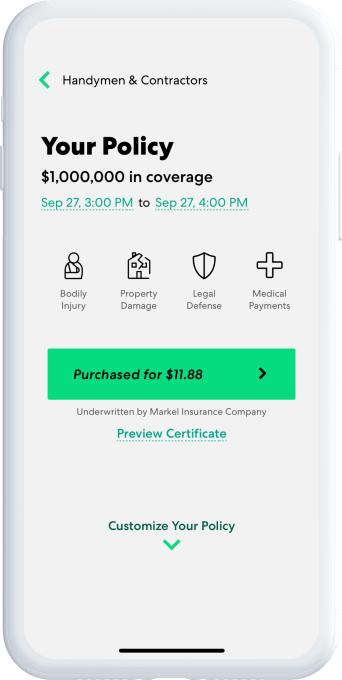
In fact, Thimble now says it provides liability coverage for customers in more than 100 professions, including handymen, landscapers, DJs, musicians, beauticians and dog walkers. Policies can be purchased directly from the Thimble website or app by the hour, day, week, month or year.

Thimble Policy Overview iPhone

The idea, Bregman said, is that as work becomes shorter term and “more transactional,” it doesn’t make sense to buy an annual insurance policy. To illustrate that point, he noted that 75% of customers didn’t have insurance before buying from Thimble, and that 50% of customers are buying policies to cover a single day or less. And the company says it’s on-track to sell 100,000 by the end of the year.

Thimble’s policies are underwritten by Markel, an insurance company that Bregman praised for its “infrastructure and talent.”

At the same time, he said, “We have always been the owner of the product itself. Basically, we worked with carrier partners to bring [our products] to market; the way we do that may evolve slightly as we get older and more mature.”

Thimble has received regulatory approval to sell insurance in 48 states so far. Asked whether the broader political debates about whether gig workers are employees could affect the company’s business, Bregman pointed again to the fact that the vast majority of Thimble customers don’t consider themselves gig workers.

“Our only fear here is that in trying to solve a very particular problem with long-term gig employment, that some of these laws may actually unintentionally scare off or capture legitimate freelancers,” he said.

As for the investment, IAC’s chief strategy officer Mark Stein acknowledged that the digital media holding company doesn’t make many early-stage, minority investments. But he said that deals like this are about “planting seeds.”

“What we think about at IAC is: How can we go about planting seeds of growth for the future? What will become the next ANGI Homeservices? What will become the next Match Group?” Stein said, alluding to two IAC-owned businesses that may get spun off.  “We need to find these kinds of large, addressable market opportunities now in the hopes of creating very large, industry-changing companies in the future.”

Previous investors Slow Ventures, AXA Venture Partners and Open Ocean also participated in the round, bringing Thimble’s total funding to $29 million.

15 Oct 2019

Germany says it won’t ban Huawei or any 5G supplier up front

Germany is resisting US pressure to shut out Chinese tech giant Huawei from its 5G networks — saying it will not ban any supplier for the next-gen mobile networks on an up front basis, per Reuters.

“Essentially our approach is as follows: We are not taking a pre-emptive decision to ban any actor, or any company,” government spokesman, Steffen Seibert, told a news conference in Berlin yesterday.

The country’s Federal Network Agency is slated to be publishing detailed security guidance on the technical and governance criteria for 5G networks in the next few days.

The next-gen mobile technology delivers faster speeds and lower latency than current-gen cellular technologies, as well as supporting many more connections per cell site. So it’s being viewed as the enabling foundation for a raft of futuristic technologies — from connected and autonomous vehicles to real-time telesurgery.

But increased network capabilities that support many more critical functions means rising security risk. The complexity of 5G networks — marketed by operators as “intelligent connectivity” — also increases the surface area for attacks. So future network security is now a major geopolitical concern.

German business newspaper Handelsblatt, which says it has reviewed a draft of the incoming 5G security requirements, reports that chancellor Angela Merkel stepped in to intervene to exclude a clause which would have blocked Huawei’s market access — fearing a rift with China if the tech giant is shut out.

Earlier this year it says the federal government pledged the highest possible security standards for regulating next-gen mobile networks, saying also that systems should only be sourced from “trusted suppliers”. But those commitments have now been watered down by economic considerations at the top of the German government.

The decision not to block Huawei’s access has attracted criticism within Germany, and flies in the face of continued US pressure on allies to ban the Chinese tech giant over security and espionage risks.

The US imposed its own export controls on Huawei in May.

A key concern attached to Huawei is that back in 2017 China’s Communist Party passed a national intelligence law which gives the state swingeing powers to compel assistance from companies and individuals to gather foreign and domestic intelligence.

For network operators outside China the problem is Huawei has the lead as a global 5G supplier — meaning any ban on it as a supplier would translate into delays to network rollouts. Years of delay and billions of dollars of cost to 5G launches, according to warnings by German operators.

Another issue is that Huawei’s 5G technology has also been criticized on security grounds.

A report this spring by a UK oversight body set up to assess the company’s approach to security was damning — finding “serious and systematic defects” in its software engineering and cyber security competence.

Though a leak shortly afterwards from the UK government suggested it would allow Huawei partial access — to supply non-core elements of networks.

An official UK government decision on Huawei has been delayed, causing ongoing uncertainty for local carriers. In the meanwhile a government review of the telecoms supply chain this summer called for tougher security standards and updated regulations — with major fines for failure. So it’s possible that stringent UK regulations might sum to a de facto ban if Huawei’s approach to security isn’t seen to take major steps forward soon.

According to Handelsblatt’s report, Germany’s incoming guidance for 5G network operators will require carriers identify critical areas of network architecture and apply an increased level of security. (Although it’s worth pointing out there’s ongoing debate about how to define critical/core network areas in 5G networks.)

The Federal Office for Information Security (BSI) will be responsible for carrying out security inspections of networks.

Last week a pan-EU security threat assessment of 5G technology highlighted risks from “non-EU state or state-backed actors” — in a coded jab at Huawei.

The report also flagged increased security challenges attached to 5G vs current gen networks on account of the expanded role of software in the networks and apps running on 5G. And warned of too much dependence on individual 5G suppliers, and of operators relying overly on a single supplier.

Shortly afterwards the WSJ obtained a private risk assessment by EU governments — which appears to dial up regional concerns over Huawei, focusing on threats linked to 5G providers in countries with “no democratic and legal restrictions in place”.

Among the discussed risks in this non-public report are the insertion of concealed hardware, software or flaws into 5G networks; and the risk of uncontrolled software updates, backdoors or undocumented testing features left in the production version of networking products.

“These vulnerabilities are not ones which can be remedied by making small technical changes, but are strategic and lasting in nature,” a source familiar with the discussions told the WSJ — which implies that short term economic considerations risk translating into major strategic vulnerabilities down the line.

5G alternatives are in short supply, though.

US Senator Mark Warner recently floated the idea of creating a consortium of ‘Five Eyes’ allies — aka the U.S., Australia, Canada, New Zealand and the UK — to finance and build “a Western open-democracy type equivalent” to Huawei.

But any such move would clearly take time, even as Huawei continues selling services around the world and embedding its 5G kit into next-gen networks.

15 Oct 2019

Smart home startup Level Home emerges from stealth with $71M and a new take on the smart lock

As companies like Google, Amazon and Apple hone their strategies to build the brain that helps you use the smart home of the future, where a new wave of internet-enabled appliances, climate and security systems and other connected objects can be connected and controlled through their hubs, a new smart home startup called Level Home is emerging from stealth today with a big packet of funding and a hope of bringing something new to the table, by focusing on ways of rethinking old things you own already, starting with the lock on your front door.

The Level Lock, the first patented product, is a system — tested for durability and powered by a basic CR2 battery (average life: one year) and equipped with ANSI GRADE 1/A security and encryption — that is fitted into the existing dead bolt on your door to make it “smart”.

The door will not look any different after you install the Level Lock, but linking it up with HomeKit, you can then use an Apple iPhone or Watch to unlock it (or, you can also still use the physical keys that come with the lock to open the door). Priced at $249 when it goes on sale (first in the US), the Lock is available now for preorder on Level’s site.

Screenshot 2019 10 15 at 09.36.52

There is a good chance that when the Lock does become generally available, you will be able to get it in more places beyond Level’s site. Along with the launch of the Level Lock and the company itself, Level Home is also announcing that it has raised $71 million in funding since the company was first founded in 2016, with investors including a firm called Hut 8 Ventures (unclear if connected to Hut 8 cryptocurrency mining, I’m asking), Lennar Homes — the home maker that has worked with the likes of Apple and Amazon to build in connected features into new properties — and Walmart.

The retail giant has been working double time to “level up” to Amazon on the e-commerce front, building a range of services online and increasing the ways in which it can connect with shoppers beyond visits to its large retail locations, and while Level is not disclosing any details yet on how it will work with its strategic investors, you could imagine its involvement having more than one touchpoint.

It could be a very strong sales channel for the Level Lock through its many well-visited retail locations.

But it could also be sold potentially as part of a bigger service offering, in competition with something like Amazon Key, where Walmart offers smart locks to its customers as part of a bigger home delivery business. (Walmart has already started down this road: back in 2017 it first partnered with smart lock maker August to test in-home delivery.)

Partnerships with the likes of Walmart and Lennar sound like a big deal, considering that the company hasn’t tested its product or brand in the market, and the area of smart home hardware is also very crowded already.

Part of the reason for the leap may be because of the background of the founders. John Martin (CEO) and Ken Goto (CTO) have worked together for decades across a range of major tech and other consumer companies including Microsoft, Starbucks and Apple. Very far from the image of young startup-guys, they are taking a measured and very confident approach to the bigger task of thinking about how to approach a new generation of hardware that isn’t so much as “disrupting” what is already being used, but is trying to augment it to bring in a wider population of adopters beyond those who embrace the cutting edge of tech.

“We could have made anything for the connected home, so and we thought for weeks about what to invent,” Martin told me about the pair’s decision to focus first on the front door lock three years ago. “We had a couple of fundamentals: we wanted products for everyday life, and we didn’t want home automation out of the mainline of what normally happens. We didn’t want lightbulbs to change color for the sake of it, and we didn’t want to appeal just to the tech professional. So we thought entry was the right point to start.” Or, entry was a good point of entry, if you will.

Of course, Level Home isn’t the first to come on this progression of logic. Smart doors and smart locks are everywhere now, although ironically, they are not being used all that much. “When we looked at first generation smart locks, we were offended by how aggressively the experience was departing from how people use locks today.” By this, Martin is referring to things like physical keys, or aesthetically pleasing doors and locks without large objects attached to them.

Indeed, the smart home market has not been a home run so far, but it shows some promise. The smart home market overall is projected to generate revenues of nearly $74 million this year, nearly doubling to $141 billion by 2023. A stream of hardware sales will underpin that growth, with some 140 million smart locks and other home security devices — the second-biggest category after video entertainment — expected to be shipped this year, growing to 352 million by 2023 globally.

But within that, penetration has not been massive: in Europe, only around 11 percent of homes have smart home devices in them (not counting phones), and in the US, the figure is only slightly higher, at 15%. That speaks to a still-nascent market, but also the fact that many people’s imaginations, and crucially wallets, have get to be captured by what is on offer today.

That spells opportunity for the smart home entrepreneurs, and investors willing to take the leap to back them.

Martin and Goto say that they have a pipeline of several other products that they will be working on, although for now, they are keeping quiet on what they might be. The basic idea will be to continue present an alternative version of the smart home: to quietly make our lives at home easier and more connected, but without any massively perceptible shifts. Move slow, don’t break things.

In a market with a lot of options for how to bring more modern objects into the mix that genuinely look like the future, this could be a good differentiator.

“We’re pleased to make an investment in Level Home as they unveil their latest technology, the Level Lock,” said Ashley Hubka, Senior Vice President of Corporate Strategy, Development and Partnerships, Walmart, in a statement. “Smart technology products and home automation provide us with more opportunities to serve customers in new ways today and into the future.”

“Level Home’s unique approach and technology is a game changer for homebuilders,” said Eric Feder, Managing General Partner, Lennar Ventures, in a statement. “As one of the nation’s leading home builders, Lennar is founded on a long tradition of quality craftsmanship and attention to detail. The Level Lock will transform the smart lock category by allowing home builders to offer innovation without having to compromise on their home experience.”

15 Oct 2019

True Balance raises $23M to bring its payments app to more small cities and towns in India

South Korean startup True Balance, which operates an eponymous financial services app aimed at tens of millions of users in small cities and towns in India, has closed a new financing round as it looks to court more first time users in the world’s second largest internet market.

True Balance said on Tuesday that it has raised $23 million in its Series C financing round from seven Korean investors — NH Investment & Securities, IBK Capital, D3 Jubilee Partners, SB Partners, Shinhan Capital, and existing partners IMM Investment, and HB Investment.

TechCrunch reported earlier this year that True Balance — which has raised $65 million to date including the $38 million that it closed in its previous financing round — was looking to raise as much as $70 million for this financing round.

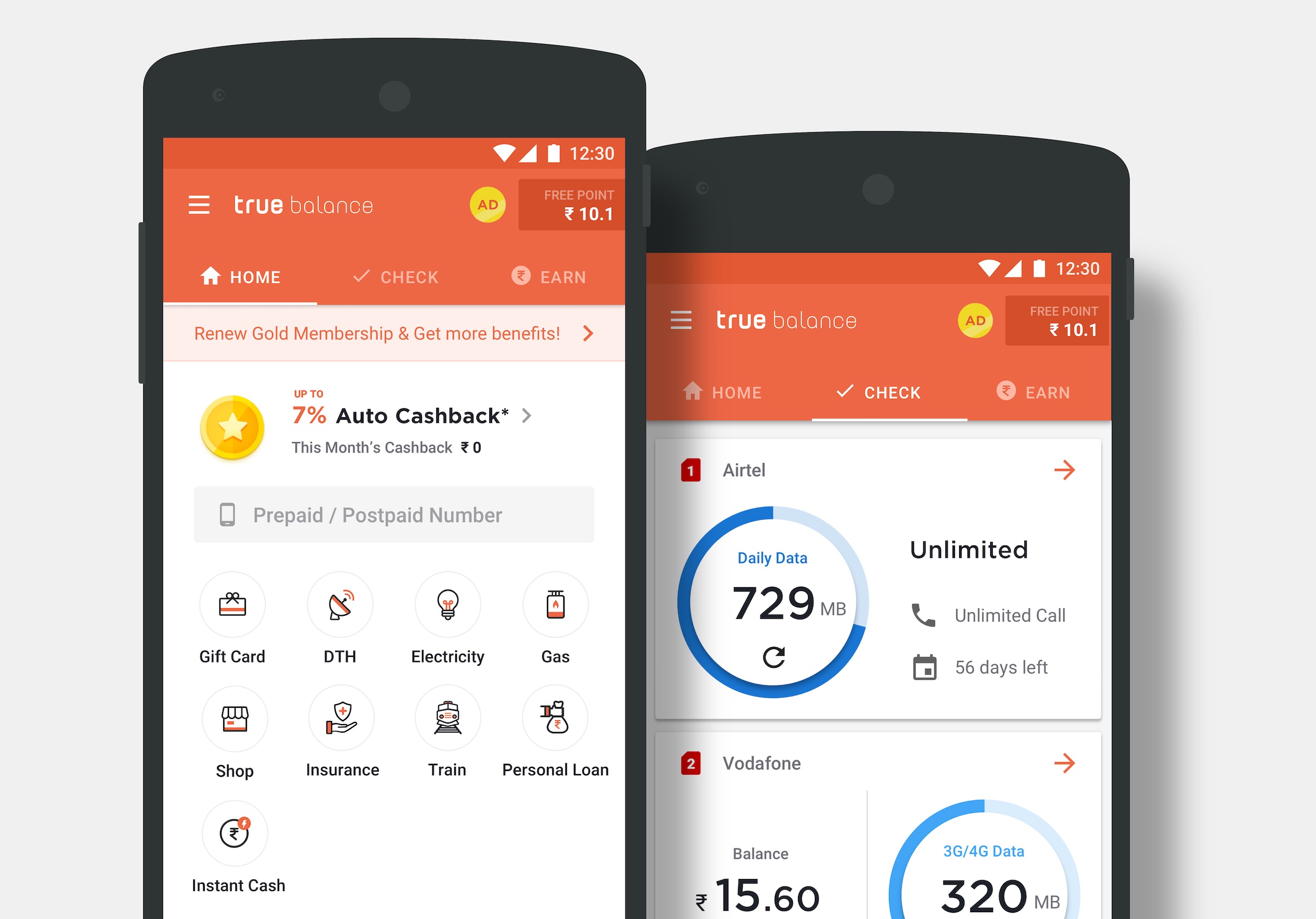
True Balance began its life as a tool to help users easily find their mobile balance, or top up pre-pay mobile credit. But in its four-year journey, its ambition has significantly grown beyond that. Today, it serves as a digital wallet app that helps users pay their mobile and electricity bills, and offer credit to customers so that they can pay later for their digital purchases.

true balance

The startup says it has amassed over 60 million registered users in India, most of whom live in small cities and towns — or dubbed India 2 and India 3. Most of these users are coming online for the first time and True Balance says it has an army of local agents — who get certain incentives — to help first time internet users understand the benefit of online transactions and start using the app.

True Balance says it clocks more than 300,000 digital transactions on its app each day. The startup, which recently introduced e-commerce shopping service on its app to sell products like smartphones, has clocked $100 million in GMV sales in the country to date.

Charlie Lee, founder of True Balance, said the startup will use the fresh capital to bulk up the offerings on the app. Some of the features that True Balance intends to add before the end of this fiscal year include the ability to purchase bus and train tickets, digital gold, and book cooking gas cylinders.

True Balance will also expand its lending and e-commerce services, Lee said. Its lending feature was used 1 million times in three months when it was introduced earlier this year. “We aim to strengthen our data and alternative credit scoring strategy to provide better financial services to our target — the next billion Indian users. Our goal is to reach 100 million digital touch points and become one of the top fin-tech companies in India by 2022,” he added in a statement.

Even as more than 600 million users in India are online today, just about as many remain offline. In recent years, many major companies in India have started to customize their services to appeal to users in India 2 and India 3 — who also have limited financial power.

15 Oct 2019

Watch Google unveil the Pixel 4 live right here

Google is about to unveil its new smartphone lineup, the Pixel 4 and Pixel 4 XL. And if you’re an Android fan, you know that the Pixel is one of the most interesting Android phones out there thanks to a bloatware-free operating system and some incredible cameras.

The conference starts at 10 AM Eastern Time (7 AM Pacific Time, 3 PM in London and 4 PM in Paris). You can watch it live right here.

Rumor has it that Google isn’t just going to announce some new phones. You can also expect some new products when it comes to the Pixelbook line, the Pixel Buds and its voice assistant devices.

The Google Home Mini has been quite successful. And the company is currently in the process of updating and rebranding its Google Home line to Google Nest devices.

We’ll have a team on the ground to report on the new devices and give you hands-on impressions.

15 Oct 2019

South Korea-based Mathpresso, developer of tutoring app Qanda, raises $14.5 million Series B

Seoul-based education technology startup Mathpresso announced today that it has raised $14.5 million in Series B funding. The company’s flagship app is Qanda, which provides students with math and science help and tutoring. Participants in the round include Legend Capital, InterVest, NP Investments and Mirae Asset Venture Investment.

This brings Mathpresso’s total funding so far to $21.2 million. Its previous round of funding was a $5.3 million Series A announced at the end of last year.

Mathpresso says Qanda (the name stands for “Q and A”) is currently used by a third of students in South Korea. The app launched in markets including Japan, Vietnam, Indonesia and Singapore last year and now has users in more than 50 countries. Qanda uses AI-based optical character recognition to scan math problems. Students take a photo of a problem and upload it to get instructions for how to solve it from the app or tutors.

In a statement, Legend Capital managing director Joon Sung Park said, “As an early investor of China’s leading mobile education companies such as Zuoyebang and Onion Math, Legend Capital has witnessed robust growth of China’s mobile education market. We strongly believe that Mathpresso has the technological and operation capabilities to expand overseas and grasp new opportunities emerging from the digitization of education, such as offering personalized learning for each student.”