Year: 2019

10 Oct 2019

Holoride makes its in-car VR available to the public for the first time

Audi spin-out Holoride is launching to the general public for the first time, though a collaboration with Ford and Universal Pictures . The young company is focused on a unique twist on virtual reality: In-car VR, to be experienced by a passenger while a vehicle is in motion.

VR in cars might sound like a bit of a conflicted or risky proposition, but it actually makes a lot of sense once you understand more about Holoride’s approach. TechCrunch took it for a spin at CES this year, and found that the technology’s ability to match a car’s movements to virtual immersive environment made for a surprisingly impressive experience.

The company has previously shown off underwater adventures, as well last a Marvel Avengers-themed story, but the one it’s launching for the public is a ‘Bride of Frankenstein’ ride which will be on offer for free between October 14 and November 9 at Universal CityWalk in Hollywood. Per the news release describing the adventure, there are virtual monsters and obstacles to overcome, and all of it is mapped to the ride you take inside a new 2020 model year Ford Explorer SUV.

HOLO0824

Entertainment technology startup, holoride teams up with Ford and Universal Pictures to create “Universal Monsters Presents Bride of Frankenstein holoride” – a highly immersive VR experience available complimentary to the public at Universal CityWalk Hollywood

The narrative is created by Universal Monsters, the sub-brand of Universal focused on its stable of cinematic ghouls, and Holoride takes in driving data, including speed of the vehicle and steering info to match the VR experience to the actual trip the rider is on.

The Ford partnership is one of the reasons Audi spun out this particularly venture, since it stated when it announced the move that it was hoping to get Holoride in the backseat of vehicles from all automakers.

This first public service offering should provide crucial insight for the Holoride team regarding its eventual commercialization and deployment plans for the technology. VR in cars still seems like a niche use case, but it’s possible it’s the niche that helps VR find some kind of footing among more general population users who aren’t likely to own their own headset at home.
10 Oct 2019

Cisco hit by an internal network outage

Not a great start to the day for Cisco employees, many of which are struggling in the face of an internal IT outage.

The technology and networking giant confirmed in a tweet it was “aware of some disruption” to its IT systems and is “working” on restoring the network.

Worse, the company’s corporate blog also went kaput. For a period, Cisco’s blog was displaying the default WordPress install page. But at the time of publication, the blog had been restored.

Some customers were unable to login through Cisco’s single sign-on. Others couldn’t access the company’s downloads page, nor could they access the company’s learning portal. And, some were unable to access its security advisories. But some of Cisco’s services, such as Webex, did not appear affected by the outage.

It’s not immediately clear exactly what caused the outage. Cisco spokespeople did not immediately respond to a request for comment.

10 Oct 2019

Tiger Global values people management tool Lattice at ~$200M

The secretive New York-based hedge fund Tiger Global Management has led a $25 million Series C investment in Lattice, an employee performance and engagement management tool, with participation from the startup’s existing investors.

The round, which values Lattice in the ballpark of $200 million, says co-founder and chief executive officer Jack Altman, comes just six months after the business closed a $15 million Series B led by Shasta Ventures. The HR tool, founded in 2015 by Altman and Eric Koslow, is also backed by Thrive Capital, the Slack Fund, Khosla Ventures and Y Combinator.

Lattice, like many startups closing venture capital deals today, was not actively fundraising when approached by John Curtius of Tiger Global, a firm that invested in the likes of Spotify, Glassdoor and Flipkart. Rather than reject the sizable capital infusion that, according to Altman, included favorable terms, Lattice closed the deal and plans to invest additional cash in its sales and marketing efforts, among other opportunities.

“Tiger was excited by the vision to keep [expanding] this platform — to extend to the rest of people management,” Altman tells TechCrunch.

Lattice, which has raised a total of $49.2 million in venture capital funding to date, doubled its headcount this year as well as its paying user count, which has swelled to 160,000. The SaaS business has developed performance management software that allows employees to reflect on their performance and receive feedback from managers and peers. The tool also empowers employees and their managers to structure agendas for one-on-one sessions, send praise to other employees and draft goals and OKRs.

“In order to compete for talent today, you do need to build the type of company where people want to work — it’s not just a money thing,” said Altman.

Last fall, the San Francisco-based startup introduced Lattice Engagement, giving human resources teams a better idea of employees’ level of connection to their company. Last month, the company launched Lattice Pulse, which, in combination with Lattice Engagement and Lattice Performance, delivers real-time insight into employees and company culture.

“You can get away with not doing these things, but it doesn’t optimize this critical thing, which is how your people are,” explains Altman. “If you don’t pay attention to how your people are performing or how they are feeling, it would be like not listening to your customers. Your employees are like your internal customers. If you don’t care how they’re doing or how they’re feeling, you’re leaving unbelievably important information on the table.”

Lattice operates a SaaS business model, charging roughly $100 per user per year. The company sells primarily to small and medium-sized businesses, including Glossier and Asana and some 1,400 others. This year, Lattice struck a deal with Slack, one of its largest customers yet. Over time, the company plans to sell to larger enterprises.

“My hope is we can just keep on adding products and functionality to what we offer,” Altman said. “We have so many more ideas than we have people to build them.”

10 Oct 2019

App revenue climbs 23% year-over-year to $21.9B in Q3

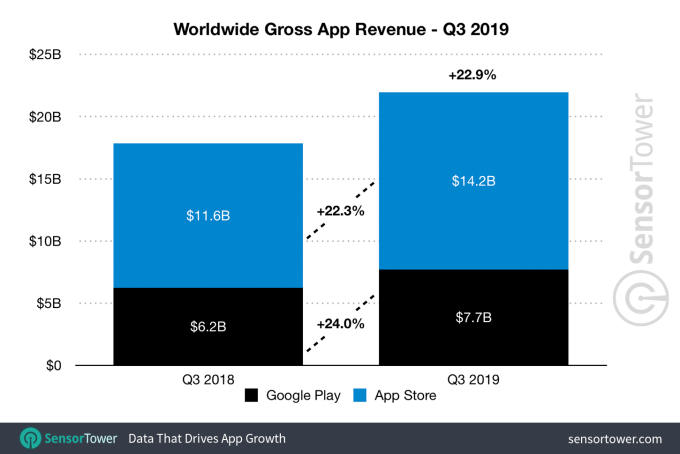
Global app revenue continues to climb, thanks to the growth in mobile gaming and the subscription economy. In the third quarter of 2019, consumer revenue grew 22.9% year-over-year from $17.9 billion to reach an estimated $21.9 billion across both the App Store and Google Play worldwide, according to new data from Sensor Tower.

Notably, the App Store continues to account for the large majority of this revenue, the report found, making up 65% of total spending compared with just 35% on Google Play.

App Store users spent $14.2 billion, up 22.3% from the $11.6 billion they spent in Q3 2018. Google Play generated $7.7 billion in revenue, up 24% from the $6.2 billion spent in the year-ago quarter.

q3 2019 app revenue worldwide

Sensor Tower’s revenue estimates are a bit lower than those provided by App Annie’s recent report, which said the quarter saw $23 billion in consumer spending, not ~$22 billion.

App Annie also estimated nearly 23 billion downloads in Q3, while Sensor Tower claimed 29.6 billion.

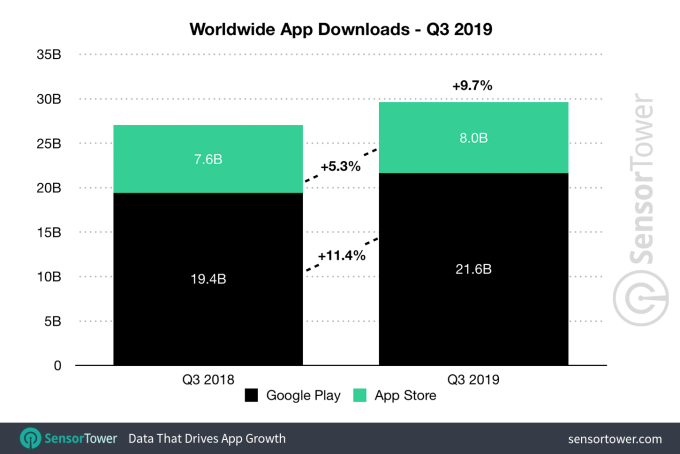
In both cases, Google Play is still said to be the main source for downloads, with nearly three times more first-time installs than the App Store. In Q3, the total number of downloads was up 9.7% year-over-year to 29.6 billion, said Sensor Tower, with Google Play accounting for 21.6 billion of those.

Despite the overall growth, one big app market — China — saw a slight decline, Sensor Tower found. Its installs dropped 6% year-over-year to 2.2 billion in the quarter. But its revenue grew by 26.9% to $4.1 billion, up from $3.2 billion the year prior. This could be attributed to the nine-month game license freeze in China which, though now lifted, had slowed momentum.

Sensor Tower’s charts don’t include third-party app stores, so it’s not a full picture of the Chinese app market, it’s worth noting.

q3 2019 top apps worldwide

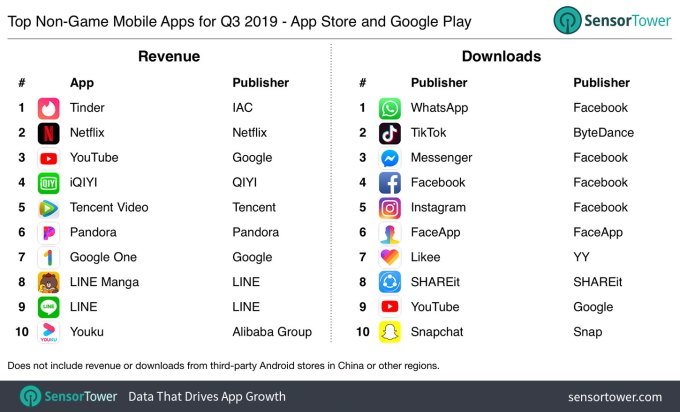
The top money-making (non-game) app in the quarter was again Tinder, which generated $233 million in consumer spending, up 7% over the prior quarter. Netflix was No. 2 and YouTube clocked in at No. 3, at $164 million in Q3.

App Annie has a slightly different ranking. It has Tinder and Netflix leading the top-grossing charts, but puts IQIYI ahead of YouTube. This could be because App Annie has a bigger window into the Chinese app market.

In terms of downloads, TikTok is continuing to disrupt Facebook-owned apps’ dominance over the top of the charts. In Sensor Tower’s rankings, WhatsApp was No. 1 and Messenger was No. 3, but Facebook and Instagram dropped to No. 4 and No. 5, respectively. And TikTok reached No. 2.

q3 2019 app downloads worldwide

This isn’t the first time TikTok has passed Facebook, Sensor Tower said — it did so back in Q4 2018 and in Q1 2019, before dropping to No. 4 again last quarter. But with 177 million downloads in Q3, it’s inching its way up to the top.

App Annie, on the other hand, sees TikTok having just a bit more of climb, sticking it at No. 3 in the quarter, behind Messenger and Facebook. It also called out some Q3 break-out hits, like the return of FaceApp’s popularity (No. 9 in downloads) and the growing subscription revenue of Google One (No. 7 in non-game revenue). Sensor Tower put FaceApp at No. 6 instead, but agreed on Google One.

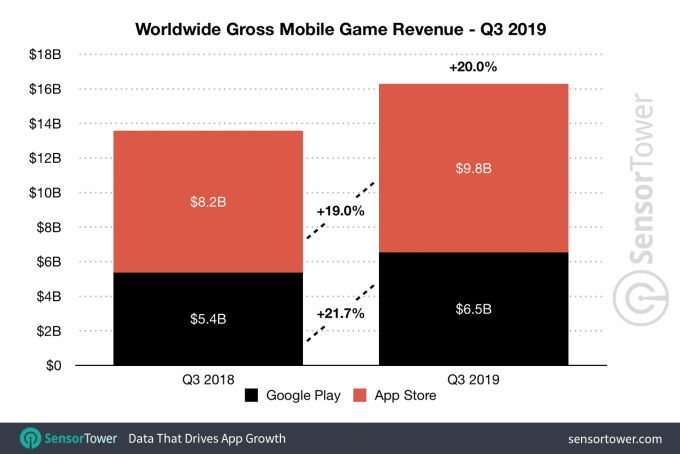
Mobile gaming continues to generate most of the cash, and did so again in Q3 with $16.3 billion in mobile game gross revenue — or 74% of the total in-app spending, the new report said. The App Store accounted for $9.8 billion of that figure, with Google Play users spending $6.5 billion.

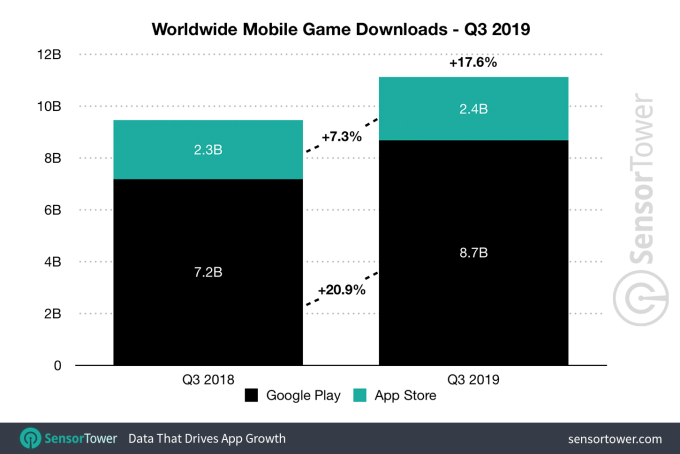
Game downloads across both Google Play and the App Store increased by 17.6% in Q3 from 9.5 billion last year to 11.1 billion.

q3 2019 game revenue worldwide

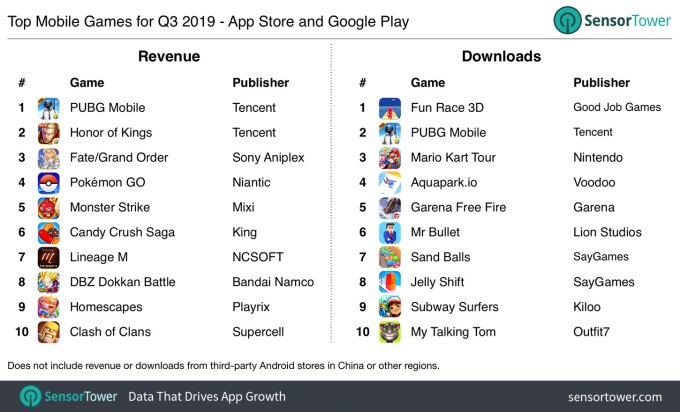
The top three games in the quarter by downloads were Fun Race 3D (123M downloads), PUBG Mobile (94M), and newcomer Mario Kart Tour, which hit 86 million downloads despite only launching in late September.

q3 2019 top games worldwide

PUBG Mobile was the top-grossing game with $496 million in revenue, up 652% over last year. The No. 2 title, Tencent’s Honor of Kings, and No. 3 Aniplex’s Fate/Grand Order generated $377 million and $354 million, respectively.

q3 2019 game downloads worldwide

Image credits: Sensor Tower

10 Oct 2019

Porsche and Boeing are partnering to develop “premium” electric flying cars

The electric vertical take-off and landing (eVTOL) industry is heating up, with a lot of companies finding dancing partners for what looks like it could be a boom industry – provided the significant technical and regulatory hurdles still standing in the way of viable commercial consumer air travel are overcome. Now, automaker Porsche is throwing its hat in the ring through a new partnership with Boeing, with the two singing a new memorandum of understanding to work together on developing a concept for a “premium” eVTOL.

This new partnership will explore what a “premium” offering might look like in the era of urban air mobility, including working together on the aircraft design (all the way up to developing and testing an actual prototype), as well as figuring out what the potential market for a premium air service would look like.

The irony is that likely for the foreseeable future, any air mobility service will be “premium” in terms of the cost of access and use. Already, Uber and others have launched short distance commuter helicopter service for routes connecting busy airport hubs, but the cost of these trips means they’re not alternatives to mass transit arteries connecting cities and airports, for instance.

Still, it sounds like this Porsche and Boeing tie-up anticipates a future where air mobility ranges in terms of price, level of service and access. The automaker cites a study by its own consulting group that found urban air transportation could increase significantly starting at around 2025, which is one reason it’s entering into this deal now.

10 Oct 2019

Parsley Health nabs $26 million Series B to launch telemedicine products

Parsley Health, the NY-based service that focuses on the source of a medical issue rather than the symptoms, has today announced the close of a $26 million Series B round of funding led by White Star Capital, with participation from FirstMark Capital, Amplo, Alpha Edison, Arkitekt Ventures and Galaxy Digital. Flatiron Health founder Nat Turner and One Medical founder Tom Lee also participated in the round.

Parsley was founded in 2016 by Dr. Robin Berzin, who saw that the average American spends around 19 minutes/year with a physician. These visits are usually focused on symptoms, and resolving them, rather than understanding the core reasons why someone is struggling. After all, the CDC says that 70% of diseases in our country are chronic and lifestyle-driven.

Parsley Health offers a membership service that allows users to work with doctors to find the root of their issues and create lifestyle changes to resolve them.

The sign-up process includes a long survey that helps capture all kinds of information about the patient, from family health history to past procedures and lifestyle. The patient then schedules their first visit with a physician, which is meant to last 75 minutes to get the full scope of that patient’s health.

From there, users can see into their medical data and doctor’s notes through a web portal. They’re also given a health plan, which includes nutritional advice and access to their own health coach, and may be referred to a specialist, if needed.

One year of membership includes five annual visits with doctors (approximately 4 hours of doctor-patient time), along with five sessions with their health coach, which help patients stay on their plan with advice on how to get more sleep, eat better, or get more physical exercise. 

On the heels of the new funding, Parsley Health is launching a new telemedicine product, which is meant to give people across the country the same access to Parsley’s service as those who visit their brick-and-mortar locations. This includes diagnostic testing, personalized medical care from doctors who practice functional medicine, health coaching, and 365-days-a-year access to their care team.

The first diagnostics product is called Comprehensive Hormone Care and is meant to help women dealing with PCOS, PMG, fatigue, weight gain, insomnia and anxiety to learn the root issue and create a care plan. This product will offer the option to get a one-time analysis with a health plan or to join as a full Parsley Health member and get coaching, re-testing and progress tracking.

To start, the telemedicine products will only be available in New York and California, but the company has plans to expand this product to all fifty states in the next six months.

10 Oct 2019

Xage now supports hierarchical blockchains for complex implementations

Xage is working with utilities, energy companies and manufacturers to secure their massive systems, and today it announced some significant updates to deal with the scale and complexity of these customers’ requirements including a new hierarchical blockchain.

Xage enables customers to set security policy, then enforce that policy on the blockchain. Company CEO Duncan Greatwood says as customers deploy his company’s solutions more widely, it has created a set of problems around scaling that they had to address inside the product including the use of blockchain.

As you have multiple sites involved in a system, there needed to be a way for these individual entities to operate whether they are connected to the main system or not. The answer was to provide each site with its own local blockchain, then have a global blockchain that acts as the ultimate enforcer of the rules once the systems reconnected.

“What we’ve done is by creating independent blockchains for each location, you can continue to write even if you are separated or the latency is too high for a global write. But when the reconnect happens with the global system, we replay the writes into the global blockchain,” Greatwood explained.

While classical blockchain doesn’t allow these kinds of separations, Xage felt it was necessary to deal with its particular kind of use case. When there is a separation a resynchronization happens where the global blockchain checks the local chains for any kinds of changes, and if they are not consistent with the global rules, it will overwrite those entries.

Greatwood says these changes can be malicious if someone managed to take over a node or they could be non-malicious such as a password change that wasn’t communicated to the global chain until it reconnected. Whatever the reason, the global blockchain has this power to fix the record when it’s required.

Another issue that has come up for Xage customers is the idea that majority rules on a blockchain, but that’s not always a good idea when you have multiple entities working together. As Greatwood explains, if one entity has 600 nodes and the other has 400, the larger entity can always enforce its rules on the smaller one. To fix that, they have created what they are calling a super majority.

“The supermajority allows us to impose impose rules such as, after you have the majority of 600 nodes, you also have to have the majority of the 400 nodes. Obviously, that will give you an overall majority. But the important point is that the company with 400 nodes is protected now because the write to the ledger account can’t happen unless a majority of the 400 node customer also agrees and participates in the write,” Greatwood explained.

Finally, the company also announced scaling improvements, which reduce computing requirements to run Xage by 10x, according to the company.

10 Oct 2019

India’s Vahdam Teas raises $11M to grow its tea-commerce business in the US and Europe

Vahdam Teas, an India-based e-commerce startup that sells fresh tea in international markets, has closed a new financing round as it looks to expand its presence in the U.S. and Europe.

The three-year old startup said it has raised $11 million in its Series C financing round. The round, which according to a person familiar with the matter valued the startup at about $40 million, was led by Sixth Sense Ventures. Existing investor Fireside Ventures, which has put money in a number of consumer-facing brands, also participated in the round.

Mankind Group Family office, Infosys co-founder Kris Gopalkrishnan, SAR Group Family office, Zomato co-founder Pankaj Chaddah, and Urmin Group family office also participated in the new financing round. The startup, headquartered in New Delhi and New York, has raised about $16 million to date.

The startup was founded by 28-year-old Bala Sarda, who comes from a tea industry family. Vahdam Teas operates an eponymous e-commerce platform and also works with giants such as Amazon, to sell tea directly to consumers in the U.S., Europe, and other international markets.

Vahdam Teas cuts the middlemen suppliers to reduce the time it takes to ship tea to consumers. “If you look at the supply chain for exporting from India, it’s completely broken. The goods go through distributors, then sold to exporters. Somewhere in the middle, brokers show up, too. Then an importer imports the tea. It all takes months to get a supply cycle to reach consumers. Unlike wine or whiskey, tea is best when it is fresh. Its ingredients lose flavor with time,” he explained.

To address this, Vahdam Teas has built a supply chain network to source tea directly from hundreds of gardens in India. It stores all the goods in its warehouses in New Delhi and then exports directly to its entities in different markets. The faster delivery of tea and better control of the supply chain is one of the key differentiating factors for Vahdam Teas.

Today about 99% of its sales comes from outside of India, said Sarda, who noted that with the new capital the startup would explore expanding its business in India, too.

But much of the fresh capital would be invested in bulking up its supply chain network and set up additional offices in the U.S. and Europe, he said in an interview with TechCrunch earlier this week. The startup also plans to launch new products and enter new markets in South Asia and UAE.

Vahdam Teas also wants to have presence in the offline (brick and mortar) market, and bring its tea to 500-700 stores in the U.S. in the coming months. “We have aspirations to become an omni-channel brand,” he said.

India controls about 25% of tea production worldwide. But Indian brands almost have a “negligible presence” on the world map, said Nikhil Vora, founder and chief executive of Sixth Sense Ventures. “Vahdam is an interesting example of how a traditional business like tea can get disrupted. We’re impressed with the way Bala has sought to target the global markets first and create a brand salience and market innovative ethnic Indian tea flavours,” he added.

Tea is one of the biggest industries for laborers in India. Sarda said the startup donates 1% of its revenue to help these workers educate their children.

10 Oct 2019

NASCAR could debut hybrids as early as 2022

NASCAR could introduce hybrid powered cars as early as 2022, NASCAR’s SVP for Racing Development John Probst told TechCrunch.

The auto-racing series — which is America’s most popular motorsport — opened up on the development of competition vehicles powered by gas and electricity.

“We travel the world visiting other sanctioning bodies and are not ignorant to the fact that the world’s going towards more hybrid technology,” Probst told TechCrunch during a track-side interview at Charlotte Motor Speedway.

“We’re pushing to go full electric. I don’t know where the balance nets out for us long-term, but some form of hybrid technology is certainly on our radar…after 2021,” he said.

A NASCAR rep speaking on background added further clarification saying, “Nothing is fully confirmed until it hits the race track. That said, hybrid tech could certainly be in our cars by 2022, if all plans stay on track.”

NASCAR will wait until after its Next-Gen gas race car  guidelines release in 2021. “Trying to do it all at once would be overwhelming,” Probst said.

As for application, NASCAR would likely debut hybrids for racing on shorter courses and those with more turns and braking. That could include technical tracks — such as Watkins Glen or Charlotte Motor Speedway’s Roval —  but would not be limited to that.

“We have to research all of this, but I think there are also some deployment options for intermediates and our speedways that can be explored,” Probst said, referring to courses of 1.5 miles or less in length.

NASCAR GIF PIT StopMany of NASCAR’s races — like the Daytona 500 — are endurance motorsport events (with multiple pit-stops) held on 1.5 to 2 mile oval tracks.

It could take more time to develop hybrid engine cars for these full-throttle formats, since EVs lose their regenerative braking qualities at steady rates of speed.

NASCAR is still sorting how a race hybrid would come together. “It will likely be some form of electrification parallel with our current internal combustion engine to add power,” Probst said.

Rather than use hybrid technology solely to extend range, NASCAR will look to harness it toward improved performance.

“Braking is typically used as a mechanism to get the power back into the batteries. As far as when you actually apply the power. I think that that’s what we need to study…and work through with our OEMs on how it’s deployed,” Probst said.

NASCAR TRACK CARSNASCAR could find ways to deploy hybrid technology for a supercharged or turbo effect on race cars.

“Is it deployed automatically in some pre-canned strategy? Is it deployed in the form of a button that the driver hits to get extra power to make a pass or complete a pass? Those are all areas that we have to look at,” Probst said.

“I think you could…use the engine to actually do the regen. So the driver gives up an amount of power, knowing that he’s recharging the battery to then strategically use the boost later on in the race.”

However NASCAR configures its hybrid setup, it could have application for EV tech on production cars sold by the race series’ manufacturing partners Ford, Chevy, and Toyota.

“As OEMs, NASCAR looking at a hybrid for the future is of interest to us,” said Pat DiMarco, Ford Performance’s NASCAR Manager.

While what currently runs on the race track is dissimilar to any production vehicle, there’s still a connection from NASCAR to the showroom floor, according to DiMarco.

“The days of old…when we built an engine to go racing and took the the parts off that to put directly into a production car, a lot of that isn’t there,” he said.

But DiMarco noted a number of things Ford teams use in NASCAR — such as systems to improve engine performance and aerodynamics — find their way to engineering teams in Michigan.

“We’ll use the tools here, develop them better in racing, make them more accurate, and everything automatically transfers to production,” he said.

NASCAR champion and current driver Brad Keselowski is long on hybrids in the sport. “I’m a big fan of the technology,” he told TechCrunch between races at Charlotte Motor Speedway.

“One, it gives the sport greater performance potential out of the cars and, two, it gives NASCAR relevance to the marketplace — because nobody will develop this technology harder or faster in motorsports than we will,” Keselowski said.


10 Oct 2019

Grammarly raises $90M at over $1B+ valuation for its AI-based grammar and writing tools

While attention continues to be focused on the rise and growing sophistication of voice-based interfaces, a startup that is using artificial intelligence to improve how we communicate through the written word has raised a round of funding to capitalise on its already-profitable growth. Grammarly — which provides a toolkit used today by 20 million people to correct their written grammar, suggest better ways to write things, and moderate the tone of what they are saying depending on who will be doing the reading — has closed a $90 million round of funding.

Brad Hoover, the company’s CEO, confirmed to TechCrunch that the funding catapults the company’s valuation to over $1 billion, as it gears up to grow to more users by expanding Grammarly’s tools and bringing them to more platforms. Today, Grammarly can be used across a number of browsers via browser extensions, as a web app, through mobile and on desktop apps, and through specific apps such as Microsoft Office. But the area where we communicate via the written word is expanding all the time — consider, for example, how much we use chat and texting apps for leisure and for work — so expect that list to continue growing.

[gallery ids="1894990,1894991"]

“The mountain of digital communication is increasing, and in the workplace we have more distributed teams,” he said, “pointing to the importance of people presenting themselves in consistent and compelling ways.”

This latest round is being led by General Catalyst, which had also helped lead its previous and only other round, for $110 million in 2017, with participation also from previous investor IVP and other, unnamed backers. It brings the total raised by the startup to $200 million.

Grammarly today operates on a freemium model, where paid tiers give users more tools beyond grammar checks and conciseness to include things “readability” detection, alternative vocabulary and tone suggestions and plagiarism checks, in tiers that are priced at $11.66, $19.98 and $29.95 per month. Hoover would not say how many of its users are taking paid tiers or how much the company makes from that, but he did confirm that, like others offering freemium, the majority of users are free ones.

Nevertheless, it’s very notable that the company has been profitable almost from the start, when it was founded as a bootstrapped outfit in 2009 by Alex Shevchenko and Max Lytvyn, who continue to respectively work on product and revenue at the company (Hoover is the startup’s longtime CEO, having joined back in 2011).

Its singularity of focus and simple message — it’s only available in English and only for written communications, with no plans to expand currently into other languages or other mediums like audio — has partly been the reason why Grammarly has found interesting traction in the market, but it’s also a consequence of the endeavor itself. The company brings together not just a vast trove of data about proper grammar, but using AI techniques around machine learning and natural language processing it is constantly synthesizing new words and phrases and styles to improve the help that it provides to users, to solve what is essentially an everyday problem for many people: writing well.

“Grammarly is solving real challenges that people face every time they pick up a device to answer a text, answer a work email or cold email a potential client,” said Hemant Taneja, who led the investment for General Catalyst, in an interview. “While there are large companies attempting to innovate in this space, creating intuitive AI that complements our natural communication abilities isn’t their primary focus. It’s not even their third, fourth or 20th focus. For Grammarly, helping people communicate more effectively is their sole goal. And that’s why, despite any competition, they’ve got more than 20 million daily active users.” That 20 million figure is more than three times the number of users Grammarly had in 2017.

Nevertheless, a number of would-be competitors have emerged to provide similar tools or those that directly compete with slightly different propositions. Google, for example, today gives you prompts of what to say when responding to an email, in the form of stock sentences or cues while you are writing. Hoover says these are less of a worry to Grammarly for a couple of reasons. The first is its approach to be available around whatever you might be writing, and the second is it’s platform-agnostic state, which means it’s potentially wherever you are writing, too.