Year: 2019

04 Oct 2019

Startups ‘are staying private way too long’ says Salesforce founder Marc Benioff

“What public markets do is indeed the great reckoning. But it cleanses [a] company of all of the bad stuff that they have.”

That’s Salesforce founder and chief executive officer Marc Benioff talking about the benefits of public markets.

It’s something that private companies seem to be ignoring in the go-go days of the current venture capital boom cycle and something that’s led to a lot of the erosion in investor value, says Benioff.

“I think in a lot of private companies these days, we’re seeing governance issues all over the place,” says Benioff.

The multi-billionaire founder of one of the most successful enterprise software companies of the past 20 years pointed to both WeWork and Uber as companies that could have benefitted from the oversight that public investors provide sooner in their lifecycle.

“I can’t believe this is the way they were running internally in all of these cases,” says Benioff. “They are staying private way too long.”

Benioff pointed to Salesforce as an example. “We went public, were $100 million in revenue [and] that was about the right time. We were small enough that we could make those changes and adjustments,” Benioff said. “And there’s a lot of those that have to continually happen, and that includes the people on your team… who are really keeping you on the straight and narrow.”

Benioff’s advocacy for public markets was just one facet of a wide-ranging interview onstage at our Disrupt SF event.

In addition to his old refrain that “Facebook should be regulated like cigarettes,” Benioff called for the creation of a national privacy policy to ensure that companies and consumers can be on the same page.

“We need a  national privacy law,” he said. “Otherwise you’re going to get a patchwork of privacy laws. We have to get our privacy and data locked down so we know where we’re  going. [Regulators] need to be stepping in now and they should be working hard to make those changes.”

Benioff also pointed to the need for a reinvention of modern capitalism and a rethinking of how executives build their startups if they want to be successful in the new business landscape of the early 21st century.

“I really strongly believe that capitalism as we know it is dead… that we’re going to see a new kind of capitalism and that new kind of capitalism that’s going to emerge is not the Milton Friedman capitalism that’s just about making money,” said Benioff. “And if your orientation is just about making money, I don’t think you’re going to hang out very long as a CEO or a founder of a company.”

04 Oct 2019

LifeCouple wants to improve your romantic relationship

Good relationships require ongoing commitment and work. LifeCouple, launching today in public beta at TechCrunch Disrupt SF Startup Battlefield, wants to help make that work a bit easier for you and your partner.

Through its app, LifeCouple enables couples to address and monitor any challenges in their relationship. The startup does this by serving up content designed to encourage people to look more closely at their relationship across four key areas: trust, communication, conflict and intimacy. The content includes daily relationship challenges, ice breakers to help approach tricky conversations, digital gifts and more.

LifeCouple is designed to supplement couples therapy, its founder Sean Rones told TechCrunch.

“It’s not a replacement to therapy but it’s a complement to it,” he said. “I don’t think this can 100% solve your problem but it can give you the tools to solve your problems.”

Additionally, Rones envisions couples therapists using this tool to further assist their clients.

Just how startups use technology to track fitness and health, LifeCouple aims to help people create relationship goals, address those goals and track them over time. The ideal is for people to spend about 15 minutes per day to get the most out of it, Rones said.

[gallery ids="1888063,1888064,1888059,1888060,1888061,1888062"]


“What motivated me is after many different startups, I’ve learned that in order to be somewhat successful, you have to be tackling a really big problem,” he said.

LifeCouple is currently free, but is working to determine the cost moving forward. In the first two months of its soft launch, LifeCouple amassed 2,500 users in the U.S.

“What we’re trying to do is create something that can help — even if it’s just 10 couples that stay together,” Rones said.

This year, LifeCouple raised a $575,000 seed round. The plan is to do a full launch in January.

03 Oct 2019

CEO David Krane suggests GV could sell the rest of its Uber stake at the end of its lockup period next month

Today at TC’s Disrupt show in San Francisco, we took the stage with David Krane, a longtime veteran of Google who took the reins as the CEO of its venture arm, GV,  three years ago but hasn’t spoken publicly since. We asked him why he’s been in hiding before diving into some questions about Uber — whose $250 million Series C round in 2013 was somewhat famously funded entirely by GV — and trying to understand better how GV is organized under his leadership.

Krane, who earlier in his career was Google’s global head of PR, is accustomed to deflecting reporters’ questions and he was circumspect about some things, but he did let drop some interesting information. For example, he told us that GV has plugged a whopping $5 billion into startups since it was formed 10 years ago. Krane also joked that Alphabet’s famous founders don’t steer entirely clear of the organization. And he suggested that GV — which sold a meaningful part of its Uber stake to SoftBank last year — might sell the rest of its Uber stake when the ride-share company’s lock-up period expires in November. (His team has a “decision to make” he said.)

Following is some of our chat, edited lightly for length and clarity:

TC: It’s been three years since you took the role of CEO. Why has it taken you so long to come out of hiding?

DK: Well, I haven’t been in hiding, I’ll tell you that we’ve been really busy. When you have a second act at Google, which is remarkably different from your first act, you actually kind of have to stay focused on that. So we’ve been busy building an extremely large scale venture firm, which this year is celebrating our 10th birthday. And I’ve been doing that [from its outset].

TC: There’s a lot to chat about. Let’s talk quickly about one of your highest-profile deals, which was investing in Uber. I’ve long heard that you are the one who was agitating to lead this $250 million dollar Series C round, which, at the time, was a very big deal. It was also a brilliant investment. Do you think Uber is also a good investment now for public shareholders?

DK: This is a special company. This company has an unmistakable brand. It operates in countries around the world. It has scaled, it ha a moat around it, it’s touched by almost no one in the category. So honestly, we’re long term. We’re bullish on this. And I think it is an interesting investment opportunity. And it happens to be on sale today.

TC: It’s obviously getting into new business lines, which is interesting. But you’d also told me that GV had sold part at stake to SoftBank last year, when the the conglomerate came in and wanted to buy up a substantial percentage of the company. Can you say how much of your stake you sold?

DK: It’s probably best not to, but I’d say it was a great transaction. Working with SoftBank was quite pleasant. And I think there were a number of shareholders that did [the same].

TC: Uber’s lockup period is coming up quickly. Will you sell the rest of your stake? 

DK:  I think it’s not clear yet, to be hones with you. We’re paying attention to the market, which is a bit unstable, to say the least. But yeah, in about a month, we’re going to have a decision to make.

48838201321 4dc8c46891 k

SAN FRANCISCO, CALIFORNIA – OCTOBER 03: (L-R) GV CEO & Managing Partner David Krane speak and TechCrunch Silicon Valley Editor Connie Loizos onstage during TechCrunch Disrupt San Francisco 2019 at Moscone Convention Center on October 03, 2019 in San Francisco, California. (Photo by Steve Jennings/Getty Images for TechCrunch)

TC: When you invested in Uber in 2013, you were investing in a different founder: Travis Kalanick, who was pressured to resign in 2017. It’s a little bit reminiscent of what happened with Adam Neumann of WeWork, who had grown the company over the last nine years and was last week pressured to resign.

Are we in agreement that maybe the investors could have done something sooner? These are two founders whose management styles were very well-known.Why suddenly, was it problematic? And why didn’t someone do something sooner?

DK Well, probably the best advice that I could offer there is it would have been prudent to curb some of Adam’s creativity little bit sooner. . . . But there’s very little similarity between Travis and Adam. Travis is a founder that in his peak at Uber was incredibly enviable, and someone that we chased very aggressively to try and be involved with.

TC: Let’s talk about GV. I think we all want to know more about GV under David Krane. One thing that I noticed is that in the firm’s early days, it would about these discrete pools of capital it was investing. One year, it was ‘We’ve raised $300 million.’ The next it was ‘We’ve been allocated $500 million.’ Is is still the case that you’re getting these yearly allocations? And if so, what are you investing right now?

DK: When we started GV, we had the opportunity to look at several decades of venture capital experience and pick some of the greatest attributes and to do our best to steer away from some things that weren’t optimized. So one of the things that we set up structurally was that yes, we would engage with our single [investor], Alphabet, and figure out what’s a reasonable pool of capital that our team could deploy each year. When we started 10 years ago, we started with literally a $50 million fund. Now 10 years later, we’re investing many hundreds of millions per year.

TC: How much has been allocated [to startups] altogether to this point?

DK: Total? We’re looking after nearly $5 billion.

TC: That’s astonishing. It’s not like Alphabet needs the money, but you did in invest in Uber — good for you. You invested in Nest Labs, which Google bought for $3.2 billion a few years ago. Can you talk about your returns? What percentage of that money has come back to Alphabet?

David Krane GVDSC02847

David Krane, CEO & managing partner of GV, at TechCrunch Disrupt SF 2019 on October 3, 2019

DK: As you know, this is a business often measured in decades. We’re 10 years old this year. And I’ll tell you, kind of directionally, that we’re incredibly happy with the financial performance of the fund. I will say, we’re backed by an investor that has a lot of bravery that puts its shoulder into risk and often tells us, ‘Do  something more complex’ ‘Do something more crazy next time.’ I mean, it wouldn’t be unimaginable that [cofounder] Sergey ]Brin] would walk in and say, ‘Why don’t you do the space elevator next time?’ So sometimes those sorts of businesses may take a lot longer to return. But all in all, we’re incredibly happy with what we’ve returned so far.

TC: When I interviewed your predecessor, Bill Maris, a few years ago, he told me that every decision felt to him and him alone, following what were wide-ranging discussions with the staff whose opinions factored in heavily. But he said, that ultimately, GV is “not like a democracy in any way.”  Are you the ultimate arbiter of what gets funded now at GV?

DK: I would say, technically speaking, we don’t run remarkably differently. That said, our success, and really, the excitement that we bring every day, is really playing a meaningful ‘meta’ team ball. So the experience for the entrepreneur is not so unusual [than] going to any other Sand Hill pitch room, where the entrepreneur would come in and spend an hour or two with us, we would have a dialogue afterwards, we would take some data, we would consult some data, and a discussion with sort of ensue.

Technically, yeah, I can come in and have a little bit of influence on what’s happening. But because we’re scaling what we’re doing,  my objective as often as I can is to green-light as many investments as make sense.

TC: How many investments are you green-lighting here?

DK: I think this year we’ll do 100 deals, in total, in 10 years, we have an active portfolio of more than 300 companies. And I think if memory serves me correctly, we’ve done over 600 deals in 10 years.

TC: How many people are in staff at this point?

DK: Ninety people full time.

TC: It seems like there’s been more focus on elevating women through the ranks.

DK: Absolutely, it’s a big focus for us. We usea page out of the Google playbook that has served the company incredibly well for goal setting and product and engineering called OKRs, for objectives and key results. And we learned that OKRs are actually extensible to diversity and inclusion. So we set some goals a couple of years ago to, most importantly, go out to the market with more focus and do our best to fund a meaningful number of new and underrepresented founders. And I’d say in the last 18 months, we’ve deployed about $200 billion into underrepresented founders.

And conversely, we’ve used that same framework to improve the diversity of our team as well. And I think we’ve made some great progress there.

TC: Is the sort of compensation structure within GV the same as with traditional venture funds with management fees and Kara carry involved? 

DK: We have a single LP, that’s probably one of the most distinctive attributes. But we’re set up mostly like Sand Hill firms, so we have access to all kinds of opportunities to run the business, with carry on our outcomes, [so] all interests are aligned. So it’s a really attractive place to be able to do venture.

TC: When Google formed this unit, 10 years ago, there was also a lot of talk about the data driven nature of investing that you would do. So can you tell me a little bit about the algorithms that you’re relying on and how they help you identify promising companies?

DK: I don’t think it would be Google Ventures without putting some emphasis on the Google part of that name. So using data machine learning has been something that’s very common in our practice for many years. We’ve got a team of something on the order of a dozen [to] focus on technology and how technology can frankly make humans smarter — and we don’t think it’s an either or, we think it’s an and. So we look at technology as an opportunity to analyze deals, discover new opportunities, but really, most importantly, to look at the portfolio at large and ensure that we’ve got the right exposure, we’ve got the right balance, to do our best to capture industry leading returns.

TC: Have you ever gone rogue and defied the data?

DK: We go rogue all the time, Data is there to help us It’s there to make us smarter. But it doesn’t singularly dictate what we do in terms of investment decisions.

TC: What are some of examples of [deals you’ve led that contradicted] the data?

DK: So An example would be a follow-on investment in a company. There may be some some tension between how the data signal will present its view, how other attributes may be more important. And it’s important for us to continue to show support to an entrepreneur, which we try to do as often as we can.
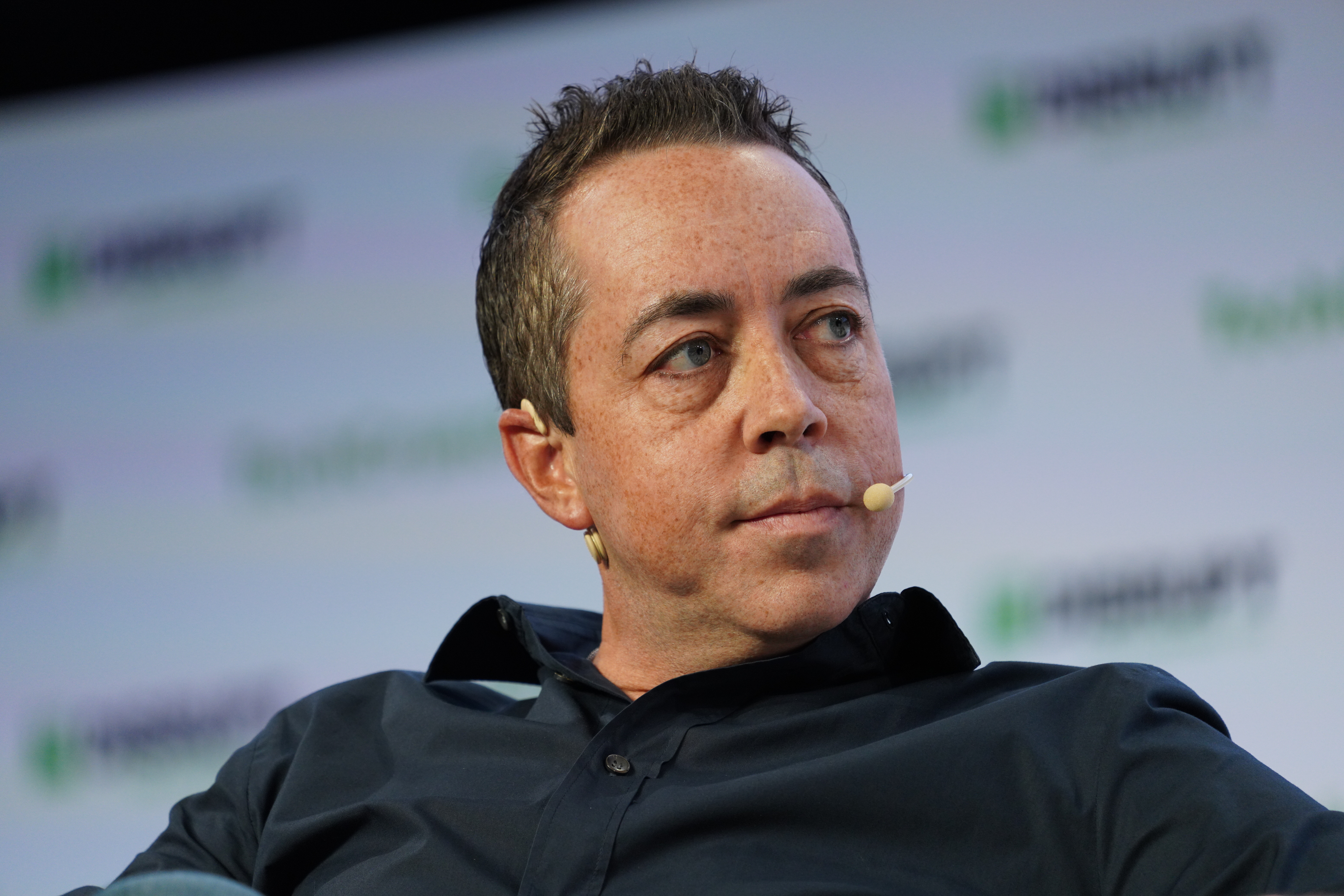
David Krane GVDSC02840

David Krane, CEO & managing partner of GV, at TechCrunch Disrupt SF 2019 on October 3, 2019

TC: You also have a big team here. You also have a team in Europe, but it seems like you’re predominantly still doing venture in the U.S.. Is that accurate?

DK: That’s correct. Yeah, most of our team is situated in a set of offices across the U.S. We’ve got a small team in London, Most of the dollars we invest go into U.S.-based companies and a wide variety of sectors. We do some investing in Europe. We don’t invest in Asia. We don’t invest in Latin America.

TC: Which is so interesting, especially Asia, given there’s so much going on there. In fact, you had told me that you’d invested in a company as a called FreshToHome that’s trying to tackle the fragmented perishable goods market in India.

How much personal investing do you do outside of GV and also, if that company takes off, is there a risk that Larry or Sergey would say, ‘Hey, David, why aren’t we in that deal?’

DK: Well, there’s certainly a chance if that company breaks out and we choose to expand our scope to investing in India that GV could look at it, no question about it. Today, we don’t have plans to invest there. So in markets where GV isn’t investing, we’re happy to support our partners’ personal interests,

I do a little bit of personal investing in categories that honestly have nothing to do with the main line of GV. I invested in a men’s outdoor professional lacrosse League, for example, called PLL, that’s probably not something that GV would do but it’s an area of passion for me; my children play lacrosse.

TC: Why not Asia, though?

DK: I think it’s inevitable that over time as we evolve, will consider taking on a new geography, but focus again, is a feature for our business, too. And I think we have a lot more opportunity to continue to further establish ourselves here.

TC: Shifting gears, let’s talk about bigger-picture stuff. We talked a little bit about Uber. You think Uber is still on sale and an attractive investment; obviously, some people disagree, we’ll see what happens with that company. But more broadly, are companies staying private too long?

DK: No. It’s interesting. There is so much capital in the market right now that there isn’t the burden to put oneself in a position that’s remarkably different from the control, the privacy, that one has is private. So it’s very company specific, your question, but I’d say in general, the market has changed so meaningfully in the last two years that there isn’t that pressure to seek capital in the public markets. You have many, many options to stay private. And for lots of companies, that’s a good thing.

TC: But is it good for Americans? So much wealth has been created before these companies go out, as with Uber, that once they go public, there’s not huge upside [for public market investors]. Taking yourself out of GV, does this [point] resonate at all?

DK: It resonates to some degree. Entrepreneurship is certainly one of the growth factors in this economy. And so we want to see it thrive. We want to see people in the public markets have an opportunity to experience growth and ride the evolution of these companies. But again, I think it’s really a very company specific question.

TC: What about direct listings, which seem to be top of mind, thanks to a confab organized earlier this week by VCs Bill Gurley and Mike Moritz. Since these aren’t fundraising events for companies, it’s hard for me to see these being widely adopted but what do you think?

DK: I think we heard on the stage yesterday from the founder of Slack that direct listings are not quite as clear as some of the benefits have been presented. As you noted, the company doesn’t always get capital. But I think there’s a lot of thinking right now about how to do a direct listing [to] ensure that employees and shareholders on the cap table can get some liquidity, but the company can also seek financing as well.

We were very fortunate to be part of Slack’s direct listing [and] had a great outcome with that. And as an investor, it’s great not to have a lock-up one day one.

TC: But do you think they’ll they’ll pick up momentum or will these be relegated to very special companies?

DK: I think directionally, there’s a huge opportunity to continue to innovate and enhance on on many aspects of how companies [obtain] liquidity. I think they’re promising but we need [more] examples of them. I think it’s a little bit early to tell.

TC: Before you go, there’s a lot of talk about regulating your parent company. Should it be broken up?

DK:  I’ve read the same fear and and focused news articles that you have about this topic. I would say honestly, I’ve been a Google 20 years, It lives inside my veins. I’m very proud of what the company has built. I’m proud to have played a part of that. But I’d say for the last 10 years, having focused on venture capital, I’m really not the most authoritative expert in how Google should think about those sorts of issues. So I’m actually going to take a pass on that one, because we’re focused on something totally different.

TC: Okay. Do you think Facebook should be regulated?

DK: [Laughs.] We can if you like. You know, these are companies that do have a lot of power, they do have a lot of control. But also, the sum of those pieces can be very valuable for consumers and for partners as well. So again, these are these are big, complicated questions. I think these companies will have a lot of questions to answer in the coming months, and we’ll see what happens.


03 Oct 2019

NASA’s first all-electric experimental X-plane is ready for testing

NASA will fly a crewed X-plane, one of the experimental aircraft it creates to test various technologies, for the first time in two decades in the near future. This X-plane, the X-57 Maxwell to be exact, is significant for another reason, too: It’s the first fully electric experimental plane that NASA will fly.

The delivery of the X-57 Maxwell to NASA’s Armstrong Flight Research Center in California means that they can begin ground testing, which will then be followed by flight testing once they confirm through the ground testing phase that it’s flight-ready. This all-electric X-57 is just one of a number of modified vehicles that will not only help NASA researchers test electric propulsion systems for aircraft, but will also help them set up standards, design practices and certification plans alongside industry for forthcoming electric aerial transportation options, including the growing industry springing up around electric vertical take-off and landing aircraft for short-distance transportation.

NASA plans to share the results of its testing and flights of the all-electric X-57, as well as its other modified versions, with industry and other agencies and regulatory bodies. The X-plane project also provides another way for NASA to work towards a number of technical challenges that will have big benefits in terms of everyday commercial aerial transportation, like boosting vehicle efficiency and lowering noise to develop planes that are far less disturbing to people on the ground.

03 Oct 2019

Avalow wants to be your gardening coach

What’s the opposite of a green thumb?

Whatever it is, I have that. My house and yard are full of succulents not because they’re trendy, but because anything else I try to plant dies within a month. When I turn to Google to figure out why my zucchini plant randomly turned white and fell over (did I over water it? Under water it? Plant it on the wrong side of my house? Look at it the wrong way too many times?), I fall into a rabbit hole of forum posts with a million different answers, get overwhelmed, and go back to buying my zucchini from the store like a chump.

Avalow, a company presenting in the TechCrunch Disrupt SF Startup Battlefield today, wants to help would-be gardeners like myself with a solution that’s 50% hardware and 50% online coaching.

Unlike most of the hardware that hits the stage at Disrupt, you don’t plug Avalon’s hardware into anything. There’s no Bluetooth, WiFi, batteries, or robotic arms involved.

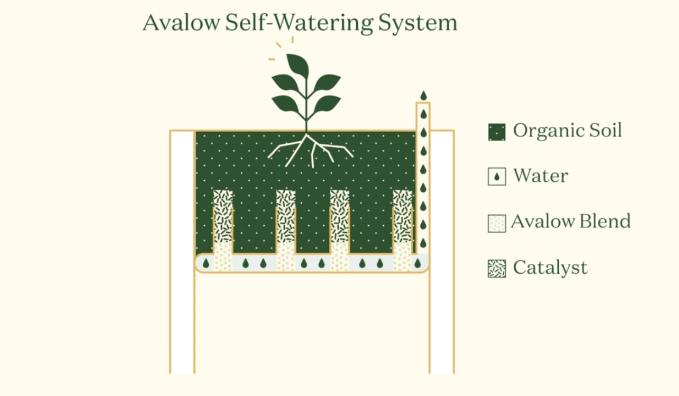
Instead, they’ve built a self-watering, sub-irrigation-based, raised planter bed. You fill a water reservoir about once a week, and your plants pull up water through the soil by way of capillary action. By letting the plants pull up just the water they need, the company says their planter requires about 30x less water than top-down gardening might.

Their planter costs $400, which might seem a bit wild to anyone who’s used to growing things at the cost of digging a hole in the ground. For comparison, a basic, all-wood raised planter box of similar dimensions (without the self-watering reservoir) would cost you $50-$150 from a big box store. Avalow’s bed is built to last — the company says it should hold up for at least 25 years, though some parts like the self-watering system’s wicks should be replaced every 5 years or so. It’s also insulated to keep your plant’s roots safe through weather hot and cold.

The company’s founders tell me they’ve shipped about 400 units so far during its pre-launch pilot program.

avalow diagram

But there’s a bit more to Avalow than a fancy planter. That feeling of disappointment that comes when you go out to check your plants and find that, after 5 weeks of careful watering and care, your little plant friend has suddenly dropped dead? They want to help you avoid it — and if something does go wrong, help you figure out exactly what happened.

To do this, Avalow is also selling a gardening coaching service. At around $120 per season (or roughly $33 per month if bought annually), their experts will help you figure out what you should grow (based on where you are, the local climates, and your personal goals), when to harvest, etc. When your plant does something funky — be it mystery spots on the leaves, sudden plant death, or anything in between — you can chat with your gardening coach for advice, sending them pictures that might help them figure out what’s going on. They’ll send you the soil and seedlings to get started, plus whatever soil amendments they recommend to make things grow best from season to season. It’s like having a really, really smart gardener friend on speed dial, except they don’t get annoyed when you call them about your zucchini for the seventh time.

Avalow partners with expert gardeners and hires them as coaches. Their coaching team currently includes plant biologists from UC Berkeley, orchard managers, and master certified gardeners. With decades of experience, they’re able to adapt their advice across regions and climates.

As someone who finds himself thinking “I should totally grow some vegetables!” once a year only to end up disappointed and hungry… I totally get this. Having your plant die randomly six weeks into the process sucks and is super demotivating. Having someone who can say “Oh! That’s not your fault, you just need more [whatever] in the soil!” would be real nice. I don’t know that I’d sign up for it season after season, but I can definitely see myself using it to get things going (/growing.)

03 Oct 2019

Zuckerberg says Facebook will sue to stop EU’s global content takedowns

Facebook plans to challenge Europe’s top court, which today ruled that EU countries can order Facebook to globally remove content that violates local laws. Facebook currently complies with proper legal requests to remove content that breaks a nation’s laws, but can leave it up for global viewers if the post doesn’t violate its Community Standards.

But today during a livestreamed Q&A with Facebook employees, CEO Mark Zuckerberg said that “This is something I expect us and other companies will be litigating.”

Zuckerberg explained that Facebook had “successfully fought” overly broad takedown requests in the past. He also noted that “a lot fo the details about exactly how [the ruling gets] implemented will depend on national courts across Europe.”

Live from our weekly internal Q&A

Live from our weekly internal Q&A

Posted by Mark Zuckerberg on Thursday, October 3, 2019

Facebook told the New York Times in a statement today that the European Court Of Justice ruling “undermines the longstanding principle that one country does not have the right to impose its laws on speech on another country”, noting the judgement surfaces concerns about “the role that internet companies should play in monitoring, interpreting and removing speech that might be illegal in any particular country.”

During pre-question remarks, Zuckerberg also discussed the US Attorney General Bill Bar’s open letter from the US, UK, and Australia demanding that Facebook halt the expansion of encryption across all its messaging apps. “We get that there are real concerns with doing that ” Zuckerberg said. “There are these different equities we try to balance”, specifically safety needs like catching child abusers and terrorists versus privacy and protecting political dissidents as well as normal citizens.

The CEO argued Facebook could still police encrypted apps, noting the “There’s a lot we can do with detecting patterns” including linking accounts together so it can shut down the WhatsApp accounts of bad actors on Facebook, and that Facebook can “find it upstream” by analyzing suspicious activity outside of the messages threads themselves.

Zuckerberg hadn’t done a livestreamed Q&A recently, but holds them weekly inside Facebook. Yet after The Verge’s Casey Newton published two-hours of leaked audio from Facebook internal all-hands meetings, Zuckerberg is trying to show he has nothing to hide. He joked at the beginning of the Q&A that he’s making this one publicly available because “I do such a bad job in interviews that it’s like, what do we have to lose?”

03 Oct 2019

The lack of cybersecurity talent is “a national security threat,” says DHS official

One of the most senior officials tasked with protecting U.S. critical infrastructure says that the lack of security professionals in the U.S. is one of the leading threats to national cyber security.

Speaking at TechCrunch Disrupt SF, Jeannette Manfra, the assistant director for cybersecurity for the Homeland Security’s Cybersecurity and Infrastructure Security Agency (CISA), said that the agency was making training for new cybersecurity professionals a priority.

“It’s a national security risk that we don’t have the talent regardless of whether it’s in the government or the private sector,” said Manfra. “We have a massive shortage that is expected that will grow larger.”

Homeland Security is already responding, working on developing curriculum for potential developers as soon as they hit the school system. “We spend a lot of time invested in K-12 curriculum,” she said.

The agency is also looking to take a page from the the tech industry’s playbook and developing a new workforce training program that’s modeled after how recruit and retain individuals.

For Manfra, it’s important that the tech community and the government agencies tasked with protecting the nation’s critical assets work more closely together and the best way to do that is to encourage a revolving door between cybersecurity agencies and technology companies. That may raise the hackles of privacy experts and private companies given the friction between what private companies wish to protect and what governments wish were exposed — through things like backdoors — but Manfra says close collaboration is critical.

Manfra envisions that government will pay for scholarships for cybersecurity professionals who will spend three to five years in government before moving into the private sector. “It builds a community of people with shared experience [and] in security we’re all trying to do the same things,” she said.

Priorities for Homeland Security are driving down the cost of technologies so that the most vulnerable institutions like states, municipalities and townships or the private companies who are tasked with maintaining public infrastructure — who don’t have the same money to spend as the federal government — can protect themselves.

“When you think about a lot of these institutions that are the targets of nation sates… a lot of them have resources at their disposal and many of them do not,” said Manfra. “[So] how do we work with the market to build more secure solutions — particularly with industrial control systems.”

The public also has a role to play, she said. Because it’s not just the actual technological infrastructure that enemies of the U.S. are trying to target, but the overall faith in American institutions — as the Russian attempt to meddle in the 2016 election revealed.

“It’s also about building a more resilient and aware public,” said Manfra. “And adversaries have learned how they can manipulate the trust in these institutions.”

03 Oct 2019

Naspers CEO Bob van Dijk on SoftBank comparisons: ‘They’re broad, we’re focused; we invest in what we know’

Naspers, a South African internet company that has become a major investor in a wide range of digital commerce companies, has in recent years drawn comparisons to the Japanese conglomerate SoftBank. For one thing, Naspers, like SoftBank, is very global in nature, with investments in more than 90 countries. Naspers, like SoftBank, doesn’t shy from writing big checks, as happened a few years ago when it plugged $100 million into LetGo, a New York-based company whose app aims to make it as easy to sell something as it is to throw it away.

Naspers also goes after startups at a variety of stages with the promise that it can help them expand around the world. LetGo, for example, is now available to users in more than 35 countries.

Yet most meaningfully,  both are largely associated with early and exceedingly lucrative investments in Chinese companies. In SoftBank’s case, it made an early bet on the Chinese giant Alibaba, and even while it has pared its stake slightly, that holding is valued at more than $100 billion. Similarly, Naspers made an early bet on the Chinese giant Tencent, and it retains a 31% percent stake in the business that its CEO, Bob van Dijk, said today on stage at Disrupt that it has no intention of selling any time soon. That stake is also valued at more than $100 billion.

Still, van Dijk made clear that the comparisons should stop there during the sit-down. Asked how Naspers differentiates itself from SoftBank and whether it would ever form a Vision Fund-esque vehicle to invest money even more aggressively into startups, the answers were that a.) the two are very different and b.) no.

Said van Dijk, “I’ve met [CEO] Masa [Son] and many of his team over the years and they’re an impressive bunch of people. I think what they’ve done is unprecedented and had a big impact on the industry.” Still, Naspers is “not a fund,” he noted; It’s a holding company, and, as such, it can invest for 20 years if it needs. And “that helps, he said. “It allows you to think [about investments] over a long amount of time.” He said this was particularly important around food delivery, into which Naspers has plugged $5 billion in recent years and van Dijk feels strongly has vast potential, even while he acknowledged that for the foreseeable future, the industry is likely to remain to hugely unprofitable.

As for SoftBank, he continued, “They are great investors.” But they are also “broad in their approach,” whereas Naspers is “more focused. We invest in what we really know. What has served us well is to build up expertise, then go bigger. But we couldn’t deploy $100 billion in things that I understand.”

As for how he would judge the performance of SoftBank’s strategy, van Dijk was unsurprisingly democratic. “We co-invested in Flipkart, and we had the same vision of an attractive India market with great growth and great founders.”

Added van Dijk, “They’ve taken a bigger volume approach, and I hope it works out.”

You can catch the entire conversation — in which van Dijk also noted Naspers’s growing interest in U.S. startups, and shared some insights into a new holding company that Naspers recently took public in Europe — below.

03 Oct 2019

Zola, the $650M wedding portal, taps the travel market with an expansion into honeymoons

The wedding industry is estimated to be worth some $100 billion in the U.S. alone, and now one of the fastest-growing companies in that space — the wedding planning site Zola — is making a move to augment its position with a sidestep into travel. Today at Disrupt (our conference in San Francisco), the company is announcing Honeymoons, which will let couples plan, book and raise money for their post-nuptial travels at the same time that they plan the main event.

The beta invite is open for those interested from today. To start off, couples will be able to plan itineraries and book accommodations, with flights getting added in after the launch as part of a bigger effort to own the end-to-end marriage experience.

“Over time, we want to book all your travel needs, both before and after the wedding,” said Shan-Lyn Ma, the company’s CEO and founder.

Zola’s business today is based around pre-wedding organization: users can set up free websites, design and print (paid) wedding invitations, and create Zola-based gift registries for family and friends to buy goods for the couple through the site — a business that has been successful enough to net the company more than $140 million in funding and a $650 million valuation.

But the average time spent planning weddings is 13-18 months, and so Honeymoons will be one way for Zola to extend that relationship not just in terms of money spent — honeymoons is estimated to be a $12 billion industry in the US — but time spent using Zola, which in turn can help build a tighter relationship for whatever moves the company might make in the future. (One very obvious next step: parenting-related content and products.)

The Honeymoons feature also brings something else to Zola: a little breathing space. The online market for wedding planning is old and massive — it’s one of the first kinds of e-commerce sites that emerged with the rise of the world wide web itself, and as such there are a lot of large and incumbent competitors. However, “honeymoons” has been generally a more fragmented space, where people plan their own trips themselves via sites that cater to other kinds of travel like vacations, making “online honeymoon planning” far less of an industry per se, and making Zola’s move into the area relatively less pressured.

Ma said that the decision to launch the business came from couples requesting the feature, and it’s taking the rollout relatively slowly. The service will start with a limited number of markets that Zola chose based on them already being popular honeymoon destinations. The plan will be to expand the list to many more locations over time.

“We know where all the key destinations are based on demand from couples,” she added.

Within that list, Zola has negotiated special packages for accommodation and flights. It will also come with a personalized twist: couples input their preferences and are offered honeymoon packages designed to fit their tastes.

Shan-Lyn Ma said thousands have already signed up for the waitlist for the product, which will officially launch next month.

The company already has a strong connection to a wider marketplace that taps into how millennials and younger consumers, in general, like to shop today, offering a Houzz-style approach of letting users create “look books” for their aesthetics, and giving them flexibility to either register for specific items, or to cash out in gift cards that can be used on other goods and services.

The Honeymoons move will give the company an opening to working with other companies much more closely, specifically those in the travel industry, to create cohesive experiences. Given how many weddings today are focused around “destinations”, this also opens the door to planning events for more than just the couples involved.

03 Oct 2019

Facebook is being leant on by US, UK, Australia to ditch its end-to-end encryption expansion plan

Here we go again. Western governments are once again dialling up their attack on end-to-end encryption — calling for either no e2e encryption or backdoored e2e encryption so platforms can be commanded to serve state agents with messaging data in “a readable and usable format”.

US attorney general William Barr, acting US homeland security secretary Kevin McAleenan, UK home secretary Priti Patel and Australia’s minister for home affairs, Peter Dutton, have co-signed an open letter to Facebook calling on the company to halt its plan to roll out e2e encryption across its suite of messaging products. Unless the company can ensure what they describe as “no reduction to user safety and without including a means for lawful access to the content of communications to protect our citizens”, per a draft of the letter obtained by BuzzFeed ahead of publication later today.

If platforms have e2e encryption a “means for lawful access” to the content of communications sums to a backdoor in the crypto.

Presumably along the lines of the ‘ghost protocol’ that UK spooks have been pushing for the past year. Aka an “exceptional access mechanism” that would require platforms CC’ing a state/law enforcement agent as a silent listener to eavesdrop on a conversation on warranted request.

Facebook -owned WhatsApp was one of a number of tech giants joining an international coalition of civic society organizations, security and policy experts condemning the proposal as utter folly earlier this year.

The group warned that demanding a special security hole in encryption for law enforcement risks everyone’s security by creating a vulnerability which could be exploited by hackers. Or indeed service providers themselves. But the age-old ‘there’s no such thing as a backdoor just for you’ warning appears to have fallen on deaf ears.

In their open letter to Facebook, the officials write: “Companies should not deliberately design their systems to preclude any form of access to content, even for preventing or investigating the most serious crimes. This puts our citizens and societies at risk by severely eroding a company’s ability to detect and respond to illegal content and activity, such as child sexual exploitation and abuse, terrorism, and foreign adversaries’ attempts to undermine democratic values and institutions, preventing the prosecution of offenders and safeguarding of victims. It also impedes law enforcement’s ability to investigate these and other serious crimes.”

Of course Facebook is not the only messaging company using e2e encryption but it’s in the governments’ crosshairs now on account of a plan to expand its use of e2e crypto — announced earlier this year, as part of a claimed ‘pivot to privacy’. And, well, on account of it having two billion+ users.

The officials claim in the letter that “much” of the investigative activity which is critical to protecting child safety and fighting terrorism “will no longer be possible if Facebook implements its proposals as planned”.

“Risks to public safety from Facebook’s proposals are exacerbated in the context of a single platform that would combine inaccessible messaging services with open profiles, providing unique routes for prospective offenders to identify and groom our children,” they warn, noting that the Facebook founder expressed his own concerns about finding “the right ways to protect both privacy and safety”.

In March Mark Zuckerberg also talked about building “the appropriate safety systems that stop bad actors as much as we possibly can within the limits of an encrypted service”.

Which could, if you’re cynically inclined, be read as Facebook dangling a carrot to governments — along the lines of: ‘We might be able to scratch your security itch, if your regulators don’t break up our business.’

Ironically enough the high profile intervention by officials risks derailing Facebook’s plan to unify the backends of its platforms — widely interpreted as a play to make it harder for regulators to act on competition concerns and break up Facebook’s business empire along messaging product lines: Facebook, WhatsApp, Instagram.

Or, well — alternative scenario — Facebook could choose to strip e2e crypto from WhatsApp. Which is currently the odd one out in its messaging suite on account of having proper crypto. Governments would sure be happy if it did that. But it’s the opposite of what Zuckerberg has said he’s planning.

Curiously the draft letter makes no mention of platform metadata. Which is not shielded by even WhatsApp’s e2e encryption. And thus can be extracted — via a warrant — in a readable format for legit investigative purposes. And let’s not forget US spooks are more than happy to kill people based on metadata.

Instead the officials write: “We must find a way to balance the need to secure data with public safety and the need for law enforcement to access the information they need to safeguard the public, investigate crimes, and prevent future criminal activity. Not doing so hinders our law enforcement agencies’ ability to stop criminals and abusers in their tracks.”

The debate is being framed by spooks and security ministers as all about content.

Yet a scrambled single Facebook backend would undoubtedly yield vastly more metadata, and higher resolution metadata, on account of triangulation across the services. So it really is a curious omission.

We’ve reached out to Facebook for its reaction to the letter. BuzzFeed reports that it sent a statement in which it strongly opposes government attempts to build backdoors. So if Facebook holds firm to that stance it looks like another big crypto fight could well be brewing. A la Apple vs the FBI.

Bilateral Data Access Agreement

In another announcement being made today, the UK and the US have signed a “world first” Bilateral Data Access Agreement that’s intended to greatly speed up electronic data access requests by their respective law enforcement agencies.

The agreement is intended to replace the current process which sees requests for communications data from law enforcement agencies submitted and approved by central governments via a process called Mutual Legal Assistance — which can take months or even years.

Once up and running, the claim is the new arrangement will see the process reduced to a matter of weeks or even days.

The agreement will work reciprocally with the UK getting data from US tech firms, and the US getting access from UK communication service providers (via a US court order).

Any request for data must be made under an authorisation in accordance with the legislation of the country making the request and will be subject to independent oversight or review by a court, judge, magistrate or other independent authority, per the announcement.

The UK also says specifically that it has obtained “assurances” which are in line with the government’s continued opposition to the death penalty in all circumstances. Which is only mildly reassuring given the home secretary’s previous views on the topic.

The announcement also makes a point of noting the data access agreement does not change anything about how companies can use encryption — nor prevent them from encrypting data.

For interfering with proper encryption the plan among this trio of signals intelligence allies is, seemingly, to reach for the old PR lever and apply public pressure. So, yeah, here we go again.