Year: 2019

01 Oct 2019

Cybersecurity giant Comodo can’t even keep its own website secure

Comodo, which bills itself as a “global leader in cybersecurity solutions,” said its forum was hacked.

The admission came in no less than a forum post, which confirmed a hacker exploited a recently disclosed vulnerability in vBulletin, a popular forum software and used by Comodo. The flaw, which requires little skill to exploit, allows an attacker to remotely run malicious code on a vulnerable forum. In this case, the exploit was used to dump the entire user database.

Exploit code was released on September 23. Two days later, vBulletin released patches for the software.

But despite claiming in it disclosure that it takes “security very seriously” and is its “highest priority,” the company didn’t immediately patch its forum software. Four days after the patches were released, its forum was hacked.

According to the disclosure, Comodo said the hackers stole usernames, names and email addresses, and the user’s last IP address used to access the forum. Some social media handles were also stolen in the breach.

Comodo said it has about 245,000 registered forum users.

It’s not the most damaging breach on record but it’s a bruising security lapse for a company that claims to be half-decent at this stuff.

This is Comodo’s second security snafu this year following another breach involving an exposed password, which allowed a security researcher access to the company’s intranet — and access to internal files and documents.

01 Oct 2019

Tesla acquires computer vision startup DeepScale in push towards robotaxis

Tesla has acquired DeepScale, a Silicon Valley startup that uses low-wattage processors to power more accurate computer vision, in a bid to improve its Autopilot driver assistance system and deliver on CEO Elon Musk’s vision to turn its electric vehicles into robotaxis.

CNBC was the first to report the acquisition. TechCrunch independently confirmed the deal with two unnamed sources, although neither one would provide more information on the financial terms of the deal. 

Tesla vehicles are not considered fully autonomous, or Level 4, a designation by SAE that means the car can handle all aspects of driving in certain conditions without human intervention.

Instead, Tesla vehicles are “Level 2,” and its Autopilot feature is a more advanced driver assistance system than most other vehicles on the road today. Musk has promised that the advanced driver assistance capabilities on Tesla vehicles will continue to improve until eventually reaching that full automation high-water mark.

Earlier this year, Musk said Tesla would launch an autonomous ride-sharing network by 2020. DeepScale, a four-year-old startup based in Mountain View, Calif., appears to be part of that plan. The acquisition also brings much needed talent to Tesla’s Autopilot team, which has suffered from a number of departures in the past year, The Information reported in July.

DeepScale has developed a way to use efficient deep neural networks on small, low-cost, automotive-grade sensors and processors to improve the accuracy of perception systems. These perception systems, which use sensors, mapping, planning and control systems to interpret and classify data in real time, are essential to the operation of autonomous vehicles. In short, these system allow vehicles to understand the world around them.

The company argued that its method of using low-wattage and low cost sensors and processors allowed it to deliver driver assistance and autonomous driving to vehicles at all price points.

The company had raised more than $18 million — in $3 million seed and $156 million Series A rounds — from investors that included Autotech VC, Bessemer, Greylock and Trucks VC.

On Monday, DeepScale’s co-founder Forrest Iandola posted an announcement on Twitter and updated his LinkedIn account. The Twitter message read “I joined the @Tesla #Autopilot team this week. I am looking forward to working with some of the brightest minds in #deeplearning and #autonomousdriving.”

In Tesla’s push towards “full self-driving,” it developed a new custom chip designed to those capabilities. This chip is now in all new Model 3, X and S vehicles. Musk has said that Tesla vehicles being produced now have the hardware necessary — computer and otherwise — for full self-driving. “All you need to do is improve the software,” Musk said in April at the company’s Autonomy Day.

Others in the industry have balked at those claims. Tesla and Musk have maintained the “improve software” line, and have continued to rollout improvements to the capability of Autopilot. Earlier this month, Tesla released a software update that adds new features to its cars. The update included “Smart Summon, an autonomous parking feature that allows owners to use their app to summon their vehicles from a parking space.

01 Oct 2019

Cloosiv raises $1M to bring mobile ordering to every coffee shop


A few months back we took a look at Cloosiv, a company aiming to provide smaller coffee shops a mobile ordering solution that can compete with those of the mega coffee chains.

Today the Cloosiv team is announcing that they’ve raised a $1M seed round.

Most coffee shops want to be able to offer mobile ordering — but apps are tough to build and maintain, and users don’t want to install an app for a coffee shop they might only visit once or twice.

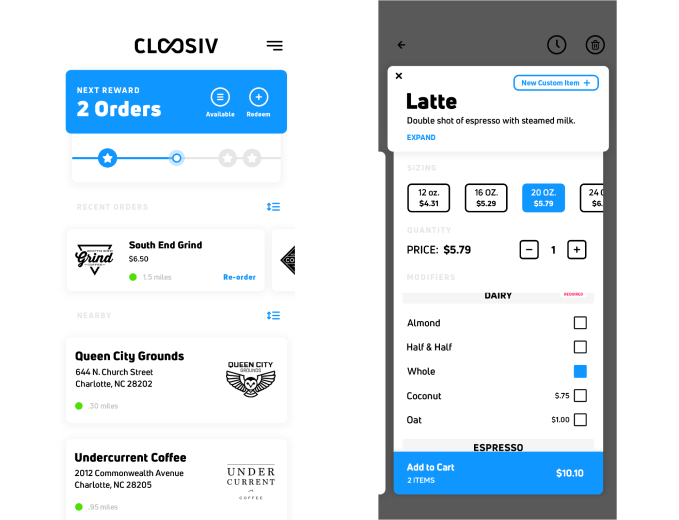
Instead, Cloosiv’s approach is to build one big network of coffee shops all under the same app roof. Open up Cloosiv, and up pops a list of nearby, Cloosiv-enabled shops. Tap into any of the shops, and you’ll get a mobile ordering experience not unlike what you’ll find at the huge name competitors — with things like order history, item customization, and tipping all incorporated. Cloosiv charges merchants a percentage off each order, with the percentage decreasing as order volume goes up.

cloosiv ordering

Cloosiv founder Tim Griffin tells me that investors in the round include Y Combinator co-founder Paul Graham, Roger Dickey (Founder and former CEO of Gigster), Avichal Garg (former Facebook Director of Product Management), Ken Deeter, Brad Powers (CTO of Passport), and John Kim (co-founder of the chat API company SendBird).

Cloosiv currently has around 315 locations using the platform, and they’re expecting to pass 500 by the end of this year.

With mobile ordering making up at least 13% of Starbucks’ transactions in the US last year, this space is heating up. A competing platform out of Seattle, Joe Coffee, announced just a few months back that it had raised $750k with plans to expand its network to other major cities.

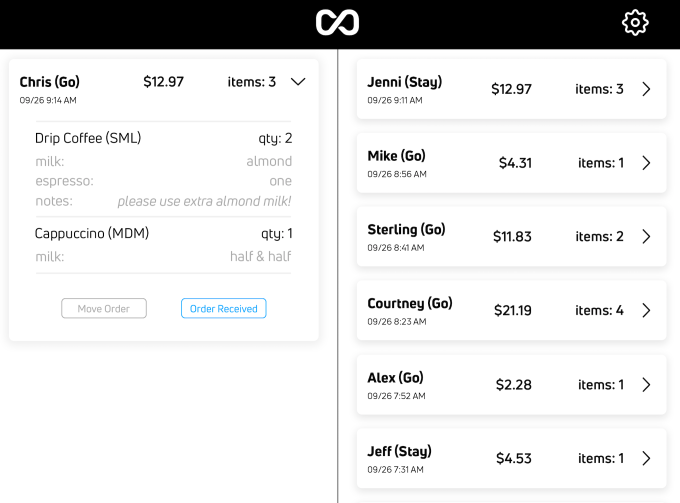
While Cloosiv merchants currently receive orders through the standalone Cloosiv app, the next step for the company is integrating orders into the point-of-sales apps many merchants are already using — like Clover, Micros, and Square. Griffin tells me a partnership with Square is already in the works, with integration into the Square point-of-sales app “close.”

cloosiv merchant

01 Oct 2019

Court says FCC’s ‘unhinged’ net neutrality repeal can’t stop state laws

The FCC’s repeal of net neutrality rules has been significantly weakened by a federal appeals court, which ruled that the Commission could not preempt state laws like those pending in California. And although the repeal largely survived otherwise, one judge called the logic on which it is based “unhinged from the realities of modern broadband service.”

The outcome of this case is not final, as the issue may rise as far as the Supreme Court, whose past decisions lower courts are bound to follow, yet are increasingly shown to be out of step with the way technology and markets work today. (You can read the full 186-page court opinion here.)

But the threat of preempting state net neutrality rules with a weaker federal rule was a very serious one that promised a proliferation of legal battles when the inevitable state-federal conflicts arose. Fortunately for the states, the court completely shut down the FCC’s arguments that it had the authority to overrule states, completely declawing the Commission’s rules.

Mozilla and several partners filed the lawsuit against the FCC last year, challenging Chairman Ajit Pai’s “Restoring Internet Freedom” rulemaking on a variety of fronts. Few of these were availing, as the court showed a marked predisposition towards taking the agency at its word on matters of, say, economic effects of previous rules, the competitive landscape of broadband providers, and suggested alternatives for consumer protection.

The biggest miss was the challenge to broadband being reclassified as an information service from a telecommunications service — the distinction at the heart of this decades-long conflict.

The court found that the FCC’s explanation that DNS and caching services mean that broadband providers do more than simply move bits from place to place. This is a hugely disingenuous argument, as I have discussed in detail before (involving Brett Kavanaugh, now on the Supreme Court), but the court determined that it was bound by precedent to defer to the agency.

FCC wrong on public safety, Lifeline, and state laws

The court did agree with Mozilla et al. on a few fronts.

First there are the potential threats to public safety of potential blocking and throttling by broadband providers. The case last year of firefighters in California having their Verizon devices throttled in the middle of wildfire control operations showed that there are times when these threats may be matters of life and death. Because the FCC only barely touches on this matter, the court ordered them to revisit the order and do so.

The Commission’s disregard of its duty to analyze the impact of the 2018 Order on public safety renders its decision arbitrary and capricious in that part and warrants a remand with direction to address the issues raised.

Second there is the Lifeline program, which uses federal funds to subsidize mobile and broadband access for people in underserved areas, tribal lands, and so on. The law defining Lifeline terms these things telecommunications services, but the FCC just reclassified broadband as an information service — which basically removes the authority to run the Lifeline program at all. The lawsuit points this out, and the court agrees that it’s a huge oversight for the FCC not to address it.

The Commission brushed off their concern. That was straightforward legal error which requires remand.

Lastly and most importantly is the question of preemption. As I and others have noted before, the FCC in its repeal of 2015’s net neutrality rules abdicated its only real authority for interfering with state rules. The Title II powers that govern telecommunications services would allow the FCC to regulate interstate common carriers, but it gave up those powers when it gave up Title II.

Yet it still claimed to be able to stop states from doing their own thing, which the court rightly deemed an attempt to “create preemption authority out of thin air.”

The Commission ignored binding precedent by failing to ground its sweeping Preemption Directive—which goes far beyond conflict preemption—in a lawful source of statutory authority. That failure is fatal.

By reclassifying broadband as an information service, the Commission placed broadband outside of its Title II jurisdiction.

As a matter of both basic agency law and federalism, the power to preempt the States’ laws must be conferred by Congress. It cannot be a mere byproduct of self-made agency policy.

Not only is the Commission lacking in its own statutory authority to preempt, but its effort to kick the States out of intrastate broadband regulation also overlooks the Communications Act’s vision of dual federal-state authority and cooperation in this area specifically.

The entire preemption section of the rulemaking is therefore vacated, the court decided.

That is huge news. If the federal rules, whatever they are, do not have precedence over state rules, then states are free to enact their own and expect companies to abide by them. We’ve seen how this works in some cases like Illinois, where biometric measures like facial recognition are strictly regulated. This necessitated, for instance, Facebook making changes to its photo tagging systems that also affect users outside Illinois.

In a similar vein, state rules focused on net neutrality and user privacy, like California’s, could force companies to adjust policies at a global level. It would make little sense and no little trouble for Comcast to have a special “California edition” of its services.

This effectively makes the FCC’s national rules more of a lowest possible baseline than the law of the land. Having such inadequate and poorly justified rules in that role isn’t quite as scary.

Mozilla was optimistic despite much of its complaint being thrown out. “We are encouraged to see the Court free states to enact net neutrality rules that protect consumers,” said the company’s chief legal officer, Amy Keating. “We are considering our next steps in the litigation around the FCC’s 2018 Order, and are grateful to be a part of a broad community pressing for net neutrality protections in courts, states and in Congress.”

Denouncing the FCC’s “technological anachronism”

The court repeatedly deferred to previous Supreme Court rulings and to the FCC’s freedom as an expert agency to provide “reasonable” interpretation of the law to justify its policies, even if those interpretation is not necessarily the “best.”

But the FCC is testing the utmost limits of the court’s favor in this, warned circuit judge Patricia Millett. She referred specifically to using the existence of DNS and caching as justification for claiming broadband services are more than just telecommunications.

This explanation has been set forth before by no less than Justice Brett Kavanaugh, who subsequently received a sound intellectual pummeling by his colleague, circuit judge Srinivasan.

Although the court was bound to allow it, Judge Millett in an extended concurring opinion that she was “deeply concerned that the result is unhinged from the realities of modern broadband service”:

Brand X [the relevant Supreme Court decision] was decided almost fifteen years ago, during the bygone era of iPods, AOL, and Razr flip phones. The market for broadband access has changed dramatically in the interim.

In 2005, the Commission’s classification decision was “just barely” permissible. Almost fifteen years later, hanging the legal status of Internet broadband services on DNS and caching blinks technological reality.

The question is whether the combination of transmission with DNS and caching alone can justify the information service classification. If we were writing on a clean slate, that question would seem to have only one answer given the current state of technology: No.

By putting singular and dispositive regulatory weight on broadband’s incidental offering of DNS and caching, the Commission misses the technological forest for a twig.

(Emphasis mine.) She laments that as a lower court they had no power to consider this, but that the Supreme Court can — and should. Or if it won’t, Congress can act and intervene to expose the FCC’s threadbare logic for the sham it is. “Either intervention would avoid trapping Internet regulation in technological anachronism,” she concludes.

In other words, the FCC’s entire argument rests on an increasingly flimsy legal technicality that only a higher court or Congress can address.

Until that happens the current FCC rules, much weaker than the 2015 ones, will remain in effect — but as noted earlier, states are free to enact better ones and the Commission can’t do a thing about it. That’s an enormous victory for net neutrality advocates.

“When the FCC rolled back net neutrality it was on the wrong side of the American people and the wrong side of history. Today’s court decision shows that the agency also got it wrong on the law,” said FCC Commissioner Jessica Rosenworcel, who has consistently opposed the new rule, in a statement. “As the FCC revisits its policies in light of the court’s directives, I hope it has the courage to run an open and fair process.”


01 Oct 2019

NASA awards $43.2M to Blue Origin, SpaceX and others for tech to take us to the Moon and Mars

NASA has announced the total funding it will distribute to the 14 companies it’s chosen to work with on developing key, innovative technologies that will be instrumental in helping get the agency to the Moon through the Artemis program, and potential to Mars and beyond later on.

The U.S. space agency is awarding $43.2 million to the companies, in varying amounts ranging from $1.3 million to as much as $10 million (going to Blue Origin) for the most lucrative contract.

NASA announced a similar series of partnerships selected to further its Moon shot program back in July, which also included SpaceX and Blue Origin. This new “Tipping Point” partnership program round includes Blue Origin, as mentioned, as well as SpaceX, OxEon Energy, Skyre, SpaceX, Infinity Fuel Cell and Hydrogen, Paragon Space, TallannQuest, Accion Systems, CU Aerospace, ExoTerra, Blue Canyon Technologies, Astrobotic Technology, Intuitive Machines and Luna Innovations.

It includes projects that range from developing autonomous navigation for satellites, better propulsion systems, rover tech, advanced spacecraft avionics, cryogenic propellant and more.

Blue Origin will be using its $10 million to develop a ground-based demonstration of liquefying hydrogen and oxygen, and storing the resulting liquid. This will demonstrate the viability of producing and storing liquid rocket propellant on the Moon, and will be a key stepping down towards the development of a Moon-based propellant production plant.

Meanwhile, SpaceX will be working with NASA Marshall in Huntsville, Alabama to build nozzles that will be used in spacecraft refuelling operations. This tech will be crucial to SpaceX’s Starship, which Elon Musk said on Saturday will need to refuel ship-to-space tanker in orbit in order to load in enough propellant post Earth-based launch to make the rest of the trip to the Moon and Mars. NASA awarded SpaceX $3 million to support this project.

Astrobotic is working with Carnegie Mellon University with a $2 million investment from NASA in order to develop and build small rovers that can carry light payloads and work in tandem with large landers. These would act like advance scouts to work on researching and readying landing and base sites on the Moon. The concept illustration above depicts one of these proposed rover designs.

For the full list of projects, and the amount award to each, check out the official NASA announcement of the ‘Tipping Point’ partnerships.

01 Oct 2019

Where top VCs are investing in edtech

Education is a $4 trillion market globally in urgent need of overall — so where within education are top venture capitalists optimistic about startups building large businesses by providing new solutions?

According to EdSurge, $1.45 billion of venture capital (a mere 1.1% of the $130 billion in US venture funding) was invested in education startups in the US in 2018; there were only 112 education-focused deals. In line with the trend in venture capital overall, this represented an increase in overall capital but a concentration in fewer deals (mainly large late-stage rounds).

Education is regarded as a tough market for achieving VC scale returns. Selling into school districts and universities is difficult and slow, and freemium models that go direct-to-teachers have struggled to monetize.

New software, content, and financing solutions for learning outside the traditional school system are more compelling business opportunities. This is particularly the case in vocational training where the return on investment of an educational program or tool can be quantitatively measured in job offers and salary increases

I asked four leading edtech VCs and six of the top generalist VCs (who have a track record of education investments) to share where they see opportunity in this sector:

  • Jennifer Carolan, Reach Capital
  • Amit Mukherjee, NEA
  • Michael Staton, Learn Capital
  • Annie Kadavy, Redpoint Ventures
  • Aydin Senkut, Felicis Ventures
  • Matt Greenfield, Rethink Education
  • Hemant Taneja, General Catalyst Partners
  • Marlon Nichols, MaC Venture Capital
  • Jan Lynn-Matern, Emerge Education
  • Charles Birnbaum, Bessemer Venture Partner

Here are their answers…

GettyImages 925988314

Image via Getty Images / doyata

Jennifer Carolan, General Partner at Reach Capital (an education-focused VC firm in Palo Alto with investments including Abl, BetterLesson, Epic!, Handshake, Holberton School, Newsela, Outschool, and Tinkergarten):

“Human-centered learning has been traditionally limited to one’s physical geography but technology is unlocking learning opportunities that never before existed.  We’re particularly interested in the marketplaces that are better matching supply and demand across experiential learning, educator coaching, tutoring, and online small groups.

01 Oct 2019

The future of sports tech: Here’s where investors are placing their bets

Sports have always been the ultimate unifier — transcending geographic borders, rising above partisan politics and enabling multiple audiences (and generations) to find alignment — the little-known secret behind this global unifier? Technology.

Technology influences how athletes train and compete, how fans engage and consume content and how world-class venues are constructed. Technology has been quietly transforming the world of sports for years, with investment in areas like esports continuing to rise, surpassing a total of $2.5 billion in VC funding in 2018 — and some estimates predicting the sports tech sector will reach $30 billion by 2024.

With the 2020 Tokyo Olympics less than a year away, a massive amount of investment and innovation are pouring into the sports technology industry ahead of this globally unifying event. But which technologies are making the biggest impact? Where are investors placing their bets? Which sports are at the forefront of the technology revolution and which factors are holding the industry back?

In an attempt to pull the curtain back on the sports tech industry, we conducted a survey, The Current State of Sports Technology, of industry experts, including investors, founders and professionals from teams, leagues and media properties, to answer these very questions. Below you’ll find some key takeaways from our findings, pointing to the areas we believe the industry is headed in the year to come.

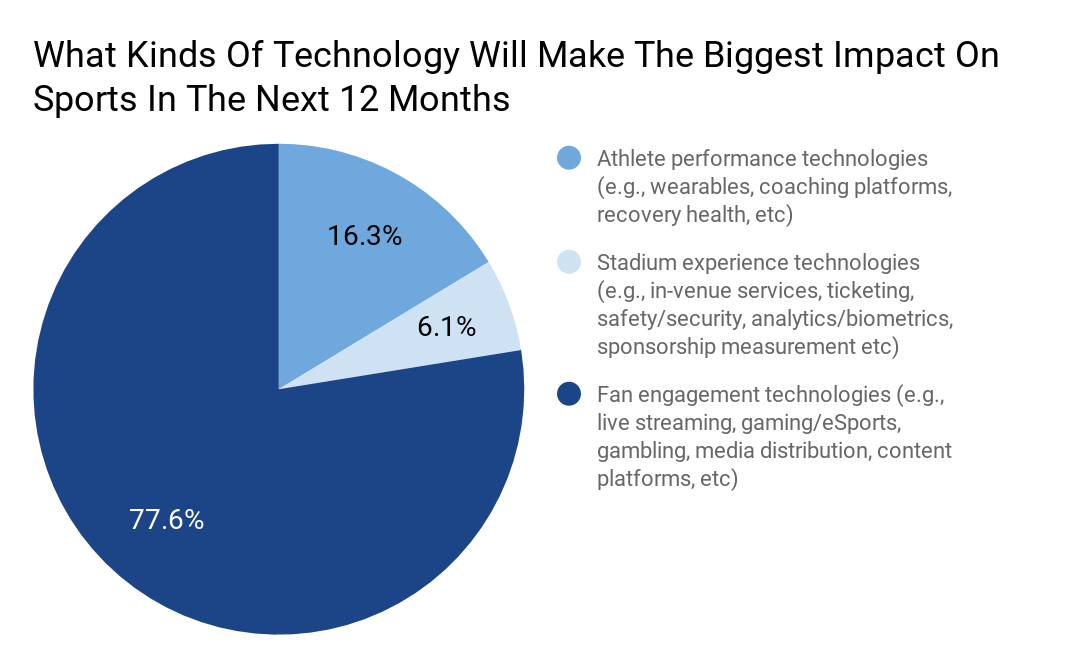
Fan engagement technologies, including live streaming and esports, are set to make the largest impact on sports in the next 12 months

When asked about which technologies would make the biggest impact on the sports industry in the next 12 months, an overwhelming 78% selected fan engagement technologies, such as live streaming, esports and content platforms, compared to technologies related to athlete performance (16%) and stadium experience (6%). Respondents also believe that this will hold true for the upcoming 2020 Olympic Games in Tokyo.

image002

“Anticipating the next fan engagement trend is critical, whether you’re a team, brand or media company,” says Tom Masterman, global head of Publisher Sales at Genius Sports Media, a leading provider of sports data and technology solutions. “Tokyo 2020 will be a make-or-break event for startups as well as incumbent technologies.”

Having worked on two Olympics at previous digital media companies, Masterman is aware of how quickly the Games come and go. “Among the questions that will keep many of us up at night include, ‘Will fans adopt my tech? Is my sponsorship integration a good experience? Did I choose the right channel partners?’ ”

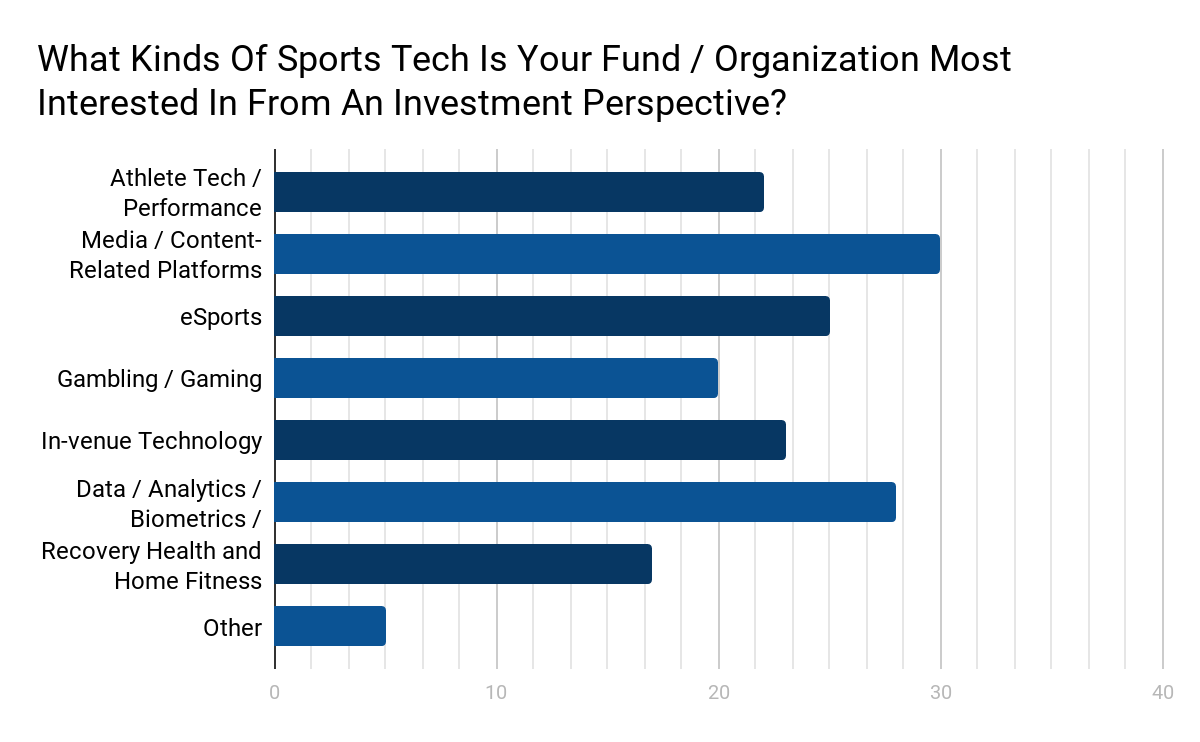
Top three technologies for investment: Media and content-related platforms; measurement platforms for data, analytics and biometrics; and esports

image003

From an investment perspective, media and content-related platforms, esports and measurement platforms for data, analytics and biometrics were among the top three areas of interest. Other notable areas include athlete tech and performance optimization, in-venue technology, gambling and gaming and recovery health and home fitness. This is a powerful indication of where venture capital funding focus is trending, given that more than 50% of respondents, coming from a wide array of areas in the industry, identified themselves as investors.

“As investors, we see cyclicality in every industry except sports, which has the biggest consumer ecosystem. Sports had been a very traditional industry powered by legacy tech, but now with the advent of streaming, sports content media distribution is decentralized via social media platforms,” says Gayatri Sarkar, managing partner at Hype Capital, who offered her take on this investment trend. “The sports market has the opportunity to be a multitrillion-dollar ecosystem with technological advances such as 5G, digital collectible trading and the rise of esports, which will fuel new market and social behavior. As the infusion of deep tech continues in smart venue, gambling, performance biometrics and many more sub verticals where data is the engine, we’ll naturally see more and more deep tech investors entering the sports investment landscape.”

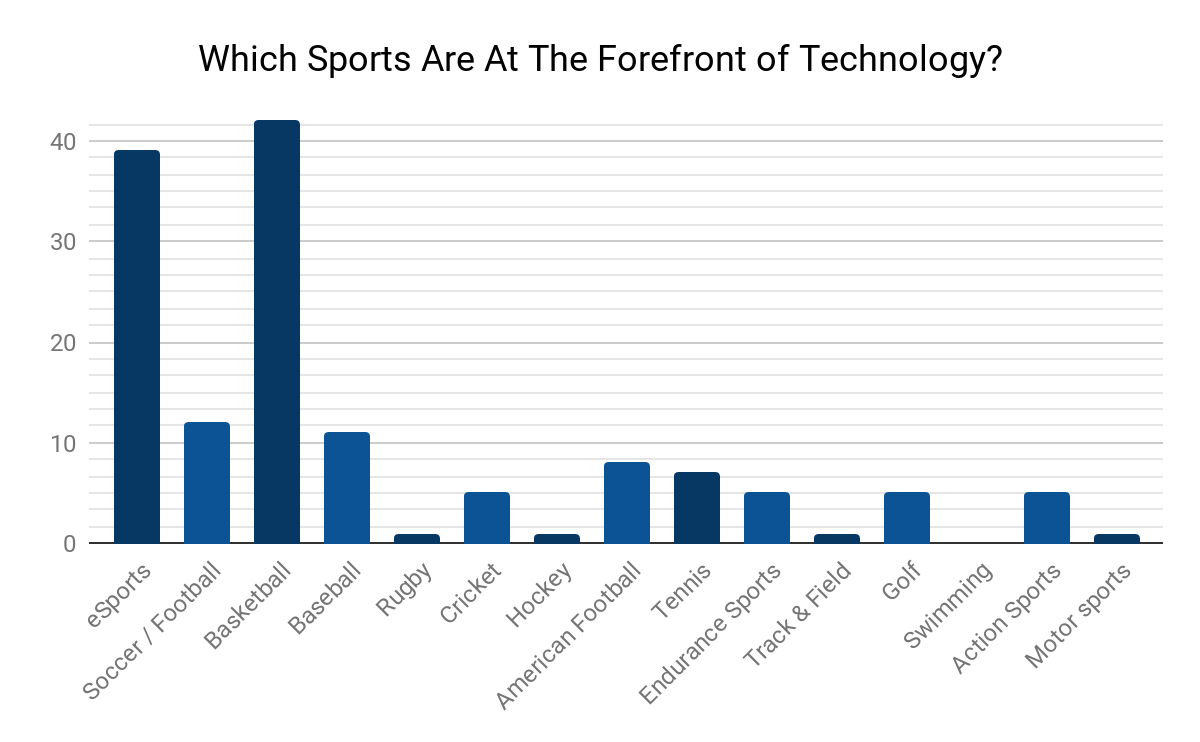
Basketball and esports are at the forefront of technology

While esports is a likely leader in the use of technology, with 79% of respondents placing it in the top three category, basketball remains the top pick, with 87% placing the traditional sport at the forefront of innovation.

image004

As a former NBA-er*, this comes as no big surprise. The league has always been known as a thought-leader in technology and innovation, and their dominance is what is driving the sport’s tech-savvy DNA on a global level.

When talking to Tom Hunt, EVP, Business Operations at the Sacramento Kings about his take on innovation in the NBA, he placed technology as a top priority. Golden 1 Center is one of the most technologically advanced and connected indoor arenas in the world, and serves as our 21st Century communal fireplace,” said Hunt. “We’ve been at the forefront of leveraging technologies such as AI, AR, blockchain and esports (Kings Guard Gaming/NBA 2K) to deepen connections to our brands while customizing and personalizing frictionless fan experiences remains core to our mission.”

That being said, I’d make a bet that baseball-related technology will catch up very quickly. We’ve seen several startups currently working with baseball clubs — enhancing everything from a player’s cognitive reactions to the ways in which your food is delivered to you at ballparks.

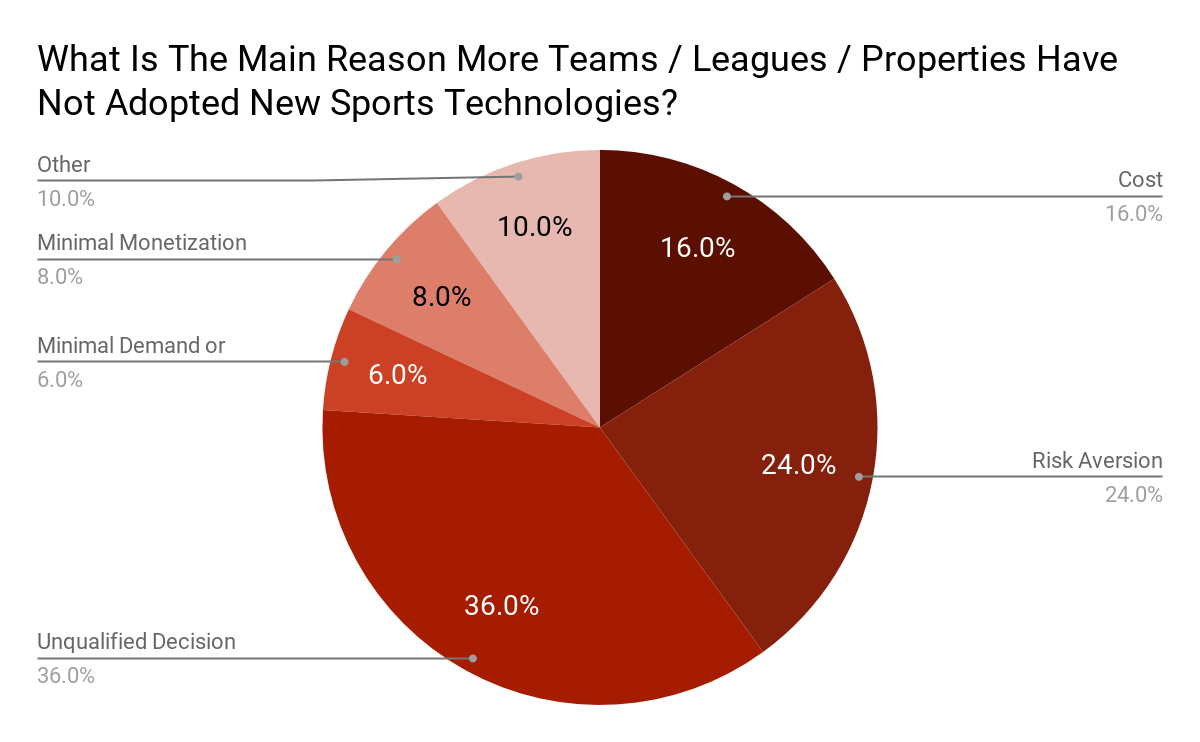
What’s holding back sports tech adoption?

image005

Respondents cited several factors holding back sports technology adoption, with the top three reasons, similar to many non-traditional technology sectors, being unqualified decision makers, risk aversion and cost.

While there’s plenty of blame to go around (and everyone can assume a degree of responsibility), startups in the space need to validate their business model outside of a core sports stakeholder. They need to realize revenue from more than just sports teams, leagues and properties — organizations that have historically reinforced the leading responses to this question. More importantly, relationships with these audiences require long sales cycles and traditionally represent “cents on the dollar” in comparison to partnerships with other industry (e.g. brands) and non-industry (e.g. military, retail, airline, etc.) opportunities.

Parting thoughts

The sports tech industry has and continues to suffer from massive amounts of fragmentation. Whether it be by geography, industry area of focus or funding stage, sports tech startups are missing the community that it has enabled others to realize.

There is a historic opportunity to bring this community together, and when we do, the legacy that we create will be one of continued growth and opportunity — perpetuating the current influx of capital into the space and reinforcing the notion that sports are truly the ultimate unifier.

*I worked for the NBA for more than four years in Global Business Development.

01 Oct 2019

NASA launches a new Earth-like planet hunting telescope using a giant balloon

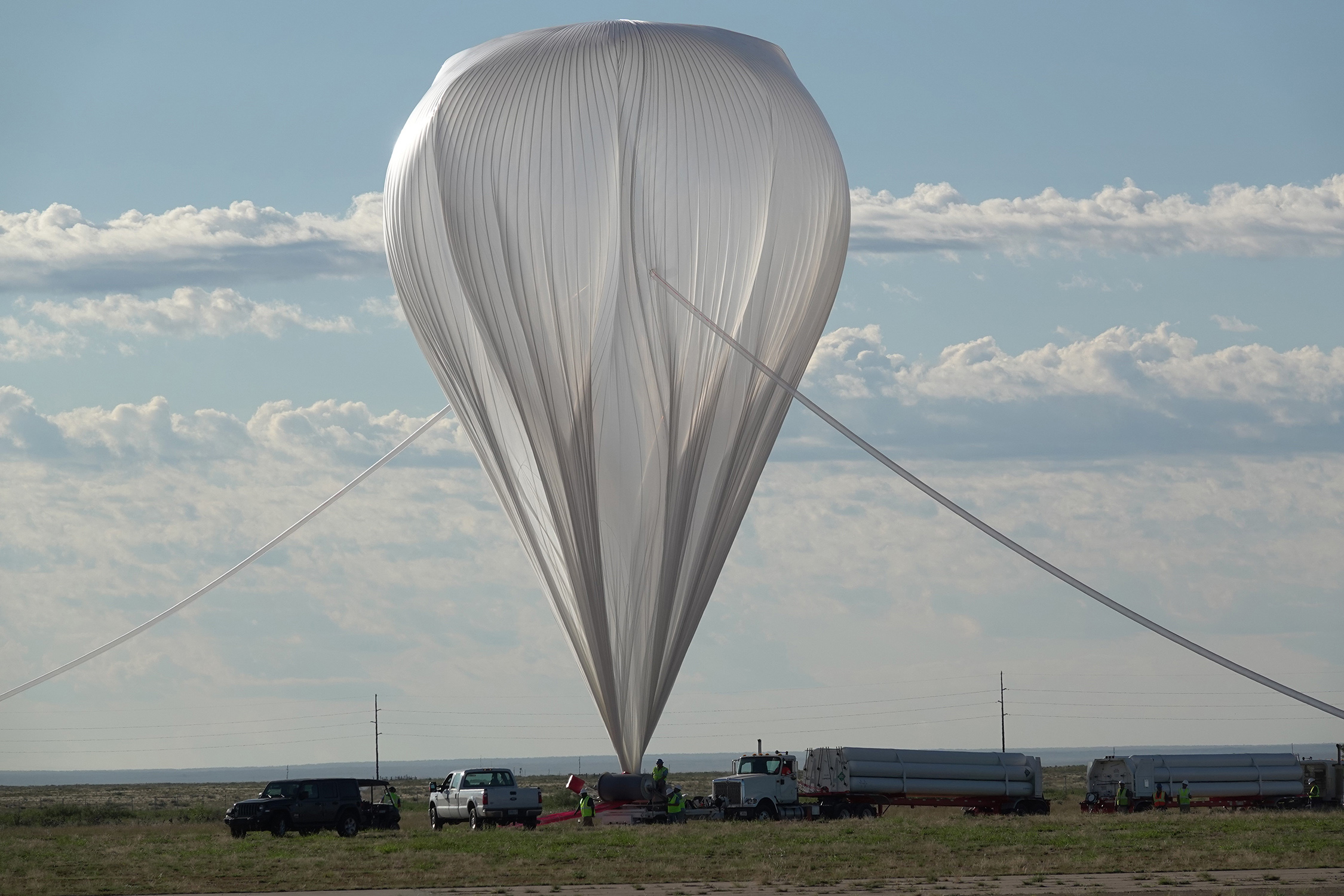
A new telescope will seek out planets that resemble Earth from a height of around 125,000 feet, suing special optical technology that will filter out light from the stars they orbit to provide a better view. The telescope is the product of UMass Lowell, and took off on Tuesday morning from Fort Sumner, New Mexico aboard a helium balloon roughly the size of an entire football field.

The balloon had to be that big to carry the telescope, which itself weighs around 1,500 lbs, and measures 14 feet long by 3 feet wide. The so-called ‘PICTURE-C’ telescope will operate at the edge of the Earth’s atmosphere for a clear view, and it’s a reusable piece of equipment that will stay aloft for several hours at at time before being decoupled and making its way back via parachute-assisted descent.

NASA is funding the project via a $5.6 million five-year grant for the university, and it’ll return for a follow-up trip next year to capture more images to assist their research team in their search. The project could result in the discovery of other objects in space beyond Earth-like planets, since it’s a novel approach to taking a look at bodies in space that were previously washed out by ambient light from stars.

2d39ecea 6bb4 4beb ab30 8e686a287bb5

Photo credit: NASA

01 Oct 2019

Here’s what Microsoft will probably announce at tomorrow’s Surface event

It’s hardware season, and now it’s Microsoft’s turn to deliver the goods. The company will be holding its big Surface event bright and early tomorrow morning in New York. If past years’ events are any precedent (and they generally are), there’s going to be a lot of stuff shown off in the Big Apple this week.

This time last year, Microsoft introduced a new version of the Surface Pro, Laptop and Studio and adding over-ear headphones to the lineup. This time out, we’ve already seen a number of leaks that point to additional refreshes and a couple of big “surprises” (in as much as rumored products can truly be a surprise).

The Surface Pro and Laptop are both said to be getting refreshes this year. The Surface Pro 7 is getting a smattering of upgrades — likely the most underwhelming of the event, including a new Intel processor and a USB-C port, dragging it kicking and screaming in 2019. The Surface Laptop 3, meanwhile, gets two size options: a 13- and 15-inch inch model, along with, potentially, a new AMD processor.

As for fully new stuff, Microsoft is believed to finally be embracing the ARM for Windows 10 platform with its Surface line. Rumors have it launching an ARM-powered two-in-one at the event. Among the benefits are a smaller footprint and far improved battery life — both marked benefits for any portable.

The biggest reveal of the show, however, is expected to be the long awaited addition of a dual-screen Surface. A decade after abandoning Courier, Microsoft is expected to announced a new form factor for the line. The rumor, which includes a bespoke version of Windows 10 (the somewhat confusingly named Windows 10 X), also point to a potential launch for the device some time later this year.

01 Oct 2019

Elizabeth Warren bites back at Zuckerberg’s leaked threat to K.O. the government

Presidential candidate Senator Elizabeth Warren has responded publicly to a leaked attack on her by Facebook CEO Mark Zuckerberg, saying she won’t be bullied out of taking big tech to task for anticompetitive practices.

Warren’s subtweeting of the Facebook founder follows a leak in which the Verge obtained two hours of audio from an internal Q&A session with Zuckerberg — publishing a series of snippets today.

In one snippet the Facebook leader can be heard opining on how Warren’s plan to break up big tech would “suck”.

“You have someone like Elizabeth Warren who thinks that the right answer is to break up the companies … if she gets elected president, then I would bet that we will have a legal challenge, and I would bet that we will win the legal challenge,” he can be heard saying. “Does that still suck for us? Yeah. I mean, I don’t want to have a major lawsuit against our own government. … But look, at the end of the day, if someone’s going to try to threaten something that existential, you go to the mat and you fight.”

Warren responded soon after publication with a pithy zinger, writing on Twitter: “What would really ‘suck’ is if we don’t fix a corrupt system that lets giant companies like Facebook engage in illegal anticompetitive practices, stomp on consumer privacy rights, and repeatedly fumble their responsibility to protect our democracy.”

In a follow up tweet she added that she would not be afraid to “hold Big Tech companies like Facebook, Google and Amazon accountable”.

The Verge claims it did not obtain the leaked audio from Facebook’s PR machine. But in a public Facebook post following its publication of the audio snippets Zuckerberg links to their article — and doesn’t exactly sound mad to have what he calls his “unfiltered” views put right out there…

Whether the audio was leaked intentionally or not, as many commentators have been quick to point out — Warren principal among them — the fact that a company has gotten so vastly powerful it feels able to threaten to fight and defeat its own government should give pause for civilized thought.

Someone high up in Facebook’s PR department might want to pull Zuckerberg aside and make a major wincing gesture right in his face.

In another of the audio snippets Zuckerberg extends the threat — arguing that breaking up tech giants would threaten the integrity of elections.

“It’s just that breaking up these companies, whether it’s Facebook or Google or Amazon, is not actually going to solve the issues,” he is heard saying. “And, you know, it doesn’t make election interference less likely. It makes it more likely because now the companies can’t coordinate and work together.”

Elections such as the one Warren hopes to be running in as a US presidential candidate… so er… again this argument is a very strange one to be making when the critics you’re railing against are calling you an overbearing, oversized democracy-denting beast.

Zuckerberg’s remarks also contain the implied threat that a failure to properly police elections, by Facebook, could result in someone like Warren not actually getting elected in the first place.

Given, y’know, the vast power Facebook wields with its content-shaping algorithms which amplify narratives and shape public opinion at cheap, factory farm scale.

Reading between the lines, then, presidential hopefuls should be really careful what they say about important technology companies — or, er, else!

How times change.

Just a few short years ago Zuckerberg was the guy telling everyone that election interference via algorithmically amplified social media fakes was “a pretty crazy idea”.

Now he’s saying only tech behemoths like Facebook can save democracy from, uh, tech behemoths like Facebook…

For more on where Zuckerberg’s self-servingly circular logic leads, let’s refer to another of his public talking points: That only Facebook’s continued use of powerful, privacy-hostile AI technologies such as facial recognition can save Western society from a Chinese-style state dystopia in which the presence of your face broadcasts a social credit score for others to determine what you get to access.

This equally uncompelling piece of ‘Zuckerlogic’ sums to: ‘Don’t regulate our privacy hostile shit — or China will get to do worse shit before we can!’

So um… yeah but no.