Year: 2019

26 Sep 2019

Amazon makes it easier for smart home devices to alert customers to low supply levels

Alongside all the new Alexa-powered consumer devices Amazon introduced yesterday, the company also unveiled a new set of tools for the makers of smart home device skills that will allow them to tap into Alexa to re-order their supplies. Think — things like printer ink, air filters for smart thermostats, detergent for washing machines, or anything else that has replaceable parts.

This is an area Amazon has focused on before, by way of the Dash Replenishment Service, or DRS. Devices that use the service’s APIs can automatically re-order their supplies, after a customer sets up their account and selects the product they’ll want to be shipped when they run low.

The new set of tools is an extension to that earlier service, as it will allow the device makers to alert their customers they’re low on necessary supplies by way of Alexa’s skills.

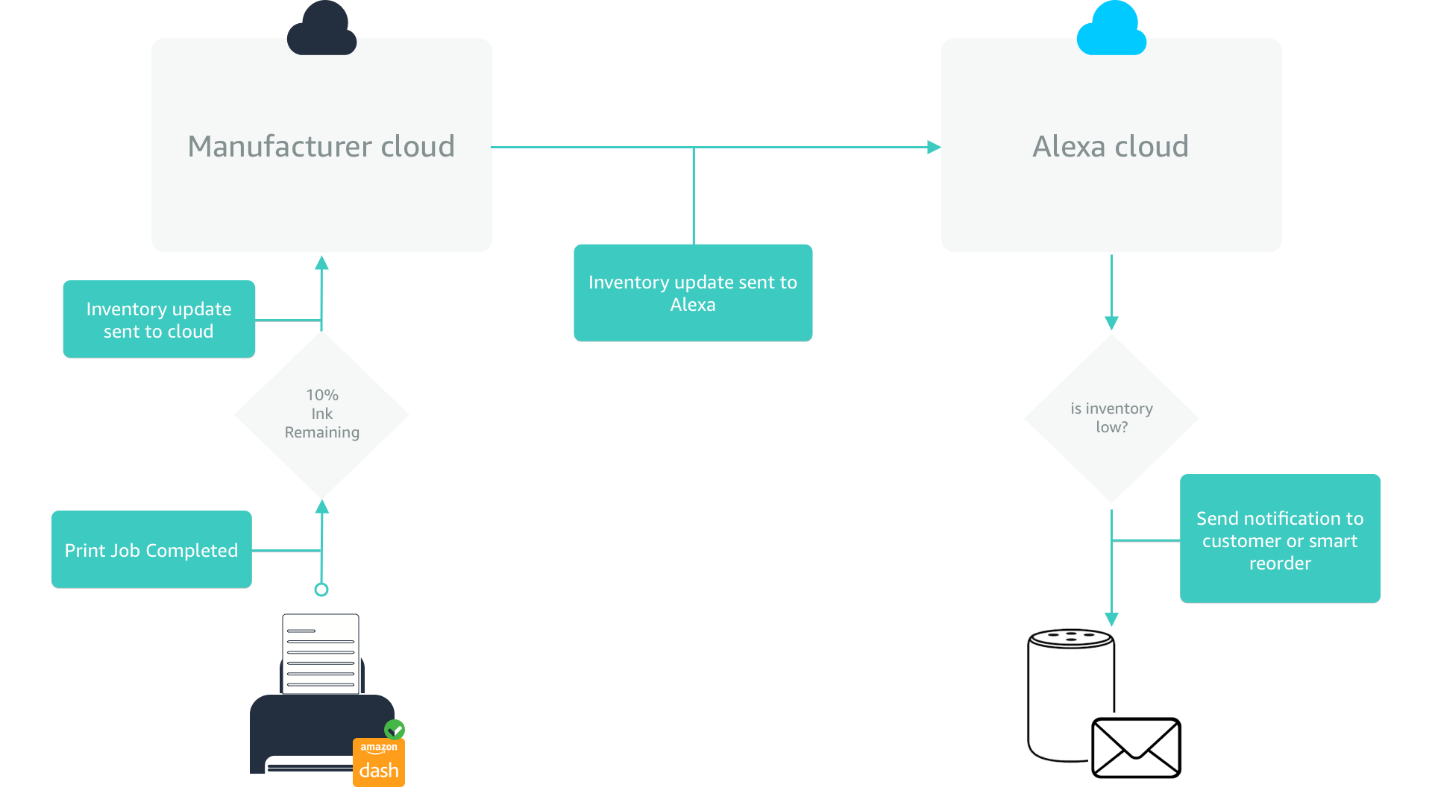
This will work by way of a new set of inventory sensors, due to launch soon, in Amazon’s Smart Home Skill API. There are three different types of sensors to choose from, depending on the device’s needs.
DARTpic.png. CB452512254

The first to arrive sometime later this year is the Alexa.InventoryLevelSensor. This will address the needs of devices where the consumable product is stored internally — like the batteries in smart cameras or printer ink, for example.

Next year, two other sensors will launch. The Alexa.InventoryUsageSensor will work when the product is not stored internally, but the device can determine when a certain amount of consumable inventory is used. In this case, good examples would include a smart coffee pot, washing machine, or dishwasher.

The third, Alexa.InventoryLevelUsageSensor, can be used when the consumable product is stored internally, and the device can report on its usage rather than its current state. For example, a smart thermostat could report the fan time to let customers know it’s time to change the air filter. Or a vacuum cleaner could alert customers to replace a dust bag.

By using these APIs, Alexa can help the customers manage their household supplies, by letting them know they’re low or helping them to set up automatic re-orders in the Alexa app. If the customer chooses to set up smart re-ordering, that’s when the Dash Replenishment Service will kick in. Unlike Amazon’s “Subscribe & Save” shopping feature, these smart home supply re-orders will only be placed when the consumable item is running low.

The benefit of this design is that it can help nudge smart home device users to place orders — from Amazon, the company hopes, just by having Alexa remind them. And it can also work even if the customer doesn’t want to set up automatic re-ordering for some reason — perhaps because they shop for supplies locally or want to comparison shop online.

Amazon says August, Blink, Ring, Schlage, and Yale are already working on including inventory sensors to report battery levels from their skills, and Coway is working to report the usage of air filters.

In addition to helping their customers manage their household, the new feature will also enable smart home kill developers to establish recurring revenue streams associated with their devices. When a customer signs up for Dash Replenishment, Amazon pays out a one-time referral fee. And then as the re-orders come in, developers will earn a revenue share on all the orders placed — even if ordered manually following an Alexa notification. Of course, if the device maker is selling its own manufactured products, they’ll earn even more.

Amazon says all U.S. developers will be able to use the new inventory sensors soon.

26 Sep 2019

Battlefield vets StrongSalt (formerly OverNest) announces $3M seed round

StrongSalt, then known as Overnest, appeared at the TechCrunch Disrupt NYC Battlefield in 2016, and announced a searchable encryption product, which remains unusual to this day. Today, the company announced a $3 million seed round led by Valley Capital Partners.

StrongSalt founder and CEO Ed Yu, says encryption remains a difficult proposition, and that when you look at the majority of breaches, encryption wasn’t used. He said that his company wants to simplify adding encryption to applications, and came up with a new service to let developers add encryption in the form of an API. “We decided to come up with what we call an API platform. It’s like infrastructure that allows you to integrate our solution into any existing or any new applications,” he said.

The company’s original idea was to create a product to search encrypted data, but Yu says the tech has much more utility as an API, and that’s why they decided to package it as a service. It’s not unlike Twilio for communications or Stripe for payments, except in this case you can build in searchable encryption.

The searchable part is actually a pretty big deal because, as Yu points out, when you encrypt data it is no longer searchable. “If you encrypt all your data, you cannot search within it, and if you cannot search within it, you cannot find the data you’re looking for, and obviously you can’t really use the data. So we actually solved that problem,” he said.

Developers can add searchable encryption as part of their products. For customers already using a commercial product, the company’s API actually integrates with popular services, enabling customers to encrypt the data stored there, while keeping it searchable.

“We will offer a storage API on top of Box, AWS, Google cloud, Azure — depending on what the customer has or wants. If the customer already has AWS S3 storage, for example, then when they use our API, and after encrypting the data, it will be stored in their AWS repository,” Yu explained.

For those companies who don’t have a storage service, the company is offering one. What’s more, they are using the blockchain to provide a mechanism for the sharing, auditing and managing encrypted data. “We also use the blockchain for sharing data by recording the authorization by the sender, so the receiver can retrieve the information needed to reconstruct the keys in order to retrieve the data. This simplifies key management in the case of sharing and ensures auditability and revocability of the sharing by the sender,” Yu said.

If you’re wondering how the company has been surviving since 2016, while only getting its seed round today, it had a couple of small seed rounds prior to this, and a contract with the US Department of Defense, which replaced the need for substantial earlier funding.

“The DOD was looking for a solution to have secure communication between between computers, and they needed to have a way to securely store data, and so we were providing a solution for them,” he said. In fact, this work was what led them to build the commercial API platform they are offering today.

The company, which was founded in 2015, currently has 12 employees, spread across the globe.

26 Sep 2019

Serial founder David Cancel to share people-first, SaaS insights at Disrupt SF next week

What do you wish you’d known about building a company beforehand? It’s a question that haunts many a startup founder their first time around.

Serial SaaS-focused entrepreneur David Cancel has found some answers for himself, having founded a good half-dozen companies over the last two and a half decades. He’ll be discussing his lessons with you next week at Disrupt SF (Oct. 2-4).

Currently the CEO and cofounder of Drift, a fast-growing marketing software company, he’s had a long string of exits including Performable (HubSpot, where he became CPO), Ghostery (Evidon), Lookery (Adknowledge), Compete (TNS/WPP), BuyerZone (Reed Elsevier) and more.

This time around, he tells me he’s focused on people — making sure the team fits together right for what the company is building. When he first started founding companies, he was focused on getting to product-marketing fit as fast as possible. As he gained more experienced, he became focused on process first. But that still wasn’t the right approach. So now he is focused on people, because getting the right team together and preventing interpersonal problems is worth far more than anything else. How does he make that happen? He’ll come prepared to share tactics — and because this is on the Extra Crunch stage, the audience will have extra time to ask questions themselves.

Cancel will also be sharing his insights on the evolution of the SaaS market over the 20+ years he’s been building enterprise-focused solutions. In the early days, it was a greenfield where simply building a great product could get you further. Then it became a matter of iterating on SaaS concepts for an exploding range of B2B use-cases. Today, the know-how to build SaaS companies is widely understood, and now it’s a matter of being able to go the fastest to expand across B2B markets. Where does that leave the opportunities for startups? Come prepared to hear more details, and ask him your questions yourself.

In order to hear from him, you’ll need to grab your Innovator, Founder or Investor pass to Disrupt SF. You just have a few more days to secure your seat and save a cool $600 before prices increase next week.

26 Sep 2019

Entrepreneurs Roundtable Accelerator introduces 12 new startups at demo day

The Entrepreneurs Roundtable Accelerator, based in New York, is ready to once again unveil its latest class of startups. Thus far, ERA has produced 190 startup which have raised more than $450 imllion in capital and exceed $2 billion in valuation collectively, according to the accelerator.

So without any further ado, let’s take a look at these new startups:

CoolR is tackling the CPG retail and beverage industries with a machine learning platform that’s meant to not only track inventory and shelf performance but also detect planogram non-compliance, foreign products and pricing inconsistencies. The company does this by combining its machine learning platform with hardware such as wireless cameras and sensors.

Everybody loves online shopping, but no one likes dealing with returning unwanted products. Cricket Returns is looking to solve that by allowing retailers to optimize their online return policies based on the product, category, place and/or time. Cricket Returns is easily integrated with Shopify merchants and the company says it delivers a measurable ROI improvement for managing and accepting returns.

FoodFul is bringing tech to the dairy farm with the DairyX product. It uses sensors and cloud-based software to monitor cow health and measure feed efficiency, saving the farmers from making extra on-farm visual inspections and giving them the tools to make data-driven decisions.

Intenseye is focused on improving workplace safety through a machine-learning video analytics platform. The company allows manufacturing facilities to link their existing video infrastructure to the Intenseye cloud platform that analyzes worker body posture, protective equipment and danger zone violations in real time.

Maia is an employment platform that allows employers to capture and engage with the 92 percent of people that visit a job application site but don’t apply. The system integrates with an employer’s career site and offers exit forms for folks leaving without applying, giving them the opportunity to be on tap for future employment options, as well.

Much like ZocDoc connects patients to the right doctor, My Wellbeing is looking to connect therapists and mental health professionals with their clients. Therapists get new client leads and access to a professional community of other vetted therapists, and clients can find the right therapist using the My Wellbeing matching technology.

Navimize is a platform that will help healthcare professionals minimize wait times for their patients. The software integrates with electronic medical records systems to detect, and even predict, delays in real times and notify upcoming patients of those delays, allowing them to show up at the exact right time.

Polymer wants to bring the power of big data analytics and data science to small data, like raw spreadsheets in Excel, Google Drive or Salesforce. Polymer search users can visualize their small data, ask complex questions, and automatically receive insights about their data with absolutely no coding whatsoever.

Recapped is a communication platform for enterprise deals that consolidates the communication between salespeople and clients. Salespeople can simply create an action plan to close the deal and share a link with clients. Rather than hopping between tools like Zoom, Dropbox, Docusign, email, etc, Recapped allows both parties to collaborate on next steps for a deal much more efficiently by simply integrating with those tools in a single place.

She’s Well is a concierge service for women and couples seeking professional fertility services. The platform connects users to a wide variety of service providers, including IVF, egg freezing, and wellness coaching. She’s Well tries to bring pricing transparency to the industry by aggregating the nation’s largest network of fertility centers, labs, and financing partners.

Sigo is looking to offer insurance in a new way. The company offers mobile-first non-standard auto insurance to Spanish-speaking drivers. The demographic may have limited insurance histories, and Sigo uses data to provide non-standard, lower-cost policies offering quotes that are bilingual, clear, and compliant without charging extra to drivers.

Stix is a new d2c brand looking to offer products in the women’s health category, starting with pregnancy tests. The company delivers the product discreetly and conveniently at an affordable price point. The hope is to make awkward pharmacy visits a thing of the past.

Techmate offers on-demand technical support to businesses with remote workers and satellite offices. The company matches customers with a vetted, qualified technician within two hours by factoring in office location, appointment time and job scope.

Tembo Health is a telemedicine company serving retirement homes, senior care centers and skilled nursing facilities to connect patients with specialty services like psychiatry and cardiology. The platform connects the specialists to patient data and collaborates with the nursing staff to provide better care plans.

26 Sep 2019

Honeycomb.io raises $11.4M to help developers observe and debug their apps

As companies continue to expand the number of cloud-based tools and apps that are used to run their businesses, DevOps continues to grow as a field of IT to help developers meet those demands. In one of the more recent moves, Honeycomb.io, which developers use to observe code on live apps, microservices and other processes in order to identify where something is not working, is today announcing that it has raised a Series A of $11.4 million to expand its sales and support efforts for existing customers.

The funding is being led by Scale Venture Partners, with Storm Ventures, eVentures, NextWorld Capital, and Merian Ventures also participating. Honeycomb has now raised $26.9 million.

Paul Graham, the co-founder of Y Combinator, once famously described how a startup (Stripe) grew in part by building a tool (in payments) that was useful and needed by other startups. Honeycomb itself is embodiment of that model, too: the story is one of engineers building tools that engineers need. Charity Majors and Christine Yen came to Facebook by way of Parse, where they were both engineers, and in the bigger environment, they found that the coexistence of apps and other services both built in-house and those interacting with Facebook’s platform created a minefield when it came to things working harmoniously.

“Things were just going down, or [even worse] looked like they were going down, all the time,” Majors said, noting that one of the big issues was that “you couldn’t look at things at a finer level” to figure out what was going wrong, and to identify issues behind why things were not working.

“Testing platforms can only cover the things you predict in advance, things you know might go wrong,” Yen noted. “Observability is about capturing what is going wrong,” a critical piece of data that will subsequently help an engineer figure out how to best fix it, rather than spending time trying to identify where the actual problem is.

Without a performance monitoring product on the market that was able to provide insight into real-time activity and interactivity between apps — and with a large part of the process requiring yet more code to be deployed to search for and fix problems — Majors (who is now the CTO of Honeycomb) mapped out a way to do this by observing the overall environment. When she decided to leave Facebook and work further on the idea, she teamed up with Yen (now the CEO) to build Honeycomb. (The internal tool that Majors built as an infrastructure engineer, she said, is also still being used, and you can see more on the structure behind how Honeycomb works here.)

Honeycomb has resonated with developers at both smaller and very giant tech companies (that prefer not to be named), with the high correlation between those who trial and those who end up buying the product speaking both to the demand for Honeycomb’s solution and its impact on developers’ work.

The company says that it has doubled ARR in the last six months, doubling the number of six-figure contracts, and is on track to triple ARR by the end of 2019.

“Honeycomb is enabling a long-overdue shift in the way developers interact with and operate the software they build,” said Ariel Tseitlin, Partner at Scale Venture Partners, who is also joining the board with this round. “As production systems become more complex and distributed, the company is taking advantage of the massive market opportunity and establishing itself as a leader in real-time observability. It’s no wonder developers say they can’t live without it after they try it.”

26 Sep 2019

Package Free picks up $4.5 million to scale sustainable CPG products

The climate crisis continues to be just that… a crisis. And it’s spurring people across the country (and globe) to take action, particularly when it comes to their own lifestyle.

Lauren Singer is one such person. After studying Environmental Science and Politics at NYU, she started a blog called Trash Is For Tossers to make a zero-waste lifestyle more accessible and comprehensible to everyone. But there’s still an issue. Even with a steep rise in sustainable CPG products, these brands rarely have the scale to compete with traditional CPG products in price, and lack the distribution to be accessible to everyone.

That’s where the Package Free Shop comes into play. Today, Package Free is announcing that it has raised its very first capital since launch in 2017, with a fresh $4.5 million in seed funding led by Primary Ventures. Scooter Braun’s TQ Ventures, Day One Ventures, Ryan Engel of Peleton, Brooke Wall of The Wall Group, and Casper founder Neil Parikh also participated in the round, alongside others.

Package Free started as a little pop-up shop for sustainable CPG brands to show off their wares in a brick-and-mortar environment. The brands themselves paid between $1000 and $3000 to participate, and were given 100 percent of the profit from the pop-up.

[gallery ids="1887151,1887152,1887153"]

By the end of month one, says Singer, every brand had been paid back for their investment. By the end of month three, Package Free had become the primary revenue driver for those brands. At that point, they switched over to a traditional retail model to generate revenue to launch an ecommerce site.

Today, Package Free is a full-fledged reseller. The pop-up shop now has a permanent status in the trendy neighborhood of Williamsburg in Brooklyn, NY, with its own warehouse in Greenpoint. The company buys their inventory wholesale and enforces incredibly strict guidelines for the vendors they work with, not least of which is a no-exceptions no-plastic policy.

Brands that sell through Package Free not only have to use all natural ingredients and be plastic-free, but must also ship to the Package Free warehouse without using any plastic. The company actually charges vendors a percentage of the shipment if the shipment arrives with plastic, and increases that percentage on the second infraction. Three strikes, and that vendor is out for good.

“We know it’s completely possible to do these things without plastic, it’s just not the norm now,” said Singer. “So we’re trying to change the foundational benchmarks of what it means to package sustainably. I truly believe that the burden of waste should never fall on the consumer. It should fall on the manufacturer first, and then the reseller.”

Once products are at the warehouse, Package Free reuses the dunnage (packaging materials) that the original shipment came with, meaning the company never uses ‘virgin dunnage’. The boxes that Package Free ships to consumers are 100 percent recycled, and shipping labels are also 100 percent recyclable. In fact, every Package Free box is printed with the words “I’m not trash” with further facts about trash.

With the funding, Package Free wants to expand to creating its own sustainable CPG products, first tackling the ‘white space’ of products that aren’t currently available via vendor partners. Singer declined to share any more details around what Package Free’s first products might be.

Package Free is also looking to hire, with a specific focus on the marketing vertical as the company has yet to do any formal marketing or paid marketing up until this point.

The ultimate goal is to put sustainable CPG on the same playing field as traditional CPG products simply by way of economies of scale. Price is the primary obstacle between everyday consumers and accessible sustainable products, and Singer’s goal is to scale up the sustainable CPG category as a whole to the point where it can reasonably compete with the Unilevers and P&Gs of the world.

26 Sep 2019

Airbus-owned Voom brings its on-demand helicopter service to the U.S. with SF Bay Area launch

Voom, the helicopter service with ride-sharing and one-hour advance booking that Airbus developed and launch first in Latin America, is getting its U.S. debut starting in San Francisco. The service will be available for travel between five Bay Area airpots, including SFO, San Jose, Napa, Oakland and Palo Alto.

Travellers wanting to make use of Voom can book their trips online, using either the dedicated Voom app for smartphones, or the Voom website. You can make bookings up to an hour before a scheduled flight departure, and on the day of travel, you only need to be at the helipad 15 minutes prior to boarding, which makes it a pretty attractive option for business travellers frequently making trips around the Bay Area, or as a traffic-skipping option to get to the airport faster for longer-haul trips.

Voom’s trip time from SFO to San Jose, for instance, is just 20 minutes – which is about 20 minutes better than driving times in the best possible traffic conditions, like in the middle of the night. During prime commuting hours, that same trip will be at least an hour, and more like an hour and a half, which is a considerable additional chunk of travel time.

Though this is the first time Voom is launching its services in the Bay Area, the company is no stranger to the region: Voom’s headquarters is in San Francisco, and it launched in 2016 as part of Airbus’ A^3 Silicon Valley-based innovation lab.

Voom enters a U.S. market that’s starting to see more activity in short-hop helicopter service, with streamlined booking through apps and online reservation platforms, and essentially on-demand options for short notice flights. Blade and Uber both offer similar service in NYC, for instance, connecting JFK with Manhattan in another popular business travel route that’s frequently mired in plenty of traffic.

VOOM PassengersInFlight

Voom’s model is a platform one, with third-party helicopter operators and helipads offering their services via its booking tools, though the Airbus company does stringently vet its ride providers. The young company is also launching a Voom for Business offering in the U.S., which is designed to provide easy employee travel management options for enterprises who want to make access to Voom available to its staff while simplifying and unifying billing.

Of course, a commuter helicopter option isn’t exactly within reach for everyone – but because of the ride-sharing model wherein you can book a seat on a helicopter alongside other passengers, costs are lower than full charters, with rides in the Bay Area starting at $215 depending on the route. It’s a lot more than an Uber ride between San Jose and SFO, definitely, but it’s also a massive time saver and not something that would appear out of place on some corporate expense policies – especially in the U.S. tech and innovation capital, home to the wealthiest companies on the planet.

Voom’s service in the Bay Area is available now, and you can also use the platform to book full plane charters to other small airports serving the region, including Half Moon Bay, Monterey, Livermore and Sacramento.

26 Sep 2019

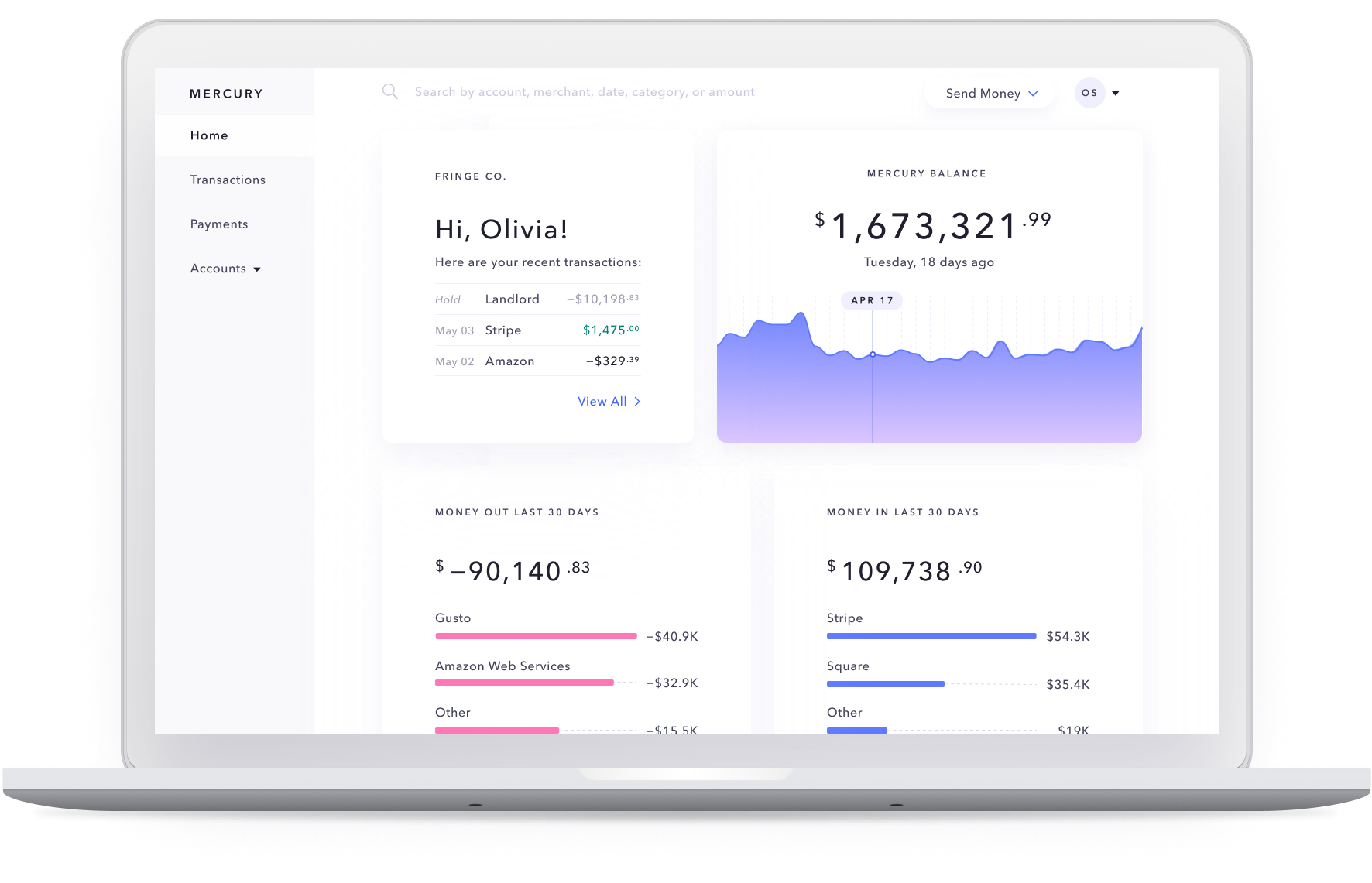
Mercury banks $20M for its banking service aimed at startups

Online-only banks have become a viable option for many people who would have traditionally used a brick-and-mortar bank but are now looking for more flexible, potentially cheaper ways to handle their monthly incoming and outgoing finances, their savings and loans, and their payment cards. That maxim has also extended to the world of business, and today a startup that has built a business-focused challenger bank, specifically for startups like itself, is announcing a round of funding as starts its growth in earnest.

Mercury, which describes itself as a bank for startups, has banked $20 million of its own in funding, a Series A that is being led by CRV with support also from Andreessen Horowitz, the VC that led its investor-heavy $6 million seed round earlier this year. The company, I understand, has a post-money valuation now of $100 million.

And by investor-heavy, I mean that on two counts: it featured a lot of heavyweights, and there were nearly 40 individuals and firms chipping in. Others in this latest round include Kevin Hartz, CEO of Eventbrite; Scott Belsky, co-founder of Behance; Ryan Petersen, CEO of Flexport; Kevin Durant of the Brooklyn Nets; and Andre Iguodala of the Memphis Grizzlies. Its bigger list of backers now totals over 100 and also includes the founder of Silicon Valley Bank Roger Smith, Bill Clerico of WePay, and Naval Ravikant, among many others.

This latest funding comes on the heels of Mercury having launched only in April 2019, and is a result of what appears to be very strong demand for what it has to offer. In the first week of its launch it had 1,500 signups, and it has been growing at 40% each month since.

To be sure, there are already a number of options on the market for a startup looking for a bank. Aside from traditional institutions that all offer special accounts for small businesses (which essentially is what a startup is), there is Silicon Valley Bank), and other challengers like Revolut and N26 that started first with consumers but are now increasingly also targeting smaller SMBs.

That’s before you consider the wave of other fintech juggernauts out there, like Stripe, that are slowly building a suite of services that could be a natural complement (and, thus, potential precursors) to basic banking, too. (No plans from Stripe to build something like this at the moment, co-founder John Collison told me earlier this month when I asked about it.)

mercury

Immad Akhund, the CEO and co-founder of Mercury, is aware of what the shortcomings are today in the market from a couple of perspectives. His previous startup, mobile ad network Heyzap, regularly “was constrained by cashflow” that inhibited growth and operations and needed to do run of the paying out processes of the business (which included a programmatic ad network) manually.

After he and his co-founders sold Heyzap in 2016, Akhund used some of the proceeds to become an investor in early-stage startups (120 in all), he saw the same challenge continue to persist. “Nothing had really changed,” he said, “and I thought a bank could do a better job. With Mercury I saw that I had the opportunity to build something that was needed.”

Inspired by the proliferation of challenger banks that have sprung up across Europe that were mostly targeting consumers (and now potentially stand to be competitors with newer business services), he set out to build Mercury with a lot of services that are very specific to the kinds of things that a startup might need to be managing when it comes to its money.

In addition to checking and savings accounts (FDIC-insured, by way of Mercury’s white-label partnership with Evolve) that come with up to 1.75% interest, the service features clean, modern dashboards; easy interfaces for setting up payments; an online sign-up that Mercury says takes only 10 minutes to go through, with the account ready to use within 24 hours; and a facility to manage and monitor activities of different employees that have access to the account.

These are just the basics, however. The service integrates with a company’s existing accounting software or any software that already manages recurring payments. And on the horizon are a number of new features that Mercury is building, along with an API, that will let its clients manage the money in their accounts and all of the places where it might typically be getting paid in and paid out.

“We are talking to customers and building what they need,” Akhund said. 

This will including lending, but also a number of other features around payments, with an API that will let users access who paid the company, without logging into Mercury’s actual dashboard to do that. This could be useful, for example, for integrating this into another piece of accounting software. He also noted that in marketplace-style business, you are not only receiving money from many places but also needing to pay people out, so having a way of being able to do that more easily and immediately could be a big boost to a business.

The aim is to automate and speed up the way money moves, or “to pay out programmatically,” as Akhund describes it.  Much further down the line, you could imagine this to also include interesting insights and other services based on all the data Mercury amasses about a business.

This idea has resonated with founders — who are both signing up to the service and also coming in as backers. Despite the work that having a huge investor pool might entail for the business (many ideas, many voices to be heard) Akhund said that having a big pool of them involved financially was important to him, given his target market.

“Any founder that’s worked with a bank before knows the experience as it has been is fundamentally broken. Banking has been the crucial missing piece of the startup stack that hasn’t yet been modernized. I think entrepreneurs know something special is being built right now,” said Justin Kan, the repeat entrepreneur who is now the CEO of Atrium, said in a statement.

Mercury’s current customers include​ ​YC startup Tandem​, Remote​, and​ ​Linear​. “​Using Mercury was a no-brainer for me,” said Rajiv Ayyangar, CEO and co-founder of Tandem, in a statement. “After decades of dealing with terrible banking systems, it’s been amazing to use Mercury, where things just work. I’m never worried I did something wrong nor am I frustrated because I can’t find a piece of information I need. The delta is so large that I actually look forward to the odd finance task!​” Given what a headache working with banks can be, I’m not there could be a better endorsement, so the ball’s in Mercury’s court now to deliver and be more than a short-lived startup to these startups.

26 Sep 2019

Apple’s iOS and iPadOS 13 support multiple PS4 or Xbox One controllers, which could be huge for Arcade

Apple’s iOS 13 update (and the newly-renamed iPadOS for iPad hardware) both support multiple simultaneous Bluetooth game controller connections. Apple added Xbox One and PlayStation 4 controller support in the updates, and after doing some digging, I can confirm that you can use multiple of either type of controller on one iOS device running the update, with each controlling a different player character.

That’s the good news: The bad news is that not many games take advantage of this right now. I wasn’t able to find a game in Apple’s new Arcade subscription service to try this out, for instance – and even finding a non-Arcade iOS game took a bit of digging. I finally was able to try local multi-controller multiplayer with Horde, a free-to-play 2-player co-op brawler, and found that it worked exactly as you’d expect.

With Arcade, Apple has done more to re-invigorate the App Store, and gaming on iOS in particular, than it has since the original launch of the iPhone. The all-you can game subscription offering, which delivers extremely high-quality gaming experiences without ads or in-app purchases, has already impressed me immensely with the breadth and depth of its launch slate, which includes fantastic titles like Where Cards Fall, Skate, Sayonara: Wild Hearts and What the Golf, to name just a few.

Combine the quality and value of the library with cross-play on iOS, iPadOS, Apple TV and eventually Mac devices, and you have a killer combo that’s well-positioned to eat up a lot of the gaming market currently owned by Nintendo’s Switch and other home consoles.

Local multiplayer, especially on iPads, is another potential killer feature here. Already, iPad owners are likely to be using their tablets both at home and on the road, and providing quality local gaming experiences on that big display, with just the added requirement that you pack a couple of PS4 or Xbox controllers in your suitcase or carry-on, opens up a lot of potential value for device owners.

As I said above, there’s not much in the way of games that support this right now, but it’s refreshing to know that the features are there for when game developers want to take advantage.

26 Sep 2019

Verizon lights up 5G in (parts of) NYC

Verizon this week announced that it’s finally begun to flip the switch on its 5G network in parts of New York City, along with Panama City and Boise. That brings the wireless carrier’s (disclosure: also TechCrunch’s parent) totally number up to 13 cities with a taste of the next ten network.

Here in NYC, 5G will touch three of the five boroughs (my home base of Queens, sadly, is not among them). Manhattan and Downtown Brooklyn are, not surprisingly, the first focus of coverage. Here’s the specific breakdown per VZW,

  • Manhattan: Midtown, Financial District, Harlem, East Harlem, Hell’s Kitchen and Washington Heights.
  • Brooklyn: Downtown Brooklyn
  • The Bronx: Pelham Bay, Fordham Heights, and Hunt’s Point
  • Around Landmarks: Bryant Park, St. Patrick’s Cathedral, Madison Square Garden, Trinity Park (Brooklyn), the Lincoln Tunnel (Manhattan Entrance), Javits Center on 11th Ave between 36th and 37th and the Theatre District on Broadway between 49th and 52nd.

The network is similarly limited to specific neighborhoods in Panama City and Boise, as well. AT&T rolled out its own limited 5G coverage in the Big Apple back in August. I’ve been carrying around a 5G AT&T phone for a few days now and it brings to mind the early days of LTE. The 5G marker pops up on the phone for a fleeting bit in the most surprising places.

Until rollout is wider, however, it’s probably not worth the extra money for most folks. Verizon says it plans to have the service in (parts of) 30 cities by end of year.