Year: 2019

25 Sep 2019

Inside the venture capital recruiting process

The venture capital industry has seen record amounts of capital in recent years, with many firms raising their biggest funds ever and new funds popping up every week. Professionalization in this once small industry has led to hiring at historic levels. Many of my clients are looking outside of the existing world of venture for the human capital to fuel that growth, seeking to build teams with more diverse experiences.

Switching careers is not easy, and VC is often not as glamorous or as lucrative as it can be perceived to be, but you are thinking of getting into the industry; maybe you made a seed investment once, maybe you started a company and loved your VC board member and thought their job looked interesting, maybe you’ve been an advisor to a friend’s startup and it sparked your interest.

What do VCs look for, and what’s it like to interview for these roles? I’ve worked on many senior investor searches for VC firms and I’ll share as much as I can.

What kinds of backgrounds do VCs like?

VCs generally see value in networking. So if you come from a company a VC might know, they’ll probably have a coffee with you even if they don’t have any real interest in hiring you, because that coffee could have several “successful” outcomes —you may be right for a role in their portfolio, you may find a startup of interest in the future, you might even be a good hire for their investment team.

What’s the sort of operating background that a VC firm is actually interested in hiring? In my experience, two types of backgrounds tend to fare well with VCs.

Image via Getty Images / katleho Seisa

25 Sep 2019

Amazon’s new Echo Dot With Clock is a new Echo Dot that has a clock

Today’s deluge of Amazon hardware kicked off with a new addition to the Echo Dot line, the Echo Dot With Clock. That’s it. That’s the name. It is, as advertised, an Echo dot with a digital alarm clock built into the front, next to the speaker grille.

The new version of Amazon’s insanely popular entry level smart speaker doesn’t replace the current Dot, but will instead exist along side it in the company’s current Echo lineup. It’s available for pre-order starting today, priced at an extremely reasonable $59 — that’s $10 more than the standard Dot.

Like the Echo Spot and Echo Show 5, the Echo Dot With Clock seems well suited to serve as a bedside alarm clock. Though, honestly, the lack of a display and camera could make it even more appealing for that purpose, given the laundry list of privacy concerns the company laid out at the top of the event.

The addition of a built-in clock also gives the product added utility beyond serving as a smart speaker. It’s a clever touch and Amazon’s bound to sell a ton of the things.

25 Sep 2019

Facebook announces Oculus Link which brings PC games to its standalone Quest headset

Oculus is going to be further blurring the lines between its standalone virtual reality headset and what it’s built on PC with a new software update in November, Mark Zuckerberg announced onstage at the company’s Oculus Connect 6 conference.

Oculus Link will allow Quest users to tether their Quest to PCs via USB-C and play PC content that is more graphically-rich and power-intensive than what’s currently possible.

We don’t know any limitations of the system yet, but both the Quest and Rift S share plenty of system specs, so this may be a clear sign that Facebook is pushing Oculus to go all-in on the Quest and perhaps leave PC VR behind.

We’ll get more details soon on Oculus Link.

Updating

25 Sep 2019

Segment’s new privacy portal helps companies comply with expanding regulations

With the EU’s sweeping GDPR privacy laws and the upcoming California Consumer Privacy ACT (CCPA), companies have to figure out how to deal with keeping private data private or face massive fines. Segment announced a new Privacy Portal today, that could help companies trying to remain in compliance.

Segment CEO and co-founder Peter Reinhardt says companies have built a false dichotomy between personalization and privacy, and he says that it doesn’t have to be that way. “We’ve noticed that a lot of companies feel this tension between privacy and growth. They basically see a paradox between being either privacy-respectful versus providing a very personalized experience,” he said.

The new Privacy Portal is designed to be a central place where customers can sort their data in an automated way and create an inventory of what data they have inside the company. “By introducing a single point of collection for all the data, it creates a choke point on the data collection to allow you to actually govern that, a single place to inspect, monitor, alert and have an inventory of all the data that you’re collecting, so that you can ensure that it’s compliant, and so that you can ensure that you’ve got consent, and all of those things,” he said.

The way this works is that as the data comes into the portal, it automatically gets put into a bucket based on the level of concern about it. “We are basically giving customers monitoring and a consolidated view over all of the different data points that are coming in. So we have matches that basically look for things that might be PII, and we automatically grade most of them with green, yellow or red in terms of the level of potential concern,” Reinhardt explained.

On top of that, companies can apply policies, based on the grades, say letting anything that’s green or yellow through, but preventing any red data (PII) from being shared with other applications.

In addition, to make sure that the product can connect to as many marketing tools as possible to get the most complete data picture, the company is releasing a new feature called Functions, which lets customers build their own custom data connectors. With thousands of marketing technology tools, it’s impossible for Segment to build connectors for all of them. Functions lets companies build custom connectors in a low-code way in instances where Segment doesn’t provide it out of the box.

The two tools are available to Segment customers starting today.

25 Sep 2019

How to sell a startup for a $1B, Automattic, WeWork craziness, Kobalt, Netflix, Blackstone, and ClimateTech

Editor’s Note

Apologies for not getting this roundup newsletter out on Saturday — I was on vacation this weekend. So this newsletter covers the back half of last week and the first half of this week, and some of the articles are summarized more aggressively to keep this email at least somewhat reasonable in length.

How founder and CTO Dries Buytaert sold Acquia for $1B

Earlier this week, Acquia (the company behind content management system Drupal) announced that it had been acquired by Vista Equity for $1 billion. It’s a big exit for co-founder Dries Buytaert, who built out the original version of Drupal almost twenty years ago as an open-source approach to CMSes.

Our enterprise reporter Ron Miller talked with Buytaert about why he sold, what it feels like to exit a startup after building it for so long, and what’s next for Acquia and Drupal.

“We were born out of open source. All of our customers use open source. We give back to open source. It’s part of our DNA. It’s what we do. And so making sure that any new investor understood that and was aligned with was critically important, and Vista is very excited about the open source community around Drupal and Mautic (two open source projects Acquia is the steward of), and has even agreed to invest more in them,” he said.

It was more than aligned values around open source though. He says that Acquia is competing with some big companies like Adobe and it needs more capital, especially for larger M&A projects, and Vista provides that financial backbone that they have been lacking. While they have been able to make a couple of smaller acquisitions, being part of Vista should open the door for far more substantial ones.

How Automattic wants to build the operating system of the web

Speaking of content management systems, Automattic, which owns WordPress.com and recently bought the remnants of Tumblr from TechCrunch parent company Verizon Media, has a major vision for the future of content (and of course, how it fits into that world).

25 Sep 2019

Why Flexport built a slick Slack SAAS for shipping

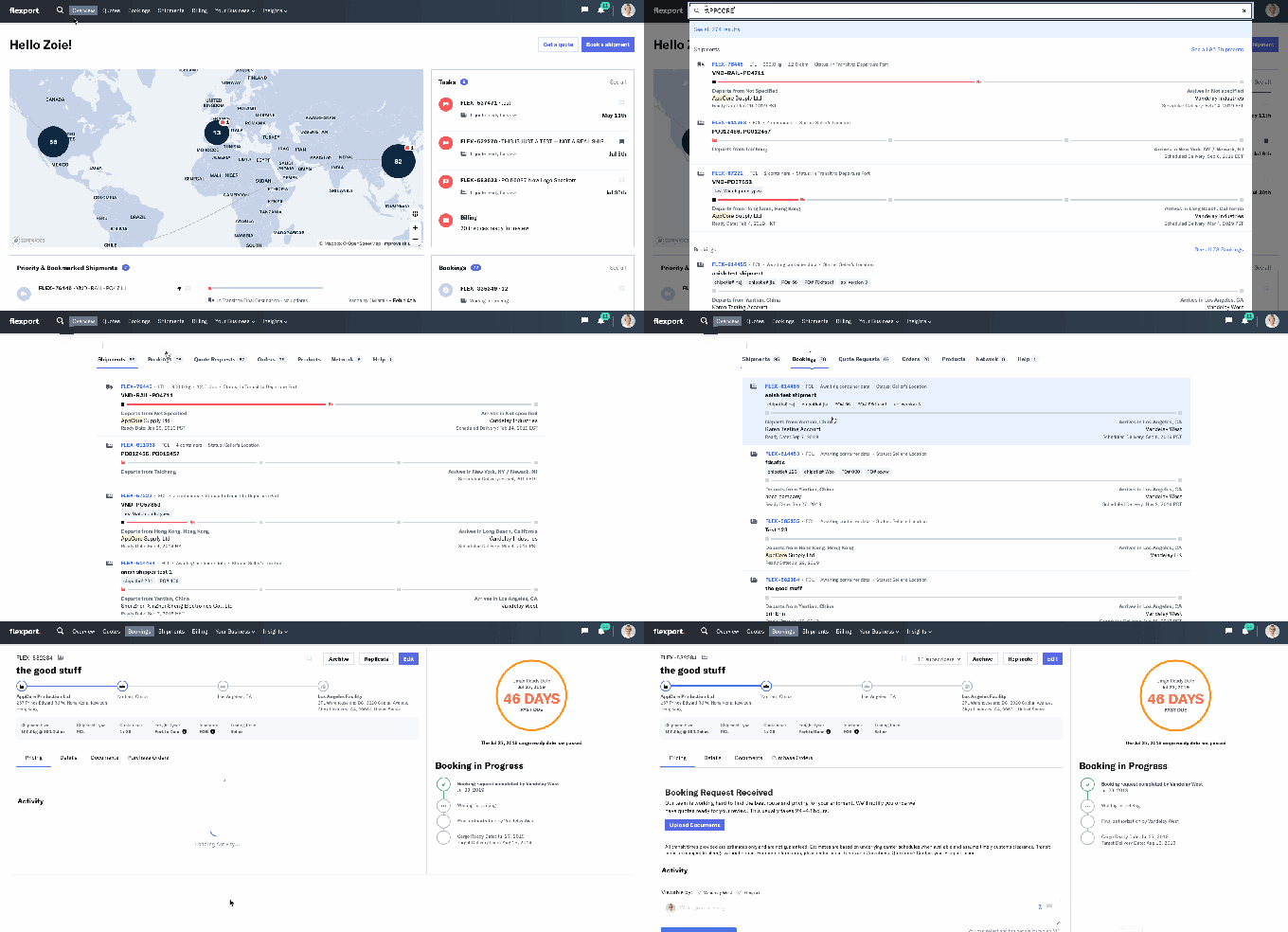
“Make their metrics your metrics” is one of Flexport CEO Ryan Petersen’s mantras. Sometimes that means building free software for your clients. It can be frustrating aligning your fates with a fellow business if they operate on email, phone, and fax like much of the freight forwarding industry that gets pallets of good across the world from factories to retailer’s floors. So today the new Flexport Platform launches allowing brand clients, their factories, and their Flexport logistics reps to all team up to get stuff where it belongs on time.

The software could further stoke Flexport‘s growth by locking in customers to work with the shipping startup that was valued at $3.2 billion after raising $1 billion from SoftBank in February to bring it to $1.3 billion in funding. Flexport’s revenue was up 95% to $441 million in 2018, Forbes’s Alex Konrad reported. Yet there’s plenty of green field to conquer given even Flexport’s largest competitor Kuehne & Nagel only holds 2.5% market share while the whole freight forwarding industry grows 4% per year.

Flexport Search

The Flexport Platform lets 10,000 clients like Bombas socks invite their suppliers to collaborate on managing shipments together. An integrated calendar makes shipping timelines clear. A map gives clients a god-view of their freight criss-crossing the globe. Pre-filled forms speed up compliance. Tagging lets users group shipments and filter or search their dashboards, and flag something for extra care — like a pallet of goods critical for a marketing launch event. Collaborators can also sync up via a Facebook Wall style feature, or direct message the team with threaded conversations much like Slack.

Ryan Petersen Flexport

Flexport CEO Ryan Petersen

“There’s infinite demand for a job well done” Petersen says about his industry.The hard part has always been doing a good job.” Taking the confusion out communication scattered across email chains means clients get shipping documentation filled out 50% faster with 4X more accurate data. Flexport is on the tip of the tongue as software eats the world, with antiquated sectors suddenly leveling up.

Petersen saw the inefficiency first-hand growing up running his own import/export and customs business. He part of a wave of entrepreneurs attacking unsexy businesses that the typical Silicon Valley enterprise exec might never stumble across. But three years after we profiled his scrappy company when it had raised just $26 million in funding and had 700 clients, Petersen tells me “We’re trying to retire the word startup.”

It turns out top global brands like Sonos and Klean Kanteen don’t like the second half of “move fast and break things” when those things are boats and planes full of their products. “They want a company that will help them grow, not the fly-by-night startup” Petersen explains. But with competitors trying to chase it and incumbents trying to adopt similar technologies, Flexport must maintain its agility to be subsumed by the pack.

As his company has grown to 1700 employees, he’s dedicated a ton of his time to keeping its culture in check — especially after a certain other logistics giant startup had some uber-painful troubles with workplace toxicity. “You either have too much bureaucracy or not enough process and no one knows what to do. The English language lacks a positive word for bureaucracy — just the right amount of process so people can move quickly”.

That’s what Flexport wanted to give clients with the new platform. From a dedicated tasks queue to a notifications pane, it’s built to take the guess work out of what to do next while being as approachable as consumer software for new users. That also why it’s free. It’s not supposed to be some chore you’re forced to complete, product lead Frank Te Pas tells me. “As you move your first shipment you get onboarded onto this system” says Te Pas. “It’s our way of helping.”

Flexport Warehouse

That’s meant a ton of personal growth too. Petersen is still enthusiastic, curious, and charmingly rough around the edges, but he carries it all with more dignity and gravity than a few years back. “The only way I get to stay in this role is if I learn faster than anybody else. Being the CEO of a 1700-person company is not something I knew how to do four to five years ago, or even last year” he tells me. “I’ve changed and become more self aware. It’s been really important to take care of myself — sleeping a lot, I quit drinking alcohol, I lost 30 pounds. I feel great.”

With plenty of cash in the bank, industry talent taking it seriously, and new businesses like Flexport Capital freight financing and its cargo insurance offered in partnership with Marsh, the company might not be a startup for long. It looks like a hot candidate for a coming season of IPOs. And while this company has its own plane (the leading entry for the naming contest is ‘Weird Flex But OK’), it’s actually part of its shipping fleet.

25 Sep 2019

Daily Crunch: WeWork CEO steps down

The Daily Crunch is TechCrunch’s roundup of our biggest and most important stories. If you’d like to get this delivered to your inbox every day at around 9am Pacific, you can subscribe here.

1. CEO ouster, looming layoffs and devaluation turn WeWork into cautionary tale

Adam Neumann succumbed to pressure yesterday to step down as CEO, taking the role of non-executive chairman at the company he co-founded nine years ago.

Layoffs are likely to follow — in fact, sources tell TechCrunch that the scope of these layoffs will be massive, with newer business units scaled back so the company can focus on its core business. (Extra Crunch membership required.)

2. Facebook promises not to stop politicians’ lies & hate

Facebook says it won’t fact check politicians’ speech or block their content if it’s newsworthy — even if that content violates the site’s hate-speech rules or other policies.

3. Nintendo’s ‘Mario Kart Tour’ is out now for iPhone, iPad and Android

Like Nintendo’s other mobile releases, Mario Kart Tour is free to play, with in-app purchases (in-game currency called “rubies”) that you use for upgrades and unlocks.

4. Media metrics giant Comscore pays SEC $5 million in fraud settlement

The company’s share price has been in free-fall since some of its actions came to light earlier this year. It was trading above $20 back in April; the company’s stock now sits just above $2 per share.

5. Devin Wenig steps down as eBay CEO

Earlier this year, investors Elliott Management suggested key structural changes to help reinvigorate a floundering company. Layoffs and restructuring followed the letter.

6. Apple says a bug may grant ‘full access’ to third-party keyboards by mistake

“Full access” allows keyboard makers to capture keystroke data or anything you type — like emails, messages or passwords. This bug may allow third-party keyboards to gain full access permissions without user approval.

7. Fidel raises $18M to let developers build on top of payment data from Visa, Mastercard and Amex

Working in partnership with Mastercard, Visa and American Express, Fidel has developed a suite of APIs that make it easy to link a user’s payment card to an app. This means that developers are able to build card-linked applications “in a matter of minutes.”

25 Sep 2019

Bird CEO Travis VanderZanden to talk scooters, unit economics and multibillion-dollar valuation

Travis VanderZanden is perhaps one of the best known electric scooter startup founders in the business. Although his business, Bird, competes with the likes of Uber and Lyft these days, VanderZanden has been all-in on micromobility since 2017, when Bird deployed its first batch of scooters on the streets of Santa Monica.

Since then, the scooter industry has taken off with many new entrants to the space, and Bird hitting a ~$2 billion valuation. The rise of electric scooters is often compared to the rise of ride-hailing, but there are some key differences at play. For one, cities are in charge of regulation — not the states. And since these are much smaller vehicles, cities can easily pick them up and throw them in the back of a truck if they become a nuisance. Meanwhile, as part of city regulation, data-sharing is not optional — it’s a requirement in order for companies to receive permission to deploy scooters on city streets.

Bird has also made waves with its alternative business models. In addition to running a shared electric scooter business, Bird now sells scooters direct-to-consumers, operates a monthly rental program and enables entrepreneurs to run their own shared scooter businesses through Bird Platform. Most recently, Bird unveiled a two-seater electric vehicle to become more than just a kick scooter company.

This has all happened under the leadership of VanderZanden. Before VanderZanden started Bird, he spent time at both Uber and Lyft. At Uber, VanderZanden was VP of growth and was COO at Lyft, which had acquired his on-demand car wash business, Cherry, in 2013.

At TechCrunch Disrupt SF, I’ll be chatting with VanderZanden about the rise of micromobility, the challenges that come with running a business in the space and what lies ahead for Bird.

If you still need a ticket, be sure to snag one here.

25 Sep 2019

Vox Media acquires the company behind New York Magazine

Vox Media announced yesterday that it’s acquiring New York Media, making it the new owner New York Magazine, as well as digital offshoots like The Cut and Vulture.

The companies said Vox Media’s chairman and CEO Jim Bankoff will continue to lead the combined organization, while New York Media CEO Pam Wasserstein will become president and join the Vox board of directors.

Along with the titular website, Vox also owns SB Nation, Recode, The Verge and other online properties. It’s also launched shows on Netflix and PBS, and has a multi-year deal with Hulu. This, however, marks its first move into traditional magazine publishing.

New York Magazine, meanwhile, started out as a supplement to the New York Herald Tribune before becoming a standalone magazine in 1968. It was acquired by Wasserstein’s father Bruce in 2004.

“I have long admired what Pam and the New York Media team have built, especially their ability to shape conversations with some of the most relevant and ambitious work in digital, print, and events,” Bankoff said in a statement. “This combination puts Vox Media in an unparalleled position to lead the media industry forward by focusing on the highest-quality offerings, most robust business models, and strongest company culture.”

The New York Times reports that this was an all-stock transaction of undisclosed value. Bankoff and Wasserstein told The Times that even after the acquisition, they expect Vox Media to remain profitable.

The deal is expected to close later in the fall.

25 Sep 2019

Fractional home ownership startup Divvy raises $43m series B to build a path from rent to purchase

There is no more important savings asset for most American families than owning a home, but the dream of ownership has turned into a nightmare. Homeownership, which peaked in 2004 at around 70%, hit its nadir after the global financial crisis, reaching 63% in 2016 according to data from the St. Louis Federal Reserve bank.

While the reasons behind the decline are numerous and complicated, one point of friction is the extreme homogeneity of mortgage products available to consumers, which mostly revolves around the government-backed 30-year-fixed mortgage.

Divvy has ambitious hopes to offer consumers an alternative that is more tailored to middle-class Americans who might not have sterling credit, perfectly reliable incomes, or single jobs that are often key aspects of traditional mortgage underwriting.

The company’s product offers a path for homebuyers to transition from renting to ownership over three years. Each month, a part of the rental payment made to Divvy (generally around 25%) is added to a future down payment to buy the home outright. After three years and assuming all payments are made, Divvy’s customers are able to migrate to other mortgage products such as the 30-year-fixed.

Divvy’s model has already attracted the attention of Andreessen Horowitz, where partner Alex Rampell led the $10 million series A round into the company.

Now, the company announced today that it has raised a $43 million series B round of venture capital from Singapore’s sovereign wealth fund GIC, which has about 10% of its more than $100 billion in assets in real estate, along with Lennar, the $13 billion revenue home construction company. Divvy is a spinout of HVF, the startup studio founded by Max Levchin.

Besides equity capital, the company has raised more than $100 million in debt since its founding, bringing its total funding to nearly $200 million all in.

Adena Hefets, who along with Brian Ma co-founded the company and is its CEO, explained that the company is focused on middle-class Americans who have been locked out of the traditional mortgage system. “Our customers have, on average, about $4,000 saved up in the bank, about $60-80,000 in income, and generally have about a 635 FICO score,” she explained. “It’s usually a couple settling down, they have kids, … they’re going through a life event like that.” Divvy is still live in its original three launch markets of Cleveland, Memphis, and Atlanta.

Adena Hefets 7893

Divvy Homes CEO Adena Hefets. Photo via Divvy Homes.

In the past few years, a bunch of startups have emerged to target the mortgage space. As Extra Crunch guest writer Daniel Wu described it earlier this year in his massive analysis of 200 housing-related startups, companies like Point, Loftium, Kabbage, Provito, Homevest, CoBuy, Zerodown, Flyhomes, and more are all targeting expanding the funnel to homeownership.

Hefets says that she welcomes the competition but believes that Divvy has a unique focus that sets it apart. “For us, the mission is really important to be serving those who I think most benefit from access to ownership and who most struggle with it.”

That’s partly why Hefets wanted to work with GIC and Lennar as her Series B leads. “I like to just talk to folks and surround myself with folks who are experts,” she said. GIC and Lennar “I would probably argue have more traditional real estate knowledge than most folks on the Divvy team, right? We bring the technology, but surrounding ourselves with the right real estate experts is super important.”

Ultimately, Divvy hopes to empower 100,000 new homeowners and expand to new markets outside of its original trio of launch cities. “So the way I see the future of Divvy is we’re not just going to be a place where you go to get just purely a rental, but in fact, we’re going to be a complete bridge into homeownership,” Hefets said. She noted that Divvy wants to go beyond just financing to figuring out other friction points to homeownership like preparing taxes, handling maintenance and other services.