Year: 2019

25 Sep 2019

Juul names longtime tobacco exec as chief executive as Kevin Burns steps down

Juul Labs chief executive Kevin Brown is stepping down from the leadership role in the company making way for a longtime tobacco executive from the company’s largest shareholder, Atria, to take the reins.

The move comes as Juul faces extreme scrutiny from U.S. regulators over the company’s marketing tactics and a possible ban on some of its best-selling products. As part of the announcement today, Juul has agreed to suspend all of its marketing, advertising, and lobbying efforts in the U.S., which were a target for criticism.

The man taking over from Burns is K.C. Crosthwaite, who previously served as the chief growth officer at Altria Group and oversaw the company’s expansion into electronic cigarettes with the launch of its IQOS brand. Crosthwaite also served on the Juul board of directors as an observer.

“I have long believed in a future where adult smokers overwhelmingly choose alternative products like JUUL . That has been this company’s mission since it was founded, and it has taken great strides in that direction,” said Crosthwaite in a statement. “Unfortunately, today that future is at risk due to unacceptable levels of youth usage and eroding public confidence in our industry. Against that backdrop, we must strive to work with regulators, policymakers and other stakeholders, and earn the trust of the societies in which we operate.”

With Burns at the helm, Juul grew from a few hundred employees to over thousands of staff members working in 20 countries around the world. The executive also advocated for raising the legal age of smoking to 21, halted the sale of non-tobacco and non-menthol-flavored Juul pods to brick and . mortar retailers, enhanced online age verification, and discontinued Facebook and Instagram accounts (in the U.S.).

The steps may not be enough to alleviate the concerns of regulators and lawmakers over Juul’s sway over underage e-cigarette users. The company commands roughly 70% of the e-cigarette market for tobacco products and remains the de-facto brand for all vaping (in the same way that Google is the brand for online search).

Juul’s role as a smoking alternative may also be challenged by startups (like Hava Health) that are developing vaporizer technologies for smoking cessation.

“Working at JUUL Labs has been an honor and I still believe the company’s mission of eliminating combustible cigarettes is vitally important. I am very proud of my team’s efforts to lead the industry toward much needed category-wide action to tackle underage usage of these products, which are intended for adult smokers only,” said Brown in a statement. “Since joining JUUL Labs, I have worked non-stop, helping turn a small firm into a worldwide business, so a few weeks ago I decided that now was the right time for me to step down. I am grateful to be able to confidently hand the reins to someone with K.C.’s skill set, which is well-suited to the next phase of the company’s journey.”

25 Sep 2019

Microsoft launches its AI presentation coach for PowerPoint

A few months ago, Microsoft announced that PowerPoint would soon get an AI-powered presentation coach that could help you prepare for that important next presentation by giving you immediate feedback. Today, the company is launching this new tool, starting with the web version of PowerPoint.

Public speaking is a skill that takes lots of practice, but few people ever rehearse their presentations. Some don’t because they maybe think they are already great (but aren’t) and others because even the rehearsal makes them nervous. There’s no doubt, though, that practicing a presentation helps.

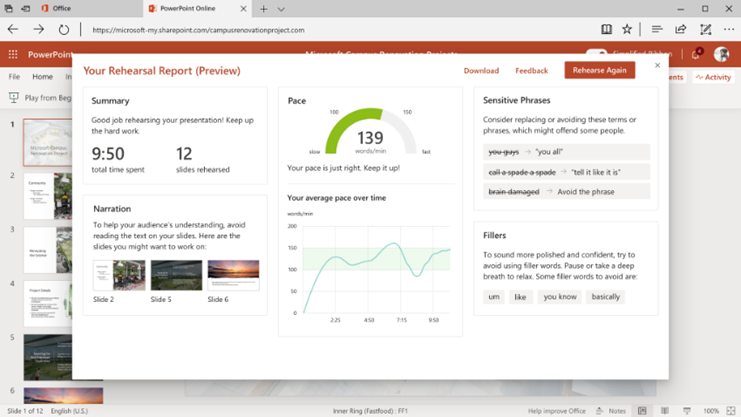
The new PowerPoint Presentation Coach aims to take the hassle out of practicing. In its current version, the tool looks at three things: pace, slide reading and word choice. Pace is pretty self-explanatory and looks at how fast or slow somebody is speaking. The ‘slide reading’ feature detects when you are simply reading the words from your slides word for word. Nobody wants to sit through that kind of presentation. The ‘word choice’ tool doesn’t just detect how often you say ‘um,’ ‘ah,’ ‘actually,’ or ‘basically,’ but it also gives you feedback when you are using culturally insensitive phrases like ‘you guys’ or ‘best man for the job.’

image001 4In addition to the new presentation coach, Office 365 is also getting a few other new features today. These include better inking support in PowerPoint, including the ability to replay what you drew on a slide so that you can essentially create animations that way (this is now available on Windows and Mac, with more inking support for Office on the web coming soon). Microsoft is also updating the  Microsoft Whiteboard with new templates and teachers with an Office 365 subscription can now make use of 10 new lesson plans that include 23 custom 3D models to bring those lessons to life.

25 Sep 2019

Netdata, a monitoring startup with 50 year old founder, announces $17M Series A

Nearly everything about Netdata, makers of open source monitoring tool, defies standard thinking about startups. Consider that the founder is a polished, experienced 50-year old executive, who started his company several years ago when he became frustrated by what he was seeing in the monitoring tools space. Like any good founder, he decided to build his own, and today the company announced a $17 million Series A led by Bain Capital.

Marathon Ventures also participated in the round. The company received a $3.7 million seed round earlier this year, which was led by Marathon.

Costa Tsaousis, the company’s founder and CEO, was working as an executive for a company in Greece in 2014 when he decided he had had enough of the monitoring tools he was seeing. “At that time, I decided to do something about it myself — actually, I was pissed off by the industry. So I started writing a tool at night and on weekends to simplify monitoring significantly, and also provide a lot more insights,” Tsaousis told TechCrunch.

Mind you, he was a 45 year old executive, who hadn’t done much coding in years, but he was determined as any startup founder tends to be, and he took two years to create his monitoring tool As he tells it, he released it to open source in 2016 and it just took off. “In 2016, I released this project to the public, and it went viral, I wrote a single Reddit post, and immediately started building a huge community. It grew up about 10,000 GitHub stars in a matter of a week,” he said. Even today, he says that it gets a half million downloads every single day, and hundreds of people are contributing to the open source version of the product, relieving him of the burden of supporting the product himself.

Panos Papadopoulos, who led the investment at Marathon, says Tsaousis is not your typical early stage startup founder. “He is not following many norms. He is 50 years old, and he was a C level executive. His presentation and the depth of his thinking, and even his core materials are unlike anything else have seen in an early stage startup,” he said.

What he created was an open source monitoring tool, one that he says simplifies monitoring significantly, and also provide a lot more insights, offering hundreds of metrics as soon as you install it. He says it is also much faster, providing those insights every second, and it’s distributed, meaning Netdata doesn’t actually collect the data, just provides insights on it wherever it lives.

Screenshot 2019 09 25 09.58.36

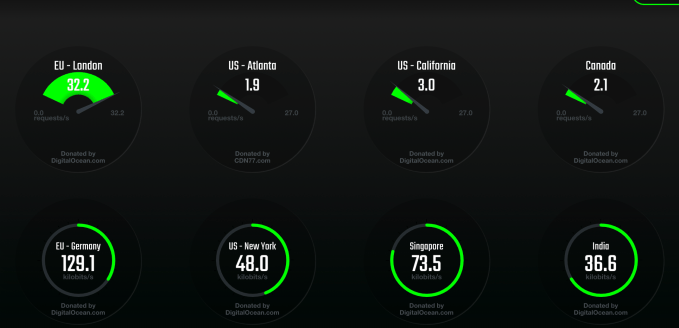
Live dashboard on the Netdata website.

Today, the company has 24 employees and Tsaousis has set up shop in San Francisco. In addition, to the open source version of the product, there is a SaaS version, which also has what he calls a “massively free plan.” He says the open source monitoring agent is “a gift to the world.” The SaaS tool is about democratizing monitoring, and finally, the pay version is even different from most monitoring tools, charging by the seat instead of by the amount of infrastructure you are monitoring.

Tsaousis wants no less than to lead the monitoring space eventually, and believes that the free tiers will lead the way. “I think Netdata can change the way people perceive and understand monitoring, but in order to do this, I think that offering free services in a massive way is essential, Otherwise, it will not work. So My aim is to lead monitoring. This may sound arrogant, and Netdata is not there yet, but I think it can be,” he said.

25 Sep 2019

How founder and CTO Dries Buytaert sold Acquia for $1B

Acquia announced yesterday that Vista Equity Partners was going to buy a majority stake in the company worth a $1 billion. That would seem to be reason enough to sell the company. That’s a good amount a dough, but as co-founder and CTO Dries Buytaert told Extra Crunch, he’s also happy to be taking care of his early investors and his long-time, loyal employees who stuck by him all these years.

Vista is actually buying out early investors as part of the deal, while providing some liquidity for employee equity holders. “I feel proud that we are able to reward our employees, especially those that have been so loyal to the company and worked so hard for so many years. It makes me feel good that we can do that for our employees,” he said.

Image via TechCrunch

25 Sep 2019

Arceo.ai raises $37 million to expand cyber insurance coverage and access

Critical cyber attacks on both businesses and individuals have been grabbing headlines at an alarming rate. Cybersecurity has moved from a background risk for enterprises to a critical day-to-day threat to business operations, forcing executive teams to pour time and hundreds of billions in capital into monitoring and prevention efforts.

Yet even as investment in security ticks up, the frequency and cost of cybercrime to businesses continues to rapidly accelerate, with the World Economic Forum estimating the economic loss due to cybercrime could reach $3 trillion by 2020.

More companies are now turning to cyber insurance as a means of mitigating financial exposure. However, for traditional insurers, cybersecurity remains a relatively nascent and unfamiliar issue, requiring risk-assessment data points and methodologies largely different from those seen in traditional insurance products. As a result, businesses often struggle to get the scale of cybersecurity coverage they require.

Arceo.ai is hoping to expand the size and scope of the cyber insurance market for both insurers and companies, by providing insurers with effective real-time data, analytics and context, necessary for safely and efficiently underwrite cyber risk.

This morning, Arceo took a major step in achieving that goal, announcing the company has raised a $37 million round of funding led by Lightspeed Venture Partners and Founders Fund with participation from CRV and  UL Ventures.

Using an expansive set of global sources across a customer’s digital footprint, Arceo.AI collects internal, external and macro cyber risk data which it uses to evaluate a company’s security and cyber risk management behavior. By automating the data collection process and connecting it with insurer underwriting processes, Arceo is able to keep its data and policy assessments up to date in real-time and enable faster, more efficient quotes.

A vital component of Arceo’s platform is its analytics offering. Using patented data science and cyber risk models, Arceo generates analytics-driven insights for insurance carriers, brokers and end-insured customers. For end-insured customers, Arceo helps companies understand whether they’re using the best mitigation strategies by providing policy recommendations and industry benchmarking to help contextualize day-to-day cyber behavior and hygiene. For underwriters, Arceo can provide specific insurance recommendations based on particular policy coverages.

Ultimately, Arceo looks to provide both insurers and the insured with actionable answers to key questions such as how one assesses cyber risk, how one determines what risks can be mitigated with technology alone, how one knows which systems are best and whether those systems are being used appropriately.

Raj Shah

Arceo.ai Chairman Raj Shah. Image via Arceo.ai

In an interview with TechCrunch, Arceo Chairman Raj Shah explained that the company’s background expertise, proprietary data systems, and deep pedigree in both the security and insurance truly differentiate Arceo from competing solutions. For starters, both Shah and Arceo co-founder and CEO Vishaal Hariprasad have spent close to the entirety of their careers in national security and cybersecurity. Hariprasad started his career in the Airforce’s first cohort of cyber warfare officers, before teaming up with Shah to start Morta Security in 2012, a security startup the two sold to Palo Alto networks in just roughly two years.

After selling the company, Shah and Hariprasad remained in the security world before realizing that there was a natural intersection between security and insurance, and a real opportunity for risk transfer solutions.

“Having studied the market, we saw that people are spending more and more dollars on cybersecurity products… There are hundreds of thousands of new vendors every year… Spend is going up, but we don’t feel any safer!” Shah told TechCrunch.

“That’s when we said ‘Hey, we need to move beyond just thinking about technology points and products, and think about holistic cyber risk management.’ And this is where insurance has historically done a great job. Putting a price on behavior and making people think and letting them take risks… From life and death and health to buyers and property and casualty. And so cyber is that next class risk… So that’s really why we started the business. We wanted to provide a real way to manage the cyber stress that they’re facing and that will impact every single one of our digital lives.”

Since the company’s founding, Raj and Vishaal have been joined by a deep network of cyber and insurance experts. Today, Arceo also announced that Hemant Shah, founder and former CEO of catastrophe risk modeling company RMS has joined Arceo’s Board of Directors. Additionally, earlier this month, the company announced that Mario Vitale, the former CEO of publically-traded insurance companies Willis Towers Watson and Zurich Insurance Group, would be joining the Arceo team as the company’s President.

The company noted that participation from high-profile industry vets like Hemant and Mario not only further advance Arceo’s competitive advantage but also acts as another major validation of the company’s future and work to date.

According to Arceo Chairman Raj Shah, after years of investing in R&D, the latest funds will be used towards expansion efforts and scaling Arceo to the broader ecosystem of insurance and brokers. Longer-term, the company hopes to offer the most complete combined cybersecurity and risk transfer solution to insurers and the insured, easing the stress around cyber threats for both enterprises and individuals and ultimately improving broader cyber resiliency.

If you’d like to hear more from Arceo’s Raj Shah, Raj will also be joining us this year on the Extra Crunch stage at TechCrunch Disrupt SF, where he’ll discuss how founders and companies should think about potential US government investment. We hope to see you there!


25 Sep 2019

Unbabel gets $60M for its blended approach to business translation

Unbabel, a Lisbon-based startup that’s built a platform for translating customer service messages at scale by combining the speed of machine translation with native (human) speaker nuance and expertise, has closed a $60 million Series C round.

The investment was led by Point72 Ventures, with participation from e.ventures, Greycroft, and Indico Capital Partners. The 2013-founded startup last raised a $23M Series B in January 2018. The latest round brings its total funding to date to $91M.

Unbabel describes its approach as “AI augmentation” and translation as a service — by which it means it combines the speed and low cost of machine translation with a layer of human expertise powered by a “global community” of human translators.

Last year its network of human translators was said to number around 55,000. The company told us it now has more than 100k registered translators providing translation services for its platform.

Unbabel classifies these workers as freelancers — saying it pays them online, into an Unbabel account, every time they complete a translation job.

The business itself lists just 200+ full time employees on its books.

UNBABEL TEAM

Customers signed up to use Unbabel’s translation platform to scale the global reach of their customer support services include the likes of Facebook, Microsoft, Booking.com and easyJet.

Unbabel says it has more than 150 enterprise customers using its platform, mainly in the travel, high tech, gaming and ecommerce sectors. It touts cost savings of up to 76% vs other translation methods and increased customer satisfaction.

It also claims it’s just seen its strongest quarter yet in terms of revenue growth (though it’s not breaking figures out), and also in machine learning “breakthroughs”, as it puts it (on the latter it references a shared task win in machine quality at the WMT19 conference this year).

Unbabel says the Series C funding will go on ramping up growth in the US, Europe and Asia, as well as on enhancing the capabilities of its AI — including building out an artificial intelligence research lab it recently announced in Pittsburgh.

“We are now translating over 1,000,000 customer service messages a month. That’s over five times the volume we saw in 2018, which underscores the global demand for agile multilingual customer service,” said co-founder and CEO Pedro Vasco in a statement.

“We were inspired by Unbabel’s vision to provide enterprise-grade translations at the click of a button and impressed with the human-in-the-loop translation technology they’ve built,” added Sri Chandrasekar, partner at Point72 Ventures, in a supporting statement. “We believe that Unbabel is poised to transform the translation industry, and we are incredibly excited to partner with them on this journey.”

25 Sep 2019

Ford expands self-driving vehicle fleet to Austin

Ford is adding another city to the list of places it’s going to be deploying self-driving vehicles: Austin. The automaker revealed that the Texas city would join Miami-Dade County and Washington, D.C. as the third deployment location for its autonomous vehicle testing and commercial service development.

As with its prior roll-outs, Ford will first begin by putting its Fusion Hybrid AV test vehicles, which are powered by Argo AI autonomous driving technology, on Austin roads by the end of November to begin mapping the city. Mapping cars will have a safety driver and an observer on board, and the cars will be collecting data to build the HD maps needed for eventual deployment of pilot commercial services with partners.

Ford will be announcing the specific location of the terminal from which its AVs will be operating soon, but said that the cars will be operating in the Downtown and east Austin areas to start, but that eventually they’ll look to expand as much as the market requires, going “as big as Austin allows us from a delivery standpoint,” according to Sherif Marakby, the CEO of Ford Autonomous Vehicles.

Marakby said on a briefing with journalists that Austin represents another very different and varied environment in which to test its technology, with a busy downtown, college areas and more. Autonomous vehicles should be able to “solve some issues” when working in tandem with the city, he added.

Ford’s strategy in developing and deploying AVs is to work on both the autonomous technology and the business aspects simultaneously, which is why it’s going to be looking for pilot businesses to partner with in the area. In the course of its research both in Austin and in its existing cities, it’s looking to figure out what the right mix is in terms of goods and package delivery, and ride-hailing and personal transportation.

Marakby says that Ford is still planning to deploy its AV fleet commercially for customers by 2021, and that Austin will be part of that deployment. He added that this will incorporate both passenger and goods transportation in response to a question about whether package delivery would precede moving people, but that the “exact mix will be determined as they work on segmentation.”

As for the vehicles themselves, the current Fusion Hybrid AVs are testing vehicles only, which are useful to Ford in developing and testing their technology stack, but the vehicles in actual commercial service will be purpose-built cars designed specifically for autonomous use.

21A0021 C1

This vehicle will be a hybrid-electric, which “makes sense from the perspective of running all day” and decreasing down-time due to charging, Marakby says. It’ll also be a commercial-grade vehicle, since “in autonomous mode, it’s hundreds of thousands of miles in a short period of time,” he added. The vehicle will also feature easy entry and exit and comfortable seating for passengers, but there will be a custom version that will be focused on goods transportation as well.

25 Sep 2019

Holberton School is coming to Tulsa, Oklahoma

Holberton School, the coding school that bills itself as an alternative to college for budding software engineers from all walks of life, keeps expanding. After recently opening up schools in Colombia and Tunisia, the organization today announced that it will open new campus in Tulsa, Oklahoma in January 2020. With this, Holberton will soon operate three schools in the U.S. (San Francisco, New Haven and Tulsa), three in Colombia (Bogota, Cali and Medellin), and one in Tunis, Tunesia.

For the Tulsa campus, Holberton is partnering with the George Kaiser Family Foundation (the third largest charitable foundation in the U.S.) and the Charles and Lynn Schusterman Family Foundation to offer students a need-based living assistance of $1,5000 per month to help cover expenses. Once students pass the blind entrance exam and gain admission to its two-year program, classes at Holberton are free until you get a job that pays more than $40,000. At that point, you pay Holberton a share of your income for the next 42 months, capped at $85,000.

“Holberton education will bring Silicon Valley skills to America’s heartland,” said Pauline Cohen Vorms, Holberton’s director of business development and partnerships. “By training students in the Tulsa area in high-paying, in-demand jobs, we can contribute to both the workforce development and economic growth in Tulsa.”

The school argues that its admissions process has enabled it to recruit one of the most diverse classes in the tech industry and that it has placed students at companies including Apple, Facebook, LinkedIn and Tesla. As with some of its other campuses, Tulsa brings Holberton’s curriculum to communities that aren’t typically seen as competitors to Silicon Valley but that surely have a large pool of engineering talent.

25 Sep 2019

QC Ware Forge will give developers access to quantum hardware and simulators across vendors

Quantum computing is almost ready for prime time, and, according to most experts, now is the time to start learning how to best develop for this new and less than intuitive technology. With multiple vendors like D-Wave, Google, IBM, Microsoft and Rigetti offering commercial and open-source hardware solutions, simulators and other tools, there’s already a lot of fragmentation in this business. QC Ware, which is launching its Forge cloud platform into beta today, wants to become the go-to middleman for accessing the quantum computing hardware and simulators of these vendors.

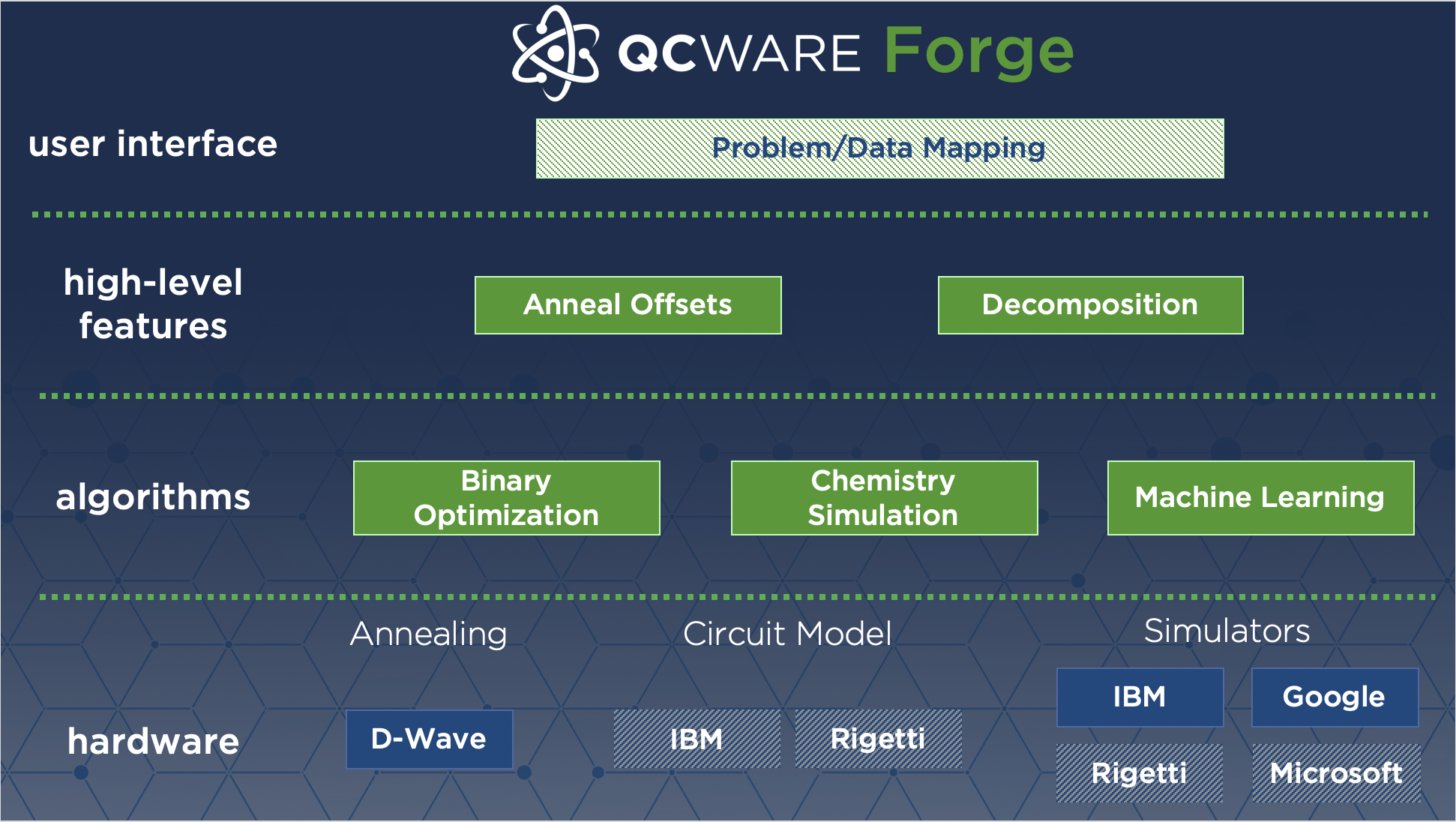
Forge, which like the rest of QC Ware’s efforts is aimed at enterprise users, will give developers the ability to run their algorithms on a variety of hardware platforms and simulators. The company argues that developers won’t need to have any previous expertise in quantum computing, though having a bit of background surely isn’t going to hurt. From Forge’s user interface, developers will be able to run algorithms for binary optimization, chemistry simulation and machine learning.

Screen Shot 2019 09 19 at 2.16.37 PM

“Practical quantum advantage will occur. Most experts agree that it’s a matter of ‘when’ not ‘if.’ The way to pull that horizon closer is by having the user community fully engaged in quantum computing application discovery. The objective of Forge is to allow those users to access the full range of quantum computing resources through a single platform,” said Matt Johnson, CEO, QC Ware. “To assist our customers in that exploration, we are spending all of our cycles working on ways to squeeze as much power as possible out of near-term quantum computers, and to bake those methods into Forge.”

Currently, QC Ware Forge offers access to hardware from D-Wave, as well as open-source simulators running on Google’s and IBM’s clouds, with plans to support a wider variety of platforms in the near future.

Initially, QC Ware also told me that it offered direct access to IBM’s hardware, but that’s not yet the case. “We currently have the integration complete and actively utilized by QC Ware developers and quantum experts,”  QC Ware’s head of business development Yianni Gamvros told me. “However, we are still working with IBM to put an agreement in place in order for our end-users to directly access IBM hardware. We expect that to be available in our next major release. For users, this makes it easier for them to deal with the churn. We expect different hardware vendors will lead at different times and that will keep changing every six months. And for our quantum computing hardware vendors, they have a channel partner they can sell through.”

Users who sign up for the beta will receive 30 days of access to the platform and one minute of actual Quantum Computing Time to evaluate the platform.

25 Sep 2019

Watch a Roscosmos rocket launch the next crew of the International Space Station live

NASA astronaut Jessica Meir, Rocscosmos cosmonaut Oleg Skripochka and first-time UAE spaceflight traveler Hazza Ali Almansoori are all set to launch aboard a Roscosmos rocket in a Soyuz capsule, as part of the Expedition 61 crew launch to the International Space Station.

The crew is set to take off from Kazakhstan at 9:57 AM EDT, and the spacecraft will dock with the ISS at around 3 PM EDT, roughly six hours after take-off. This is Skripochka’s third trip to space, but it’s the first for both Meir and Almansoori, with Almansoori on an eight-day mission contracted by the UAE with Russia’s space agency.

Once they arrive on the station, there will be 9 total occupants on board. Both Meir and Skripochka will be spending over six months on the ISS, condign research and experiments.