Year: 2019

25 Sep 2019

Devin Wenig steps down as eBay CEO

eBay this morning announced that Devin Wenig has stepped down from the role of CEO. A former executive at Reuters, Wenig joined the company eight years ago this month as president of its global market place division. He was appointed to the CEO role in July 2015, following eBay’s spinoff of PayPal.

“Devin has been a tireless advocate for driving improvement in the business, particularly in leading the Company forward after the PayPal spinoff,” Chairman of the Board Thomas Tierney said in a release tied to the news. “Indeed, eBay is stronger today than it was four years ago. Notwithstanding this progress, given a number of considerations, both Devin and the board believe that a new CEO is best for the company at this time.”

Scott Schenkel, the company’s Senior Vice President and Chief Financial Officer has been appointed interim CEO by eBay’s board. Schenkel has been with the company for 12 years, having previously spent several years in management at GE. eBay says it will “consider internal and external candidates” as it searches for someone to fill the position on a permanent basis.

The move comes amid turmoil at the company. Earlier this year, investors Elliott Management suggested key structural changes to help reinvigorate a floundering company.  “Today eBay suffers from an inefficient organizational structure, wasteful spend and a misallocation of resources,” it wrote in a letter at the time. eBay went through layoffs and restructuring, in the wake of the letter.

As part of these new changes up top, eBay will be appointing Vice President, Global Financial Planning and Analysis, Andy Cring, to the position of interim CFO.

25 Sep 2019

Vannevar Labs comes out of stealth to bring best-in-class AI tech to national security agencies

Few organizations have the complex data and analytics problems that challenge the defense and intelligence communities every single day. Whether it is managing petabytes of text, audio, or video data, finding extraordinarily small patterns in the noise, or processing multilingual analytics, the agencies at the heart of America’s national security system confront cutting-edge problems every day.

Despite the desire for better tools though, intelligence analysts are often stymied to procure up-to-date software due to the byzantine rules that drive Pentagon and intelligence procurement.

That’s why a former intelligence official and former intelligence investor are looking to build a new platform that connects the best minds in artificial intelligence, machine learning, and natural language processing and bundling it together into a service purchasable by these government agencies.

Through Palo Alto-based Vannevar, co-founders Brett Granberg and Nini Moorhead are hoping to launch their first product, which is focused on bringing NLP technologies like feature detection to international counterterrorism missions.

Vannevar Labs

Co-founders Nimi Moorhead and Brett Granberg of Vannevar Labs. Photo via Vannevar Labs.

The company is named for Vannevar Bush, who is often credited with inventing an early form of the computer, putting together the Manhattan Project which led to the atom bomb, and for writing a seminal essay that sort of predicted the internet decades before its inception.

The two chose this particular product as an entrée because of their past experiences. Before beginning Vannevar, Granberg spent two years at In-Q-Tel, the non-profit VC firm that works deeply with the intelligence community to supply agencies with the best in startup technology. He also was an advisor at Lilt, a real-time deep learning translation product that spun out of Chris Manning’s famed Stanford NLP research lab.

Meanwhile, Moorhead spent seven years working as a counterterrorism officer within the intelligence community, working to disrupt terrorist networks.

The two met while they overlapped at Stanford GSB and realized they had seen similar problems that they both wanted to solve. While in business school, “top of mind for me was some of the technological challenges that I encountered as an end user [and] analyst in the intelligence community,” Moorhead said. “We immediately connected and shared a lot of experiences in common in terms of seeing gaps between the really hard domain problems that I’d been working on in my career as an analyst and some of the technology that was available to me,” she said. The two actually met the first day of school.

Their approach is to take proven techniques and attempt to translate them into government use cases. “We’re not sort of inventing new math to solve these problems, we’re more taking cutting-edge approaches and just applying them to specific use cases,” Granberg said.

While the project is early, the team raised a $4.5 million seed venture capital funding from fellow GSB alum Katherine Boyle of General Catalyst and Costanoa Ventures. Boyle has made a big push into defense and highly-regulated industries as part of her investment practice, where she previously funded Anduril, the company started by Oculus founder Palmer Luckey that has attempted to apply ML technology to security issues such as battlefield awareness and border control (and gotten into some controversy along the way as well).

She is particularly excited about new ways for startups to secure government contracts at a speed faster than the sun burning out. Talking to me about the potential in this industry, she said:

We’ve been spending a lot of time with companies that are going after what’s known as Other Transaction Authorities, which are a new type of contracting vehicle that was developed in 2015 by former Secretary of Defense Ash Carter, to help tech companies work very quickly with the Department of Defense and with the intelligence community. So what historically might have taken 18 months to get a contract now takes 30 to 60 days for critical pieces of technology

Boyle explained that Vannevar fits directly into her thesis for the future of government procurement. “Our view is that the companies that do best in the space are people who have worked in government or understand how to sell to governments,” she said. She noted that the company is very early, and her investment was primarily focused on the team.

I asked about recent controversies that have hit companies like Google, which saw a revolt by some employees over its involvement with a defense program called Project Maven, which attempted to use machine learning technology and apply that to the battlefield, so that, for instance, drones could increase their effectiveness during strikes.

Granberg said that “we think that the people that defend our country should have access to the best tools and technologies to do their job. We know these people, we used to work with them, and we want to help them.”

He understands the concerns of critics though, and says that Vannevar intends to work with the government to ensure ethics remains core to its product. “We believe it’s our responsibility to sort of shape that technology and help the government think about putting in place policies that … prevent the misuse from happening.”

Boyle agreed. “One of the things that we’ve noticed is that if you’re very transparent and upfront about the types of products you’re going to be building in the beginning, it’s not a recruitment problem, it’s not an ethics problem.” Unlike Google, which had a six-figure large workforce with many employees who don’t want to touch defense-related code, the hope for Granberg and Moorhead is that a company like Vannevar can build a coalition of the willing, as it were, and maybe solve some serious security problems as well.


25 Sep 2019

Hack with these APIs at the Disrupt SF 2019 Hackathon

If you’re one of the 800 code poets lucky enough to score a seat for the TechCrunch Hackathon at Disrupt San Francisco 2019 on October 2-4, congratulations! The event is completely full, so if you missed out, try your luck next time.

The TC Disrupt SF Hackathon is a week away, and we bet you can’t wait to learn about what APIs you’ll be able to build on, correct? Without further ado, check out the APIs you’ll use to breathe life into your creation.

Filestack is the number-one file handling service for developers. Upload files into your app with 100x more reliability. Take those uploads and transform images at any URL by adding a few parameters and automatically generating a fully transformed image. Filestack provides responsive, reliable and secure delivery so that your files are delivered with unparalleled speed and control. Simplify content tasks using Filestack Workflows, an easy-to-manage UI that lets you automate commands into a single API call. Add intelligence to your workflow so your content is tagged, SFW and virus free before it ever hits your app. We’ve coded in the logic so that you don’t have to. Implement all of this with just a few lines of code.

Snap: Snap Kit is a collection of developer tools that help third parties build integrations with Snapchat. This collection developer libraries and APIs lets you build exciting new features for your app that Snapchatters love. Share to Snapchat’s camera, bring a user’s Bitmoji into your app, log in with Snapchat, and more!

Intersystems: InterSystems IRIS™ is a data platform for rapidly developing and deploying applications. It includes a massively scalable multi-model database, and automated mechanisms for deployment, in a reliable, unified platform spanning data management, interoperability, transaction processing, and analytics. We are providing our FHIR server and sample patient data so that you can build a healthcare solution using a simple REST interface. InterSystems IRIS supports relational and non-relational models and can be deployed through a variety of programing languages and available for on-premises, private or public cloud-based and hybrid deployments.

Kinship

Kinship will provide data around pet nutrition, location, activity, health and genetic health, breed info and more.

Humana: Teams may use approaches, tools and emerging technologies such as:

  • Sketch, InDesign, Balsamiq, Azure, Adobe XD, etc.
  • Web experiences, tablets or smartphone apps
  • Alexa, Google Home, Siri, etc.
  • Artificial Intelligence, Machine Learning
  • Natural Language Processing

Plaid will open up their libraries for use.

Plus we’ll have API information from United Airlines in the coming days.

The TechCrunch Hackathon takes place on October 2-4 at Disrupt SF 2019. Get ready to make your mark and revel in some high-pressure, exhilarating competition. We can’t wait to see what you create, and which team will take home the TechCrunch $10,000 grand prize for the best over-all hack.

Is your company interested in sponsoring the Hackathon at Disrupt SF 2019? Contact our sponsorship sales team by filling out this form.

25 Sep 2019

With a new $20 million in funding, electronic stethoscope startup Eko wants to research your beating heart

It’s hard to compete against the Apple Watch or even an app on your phone when it comes to personal heart rate monitors these days. However, Eko, a startup best known for creating an electronic stethoscope to monitor your heart rhythm, hopes further research and development will help give its more clinically promoted device a leg up as a leader in the fight against heart disease.

To get there, the company recently closed on a $20 million round of Series B financing, led by Artis Ventures. New and returning investors in the round also include DigiTx PartnersNTT Venture Capital (NTTVC)3M VenturesMayo ClinicSeraph Group, and XTX Ventures.

On top of that, the company has teamed up with some well-known health partners such as the Mayo Clinic, Northwestern Medicine and Sutter Health, to further connect data points and screen patients using the Eko device.

EkoIt’s no leap to say technology has made great strides in cardiac care in the last decade. Today, we can use a number of devices to find out if there’s some sort of arrhythmia in a matter of seconds. However, choosing the way we do that is critical — getting the right information from trained professionals before jumping to conclusions is even more necessary.
It also does more than just test your heart rate, Eko co-founder and COO Jason Berler told Techcrunch. “While Eko helps screen for AFib, we’re also focused on screening for structural heart diseases and heart failure, which Apple is not,” he said. “Eko captures both heart sounds and EKG simultaneously, giving physicians the most holistic assessment of a patient’s health, and the information needed to make better-informed decisions.”

While Eko faces stiff competition from many heart rate monitoring devices out on the market today, it seems to grasp the need to go beyond a simple heart rate app for further knowledge on determining heart health through doctors and specialists who can identify and further inform patients in need.

“Eko is transforming cardiac care as we know it,” Artis Venture partner Vasudev Bailey said in a statement. “They are the perfect example of how machine learning using quality data sets can positively influence patient outcomes and improve quality of care. This demonstrates the potential for an immense pipeline of life-saving applications where sound can aid in the screening of many other diseases.”

25 Sep 2019

ZenBusiness raises $10m to help founders launch and grow “worry-free”

There are two sides to starting a new business. On one side, entrepreneurs need creativity, imagination — a dream, essentially — to find, build, and market a new product to users and consumers. But on the other side, they have to deal with the regulatory state and all the minutia that comes with running any business in the 21st century.

That includes such delightful topics as choosing a particular model for incorporation, ensuring that a business has the right licenses to operate, and tracking all the legal changes happening in 50 state legislatures every year. It can be inordinately complicated (and expensive!) to ensure that your business is ready and legal.

That’s where ZenBusiness comes in. The Austin-based startup wants to empower entrepreneurs to build businesses large and small by dramatically simplifying the processes required to launch a business and then grow it.

When I last chatted with the company 18 months ago, they had just raised a $4.5 million seed round and had launched its platform. Today, it’s announcing that it has raised a new $10 million series A round led by return backer Greycroft, along with returning investors Lerer Hippeau and Revolution’s Rise of the Rest fund, alongside new investors Rosecliff Venture Partners, Interlock Partners and Recruit Strategic Partners.

The company launched with a product that was essentially an automated registered agent for new entrepreneurs. Under state incorporation laws, companies must designate a so-called “registered agent” to receive official notices from regulatory agencies, and so ZenBusiness chose this strategic point for entry into the market.

When I last chatted with CEO Russ Buhrdorf, he described rolling up this market as one of the key initial targets for the company:

ZenBusiness is the brainchild of Ross Buhrdorf, who joined vacation rental marketplace HomeAway five months after its inception as founding CTO, and stayed for a decade until its acquisition by Expedia in 2015 for $3.9 billion. Buhrdorf intended to take a year off, but “didn’t quite make it a year” he told me.

He explained to me that HomeAway in many ways followed a rollup playbook, “raising $400 million and acquired 26 companies.” Bringing that rollup lens while exploring new spaces, he ran into the corporate legal services market, which offers help to companies to keep them in compliance with the law. Buhrdorf liked what he saw. “It’s different in all 50 states, highly-regulated, which is great for technology, it is overpriced, and they underserve their customers.” He says the space is “completely ripe for disruption.”

Since that time, the company has expanded its product to help entrepreneurs get beyond merely incorporating to actually building out their business by recommending services like banking, lending, tax preparation, website building, and more. The hope is to provide a “worry-free” guarantee to entrepreneurs so that they can get those early critical logistics out of the way and back to actually operating and growing their business.

“Small businesses come through this funnel, they don’t necessarily know exactly what to do. So we curate that solution, and then we provide them with the basics for them to get up and running and to be successful,” Buhrdorf said.

He explained that the company has built out some tools itself such as a simple webpage creator, but in the long run, he hopes to partner with other providers who integrate into the ZenBusiness platform. For instance, ZenBusiness has partnered with Xero as the company’s main accounting provider, while also backstopping that offering with accountants working at ZenBusiness. The idea is that the automated tooling plus a little human touch can help most owners handle the day-to-day challenges of running a business.

TeamPhoto2018

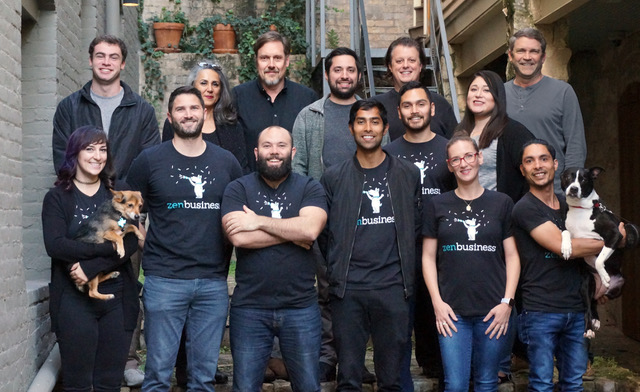
The ZenBusiness team in 2018. Photo via ZenBusiness.

Buhrdorf is particularly focused on keeping the product very self-service and automated to allow it to focus on these smaller customers. “Many of the companies that you cover that are in the enterprise space, who provide solutions for medium-sized businesses, they have to charge, they have to have sales forces, it’s very competitive there,” Buhrdorf said. “What we’re after is the segment that’s underserved, it’s the long tail of the small business segment.”

ZenBusiness has expanded its services, and it is hoping to use the fresh infusion of capital to invest in building out community features that will allow small business owners to swap tips with each other and help one another grow their businesses (presumably with some guidance from ZenBusiness community managers and experts).

The company is now 40 employees predominantly in Austin with a small office in Peru. Since we last checked in, the company has transitioned to become a public benefit corporation, which Buhrdorf said was an attempt to better align the company’s charter with its mission orientation to help small business entrepreneurs.

25 Sep 2019

ZenBusiness raises $10m to help founders launch and grow “worry-free”

There are two sides to starting a new business. On one side, entrepreneurs need creativity, imagination — a dream, essentially — to find, build, and market a new product to users and consumers. But on the other side, they have to deal with the regulatory state and all the minutia that comes with running any business in the 21st century.

That includes such delightful topics as choosing a particular model for incorporation, ensuring that a business has the right licenses to operate, and tracking all the legal changes happening in 50 state legislatures every year. It can be inordinately complicated (and expensive!) to ensure that your business is ready and legal.

That’s where ZenBusiness comes in. The Austin-based startup wants to empower entrepreneurs to build businesses large and small by dramatically simplifying the processes required to launch a business and then grow it.

When I last chatted with the company 18 months ago, they had just raised a $4.5 million seed round and had launched its platform. Today, it’s announcing that it has raised a new $10 million series A round led by return backer Greycroft, along with returning investors Lerer Hippeau and Revolution’s Rise of the Rest fund, alongside new investors Rosecliff Venture Partners, Interlock Partners and Recruit Strategic Partners.

The company launched with a product that was essentially an automated registered agent for new entrepreneurs. Under state incorporation laws, companies must designate a so-called “registered agent” to receive official notices from regulatory agencies, and so ZenBusiness chose this strategic point for entry into the market.

When I last chatted with CEO Russ Buhrdorf, he described rolling up this market as one of the key initial targets for the company:

ZenBusiness is the brainchild of Ross Buhrdorf, who joined vacation rental marketplace HomeAway five months after its inception as founding CTO, and stayed for a decade until its acquisition by Expedia in 2015 for $3.9 billion. Buhrdorf intended to take a year off, but “didn’t quite make it a year” he told me.

He explained to me that HomeAway in many ways followed a rollup playbook, “raising $400 million and acquired 26 companies.” Bringing that rollup lens while exploring new spaces, he ran into the corporate legal services market, which offers help to companies to keep them in compliance with the law. Buhrdorf liked what he saw. “It’s different in all 50 states, highly-regulated, which is great for technology, it is overpriced, and they underserve their customers.” He says the space is “completely ripe for disruption.”

Since that time, the company has expanded its product to help entrepreneurs get beyond merely incorporating to actually building out their business by recommending services like banking, lending, tax preparation, website building, and more. The hope is to provide a “worry-free” guarantee to entrepreneurs so that they can get those early critical logistics out of the way and back to actually operating and growing their business.

“Small businesses come through this funnel, they don’t necessarily know exactly what to do. So we curate that solution, and then we provide them with the basics for them to get up and running and to be successful,” Buhrdorf said.

He explained that the company has built out some tools itself such as a simple webpage creator, but in the long run, he hopes to partner with other providers who integrate into the ZenBusiness platform. For instance, ZenBusiness has partnered with Xero as the company’s main accounting provider, while also backstopping that offering with accountants working at ZenBusiness. The idea is that the automated tooling plus a little human touch can help most owners handle the day-to-day challenges of running a business.

TeamPhoto2018

The ZenBusiness team in 2018. Photo via ZenBusiness.

Buhrdorf is particularly focused on keeping the product very self-service and automated to allow it to focus on these smaller customers. “Many of the companies that you cover that are in the enterprise space, who provide solutions for medium-sized businesses, they have to charge, they have to have sales forces, it’s very competitive there,” Buhrdorf said. “What we’re after is the segment that’s underserved, it’s the long tail of the small business segment.”

ZenBusiness has expanded its services, and it is hoping to use the fresh infusion of capital to invest in building out community features that will allow small business owners to swap tips with each other and help one another grow their businesses (presumably with some guidance from ZenBusiness community managers and experts).

The company is now 40 employees predominantly in Austin with a small office in Peru. Since we last checked in, the company has transitioned to become a public benefit corporation, which Buhrdorf said was an attempt to better align the company’s charter with its mission orientation to help small business entrepreneurs.

25 Sep 2019

Social care startup Lifted raises £1.5M for end-to-end elderly care platform

The number of elderly adults requiring home care is set to grow at an alarming rate in most western countries as people live progressively longer. But underinvestment in technology and healthcare means society is at risk of vastly under-delivering. It’s very hard to scale these service and subsequently, no company has more than a low percentage market share. Few home care brands have much trust. In the UK 38% of people caring for a loved one (81% of whom are women) drop out of the workforce to have to deal with elderly relatives.

In the UK, a few companies are trying to address this issues: Traditional incumbents like Bluebird Care and Home Instead which are traditional home care agencies which don’t scale; “Introductory agencies” like Supercarers and Elder who do not train their carers directly with the associated problems; and so-called tech-enabled new players like Cera which have limits tech deployment as it is.

London-based Lifted plans to address some of these shortcomings with a full-blown end-to-end ‘Apple-like’ solution.

It’s now raised £1.5m in seed funding after being founded by Rachael Crook and Sam Cohen. Crook is a former Cabinet Office and McKinsey Consultant, who started Lifted after a frustrating experience trying to arrange care for her mother after she was diagnosed with dementia aged 56.

The startup was incubated inside Zero 1, a new corporate venture builder.

The company is a CQC-regulated care provider which gives families real-time updates on care, and a set of wellness data about their loved one. The Care Management Platform is a way to schedule visits, keep a check on tasks that have been completed and receive notifications when care begins and ends.

The default rate is £19 an hour for hourly care and £950 a week for live-in care. Clients can choose to purchase this as an additional service for which they will charge a subscription fee.

Crook says: “There are few more important decisions than who to trust to look after your loved ones. Yet the current market is broken with a lack of transparency, poor quality care and poor working conditions for carers. Precious data languishes in paper files. Lifted is on a mission to change this by harnessing the power of technology and data to transform the quality of care and improve the lives of carers and families.”

Lifted’s future plans include broadening their service offering by combining professional care and in-home technology. This will bring together health alerts, in-home sensors, and professional carers to transform what it means to care.

Lifted will develop AI-based analytics to predict and prevent health deterioration.

Unlike other start-up care providers, Lifted directly employs its carers and pays the London Living Wage, which is 20% above the market average for hourly care and enabled by operational savings achieved by using a technology platform.

Founded in 2018 by Finn MacCabe, Damian Cristian and Guy Conway, Zero 1 has built three new companies in Insurance, Cloud Compute and Health Care, in partnership with FTSE 100 companies.

25 Sep 2019

Duda nabs $25M to take on WordPress with a web development platform aimed at agencies

WordPress last week secured its position as a top dog in the world of web development when its parent company Automattic announced a $300 million raise at a $3 billion valuation, just weeks after it snapped up Tumblr from Verizon. But true competition never really ends, and today brings the latest development on that front: Duda, which provides a cloud-based website building platform for developers — in its case targeting potentially non-technical builders at digital agencies and SaaS platforms — is today announcing that it has raised $25 million from a single investor, Susquehanna Growth Equity.

The funding, which brings the Palo Alto-based startup to $50 million raised to date, comes as Duda hits some strong milestones. There have been more than 560,000 websites built on its platform to date from some 6,000 web professionals — a mark of the B2B2C channel that Duda uses to grow (on an average this would work out to around 93 sites per developer or agency).

Itai Sadan, Duda’s co-founder and CEO, said in an interview that the plan will be to use the funding to continue investing in its platform — it has a team of engineers in Israel — as well as in sales and marketing, and specifically in convincing customers to make the switch to its platform from bigger competitors.

To wit: if you do a quick Google search for Duda WordPress, you’ll see that the company has already put a lot of effort into creating tools to port sites from the latter to the former, and articulating the reasons why Duda is faster to use, better for pushing updates and preferable for publishing further websites and web pages at scale. (Duda claims that those making the switch achieve a 50% reduction in site build times.)

The company began life as a mobile-first web development company, at a time when many thought that mobile web would be a viable, and potentially larger, alternative to building native apps for mobile platforms. That, of course, never quite materialised as a big business, since apps did indeed continue to boom, and responsive web design meant that it was much easier to build once for the web and have it simply work on mobile, rather than invest in a separate mobile-web-only build.

That doesn’t mean, however, that all the platforms that are on the market today have been a perfect fit for agencies or SaaS platforms that might be working on bringing dozens or hundreds of sites, or pages of sites, online simultaneously.

“We are very familiar with the frustration many web professionals experience daily due to the lack of suitable web design platforms. Our team has developed a product that integrates all of the components needed for professional-grade web design to effectively serve digital agencies and SaaS platforms and allow them to scale their business,” said Itai Sadan, Co-Founder and CEO of Duda, in a statement.

Working with agencies and others that may not be hard-coding websites, the company has build a suite of tools to help those who are non-technical designers to be able to build and update sites with minimal fuss and bugs.

The idea here is to provide something much more advanced and customizable than what you might get on a platform like Wix, but without some of the hiccups that Duda claims you are likely to encounter on WordPress (or via a provider that works on WP), in part because, as Sadan described it to me, the open source foundation on which WordPress has been built can throw up a catalog of errors that are complicated to fix, even for engineers let alone non-technical staff.

The features, for example, include something Duda calls its Widget Builder, so that a tool or action that is repeated across multiple sites can be turned into a widget to be implemented more quickly and easily. These also come with APIs to integrate other data sources into Duda sites. It also has a tool to manage site comments — not commenting by site visitors, but a way for clients to better mark requests and changes for their agencies. Asset sharing is also possible on the platform.

The pitch is that this is what customers need today.

“While the Susquehanna team and I were initially impressed with the product, it wasn’t until we started speaking with customers that we realized just how powerful the platform is for the thousands of web professionals it serves. Time and again, customers told us that Duda catalyzed the growth of their agencies,” said Noa Wolfson, Investor at SGE, in a statement. “The ability to have all site building and client management needs on a centralized, and more importantly, secure, platform saves web professionals time and money.” Noa Wolfson has also joined the company’s board.

With tens of thousands of agencies globally still to tackle, the ambitions are high at the company. “We’re just scratching the surface,” said Sadan.

25 Sep 2019

Nintendo’s ‘Mario Kart Tour’ is out now for iPhone and iPad

Mario Kart Tour, Nintendo’s latest mobile game, is now available on iOS for iPhone, iPad and iPod touch. The game, like Nintendo’s other iOS releases, is free-to-play with in-app purchases (in-game currency called ‘rubies’) that you use for upgrades and unlocks.

Players immediately unlock one rider and get a tutorial to start, which introduces you to the Mario Kart Tour driving mechanics, which are slightly different than the ones you’re probably used to if you’ve played Mario Kart games for Nintendo’s various consoles. Specifically, your kart will always be moving forward, so there’s no acceleration to press, and instead you slide your finger side-to-side on the screen to steer left and right, with a tap firing off any items or weapons you might pick up.

High scores earn you points that can be redeemed for in-game unlocks, and the game also features other new mechanics like ‘frenzy mode,’ which gives you a timed period of unlimited item use whenever you pick up three of the same. Special challenges are also new in this mobile iteration, which introduce new ways to win instead of just placing first in a race with other kart drivers. Mario Kart Tour also features online ranking with other mobile players worldwide.

The ‘Tour’ component of the game is also a new twist: Nintendo is mixing courses inspired by real-world cities in with levels that are taken from classic Mario Kart games, and these will be cycling every two weeks for a fresh global tour on a regular basis. In-game characters will also get costume variants that are inspired by these globe-trotting destinations.

Based on Nintendo’s past track record, Mario Kart Tour should be perfectly playable without any in-game purchases, but players may feel that they hit a progression wall pretty quickly without picking up some currency. It’ll be interesting to see how this one fares, given that Apple has just introduced its own Arcade subscription service focused on games that eschew in-app purchase mechanics – including cart racer Sonic Racing, which looks very much like it was once intended to offer similar in-app mechanics before Arcade came along.

25 Sep 2019

Kreditech, the AI-based near-prime loans platform, nabs $22M under new CEO to expand globally

Cash advances (or simply, loans) continue to be a lucrative area for startups to tackle. By leveraging new AI-based tools to evaluate potential customers, the network effect of the internet and the quick efficiency of digital money transfer, they’re taking on incumbent banks to disrupt a consumer lending market estimated to be worth some $284 billion in 2018 and around $300 billion this year.

Today, one of the earlier players in the space that specifically targets emerging economies is announcing a round of funding to expand its business: Kreditech, the Hamburg, Germany-based provider of loans and point-of-sale financing to near-prime borrowers in countries that include Poland, Spain, Russia and India, has picked up €20 million ($22 million).

The funding is being led by Russian VC Runa Capital, with participation also from an unnamed German private investor, and previous investors HPE Growth and Amadeus Capital Partners, along with unnamed fintech angels. Valuation is not being disclosed, but as a point of reference Kreditech was valued at around €500 million in its last fundraise. Other investors in the company include Peter Thiel, Rakuten and the IFC.

This is an equity round that it will be using to continue building its business specifically in the latter of those four countries — doubling down on the fact that India is not only one of the world’s biggest economies, but one of the fastest-growing, too. It’s also a country where Kreditech has been working to build its business for years at this point: its last big funding round before this was in 2017, when Naspers’ PayU invested €110 million in the company as part of a strategic partnership to offer Kreditech financing in India.

Kreditech was founded originally around the idea of using AI to make better assessments of potential borrowers in developing economies (and manage the underwriting using that data and automation), the idea being to target those who have little or no credit history behind them. The company started to shift this strategy in 2017 to concentrate instead on “near prime” borrowers — those who may have a credit history, but not a particularly good one.

It’s a strategy it has continued to pursue under newish CEO David Chan (he joined in 2018 as part of a larger management overhaul and comes with a pretty impressive background with executive roles at Barclay’s consumer division, Citigroup and American Express). The company now projects that it will be clearing €1 billion in revenues by 2025 (so, roughly in the next five years) following this strategy. It will only be disclosing its current turnover and other financials next month.

Today’s funding round is not the biggest you will see in fintech, a capital-intensive business that regularly sees rounds in the hundreds of millions (or even in the multiple billions of dollars) to help startups in their expansion efforts. But it also comes after a relatively cool period for fintech funding, where the very biggest acquisitions — such as Alibaba yesterday reupping its stake in Ant Financial by 33 percentage points — have been closures of deals that actually first materialised a year ago.

With that backdrop, the company has been somewhat under the radar in the last couple of years, but appears now to be lifting its head again above the parapet.

“We are on track to realize our vision, which is to be one of the leading technology-enabled consumer-lending companies; a fintech platform of choice for both individuals and POS and e-commerce partners. With a new strategy in place, a solid capital base and our highly motivated and experienced team, we are perfectly positioned to achieve our goals”, says David Chan, Kreditech CEO, in a statement.

“I am really excited about our growth plans in India,” he continued. “We hold a first-of-its-kind digital NBFC (non-banking financial company) license in a large and fast-growing market. We have been successful in finding our niche and have established the right proof of concept. Now it’s time to scale up while a key target customer segment remains unaddressed by the competition.”

Runa’s involvement is a sign that we will see Kreditech also active in Russia and other Eastern European markets, is my guess.

“We are excited to be partnering with Kreditech as it continues on its path to becoming a global leader in digital near-prime lending. We believe that access to credit will continue to be improved through innovation and we see Kreditech as the emerging leader in this space, especially considering its presence in multiple fast-growing markets around the world,” said Andre Bliznyuk, General Partner at Runa Capital, in a statement.

“We are keen to support Kreditech,” Tim van Delden, co-founder of HPE Growth, added in a statement. “We have great trust in the new management team that Kreditech put in place in 2018. Kreditech’s track record over the last eighteen months, together with its business focus, strategy refinement and path to profitability has been truly impressive. For these reasons, HPE is convinced that Kreditech has the right management team to scale the business into the near-prime market. Kreditech’s core pillars of success remain the same – it is a technology and data-driven company that is able to use machine learning scoring models to make credit decisions in real time and with greater accuracy.”