Year: 2019

25 Sep 2019

MaxAB raises $6M seed round to optimize Egypt’s B2B grocery markets

Cairo based startup MaxAB looks to optimize the supply-chain network for Egypt’s food and grocery retailers.

The B2B e-commerce company raised a $6.2 million seed-investment co-led by Beco Capital and 4DX Ventures. Others to join the round were 500 Startups, Endure Capital, and Outlierz Ventures.

Founded in 2018, MaxAB has built a digital platform to manage procurement and delivery of grocery products to shops in Egypt. The startup’s developer team created an app for store-owners to purchase goods, another logistics app for its delivery fleet, and one for its customer support team.

MaxAB’s target market is small-scale retailers in Egypt, who sell to the country’s 100 million population.

“The Wal-Mart’s and the Krogers and Walgreen’s of Egypt only represent 10% of the market; 90% of this $50 billion market gets transacted through small mom and pop shops,” MaxAB CEO Belal El-Megharbel told TechCrunch on a call from Cairo.

He developed the startup idea while working as a General Manager at Careem — the Middle Eastern ride-hail company acquired by Uber in 2019 — and co-founded MaxAB with Mohamed Ben Halim.

Both saw an opening to reduce cost and complication in Egypt’s B2B food and grocery markets.

MaxAB Belal El Megharbel CEO“It’s a very segmented supply-chain. Small shops in Cairo have to go through six or seven-layers in between — the shipping,  unboxing, determining product quality, and setting base prices — and that’s what we’re fixing for them,” said El-Megharbel.

MaxAB has a fleet of 60 trucks and a large warehouse that serves Cairo. The startup tailored a logistics practice for Egypt to make sure it can meet retail customer needs. “We’ve come up with our own model we call just-in-case inventory, where we keep three to four days additional inventory to accommodate for supplier unreliability,” explained El-Megharbel.

MaxAB has a staff of 270 and 9,000 retailers on its app, according to a company release. The venture generates revenue on margins it earns from the buy to sell price of the products it offers. Unsurprisingly, El-Megharbel names achieving scale as the path to profitability. “The bigger your scale the better the margins you gain on supply,” he said.

Drawing on its seed-round, MaxAB also aims to generate revenue by expanding its offerings to working-capital financing and data-analytics services to its retail clients. The startup will expand its operations to several different cities in Egypt and grow its tech team.

The company has no immediate plans to operate outside of Egypt, according to El-Megharbel, but could consider expansion in North Africa in the future.
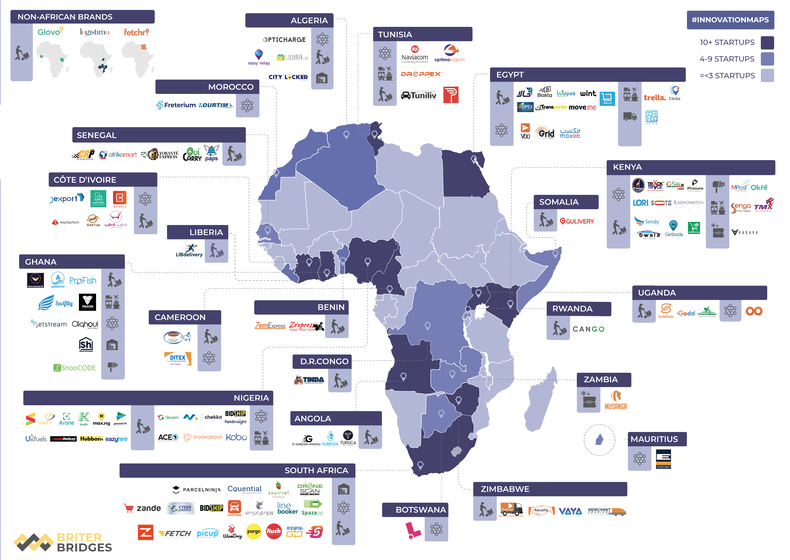
Briter Bridges Map Logistics Africa CroppedMaxAB will raise another funding round in approximately a year’s time, he said. 4DX Ventures  Managing Partner Peter Orth confirmed the fund’s participation in the $6.2 million seed-financing. Orth will take a board seat with MaxAB.

Transport-tech focused startups received the largest share of the $33 million in VC invested in Egypt in 2018, according to WeeTracker. Research by Briter Bridges tracks 120 logistics and supply-chain related startups in Africa.

In 2018, MaxAB investor 4DX ventures led a $2 million round in Kenya based B2B supply-chain startup Sokowatch, founded by Daniel Yu.

The companies share a similar retail logistics focus, but the founders don’t appear poised to enter each other’s markets or become competitors just yet. “Daniel’s a really smart-guy. We meet and talk quite often,” MaxAB CEO Belal El-Megharbel said.




25 Sep 2019

MaxAB raises $6M seed round to optimize Egypt’s B2B grocery markets

Cairo based startup MaxAB looks to optimize the supply-chain network for Egypt’s food and grocery retailers.

The B2B e-commerce company raised a $6.2 million seed-investment co-led by Beco Capital and 4DX Ventures. Others to join the round were 500 Startups, Endure Capital, and Outlierz Ventures.

Founded in 2018, MaxAB has built a digital platform to manage procurement and delivery of grocery products to shops in Egypt. The startup’s developer team created an app for store-owners to purchase goods, another logistics app for its delivery fleet, and one for its customer support team.

MaxAB’s target market is small-scale retailers in Egypt, who sell to the country’s 100 million population.

“The Wal-Mart’s and the Krogers and Walgreen’s of Egypt only represent 10% of the market; 90% of this $50 billion market gets transacted through small mom and pop shops,” MaxAB CEO Belal El-Megharbel told TechCrunch on a call from Cairo.

He developed the startup idea while working as a General Manager at Careem — the Middle Eastern ride-hail company acquired by Uber in 2019 — and co-founded MaxAB with Mohamed Ben Halim.

Both saw an opening to reduce cost and complication in Egypt’s B2B food and grocery markets.

MaxAB Belal El Megharbel CEO“It’s a very segmented supply-chain. Small shops in Cairo have to go through six or seven-layers in between — the shipping,  unboxing, determining product quality, and setting base prices — and that’s what we’re fixing for them,” said El-Megharbel.

MaxAB has a fleet of 60 trucks and a large warehouse that serves Cairo. The startup tailored a logistics practice for Egypt to make sure it can meet retail customer needs. “We’ve come up with our own model we call just-in-case inventory, where we keep three to four days additional inventory to accommodate for supplier unreliability,” explained El-Megharbel.

MaxAB has a staff of 270 and 9,000 retailers on its app, according to a company release. The venture generates revenue on margins it earns from the buy to sell price of the products it offers. Unsurprisingly, El-Megharbel names achieving scale as the path to profitability. “The bigger your scale the better the margins you gain on supply,” he said.

Drawing on its seed-round, MaxAB also aims to generate revenue by expanding its offerings to working-capital financing and data-analytics services to its retail clients. The startup will expand its operations to several different cities in Egypt and grow its tech team.

The company has no immediate plans to operate outside of Egypt, according to El-Megharbel, but could consider expansion in North Africa in the future.

Briter Bridges Map Logistics Africa CroppedMaxAB will raise another funding round in approximately a year’s time, he said. 4DX Ventures  Managing Partner Peter Orth confirmed the fund’s participation in the $6.2 million seed-financing. Orth will take a board seat with MaxAB.

Transport-tech focused startups received the largest share of the $33 million in VC invested in Egypt in 2018, according to WeeTracker. Research by Briter Bridges tracks 120 logistics and supply-chain related startups in Africa.

In 2018, MaxAB investor 4DX ventures led a $2 million round in Kenya based B2B supply-chain startup Sokowatch, founded by Daniel Yu.

The companies share a similar retail logistics focus, but the founders don’t appear poised to enter each other’s markets or become competitors just yet. “Daniel’s a really smart-guy. We meet and talk quite often,” MaxAB CEO Belal El-Megharbel said.



25 Sep 2019

Manila-based payments processing startup PayMongo raises $2.7 million in seed funding

Manila-based financial tech startup PayMongo has raised $2.7 million in seed funding to give merchants in the Philippines and other Southeast Asian markets simple ways to set up online payments. Investors included Founders Fund, Peter Thiel and Stripe, with participation from Y Combinator (PayMongo is the first Philippine fintech company it has funded), Global Founders Capital, Soma Capital, Tinder co-founder Justin Mateen and other angel investors.

PayMongo was launched in June by a founding team that includes CEO Francis Plaza, COO Edwin Lacierda, CTO Jamie Hing and chief growth officer Luis Sia. Since then, more than 1,000 businesses have started using its platform and the startup says its total transaction value processed is growing at an average of 117% week over week. PayMongo’s seed round will be used for hiring, product development, business acquisitions and strategic partnerships.

paymongo founders

PayMongo founders

The startup will focus on the Philippines first, where the country’s central bank has set a target of increasing the rate of cashless payments to 20%. Plaza says PayMongo’s goal is to become the largest payment service provider in the country before expanding to other markets in Southeast Asia.

Prior to launching PayMongo, its team spent several years working on other projects. During that time, they realized payments were the hardest feature to integrate into products and services. Even though the Philippines’ Internet economy is growing quickly (a report from Google expects it to increase from $5 billion in 2018 to $21 billion by 2025) and more people are using e-commerce, online payments have lagged behind the rest of the world, Plaza says.

“When you want to launch something online for a payment gateway, you have to deal with banks and many different financial institutions. It takes months, we tried it ourselves, from negotiating rates to submitting paperwork. It takes a long time, and then in the end you are charged high fees,” he tells TechCrunch.

Even after businesses finish dealing with banks, they need to figure out payment gateways that are often difficult for people with little tech experience to start using.

PayMongo has already partnered with several financial institutions and its technology, including a payments API that Plaza says can be set up in minutes, is designed to be user friendly. Since many online merchants in the Philippines sell through social media platforms and messaging apps, like Facebook, Instagram, Viber and WhatsApp, PayMongo also provides customizable payment links that they can send to customers.

The credit card penetration rate in the Philippines is only about 6%, Plaza says, so PayMongo also supports e-wallets like GCash and PayMaya and services that allow people to pay for online purchases in cash at convenience stores. PayMongo’s products for micro-entrepreneurs, like freelancers and people who sell items through social media, help it differentiate from competitors like Paynamics, Dragonpay and PesoPay that typically focus on serving larger businesses (though Plaza says PayMongo has also been adopted by large retail chains).

In a statement, Y Combinator partner Kevin Hale said “At YC, we love companies who build services that empower startups. We believe PayMongo will provide the infrastructure that is needed for more Filipinos to become founders who are in charge of their own destiny.”

25 Sep 2019

Fidel raises $18M to let developers build on top of payment data from Visa, MasterCard and Amex

Fidel, the U.K.-headquartered startup that offers an API to let developers build functionality, such as rewards, on top of the major card payment networks, has raised $18 million in Series A funding.

The pretty sizeable round is co-led by U.S.-based fintech funds Nyca Partners and QED Investors. Also participating are Citi Ventures, Commerce VC, Elefund, Horizons Ventures, RBC Ventures Inc. (a subsidiary of Royal Bank of Canada), and 500 Startups. Several angel investors also joined in, such as Cris Conde, former CEO of Sungard, and Taavet Hinrikus, founder of TransferWise.

Meanwhile, Hans Morris, former President of Visa and Managing Partner of Nyca Partners, and Yusuf Ozdalga, Partner at QED Investors, will join the company’s board.

Fidel says the new funding will be used to expand the Fidel team and support the company’s growth, product development and international ambitions in North America, the Nordics and APAC.

Working in partnership with Mastercard, Visa and American Express, put simply Fidel has developed a suite of APIs that make it easy to link a user’s payment card to an app. This means that developers are able to build card-linked applications “in a matter of minutes,” such as loyalty-based rewards and more innovative use-cases afforded by access to the real-time data that card payment networks can provide.

Not only does Fidel offer a single point of integration — thanks to its partnerships with all three card networks — but the company also removes the burden of regulatory compliance from its customers by securely tokenising card numbers. “All of this helps businesses get to market and scale faster,” says Fidel co-founder and CEO Subrata Dev.

“Card-linking is the optimal choice for any user journey that relies upon real-time payment information, location accuracy and a frictionless customer experience,” he says. This includes loyalty, digital receipts, PFM/expense management, and “online-to-offline attribution”.

Loyalty is currently Fidel’s main use case. This typically sees a user sign up to a loyalty program, where they can earn points, rewards and cash back automatically when they pay using a registered card. It’s the card-linking aspect that Fidel makes possible, regardless of what type of card it is and who the user banks with. Of course, with any such loyalty app, cards are only linked when a user opts in.

Fidel Mobile SDK ios

One example of Fidel-powered card-linking is the British Airways Executive Club app that lets members earn Avios points automatically when they shop with any linked credit or debit card at participating retailers.

Dev tells me the benefits of using Fidel instead of “open data sources” enabled through Open Bankking/PSD2 is that card network data is real-time and granular. In contrast, bank account data, especially that offered by legacy banks as apposed to challengers, can be slow and quite limited.

“We are able to see specific information including – crucially – location, in real-time, which is pivotal to many use cases,” he explains. “Open data sources typically provide much lower quality data, even once scraped. Card-linking is also frictionless for the user, who registers their card once and shops as usual. Again, this is key for loyalty and retention use cases where open banking’s requirement for customers to re-authenticate every 90 days would cause far too much friction and dropout”.

With that said, as it stands, Dev says that Fidel rarely competes against Open Banking API solutions, as the choice of data source is generally dependent on the specific use case. “Many of our customers are using a combination of the two sources to gather a more holistic view and create better user experiences,” he adds. “So whilst there may be some level of overlaps, account-linking and card-Linking are largely complementary”.

25 Sep 2019

Alibaba unveils Hanguang 800, an AI inference chip it says significantly increases the speed of machine learning tasks

Alibaba Group introduced its first AI inference chip today, a neural processing unit called Hanguang 800 that it says makes performing machine learning tasks dramatically faster and more energy-efficient. The chip, announced today during Alibaba Cloud’s annual Apsara Computing Conference in Hangzhou, is already being used to power features on Alibaba’s e-commerce sites, including product search and personalized recommendations. It will be made available to Alibaba Cloud customers later.

As an example of what the chip can do, Alibaba said it usually takes Taobao an hour to categorize the one billion product images that are uploaded to the e-commerce platform each day by merchants and prepare them for search and personalized recommendations. Using Hanguang 800, Taobao was able to complete the task in only five minutes.

Alibaba is already using Hanguang 800 in many of its business operations that need machine processing. In addition to product search and recommendations, this includes automatic translation on its e-commerce sites, advertising and intelligence customer services.

Though Alibaba hasn’t revealed when the chip will be available to its cloud customers, the chip may help Chinese companies reduce their dependence on U.S. technology as the trade war makes business partnerships between Chinese and American tech companies more difficult. It can also help Alibaba Cloud grow in markets outside of China. Within China, it is the market leader, but in the Asia-Pacific region, Alibaba Cloud still ranks behind Amazon, Microsoft and Google, according to the Synergy Research Group.

Hanguang 800 was created by T-Head, the unit that leads the development of chips for cloud and edge computing within Alibaba DAMO Academy, the global research and development initiative that Alibaba is investing more than $15 billion in. T-Head developed the chip’s hardware and algorithms designed for business apps, including Alibaba’s retail and logistics apps.

In a statement, Alibaba Group CTO and president of Alibaba Cloud Intelligence Jeff Zhang (pictured above) said “The launch of Hanguang 800 is an important step in our pursuit of next-generation technologies, boosting computing capabilities that will drive both our current and emerging businesses while improving energy-efficiency.”

He added “In the near future, we plan to empower our clients by providing access through our cloud business to the advanced computing that is made possible by the chip, anytime and anywhere.”

T-Head’s other launches included the XuanTie 910 earlier this year, an IoT processor based on RISC-V, the open-source hardware instruction set that began as a project at U.C. Berkeley. XuanTie 910 was created for heavy-duty IoT applications, including edge servers, networking, gateway and autonomous vehicles.

Alibaba DAMO Academy collaborates with universities around the world that have included U.C. Berkeley and Tel Aviv University. Researchers in the program focus on machine learning, network security, visual computing and natural language processing, with the goal of serving two billion customers and creating 100 million jobs by 2035.

25 Sep 2019

India’s ALTBalaji partners with Microsoft to bring online video streaming to offline users

ALTBalaji, a leading video streaming service in India, has partnered with Microsoft and fintech firm Eko as it moves to expand its subscriber base in the country that is already larger than any of its local rival.

ALTBalaji, which has over 27 million paying subscribers, said it will use Microsoft’s BlendNet technology to help its users download and access more titles without consuming large amounts of cellular data.

Microsoft is providing ALTBalaji with BlendNet technology that enables videos to be disseminated through a combination of cloud-enabled metadata systems. “The file is transferred onto the recipient’s mobile using peer-to-peer local Wi-Fi. While the creation of this cloud plane might need a data network, the transfer of data will happen over local WiFi,” Microsoft said.

The idea is to move much of the downloading without relying on cellular data connectivity, which remains costly for the masses in India. ALTBalaji subscribers will be able to download files from their nearby EKO retail stores, as well as from other users who have the same files. When neither options are viable, the downloading is paused.

Nachiket Pantvaidya, CEO ALTBalaji and Group COO Balaji Telefilms, said he hopes that the new feature would help the video streaming service attract new users who don’t have access to cheap and reliable data. He said the firm also expects the feature to boost engagement for other subscribers on the platform who’re watching two to three episodes on the app each day.

“At ALTBalaji it has always been our endeavor to reach out to the masses and enhance our users’ experience through such services, while being affordable. And through this pilot feature, we aim to attract more viewers to our platform from areas with not so good internet connectivity,” said Pantvaidya.

In a statement, Meetul Patel, COO of Microsoft India, said, “Microsoft’s BlendNet is a great example of advanced technologies being used to make information and content accessible to all. It leverages the power of the cloud and intelligent edge networks to address gaps in connectivity and reduces the costs of content distribution.”

ALTBalaji, a wholly-owned subsidiary of Balaji Telefilms, has more paying subscribers in India than any other video streaming service in the nation, Nachiket told TechCrunch in a recent interview. The service is available for Rs 100 ($1.4) for three months, or comes bundled with offerings from telecom providers.

Unlike most other streaming services, ALTBalaji only serves originally produced locally relevant content on its platform. It has made 45 original TV shows to date. Each year, the firm invests about 1500 million Indian rupees ($21 million) in production of original shows, Nachiket said.

The firm, which employs about 100 people, today fights with more than three dozen companies including Netflix, Amazon Prime Video, and Disney-owned Hotstar. Even has Hotstar claimed to have more than 300 million users earlier this years, it has fewer than 10 million paying subscribers, people familiar with the matter have told TechCrunch.

Netflix has fewer than 3 million subscribers in India, according to industry estimates. It recently launched a mobile-only plan in the country that is aggressively priced. A person familiar with the matter told TechCrunch that the new price tier has attracted a significant number of new subscribers to Netflix.

25 Sep 2019

DJI launches new industrial drones for agriculture and new services for industry customers

DJI announced two new drones and a new initiative to support first responders during natural disasters and recovery missions with drone technologies as it moves to consolidate its position as the leading drone technology provider.

The company hyped its new multispectral drone as the world’s first fully integrated multispectral imaging drone to enable more efficient land management and the Agras T16, which is a spray drone to apply fertilizers and pesticides to field crops and orchards.

For first responders, the company is working with pre-selected U.S.-based partners to equip state and local public safety agencies with hardware and software from the company.  Initially DJI is working with public and volunteer institutions like the Los Angeles Fire Department, the Menlo Park Fire Protection District, Alameda County Sheriff’s Office, and the volunteer-based Public Safety Unmanned Response Team North Texas. Companies distributing and managing services include FlyMotion and Axon (which was formerly known as Taser International).

These partnerships are being pursued even as the U.S. military has officially banned the use of DJI drones over security concerns since 2017. The military still purchases DJI drones on a case-by-case basis, but there have been a number of red flags raised by U.S. defense and intelligence officials over the potential threat that using Chinese equipment may pose to national security.

“This program builds on DJI’s growing commitment to the public safety industry, as more than 900 public safety organizations across the United States, including the Los Angeles Fire Department, are deploying DJI drones for lifesaving activities,” said Romeo Durscher, Director of Public Safety Integration at DJI. “To date, at least 278 people around the world have been rescued from peril by drones and this program will ensure that many more lives are saved by mitigating the risks to emergency responders on the ground and on the front lines of natural disasters.”

Drone hardware and software distributed through the program will include DJI’s most advanced technologies including the DJI Matrice 200 series and Mavic 2 Enterprise series drones, accessories and batteries, powerful visual and thermal cameras, DJI’s FlightHub drone fleet management software, and DJI AeroScope for airspace management and unauthorized drone detection and mitigation. In addition, DJI will provide technical support, repair services, and on-site manpower to help organizations more effectively and efficiently deploy drone technology in times of need.

“Over the past year DJI has focused on delivering enterprise-grade drone technology that enables some of the most sophisticated businesses and government agencies in America to safely and securely deploy drone technology into their daily operations,” said Mario Rebello, Vice President and Americas Regional Manager at DJI. “This year we aim to put our easy-to-use drones in the hands of farmers, agronomists, and land stewards to help manage their lands in a more efficient and environmentally friendly way, while also making sure we equip emergency responders with access to the industry’s best tools and support they need to rapidly respond and save lives during natural disasters.”

DJI also took the opportunity to show off its drones as a platform for other technology developers, with FLIR Systems introducing its first multi-gas detector integrated with the DJI Matrice 210 drone for applications in chemical, industrial and environmental monitoring. DJI is allowing for even more development with the creation of a DJI X-Port, a gimbal attachment that allows hardware developers to integrate their own sensors, cameras, and arrays. The X-Port features built-in communication APIs, SkyPort integration, and . a gimbal debugging interface to bring more sensors to market.

Finally, the company introduced new service protection plans like the “Enterprise Shield Basic Renew”, which offers a reduced price product replacement for a damaged drone within one year of purchase and a “Shield Plus Renew” plan, which offers unlimited product replacements or free repair services within a year for the coverage amount a company purchases.

25 Sep 2019

Passbase grabs $3.6M to power privacy-preserving online ID checks

Digital identity startup Passbase has closed a $3.6 million seed round, led by Cowboy Ventures and Eniac Ventures, with participation from Seedcamp and other European investors.

The 2018 founded startup bagged a $600k pre-seed round earlier this year for its full-stack identity engine with a privacy twist.

The latest tranche of funding will go on growing the team and sales channels in the US and Europe, says co-founder Mathias Klenk. “Our goal is to build an API-first company, so building a strong core organization is key for us to be able to fully focus on securing partnerships with complementary services,” he tells TechCrunch.

“By the end of next year, we aim to have our consumer application rolled out so that individuals can leverage the core value proposition of our service and businesses can reap the rewards of seamless reauthentication,” he adds. In terms of clients, our goal is to move up in scale and conduct pilots with some of the larger players in our target segment.”

Passbase launched an open beta in May and has been running tests over the summer, according to Klenk, who says around 15 companies have been actively testing the platform — claiming 300+ businesses have “expressed interest” in the product.

Earlier testers hail from industries including healthcare, gig economy and mobility, with “exciting use cases in the pipeline from recruitment to financial services that will launch soon”, per Klenk.

What is the product? Passbase dubs it ‘Stripe for identity verification’ — meaning it’s offering APIs to make it easy for developers to plug and integrate a range of consumer-friendly identity checks into their digital services. Such as selfie video scans and identity document scanning. (Passbase is itself plugging into ID document verification services from a range of partners, augmented with add-ons such as a liveness check.)

It touts “NIST-certified facial recognition, forensic ID authenticity analysis, and a patent-pending zero-knowledge sharing architecture” as forming part of its stack. 

The overarching goal is to become a trusted intermediary exchange later between businesses and end users — aka a “consent layer” — by building out a developer platform to support the integration of verification technologies into web services, while — on the consumer end — allowing web users to limit who gets access to their actual data. Hence the promise of privacy baked in.

“Our vision is to build out an open identity system that encourages services to hold less information, yet be sure of the quality of the result they are receiving,” adds Klenk.

Consumers can submit personal data to verify their ID, such as a facial biometric scan and identity document scan via their webcam, without having to rely on their data being exposed to and potentially mishandled by non-specialists — instead they have to trust Passbase’s tech architecture.

It also plans to launch a (free) consumer app early next year that will provide end users with controls over the information they’re sharing for ID verification and also serve up insights on how it’s being used — to give people “a holistic view and analytics of their data exposure online”, as Klenk puts it. 

Though it won’t be requiring such highly engaged participation from end users — to ‘claim their digital identity’ by downloading its app.

“Our aim is to incorporate your digital identity into the verification flow,” he says, adding: “If you do not care enough about your digital footprint, you do not have to claim your digital identity and can process through a transactional relationship like with any other identity verification provider. However, with a combination of your biometrics and unique identifier, we have the first building blocks of creating a universal digital identity.”

Klenk says he expects access management and account recovery to become an important area for Passbase as — or, well, if — consumers adopt its idea of a “verified digital identity” which they can control.

“In terms of businesses accepting this, of course there are network effects in play,” he goes on. “That being said, identity works as a stack and if we manage to tie the root identity to additional credentials (through partnerships) like background checks, credit scores etc, it would be difficult to pass on using such a system. So at the end of the day, it comes down to who can offer the most full-stack solution.”

There’s plentiful and growing competition in the digital identity management space — including for privacy-protecting sign-ins now Apple has skin in the game — so Passbase certainly has its work cut out to get traction. Though it’s targeting fuller ID checks, arguing that a username and password are inadequate for many of the authentication checks which digital services now demand, given there’s a platforms offering to connect you to pretty much anyone these days, be it a medical professional, babysitter, taxi driver, cleaner, delivery driver or potential life partner.

Klenk says Passbase’s defensibility “comes from the B2B2C approach whereby we are creating a useful service for businesses from day 1, while enabling data ownership for consumers in order to create a more secure and privacy-preserving digital future”.

It does also have patents pending in the US.

“For some of the incumbents in the market, it is complicated to completely shift their business model, whereas for newer competitors, it comes down to the operating model and execution,” he also argues of the competitive landscape.

If Passbase can make their full-stack stick, the plan is to monetize via the developer platform where they’ll offer businesses their first 50 verifications for free.

“Afterwards, our pricing has a platform access fee combined with a per verification cost. The reason being that as we build out more and more modules (ID document verification, phone number, living address, email, work permit) we plan to move towards a SaaS model, offering businesses all kinds of identification services for a predictable cost,” he says. “This is why our pricing also reflects a lower variable cost and increased subscription fee, as volumes grow.”

A self-service b2b product will launch next month — meaning any business will be able to tap Passbase’s APIs and integrate its verification service. The consumer app will naturally follow later.

“For the consumer, the product will always be free as we believe that the data needs to be given back and belong to consumers,” Klenk adds.

25 Sep 2019

Canoo takes the covers off of its debut electric vehicle

The Los Angeles-based startup Canoo has finally unveiled its first model, the eponymously named canoo.

The Canoo designers have departed pretty radically from the traditional designs that other electric vehicle manufacturers have favored going with something that looks more like a VW Microbus than the sport utility vehicle that Byton is aiming for, or Tesla and Fisker’s sportscars and sedans or Rivian’s electric trucks.

Remarkably, Canoo has completed the design and engineering of its first model in just 19 months and is preparing its vehicles for production through a contract manufacturer. The first cars are slated to appear on the road by 2021, according to the company’s current leader, Ulrich Kranz.

Kranz, who initially came on board as the company’s chief technology officer, took over the day-to-day operations of Canoo after Stefan Krause, Canoo’s co-founder and chief executive, stepped away from the company in August for personal reasons, as The Verge previously reported. 

The two key features that Canoo was designing for were space and value, according to a statement from Kranz, and the first car from the company has plenty of both.

Canoo has beta cars on site at its Los Angeles headquarters where prospective partners and customers can test out the vehicles, which were made by an undisclosed contract manufacturer based in Michigan. “We will crank out a couple of cars which will be used to verify and confirm the simulations we have done so far,” says Kranz.

clip image003

Canoo has spent the past year discussing the development of its prototype vehicle with the manufacturer so the company could provide advice on how to design and develop the car.

Canoo will launch its first vehicles in the Los Angeles market and expects to not only provide its “skateboard” platform for its own vehicles, but potentially work with other customers that would put their own cabin on top of the Canoo platform, Kranz says.

The company intends to go to market with an entirely new business model by providing customers with its cars for a monthly subscription fee. That service will likely include perks like automatic vehicle registration, maintenance, insurance management and charging through a single app on a customer’s phone. The idea, the company says, is to bring convenience and afforability of a Netflix movie service to the auto industry.

The first vehicle will have enough room for seven people, with the interior space of a large sport utility vehicle in a car with the footprint of a small compact car, the company says. In the back, seats are positioned in a semicircular formation against the sides and rear of the vehicle, while the front cabin is arranged like a sofa, according to Kranz.

“Cars always have been designed to convey a certain image and emotion; however, we chose to completely rethink car design and focus on what future users will actually need. Thus, we came up with this loft-inspired vehicle,” says Richard Kim, in Charge of Design at Canoo. “When you subscribe, you think differently about a car – now the value is defined by the user benefit. We implemented the Bauhaus philosophy, which is centered around minimalism and functionality, and started with the reduction to the absolute minimal need. Next, we applied that approach to the seamless connectivity with the personal devices customers care most about – their phones.”

clip image002

Entertainment systems are dependent on customers’ own devices and the canoo is compatible with both iOS and Android operating systems. Rather than having a central display, the company expects that drivers and passengers will want to use their own navigation and apps in the vehicle.

Kranz says it was also made with autonomy in mind, and while the current system is arrayed with seven cameras, five radars and 12 ultra sonic sensors to provide level two autonomy. Kranz is especially proud of a new feature which has a video camera focused on the driver to monitor their actions and avoid unnecessary alerts when they’re operating a vehicle safely.

We watch the face and the meaning of the driver with the camera” Kranz says. “When the camera recognizes that the driver pays attention… like looking to the right side and checking blind spots, we don’t warn them with an alert… Because people sometimes turn off  the warning systems.” 

The heart of the Canoo system though, is its “skateboard” architecture, which houses the batteries and the electric drivetrain in a chassis underneath the vehicle’s cabin. All of the companies vehicles will have the same base and different cabins to create all sorts of vehicles for different applications, the company says.

The first vehicle has a five-star safety rating and includes driver and passenger airbags throughout the canoo. The skateboard platform can also support dual, front, or rear motor configurations the company said.  

Finally, the company says it will have the first truly steer-by-wire vehicle on the market without a hardware connection between the steering wheel and the wheels.

Steering is conducted by electric signals only, with a fully redundant control system that the company says has some long-term benefits for future designs. Steer-by-wire offers both weight savings and gives Canoo flexibility on where to locate the steering wheel to accommodate different designs and . driver positions.

As for range, the company’s first car has a range of 250 miles and can reach an 80% charge in less than 30 minutes. Its battery pack is fastened directly to the skateboard structure and saves more space since there’s no separate structure. The battery also is able to provide torsional rigidity and support for the vehicle since its resting directly on the chassis.

Kranz wouldn’t say how much Canoo will charge for its subscription service, but said that the company can reduce its cost because it can depreciate the vehicle’s value over a seven-to-ten year timeframe. “These savings we will be able to give back to the customer,” he said. And even with the low price, Kranz expects to make a mint with his new company. “We want to be the first EV company that makes a profit with an EV,” he says.

The rental model will help as will the company’s conservative rollout plan. Kranz says that Canoo will start offering its subscription vehicles in one geography and scale slowly from there.

“We will roll out city-by-city,” he says. “Eight to ten cities represent more than 70% of all the electric vehicle population [so] there is no need to provide our EV nationwide.”

The plan for 2021 is to launch in Los Angeles and have another eight cities account for the company’s U.S. market. That means four on the West Coast and four on the East Coast, according to Kranz.

“After the launch in the  U.S. we are considering launching the vehicle in China… There are 18 cities that represent 75% of the EV population in China,” he said.

The controlled expansion plans and modest goals for geographical reach should be a big benefit for the company, according to Kranz.

“It gives us the big advantage that we can  easily control our fleet and we are ramping up in a more conservative way and we are not bragging that we can churn out hundred thousand of cars,” he says. “We know how difficult it is to manufacture a good quality car at a high pace.”

[gallery ids="1886205,1886206,1886207,1886208,1886209"]

24 Sep 2019

CEO ouster, looming layoffs and devaluation turn WeWork into cautionary tale

Major layoffs are all but inevitable at high-flying real estate startup WeWork after Adam Neumann succumbed to pressure today to step down as CEO and take the role instead of non-executive chairman of the company he cofounded nine years ago.

Two well-placed sources tell us that the scope is likely to be massive, and includes some of of its newest business divisions, which these same sources anticipate will be jettisoned to get the company’s focus back on its core business. One of these sources speculates that over time, up to half of WeWork’s 15,000 employees — 9,000 of whom have been brought on in the last two years — could be laid off to shore up the unprofitable company’s expenses. The sentiment echoes a new piece in The Information that reports a “group of executives from WeWork’s parent company and bankers” have discussed laying off as many as 5,000 employees—a third of its workforce.

Neumann won’t have as much say in the matter, either way. As part of his departure from the role, he has agreed to further reduce the power of his supervoting shares from an original 20 votes for every one vote that a regular investor in WeWork would receive to just three, reports Bloomberg. His wife, Rebekah, a cofounder who is thought by insiders to have played a heavy role in the company’s original — and highly atypical — IPO prospectus, is also leaving the business.

It’s rather breathtaking, the speed with which the couple was just elbowed aside. Still, some others involved in the company look poised to get a far worse deal. The Japanese conglomerate SoftBank currently stands to lose billions of dollars on its investment in the company — if it doesn’t wind up writing down nearly the entire investment.  Even an aggressive ratchet clause won’t do much to protect SoftBank if WeWork’s shares eventually sink on the public market.

It would seem an extreme correction to a culture that had become, well, anything but restrained. It’s also far from clear that it would have the intended effect of attracting public shareholders to the company, whose wheels began to come off when SoftBank first plugged $4.4 billion into WeWork roughly two years ago, according to our sources. (Roughly $6 billion more would follow.) As says one of these individuals, who has known Neumann for many years, “Adam already had a healthy ego. What the f_ck do you think is going to happen when he’s given billions of dollars?”