Year: 2019

24 Sep 2019

Media metrics giant Comscore pays SEC $5 million in fraud settlement

Comscore, a company that’s performance metrics are widely touted in the media world, has settled with the SEC following charges of inflating its own metrics.

The company and its former CEO Serge Matta have been charged with fraud by the SEC and have agreed to pay $5 million and $700,000 respectively, in a settlement. Matta has also agreed to reimburse Comscore $2.1 million representing profits from the sale of his Comscore stock, a post on the agency’s website reveals.

The orders state that Matta and the company engaged in fraudulent behavior that overstated the company’s revenues by $50 million and made other false statements about the company’s performance.

“As the SEC orders find, Comscore and its former CEO manipulated the accounting for non-monetary and other transactions in an effort to chase revenue targets and deceive investors about the performance of Comscore’s business,” said Melissa R. Hodgman, Associate Director in the SEC’s Enforcement Division in a statement.

More from the SEC’s announcement:

The SEC’s orders find, among other things, that from February 2014 through February 2016, Comscore, at the direction of its former CEO Serge Matta, entered into non-monetary transactions for the purpose of improperly increasing its reported revenue. Through these transactions, Comscore and a counterparty would negotiate and agree to exchange sets of data without any cash consideration. Comscore recognized revenue on these transactions based on the fair value of the data it delivered, which had been improperly increased in order to inflate revenue. The SEC’s orders also find that Comscore and Matta made false and misleading public disclosures regarding the company’s customer base and flagship product and that Matta lied to Comscore’s internal accountants and external audit firm. This scheme enabled Comscore to artificially exceed its analysts’ consensus revenue target in seven consecutive quarters and create the illusion of smooth and steady growth in Comscore’s business.

The company’s share price has been in free-fall since some of its actions came to light earlier this year. It was trading above $20 back in April, the company’s stock now sits just above $2 per share. The stock was down nearly 5% on the day as trading neared its close.

In a lengthy statement, Comscore says that the company “neither admits nor denies the Commission’s allegations,” while further noting that “a separate proceeding against Mr. Matta was announced by the SEC today.”

Matta resigned from Comscore in 2016.

The company’s slogan is “Comscore is the trusted currency for planning, transacting, and evaluating media across platforms.”


24 Sep 2019

Boston Dynamics puts its robotic quadruped Spot up for sale

Since the days of BigDog, the quadrupedal robots of Boston Dynamics have impressed and repelled us. But while the early, bulky robots never felt like something we’d see in real life, the company’s latest and greatest creation, Spot, is not only quite real but now for sale — in fact, some people have had them for months already.

Boston Dynamics announced that Spot, previously known as SpotMini, would be its first commercial product on our stage at TC Sessions: Robotics last year — and we got the first peek at the production version at this year’s conference in May. It’s an incredibly impressive and flexible robotics platform capable of navigating a variety of environments and interacting with many everyday objects and obstacles. And while today is the first day of official sales, there are already robots out there in use.

“We’re putting Spots out into the wild as we speak,” Boston Dynamics VP of business development Michael Perry told TechCrunch. “Last month we started delivering robots to customers, as part of an early adopter program.The question we’re posing to these early customers is ‘what do you think spot can do for you that’s valuable?’ We had some initial ideas, but it’s all our thinking and the hope is that this program will enable a whole new set of use cases.”

The early adopter program is lease-based rather than a straight purchase, but there’s no shortage of customers who want to own their Spot outright. The cost of one of the robots varies, but think tens of thousands of dollars — this isn’t a hobby bot.

“The general guidance is that the entire early adopter program is going to be about the price of a car, but how nice of a car depends on a lot,” said Perry.

Some people might want a barebones platform that they can integrate their own sensing and interaction tech onto. Others might want a fully functional robot that they can plug into their existing automation workflow.

But either way it will take some work on the part of the customer. Spot isn’t going to inspect that oil pipeline or patrol a facility with the push of a button. It’s a powerful, flexible legged robot platform, but Boston Dynamics isn’t running a turn-key service.

“We’re now at a phase where we don’t have to send out 12 engineers with the robot,” said Perry. “Say a customer wants to operate it close to people — it needs to detect people and change its behavior. That’s totally possible. We can actually leave it with them, give them access to our Github repo, and say ‘have at it.’ But if someone says they just want it built into the robot… We want people to have realistic expectations about what it can do.”

That said, you don’t need to present a whole whitepaper on your intentions. A lot of companies just want to buy a couple of these guys to play around with and test. If you’re one of those, or perhaps a smaller operation with more specific goals in mind, get in touch with Boston Dynamics and its sales team via the link here.

“We have a deluge of people emailing us,” he lamented. “Some are legitimate applications, but some just want Spot as a pet, or to get them a beer from the fridge. It would be thrilling to accommodate them, but we’re not quite there yet.”

No word on when you’ll be able to buy an Atlas.

24 Sep 2019

Apple says a bug may grant ‘full access’ to third-party keyboards by mistake

Apple is warning users of an iOS bug involving third-party keyboards.

In a brief advisory posted Tuesday, the tech giant said the bug impacts third-party keyboards which have the ability to request “full access” permissions.

Third-party keyboards can either run as standalone, or with “full access” they can talk to other apps or get internet access for additional features, like spell check. But “full access” also allows the keyboard maker to capture keystroke data or anything you type — like emails, messages or passwords — to its servers.

This bug, however, may allow third-party keyboards to gain full access permissions — even if it was not approved

Apple didn’t say much more about the problem. A spokesperson did not comment beyond the advisory. But the advisory said that the bug doesn’t affect iOS’ in-built keyboard.

The bug will be fixed in an upcoming software update.

24 Sep 2019

Lyft revamps app to focus on multimodal transportation

Lyft is rolling out an update that makes it possible to access bikes, scooters, transit and car rentals within the app. Uber, however, did this more than one year ago. With Lyft’s update, customers can more easily see all of the transportation modes available to them.

“At Lyft, we’re working toward a future where cities are centered around people, not cars,” Lyft co-founder and President John Zimmer said in a statement. “The changes we’re making today will unlock better transportation solutions — whether that’s a trip on public transit, a bike ride or a shared Lyft — for people in cities around the country. ”

Lyft began testing car rentals in San Francisco earlier this year. As part of the offering, Lyft will give renters a free ride to and from the car rental location. Currently, there are just three car rental locations in California, including one in San Francisco, Oakland and Los Angeles. Uber launched a rental program in 2018, but it shut down after just seven months.

[gallery ids="1885740,1885741,1885742"]

While app updates are nice and all, I’d be remiss not to mention California gig worker bill AB 5, which Governor Gavin Newsom recently signed into law. The bill effectively makes it harder for the likes of Lyft and Uber to classify their drivers as independent contractors.

Before the bill even passed, Lyft and Uber announced they were both putting $30 million toward a 2020 campaign initiative that would enable them to continue classifying their drivers as independent contractors.

The cynical view on Lyft’s update is that it’s looking to move people away from its ride-hail business, which is now under more threat than it has been in the past, and into other modes of transportation that rely less on working humans. A more neutral take is that this update is simply a way for Lyft to increase profits and better compete against Uber.

24 Sep 2019

CrunchMatch is open: Ready, set, vet and network at Disrupt SF 2019

Attention all current and future pass holders to Disrupt SF 2019! Our CrunchMatch platform is up, operational and ready for you to create your profile and get down to the business of connecting with the people who can move your business to new heights.

Hold up a sec’. If you don’t already have one, stop what you’re doing and buy your pass to Disrupt SF right now.

Okay, back to networking. More than 10,000 people will attend Disrupt SF and CruntchMatch is the most efficient way for you to zero in on the connections you want to make. Whether you’re a founder looking for developers, an investor looking to fatten your portfolio, technology service providers trolling for new customers, founders looking for marketing help, CrunchMatch will make connecting so much easier.

Now’s the time to create a CrunchMatch profile listing your specific criteria, goals and interests. For example, you’ll identify your role (developer, service provider, founder, etc.) and the type of people you want to connect with at Disrupt.

CrunchMatch kicks into high, algorithmic gear to find and suggest suitable matches and, subject to your approval, proposes meeting times and sends meeting requests. You can even use it to reserve meeting spaces. How well does it work? Here’s what Michael Kocan, managing partner at Trend Discovery, says about CrunchMatch.

“I scheduled more than 35 meetings with startups that I pre-vetted using CrunchMatch, and we made a significant investment in one, who came to our attention through Startup Battlefield. It’s an extremely efficient way to vet deals.”

Last year alone, the program facilitated more than 3,000 meetings. And Yoolbox — makers of a portable wireless charger — says the connections it made through CrunchMatch helped Yoolbox increase its distribution.

Make the most of your limited time at Disrupt San Francisco 2019 on October 2-4. CrunchMatch relieves you of the hassle and the guesswork associated with traditional conference networking. Buy your pass, go create your profile and get ready to meet the right movers and shakers for your business.

Is your company interested in sponsoring or exhibiting at Disrupt San Francisco 2019? Contact our sponsorship sales team by filling out this form.

24 Sep 2019

Google veteran Tony Wang joins 500 Startups as managing partner

San Francisco-based accelerator 500 Startups is expanding its executive team with the hiring of Tony Wang.

Wang is joining the early-stage firm from Color Genomics, a venture-backed developer of genetic testing kits where he had served as chief operating officer since 2014. Prior to Color, Wang was the vice president of global partnerships and development at Twitter and managing counsel for Google’s international operations.

“The venture capital world is undergoing a dramatic shift towards globalization where 500 Startups has been the leader and investing for the past decade,” Wang said in a statement. “There’s no question there are talented founders around the world, as proven by the number of unicorn companies in the 500 family.”

500 Startups, led by chief executive officer Christine Tsai, is an early investor in TalkDesk, Twilio, GitLab, Canva and several others.

Through its four-month seed program, the 500 Startups seed fund invests $150,000 in participating companies in exchange for 6% equity. Here’s a closer look at all the startups to finish 500 Startups’ latest program.

24 Sep 2019

Daily Crunch: Facebook acquires a neural monitoring startup

The Daily Crunch is TechCrunch’s roundup of our biggest and most important stories. If you’d like to get this delivered to your inbox every day at around 9am Pacific, you can subscribe here.

1. Facebook buys startup building neural monitoring armband

Facebook has talked a lot about working on a non-invasive brain input device that can make things like text entry possible just by thinking.

So far, most of the company’s progress on that project appears to be taking the form of university research, but with the acquisition of CTRL-labs (which we’ve confirmed was worth between $500 million and $1 billion), Facebook appears to be moving closer to turning this idea into a commercial product.

2. Messaging app Kik shuts down as company focuses on Kin, its cryptocurrency

The company’s team will be reduced to 19 people, a reduction that will affect over 100 employees, as it focuses on converting more Kin users into buyers. Kin still faces a lawsuit from the SEC, claiming the company’s ICO was illegal.

3. Europe’s top court rules that ‘right to be forgotten’ only applies in Europe

Google and other search engines started implementing the right to be forgotten in 2014, allowing European citizens to ask search engines to delist results with sensitive personal information. Now the Court of Justice of the European Union has ruled that Google doesn’t have to de-reference those results on a global scale.

Samsung Galaxy Fold

4. Samsung Galaxy Fold, take two

This week, the Fold finally debuts on North American store shelves, about five months later than initially planned.

5. ClimateTech is the new hot space for investors in a warming planet

Whereas CleanTech has traditionally been known in the field of energy generation, such as solar, battery and hydro, ClimateTech could perhaps be defined as data-driven products aimed at addressing the risk and exposure to the effects of climate change. (Extra Crunch membership required.)

6. Honestbee owes almost $1 million in unpaid salary to employees, according to affidavit filed by its CEO

Honestbee, the Singapore-based grocery delivery startup that has been struggling with financial issues, owes 217 employees a total of almost USD $1 million in unpaid salary.

7. Hear about investing in African tech at Disrupt SF with Marième Diop, Wale Ayeni and Sheel Mohnot

We’ll be hosting a Q&A session with Orange Digital Ventures’ Marième Diop, International Finance Organization‘s Wale Ayeni and 500 Startups’ Sheel Mohnot, three Africa-based investors who bring plenty of experience screening startups across its top tech hubs.

24 Sep 2019

Stealth startup Manticore Games raises $30M to launch a game-making platform for novices

Investors are betting on gaming platforms as an area of consumer tech with plenty of room left to grow.

Today, Manticore Games, a stealth gaming startup announced that it has raised $30 million in Series B funding from Benchmark Capital, Correlation Ventures, BITKRAFT Esports Ventures, M Ventures, Arrive, Sapphire Sport, Tuesday Capital, and SV Angel. The gaming startup has now disclosed that they’re raised at least $45 million in financing, all before they’ve shipped a product.

They are announcing the name and some limited details of what it is that they’re building.

Their upcoming product is called CORE and it’s a way for gamers to build new, custom experiences. Users can build and monetize experiences that they create on the platform and it appears that they won’t need much of a technical background to be order to do so.

“The traditional game development pipeline is very rigid and very complex,” CEO Frederic Descamps told TechCrunch in an interview. “We’re really focused on bringing a new generation of game-makers to game-making.”

The startup is still in stealth so there’s a good deal about CORE that they say they’re not ready to talk about quite yet. It’s built on the Unreal Engine and doesn’t appear to be a game engine in itself and Manticore’s founders are comparing it more to a Twitch or YouTube in terms of how users will engage with creators’ game content, there’s all a good deal up in the air. They haven’t given a timeline for launch, but it sounds like something will be available soon.

In press materials, the company calls itself a “collaborative social ecosystem that supports a wide variety of shared online experiences.”

Manticore appears to be injecting itself into an arena that’s mostly represented by massively popular online games with “creator modes” like Fortnite, Roblox and Minecraft. Moving to the platform side before establishing a strong base via a popular title is obviously risky. The company declined to comment on whether they would be launching the platform alongside some of its own first-party experiences.

Descamps and his co-founder Jordan Maynard previously ran a game studio called “A Bit Lucky” that was acquired by Zynga in 2012. The co-founders both stayed on as executives at Zynga until launching Manticore.


24 Sep 2019

Report: WeWork’s Adam Neumann to step down as CEO

WeWork’s co-founder and chief executive officer Adam Neumann is expected to step down, according to a new report from The Wall Street Journal. WeWork’s vice chairman Sebastian Gunningham, as well as the company’s president & chief operating officer Artie Minson will serve as interim co-CEOs, The New York Times reports.

The eclectic executive has faced increasing pressure to relinquish his throne after another report from the WSJ highlighted his drug use and desires to become Israel’s prime minister, among other strange behaviors.

We’ve reached out to WeWork for comment.

SoftBank, the Japanese investor that has funneled billions into the star co-working business, is said to have encouraged — rather, enforced — Neumann’s reported transition out of the CEO role ahead of the company’s anticipated initial public offering. Per the WSJ, moving to the chairman seat would “allow [Neumann] to stay at the company he built into one of the country’s most valuable startups, but inject fresh leadership to pursue an IPO that would bring We the cash it needs to keep up its torrid growth.”

WeWork revealed its unusual IPO prospectus last month after raising more than $8 billion in equity and debt funding. The New York-based company had been valued at a whopping $47 billion, thanks largely to SoftBank’s repeated investments, despite financials that show losses of nearly $1 billion in the six months ending June 30.

Wall Street investors were skeptical of the eye-popping valuation, leading to reports WeWork would seek a valuation of below $20 billion, a magnificent defeat for one of the most valuable private companies in the world.

This story is updating.

24 Sep 2019

Meme editor Kapwing grows 10X, raises $11M

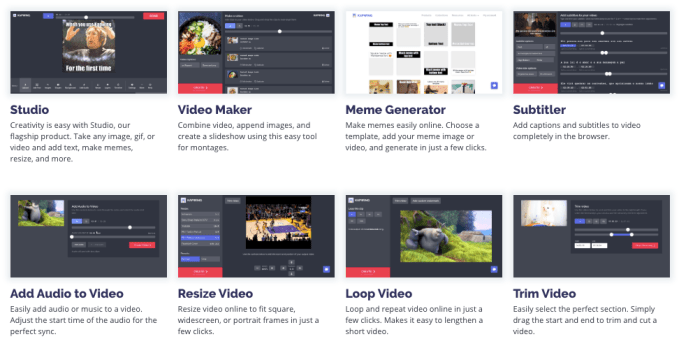
Kapwing is a laymen’s Adobe Creative Suite built for what people actually do on the internet: make memes and remix media. Need to resize a video? Add text or subtitles to a video? Trim or crop or loop or frame or rotate or soundtrack or… Then you need Kapwing. The free web and mobile too is built for everyone, not just designers.

In a year since coming out of steal with 100,000 users, Kapwing has grown 10X. Now it wants to go pro, building out its $20/month collaboration tools for social media managers and scrappy creative teams. But it won’t forget its roots with teens, so it’s dropped its pay-$6-to-remove-watermarks tier while keeping its core features free.

Kapwing Tools

Eager to capitalize on the meme and mobile content business, CRV has just led an $11 million Series A round for Kapwing. It’s joined by follow-on cash from Village Global, Sinai, and Shasta Ventures plus new investors Jane VC, Harry Stebbings, Vector, and the Xoogler Syndicate.

More info to come