
Year: 2019

24 Sep 2019

Hear about investing in African tech at Disrupt SF with Marieme Diop, Wale Ayeni and Sheel Mohnot

If you’re a VC or founder in London, Bangalore or San Francisco, you’ll likely interact with some part of Africa’s tech landscape for the first time — or more — in the near future. When measured by monetary values, the continent’s tech ecosystem is small by Shenzhen or Silicon Valley standards.

But when you look at year-over-year expansion in venture capital, startup formation and tech hubs, it’s one of the fastest-growing tech markets in the world.

Join us at TechCrunch Disrupt SF where we will host a Q&A session on VC in Africa with Orange Digital Ventures’ Marieme Diop, International Finance Organization‘s Wale Ayeni and 500 Startups’ Sheel Mohnot, three Africa-based investors who bring plenty of experience screening startups across its top tech hubs. We’ll open up the bulk of the session to allow Disrupt attendees to ask questions of each speaker.

Marieme Diop oversees Africa VC investments at Orange Digital Ventures, the funding arm of France’s largest telecom, Orange.

Under her tutelage, Orange Digital Ventures  (ODV) participated in a $16 million round for South African fintech startup Yoco and the $8.6 million round to Africa’s Talking—a Pan-African business enterprise software startup.

Formed in 2017, ODV is a €150 fund with €50 allocated for Africa, according to Diop. Orange was one of the early investors in Africa focused e-commerce unicorn, Jumia, which recently went public in a NYSE IPO.

Diop is also working to bridge the resource gap for startups in French-speaking Africa — or 24 of the continent’s 54 countries.

This year she was a co-founder of Dakar Angels Network, a seed fund offering $25,000 to $100,000 investments and entrepreneurial guidance to early-stage ventures in Francophone Africa.

Wale Ayeni leads the IFC venture capital practice focused on Sub-Saharan Africa — IFC is part of the World Bank Group. The IFC’s venture capital team focuses on technology companies in frontier markets, and has deployed ~$800 million in early/growth-stage tech investments over the past decade.

Recent funding includes co-leading a $6.5 million Series A round in South African fintech company Lulalend and participating in one of the larger tech investments in African tech this year — the $20 million Series A round raised by Nigerian trucking logistics startup Kobo360.

Sheel Mohnot leads fintech investments for 500 Startups . The San Francisco based accelerator has been out front on Africa, taking its Geeks on a Plane tour to the continent in 2017, and racking up over 40 Africa related investments, according to Mohnot.

He recently led 500 Startups’ seed-stage investment in Chipper Cash, an Africa focused cross-border payment venture.

Startups building financial technologies for Africa’s 1.2 billion population are gaining greater attention of investors. As a sector, fintech (or financial inclusion) attracted 50% of the estimated $1.1 billion funding to African startups in 2018, according to Partech.

So bring your bring your questions on investing in fintech and other sectors in Africa to Disrupt SF on October 4, where speakers Diop, Ayeni, and Mohnot will take the Q&A stage to share their expert insights.
23 Sep 2019

Facebook buys startup building neural monitoring armband

Facebook is buying CTRL-labs, a NY-based startup building an armband that translates movement and the wearer’s neural impulses into digital input signals, a company spokesperson tells TechCrunch.

CTRL-labs raised $67 million according to Crunchbase. The startup’s investors include GV, Lux Capital, Amazon’s Alexa Fund, Spark Capital, Founders Fund, among others. Facebook didn’t disclose how much they paid for the startup, but we’re digging around.

The acquisition, which has not yet closed, will bring the startup into the company’s Facebook Reality Labs division. CTRL labs’ CEO and co-founder Thomas Reardon, a veteran technologist whose accolades include founding the team at Microsoft that built Internet Explorer, will be joining Facebook while CTRL-labs’ employees will have the option to do the same, we are told.

Facebook has talked a lot about working on a non-invasive brain input device that can make things like text entry possible just by thinking. So far, most of the company’s progress on that project appears to be taking the form of university research that they’ve funded. With this acquisition, the company appears to be working more closely with technology that could one day be productized.

“We know there are more natural, intuitive ways to interact with devices and technology. And we want to build them,” Facebook AR/VR VP Andrew Bosworth wrote in a post announcing the deal. “It’s why we’ve agreed to acquire CTRL-labs. They will be joining our Facebook Reality Labs team where we hope to build this kind of technology, at scale, and get it into consumer products faster.”

CTRL-labs’ technology isn’t focused on text-entry as much as it is muscle movement and hand movements specifically. The startup’s progress was most recently distilled in a developer kit which paired multiple types of sensors together to accurately determine the wearer’s hand position. The wrist-worn device offered developers an alternative to camera-based or glove-based hand-tracking solutions. The company has previously talked about AR and VR input as a clear use case for the kit. Facebook did not give details on what this acquisition means for developers currently using CTRL-labs’ kit.

This acquisition also brings the armband patents of North (formerly Thalmic Labs) to Facebook. CTRL-labs purchased the patents related to the startup’s defunct Myo armband earlier this year for an undisclosed sum.

CTRL-labs acquisition brings more IP and talent under Facebook’s wings as competitors like Microsoft and Apple continue to build out augmented reality products. There is plenty of overlap between many of the technologies that Oculus is building for Facebook’s virtual reality products like the Quest and Rift S, but CTRL-Labs’ tech can help the company build input devices that are less bulky, less conspicuous and more robust.

“There are some fundamental advantages that we have over really any camera-based technology — including Leap Motion or Kinect — because we’re directly on the body sensing the signal that’s going from the brain to the hand.”  CTRL-labs Head of R&D Adam Berenzweig told TechCrunch in an interview late last year. “There are no issues with collusion or field-of-view problems — it doesn’t matter where your hands are, whether they’re in a glove or a spacesuit.”

Facebook is holding its Oculus Connect 6 developer conference later this week where the company will be delivering updates on its AR/VR efforts.

23 Sep 2019

Engage:BDR raises $26.25M to fund its NetZero publisher payments

Engage:BDR announced today that it has raised $23.25 million in new funding.

CEO Ted Dhanik told me that this includes both debt and equity funding, and will be used to the grow the company’s NetZero payments program.

NetZero is designed to address the ongoing issue of long delays faced by publishers before they get paid by advertisers. Dhanik said “the terms are getting worse and worse,” with publishers being asked to wait 30, 60, 90 or even 120 days after they invoice their advertising partners before payment.

Other companies like FastPay have tried to fill in the gap, but Dhanik said these loans can have interest rates as high as 25%. So the team at Engage:BDR (which is publicly traded on the Australian Securities Exchange) asked itself: “Hey, what if we could just pay publishers exact same day that they invoice us?”

Rather than making money by charging interest, Dhanik said his company is trying to drive more publishers to its programmatic advertising platform.

“We just want the business — the incremental revenue,” he said.

Engage:BDR says web, mobile and connected TV publishers in North America, Australia and Europe are eligible to participate in the NetZero program, though they’ll need to be approved by the company first.

“If you think about NetZero, you might think: Hey, if there’s fraud, it’s pretty dangerous you don’t have the ability to clawback [the payment],” Dhanik said. But apparently Engage:BDR has “a lot of technology in place to qualify them pretty quickly, within the first few days.”

23 Sep 2019

Social radio startup Stationhead moves beyond live broadcasts

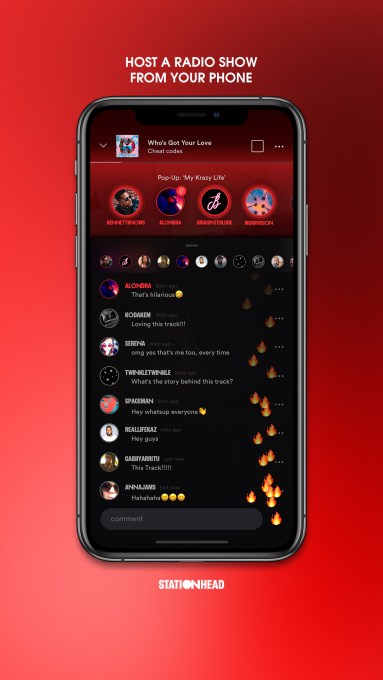
Stationhead, the mobile app that turns its users into streaming radio DJs, got a big upgrade today. Where Stationhead DJs were previously limited to broadcasting live, they can now record their shows, making them available on-demand for anyone to listen later.

The idea behind Stationhead is to democratize and recapture the personality of traditional radio broadcasts — the kind of conversation and personal connection that’s missing from a playlist.

The app includes features like the ability to call guests to join the show, and integration with Spotify and Apple Music. For Stationhead, that means it doesn’t have to make its own licensing deals with the music labels; for listeners, it means that when a DJ plays a song, you’re hearing it stream from the music service of your choice.

That integration will continue with these new on-demand broadcasts — so they don’t really exist as a single, continuous recording, but rather as DJ recordings interspersed with cued-up songs from Apple or Spotify. (That’s presumably why these broadcasts won’t be available for offline listening.)

CEO Ryan Star has said that he co-founded Stationhead as a result of his own frustrations as an independent musician, particularly the difficulty and cost of getting a single played on the radio.

More recently, he told me that Stationhead is becoming a real alternative for independent musicians trying to get attention, with more than 200,000 shows created since November of last year.

Stationhead

“Some shows are mostly talk, some shows are mostly music, but just having the ability to play the song completely changes the way it’s consumed,” said COO Levison.

The company isn’t sharing overall listener numbers, but it pointed to success stories like Burrell Kobe, who said he drove 23,000 streams on Stationhead.

And Star described the Stationhead approach as combining “creative freedom and real human connection. While the most popular Stationhead broadcasts can get more than 1,000 live listeners, he suggested that the connection can happen even when the audience is much smaller:  He recalled stumbling on a broadcast where he was literally the only person listening, but the host was “spilling her guts — this was her therapy.”

And by making these broadcasts available on-demand, he said Stationhead is “tapping into something proven to be the most intimate form of communication.”

He added, “For the first time, you’re actually able to create binge-able audio content around these streams.”

23 Sep 2019

What’s the right way to sponsor a YouTube influencer?