As Samsung and Huawei double down on their foldable smartphone lineups, and other handset vendors try to hide the notch, Chinese giant Xiaomi today chalked out a different path altogether. The company unveiled the Mi Mix Alpha, a smartphone with a front display that fully wraps around the back, save for a strip.
The Mi Mix Alpha’s body is made of a single piece of sapphire glass with ceramics and aerospace-grade titanium alloy. So what does the extra display gets you? Nothing much. The back display lights up and takes over the front screen’s duties when you flip the phone. Otherwise, it just sits there doing nothing.
Xiaomi says the Mix Alpha is a concept phone, so it is going to have a limited production run for the device. The smartphone will go on sale in China in December for 19,999 yuan (~$2,800).
While the size of the display remains unknown, it boasts a 180.6% screen-to-body ratio, Xiaomi said at an event in China. The Mi Mix Alpha is powered by Qualcomm’s latest and greatest Snapdragon 855+, coupled with 12GB of RAM, and 512GB UFS 3.0 storage. And it supports 5G connectivity.
The handset is housing 4,050 mAh battery and supports 40W wired fast charging, the company said. The Mi Mix Alpha is running Android Pie-based MIUI 11 software.
Which brings us to the strip: The front side of the Mi Mix Alpha does not have any camera sensors. Instead the back side sports a three-camera system: 108MP primary sensor it developed in collaboration Samsung, 20MP wide-angle sensor, and 12MP telephoto sensor.
At the sidelines of today’s event, Xiaomi also launched the Mi 9 Pro, follow up to the Mi 9 handset that the company unveiled earlier this year. The Mi 9 Pro, priced at roughly $520, now features support for 5G connectivity, becoming one of the low-cost handsets to support the networking technology. It also supports 40W fast charging, the company said.
Accounting is one of the cornerstones to building a business, but for most companies, getting it right is more of a necessity than it is one of their core competencies. That has created a vacuum, and now, a company called Tipalti — which has developed a popular solution to automate accounting for businesses that are not accounting companies by nature — has raised a significant round of funding to underscore that demand.
Today, the Israeli-Californian startup is announcing that it has picked up $76 million, money it plans to use to continue expanding the functionality of its platform and growing its business.
The funding, a Series D that brings the total raised by Tipalti to $146 million, is interesting in part because of who is providing it. Led by Zeev Ventures, it also includes backing from previous investor Group 11, along with new backers 01 Advisors, Greenspring Associates, and TrueBridge Capital Partners.
In case the name doesn’t ring a bell, 01 Advisors is the new investment firm co-founded Twitter’s former CEO and COO, Dick Costolo and Adam Bain, which started raising money only last month and appears to have disclosed one other investment before this, in the e-sports startup PlayVS.
01 Advisors’ interest in backing Tipalti comes from the fact that Twitter is a longtime customer of Tipalti’s, dating back to when Costolo and Bain were running things. Chen Amit, CEO and Co-founder of Tipalti, told me in an interview that the social media company signed up around the time that it was going public, ramping up its revenue generating functions (mainly advertising), and needed a strong accounts payable solution to pay suppliers and others in its ecosystem that wouldn’t break the bank and would help it track all the taxes and other areas that would now be getting thoroughly audited.
That experience, along with Tipalti’s wider track record among other fast-growing tech businesses whose business models are built on working with large networks of partners — other customers include Uber, Roku, Zumba, GoDaddy, Zola, GoPro, Foursquare, and Vimeo — is what compelled Costolo and co. to invest.
“While at Twitter, we chose Tipalti and they played a pivotal role in enabling us to scale and grow,” he said in a statement. “Tipalti’s platform was crucial In helping us manage payments to thousands of our publishers and partners around the world with ease, while delivering a flawless experience. Investing in Tipalti allows us to help bring the same benefits we experienced as operators to the thousands of companies that need this support.
Tipalti’s emergence and growth comes out of an interesting climate shift in the world of startups. The accounting department is not the first thing people usually think about when they consider an exciting tech startup. Indeed, there’s a longstanding belief among some founders and their investors that certain ideas are too good to adulterate early on with thoughts of generating revenue, especially when the startup is in high-growth mode. However, when the scale does tip over into making money (way earlier for some than others), it becomes a crucial area to get right.
Tipalti sits among a number of other startups that have emerged in recent years to help handle less-sexy, but very essential back office functions, the kind that can cripple or even kill off a business of not handled well. Others in the group include the likes of AppZen, which has built AI-based expense auditing tools that it now wants to expand into other finance team functions; and Gusto, which helps manage payroll and benefits.
There are also a number of companies also looking to build better tools for accounts payable automation, including the likes of AccessPay (which also covers accounts receivable functions), OneSource Virtual, abd MineralTree. All of the big accounting software providers will provide a degree of automation in their products, too, although Tipalti’s Amit believes that these target much larger enterprises. RPA companies that are aiming to automate all back-office functions are also potential (if not existing) competitors, too.
Tipalti’s pitch is primarily to the midmarket, which is partly why it has been a big hit with startups that are growing fast but might not yet be at the point of considering solutions built for much larger companies. The tools are able to read, process, pay, and account for invoices using its automation technology, and the startup measures its effectiveness in terms of how much human work it can take on.
In fact, it describes a slightly frighteningly precise efficiency equivalent: citing research from the Levvel Research Accounts Payable Survey, the average midmarket organization has “an average of 9.8 full-time accounts payable employees.” Tipalti says that its platform can provide 80% of that workload function. (The idea being that the remaining 1.96 of humans (!) left over after Tiptali has done its magic can work on other tasks and longer need to dedicate all of their time to accounts payable procedures.)
It’s not just about reducing human overhead, though.
Amit said that some 30%-40% of its customers are gig economy businesses, with a fair number working across different international markets. That makes for a very messy accounting operation. “When you have payees all over the world, that affects you every month,” he said, adding that regulations are becoming ever more stringent on how businesses account for revenues and pay out to people, with the rise in money laundering and using assets in nefarious ways. “Regulators want more information communicated around payments, or the can be a new embargo on an entity, and so you need to change that, your banking process and who you can work with.”
The big pitch with automating companies may be that they are not aiming to take humans out of work, but to free them up to work on other things that AI cannot replace — not yet, anyway — and as an added benefit, they are helping companies reduce their operational expenses and helping them to run things better. How that will play out in the longer term could indeed be great, or it could see even more people with too much time on their hands. But in the meanwhile, Tiptali has grown by leaps and bounds. The company says it’s now processing more than $8 billion in annual transactions, with its customer and business bookings doubling in the first half of 2019.
Tipalti is not disclosing its valuation with this round, but Amit said on the back of that growth it has tripled since it last raised money.
Cluno, the Munich startup providing what it calls a “car subscription” service, is disclosing that it has raised €140 million in debt financing.
Two asset-backed financing deals totalling €80 million were signed recently, adding to €60 million of debt previously secured — ie it’s not all entirely new money.
Separately, the company raised €25 million in equity-financing in a Series B round in February led by Valar Ventures, the U.S.-based venture capital firm founded by Peter Thiel. Others who participated are Acton Capital Partners and Atlantic Labs, which both backed the Cluno’s Series A round. It brought total equity raised by Cluno to €32 million.
Founded in 2017 by the same team behind easyautosale (which exited to Autoscout24 in 2015), Cluno offers an alternative to car ownership or a more restrictive lease by enabling you to subscribe to a car for an all-inclusive monthly fee.
Available in Germany only, you book your car online or via the Cluno app, with the monthly fee covering all costs except fuel. After a minimum term of six months, subscribers can return or switch their car with three months notice.
Convenience and choice is also part of the pitch. This sees bookings, as well as credit checks and signatures, all carried out paperlessly via the Cluno app. The startup offers multiple models from nine different car companies, including BMW, VW, Audi and Ford. Models span small cars to SUVs, including hybrid and electric vehicles.
Cluno tells me the new debt financing is dedicated to growing the company’s car subscription fleet “and serves as the basis for structures that are fit for capital markets”.
“The structured, asset-based financing via ‘Cluno FinTech 1 GmbH’ and ‘Cluno FinTech 2 GmbH’ is a highly profitable and at the same time insolvency-proof investment for banks. Cluno’s fully digital reporting and the resilient backup service structure contribute to reliability,” says Dr. Veronika von Heise-Rotenburg, CFO of Cluno in a statement.
Meanwhile, the previously raised equity is being used to grow the two-year-old Cluno, which currently counts 80 employees.
Adds Nico Polleti, co-founder and CEO of Cluno: “Car subscription has proved to be very successful as a mobility concept and is on the verge of entering the mass market. As innovation driver in a fast-paced industry, we want to take our business model to the next level as quickly as possible. Our goals are scaling and, in the long run, internationalization. Both the financial resources as well as the trust of the financial institutions are a crucial lever.”
The Court of Justice of the European Union has ruled that Google doesn’t have to de-reference results related to the so-called right to be forgotten at a global scale.
Europe’s top court also reminds Google and other search engines that it doesn’t change anything when it comes to the right to be forgotten in Europe. Google still has to de-reference results for all of the 28 Member States of the European Union.
“Thus, the Court concludes that, currently, there is no obligation under EU law, for a search engine operator who grants a request for de-referencing made by a data subject, as the case may be, following an injunction from a supervisory or judicial authority of a Member State, to carry out such a de-referencing on all the versions of its search engine,” the court said in its decision.
Google and other search engines started implementing the right to be forgotten in 2014. As a European citizen, if you can find sensitive information about you when you query your name, you can ask search engines to delist those results.
If a link gets delisted, you won’t be able to find it when you search for a name when you’re in Europe. Google de-references pages at a regional level and applies the right to be forgotten on local versions of its search engine — Google uses IP addresses and geo-blocking.
But the CNIL, France’s data protection agency, fined Google in 2016 saying that regional delisting wasn’t enough. According to the CNIL, Google should have removed those results at a global level to comply with the law.
Google first filed an appeal in France and the case ended up at the Court of Justice of the European Union. According to Google, global delistings had the potential to damage free speech and help authoritarian regimes de-reference sensitive stuff from the search results.
And Europe’s top court agrees to some degree. “In addition, the balance between the right to privacy and the protection of personal data, on the one hand, and the freedom of information of internet users, on the other, is likely to vary significantly around the world,” the court said.
Earlier this year, an advisor to Europe’s top court also said that the right to be forgotten should be limited to Europe.
European citizens living outside of the European Union or people living in the European Union who use a VPN server could potentially access delisted results.
That’s why Europe’s top court says that search engines should take measures to “prevent or, at the very least, seriously discourage an internet user conducting a search from one of the Member States on the basis of a data subject’s name from gaining access, via the list of results displayed following that search, through a version of that search engine outside the EU, to the links which are the subject of the request for de-referencing.”
The Galaxy Fold comes in a nice box. It’s a thing I rarely, if ever, mention in product write-ups, because, if done right, shipping containers are generally the least interesting thing about a product. But Samsung, to its credit, has taken great care. That’s been one of the constants across this admittedly bungled product launch: presentation.
The first time I saw the device, it was well lit, in an elaborate display behind several layers of glass on the floor of Mobile World Congress. Samsung wasn’t letting anyone go past a literal velvet rope a few feet from the device.
When we finally got our hands on the Fold, Samsung had laid out several large boxes, which, when opened, had the effect of raising the device up, toward the viewer. It was a fun thing for a room full of journalists who had largely been engaging with the product through guarded curiosity, wondering aloud whether it would ever actually see the light of day.
That skepticism was warranted, as it turned out. The Fold came back broken from several reviewers. After placing the blame at the feet of users, Samsung eventually changed tack, pushed back the April release date indefinitely and tried to get to the bottom of what was going on with the product.
This week, the Fold returns to North American store shelves — or, rather, it finally debuts, about five months after initially planned. And once again, Samsung’s delivering the device in a nice box. The purpose of this one, however, is as much about setting expectations as it is providing a splashy debut.
Really, it’s like the analog version of the “Caring for Your Fold” video the company debuted on YouTube last week. It was as flashy and well-produced as we’d expect from Samsung, right down to the dramatic piano music while instructing the viewer to “Just use a light touch.” That note arrived with its own (somewhat redundant) footnote: “Do not apply excessive pressure to it.”
Similarly, the Fold box comes with its fair share of paperwork. The first bit is an overview of Galaxy Fold “Premier Service,” the white-glove offering the company announced a while back. That was, it explained, the reason it canceled initial AT&T pre-orders. The 24/7 service comes free with the purchase of the $2,000 phone, offering users phone support, starting with setup. The company’s got a call center in North Carolina fielding the calls during U.S. business hours, and routes them abroad after that.
There are other elements to it, as well, including a $149 screen warranty. All of these pieces add up to a company confident enough to bring the product back to market, but not quite ready to ensure that the Fold’s screens might not crack under pressure for some. In fact, there’s a five-point warranty adhered to the screen that warns against:
Excessive pressure (It’s the terror of knowing what the world is about / Watching some good friends screaming / “Let me out!”)
Placing objects like keys on the screen before folding
Exposing the Fold to water or dust
Adding your own screen protector to the existing screen protector
Keeping the device next to easily deactivated objects like credit cards (or, in my experience, hotel key cards) and *gulp* implanted medical devices
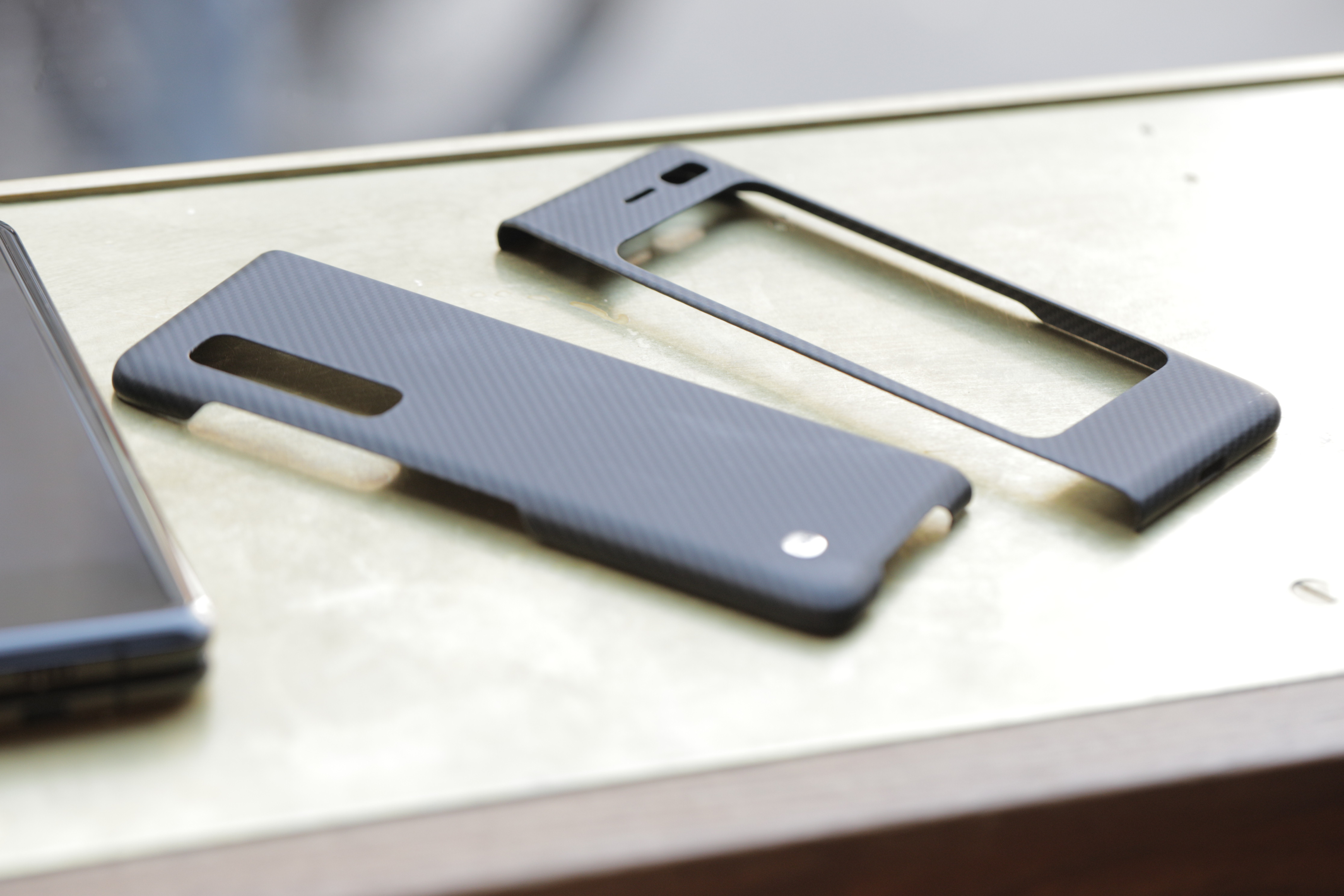
The product does, thankfully, ship with a case, which is a thin, two-piece snap-on covering. It won’t protect the front display from scratches, but it may help the product avoid dings if dropped. When closed, at least. I’m very much looking forward to someone purchasing the device for extensive drop testing while open.
Samsung does get some bonus points for also throwing in a pair of its very good Galaxy Buds Bluetooth earbuds for free. A nice gesture, to be sure.
As those who read the site with some regularity likely already know, we’ve actually spent a significant amount of time with the device. I was carrying the original version of the Fold around during our Robotics event back in April. Fitting, I suppose, that I’ll be sporting it next week at Disrupt. I do once again plan to hold onto the phone for a bit to get a better idea of day to day life with the foldable (though I likely won’t be doing daily dispatches this time).
Full disclosure: Samsung just gave us the revised version of the product yesterday afternoon. Hardly enough time to give you anything conclusive, so I’m not going to pretend to do so here. I will say that aesthetically, very little has changed. For better and worse. The one immediate thing that leaps out is the lack of a visible screen protector.
If you’ll recall, that was a major source of the problems last time out. The edges of the built-in screen protector were visible and, yes, it looked an awful lot like the removable screen protectors other Galaxy products ship with. Did I peel it off? No. Was I tempted? You better believe it.
This time out, the laminate has been extended to under the outer edges to avoid that temptation altogether. The other big fixes include plugging the gaps in the hinges that previously allowed debris to fall behind the screen, damaging it when pressure is applied. There’s also a new, unseen layer of metal under the display designed to reinforce the screen. This gives the device a slightly more rigid feel.
Otherwise, the hardware is largely unchanged, including the small 4.6-inch window display up front and the large 7.3-inch foldable screen inside, which still has a visible seam when the light reflects it at an angle.
There’s a tacit understanding that the Fold is an imperfect device. The product builds upon a decade of experience creating Galaxy flagship smartphones, along with all of Samsung’s prior electronics knowledge, but the foldable category is still very much a kind of uncharted territory. Companies are going to fail plenty before they succeed here, and at very least, Samsung deserves some kudos for being among the first to try the thing, tumbling a bit and getting back up and trying again.
There remains the important question, however, of whether consumers are okay with what feels a little like an extended beta test — albeit one that costs $2,000 to join. Thankfully, Samsung got some of those unfortunate bungles out of the way before bringing the product to market. Along with a reinforced display, however, Samsung does appear to be girding itself for the possibility that consumers will find creative and new ways to mangle the display — accidentally and otherwise.
Suffice it to say, I’ve got a lot more thoughts on the matter, many of which I’ll be formulating over the coming days and weeks. So, stay tuned for those. Meantime, if you’d like to leap before you look, the Fold can be yours this Friday, starting at $1,980 U.S.
A recently revealed mobile malware campaign targeting Uyghur Muslims also ensnared a number of senior Tibetan officials and activists, according to new research.
Security researchers at the University of Toronto’s Citizen Lab say some of the Tibetan targets were sent specifically tailored malicious web links over WhatsApp, which, when opened, stealthily gained full access to their phone, installed spyware and silently stole private and sensitive information.
The exploits shared “technical overlaps” with a recently disclosed campaign targeting Uyghur Muslims, an oppressed minority in China’s Xinjiang state. Google last month disclosed the details of the campaign, which targeted iPhone users, but did not say who was targeted or who was behind the attack. Sources told TechCrunch that Beijing was to blame. Apple, which patched the vulnerabilities, later confirmed the exploits targeted Uyghurs.
Although Citizen Lab would not specify who was behind the latest round of attacks, the researchers said the same group targeting both Uyghurs and Tibetans also utilized Android exploits. Those exploits, recently disclosed and detailed by security firm Volexity, were used to steal text messages, contact lists and call logs, as well as watch and listen through the device’s camera and microphone.
It’s the latest move in a marked escalation of attacks on ethnic minority groups under surveillance and subjection by Beijing. China has long claimed rights to Tibet, but many Tibetans hold allegiance to the country’s spiritual leader, the Dalai Lama. Rights groups say China continues to oppress the Tibetan people, just as it does with Uyghurs.
A spokesperson for the Chinese consulate in New York did not return an email requesting comment, but China has long denied state-backed hacking efforts, despite a consistent stream of evidence to the contrary. Although China has recognized it has taken action against Uyghurs on the mainland, it instead categorizes its mass forced detentions of more than a million Chinese citizens as “re-education” efforts, a claim widely refuted by the west.
The hacking group, which Citizen Lab calls “Poison Carp,” uses the same exploits, spyware and infrastructure to target Tibetans as well as Uyghurs, including officials in the Dalai Lama’s office, parliamentarians and human rights groups.
Bill Marczak, a research fellow at Citizen Lab, said the campaign was a “major escalation” in efforts to access and sabotage these Tibetans groups.
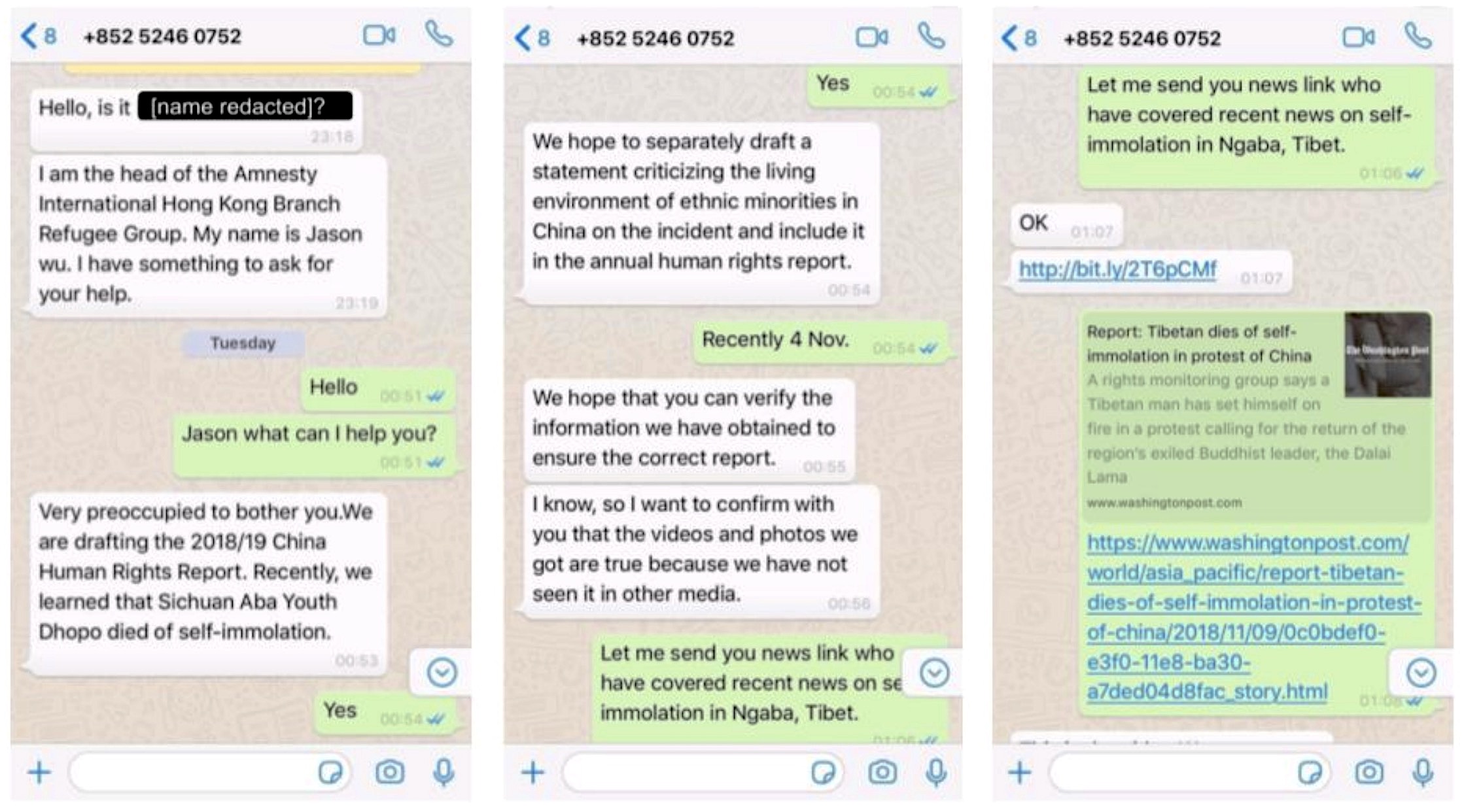
In its new research out Tuesday and shared with TechCrunch, Citizen Lab said a number of Tibetan victims were targeted with malicious links sent in WhatsApp messages by individuals purporting to work for Amnesty International and The New York Times. The researchers obtained some of those WhatsApp messages from TibCERT, a Tibetan coalition for sharing threat intelligence, and found each message was designed to trick each target into clicking the link containing the exploit. The links were disguised using a link-shortening service, allowing the attackers to mask the full web address but also gain insight into how many people clicked on a link and when.
“The ruse was persuasive,” the researchers wrote. During a week-long period in November 2018, the targeted victims opened more than half of the attempted infections. Not all were infected, however; all of the targets were running non-vulnerable iPhone software.
One of the specific social engineering messages, pretending to be an Amnesty International aid worker, targeting Tibetan officials (Image: Citizen Lab/supplied)
The researchers said tapping on a malicious link targeting iPhones would trigger a chain of exploits designed to target a number of vulnerabilities, one after the other, in order to gain access to the underlying, typically off-limits, iPhone software.
The chain “ultimately executed a spyware payload designed to steal data from a range of applications and services,” said the report.
Once the exploitation had been achieved, a spyware implant would be installed, allowing the attackers to collect and send data to the attackers’ command and control server, including locations, contacts, call history, text messages and more. The implant also would exfiltrate data, like messages and content, from a hardcoded list of apps — most of which are popular with Asian users, like QQMail and Viber.
Apple had fixed the vulnerabilities months earlier (in July 2018); they were later confirmed as the same flaws found by Google earlier this month.
“Our customers’ data security is one of Apple’s highest priorities and we greatly value our collaboration with security researchers like Citizen Lab,” an Apple spokesperson told TechCrunch. “The iOS issue detailed in the report had already been discovered and patched by the security team at Apple. We always encourage customers to download the latest version of iOS for the best and most current security enhancements.”
Meanwhile, the researchers found that the Android-based attacks would detect which version of Chrome was running on the device and would serve a matching exploit. Those exploits had been disclosed and were “obviously copied” from previously released proof-of-concept code published by their finders on bug trackers, said Marczak. A successful exploitation would trick the device into opening Facebook’s in-app Chrome browser, which gives the spyware implant access to device data by taking advantage of Facebook’s vast number of device permissions.
The researchers said the code suggests the implant could be installed in a similar way using Facebook Messenger, and messaging apps WeChat and QQ, but failed to work in the researchers’ testing.
Once installed, the implant downloads plugins from the attacker’s server in order to collect contacts, messages, locations and access to the device’s camera and microphone.
When reached, Google did not comment. Facebook, which received Citizen Lab’s report on the exploit activity in November 2018, did not comment at the time of publication.
“From an adversary perspective what makes mobile an attractive spying target is obvious,” the researchers wrote. “It’s on mobile devices that we consolidate our online lives and for civil society that also means organizing and mobilizing social movements that a government may view as threatening.”
“A view inside a phone can give a view inside these movements,” they said.
The researchers also found another wave of links trying to trick a Tibetan parliamentarian into allowing a malicious app access to their Gmail account.
Citizen Lab said the threat from the mobile malware campaign was a “game changer.”
“These campaigns are the first documented cases of iOS exploits and spyware being used against these communities,” the researchers wrote. But attacks like Poison Carp show mobile threats “are not expected by the community,” as shown by the high click rates on the exploit links.
Gyatso Sither, TibCERT’s secretary, said the highly targeted nature of these attacks presents a “huge challenge” for the security of Tibetans.
“The only way to mitigate these threats is through collaborative sharing and awareness,” he said.
Jellysmack originally started as a social media company with popular brands on Facebook and other social platforms, such as Beauty Studio, Oh My Goal, Gamology and Riddle Me This. The company is now branching out and expanding with a different product, the ‘Creator’s Program.’
The startup is going to partner with popular YouTube creators and grow their audience on other social media platforms, starting with Facebook and Snapchat. This way, YouTube creators get a new audience on a separate platform, which reduces dependency on YouTube’s algorithm.
Jellysmack has developed several tools for its own media brands, such as tools to detect popular content, optimize content itself and improve distribution on social platform. The company now attracts 88 million unique viewers per month in the U.S.
“We realized that we could reuse this suite of tools with many other creators and not just on our own content,” Jellysmack co-founder and CEO Michael Philippe told me.
The startup already identified a bunch of YouTube creators that could benefit from these tools. It has partnered with Reaction Time, Infinite, Karina Garcia, How Ridiculous and others.
After that, Jellysmack obtains all the back catalog of videos, recuts them and shares them on Facebook and Snapchat — 10-minute videos on YouTube will become 3-minute videos on Facebook for instance.
Jellysmack then tests multiple thumbnails and video names using A/B testing and a bit of paid promotion. When the startup has found a name and thumbnail that generates a lot of engagement, the company releases the video.
The company then invests some of its money to grow the audience of a Facebook page or Snapchat account using paid acquisition. “We have developed a proprietary acquisition tool that finds the right audiences,”
Everything is then tracked using Jellysmack’s tools. Each video is tagged and gets a score based on retention, monetization, etc. Creators could potentially leverage those insights for future videos.
Reaction Times had 80,000 Facebook fans before partnering with Jellysmack. It now has 3 million Facebook fans and generates 100 million views per month on the platform.
With today’s new program, Jellysmack says that its own brands will also stick around — this is just a new bet for the company. The company also plans to launch a new vertical in the future.
Cledara, a startup that has developed a SaaS to help companies manage their SaaS spending — as if things couldn’t get any more meta — has picked up pre-seed backing from the recently announced Anthemis/BBVA strategic partnership, and others.
In total, the startup has raised $930,000. This includes completing the Techstars London accelerator, along with investment from various angels, such as Chris Adelsbach.
Founded in July 2018 by Cristina Vila, after she experienced the SaaS management nightmare first-hand while working at London fintech Dopay, Cledara has developed software to let companies track and manage their SaaS usage and spending, including analytics to help understand if it is money well spent.
Another feature is unlimited virtual debit cards to empower employees and even outside teams to purchase appropriate SaaS offerings independently. This includes the option for management to approve every purchase before it happens and access real-time updates on what everyone is buying.
“Previously, I was responsible for the operations of a fintech company, and as part of my job I had to streamline processes which meant that I had to know what software people were using to do their job,” Vila tells me.
“Turns out, that that was a real challenge. We had offices in 3 different countries, remote developers, people working from home all signing up for different SaaS products and then expensing them back to the company. So I had to manually go around and ask everyone to fill in a spreadsheet to get the data, which was impossible because people only wrote those that they were actively using and could remember”.
Villa says this also caused problems for the finance team, since they could see payments going out each month but didn’t always know what they were for. “I looked around for solutions, spoke to founders to see how they were managing it and when the best answer was ‘Google Sheets’ I realised that something like Cledara had to exist”.
Describing the macro problem that Cledara hopes to solve, Villa says that every year companies waste more than $20 billion on duplicate, unused or forgotten software subscriptions. “There are dozens of companies that help sellers of subscription software optimise their sales but there is basically none that helps companies buy and manage their software subscription in a scalable way,” she adds. “We believe that unless companies have a way to manage cloud software at scale, it will be very difficult for SaaS to reach the mass market”.
To that end, Cledara is being pitched as a purchasing and analytics platform that enables companies to manage and control recurring subscription payments. In this sense, it is a fintech as much as a traditional SaaS — hence the Anthemis/BBVA backing.
Villa cites direct competitors as companies like Soldo, Pleo or Spendesk. “We are different in that we are fully focused on helping tech companies with the purchase and the ongoing management of their subscriptions because everything is becoming a subscription and the way to manage one off payments if very different to the way in which we manage recurring payments,” she argues.
“Also, we are building a collaborative platform, hence breaking the traditional finance silo where all the data is gathered but not shared. We want to provide that data to the business as they are the ones that can take action based on the analytics and insights”.
Meanwhile, the startup generates revenue from subscription fees, and through interchange fees via the Cledara virtual Mastercard debit cards its customers use to make SaaS purchases.
Honestbee, the Singapore-based grocery delivery startup that has been struggling with financial issues, owes 217 employees a total of almost USD $1 million in unpaid salary. The Strait Times reported that the figure was revealed in an affidavit filed in court on Sept. 20 by Honestbee CEO Ong Lay Ann as part of the startup’s debt moratorium application.
The Ministry of Manpower told the Strait Times that 44 employees have filed claims with the Tripartite Alliance for Dispute Management, with some of the employees settling mediation by agreeing to a payment schedule with Honestbee that will be monitored by the alliance.
In an emailed statement to TechCrunch, an Honestbee spokesperson said, “There is a communicated salary delay for Honestbee’s ex-employees and employees currently serving notice. While there are regular injections of working capital, the amount remains insufficient for all headcount. As a result, the company has made the difficult decision to prioritize existing staff in Singapore. The company has the full intention in meeting its obligations to staff and will be, if not already in active discussions with staff in relation to a feasible payment schedule.”
TechCrunch reported in April that Honestbee was running out of money and trying to find a buyer. The company, which used to operate in eight markets across Asia, has stopped operating in Hong Kong and Indonesia, temporarily halted services in Japan and the Philippines and suspended its food delivery service in Thailand.
The affidavit filed by Ong says Honestbee currently has 190 employees, down from 523 full-time employees and 77 part-time workers in January.
Ong also said that Honestbee chairman Brian Koo resigned from the board on on Sept. 12.
According to the affidavit, Koo and associates including investment vehicles he set up, are owed about $258 million, or about 90% of Honestbee’s debt. Koo, a founding managing partner of venture capital firm Formation Group, was one of Honestbee’s earliest investors and served as interim CEO from May to July after former chief executive Joel Sng stepped down.
Kik Interactive CEO Ted Livingston announced today that the company is shutting down Kik Messenger to focus on its cryptocurrency Kin, the target of a lawsuit filed by the Securities and Exchange Commission. The company’s team will be reduced to 19 people, a reduction that will affect over 100 employees, as it focuses on converting more Kin users into buyers.
“Instead of selling some of our Kin into the limited liquidity that exists today, we made the decision to focus our current resources on the few things that matter most,” Livingston wrote in a blog post, adding that the changes will reduce the company’s burn rate by 85%, enabling it to get through the SEC trial.
But in June, the SEC filed a lawsuit against Kik Interactive, claiming the ICO was illegal, as part of the Commission’s wider crackdown on companies it alleges are issuing securities illegally.
The SEC also claimed that the company’s management had predicted Kik Messenger would run out of money by 2017, when it started planning the launch of Kin. Kik Interactive hit back in a court filing last month, saying that the SEC’s claims about its finances were “solely designed for misdirection, thereby prejudicing Kik and portraying it in a negative light.”
One of the core issues in the lawsuit is whether or not Kin is a security. The SEC alleges that it is and that the token sale violated securities laws. Kik Interactive denies Kin is a security.
“After 18 months of working with the SEC the only choice they gave us was to either label Kin a security or fight them in court. Becoming a security would kill the usability of any cryptocurrency and set a dangerous precedent for the industry,” Livingston wrote in today’s blog post. “So with the SEC working to characterize almost all cryptocurrencies as securities we made the decision to step forward and fight.”
Livingston added that since Kin isn’t available on most exchanges, it doesn’t rely on speculative demand. Instead, Kin is used by “millions of people in dozens of independent apps,” with more than two million monthly active users and 600,000 monthly active spenders, he wrote. Kik Interactive’s objective now is to increase those numbers.
To get more people who buy Kin to use the currency, Livingston said the company will focus on three things: enabling the Kin blockchain to support a billion consumers making a dozen transactions a day, with confirmation times of less than a second; increasing adoption and growth for developers who use Kin in their apps; and building a mobile wallet that makes it easier to buy and use Kin.