Year: 2019

19 Sep 2019

Rocket Lab moves closer to opening U.S. launch facility with landing pad completion

Rocket Lab is nearing completion of its second launch facility – its first in the U.S., located on Wallops Island in Virginia. The company announced that it has finished installing the launchpad at Launch Complex 2, which is set to finish construction as early as the end of this year, with the first launches taking off from the site in early 2020.

All final build and integration of launch systems are expected to be done by December, according to the company, which will then allow for final testing and readiness prep of the launch site itself ahead of the first rocket actually launching from LC-2 next year. Rocket Lab’s first Electron launch from the U.S. will be a key milestone for the company – not only because it will double their potential mission capacity when combined with their existing facility in New Zealand, but also because a U.S. launch site will open up additional business for Rocket Lab in the form of lucrative government launch contracts.

WE don’t yet know who the first customer to launch on board a Rocket Lab customer from the Wallops facility will be, but Rocket Lab says it will reveal this info in short order, with a reveal planned for later this year.

LC-2 construction began in February this year, and the facility largely mirrors the existing Rocket Lab launch complex in New Zealand, which has been successfully serving clients with launches since early 2018.

19 Sep 2019

Automattic raises $300 million at $3 billion valuation from Salesforce Ventures

Automattic, the company behind WordPress.com, WooCommerce and soon Tumblr, has closed a $300 million funding round at a $3 billion post-money valuation. The Series D round has a single investor, Salesforce Ventures.

Founding rounds are something special for Automattic . While the company has been around for nearly 15 years, it hasn’t raised a ton of money. It closed a $160 million Series C round back in 2014 and raised little money before that.

Automattic and the WordPress open source project have a shared history. Many people are already familiar with WordPress, the most popular content management system on the planet. The company contributes to the open source project and also runs some of the most popular services on top of that project, such as WordPress.com and the Jetpack plugin, WordPress.com VIP (which TechCrunch uses) and WooCommerce.

This freemium business model with an open source philosophy at its core has been working well for the company. In 2014, Automattic had between 200 and 300 employees. The company will have close to 1,200 employees when the Tumblr acquisition closes.

Back in 2014, 22% of the world’s top 10 million websites used WordPress. There are now 34% of the world’s top 10 million websites running on WordPress.

“I think there’s potential to get to a similar market share as Android, which I believe now has 85% of all handsets. When you think about it, open source has a virtuous cycle of adoption, people building on the platform and more adoption,” Automattic founder and CEO Matt Mullenweg told me.

While WordPress started as an open source blogging platform, it has evolved into a highly customizable content management system. You can use it to show a portfolio, build a restaurant website, run an e-commerce company or even distribute news articles to millions of people.

“What we want to do is to become the operating system for the open web. We want every website, whether it’s e-commerce or anything to be powered by WordPress. And by doing so, we’ll make sure that the web can go back to being more open, more integrated and more user-centric than it would be if proprietary platforms become dominant,” Mullenweg told me.

And with the rise of social networks and closed platforms, such as Facebook, YouTube or Medium, Automattic is at odds with many of the dominant trends. Mullenweg still believes that the open source model creates some great network effects.

Instead of optimizing Automattic’s services for engagement and time spent, the company wants to empower content creators with great tools. Mullenweg mentioned Ben Thompson’s Stratechery as a great example of a content creator in control of his own destiny.

“The problem we’re tying to solve is likely multigenerational. It can take the rest of our lives and we need to pass it on to the generation that comes after to continue to work on it. Hopefully for the rest of humanity because I can’t imagine a time when humanity cannot benefit from an open, free, connected web,” Mullenweg told me.

When it comes to today’s funding round, Salesforce Ventures isn’t your traditional investor — and Mullenweg is well aware of that. There could be some partnerships and integrations between Salesforce and Automattic in the future.

“We’ve been a long time customer of Salesforce, we’re big fan of the platform. And definitely, you could imagine, given a lot of thoughts, how WordPress could complement their products,” he said.

Automattic doesn’t want to change course. With the new influx of cash, there won’t be any big departure from the current lineup of products and services. Automattic insists on its slow-paced and sustainable approach when it comes to launching and iterating on products.

“The roadmap is the same. I just think we might be able to do it in five years instead of ten,” Mullenweg said.

We’ll share a full interview with Matt Mullenweg in a few minutes.

19 Sep 2019

Roku unveils a new streaming player lineup, plus Roku OS 9.2 launch

Roku is getting a jump on the holiday shopping season with the arrival of new and updated devices. The company is expanding its media player lineup for the U.S. and abroad with updated versions of both its entry-level and high-end players, the Roku Express and Roku Ultra, respectively. It’s also introducing a new version of the Roku Express exclusively for Walmart, and a Streaming Stick that will be exclusively sold at Best Buy. Alongside the new hardware, it’s beginning to roll out an update to Roku’s operating system, with Roku OS 9.2, that focuses on improved search and discovery features, including the launch of curated search results it’s calling “Roku Zones.”

On the hardware side, the low-end Roku Express ($29.99) has been redesigned to be 10% than the last version, and can now be fully powered by most TVs’ USB port to reduce clutter.

Roku Express with Remote

And while we haven’t yet seen the results of the recent announcement of Roku’s plans to offer products to Walmart to be sold under the retailer’s own Onn brand, Roku is continuing to work with its retail partner on exclusive devices. The Roku Express+ model has dropped last year’s support for the analog inputs designed to work with older TVs, and instead bundles in the Roku voice remote for $39.99.

Roku’s entry-level 4K player, the Roku Premiere, will be sold at the same price point with a standard remote.

The two streaming stick form factors, the Streaming Stick+ and Streaming Stick+ HE, will both be $59.99 for the time being. While both are 4K-ready, the latter will be sold exclusively at Best Buy and will swap in an Enhanced Voice Remote with the headphone jack for private listening and Roku headphones. The Streaming Stick+ will offer the voice remote with TV controls instead. That begs to see a price point drop, but Roku isn’t yet announcing anything on that front.

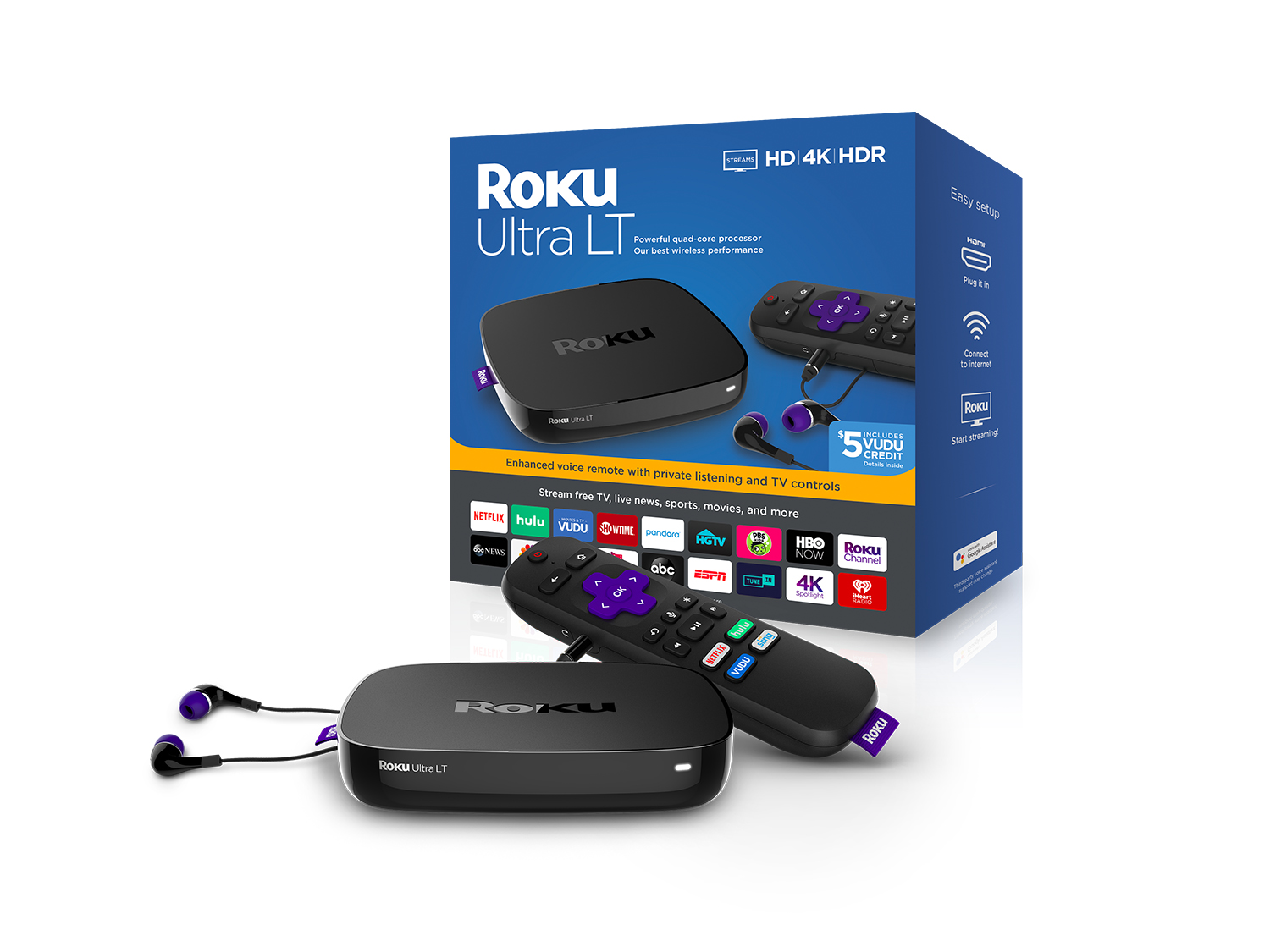
New Roku Ultra RemoteMeanwhile, at the upper end of the lineup sits the Roku Ultra ($99.99). This more expensive device supports HD, 4K and HDR picture quality, and features a quad-core processor, 802.11ac dual-band wireless, Ethernet, a USB port and a MicroSD slot for local media playback, and supports Dolby and DTS Digital Sound. It ships with Roku’s Enhanced Voice Remote with JBL headphones for private listening.

This remote has been upgraded, too, with personal shortcut buttons that can be mapped to any Roku voice command. For example, you could say “Watch Disney+” or “Watch Brooklyn Nine-Nine” or “play jazz on Pandora” and make that one of your buttons.

What’s new this year is an entry-level Ultra edition for $79.99 that will be a Walmart exclusive. The device drops a few features like the Remote Finder and USB port, and it sports the older specs. It ships with the Enhanced Voice Remote with TV control and Roku headphones.

The Roku Express and Roku Ultra are available for pre-order at Roku.com today. The Roku Express and Roku Express+ will be available at the end of September with the rest of the devices on sale in October.

Roku Ultra LT

The Roku Express, Roku Premiere and Roku Streaming Stick+ are expected to be available outside the U.S. in the weeks ahead in Canada, the U.K., the Republic of Ireland and select countries in Latin America.

ROKU OS 9.2

As per usual, Roku’s fall update isn’t only hardware-focused. The operating system that powers its players is being updated, too, with the launch of Roku OS 9.2.

The standout feature is a search and discovery update called Roku Zones.

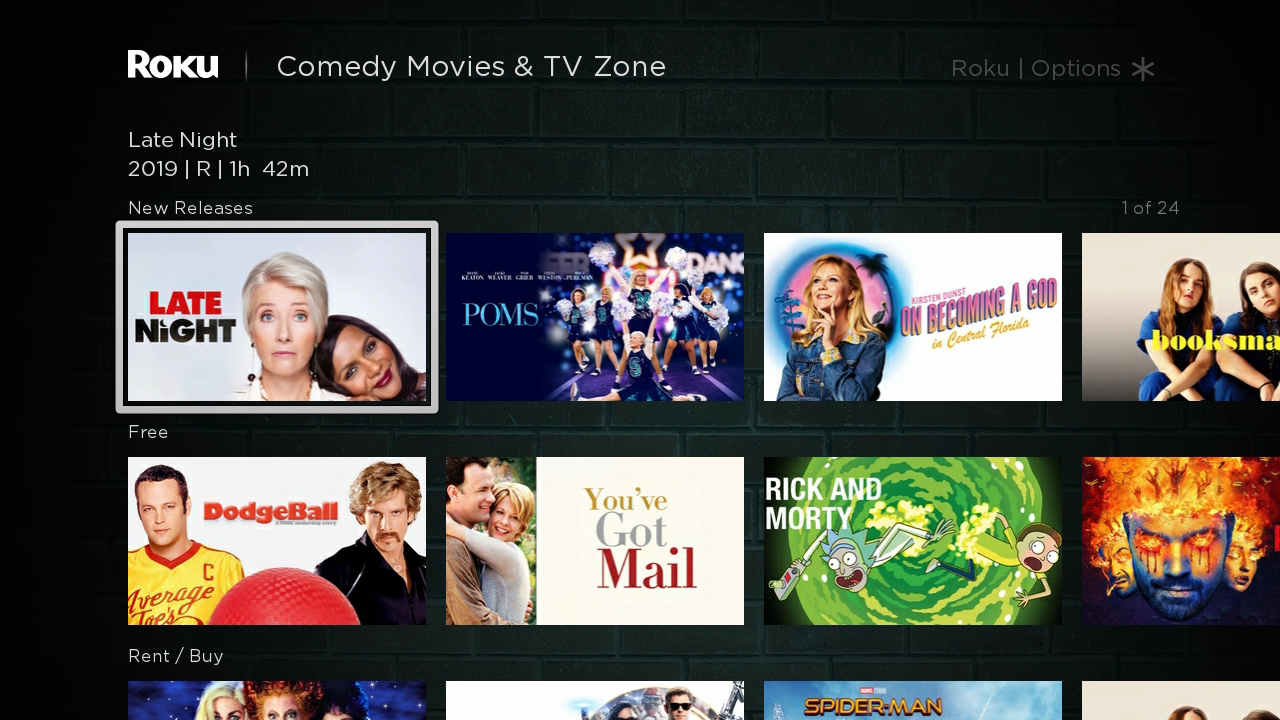
These “zones” are actually curated content collections organized around a genre, like “drama movies and TV,” or a theme, like holiday movies, for example. The zones will appear in the search results when you do a relevant search. Unlike the typically text-based search results, zones are visual guides with thumbnail images, scrollable rows, and content sourced from Roku’s partners — the same partners whose content would otherwise appear in its search results.

Roku Comedy Zone

Today, that’s grown to nearly 40 partners, including both free and paid channels. It will also feature content from your subscriptions and The Roku Channel.

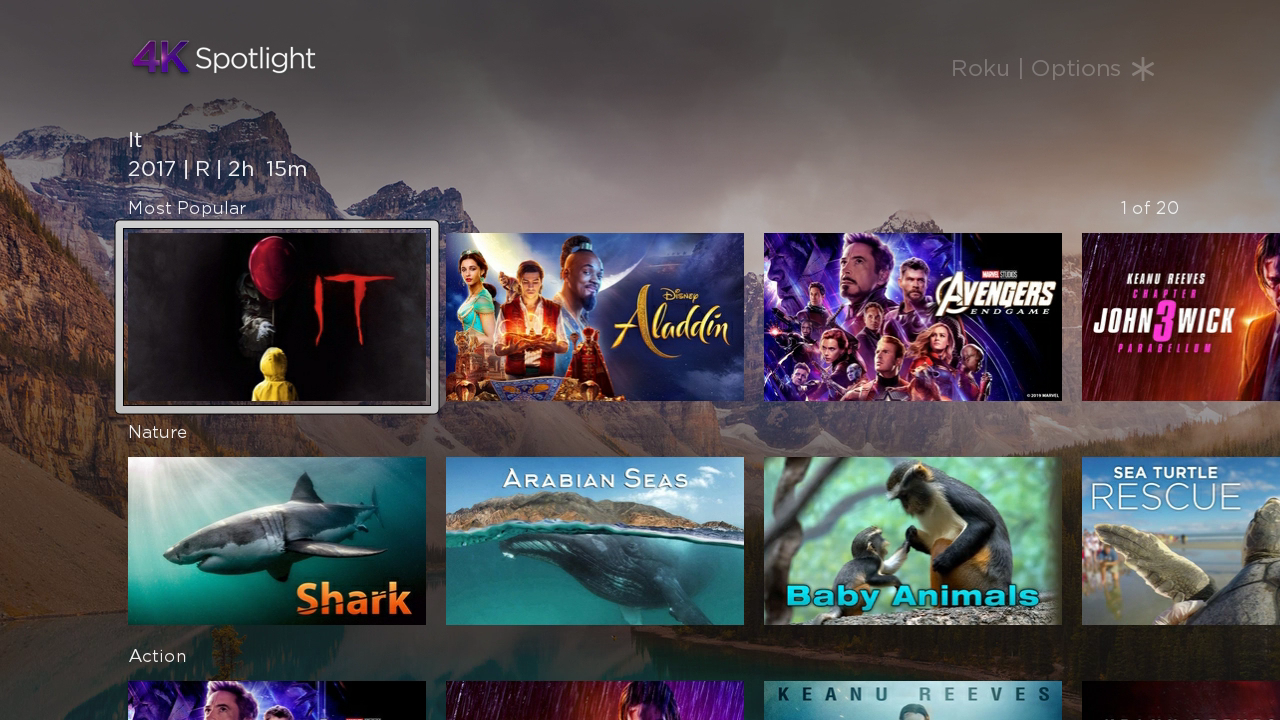
The Roku OS update additionally includes a redesigned 4K spotlight channel that now uses the Zones architecture to similarly organize content; plus a new “Tips & Tricks” channel with helpful how-to videos on using Roku; the addition of voice-controlled sleep timers on Roku TVs; and a fun feature that lets you search for movie quotes by voice.

Roku 4K Spotlight Channel

Roku Voice search can now find 4K movies and users can now control personal music, movies, and photos using voice commands, too. Alexa and Google Assistant users can control multiple Roku devices in the home with voice commands, with the 9.2 update.

The update will also bring support for the new Roku Wireless Subwoofer when Roku TV Wireless speakers are paired to a Roku TV, as earlier promised.

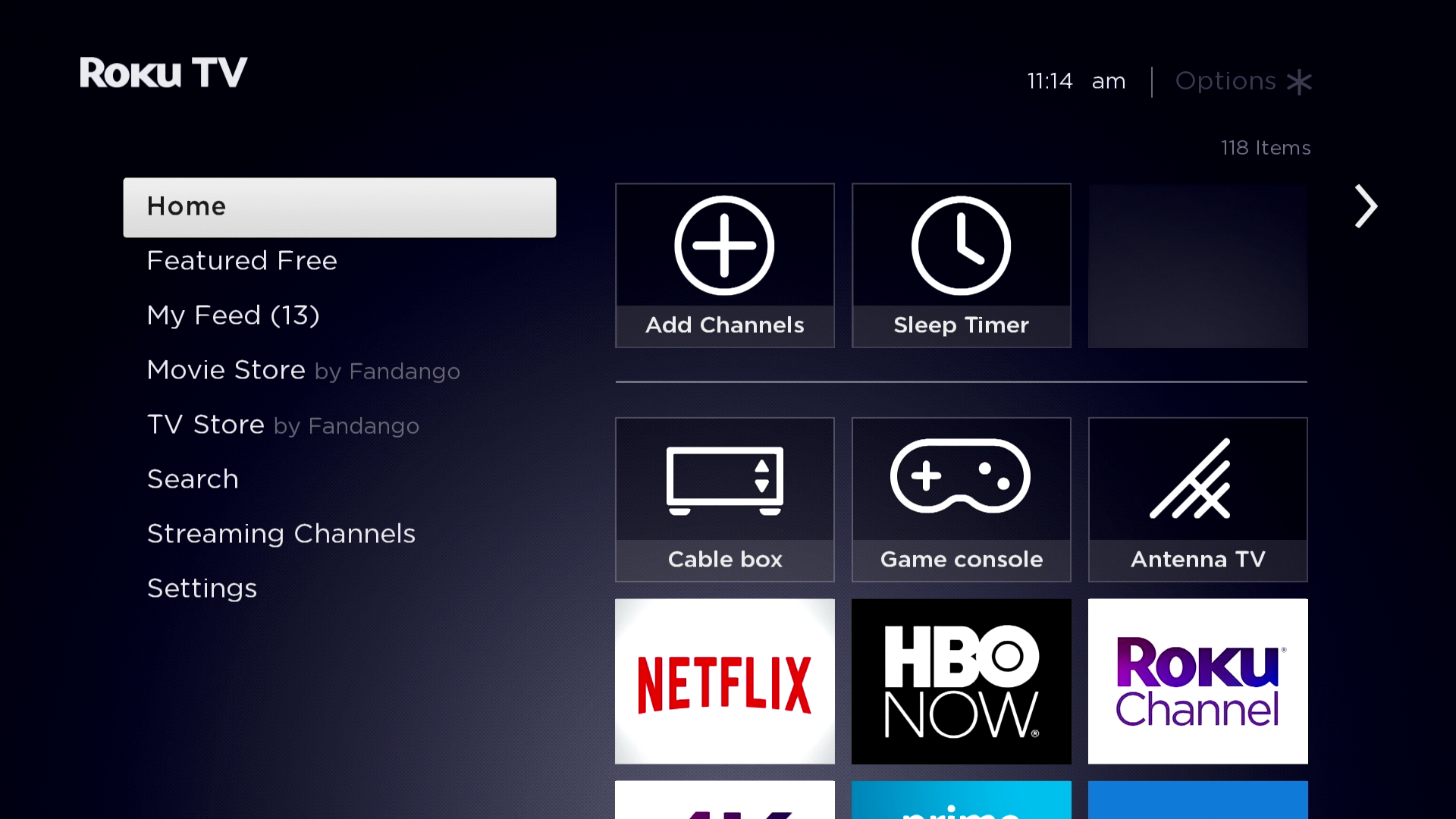
And it’s introducing a new “shortcuts” feature that will let you stick common actions — like adding channels, setting sleep timers or powering off the TV (soon) — right on the Roku homescreen.

Roku TV with Shortcuts

The company says Roku OS 9.2 will begin rolling out to select Roku players this month and is expected to roll out to all supported streaming players, including the recently launched Roku Smart Soundbar, in the next few weeks.

Roku TV models are expected to receive the update in phases in the next few months.

[gallery ids="1883345,1883344,1883343,1883342,1883341,1883340,1883339,1883338,1883336,1883335,1883334,1883328,1883333,1883332,1883331,1883330,1883329"]

19 Sep 2019

Built Robotics raises $33M for its self-driving construction equipment


Built Robotics, a company aiming to make construction equipment autonomous, is announcing a $33M Series B round this morning.

With the construction industry facing a global labor shortage, Built’s aim is to allow one equipment operator to oversee a fleet of vehicles working autonomously in parallel, hopping in the cab only for tasks the machine can’t handle.

Rather than building its own vehicles, Built focuses on converting the popular construction equipment thats already out there. They sell a kit that straps to the top of things like excavators, bull dozers, and skid steers, taking tech like LIDAR, GPS, and WiFi and meshing them into the machine’s innards to give it autonomous smarts. They sell the conversion boxes to other companies, help them get installed, then charge a usage fee whenever the machines are in autonomous mode.

No one wants a 20-ton piece of machinery blasting around a construction site without a care for those around it, so the autonomous machines try to keep a constant eye on their surroundings. As I wrote back in April:

Cameras on and around the vehicles are constantly checking for anyone who might stray too close. If something goes wrong and the machine starts to tip too much, or if on-board sensors detect that something is in the way underground? Power gets cut. And there’s a big red emergency stop button on the back of each machine (and a wireless button meant to stay on the operator’s desk) for good measure.

We also took a look at some of Built’s gear a few months back:

The round is lead by Next47 (the investment arm of the European mega company Siemens), along with Building Ventures and previous investors Founders Fund, Presidio Ventures, Lemnos, and NEA. As part of the deal, Next47’s T.J. Rylander will be joining Built’s board of directors.

The company had previously disclosed a $15M Series A it raised in 2017, bringing its total funding up to $48M. Built co-founder Noah Ready-Campbell tells me that the company has roughly doubled in headcount over the past few months, with the team now sitting at roughly 40 people.

19 Sep 2019

New Relic launches platform for developers to build custom apps

When Salesforce launched Force.com in 2007 as a place for developers to build applications on top of Salesforce, it was a pivotal moment for the concept of SaaS platforms. Since then, it’s been said that every enterprise SaaS company wants to be a platform play. Today, New Relic achieved that goal when it announced the New Relic One Observability Platform at the company’s FutureStack conference in New York City.

Company co-founder and CEO Lew Cirne explained that in order to be a platform, by definition, it is something that other people can build software on. “What we are shipping is a set of capabilities to enable our customers and partners to build their own observability applications on the very same platform that we’ve built our product,” Cirne told TechCrunch.

He sees these third-party developers building applications to enable additional innovations on top of the New Relic platform that perhaps New Relic’s engineers couldn’t because of time and resource constraints. “There are so many use cases for this data, far more than the engineers that we have at our company could ever do, but a community of people who can do this together can totally unlock the power of this data,” Cirne said.

Like many platform companies, New Relic found that as it expanded its own offering, it required a platform for its developers to access a common set of services to build these additional offerings, and as they built out this platform, it made it possible to open it up to external developers to access the same set of services as the New Relic engineering team.

“What we have is metrics, logs, events and traces coming from our customers’ digital software. So they have access to all that data in real time to build applications, measure the health of their digital business and build applications on top of that. Just as Force.com was the thing that really transformed Salesforce as a company into being a strategic vendor, we think the same thing will happen for us with what we’re offering,” he said.

As a proof point for the platform, the company is releasing a dozen open source tools built on top of the New Relic platform today in conjunction with the announcement. One example is an application to help identify where companies could be over-spending on their AWS bills. “We’re actually finding 30-40% savings opportunities for them where they’re provisioning larger servers than they need for the workload. Based on the data that we’re analyzing, we’re recommending what the right size deployment should be,” Cirne said.

The New Relic One Observability Platform and the 12 free apps will be available starting today.

19 Sep 2019

Zume will provide food trucks for &pizza

Zume first made waves by entering the scene as a robotic pizza company. Since then, however, the SF Bay Area startup has taken pains to demonstrate that it has its sights set on a loftier goal of providing sustainable infrastructure for the restaurant industry.

Last April, the company made its Zume Pizza wing a wholly owned subsidiary of the newly minted Zume Inc. Seven months later, it reportedly snapped up $375 million from SoftBank, and, in June, used some of that money to purchase Pivot, a plant-based alternative packaging company.

Today, the company takes an important step toward larger industry outreach with the announcement of new partner, &pizza. The chain, which operates 36 “fast-casual” locations, will be utilizing Zume’s “Forward Mobile Kitchen” trucks to expand outreach in its native Washington, D.C.

The food truck model opens the company to some new opportunities not always afforded by the standard brick and mortar model, including the ability to try out new neighborhoods and check the demand for different products.

“Today it costs hundreds of thousands of dollars and takes a year, sometimes more, to open up a bricks and mortar store, but by leveraging our infrastructure they can open a new market in a matter of weeks and they can do it with a flexible financial model,” Zume CEO Alex Garden said in an interview with TechCrunch.

Zume’s offering is a combination of bespoke mobile kitchens that double as food trucks and delivery vehicles, combined with AI systems designed to better understand and respond to customer demand, based on location, traffic patterns and the like.

The deal isn’t make or break for Zume, but it’s an important step for a startup whose promises for profitability still appear fairly abstract from the outside. “What I can tell you for sure is that over between now and the end of the year there’s going to be really a staccato of announcements where we’ll talk about things we’re doing with partners and ways that we’re helping improve their businesses,” says Garden. “People can draw whatever conclusions they want from that financially, but all I can tell you about our financial approach to things is that we are good custodians of the investments that people have made in us and we take it really seriously.”

From the outside, at least, it appears as though the company has made a pivot from a focus on robot-made pizza to something much broader in search of a more viable model. Zume is quick to counter such claims, however, as Garden compares the company to the early days of Amazon. The executive notes that the company has shifted its focus to various aspects of the industry as offering real-world services like its pizza trucks has brought to life various solvable problems.

He turns to the example of pizza boxes, which Zume has transformed from the recognizable square cardboard variety to a round one with grates at the bottom, designed with the express purpose of keeping their contents warm.

“We did internet searches for two weeks trying to find packaging companies that made different pizza boxes and there really wasn’t very much out there, they’re almost all made by a small select group of companies that just repeat the same ideas over and over again,” Garden explains. “So I said, wow that’s really weird. Okay, well, let’s just, we’re a startup, no one can tell us what the rules are. Why don’t we just get a white board and draw what a cool pizza box would be.”

It’s a restless sort of approach to running a startup, but at very least, it has led the company in some interesting directions, and $375 million from SoftBank certainly demonstrates strong investor confidence for a startup with big ideas about revolutionizing the food industry.

Interestingly, it will also make &pizza a potential competitor for Zume Pizza, though the two won’t share a market for now. Garden adds that there’s plenty of space for competition. “People eat a lot of pizza,” he says. “I know it sounds like a trite answer, but there’s no risk at all of cannibalization.”

19 Sep 2019

Google completes controversial takeover of DeepMind Health

Google has completed a controversial take-over of the health division of its UK AI acquisition, DeepMind.

The personnel move had been delayed as National Health Service (NHS) trusts considered whether to shift their existing DeepMind contracts — some for a clinical task management app, others involving predictive health AI research — to Google.

In a blog post yesterday Dr Dominic King, formerly of DeepMind (and the NHS), now UK site lead at Google Health, confirmed the transfer, writing: “It’s clear that a transition like this takes time. Health data is sensitive, and we gave proper time and care to make sure that we had the full consent and cooperation of our partners. This included giving them the time to ask questions and fully understand our plans and to choose whether to continue our partnerships. As has always been the case, our partners are in full control of all patient data and we will only use patient data to help improve care, under their oversight and instructions.”

The Royal Free NHS Trust, Taunton & Somerset NHS Foundation Trust, Imperial College Healthcare NHS Trust, Moorfields Eye Hospital NHS Foundation Trust and University College London Hospitals NHS Foundation Trust all put out statements yesterday confirming they have moved their contractual arrangements to Google.

In the case of the Royal Free, patients’ Streams data is moving to the Google Cloud Platform infrastructure to support expanding use of the app which surfaces alerts for a kidney condition to another of its hospitals (Barnet Hospital).

One NHS trust, Yeovil District Hospital NHS Foundation Trust, has not signed a new contract — and says it had never deployed Streams, suggesting it had not found a satisfactory way to integrate the app with its existing ways of working — instead taking the decision to terminate the arrangement. Though it’s leaving the door open to future health service provision from Google.

A spokeswoman for Yeovil hospital sent us this statement:

We began our relationship with DeepMind in 2017 and since then have been determining what part the Streams application could play in clinical decision making here at Yeovil Hospital.

The app was never operationalised, and no patient data was processed.

What’s key for us as a hospital, when it comes to considering the implementation of any new piece of technology, is whether it improves the effectiveness and safety of patient care and how it tessellates with existing ways of working. Working with the DeepMind team, we found that Streams is not necessary for our organisation at the current time.

Whilst our contractual relationship has ended, we will remain an anchor partner of Google Health so will continue to be part of conversations about emerging technology which may be of benefit to our patients and our clinician in the future.

The hand-off of DeepMind Health to Google, which was announced just over a year ago, means the tech giant is now directly providing software services to a number of NHS trusts that had signed contracts with DeepMind for Streams; as well as taking over several AI research partnerships that involve the use of NHS patients’ data to try to develop predictive diagnostic models using AI technology.

DeepMind — which kicked off its health efforts by signing an agreement with the Royal Free NHS Trust in 2015, going on to publicly announce the health division in spring 2016 — said last year its future focus would be as a “research organisation”.

As recently as this July DeepMind was also touting a predictive healthcare research “breakthrough” — announcing it had trained a deep learning model for continuously predicting the future likelihood of a patient developing a life-threatening condition called acute kidney injury. (Though the AI is trained on heavily gender-skewed data from the US department of Veteran Affairs.)

Yet it’s now become clear that it’s handed off several of its key NHS research partnerships to Google Health as part of the Streams transfer.

In its statement about the move yesterday, UCLH writes that “it was proposed” that its DeepMind research partnership — which is related to radiotherapy treatment for patients with head and neck cancer — be transferred to Google Health, saying this will enable it to “make use of Google’s scale and experience to deliver potential breakthroughs to patients more rapidly”.

“We will retain control over the anonymised data and remain responsible for deciding how it is used,” it adds. “The anonymised data is encrypted and only accessible to a limited number of researchers who are working on this project with UCLH’s permission. Access to the data will only be granted for officially approved research purposes and will be automatically audited and logged.”

It’s worth pointing out that the notion of “anonymised” high dimension health data should be treated with a healthy degree of scepticism — given the risk of re-identification.

Moorfields also identifies Google’s “resources” as the incentive for agreeing for its eye-scan related research partnership to be handed off, writing: “This updated partnership will allow us to draw on Google’s resources and expertise to extend the benefits of innovations that AI offers to more of our clinicians and patients.”

Quite where this leaves DeepMind’s ambitions to “lead the way in fundamental research applying AI to important science and medical research questions, in collaboration with academic partners, to accelerate scientific progress for the benefit of everyone”, as it put it last year — when it characterized the hand-off to Google Health as all about ‘scaling Streams’ — remains to be seen.

We’ve reached out to DeepMind for comment on that.

Co-founder Mustafa Suleyman, who’s been taking a leave of absence from the company, tweeted yesterday to congratulate the Google Health team.

DeepMind’s NHS research contracts also transferring to Google Health suggests the tech giants wants zero separation between core AI health research and the means of application, using its own cloud infrastructure, of any promising models it’s able to train off of patient data and commercialize by selling to the same healthcare services providers as apps and services.

You could say Google is seeking to bundle access to the high resolution patient data that’s essential for developing health AIs with the provision of commercial digital healthcare services it hopes to sell hospitals down the line, all funnelled through the same Google cloud infrastructure.

As we reported at the time, the hand-off of DeepMind Health to Google is controversial.

Firstly because the trust that partnered with DeepMind in 2015 to develop Streams was later found by the UK’s data protection watchdog to have breached UK law. The ICO said there was no legal basis for the Royal Free to have shared the medical records of ~1.6M patients with DeepMind during the app’s development.

Despite concerns being raised over the legal basis for sharing patients’ data throughout 2016 and 2017 DeepMind continued inking NHS contracts for Streams — claiming at the time that patient data would never be handed to Google. Yet fast forward a couple of years and it’s now literally sitting on the tech giant’s servers.

It’s that U-turn that led the DeepMind to Google Health hand-off to be branded a trust demolition by legal experts when the news was announced last year.

This summer the UK’s patient data watchdog, the National Data Guardian, released correspondence between her office and the ICO which informed the latter’s 2017 finding that Streams had breached data protection law — in which she articulates a clear regulatory position that the “reasonable expectations” of patients must govern non-direct care uses for people’s health data, rather than healthcare providers relying on doctors to decide whether they think the intended purpose for people’s medical information is justified.

The Google Health blog post talks a lot about “patient care” and “patient data” but has nothing to say about patients’ expectations of how their personal information should be used, with King writing that “our partners are in full control of all patient data and we will only use patient data to help improve care, under their oversight and instructions”.

It was exactly such an ethical blindspot around the patient’s perspective that led Royal Free doctors to override considerations about people’s medical privacy in the rush to throw their lot in with Google-DeepMind and scramble for AI-fuelled predictive healthcare.

Patient consent was not sought for passing medical records then; nor have patients’ views been consulted in the transfer of Streams contracts (and people’s data) to Google now.

And while — after it was faced with public outcry over the NHS data it was processing — DeepMind did go on to publish its contracts with NHS trusts (with some redactions), Google Health is not offering any such transparency on the replacement contracts that have been inked now. So it’s not clear whether there have been any other changes to the terms. Patients have to take all that on trust.

We reached out to the Royal Free Trust with questions about the new contract with Google but a spokeswoman just pointed us to the statement on its website — where it writes: “All migration and implementation will be completed to the highest standards of security and will be compliant with relevant data protection legislation and NHS information governance requirements.”

“As with all of our arrangements with third parties, the Royal Free London remains the data controller in relation to all personal data. This means we retain control over that personal data at all times and are responsible for deciding how that data is used for the benefit of patient care,” it adds.

In another reduction in transparency accompanying this hand-off from DeepMind to Google Health, an independent panel of reviewers that DeepMind appointed to oversee its work with the NHS in another bid to boost trust has been disbanded.

“As we announced in November, that review structure — which worked for a UK entity primarily focused on finding and developing healthcare solutions with and for the NHS — is not the right structure for a global effort set to work across continents as well as different health services,” King confirmed yesterday.

In its annual report last year the panel had warned of the risk of DeepMind exerting “excessive monopoly power” as a result of the data access and streaming infrastructure bundled with provision of the Streams app. For DeepMind then read Google now.

Independent experts raising concerns about monopoly power unsurprisingly doesn’t align with Google’s global ambitions in future healthcare provision.

The last word from the independent reviewers is a Medium post penned by former chair, professor Donal O’Donoghue — who writes that he’s “disappointed that the IR experiment did not have the time to run its course and I am sad to say goodbye to a project I’ve found fascinating”.

“This was a fascinating exploration into how a new governance model could be applied to such an important area such as health,” he adds. “It’s hard to know how this would have developed over the years but… what is clear to me is that trust and transparency are of paramount importance in healthcare and I’m keen to see how Google Health, and other providers, deliver this in the future.”

But with trust demolished and transparency reduced Google Health appears to have learnt exactly nothing from DeepMind’s missteps.


19 Sep 2019

‘Link’s Awakening’ remake is a classic well worth revisiting

We’re all well aware that Nintendo is a nostalgia hound, capitalizing on its rich history to keep today’s gamers on board with its sometimes derivative but always lovingly crafted offerings. Link’s Awakening is no exception, and this remake of the under-played Game Boy title is a great opportunity to revisit a classic and get your Zelda fix while waiting for the sequel to Breath of the Wild. But it must be said that the price tag is a bit steep.

The Link’s Awakening remake was announced earlier this year, and we got a chance to play through a bit of it then. I’ve now gotten through a good deal of it and can say that, barring a few technical issues, this is a praiseworthy thing Nintendo has done, and I hope they do it with more of their classic library.

The game is pretty much block-for-block the original, with the same screen layouts, enemies, and dungeons. It’s a strict remake in that sense, so if you’ve played the Game Boy version and are hoping for new items and monsters, temper your expectations.

links awakening 1

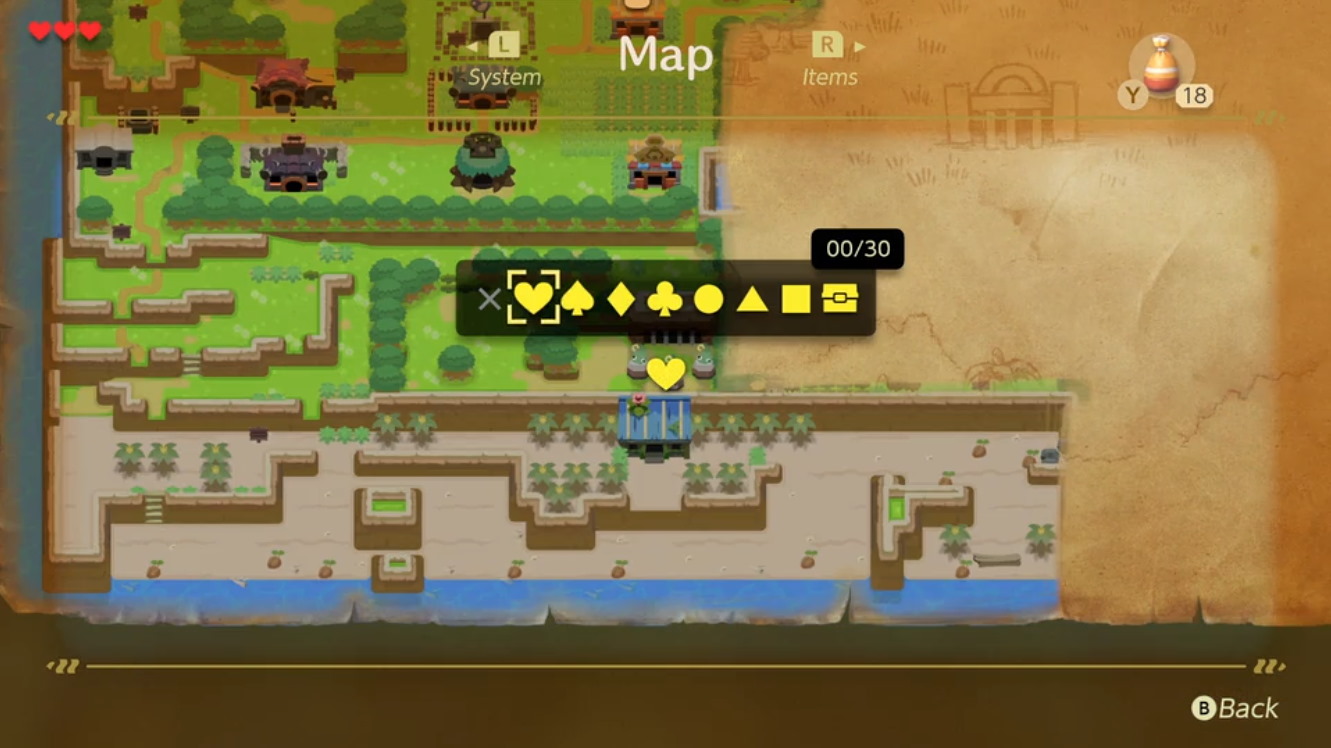
On the other hand, the fluidity of the gameplay has been brought up to modern standards and several quality-of-life improvements added. The multiplicity of inputs on the Switch allows the sword, shield, and dash to have their own buttons, while two items can be assigned freely to the others. There’s also a detailed map that you can put stamps on a la Breath of the Wild, for caves to revisit, strong enemies, and so on. No doubt the game has been tweaked otherwise here and there to accommodate modern conveniences, but those are the big ones.

The colorful graphics are, obviously, a big improvement over the 1993 Game Boy title, and rather than exposing it as dated instead make the original level design shine. Koholint Island is like a miniature Hyrule and the tilt-shift effect reinforces that feeling. Monsters and NPCs are rendered in a slightly toylike fashion that reminds me of N64 RPGs, but there’s a level of detail lavished on them that makes it clear this is a modern title.

map1

Unfortunately the graphics also lead to some performance issues, rather unexpected for a first-party title. I found that especially on the overworld, the game chugs along for a few seconds whenever loading a new area, reducing the framerate considerably and affecting the controls. Loading is rare on the island (hence the issue mentioned) but frequent, albeit brief, in dungeons.

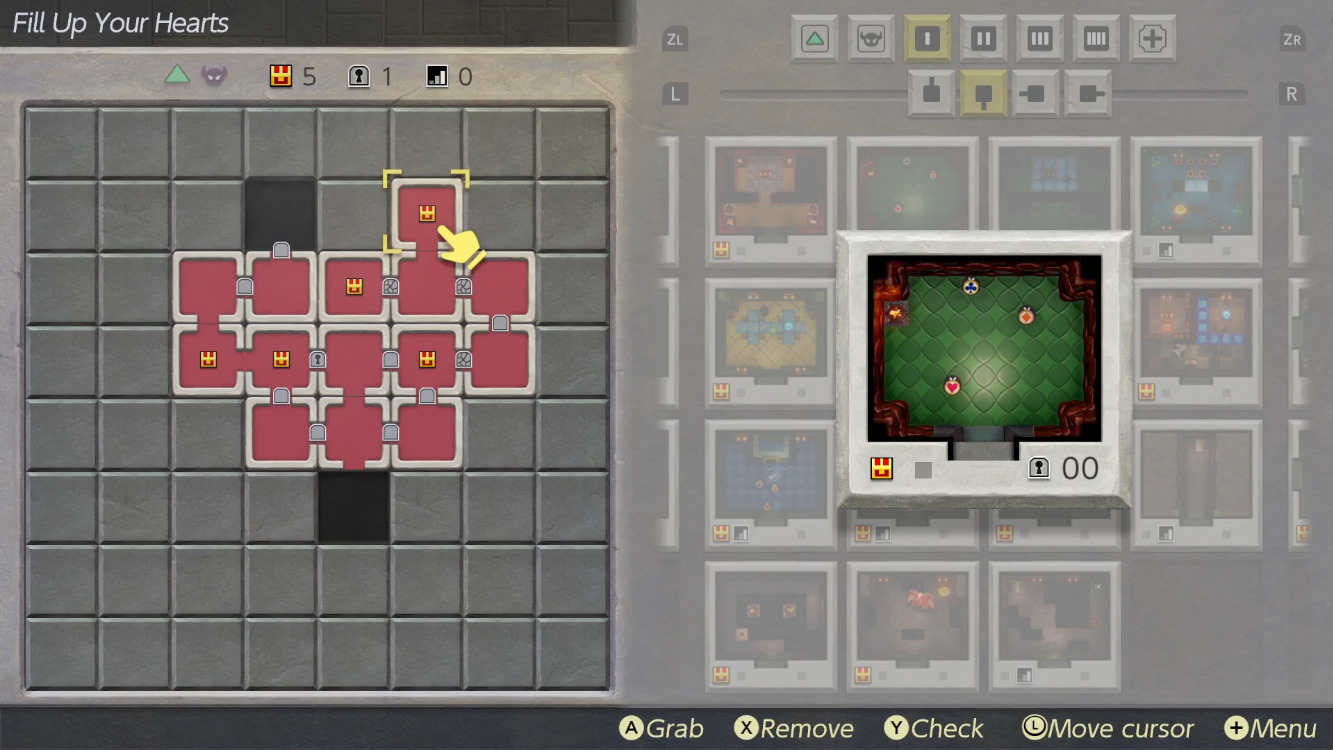
Speaking of dungeons, there you’ll find the big addition to Link’s Awakening: the Chamber Dungeon creator. But don’t expect a full-blown Zelda Maker to match Mario Maker. By speaking to Dampe the gravekeeper past a certain point in the story, you unlock the ability to make new dungeons out of tiles with various configurations — a three-exit room with a treasure chest and a solid wall on the left, for instance.

chamberdungeon

You fit these tiles together to form a complete dungeon (there’s a little tutorial) and then you go through it to earn… well, more tiles. And some rupees. But these haphazard, thematically mixed dungeons (you might have to put a dark, overgrown room next to a desert one) pale in comparison to the normal ones, which are of course in Zelda fashion carefully tuned and rewarding experiences.

There’s no way to share your dungeon with others, either, which further reduces the draw. Perhaps after completing a certain amount you get a heart piece or the like, but so far I haven’t found much reason to continue doing it.

That said the game itself is excellent, and for those like me who never finished it (or never played it at all) this remake is a real treat. A genuine time capsule of concentrated classic Zelda fun in a new style and with a few quality of life changes that make it absolutely worth playing even (and perhaps especially) if you finished the original.

links awakening 4

The price, however, is rather unrealistic. Nintendo is charging $60 for Link’s Awakening, which is of course what it went for 25 years ago, and what a brand new AAA game costs now. While I don’t want to downplay the amount of work and love that obviously went into this remake, it is just that: a remake. I’d happily recommend it at $30, but $40 would be pushing it and $60… well.

Here’s hoping Nintendo brings this level of love to more of its classics, but here’s also hoping they don’t charge an arm and a leg for them. As soon as this is on sale, snatch it up.

19 Sep 2019

The man behind Tesla’s Powerwall is now pitching an all-in-one power management system for homes

Arch Rao, the former head of product at Tesla who was behind the company’s Powerwall home energy storage is system, is back with a new company pitching energy management and efficiency for homes.

SpanIO is looking to upgrade the electrical fusebox for homes with a digital system that integrates into the existing circuit breaker technology that has been the basis for home energy management for at least a century. 

Rao and his team are looking to make integrating renewable power, energy storage, and electric vehicles easier for homeowners by redesigning the electrical panel for modern energy needs.

“We packaged the metering controls and compute between the bus bar and the breaker,” says Rao. “Energy flows through the panel through a breaker bar and the breaker bar has tabs that you slot your breakers into… that tab is usually a conductor. We have designed a digital sub-assembly that packages current metering, voltage measurement and ability to turn each circuit on or off.”

The technology is meant to be sold through channels like solar energy installers or battery installers. The company already has plans to integrate its power management devices with energy storage systems like the ones available from LG .

Initially, Span expects to be selling its products in states like California and Hawaii where demand for solar installations is strong and homeowners have significant benefits available to them for installing renewable energy and energy efficiency systems.

For homeowners, the new power management system means that they have control over which parts of the home would be powered in the event of an outage. The company’s technology connects the entire home to a renewable system. Using existing technologies, installers have to set up a separate breaker and rewire certain areas of the home to receive the power generated by a renewable energy system, Rao says.

That control is handled through a consumer app available to download on mobile devices.

SpanIO is backed by a slew of early investors including Wireframe Ventures, Wells Fargo Strategic Capital, Ulu Ventures, Hardware Club, Energy Foundry, Congruent Ventures and 1/0 Capital, and intends to raise fresh cash for before the end of the year. Rao said the round would be “in the low double digits” of millions.

19 Sep 2019

Cannabis logistics startup Wayv launches dynamic distribution platform

Supply chain logistics is a headache and a half across any industry, but the difficulty level goes way up within the world of cannabis. Because of federal laws, FedEx, UPS and USPS are not an option. Distributors need a variety of licenses and must operate within specific regulation. For example, cannabis brands must either become their own first-party distributor, with W2 employees and company-owned cars, distribution centers, etc., or use a licensed third-party distributor.

Wayv, the B2B cannabis logistics platform founded by serial entrepreneur Keith McCarty, is looking to solve this problem with the launch of its Dynamic Distribution platform. Of course, Wayv has been operational for upwards of a year, having received $5 million in seed led by Craft Ventures’ David Sacks (former coworker to McCarty from the Yammer days) back in October 2018.

Today, however, marks the public launch of Dynamic Distribution, which not only connects brands, retailers and distributors to streamline cannabis supply chain logistics, but allows brands to list themselves as third-party distributors for other brands. Plus, the platform automatically checks for compliance with all parties on the platform across federal, state and local laws.

While companies like Anvyl and Flexport are looking to support other, less regulated industries in their supply chain logistics evolution, the cannabis industry has been mostly left in the paper age. Wayv aims to streamline that by providing a single interface for brands, retailers and distributors to move cannabis products within the state of California.

For the past year, Wayv’s platform has helped power logistics among several cannabis brands — Caliva, Kurvana, High Style Brewing Company, and GoldDrop to name a few — as well as distributor Sierra Pacific Warehouse Group.

With Dynamic Distribution, brands who handle their own distribution can hop on the Wayv platform and get listed as a third-party distributor for other brands, opening up new revenue streams. Plus, this will allow brands across the state to access a much bigger pool of distribution options, allowing for small upstart brands to get selling without scaling up their own distribution operation.

Wayv generates revenue on a per transaction basis, charging a 15 percent fee to brands. Thus far, the startup has more than 80 brands on the platform.

McCarty says that one of the obstacles of an on-demand logistics business is supply constraint. He likened it to consumer on-demand services, like Uber and Lyft, whose growth is dependent on the number of drivers they can get on the platform.

“In the cannabis environment, there are so many compliance and licensing requirements, along with packaging and product testing requirements — which are all amazing and necessary — that we live in this environment that is very fragmented,” said McCarty. “It’s the fastest growing industry in the world, and there’s no Coca-Cola or Starbucks. There are no big chains. Just small companies individually. This means a lot more friction and a lot more need for something like Wayv to help solve the problem.”

McCarty has plenty of experience in the cannabis sector. Prior to Wayv, McCarty founded Eaze, the on-demand cannabis delivery platform for consumers. Before Eaze, McCarty was an early employee at Yammer, which was sold to Microsoft in June 2012 for $1.2 billion.