Year: 2019

19 Sep 2019

Silicon Valley is terrified of California’s privacy law. Good.

Silicon Valley is terrified.

In a little over three months, California will see the widest-sweeping state-wide changes to its privacy law in years. California’s Consumer Privacy Act (CCPA) kicks in on January 1 and rolls out sweeping new privacy benefits to the state’s 40 million residents — and every tech company in Silicon Valley.

California’s law is similar to Europe’s GDPR. It grants state consumers a right to know what information companies have on them, a right to have that information deleted and the right to opt-out of the sale of that information.

For California residents, these are extremely powerful provisions that allow consumers access to their own information from companies that collect an increasingly alarming amount of data on their users. Look no further than Cambridge Analytica, which saw Facebook profile page data weaponized and used against millions to try to sway an election. And given some of the heavy fines levied in recent months under GDPR, tech companies will have to brace for more fines when the enforcement provision kicks in six months later.

No wonder the law has Silicon Valley shaking in its boots. It absolutely should.

It’s no surprise that some of the largest tech companies in the U.S. — most of which are located in California — lobbied to weaken the CCPA’s provisions. These companies don’t want to be on the hook for having to deal with what they see as burdensome requests enshrined in the state’s new law any more than they currently are for Europeans with GDPR.

Despite the extensive lobbying, California’s legislature passed the bill with minor amendments, much to the chagrin of tech companies in the state.

“Don’t let this post-Cambridge Analytica ‘mea culpa’ fool you into believing these companies have consumers’ best interests in mind,” wrote the ACLU’s Neema Singh Guliani last year, shortly after the bill was signed into law. “This seeming willingness to subject themselves to federal regulation is, in fact, an effort to enlist the Trump administration and Congress in companies’ efforts to weaken state-level consumer privacy protections,” she wrote.

Since the law passed, tech giants have pulled out their last card: pushing for an overarching federal bill.

In doing so, the companies would be able to control their messaging through their extensive lobbying efforts, allowing them to push for a weaker statute that would nullify some of the provisions in California’s new privacy law. In doing so, companies wouldn’t have to spend a ton on more resources to ensure their compliance with a variety of statutes in multiple states.

Just this month, a group of 51 chief executives — including Amazon’s Jeff Bezos, IBM’s Ginni Rometty and SAP’s Bill McDermott — signed an open letter to senior lawmakers asking for a federal privacy bill, arguing that consumers aren’t clever enough to “understand rules that may change depending upon the state in which they reside.”

Then, the Internet Association, which counts Dropbox, Facebook, Reddit, Snap, Uber (and just today ZipRecruiter) as members, also pushed for a federal privacy law. “The time to act is now,” said the industry group. If the group gets its wish before the end of the year, the California privacy law could be sunk before it kicks in.

And TechNet, a “national, bipartisan network of technology CEOs and senior executives,” also demanded a federal privacy law, claiming — and without providing evidence — that any privacy law should ensure “businesses can comply with the law while continuing to innovate.” Its members include major venture capital firms, including Kleiner Perkins and JC2 Ventures, as well as other big tech giants like Apple, Google, Microsoft, Oracle and Verizon (which owns TechCrunch).

You know there’s something fishy going on when tech giants and telcos team up. But it’s not fooling anyone.

“It’s no accident that the tech industry launched this campaign right after the California legislature rejected their attempts to undermine the California Consumer Privacy Act,” Jacob Snow, a technology and civil liberties attorney at the ACLU of Northern California, told TechCrunch.

“Instead of pushing for federal legislation that wipes away state privacy law, technology companies should ensure that Californians can fully exercise their privacy rights under the CCPA on January 1, 2020, as the law requires,” he said.

There’s little lawmakers in Congress can do in three months before the CCPA deadline, but it won’t stop tech giants from trying.

Californians might not have the CCPA for long if Silicon Valley tech giants and their lobbyists get their way, but rest easy knowing the consumer won — for once.

19 Sep 2019

Amazon orders 100K electric delivery trucks from Rivian as part of going carbon neutral by 2040

Amazon will be stepping up its efforts to reduce its climate impact, CEO Jeff Bezos announced on Thursday. The company will be ordering 100,000 electric delivery trucks from Michigan’s Rivian as part of this commitment, Bezos said. The commerce giant will seek to meet its goal of becoming carbon neutral by 2040 – 10 years earlier than is outlined by the United Nations Paris Agreement.

Bezos said at a National Press Club event in Washington where he made the announcement that the updated timeline is due to the increase in climate change, which has been more aggressive than even some of the more serious predictions had anticipated five years ago whine the Paris agreement was reached.

Amazon’s overarching efforts to make the company carbon neutral are bundled under a plan the company is calling the “Climate Pledge,” which will be open to other companies as well. In addition to efforts like the Rivian order for emission-free delivery vehicles, Amazon will also be seeking  to reduce its footprint through other means, including solar energy and carbon offsets.

Rivian noted that this was the largest order to date of any electric delivery vehicles, and that they’d begin actually deploying for Amazon starting in 2021. Amazon led a $700 million investment round in Rivian in February, and the company announced a further $350 million from auto industry giant Cox automotive earlier this month.

Developing…

19 Sep 2019

Facebook expands its playable and AR ad formats

Ahead of Advertising Week, Facebook is the announcing the expansion of three interactive ad formats.

First, it says that poll ads (which you may already have seen in Instagram Stories) are moving to the main feed of the Facebook mobile app. Second, the augmented reality ads that Facebook has already been testing are moving into open beta this fall. Third, Facebook is making playable ads available to all advertisers, not just gaming companies.

The company showed off each format at a press event yesterday in New York City.

E!, for example, says it ran ads with interactive polls to promote one of its TV shows, leading to a 1.6x increase in brand awareness. Meanwhile, Vans created a playable ad where players could guide skateboarder Steve Van Doren down a mountain, resulting in a 4.4% lift in ad recall. And WeMakeUp ran an AR ad campaign allowing users to virtually try on new shades of makeup, leading to a 27.6% lift in purchases.

Mark D’Arcy, Facebook’s chief creative officer and vice president of global business marketing, said that while the initial playable ad examples had “very literal gaming mechanics, doing brands in a game,”  there could be “a whole range” of different interactions over time.

D’Arcy also acknowledged that including polls, games and AR in ads aren’t exactly new ideas, but he suggested that in the past, they’ve generally been “heavy” experiences, requiring things like a separate microsite. By bringing them front-and-center on Facebook, the company is making them “super lightweight, fun and super scalable.”

As result, he suggested that each of these formats will evolve as more advertisers get to experiment with them: “In 12 months, even six months, we’re going to look at these examples and they’ll be fundamentally different.”

And if you’re wondering how these new formats will handle user data, the Facebook team said that only the aggregate results of polls — not individual user data — will be shared with advertisers. Similarly, any images created by users through an AR ad can be saved to their camera roll, but won’t be shared with advertisers.

19 Sep 2019

Nintendo Switch Lite review

Let me preface this by saying: I realize that I’m not necessarily the target user for the original Nintendo Switch. First: I don’t own a TV, and haven’t since high school. Second: I travel all the time for this damn job.

The combination of these things have made the device’s convertible form factor a bit of a nuisance. It’s big and heavy and the Joy-Cons semi-frequently slip off during game play. And while I’ve occasionally considered playing it in convertible mode, with the kickstand up, controllers detached as the console sits on, say, an airplane tray table, the capability ultimately isn’t worth the trade-offs.

It seems odd that “built-in controllers” is listed as a feature on a gaming console, but, then, I suppose it kind of is.

Nintendo Switch Lite

That’s all a lot of words to say that I was excited when the rumors around the Switch Lite first dropped. That enthusiasm carried over to a recent hands-on with the device. And now, here we are. Honestly, the Switch Lite is pretty much what I’d hoped for.

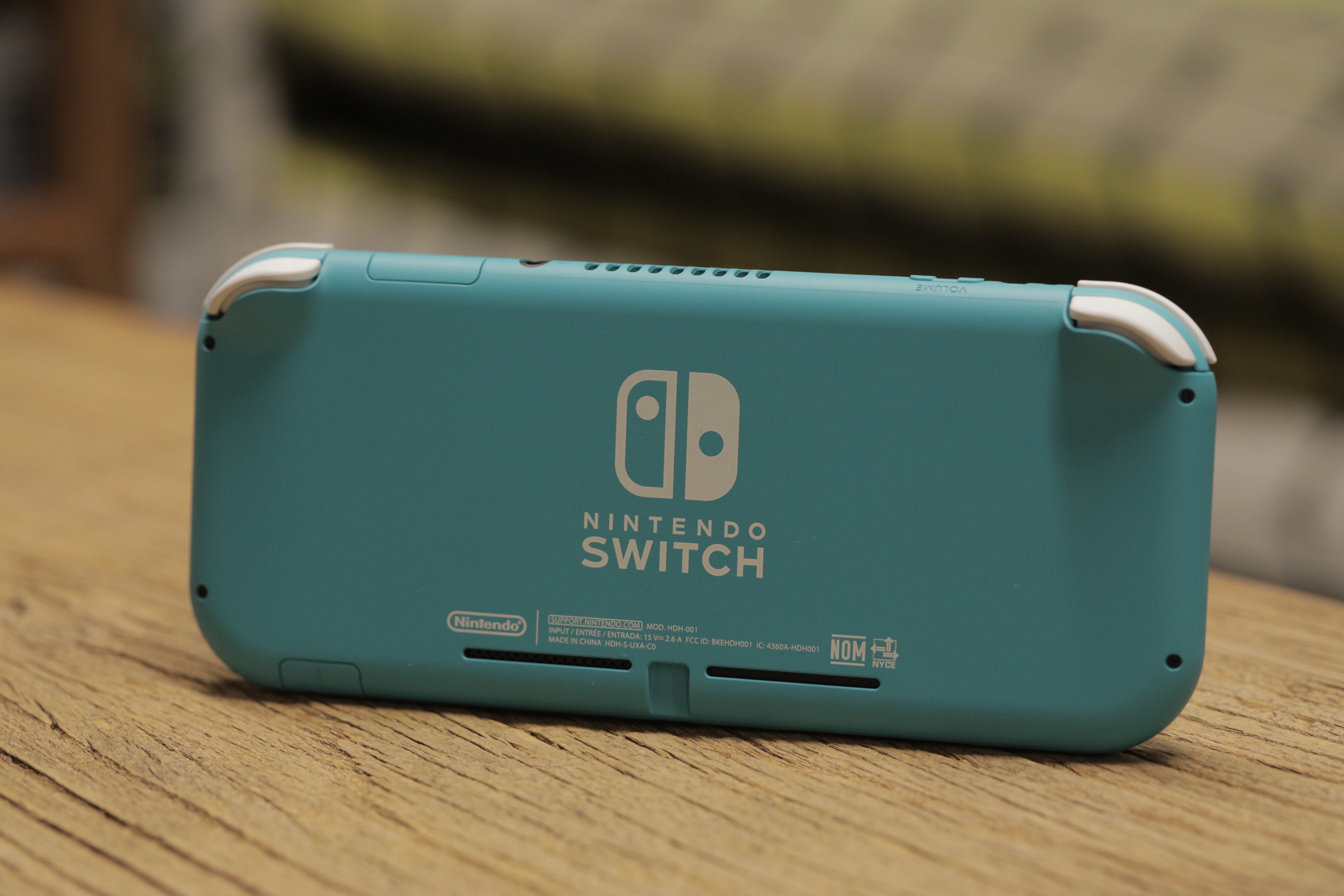
The Lite is noticeably smaller and lighter than the standard model, even without having both models handy, but here’s a shot from our hands-on for reference:

Nintendo Switch Lite

Of course, the form factor is still considerably larger than a majority of smartphones, which, at the end of the day are the Lite’s true competitor when it comes to mobile gaming. But Nintendo’s put a focus on first-party hardware, and the value of that proposition has played out remarkably well during the Switch’s nearly three-year life. Nintendo’s line has always been about making software for the hardware, and that certainly follows with the Switch line. It’s hard to imagine most of these first-party games successfully making the jump to mobile intact.

Nintendo certainly did right by the color scheme. As I wrote in the hands-on, the hardest question for me wouldn’t be whether or not to purchase a Switch Lite, but which color to get. Nintendo made the choice easy, sending a turquoise number in for review. The gray and yellow are also quite nice in different ways, but I was already leaning in that direction.

Nintendo Switch Lite

The portability’s the thing here, but shrinking the device down comes with some compromises. In addition to the loss of dockable TV versatility, the screen has been shrunk down from 6.2 to 5.5 inches (the resolution is the same admittedly unremarkable 720p). This is mostly noticeable in places like the menu, where the font has become more difficult for my aging eyes to read (the menu UI, admittedly, could still use some work). Longtime Switch players will notice the difference during gameplay, as well, but you’ll adjust soon enough — especially if you’ve grown accustomed to playing games on your phone.

The battery, too, is smaller, down to 3579mAh from 4310mAh, per FCC filings. Even so, the company is claiming three to seven hours of battery, compared to the original Switch’s 2.5 to 6.5. That slight upgrade appears to have been accomplished through a combination of a less power hungry (smaller) display and a more power efficient processor. The newer version of the classic Switch, meanwhile, sports a 4.5 to nine-hour battery. Given that a truncated life was the first gen’s biggest complaint, I’d have hoped that the company would have made battery progress on both sides — but you can’t win them all, I guess.

Nintendo Switch Lite

The headphone jack stayed put for the Lite. So, too, did the microSD and game card slots. Physical media isn’t quite dead in the gaming word just yet. The kickstand is gone because, well, there’s really no point without the detachable Joy-Cons. The other key physical difference is the addition of an omnidirectional D Pad, replacing the less-useful four arrows. I’ve honestly grown fairly accustomed to using the left stick for basically everything. Still, the arrival of the Lite’s D Pad is timed nicely with the addition of NES and Super NES titles to the Switch Online library. The button’s usefulness on standard Switch titles is a lot more limited, however. The pad also felt a bit softer than I was anticipating — something that takes some getting used to.

The Switch’s real killer app, however, is price: $200 feels just about right for the console. That’s down $100 from the standard Switch. Couple that with the surprisingly affordable $4 a month (or $20 a year) for Switch Online and you’ve got a pretty killer deal for a platform in its third year of life.

Forced to choose between the two models today, I’d almost certainly go for the Lite. Though I would grit my teeth a bit at the idea of sacrificing a couple of hours of battery life in the process. Of course, not everyone is me (thankfully). Most of you, for instance, are normal, well-adjusted people with television sets in their homes, and moving to the Lite means sacrificing the Switch’s namesake and most innovative feature.

[gallery ids="1883183,1883182,1883181,1883180,1883179,1883178,1871342,1871341,1871340,1871339,1871338,1871337,1871336,1871335,1871334,1871333,1871332,1871331,1871330"]

As someone who spends much of his life on subway cars and planes, this is the Switch I (and others, I’m sure) have been waiting for.

19 Sep 2019

Airbnb says it will go public next year

Airbnb has said that it will have its initial public offering in 2020.

The company is one of the last of the big unicorn herd that grew up roughly a decade ago and includes Uber, Lyft, the We Company, and Postmates, to declare its public market intentions.

Yesterday evening the company announced that it had hit over $1 billion in revenue for the second quarter 2019. It’s the second time in the company’s history that it pulled in more than $1 billion, according to the statement.

Airbnb also said that through September 15, 2019 users who list their homes and rooms on the company’s marketplace have made more than $80 billion since the company’s launch. The supplemental income for underpaid teachers alone clocks in at $160 million alone and roughly 51% of people surveyed by the company said hosting has helped them afford their home.

The company also said that Airbnb’s housing stock now includes 7 million listings in over 100,000 cities around the world. Airbnb says that over 1,000 cities have more than 1,000 listings — eight years ago, that figure was only 12.

Airbnb is also pulling in more money from its tourism business, with more than 40,000 tours and “experiences” booked in over 1,000 cities.

All of this travel has led to over $100 billion in economic impact across thirty countries, the company said.

This growth hasn’t come without controversy and Airbnb’s success will depend on its ability to continue to thread the needle between government regulation over the company’s impact on housing prices and the creation of vacant apartments and homes that are only investment properties which increase Airbnb’s housing stock.

The company’s imminent public offering is good news for investors like Andreessen Horowitz, Manhattan Venture Partners, Sequoia Capital, TCV, Firstmark and Altimeter Capital, which have collectively invested roughly $4.4 billion into the company, according to Crunchbase.

19 Sep 2019

Ginkgo Bioworks’ dev shop for genetic programming is now worth $4 billion

Ginkgo Bioworks is now worth $4 billion after a $290 million capital infusion that will give the company the cash to dramatically expand its developer shop for genetic programming.

The Boston-based company is one of a handful of U.S.-based early-stage companies that are on the forefront of developing the tools to modify genetic material for everyday applications.

“Cells are programmable similar to computers because they run on digital code in the form of DNA.” said Jason Kelly, CEO and co-founder of Ginkgo Bioworks, in a statement. “Ginkgo has the best compiler and debugger for writing genetic code and we use it program cells for customers in a range of industries. Today’s fundraise will allow us expand our technology and continue our drive to bring biology into every physical goods industry – materials, clothing, electronics, food, pharmaceuticals, and more. They are all biotech industries but just don’t know it yet.”

Ginkgo makes money in two ways. The company sells its development services to anyone who comes in with an idea. Kelly said that it’d be like any agreement with an entrepreneur who hires a coding shop to develop an application.

For example, if an entrepreneur wanted to develop houseplants that smelled like roses or lilies, they could approach Ginkgo, pay a (not-insignificant) fee, and Ginkgo would do the research into designing something like a lily-scented fern. (Kelly puts the sticker price on that kind of development somewhere in the neighborhood of $10 million, so a founder best believe their product can sell.)

“You don’t need to come in with deep biological know-how,” Kelly says. “The question is, is capital interested in the problem?”

The other way that Ginkgo is approaching the market is by taking equity stakes in businesses that rely on its technology.

Those take the form of joint ventures with companies like Bayer (the first joint venture partner for Ginkgo) and the launch of Joyn, a $100 million spin-out that was created in the summer of 2018.

The two companies are collaborating on the development of seeds that require less fertilizer for growth — something that could save the industry millions and decrease pollution associated with traditional chemical fertilizers.

Since that first spinout, Ginkgo has created three other companies. There’s the $122 million deal to produce rare cannabinoids with the Canadian cannabis company, Cronos; a partnership with Roche that was born out of Ginkgo’s acquisition of Warp Drive Bio; and Motif Foodworks, which is working on manufacturing alternative proteins with a $120 million in financing.

Alongside these large-scale initiatives, Ginkgo has signed partnerships with the West Coast powerhouse accelerator program from Y Combinator and a new Boston-based life sciences-focused group called Petri to conduct development work for startups from those programs in exchange for an equity stake.

“We’re not going to have all the good ideas,” says Kelly. “We want to tap the much larger pool of smart people and really have them building on our platform. Of all of the people we can give value to, we can give the most to startups. If we can offer them to do their biowork without all of the fixed costs of build a lab,” that’s valuable, he says.

Investors in the company include Y Combinator, DCVC, MassChallenge, Felicis Ventures, General Atlantic, Baillie Gifford, Bill Gates, and Viking Global.

19 Sep 2019

‘The best VC on Instagram’ is now VC-backed

About 18 months ago, Jenny Gyllander created an Instagram account by the name @thingtesting.

The premise was simple. Gyllander, who was at the center of the London startup ecosystem as an investor with the British seed fund Backed.VC, would upload photos of interesting direct-to-consumer products with a caption that served as a bite-sized review. The experiment began with Birchbox, a provider of curated boxes of beauty products that rose to prominence amid the subscription box hype of yesteryear. In her short review, tailored perfectly for the Instagram generation, Gyllander admitted to being “like 10 years late to this much hyped subscription-everything party,” adding that “after two boxes and ten products, only three products were relevant to me.” Her honesty, and perhaps more importantly, her brevity, garnered her a small following of venture capitalists, founders and consumer brand enthusiasts.


View this post on Instagram


A post shared by thingtesting (@thingtesting) on

Since that first post, Gyllander has featured and reviewed more than 100 products on her Instagram account — which today counts 32,800 followers — quit her day job and began building an Instagram inspired, full-fledged review business.

“I found something I am very, very passionate about,” Gyllander tells TechCrunch. “Finding the D2C niche was for me a little bit of a holy grail. It’s where brands and startups align for the first time in a concrete way.”

With a $300,000 pre-seed investment from angel investor and Homebrew co-founder Hunter Walk, who previously called Thingtesting “The best VC on Instagram,” early Spotify investor Shakil Khan and more, Gyllander wants to create a full-scale D2C review platform with a team of reviewers and content creators, and a portal for her loyal followers to write and submit their own reviews. She compares what she envisions for Thingtesting to that of Rotten Tomatoes. Akin to the popular website for movie and television reviews, each product review on her future website will include a Thingtesting score and an audience score. The goal is to help consumers shop smarter and filter through the D2C noise.

“People are confused right now by the sheer amount of products launching,” Gyllander said. “I want Thingtesting to be a filter for people to consume better … It’s a role department stores used to have back in the day but no body has really filled that role in the online world.”

[gallery ids="1883585,1883587,1883588"]

Gyllander, already making money from what was once a side project, has plans in store to generate significantly more revenue. Currently, she’s capitalizing off Instagram’s Close Friends list, which the social media hub launched last year to allow users to share content to fewer people. Gyllander, like a slew of other Instagram Influencers, however, quickly realized an opportunity to monetize content using the feature, a trend explained in detail in a recent report from The Atlantic.

Gyllander charges a lifetime fee of $100 to her followers hoping for a spot on her Close Friends list. Those followers are then provided exclusive content, including behind-the-scenes looks at her product review journeys. So far, 300 people have been granted access to the exclusive group as others sit on the waitlist. Gyllander explains she hasn’t green-lit every request to enter the coveted group because she wants to maintain a sense of community as the account grows in popularity. Early next year, she hopes, she will have launched a Thingtesting website and a new subscription-based membership tier targeting D2C connoisseurs, investors and anyone interested in a front seat view of the booming D2C industry.

As Thingtesting morphs into a digital review platform and expands from the bounds of Instagram, Gyllander will have to work harder to differentiate what she’s built from other review sites and D2C blogs. Her secret weapon, she believes, is her authenticity.

“It’s my honesty,” Gyllander said. “And it’s the fact that there’s no payment involved from the brands and that I’m not being paid to review products. That’s something quite rare in the Instagram world today. There aren’t that many accounts that are just talking about new products with non-monetary incentives.”


View this post on Instagram


A post shared by thingtesting (@thingtesting) on


Since launching with a review of Birchbox, Gyllander has shared her thoughts on Magic Spoon, a D2C cereal company: “one bowl kept me full for hours,” she wrote, ultimately concluding she wouldn’t continue eating the cereal. More recently, she referred to the D2C aperitif brand Haus as “stunning;” wrote a lukewarm review of the blue light-protecting eyewear brand Felix Gray; and posted a glowing summary of Dripkit, a D2C coffee brand.

To secure a spot on Gyllander’s grid, a product must bring something new to the market, as well as boast killer branding and packaging. The former VC says she tries out about 20 products a month and shares official reviews of four or five.

“The majority of people today, when it comes to modern brands, they have their first interaction through an ad or an influencer telling them about the product,” Gyllander explained. “Discovery is in a weird place right now when it comes to the general consumer.”

It’s difficult to imagine a venture-scale business within Gyllander’s vision for Thingtesting. But one should never underestimate the value of an exclusive and hyper-focused network. Gyllander, in a short time, has created a meeting place for D2C aficionados and venture capitalists and, as she’s proven, her thoughts are worth paying for.

19 Sep 2019

Quilt Data launches from stealth with free portal to access petabytes of public data

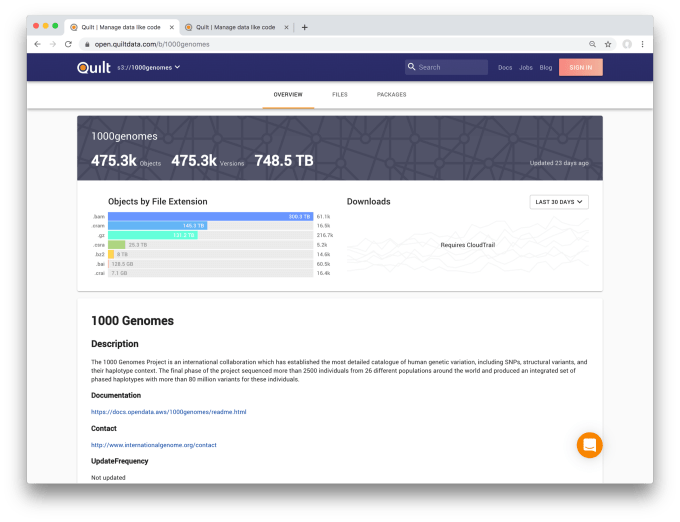
Quilt Data‘s founders, Kevin Moore and Aneesh Karve, have been hard at work for the last four years building a platform to search for data quickly across vast repositories on AWS S3 storage. The idea is to give data scientists a way to find data in S3 buckets, and then package that data in forms that a business can use. Today, the company launched out of stealth with a free data search portal that not only proves what they can do, but also provides valuable access to 3.7 petabytes of public data across 23 S3 repositories.

The public data repository includes publicly available Amazon review data along with satellite images and other high-value public information. The product works like any search engine, where you enter a query, but instead of searching the web or an enterprise repository, it finds the results in S3 storage on AWS.

The results not only include the data you are looking for, it also includes all of the information around the data, such as Jupyter notebooks, the standard  workspace that data scientists use to build machine learning models. Data scientists can then use this as the basis for building their own machine learning models.

The public data, which includes over 10 billion objects, is a resource that data scientists should greatly appreciate it, but the company is offering access to this data out of more than pure altruism. It’s doing so because it wants to show what the platform is capable of, and in the process hopes to get companies to use the commercial version of the product.

Screen Shot 2019 09 16 at 2.31.53 PM

Quilt Data search results with data about the data found. Image: Quilt Data

Customers can try Quilt Data for free or subscribe to the product in the Amazon Marketplace. The company charges a flat rate of $550 per month for each S3 bucket. It also offers an enterprise version with priority support, custom features and education and on-boarding for $999 per month for each S3 bucket.

The company was founded in 2015 and was a member of the Y Combinator Summer 2017 cohort. The company has received $4.2 million in seed money so far from Y Combinator, Vertex Ventures, Fuel Capital and Streamlined Ventures along with other unnamed investors.

19 Sep 2019

Impossible Foods will debut in SoCal grocery stores on Friday as first step in phased national rollout

Congratulations Southern California Gelsons store shoppers, you’re getting Impossible Foods on your grocery shelves.

The meatless ground meat substitute will be appearing in stores across the Southern California as the first step in a phased nationwide rollout on Friday.

With the step into groceries, Impossible Foods moves into direct competition with its bigger, publicly traded rival Beyond Meat, which is already selling its patties and sausages in major stores nationwide.

Impossible Foods, which has had some supply chain hiccups as it began to increase its production in the wake of large deals with fast food chains, will be taking a phased approach to its national expansion. Expect it to begin appearing on store shelves in other parts of the country throughout the end of the year. Its next stop is going to be another store chain on the East Coast later this month, the company said.

To celebrate the debut, Impossible Foods has tapped Chrissy Teigen’s grandmother for a VIP event on Thursday night and will be handing out samples at a Los Angeles-area Gelsons on Friday.

“Our first step into retail is a watershed moment in Impossible Foods’ history,” said Impossible Foods’ Senior Vice President Nick Halla, who oversees the company’s retail expansion. “We’re thrilled and humbled that our launch partners for this limited release are homegrown, beloved grocery stores with cult followings in their regions.”

Gelsons and Los Angeles are something of a natural first stop for the company, given LA’s place in the nation’s food, environmental, and entertainment cultures.

Indeed, celebrities are some of the backers of Impossible Foods. In the company’s last, $300 million round, Jay-Z, Katy Perry, Serena Williams, Jaden Smith, Trevor Noah and Zedd all invested.

The Impossible Burger is made to have as much iron and protein as a traditional burger and contains 14 grams of total fat, 8 grams of saturated fat and comes in at 240 calories per 4-ounce servicing. It’s not better for a person than eating a traditional burger patty, but it is better for the environment. (The company says that a conventional 4-ounce patty has 80 milligrams of cholesterol, 23 grams of total fat, 9 grams of saturated fat and 290 calories.)

Founded in 2011 by chief executive officer and former Stanford biochemistry professor Pat Brown, Impossible Foods has raised nearly $700 million from investors including Bill Gates, Khosla Ventures, the slew of celebrities, the Singaporean government’s investment fund, and Hong Kong billionaire Li Kashing (along with his venture capital fund).

The company has set itself the goal of eliminating the need for animals in the food chain by 2035.

Already selling in White Castle, Burger King and Qdoba and is, according to a GrubHub survey, the  most popular . late-night delivery item in the U.S.

19 Sep 2019

HappyOrNot raises $25M for its customer satisfaction terminals for stores and other locations

Customer experience in they physical world has been getting a major infusion of tech in recent years. We now have systems being built to replace cashiers, sensors in stores and other physical locations to track where customers are walking, and smart mirrors that suggest items you might like to try on. Today, one of the brigade of startups that is enhancing that experience further is announcing a round of funding to fuel its growth.

HappyOrNot — which makes both hardware to record whether customers are satisfied or something a little less positive by tapping a face, usually on their way out of a location, and software to parse and analyse the resulting data the comes out of that input — is today announcing that it has raised $25 million in funding, money that it will use to continue building out its technology and its customer base.

Today, it’s already a 4,000-strong list across 135 countries that includes the likes of McDonald’s, Heathrow Airport, the San Francisco 49ers, and my local swimming pool and hospital here in London. To date, HappyOrNot has record 1.3 billion feedback responses, representing a massive trove of customer sentiment that stretches from basic responses “Yes, I’m happy” or “No, I’m not happy” through to more nuanced answers around why, in the case of their interactive tablets.

(As a point of reference, when it last raised money, $14.5 million in 2017, HappyOrNot had 3,000 customers, CEO and co-founder Heikki Väänänen told me in an interview.)

The funding, a Series A, is taking the total raised by the Finnish company (which also has offices in Florida) to $40 million and is being led by Verdane, with previous investor Northzone — a storied backer of some of the biggest startups to come out of the Nordics — also participating. The valuation is not being disclosed but Väänänen said it was a big boost upwards, as the company works towards a $100 million annual run rate. (It’s not there yet and it’s not profitable.)

The face of retail sales — along with anything else that involves physical interactions with customers — has been irreversibly changed by the rise of the internet. E-commerce has taken away trade, and new digital screen-based services have emerged as strong competitors to more traditional analog experiences. And on top of that, there is now a wide range of tools to measure what customers are doing all the time on these new platforms.

HappyOrNot is giving that physical world a boost at a time when it’s under the gun. Väänänen noted to me that one of the very typical use cases where his company is stepping in, is when a retailer, in order to avoid going out of business because of losses, has had to cut retail staff. Using these terminals, they are able to figure out whether they have enough staff at certain times of the day, and whether they need to rebalance that, given that they will likely be unable to operate a full complement of employees as they had in the past. Sad times, but perhaps better than seeing business shutter altogether.

Väänänen co-founded the company out of his own experience. Working as a games designer — a big industry in Finland — he had a terrible experience at a store when he couldn’t find anyone to help him with his queries. Later, complained about the situation to his friend and coworker Ville Levaniemi. It got Levaniemi thinking and he started looking to see if anything like a measurement company to gauge this kind of sentiment existed already. Turns out, bizarrely in these days of sentiment analysis everywhere you go on the web that it did not, and they right away decided to form this startup.

The games DNA should not be underestimated: the hardware looks not unlike a controller on a games console — or more appropriately like the buttons on an old-school arcade game. And the tablet-version of the interactive console — also sold directly by HappyOrNot to customers — also plays with the idea of gamification. Similarly, he says that the analytics and motivation behind forming the company are also a hat tip to the world of gaming.

“Games are purely about user experience,” Väänänen said. “If gamers they like the games, they play them. Otherwise we go bankrupt. And it’s the same with this. If people didn’t use it, we would have abandoned the idea.”

SmileyTerminal EN HON branded Front A3 01 1The next stage of its development will likely see HappyOrNot adding in more analytics to its services. Right now, about half of the terminals located across various locations feature tablets rather than the more basic terminals with physical buttons on them. (The decision of which to use is based on how fast typically a client wants to shift customers out of their locations.)

The tablets open the door to getting more details on why customers might be happy or unhappy with their experiences.

“We’re looking forward to helping HappyOrNot scale even further, continue to win major brands as customers, and bolster its analytics and insights capabilities,” said Janne Holmia, Principal at Verdane, in a statement. “With the knowledge we possess as a leading growth equity investor in software, combined with HappyOrNot’s market dominance, and the vast potential of the customer experience market, we are confident that together we will achieve huge success.”

“There is enormous potential in the real time CX analytics market as companies across all industries wise up to how important it is to listen to the opinions of consumers and staff, and act on them in real time,” said Marta Sjögren, Partner at Northzone. “HappyOrNot is known all over the world from their presence in airports, but it’s their growth across retail, healthcare, travel, and lifestyle industries that makes the future really exciting. This is yet another huge milestone in HappyOrNot’s journey to creating a global happiness index, and thereby redefining what good service looks like vertical by vertical. In a world where instant feedback is often mainly broadcast in a one-way communication stream on social media, being able to provide it to staff in the service industry in an actionable, realtime format is truly a game-changer.”