Year: 2019

19 Sep 2019

Wing will test drone delivery in the US with Walgreens and FedEx

Wing, the drone delivery company that started its life within the Google X lab before spinning out into its own thing under the Alphabet umbrella, is prepping for takeoff.

The company announced this morning that it’s launching a test program in Virginia with Walgreens, FedEx, and local retailer Sugar Magnolia.

As part of the program, Wing will be able to deliver kids snacks (goldfish, water, gummy bears, and yogurt were mentioned as examples) and over-the-counter meds (like Tylenol or cough drops) from Walgreens, select packages from FedEx Express, and sweets and stationary from Sugar Magnolia.

Alas, unless you’re one of the roughly 22,000 people in Christiansburg, Virginia and happen to be in a neighborhood they’ve deemed eligible, you’re not going to be able to check it out just yet. Wing says the pilot program is limited to the small Montgomery County town for now as they work with locals to figure out what works and what doesn’t. The company declined to give any sort of timeline for when the program might expand to other parts of the US.

So how does it work?

When the customer places an order, one of Wing’s delivery drones heads for a pickup location. As Wing’s drones are only allowed to take-off or land in specific locations, pickups and deliveries are handled via a tether, with the drone itself hovering about 20 feet in the air. Once at the pickup location, a tether is lowered and a human operator hooks the package onto the line. The drone winches the package into the air, secures it, and heads for its destination.

Once in flight, Wing says its drone cruises at about 60-70mph, with a range of about 6 miles each way. Once the drone arrives at the delivery location, the same tether line lowers the package. When the drone detects that the package has reached the ground, the package is released and the drone heads back home. All in all, Wing estimates that they can make a delivery within about 10 minutes of a customer finalizing their order.

And if the tether gets stuck on something, or someone tries to grab it and tug it down? The drone is designed to detect the resistance and release the tether, dropping the line to the ground.

wing fedex

Wing says its drone can currently handle a payload of about 3 lbs, with the drone itself weighing roughly 10 lbs.

Wing won’t charge pilot program customers for delivery; customers will pay the store’s sticker price, and delivery during this test phase will be free.

Wing says the first deliveries should start next month.

19 Sep 2019

YouTube overhauls its problematic verification program

YouTube’s verification program is getting a massive overhaul, the company announced today, which will likely result in a number of less prominent creators losing their verification status. Previously, YouTube allowed any channel that reached 100,000 subscribers to request verification. That limit is being removed, with a change to the verification program that rolls out in late October. Going forward, YouTube will focus its efforts on verifying channels that have more of a need to prove their authenticity — like those belonging to a brand, public figure, artist or another creator who might be subject to impersonation, for example.

YouTube says the earlier verification system was established when the site was smaller, but its ecosystem has since grown and “become more complex.”

Instead of looking at a number of subscribers — a metric than can be gamed by bots — the new system will have more murky requirements. YouTube says it’s about “prominence,” which it defines in a number of ways.

For starters, YouTube will determine if the channel represents a “well-known or highly searched for creator, artist, public figure or company.” It will also consider if the channel is widely recognized outside of YouTube and has a strong online presence, or if it’s a channel that has a very similar name to many other channels.

We understand YouTube will use a combination of human curation and algorithmic signals to make these determinations. When asked, the company declined to discuss the specifics, however.

Creators V3

There were several reasons YouTube wanted to change its system, beyond raising the threshold for verification.

The company had run into a similar problem that Twitter once faced — people mistook the verification badge as an endorsement. On Twitter, that issue reached a tipping point when it was discovered that Twitter had verified the Charlottesville rally organizer. Twitter stopped verifying accounts shortly afterward. Its system today is still being fixed, but the project has been put on the back burner.

Similarly, YouTube’s research found that over 30% of users misunderstood the verification badge’s meaning, believing the checkmark indicted “endorsement of content,” not “identity.”

This is problematic for YouTube for a number of reasons, but mainly because the company wants to distance itself from the content on its platform — content that is often racist, vile, false, dangerous, conspiracy-filled and extremist. YouTube wants to be an open site, with all the troubles that entails, but doesn’t want to be held accountable for the terrible things posted there — like the 14-year-old girl who grew to online fame by posting racist, anti-Muslim, anti-LGBTQ videos, or the high-profile star who made repeated racist comments, then gets honored by YouTube with special creator rewards. 

There were other issues with the prior system, as well.

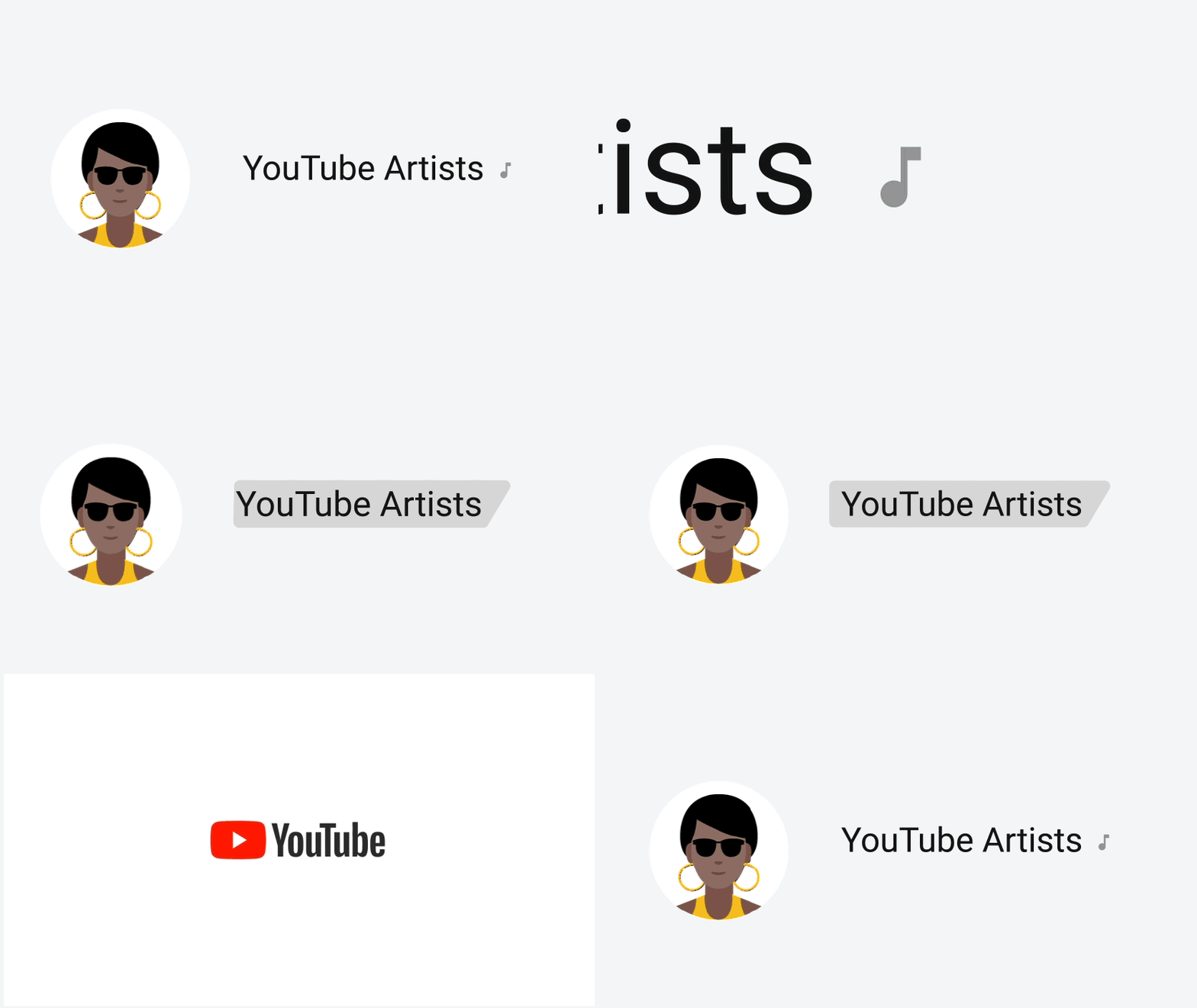
Some creators would fake their verification status, for instance. Before the changes, a verified channel would display a checkmark next to its channel name. This could be easily forged by simply adding a checkmark to the end of a channel name.

Plus, the checkmark itself only really worked when people viewed the channel’s main watch page on desktop or mobile. It didn’t translate as well to interactions in live chats, on community posts or in stories.

Music V3

By revamping the verification system, YouTube is clarifying that the verification isn’t an endorsement — it’s a neutral statement of fact. It’s also less difficult to forge, and works everywhere the creator interacts with fans.

The updated verification system drops the checkmark in favor of a gray swipe across the channel name (see above).

This applies to both channels and artists. With regards to the latter, it will replace the music note.

The system will roll out in late October, and the new criteria will apply for all channels.

Those who meet the new requirements won’t need to apply — they’ll automatically receive the new verified treatment. Others who didn’t qualify for re-verification will be notified today and will have the option to appeal the decision before the changes take place.

Information on the appeals process will be available in YouTube’s Help Center.

19 Sep 2019

How Automattic wants to build the operating system of the web

Automattic, the company behind WordPress.com, WooCommerce, Longreads, Simplenote and soon Tumblr, is now worth $3 billion. But its founder and CEO Matt Mullenweg has a bigger goal. He wants to make the web better, more open and diverse.

With the rise of social networks and closed platforms, Automattic’s mission statement has never sounded so important. Automattic doesn’t want to be the hot new startup. It wants to build a strong foundation to empower content creators for decades to come.

In an interview this week, Matt Mullenweg discussed why he raised $300 million from Salesforce Ventures, what he thinks of the current state of the web and how Automattic has a shot at building the open-source operating system of the web. The interview was edited for clarity and brevity.


Romain Dillet: Tell me more about how much money you’ve raised, who you’ve raised from.

Matt Mullenweg: What we’re announcing is that we’ve raised $300 million from Salesforce . They took the entire round. Basically Salesforce is buying 10% of the company.

Dillet: I looked at past funding stories. And the last round for Automattic was in 2014. What has changed over the past five years, and why do you want more money right now because it feels you’ve been doing fine over the past five years?

Mullenweg: It is true that we raise money when it’s right, not every year. In 2014, we were somewhere between 200 and 300 people. We’re now close to 1,000 people, we’ll be close to 1,200 when the Tumblr [acquisition] closes at the end of the month. The business has grown tremendously, pretty much on every metric.

We rewrote the whole admin to Javascript and APIs — we use React for that. We released Gutenberg, which is the next-generation of posting. I think WooCommerce was bought in that time, so we moved into e-commerce and that’s grown to be our fastest-growing business.

Really, Automattic then and now is almost a completely different company in every single regard. Like you said, I think it’s going well-meaning that the one thing that hasn’t changed is our respect for our users and doing our best to try to maintain their trust.

Dillet: You talked about WooCommerce. What’s the business breakdown today? What product is the biggest revenue maker for the company? Is it WordPress .com, WordPress.com VIP, WooCommerce?

Mullenweg: The best way to think of it is that WordPress.com and Jetpack are the largest. The second would be WooCommerce. And third is actually going to be [WordPress.com] VIP, so our enterprise business.

Dillet: Do you expect some kind of integration with Salesforce or is it purely a financial move on Salesforce’s side?

Mullenweg: Nothing to announce today, sorry about that. This is a purely financial investment but we’ve been a long-time customer of Salesforce, we’re a big fan of the platform. And definitely, you could imagine, given a lot of thoughts, how WordPress could complement their products.

Dillet: So there will be some synergies in the future…

Mullenweg: I certainly hope so.

Dillet: Do you think there will be synergies the other way round as well for Automattic? Could you leverage some of Salesforce’s technologies and products?

Mullenweg: Definitely, especially as WordPress starts being adopted more and more in the enterprise. [WordPress.com] VIP customers are already Salesforce customers. It’s just a matter of figuring out what are their biggest needs and how we can serve them. As you know, Salesforce has a million products. So it’s really hard to nail it down and choose where to begin.

Image via Takamorry / Flickr

Dillet: Usually, when you have big news about Automattic, you share some metrics saying ‘x% of the web runs on WordPress’, do you have an update on this front?

Mullenweg: 34%.

Dillet: Do you think this is too low and there’s still a lot of room to grow?

Mullenweg: I think there’s potential to get to a similar market share as Android, which I believe now has 85% of all handsets. When you think about it, open source has a virtuous cycle of adoption, people building on the platform and more adoption.

“I think there’s potential to get to a similar market share as Android, which I believe now has 85% of all handsets” Matt Mullenweg

And WordPress has been in this cycle for a few years now. The most interesting is that it’s actually accelerating. Even though there’s more competition than ever, that percentage is growing faster than it used to. Surely faster than the last time we raised money.

Do you remember where it was in 2014?

Dillet: I think it was 20 or 25%, something like that. [It was 22%.]

Mullenweg: What we want to do is to become the operating system for the open web. We want every website, whether it’s e-commerce or anything to be powered by WordPress. And by doing so, we’ll make sure that the web can go back to being more open, more integrated and more user-centric than it would be if proprietary platforms become dominant.

Dillet: You talked about the number of websites running on WordPress. But when it comes to usage, people spend a lot of time on social networks and closed platforms. How do you feel about most people spending most of their time on Facebook, YouTube and Medium?

Mullenweg: I don’t think they actually do. I think it’s just easier to account the time they spend there because it’s on one domain. If you added up all the time that everyone spends on the rest of the web, it would dwarf Facebook, etc. Even though these are impressive platforms and we’re moving into the social network side of things ourselves with Tumblr.

Dillet: Do you think it comes in waves and we’ve gone too far in one direction and we’re going to go back to a more open web?

Mullenweg: I like to think about it in terms of user experience. What Twitter, Facebook, etc. have done is actually create an amazing user experience. No one should deny that. It’s really nice to have all your friends in one place. And it’s just easier.

It’s now up to the technologists to figure out how to make an experience, which is just as good but puts more control back in the hands of users.

Dillet: How do you feel about the fragmentation of the open web? It feels like we had an okay solution with RSS feeds but not many people are using RSS feeds anymore. Do you think you should also work on a way to integrate the diversity of the open web in a central interface of some sort?

Mullenweg: Yes, and the good news is that Tumblr’s dashboard is incredibly compelling. They built a fantastic way to follow and enjoy things. I think that there’s a way to bring more of the open web back into people’s daily habits.

The social networks as we’ve seen optimize for engagement in ways that sometimes are detrimental to people’s mental health and happiness.

Dillet: Will you be optimizing for engagement with the acquisition of Tumblr?

Mullenweg: I think we’re trying to optimize for fun and a better world. I apologize if that sounds a bit cheesy but we’re going to try.
GettyImages 1158411075

(Photo: MARTIN BUREAU/AFP/Getty Images)

Dillet: With so much funding on your hands now, do you have some moonshot projects that you’ve been putting on the back-burner and that you can now tackle?

Mullenweg: We’re trying to show that we invest for the long term wherever possible. We can make our funding go a really long way. Even though we’re 15 years old, this is only our fourth round. Things like Calypso, Gutenberg, Tumblr, WooCommerce… are big bets. And with each one of those, we have a long way to go.

“The problem we’re trying to solve is likely multigenerational” Matt Mullenweg

The problem we’re trying to solve is likely multigenerational. It can take the rest of our lives and we need to pass it on to the generation that comes after to continue to work on it. Hopefully for the rest of humanity because I can’t imagine a time when humanity cannot benefit from an open, free, connected web.

Dillet: How do you feel about Progressive Web Apps?

Mullenweg: I think it’s very exciting. We’re definitely in a weird area where the app stores are… When you think about the amount of the tech economy that goes through them, it’s shocking how much power they have and how little oversight or accountability they have.

“We shouldn’t be surprised when a closed marketplace favors itself. And I think we should be mad at them.” Matt Mullenweg

And the web allows you… It’s a kind of exit hatch. It’s a way to really be in control of your destiny as a business in a way that isn’t reliant on the judgment calls of largely Google and Apple. I think overall they are great companies. They have made some decisions on their app stores that benefit them sometimes over their users or folks in their stores.

We shouldn’t be surprised when a closed marketplace favors itself. That’s just a natural thing to happen. And I think we should be mad at them. We should be mad at ourselves for not demanding on relying on something more open.

Dillet: Do you think people are not mad enough?

Mullenweg: When I say mad at ourselves, I’m not talking about the general population. I’m talking about us as people building things on these platforms. Like this story that Amazon favors its own products, that’s ‘dog bites man’. It’s not that interesting, we should have expected that to happen.

Dillet: When you look at the roadmap before raising from Salesforce, and the roadmap after. Is the roadmap that you defined, let’s say, three years ago for the next ten years going to be the same?

Mullenweg: The roadmap is the same. I just think we might be able to do it in five years instead of ten.


19 Sep 2019

iOS 13 is now available to download

Apple has just released the final version of iOS 13. This update brings many much needed quality-of-life improvements — and there are also a bunch of new features. The update is currently rolling out and is available both over-the-air in the Settings app, and by plugging your device into iTunes for a wired update.

Many people try to download these major updates at the same time. Apple usually implements a queue system to ensure speedy downloads once you’re at the front of the queue.

iOS 13 is compatible with the iPhone 6s or later, the iPhone SE or the 7th-generation iPod touch. If you have an iPad and you are looking for iPadOS 13, it’ll be available on September 30 with the release of iOS and iPadOS 13.1.

But first, backup your device. Make sure your iCloud backup is up to date by opening the Settings app on your iPhone or iPad and tapping on your account information at the top and then on your device name. Additionally, you can also plug your iOS device to your computer to do a manual backup in iTunes (or do both, really).

Don’t forget to encrypt your backup in iTunes. It is much safer if somebody hacks your computer. And encrypted backups include saved passwords and health data. This way, you don’t have to reconnect to all your online accounts.

Once this is done, you should go to the Settings app as soon as possible to get in the queue. Navigate to ‘Settings,’ then ‘General’ and then ‘Software Update.’ Then you should see ‘Update Requested…” It will then automatically start downloading once the download is available.

Here’s a quick rundown of what’s new in iOS 13. This year, in addition to dark mode, it feels like every single app has been improved with some quality-of-life updates. The Photos app features a brand new gallery view with autoplaying live photos and videos, smart curation and a more immersive design.

This version has a big emphasis on privacy as well thanks to a new signup option called “Sign in with Apple” and a bunch of privacy popups for Bluetooth and Wi-Fi consent, background location tracking. Apple Maps now features an impressive Google Street View-like feature called Look Around. It’s only available in a handful of cities, but I recommend… looking around as everything is in 3D.

Many apps have been updated, such as Reminders with a brand new version, Messages with the ability to set a profile picture shared with your contacts, Mail with better text formatting options, Health with menstrual cycle tracking, Files with desktop-like features, Safari with a new website settings menu, etc.

19 Sep 2019

Is that supplement safe to take? This AI tool scours research to find out

Dietary supplements are used by millions who accept the occasionally scarce evidence they help out with some condition or another. But also scarce is documentation of potential harmful interactions with other supplements or drugs. A new tool called Supp.ai looks through years of health research papers to extract potential conflicts that may not be listed anywhere else.

It’s not meant as a fear-mongering anti-supplement thing, though. The simple fact is that supplements don’t face the same regulations, aren’t studied as closely, and have less clinical documentation than prescription drugs. That leaves the door open for scary situations where a little-known supplement has a dangerous interaction with a drug not commonly taken.

There are a handful of common interactions that some people may know to avoid, but many of them are hidden behind medical industry paywalls, and many not reported at all. But just because they aren’t easily reported doesn’t mean they haven’t been found — the info is just buried somewhere in the thousands of research papers out there. How to find it?

Fortunately researchers at the Allen Institute for AI (AI2) already did a large part of the work with the creation of Semantic Scholar, a natural language processing system that ingests enormous numbers of papers and identifies key words, results, and other aspects, making them able to be easily searched and cross-referenced.

The team repurposed some of this work, tweaking and augmenting it so it could pick out evidence of interactions between supplements and other drugs and organizing them into a single searchable database: Supp.ai.

“Both supplements and drugs are pharmacologic entities, with the distinction more attributable to marketing and social pressures rather than functional differences,” say the researchers in their paper describing the new system.”However, due to this somewhat arbitrary distinction, supplement entities are less well represented in databases of pharmaceutical entities, and less information is publicly available on their interactions. Our work is an attempt to close this gap.”

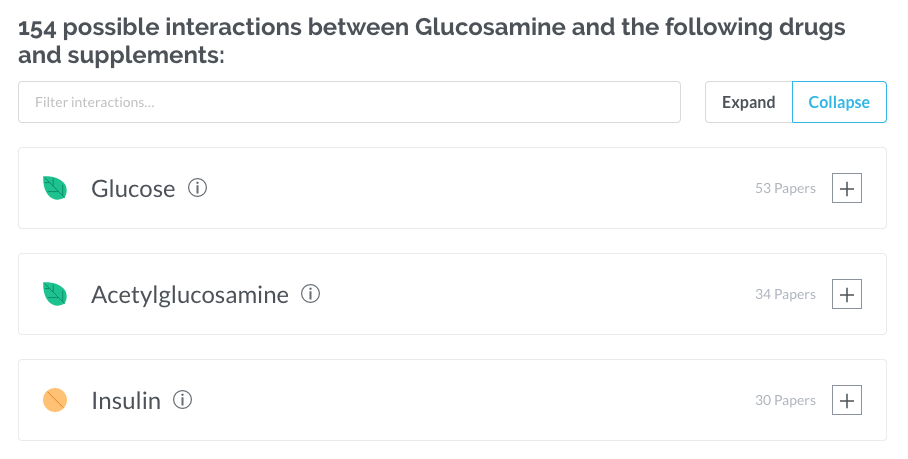
For instance, deep in some paper looking at a cross-section of the diabetic population, there might be a sentence noting that a person taking a glucosamine supplement saw slower uptake of insulin into the bloodstream. In fact there is such a sentence — dozens of them, actually, as I found out when I searched for glucosamine on the tool.

gluco suppai

Supp.AI is smart enough to recognize the search term and any abbreviations, like GlcN, and liberally interprets evidentiary sentences so that it errs on the side of inclusion. An interaction may be big or small, helpful or harmful — but what matters is that it was documented, and that a user be made aware of that documentation.

Snippets are provided from the papers, but they’re unlikely to be understood by the average person searching for info on a supplement they’re taking. The intention, however, is more to raise awareness of these potential interactions so that the user can ask their doctor or search for a specific combination they might be worried about.

“Currently, no comprehensive tool exists for consumers to determine if their supplement might interact with other medications. This information is particularly important because there is no law requiring supplement companies to place supplement-drug interactions on the label of dietary supplements,” said Harvard’s Pieter Cohen, who has addressed this before and whom AI2 asked to review the paper.

He suggested Supp.ai will become “an essential resource for consumers,” and that being able to select drug-supplement or supplement-supplement pairs to dive deeper into specific interactions is a natural direction to expand.

Supp.ai is free to use and should be updated with new information “periodically” as new papers are added to the database, but the data used to create the service is also freely available should you want to build your own version or examine the corpus yourself.

19 Sep 2019

Amazon’s “climate pledge” commits to net zero carbon emissions by 2040 and 100% renewables by 2030

In Washington today, Amazon announced a series of initiatives and issued call for companies to reduce their carbon emissions ten years ahead of the goals set forth in the Paris Agreement as part of sweeping effort to reduce its own environmental footprint.

“We’re done being in the middle of the herd on this issue—we’ve decided to use our size and scale to make a difference,” said Jeff Bezos, Amazon founder and chief executive, in a statement. “If a company with as much physical infrastructure as Amazon—which delivers more than 10 billion items a year—can meet the Paris Agreement 10 years early, then any company can.”

Bezos’ statement comes as employees at his own company and others across the tech industry plan for a walkout on Friday to protest inaction on climate change from their employers.

Amazon’s initiatives include an order for 100,000 delivery vehicles to Rivian, a company in which Amazon has previously invested $440 million.

Electric vans will appear on roads by 2021 and Amazon expects to have 10,000 of the new electric vehicles on the road by 2022 and 100,000 by 2030. The fleet is expected to reduce carbon emissions by 4 million metric tons per year by 2030, the company said.

In addition, Amazon said it would commit another $100 million to reforestation projects through the Right Now Climate Fund in partnership with The Nature Conservancy. That fund will invest in the protection of forests, wetlands and peatlands that now serve as carbon sinks which remove millions of metric tons of carbon from the atmosphere.

Finally, the . company said it will speed up its adoption of renewable energy with the goal of converting 80 percent of the company’s energy sources to renewable energy by 2024, with the goal of reaching 100% renewable energy use by 2030.

Amazon has already initiated 15 utility-scale wind and solar renewable energy projects that will generate 1.3 gigawatts of renewable capacity and deliver some 3.8 million megawatt hours of clean energy, according to the company.

All of these efforts will be backstopped by a new sustainability reporting initiative, which will be housed on a new website monitoring and tracking the company’s progress toward its sustainability goals, the company said.

These steps are part of a push from Amazon to get other companies to sign on to a global non-binding agreement . to accelerate the adoption of renewable energy and the reduction of carbon emissions.

Companies that sign on to Amazon-inspired “Climate Pledge” agree to measure and report greenhouse gas emissions regularly; implement decarbonization strategies on a timeline that matches the Paris Agreement; and neutralize remaining emissions with quantifiable and permanent offsets to achieve net zero annual carbon emissions by 2040.

“I’ve been talking with other CEOs of global companies, and I’m finding a lot of interest in joining the pledge. Large companies signing The Climate Pledge will send an important signal to the market that it’s time to invest in the products and services the signatories will need to meet their commitments,” Bezos said in a statement.

The initiative is backed by international political luminaries like Christiana Figueres, the former climate change chief and founding partner of Amazon’s collaborator on the Climate Pledge, Global Optimism.

“Bold steps by big companies will make a huge difference in the development of new technologies and industries to support a low carbon economy,” said Figueres, in a statement. “With this step, Amazon also helps many other companies to accelerate their own decarbonization. If Amazon can set ambitious goals like this and make significant changes at their scale, we think many more companies should be able to do the same and will accept the challenge. We are excited to have others join.”

19 Sep 2019

Groww, an investment app for millennials in India, raises $21.4M

Of the 1.3 billion people who live in India, more than 100 million of whom are using digital payment apps each day, only about 20 million today invest in mutual funds and stocks. An Indian startup that is betting on changing that figure by courting millennials has just received a big backing.

Groww, a Bangalore-based startup, said today it has raised $21.4 million in a Series B financing round that was led by US-based VC firm Ribbit Capital. Existing investors Sequoia India and Y Combinator also participated in the round, said the two-year-old startup that has raised about $29 million to date.

Groww allows users to invest in mutual funds, including systematic investment planning (SIP) and equity-linked savings. The app, which maintains a very simplified user interface to make it easier for its largely millennial customer base to comprehend the investment world, offers every fund that is currently available in India.

Lalit Keshre, co-founder and CEO of Groww, told TechCrunch in an interview earlier this week that the market of the mutual funds is increasingly widening in India and the startup is hoping to accelerate its growth with the fresh capital. Other than that, he plans to double Groww’s headcount to 200 in the coming months.

Groww has amassed about 2.5 million registered users, two-thirds of which are first-time investors, Keshre said. Groww is currently free to use and does not charge any commission on transactions. The startup eventually plans to offer a paid service as it looks to monetize its user base, but Keshre declined to share a timeline on how soon that would happen.

Groww will also soon begin to offer the ability to purchase stocks from its eponymous app, said Keshre, a former executive at Flipkart who co-founded Groww with three other Flipkart colleagues (Harsh Jain, Neeraj Singh and Ishan Bansal).

In a statement, Micky Malka, founder of Ribbit Capital, said, “We backed the Groww team because we believe in their mission. They have built the most trusted product in this space and are on the path to create a category-defining product.”

Ribbit Capital has made a number of investments in India in recent months. Last month, it invested in Cred, a startup that is trying to improve the financial behavior of credit card holders, and BharatPe, a payments solution for businesses.

In recent years, a number of startups such as INDWealth and Cube Wealth have emerged in India to offer wealth management platforms to country’s growing internet population.

Ashish Agarwal, a principal partner at Sequoia Capital India, said, “Investment products such as mutual funds and stocks were traditionally sold offline through financial advisors, who were mis-incentivized to sell high commission products. Groww is taking a refreshing approach with a zero-commission mobile first model, enabling investors to make their own investment choices through a slick and easy user interface.”

19 Sep 2019

Daily Crunch: Automattic raises $300M

The Daily Crunch is TechCrunch’s roundup of our biggest and most important stories. If you’d like to get this delivered to your inbox every day at around 9am Pacific, you can subscribe here.

1. Automattic raises $300 million at $3 billion valuation from Salesforce Ventures

Automattic, the company behind WordPress.com, WooCommerce and soon Tumblr, has raised new funding at a $3 billion post-money valuation. And the entire $300 million round comes from one investor — Salesforce Ventures.

“What we want to do is to become the operating system for the open web,” said founder and CEO Matt Mullenweg. “We want every website, whether it’s e-commerce or anything to be powered by WordPress.”

2. Roku unveils a new streaming player lineup, plus Roku OS 9.2 launch

The company is announcing updated versions of both its entry-level and high-end players. It’s also introducing a new version of the Roku Express exclusively for Walmart, and a Streaming Stick that will be exclusively sold at Best Buy.

3. Airbnb says it will go public next year

The company is part of a big unicorn herd that emerged roughly a decade ago (a herd that includes Uber, Lyft, The We Company and Postmates), and is one of the latest to declare its public market plans.

Nintendo Switch Lite

4. Nintendo Switch Lite review

Brian Heater says that if he was choosing between the Switch and the Switch Lite, he’d go for the Lite — but he’d grit his teeth a bit at the idea of sacrificing a couple hours of battery life in the process.

5. Netflix co-founder Marc Randolph on the company’s earliest days, the streaming wars and moving on

Randolph also shared why it took him 16 years to tell his story about what has become one of the most impactful companies in the history of television. (Extra Crunch membership required.)

6. Google completes controversial takeover of DeepMind Health

The personnel move had been delayed as trusts associated with the National Health Service considered whether to shift their existing DeepMind contracts to Google. (Ultimately, they did shift to Google.)

7. Stephen Curry Brings SC30 Inc. to Disrupt SF

When Golden State Warriors point guard and two-time MVP Stephen Curry isn’t playing basketball, he’s working with his business partner and former college basketball teammate Bryant Barr. Together, Barr and Curry run SC30 Inc., which manages Curry’s investment, media, philanthropy and brand partnership interests.

19 Sep 2019

Marissa Mayer and Alfred Lin are coming to Disrupt SF 2019

Twenty+ startups, each with six minutes to tell the world what they’re about. If they can prove to our panel of judges that they’re the best of the best, they’ll walk away with $100,000 and their name forever etched on the Disrupt cup.

That’s the core idea behind the Startup Battlefield, a pillar of TechCrunch Disrupt SF — which, as you might know, is just weeks away. As the event approaches, the list of incredible speakers and world-renowned judges only grows.

We’re thrilled to announce that Alfred Lin and Marissa Mayer will be joining us as Battlefield finals judges.

Alfred Lin is a partner at Sequoia Capital, and by no means a stranger to the startup world. He helped to helm LinkExchange as VP of Finance leading into its $265M acquisition by Microsoft in 1998, and COO at Zappos leading into its billion-dollar acquisition by Amazon. He now sits on the board of companies like Airbnb, Dia&Co, Houzz, and DoorDash.

Marissa Mayer was one of the earliest employees at Google, where she’d go on to lead the company’s search and mapping divisions. She led Yahoo! as President and CEO from 2012 to 2017, including through its acquisition by Verizon (disclosure: TechCrunch’s parent company) for nearly $5 billion in 2016. She’s now the co-founder of Lumi Labs, a stealthy incubator/lab in Palo Alto, the website of which says is “focused on building consumer applications enabled by artificial intelligence”.

Lin and Mayer join an outright amazing list of speakers, panelists, and judges coming to Disrupt, including the likes of Marc Benioff, Marillyn Hewson, Cyan Banister, Will Smith, Ashton Kutcher, Michael Seibel, Ellen Pao, James Park, Aaron Levie, Joseph Gordon-Levitt, Aileen Lee, and many, many (seriously, many) more.

Disrupt SF runs from October 2nd to 4th at the Moscone Center. Need tickets? You can find those right here.

19 Sep 2019

Darkstore raises $21 million Series B round

Darkstore, the tech-driven fulfillment solution to enable e-commerce companies to offer same-day delivery, just raised a $21 million Series B round led by EQT Ventures. The deal will bring EQT Principal Laura Yao to Darkstore’s board of directors.

This Series B round comes less than one year after Darkstore raised a $7.5 million Series A round. In total, Darkstore has raised over $30 million in funding.

Darkstore works by exploiting excess capacity in storage facilities, malls and bodegas and enables them to be fulfillment centers with just a smartphone. The idea is that brands without local inventory can store it in a Darkstore and then ship out same-day. Darkstore charges brands across three areas: fulfillment, storage and delivery.

“Consumer expectations are relentless,” Yao told TechCrunch via email. “We want things now, now, now. Obviously, it’s in a brand’s best interest to be able to meet those demands. The amazing team at Darkstore has built a platform-agnostic, cost-effective way for brands to do so, and in the process has unlocked a new revenue stream for urban infrastructure, and created valuable partnerships with last-mile delivery services.”

Currently, Darkstore has more than 600 fulfillment centers across 39 cities in the U.S., including Honolulu, Toledo, Ohio and Omaha, Neb.

Darkstore is unable to share the full roster of its customers, but it’s worked with the likes of Nike, premium headphones maker Master & Dynamic, mattress startup Tuft & Needle and others. With the additional funding, Darkstore plans to grow the general team, as well as the management team.

Yao added, “We’ve worked with Lee and the team for over a year and have been able to see this Darkstore flywheel come to life, and are excited to see what the future holds.”