Year: 2019

13 Sep 2019

Amazon tests a one-tap review system for product feedback

Amazon is testing an easier way for people to leave product feedback with the launch of one-tap ratings. The change is meant to encourage those who don’t have the time, energy or interest in writing reviews to still share their opinion about the product, which benefits the larger Amazon community of shoppers who are reliant on ratings and reviews to make better purchasing decisions.

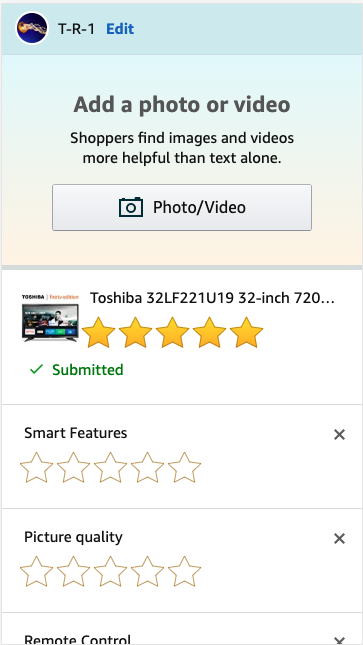
If you have access to the new experiment, you’ll be able to just tap once to leave your star rating on any item, without having to fill out additional fields like a review title and written review, as previously required.

You’ll also be able to access these one-tap ratings from a number of places, including the “Your Orders” page on Amazon where you can tap the “Write a Review” button; by going to a product page directly; or by responding to solicitations sent to you from Amazon or those that appear on the homepage when you log in.

The process of leaving a one-tap review is extremely simple — you just select the star rating and you’ll then see a green checkmark confirming the submission.

Only those one-tap ratings from Verified Purchases will contribute to the product’s overall star rating. You’re also able to expand on your feedback later on, if you choose, by adding a review, photos, or video.

amazon ratings test

The new feature could go a long way towards being able to collect feedback from a larger number of online consumers, as many don’t bother with writing reviews. It could also help balance out the ratings with feedback from real shoppers, as opposed to those who may have been incentivized or paid to leave reviews.

That’s against Amazon policy, of course, and is a practice the retailer has been cracking down on for years — including by outright banning incentivized reviews, by way of multiple lawsuits, fines, and through suspensions of seller accounts. But there are still services out there offering to boost a product’s Amazon reviews through less-than-official tactics. And there are products on Amazon that continue to have suspiciously positive reviews, ranging from weight loss pills to Bluetooth headphones.

Flooding those products with legit reviews from real customers could bring about a more accurate rating, even if Amazon isn’t able to fully flush the scammers from its review community.

The new ratings test is showing both online and in the mobile app worldwide. Not everyone will see the feature at this time as some customers will be in a control group.

Amazon confirmed the new feature is an experiment, not a public launch.

“We are testing a feature that allows customers to leave feedback easily while also helping shoppers get authentic customer ratings on products from a broader set of shoppers,” an Amazon spokesperson said.


13 Sep 2019

Despite tipping policy changes, DoorDash says back pay is not ‘at issue here’

When DoorDash announced changes in its tipping model last month, it was certainly a step in the right direction. Some workers, however, have said it’s not enough. In addition to wanting fair wages, they want back pay.

In light of DoorDash’s announcement, labor group Working Washington said a key question remained: “Will they pay workers backpay for the customer tips the company has been misappropriating since 2017?”

“There’s no ‘back pay’ at issue here because every cent of every tip on DoorDash has always gone and will always go to Dashers,” a DoorDash spokesperson told TechCrunch via email in response to a question about whether or not DoorDash would back pay its delivery workers.

When Instacart changed its tipping practices earlier this year, it also retroactively compensated shoppers when tips were included in the payment minimums. DoorDash, however, does not see the need for back pay.

“An independent third-party research firm has confirmed that Dashers were paid as was explained on our website and in our app: Dashers received a minimum base bay from DoorDash, plus 100% of customer tips, plus additional pay for some orders to reach the guaranteed minimum,” the spokesperson said. “A reminder that under our old model, DoorDash would boost pay if a customer left little or no tip. Although boost pay was intended to help Dashers, we recognize that it also had the unintended effect of making some customers feel like their tips didn’t matter. Under our new model, every dollar a customer tips will be an extra dollar in their Dasher’s pocket.”

Additionally, DoorDash says it will increase the amount it pays on average through base pay and bonuses. Ideally, that will increase overall earnings for Dashers.

“This commitment is incredibly important to us, which is why we’ll be working with that same independent third party to ensure that Dasher earnings under this new model increase,” the spokesperson said.

As DoorDash previously announced, the new payment policies will go into effect this month following feedback from its tests. Since the announcement, however, DoorDash has put $30 million toward a campaign committee to establish a 2020 ballot initiative that would enable companies to provide workers benefits, establish wage commitments and guarantees, offer flexibility and establish that drivers are not employees. Lyft and Uber have also each put $30 million into the initiative. Meanwhile, gig worker protections bill AB5 passed.

AB5 would help to ensure gig economy workers are entitled to minimum wage, workers’ compensation and other benefits by requiring employers to apply the ABC test. The bill, first introduced in December 2018, aims to codify the ruling established in Dynamex Operations West, Inc. v Superior Court of Los Angeles. In that case, the court applied the ABC test and decided Dynamex wrongfully classified its workers as independent contractors.

According to the ABC test, in order for a hiring entity to legally classify a worker as an independent contractor, it must prove the worker is free from the control and direction of the hiring entity, performs work outside the scope of the entity’s business and is regularly engaged in an “independently established trade, occupation, or business of the same nature as the work performed.”

The bill has yet to be signed into law, but Governor Gavin Newsom is expected to do so. Moving forward, we can surely expect DoorDash to continue advocating for its independent worker model. We can also expect organizers from Working Washington to keep advocating for better wages and protections.

13 Sep 2019

Daily Crunch: AR startup Daqri is shutting down

The Daily Crunch is TechCrunch’s roundup of our biggest and most important stories. If you’d like to get this delivered to your inbox every day at around 9am Pacific, you can subscribe here.

1. Another high-flying, heavily funded AR headset startup is shutting down

In an email obtained by TechCrunch, Daqri — which built enterprise-grade AR headsets — told its customers that it’s pursuing an asset sale and will be shutting down its cloud and smart-glasses hardware platforms by the end of September.

Daqri is the latest heavily funded, enterprise-focused augmented reality startup to struggle or shut down recently, with Osterhout Design Group unloading its AR glasses patents earlier this year and Meta selling its assets after it ran out of cash.

2. Apple introduces a ‘grace period’ for lapsed App Store subscriptions

Previously, any lapse in payment could cut off the customer from an app’s subscription-based features. Now, Apple says developers will have the option to offer a “grace period,” giving Apple more time to collect payment.

3. SmileDirectClub makes its debut on the public market

Teeth-straightening company SmileDirectClub rang the opening bell at Nasdaq yesterday, marking its first day of trading as a public company.

4. Element AI raises $151M on a $600-700M valuation to help companies build and run AI solutions

Element AI has built an artificial intelligence systems integrator of sorts, designed to help other companies develop and implement AI solutions.

5. Walmart’s Vudu adds Family Play feature so viewers can skip sex, violence and substance abuse

Vudu viewers can turn filters on and off for sex/nudity, violence, substance abuse and language. In the first three instances, Vudu will skip the relevant scenes, and in the case of strong language, it will mute the dialog.

6. Sidewalk Labs spins out urban data-gathering tool Replica into a company

The Replica tool grew out of Model Lab, a project started two years ago to investigate modeling as a way to address urban problems — specifically the fact that public agencies don’t have all the information needed to understand the connections between transportation and land use.

7. How the Valley can get philanthropy right with former Hewlett Foundation president Paul Brest

When he was named president of the William & Flora Hewlett Foundation, Brest applied the rigor of a legal scholar, not just to his own institution’s practices, but to those of the philanthropy field at large. (Extra Crunch membership required.)

13 Sep 2019

JUMP pulled its bikes from a number of markets in the last few months

Uber -owned JUMP pulled its bikes and scooters from a handful of markets over the last few months. The latest city affected is San Diego, where JUMP’s bikes and scooters will no longer be available as of September 19, with the exception of two naval bases in the city.

“We understand this may have a huge impact on your day-to-day commuting and we regret the fact that we can no longer provide this service to you,” JUMP wrote in an email to its San Diego customers.

The decision was in light of San Diego councilperson Barbara Bry calling for a moratorium on scooters in the city until it could figure out a fiscally responsible and thoughtful plan.

“We agree with local elected officials in San Diego who’ve said current micromobility regulations foster an unsustainable operating environment, which is why we’re ending our operations as of today,” an Uber spokesperson told TechCrunch. “We look forward to working with the city to develop more sensible regulations.”

Earlier this week, JUMP removed its bikes from Providence following acts of vandalism and misuse. This month, JUMP is also removing its bikes from Atlanta after operating in the city for just nine months. Its scooters, however, will remain.

“We are winding down our current JUMP e-bike operations in Atlanta,” an Uber spokesperson told TechCrunch. “We will continue to offer JUMP scooters and look forward to continuing conversations with city leaders on how we can work together to expand transportation options.”

That decision came after Atlanta halted its permitting process for dockless vehicles and implemented a nighttime curfew for them. Meanwhile, JUMP also pulled its bikes from Dallas, San Antonio with no real explanation. In Staten Island, regulatory hurdles forced JUMP to remove its bikes. Since June, JUMP has pulled its bikes from at least six markets.

“Our goal is to make JUMP electric bikes and scooters a sustainable part of the transportation ecosystem,” an Uber spokesperson told TechCrunch. “We currently have JUMP products in over 25 cities worldwide and we make operational decisions on a case by case basis.”

It’s likely those case-by-case decisions are at least partially fueled by unit economics — looking at everything from ridership to vandalism to theft.

Meanwhile, San Francisco seems to remain a solid market for JUMP bikes. In August, JUMP hit one million rides in San Francisco since launching in January 2018 with a total fleet size of 500 bikes. Earlier this year, JUMP touted its high utilization rates in the city compared to docked bike providers.

Uber’s JUMP, of course, is not the only company facing issues with its micromobility operations. In July, Lyft had to pull its e-bikes from San Francisco following apparent battery fires. Then, in August, a Lime bike caught on fire in Seattle. On the positive side for Uber, at least there have not been any reports of its bikes or scooters catching on fire.

This is all to say micromobility is not an easy business. Between regulatory hurdles, potential vandalism and faulty batteries, there are a number of factors that can stand in the way of success.

13 Sep 2019

Calculating sales efficiency in a start-up: The magic number that will help you scale

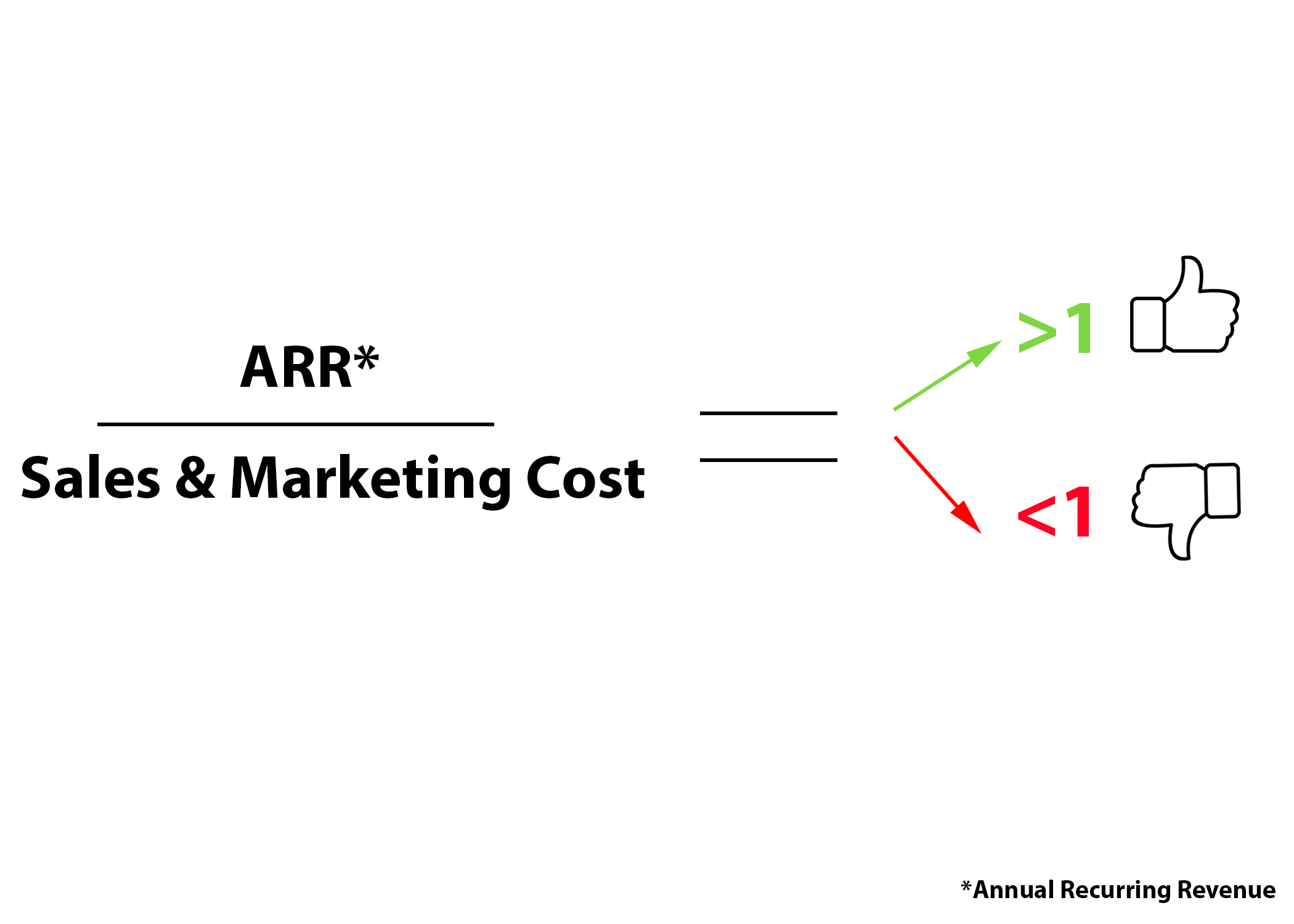
Sales efficiency is the best way to understand the economics of a business. To me, it answers the question as to whether a business can ever scale. The harsh truth is, if it can’t scale, investors won’t be interested.

Sales efficiency is more simple to measure than other related concepts like CAC (customer acquisition cost) or LTV (lifetime value). Here’s why:

  • CAC is harder to truly measure, especially new CAC. In a SaaS organization, sometimes it can be hard to allocate those costs to what that new CAC is, as opposed to upsell or cross-sell within the same organization. Salespeople are almost always trying to pursue two goals:
    • Trying to acquire new customers
    • Selling within an existing customer (more seats within an established department, or expanding to a new division)

These activities generate different CAC; trying to strip out only the new CAC can be tricky. Sales efficiency, on the other hand, looks at all net new ARR (annual recurring revenue), which includes new customer ARR as well as expansion ARR.

  • LTV tries to measure the value of a customer over time, assuming both repeat purchases and eventual churn; this gives you a good sense of the ultimate value of that customer to your business over time. The challenge with LTV in SaaS is that the data points that you might use to assume churn and repeat purchase behavior aren’t very robust — there are few SaaS businesses that have enough customers to really make these numbers reliable.

Enterprise businesses should focus on unit economics of sales early. When a business scales, it rarely buys you better economics — usually it just means more losses.

Gracphic for sales efficiency

Image via Ryan Floyd / Storm Ventures

The role of sales efficiency in your ‘go-to-market fit’

At Storm Ventures we use a concept we call finding ‘go-to-market fit’ (GTM fit).

13 Sep 2019

J.J. Abrams and Bad Robot sign exclusive deal with WarnerMedia

After being courted by seemingly every major entertainment and streaming company, Bad Robot has signed an exclusive deal with WarnerMedia.

While the production company — led by Star Wars director J.J. Abrams and his wife/co-CEO Katie McGrath — was already working with Warner Bros. to create shows like “Castle Rock” and “Westworld,” this new deal is an exclusive agreement covering TV, theatrical films, games (it formed a games division with Tencent last year) and content for digital platforms.

WarnerMedia and AT&T are delighted to launch a long-term collaboration with our world-class partners and colleagues J.J. Abrams and Katie McGrath,” said WarnerMedia CEO John Stankey in a statement. “We are extremely excited about the potential to deliver remarkable and memorable stories and characters across multiple platforms to audiences around the world. J.J., Katie and all of Bad Robot bring extraordinary vision, exquisite filmmaking, and exemplary industry leadership to this endeavor and our company.”

WarnerMedia is planning to launch its streaming service HBO Max next year, and these kinds of exclusive production deals could be an important weapon in the upcoming streaming wars. After all, reclaiming the rights to “Friends” is nice, but subscribers are also going to want fresh content.

Companies like NBCUniversal and Apple were reportedly pursuing a deal with Bad Robot as well. WarnerMedia seemed to emerge as the winner earlier this summer, but the deal wasn’t official until yesterday.

Although the financial terms were not disclosed, The Hollywood Reporter says the deal is worth $250 million.

WarnerMedia says that under this agreement, Bad Robot will make TV shows under the Warner Bros. Television Group umbrella, but it will still be able to sell those shows to “external outlets.” It also says Bad Robot will honor existing feature film commitments at Paramount — and of course, Disney will release Abrams’ next film as director, “Star Wars: The Rise of Skywalker.”

13 Sep 2019

Space is the next economic frontier… hear more about it at Disrupt SF

For decades space has been the playplace for world powers, but the advent of (relatively) cheap and frequent rocket launches has opened it up for new business opportunities. But it’s still hard as hell, as early adopters of this orbital economy Tess Hatch of Bessemer Ventures, Swarm’s Sara Spangelo, and OneWeb’s Adrian Steckel can attest. They’ll be on the Extra Crunch stage at Disrupt SF 2019 on October 3rd at 1:40 PM.

Spangelo and Steckel are in the midst of launching what have been termed “mega-constellations,” collections of hundreds or thousands of satellites offering a coordinated service, in their cases global connectivity. These efforts are only possible with the new launch economy, and came hot on its heels, showing there’s no reason to wait to put new plans in action.

But such constellations bring their own challenges. Just from an orbital logistics point of view, launching a single satellite so that it enters a unique and predictable trajectory is hard enough; launching a dozen or a hundred at once is more difficult by far. And after launch, how will those satellites be tracked? How will they communicate to the surface and each other? What about the growing risk of collisions?

On top of that are more terrestrial, but no less crucial, questions: What services can be made available from orbit? What’s a reasonable amount to spend on them? How will they compete with and accommodate one another? Whose regulations will they follow?

These latter questions are among those that must also be answered by investors like Hatch, who is familiar with both the technical and capital side of the burgeoning space industry (and of course the technical side of the capital side). Space ventures can be extremely expensive and high-risk, but to get your foot in the door at this stage could be the start of a billion-dollar advantage a couple years down the line.

If you’re planning on getting involved with the new space economy, or are just curious about it, join us for an extended discussion and Q&A on the 3rd.

Disrupt SF runs October 2 to October 4 at the Moscone Center in San Francisco. Tickets are available here, and they just happen to be available at a discount today only.

13 Sep 2019

YouTube Music cracks down on rampant chart manipulation with new pay-for-play ban

YouTube will no longer allow paid views and advertising to influence its YouTube Music Charts, the company announced this morning. Instead, it will calculate its rankings based only on view counts coming from organic plays. In addition, it’s changing its methodology for reporting on 24-hour record debuts to also only count views from organic sources including direct links to the video, search results, Watch Next, and Trending — but not video advertising.

The changes come about after multiple reports examined how music labels were spending aggressively on video advertising in order to juice the views of their artists’ newly debuted songs.

One report by Rolling Stone detailed how the practice worked, with regard to YouTube’s TrueView ads. This form of advertising lets the advertiser, like the artist or the label, play a shortened version of a music video as an advertisement in front of other videos. Under some conditions — like if a YouTube user interacts with the video or watches it for a certain amount of time — it would count towards the video’s overall view count.

Bloomberg had also reported on the curious case of Indian rapper Badshah, whose video “Paagal” broke records with 75 million views in a single day — topping a prior record set by Korean boy band BTS. Initially, there were rumors that the label, Sony Music, had used server farms and bots to accomplish this. It later turned out to be paid advertising, which Badshah confessed to on Instagram.

But this was not an uncommon practice — Taylor Swift and Blackpink and many others had done the same, the report said. Badshah had just taken it much further.

The report also said YouTube was considering revising its system, as a result.

Today, YouTube is officially announcing those changes.

“YouTube Music Charts have become an indispensable source for the industry and the most accurate place for measuring the popularity of music listening behavior happening on the world’s largest music platform,” the company explained in a blog post. “In an effort to provide more transparency to the industry and align with the policies of official charting companies such as Billboard and Nielsen, we are no longer counting paid advertising views on YouTube in the YouTube Music Charts calculation. Artists will now be ranked based on view counts from organic plays,” the post read.

The changes impact the 24-hour debuts, plus all of YouTube Music’s other charts, including those focused on what’s rising, trending, and popular, both locally and globally.

Though advertising and non-organic views will no longer contribute to the view count for the purpose of YouTube’s Music Chart rankings, the company says these changes will not impact YouTube’s existing 24-hour record debut holders. That means Badshah and others can continue to tout their “records,” tainted as those claims may now be.

The changes won’t likely mean the end of this sort of music video advertising, however. Ads still remain a great way for users to be exposed to new music which can, in turn, boost organic views as links get clicked, shared, and embedded elsewhere around the web, for example. But it could have a dampening impact on the pay-for-play business and the size of the ad spend.

“Staying true to YouTube’s overall mission of giving everyone a voice and showing them the world, we want to celebrate all artist achievements on YouTube as determined by their global fans. It’s the artists and fans that have made YouTube the best and most accurate measure of the world’s listening tastes, and we intend on keeping it that way,” said YouTube.

13 Sep 2019

Ten questions for 2020 presidential candidate John Delaney

In November 2020, America will go to the polls to vote in perhaps the most consequential election in a generation. The winner will lead the country amid great social, economic and ecological unrest. The 2020 election will be a referendum on both the current White House and the direction of the country at large.

Nearly 20 years into the young century, technology has become a pervasive element in all of our lives, and will continue to only grow more important. Whoever takes the oath of office in January 2021 will have to answer some difficult questions, raging from an impending climate disaster to concerns about job loss at the hands of robotics and automation.

Many of these questions are overlooked in day to day coverage of candidates and during debates. In order to better address the issues, TechCrunch staff has compiled a 10-part questionnaire across a wide range of tech-centric topics. The questions have been sent to national candidates, regardless of party. We will be publishing the answers as we receive them. Candidates are not required to answer all 10 in order for us to publish, but we will be noting which answers have been left blank.

First up is former Congressman John Delaney. Prior to being elected to Maryland’s 6th Congressional District, Delaney co-founded and led healthcare loan service Health Care Financial Partners (HCFP) and  commercial lender CapitalSource. He was elected to Congress in 2013, beating out a 10-term Republican incumbent. Rumored to be running against Maryland governor Larry Hogan for a 2018 bid, Delaney instead announced plans to run for president in 2020.

1. Which initiatives will you prioritize to limit humankind’s impact on climate and avoid potential climate catastrophe?

My $4 trillion Climate Plan will enable us to reach the goal of net zero emissions by 2050, which the IPCC says is the necessary target to avoid the worst effects of climate change. The centerpiece of my plan is a carbon-fee-and-dividend that will put a price on carbon emissions and return the money to the American people through a dividend. My plan also includes increased federal funding for renewable energy research, advanced nuclear technologies, direct air capture, a new Climate Corps program, and the construction of the Carbon Throughway, which would transport captured carbon from all over the country to the Permian Basin for reuse and permanent sequestration.

2. What is your plan to increase black and Latinx startup founders’ access to funding?

As a former entrepreneur who started two companies that went on to be publicly traded, I am a firm believer in the importance of entrepreneurship. To ensure people from all backgrounds have the support they need to start a new business, I will create nonprofit banks to serve economically distressed communities, launch a new SBIC program to help provide access to capital to minority entrepreneurs, and create a grant program to fund business incubators and accelerators at HBCUs. Additionally, I pledge to appoint an Entrepreneurship Czar who will be responsible for promoting entrepreneurship-friendly policies at all levels of government and encouraging entrepreneurship in rural and urban communities that have been left behind by venture capital investment.

3. Why do you think low-income students are underrepresented in STEM fields and how do you think the government can help fix that problem?

I think a major part of the problem is that schools serving low-income communities don’t have the resources they need to provide a quality STEM education to every student. To fix that, I have an education plan that will increase investment in STEM education and use Title I funding to eliminate the $23 billion annual funding gap between predominantly white and predominantly black school districts. To encourage students to continue their education after they graduate from high school and ensure every student learns the skills they need, my plan also provides two years of free in-state tuition and fees at a public university, community college, or technical school to everyone who completes one year of my mandatory national service program.

4. Do you plan on backing and rolling out paper-only ballots or paper-verified election machines? With many stakeholders in the private sector and the government, how do you aim to coordinate and achieve that?

Making sure that our elections are secure is vital, and I think using voting machines that create a voter-verified paper record could improve security and increase voters’ confidence in the integrity of our elections. To address other facets of the election security issue, I have proposed creating a Department of Cybersecurity to help protect our election systems, and while in Congress I introduced election security legislation to ensure that election vendors are solely owned and controlled by American citizens.

5. What, if any, federal regulation should be enacted for autonomous vehicles?

I was proud to be the founder of the Congressional Artificial Intelligence Caucus, a bipartisan group of lawmakers dedicated to understanding the impacts of advances in AI technology and educating other legislators so they have the knowledge they need to enact policies that ensure these innovations benefit Americans. We need to use the legislative process to have a real conversation involving experts and other stakeholders in order to develop a comprehensive set of regulations regarding autonomous vehicles, which should include standards that address data collection practices and other privacy issues as well as more fundamental questions about public safety.

6. How do you plan to achieve and maintain U.S. superiority in space, both in government programs and private industry?

Space exploration is tremendously important to me as a former Congressman from Maryland, the home of NASA’s Goddard Space Flight Center, major space research centers at the University of Maryland, and many companies that develop crucial aerospace technologies. As president, I will support the NASA budget and will continue to encourage innovation in the private sector.

7. Increased capital in startups founded by American entrepreneurs is a net positive, but should the U.S. allow its businesses to be part-owned by foreign governments, particularly the government of Saudi Arabia?

I am concerned that joint ventures between U.S. businesses and foreign governments, including state-owned enterprises, could facilitate the theft of intellectual property, potentially allowing foreign governments to benefit from taxpayer-funded research. We need to put in place greater protections that defend American innovation from theft.

8. Will U.S.-China technology decoupling harm or benefit U.S. innovation and why?

In general, I am in favor of international technology cooperation but in the case of China, it engages in predatory economic behavior and disregards international rules. Intellectual property theft has become a big problem for American businesses as China allows its companies to steal IP through joint ventures. In theory, U.S.-China collaboration could advance technology and innovation but without proper IP and economic protections, U.S.-China joint ventures and partnerships can be detrimental to the U.S.

9. How large a threat does automation represent to American jobs? Do you have a plan to help train low-skilled workers and otherwise offset job loss?

Automation could lead to the disruption of up to 54 million American jobs if we aren’t prepared and we don’t have the right policies. To help American workers transition to the high-tech, high-skill future economy, I am calling for a national AI strategy that will support public/private AI partnerships, develop a social contract with the communities that are negatively impacted by technology and globalization, and create updated education and job training programs that will help students and those currently in the workforce learn the skills they need.

To help provide jobs to displaced workers and drive economic growth in communities that suffer negative effects from automation, I have proposed a $2 trillion infrastructure plan that would create an infrastructure bank to facilitate state and local government investment, increase the Highway Trust Fund, create a Climate Infrastructure Fund, and create five new matching funds to support water infrastructure, school infrastructure, deferred maintenance projects, rural broadband, and infrastructure projects in disadvantaged communities in urban and rural areas. In addition, my proposed national service program will create new opportunities that allow young adults to learn new skills and gain valuable work experience. For example, my proposal includes a new national infrastructure apprenticeship program that will award a professional certificate proving mastery of particular skill sets for those who complete the program.

10. What steps will you take to restore net neutrality and assure internet users that their traffic and data are safe from manipulation by broadband providers?

I support the Save Net Neutrality Act to restore net neutrality, and I will appoint FCC commissioners who are committed to maintaining a fair and open internet. Additionally, I would work with Congress to update our digital privacy laws and regulations to protect consumers, especially children, from their data being collected without consent.

13 Sep 2019

24-hour Friday flashback on Disrupt SF passes

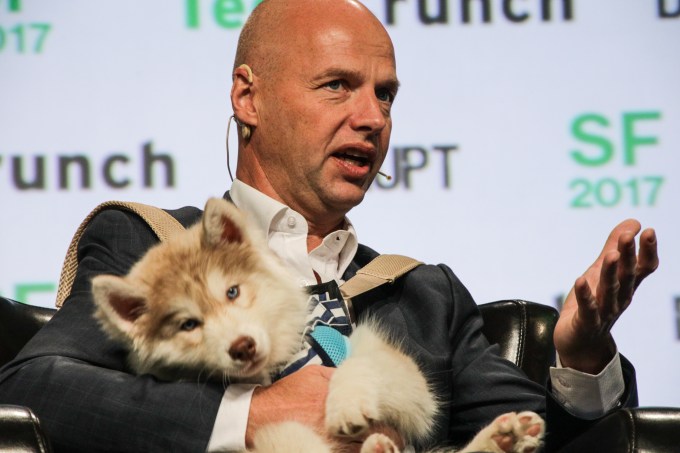
We here at TechCrunch love a good flashback, like when Sebastian Thrun’s puppy, Charlie, was in the spotlight during Thrun’s fireside chat at Disrupt SF a few years ago.

Sebastian Thrun (Udacity) at TechCrunch Disrupt SF 2017

Since then, the serial entrepreneur and inventor seems to have doubled down on his vision of the future of transportation with his current flying car company, Kitty Hawk Corporation. Thrun is working on bringing two aircraft to market — the one-person Flyer and a two-person autonomous taxi called Cora. He (along with a stellar line up of startup leaders) will be at Disrupt SF this year to give a behind the scenes look at Kitty Hawk and what the future of flight might look like.

In this same vein, we’re doing our own Flashback Friday by rolling back to early bird prices for Disrupt SF. For today only, you’ll have the chance to save up to $1,300 on your pass with even bigger savings when you bring your whole team along for the ride. Need more reasons to attend? We’ll give you five.

The excitement of Disrupt SF begins in just a few short weeks – don’t let this chance to attend the largest startup conference in Silicon Valley pass you by and register today. Who knows, we might even have a chance to see Charlie return to the limelight.