Year: 2019

13 Sep 2019

Apple introduces a ‘grace period’ for lapsed App Store subscriptions

Apple is changing how subscriptions work on its App Store. Before, any lapse in payment could cut off the customer from being able to use the app’s subscription-based features — and make it more difficult for the developer to reacquire that customer’s business in the future. Now, Apple says developers will have the option to instead offer a “grace period” for auto-renewable subscriptions which gives Apple more time to collect payment on the developer’s behalf.

Lapsed payments can occur for many reasons — like expired credit cards, changes in addresses requiring an update of the billing zip, corporate cards getting shut off because your company’s expense program is ridiculous (ahem), credit cards that get disabled by the bank, and so on. This sort of involuntary churn means developers were losing out on revenue not because the customer had wanted to end their subscription, but because of a simple billing issue.

The new Grace Period — which is opt-in, not opt-out on the developer’s part — is enabled from App Store Connect, where developers manage their apps. Here, you can navigate to “My Apps,” then in the toolbar click Features –> In-App Purchases, and in the new Billing Grace Period section, click “Turn On.”
Screen Shot 2019 09 13 at 10.06.52 AM

Of course, there’s a bit more to it than that when it comes to actually integrating support in the app itself but for many developers, it will be worth the extra effort to more easily retain their customers going forward.

Once enabled, Apple’s documentation says it will attempt to collect payment for either 6 or 16 days, depending on whether the subscription duration is weekly or monthly or longer, respectively. Meanwhile, the customer retains full access to the app’s paid content.

If the subscription is renewed within this period, there won’t be any interruption to the days of paid service or to the developer’s revenue.

If the user resubscribes after 60 days, the days of paid service will reset and the developer will receive 70% of the subscription price until one year of paid service passes. (After the first year, Apple cuts its revenue share, allowing developers to retain 85% of the subscription.)

Subscription revenue is critical to developers, as the App Store has shifted away from paid downloads towards recurring revenue streams. For developers, subscriptions mean a more sustainable business. And for Apple, subscriptions are a huge part of its growing “services” business which including App Store revenues, along with its own subscriptions like Apple Card, iCloud, Apple Music, Apple News+, Apple TV+, and its Apple Pay business.

In Q3, services revenue increased 13% to $11.46 billion from $10.17 billion a year earlier, and now accounts for a fifth of Apple’s revenue. As Apple now has a growing line of subscription products of its own, it makes sense that it would want to better design the overall subscription offering to make it easier to handle common billing problems, too.


13 Sep 2019

Boston gets a new biotech accelerator with the launch of Petri

As biotechnology becomes more central to new innovations in healthcare, material science, and manufacturing, one of the nation’s research hubs is getting a new accelerator called Petri to launch companies focused on the commercialization of new technologies.

Backed by the Boston-based venture capital firm, Pillar, Petri has a three-year $15 million commitment to back companies developing new biotech applications in food, healthcare, industrial chemicals, and new materials — along with the enabling technologies to bring these products to market.

“We’re at the inflection point where these technologies will impact and continue to impact health but will also  impact food, agriculture, chemicals and materials,” says Petri co-founder, Tony Kulesa. “Everything we touch has some element of biology.”

Pillar has already invested in a couple of companies that show the potential promise of new biotech research coming from Boston-based universities like Boston University, Harvard and the Massachusetts Institute of Technology.

Asimov,io, a company that has set an ultimate goal of designing new genomes for industrial applications, was co-founded by graduates from Boston University and MIT, and is a part of the Pillar portfolio. PathAi, a company working on enabling technologies for computational biology, also counts an MIT grad as a co-founder. Meanwhile, Harvard’s George Church has been instrumental in the development of a number of biotech companies working at the frontier of genetic applications for healthcare and manufacturing.

Kulesa, an instructor at MIT spent seven years at MIT watching, in his words, how engineering has transformed biology. “It became clear to me that these technologies need to get out in the world,” says Kulesa.

Joining Kulesa as a managing director is Brian Baynes, a serial entrepreneur who founded Midori Health, an animal nutrition startup; Kaleido Biosciences, a microbiome control focused company; Celexion, a protein engineering and synthetic biology company; and Codon Devices, a synthetic biology toolkit company which was sold to Ginkgo Bioworks .

Over time, Kulesa and Baynes expect to have 10 to 20 companies in each cohort as the program expands. In addition to checks of at least $250,000 the Petri accelerator has lab space for each company and office space available.

The companies also could benefit from potential partnerships with companies like Gingko Bioworks, which happens to share office space in the same building, and with the accelerator’s clutch of big-name advisors and “co-founders” recruited from across the life sciences industry.

These co-founders who collectively hold a double-digit equity stake in Petri’s accelerator include Reshma Shetty, from Ginkgo Bioworks; Emily Leproust of Twist Bioscience; Stan Lapidus who was at Exact Sciences and Cytyc; Daphne Koller, the co-founder and chief executive of Insitro; Alec Nielsen the founder Asimov; and researchers Chris Voigt of MIT, and Pam Silver and George Church from Harvard’s Wyss Institute.

Genetically engineered organisms are finding their way into everything from food to fuel to chemistry. Companies like Impossible Foods, which uses genetically modified soy product, has raised hundreds of millions for its protein replacement, while Solugen, a manufacturer of chemicals using genetically modified organisms, has raised tens of millions to commercialize its technology. And Ginkgo Bioworks has raised nearly half a billion dollars to pursue applications for industrial biology.

“Engineering thinking has arrived in biology and the number of entrepreneurs that are interested in this area has grown dramatically,” says Pillar founding partner, Jamie Goldstein, in a statement. “Unlike classic biotech, these ideas don’t require tens or hundreds of millions of before you can demonstrate value–creating the opportunity for different funding models.”
13 Sep 2019

WeWork and Uber are proof valuations are meaningless

Hello and welcome back to Equity, TechCrunch’s venture capital-focused podcast, where we unpack the numbers behind the headlines.

This week Kate and Alex were back to cover a lot of late-stage news, which they rounded up with some early-stage notes towards the end. As a reminder, come check out the show at Disrupt SF if you are in town, we’ll be out amongst startups, chatting all things startups and money.

Up top, we dug into WeWork and the latest from the company’s continuing IPO saga. The question regarding the co-working company’s public offering has changed to whether the IPO will happen this year, not just at what price the firm can entice enough investment to actually get public.

Alex has written about the company’s cash appetite a few times now, which raise the question of how long the company can survive without some sort of large, external investment. If SoftBank is willing to commit more capital is an open question.

Moving along to Uber, the firm underwent layoffs again this week. More than 400 people, or 8% of the operations, were cut as the company attempts to streamline operations, cut costs and, well, take baby steps toward profitability.

Turning to the early-stage part of the world, there’s a new early-stage-focused venture fund out there, Work Life Ventures, which intends to put small checks into promising SaaS companies. The firm is led by SaaS School founder Brianne Kimmel, a well-known angel investor in the enterprise space. So far she’s backed three companies out of the fund, including recent Y Combinator standout Tandem.

We finished off the episode with… cereal. A company called Magic Spoon (their website is here, as promised) raised $5.5 million this week for its D2C breakfast business. Our take is that the price point is a bit too high for comfort in its current iteration. It’ll be interesting to see if the startup can lower its prices now that it has new capital.

We’ll be back in a week! Chat soon, and please stop telling us to become angel investors!

Equity drops every Friday at 6:00 am PT, so subscribe to us on Apple PodcastsOvercastSpotify, Pocket Casts, Downcast and all the casts.

13 Sep 2019

This game uses troll tactics to teach critical thinking

The best medicine against online disinformation is an informed society that’s thinking critically. The problem is there are no shortcuts to universal education.

Enter Finnish Public Broadcasting Company, Yle, which is hoping to harness the engagement power of gamification to accelerate awareness and understanding of troll tactics and help more people spot malicious Internet fakes. It’s put together an online game, called Troll Factory, that lets you play at being, well, a hateful troll. Literally.

The game begins with a trigger warning that it uses “authentic social media content” that viewers may find disturbing. If you continue to play you’ll see examples of Islamophobic slogans and memes that have actually been spread on social media. So the trigger warning is definitely merited.

The game itself takes the form of a messaging app style conversation on a virtual smartphone in which you are tasked by the troll factory boss to whip up anti-immigrant sentiment. You do this by making choices about which messages to post online and the methods used to amplify distribution.

Online disinformation tactics intended to polarize public discourse which are depicted in the game include the seeding of conspiracy theory memes on social media; the exploitation of real news events to spread fake claims; microtargeting of hateful content at different demographics and platforms; and the use of paid bots to amplify propaganda so that hateful views appear more widely held than they really are.

After completing an inaugural week’s work in the troll factory the game displays a rating and shows how many shares and follows your dis-ops garnered. This is followed by contextual information on the influencing methods demonstrated — putting the activity you’ve just participated in into wider context.

Yle, which is a not-for-profit public service broadcaster with a remit to educate and inform, released a Finnish version of the troll factory game back in May but decided to follow up with this international version (in English) after the game got such a strong local reception, including being picked up by people in natsec and education to use as an educational resource, according to Jarno Koponen, head of AI & personalization, at Yle Uutiset News Lab.

“The initial response in Finland was so encouraging: Something like this is needed,” he told us. “Something that makes information operations tangible and visible. We believe that it’s our duty as a public broadcasting company to promote methods, in Finland and abroad, that help citizen’s to better understand our everyday digital environments from their own standing point.

“We want simultaneously to collect more feedback on what’s working in the game-like storytelling, in order to use those findings to develop better products in the future, and to share those finding with for example with other public broadcasting companies in the world.”

Koponen said the team also wanted to test a specific hypotheses about the power of games to debunk junk — after a recent Cambridge University study showed gamified methods work in fighting fake news.

“Based on our data, news articles or more traditional social media analysis doesn’t reach and thus have effect on people en masse,” he said, when asked why Yle chose a game wrapper for its anti-disinformation message, rather than a more traditional educational format such as a documentary film.

“Social media is in your pocket and goes wherever you go. The means to educate you about social media need to be in your pocket too. Especially young people are a hard audience to reach. Thus we need to actively develop new storytelling methods to provide for them nonpartisan information and insight about the world around us. We experimented with different forms from data visualisations to interactive simulations and found game-like experience being the most effectual and engaging.”

“We’ve so far collected direct feedback from our users in social media (from Twitter to Reddit) and on our website,” he added. “Some of the descriptive comments were: ‘This is horrible, but thanks for making us aware of this’ or ‘Scary but illuminating’. It was picked up in social media especially by people and organisations working with younger people from teachers to public libraries, as well as information security and national security professionals.”

Asked whether he thinks social media platforms should be doing more to clear bots and inauthentic content off their platforms, Koponen called for increased transparency from platforms but added that media literacy remains key to influencing how tech giants behave too.

We believe that more transparency is needed on behalf of the social media platforms. However, the more aware the citizen is, the better equipped she’s to decide on her own behalf what works and what doesn’t. We believe that promoting media literacy is key in having meaningful impact on the practices and policies of social media platforms.”

13 Sep 2019

Element AI raises $151M on a $600-700M valuation to help companies build and run AI solutions

While tech giants like Google and Amazon build and invest in a multitude of artificial intelligence applications to grow their businesses, a startup has raised a big round of funding to help those that are not technology businesses by nature also jump into the AI fray.

Element AI, the very well-funded, well-connected Canadian startup that has built an AI systems integrator of sorts to help other companies develop and implement artificial intelligence solutions — an ‘Accenture’ for machine learning, neural network-based solutions, computer vision applications, and so on — is today announcing a further 200 million Canadian dollars ($151.3 million) in funding, money that it plans to use to commercialise more of its products, as well as to continue working on R&D, specifically working on new AI solutions.

“Operationalising AI is currently the industry’s toughest challenge, and few companies have been successful at taking proofs-of-concept out of the lab, imbedding them strategically in their operations, and delivering actual business impact,” said Element AI CEO Jean-François (JF) Gagné in a statement. “We are proud to be working with our new partners, who understand this challenge well, and to leverage each other’s expertise in taking AI solutions to market.”

The company did not disclose its valuation in the short statement announcing the funding, nor has it ever talked about it publicly, but PitchBook notes that as of its previous funding round of $102 million back in 2017, it had a post-money valuation of $300 million, a figure a source close to the company confirmed to me. From what I understand the valuation now is between $600 million and $700 million, a mark of how Element AI has grown that’s especially interesting, considering how quiet is has been.

The funding is being led by Caisse de dépôt et placement du Québec (CDPQ), along with participation from McKinsey & Company and its advanced analytics company QuantumBlack; and the Québec government. Previous investors DCVC (Data Collective), Hanwha Asset Management, BDC (Business Development Bank of Canada), Real Ventures and others also participated, with the total raised to date now at C$340 million ($257 million). Other strategic investors in the company have included Microsoft, NVIDIA and Intel.

Element AI was started under an interesting premise that goes something like this: AI is the next major transformational shift — not just in computing, but in how businesses operate. But not every business is a technology business by DNA, and that creates a digital divide of sorts between the companies that can identify a problem that can be fixed by AI and build/invest in the technology to do that; and those that cannot.

Element AI opened for business from the start as a kind of “AI shop” for the latter kinds of enterprises, to help them identify areas where they could build AI solutions to work better, and then build and implement those solutions. Today it offers products in insurance, financial services, manufacturing, logistics and retail — a list that is likely to get longer and deeper with this latest funding.

One catch about Element AI is that company has not been very forthcoming about its customer list up to now — those that have been named as partners include Bank of Canada and Gore Mutual, but there is a very notable absence of case studies or reference customers on its site.

However, from what we understand, this is more a by-product of the companies (both Element AI and its customers) wishing to keep involvement quiet for competitive and other reasons; and in fact there are apparently a number of large enterprises that are building and deploying long-term products working with the startup. We have also been told big investors in this latest round (specifically McKinsey) are bringing in customers of their own by way of this deal, expanding that list. Total bookings are a “significant double digit million number” at the moment.

“With this transaction, we are investing capital and expertise alongside partners who are ideally suited to transform Element AI into a company with a commercial focus that anticipates and creates AI products to address clients’ needs,” said Charles Émond, EVP and Head of Québec Investments and Global Strategic Planning at la Caisse, in a statement. CDPQ launched an AI Fund this year and this is coming out of that fund to help export more of the AI tech and IP that has been incubated and developed in the region. “Through this fund, la Caisse wants to actively contribute to build and strengthen Québec’s global presence in artificial intelligence.”

Management consultancies like McKinsey would be obvious competitors to Element AI, but in fact, they are turning out to be customer pipelines, as traditional system integrators also often lack the deeper expertise needed in newer areas of computing. (And that’s even considering that McKinsey itself has been investing in building its own capabilities, for example through its acquisition of the analytics firm QuantumBlack.

“For McKinsey, this investment is all about helping our clients to further unlock the potential of AI and Machine Learning to improve business performance,” said Patrick Lahaie, Senior Partner and Montreal Managing Partner for McKinsey & Company, in a statement. “We look forward to collaborating closely with the talented team at Element AI in Canada and globally in our shared objective to turn cutting-edge thinking and technology into AI assets which will transform a wide range of industries and sectors. This investment fits into McKinsey’s long-term AI strategy, including the 2015 acquisition of QuantumBlack, which has grown substantially since then and will spearhead the collaboration with Element AI on behalf of our Firm.”

13 Sep 2019

UK police arrest a number of climate activists planning Heathrow drone protest

UK police have arrested a number of environmental activists affiliated with a group which announced  last month that it would use drones to try to ground flights at the country’s busiest airport.

The group, which calls itself Heathrow Pause, is protesting against the government decision to green light a third runway at the airport.

In a press release published today about an operation at Heathrow Airport, London’s Met Police said it has arrested nine people since yesterday in relation to the planned drone protest which had been due to commence early this morning.

Heathrow Pause suggested it had up to 200 people willing to volunteer to fly toy drones a few feet off the ground within a 5km drone ‘no fly’ zone around the airport — an act that would technically be in breach of UK laws on drone flights, although the group said it would only use small drones, flown at head height and not within flight paths. It also clearly communicated its intentions to the police and airport well in advance of the protest.

“Three women and six men aged between their 20s and the 60s have been arrested on suspicion of conspiracy to commit a public nuisance,” the Met Police said today.

“Four of the men and the three women were arrested yesterday, Thursday, 12 September, in Bethnal Green, Haringey and Wandsworth, in response to proposed plans for illegal drone use near Heathrow Airport.

“They were taken into custody at a London police station.”

The statement says a further two men were arrested this morning within the perimeter of Heathrow Airport on suspicion of conspiracy to commit a public nuisance — though it’s not clear whether they are affiliated with Heathrow Pause.

Videos of confirmed members of the group being arrested by police prior to the planned Heathrow Pause action have been circulating on social media.

In an update on its Twitter feed this morning Heathrow Pause says there have been 10 arrests so far.

It also claims to have made one successful flight, and says two earlier drone flight attempts were thwarted by signal jamming technology.

More flights are planned today, it adds.

A spokeswoman for Heathrow told us there has been no disruption to flights so far today.

In a statement the airport said: “Heathrow’s runways and taxiways remain open and fully operational despite attempts to disrupt the airport through the illegal use of drones in protest nearby. We will continue to work with the authorities to carry out dynamic risk assessment programmes and keep our passengers flying safely on their journeys today.”

“We agree with the need for climate change action but illegal protest activity designed with the intention of disrupting thousands of people, is not the answer. The answer to climate change is in constructive engagement and working together to address the issue, something that Heathrow remains strongly committed to do,” it added.

We’ve asked the airport to confirm whether signal jamming counter-drone technology is being used to try to prevent the protest.

The Met Police said a dispersal order under Section 34 of the Anti-social Behaviour, Crime and Policing Act 2014 has been implemented in the area surrounding Heathrow Airport today.

“It will be in place for approximately 48 hours, commencing at 04:30hrs on Friday, 13 September,” it writes. “The order has been implemented to prevent criminal activity which poses a significant safety and security risk to the airport.”

13 Sep 2019

India’s OkCredit raises $67M to help small merchants digitize their bookkeeping

OKCredit, a Bangalore-based startup that enables small merchants to turn their bookkeeping digital, has raised $67 million to expand its business in the nation.

The Series B financing round for the two-year-old startup was led by Lightspeed and Tiger Global. The new round, which follows Series A financing round in June this year, climbs OkCredit’s total raise to $87 million.

OkCredit operates an eponymous mobile app that allows merchants to keep track of their day-to-day purchases and sales. Last month, startup founders told TechCrunch that the app had amassed over 5 million active merchants across 2,000 cities in India.

More to follow…

13 Sep 2019

India’s OkCredit raises $67M to help small merchants digitize their bookkeeping

OKCredit, a Bangalore-based startup that enables small merchants to turn their bookkeeping digital, has raised $67 million to expand its business in the nation.

The Series B financing round for the two-year-old startup was led by Lightspeed and Tiger Global. The new round, which follows Series A financing round in June this year, climbs OkCredit’s total raise to $87 million.

OkCredit operates an eponymous mobile app that allows merchants to keep track of their day-to-day purchases and sales. Last month, startup founders told TechCrunch that the app had amassed over 5 million active merchants across 2,000 cities in India.

More to follow…

13 Sep 2019

Another high-flying, heavily-funded AR headset startup is shutting down

While Apple and Microsoft strain to sell augmented reality as the next major computing platform, many of the startups aiming to beat them to the punch are crashing and burning.

Daqri, which built enterprise-grade AR headsets, has shuttered its HQ, laid off many of its employees and is selling off assets ahead of a shutdown, former employees and sources close to the company tell TechCrunch.

In an email obtained by TechCrunch, the nearly ten-year-old company told its customers that it was pursuing an asset sale and was shutting down its cloud and smart-glasses hardware platforms by the end of September.

“I think the large majority of people who worked [at Daqri] are sad to see it closing down,” a former employee told TechCrunch. “[I] wish the end result was different.”

image

The company’s 18,000+ square foot Los Angeles headquarters (above) is currently listed as “available” by real estate firm Newmark Knight Frank. The company’s Sunnyvale offices appear to have been shuttered sometime prior to 2019.

Daqri’s shutdown is only the latest among heavily-funded augmented reality startups seeking to court enterprise customers.

Earlier this year, Osterhout Design Group unloaded its AR glasses patents after acquisition talks with Magic Leap, Facebook and others stalled. Meta, an AR headset startup which raised $73 million from VCs including Tencent, also sold its assets earlier this year after the company ran out of cash.

Daqri faced substantial challenges from competing headset-makers including Magic Leap and Microsoft, who were backed by more expansive war chests and institutional partnerships. While the headset company struggled to compete for enterprise customers, Daqri benefitted from investor excitement surrounding the broader space. That is, until the investment climate for AR startups cooled.

Daqri was, at one point, speaking with a large private equity firm about financing ahead of a potential IPO, but as the technical realities facing other AR companies came to light, the firm backed out and the deal crumbled, we are told.

As of mid-2017, a Wall Street Journal report detailed that Daqri had raised $275 million in funding. You won’t find many details on the sources of that funding, other than references to Tarsadia Investments, a private equity firm in Los Angeles that took part in the company’s sole disclosed funding round. We’re told Tarsadia had taken controlling ownership of the firm after subsequent investments.

In early 2016, Daqri acquired Two Trees Photonics, a small UK startup that was building holographic display technologies for automotive customers. The UK division soon comprised a substantial portion of the entire company’s revenues, sources tell us. By early 2018, the division was spun out from Daqri as a separate company called Envisics, leaving the Daqri team to focus wholly on bringing augmented reality to enterprise customers.

The remaining head-worn AR division failed to gain momentum after prolonged setbacks in adoption of its AR smart glasses, including difficulties in training workers to use the futuristic hardware, a source told TechCrunch.

All the while, the company’s leadership put on a brave face as the startup sputtered. In an interview this year with Cornell Enterprise Magazine, Daqri CEO Roy Ashok told the publication that the startup was forecasting shipments of “tens of thousands” of pairs of its AR glasses in 2020.

Daqri, its founder and several executives did not respond to requests for comment.

12 Sep 2019

Scientists propose ‘Spaceline’ elevator to the Moon

Fans of sci-fi and fringe tech may already be familiar with the idea of the “space elevator,” which is pretty much exactly what it sounds like — and totally impossible with today’s technology. But a pair of scientists think they’ve found an alternative: a Moon elevator. And it’s slightly less insane… technically.

The idea of the space elevator, first explored in detail by Arthur C. Clarke in his novel The Fountains of Paradise, is essentially a tower so tall it reaches space. Instead of launching ships and materials from the surface of the Earth to orbit, you just put them in the elevator of this tower and when they reach the top, somewhere about 26,000 miles up in geosynchronous orbit, they’re already beyond gravity’s pull for all intents and purposes.

It’s a fun idea, but the simple fact is that this tower would need to be so strong to support its own weight, and that of the counterweight at the far end, that no known material or even reasonably hypothetical one will do it. Not by a long shot. So the space elevator has remained well on the “fiction” side of science fiction since its first proposal. Hasn’t stopped people from patenting it, though.

But what if I told you that we could make a space elevator even bigger, with materials available today? You’d say I am completely unqualified to engineer such a structure, and you’d be right. But two astronomers from Cambridge and Columbia Universities think they’ve got an alternative. They call it the Spaceline.

The secret is in abandoning the entire concept of anchoring the space elevator to the surface of the Earth. Instead they propose a tower or cable extending the other direction: From the surface of the Moon to geosynchronous orbit around the planet.

Unsurprisingly, this idea has been put out there before, as early as the ’70s. But as Zephyr Penoyre and Emily Sandford put it in their paper:

We present the derivations herein as a full standalone mathematical and physical description of the concept, one that we and authors before us have been surprised to find is eminently plausible and may have been overlooked as a major step in the development of our capacity as a species to move within our solar system.

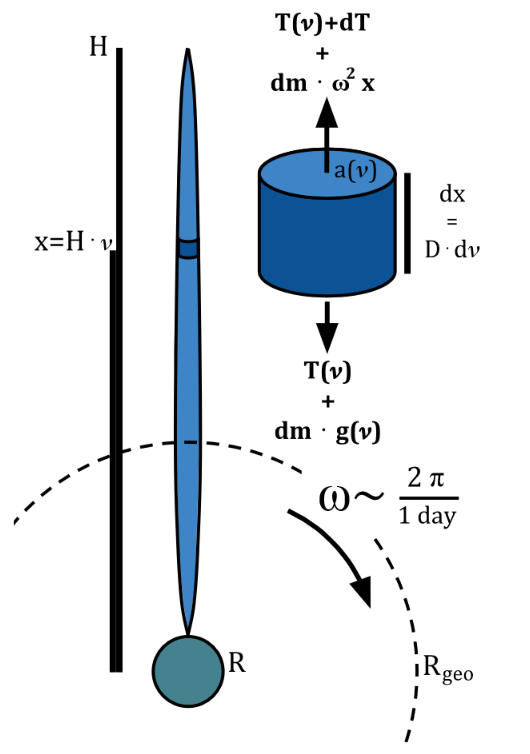
diagram

Math by Cambridge and Columbia. Diagram by MS Paint.

In other words, others have suggested it before, but they did the math. And it actually works out. And it might only cost a few billion dollars.

The Spaceline would be more like a skyhook than a tower. A thin, strong piece of material (think the width of a pencil lead) that extends about 225,000 miles from the surface of the moon to a safe distance above the planet, where it won’t interfere with satellites or encounter our pesky atmosphere.

Anyone interested in going to the moon would simply launch to the correct orbit height and sync up with the tip of the Spaceline, where there would no doubt be a station of some kind. From there they could use solar-powered propulsion to zip along the line, no fuel required. At the other end, they simply slow down and have a soft landing at lunar orbit or whatever surface facility we put on the regolith there.

Importantly, the Spaceline would pass through the Earth-Moon Lagrange point, where there is effectively zero gravity and no other physical interference, making construction and storage a snap.

Having only a small team of scientists and engineers at such a base camp would allow hand construction and maintenance of a new generation of space based experiments – one could imagine telescopes, particle accelerators, gravitational wave detectors, vivariums, power generation and launch points for missions to the rest of the solar system.

Sounds nicer than the tiny Lunar Gateway NASA has planned.

While the researchers say this is “not idle theorycrafting,” it most certainly is, with the caveat that the theory is more realistic than a famously unrealistic one no one takes seriously. Still, the possibility is tantalizing now that someone has crunched the numbers. Perhaps one of these space-bound billionaires will make a Moon elevator their next passion project.