Year: 2019

12 Sep 2019

Nintendo shows off exercise-powered RPG for Switch, Ring Fit Adventure

Nintendo has been at the crossroads of video games and fitness since the famous Power Pad for the NES, and the Switch is the latest to receive a game powered by physical activity: Ring Fit Adventure. And it actually looks fun!

In the game, you’ll jog in place to advance your character, and perform various movements and exercises to avoid obstacles and defeat enemies. Your quest is to defeat an “evil body-building dragon” who has disrupted the peaceful, apparently very fit world of the protagonist. Sure.

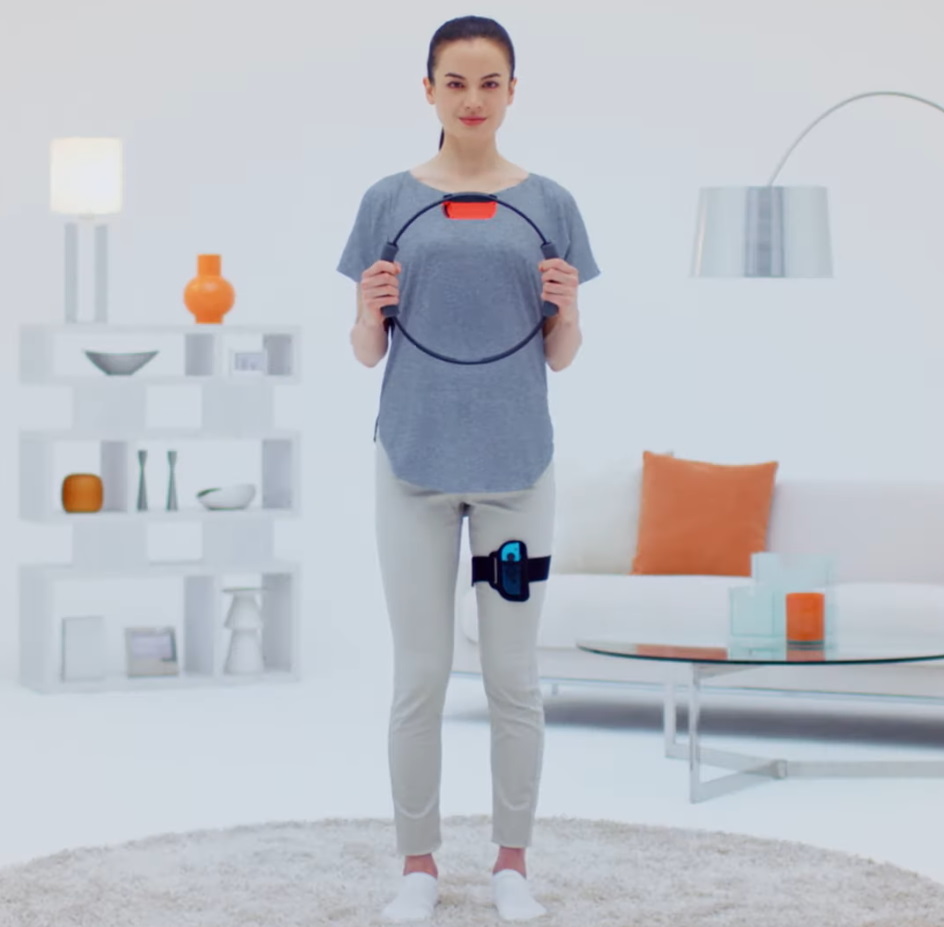
The game comes with a pair of accessories: a ring and leg strap, each of which you slot a Joy-Con into. The two controllers work together to get a picture of your whole body movement, meaning it can be sure you’re keeping your arms out in front of you when you do a squat, and not phoning it in during leg raises.

ringfit1

The ring itself is flexible and can tell how hard you’re squeezing or pulling it— but don’t worry, it can be calibrated for your strength level.

Interestingly, the top button of the controller appears to be able to be used as a heart rate monitor. That kind of came out of left field, but I like it. Just one more way Nintendo is making its hardware do interesting new things.

ringfit2

There look to be a ton of different movements you’ll be required to do, focusing on different areas of the body: upper, lower, core, and some sort of whole-body ones inspired by yoga positions. Ingeniously, some enemies are weak to one or another, and you’ll need to use different ones for other scenarios, so you’re getting a varied workout whether you like it or not.

Meanwhile your character levels up and unlocks new, more advanced moves — think a lunge instead of a squat, or adding an arm movement to a leg one — and you can get closer to the goal.

ringfit3

There are also minigames and straight-up workouts you can select, which you can do at any time if you don’t feel like playing the actual game, and contribute to your character’s level anyway.

The idea of gamifying fitness has been around for quite a while, and some titles, like Wii Fit, actually got pretty popular. But this one seems like the most in-depth actual game to use fitness as its main mechanic, and critically it is simple and easy enough that even the most slothful among us can get in a session now and then at their own pace.

Ring Fit Adventure will be available October 18 — no pricing yet, but you can probably expect it to be a little above an ordinary Switch game.

You can watch the full-length walkthrough of the game below, but beware — the acting is a little off-putting.

12 Sep 2019

Sidewalk Labs spins out urban data-gathering tool Replica into a company

Replica, the data-gathering tool created within Sidewalk Labs that maps the movement of people in cities, is now a company.

The newly formed company, which is headed by Nick Bowden, also announced Thursday it has raised $11 million in a Series A funding round from investors Innovation Endeavors, Firebrand Ventures, and Revolution’s Rise of the Rest Seed Fund. The capital will be used to accelerate Replica’s growth through new hires beyond its existing 13-person staff, expansion to new cities and investment in its technology.

Replica will remain connected to Sidewalk Labs, the smart city technology firm owned by Google’s parent company Alphabet. Both Sidewalk Labs and Innovation Endeavors will be on the company’s board.

Replica, which is headquartered in Kansas City with an engineering office in San Francisco, plans to launch in several new regions. Replica is already working with Kansas City, Portland, Chicago and Sacramento, with more cities to come this year.

The Replica tool, which has drawn the ire of some privacy advocates, grew out of Model Lab, a project  started two years ago to investigate modeling as a way to address urban problems. Early work focused on meeting with public agencies throughout the world to learn more about the data, processes and other tools they used.

The Replica planning tool was born out what they discovered: public agencies don’t have all the information needed to understand the link and interdependence between transportation and land use. The upshot is a an incomplete picture of how people move within cities, leaving public agencies ill-equipped to make decisions about how land is used and what transportation is needed and where, the company says.

“Answering questions like who uses the street, in which way and why, are critical for city planners as they work to make transit and land use more efficient and sustainable,” Bowden wrote. “But current resources available to city planners to analyze people’s travel in urban areas are less than satisfactory.”

The Replica modeling tool uses de-identified mobile location data to give public agencies a comprehensive portrait of how, when, and why people travel. Movement models are matched to a synthetic population, which has been created using samples of census demographic data to create a broad new data set that is statistically representative of the actual population. The result, Bowden says, is a model that is both privacy-sensitive and extremely useful for public agencies.

Bowden tried to quell privacy worries Thursday in a blog post emphasizing that the data has been “de-identified,” meaning that an individual’s location data would be identifiable. The company says it’s not interested in the movement of individuals. Instead, the modeling tool is used to see and understand patterns of movement.

“For this reason, we only start with data that has been de-identified,” Bowden wrote Thursday. “This data is then used to train a travel behavior model — basically, a set of rules to represent the movement in a particular place.”

12 Sep 2019

Patreon sells product curation site Kit to GeniusLink

Patreon, the platform for independent content creators to operate membership businesses for their core fans, announced it is selling the assets of Kit.com to localized affiliate link service GeniusLink.

Founded in 2015, Kit is a social-shopping platform where influencers curate bundles of products (“kits”) they recommend. When their fans buy products they featured in a kit, the influencer earns an affiliate fee commission. Kit has 2.3 million monthly web visitors, according to SimilarWeb.

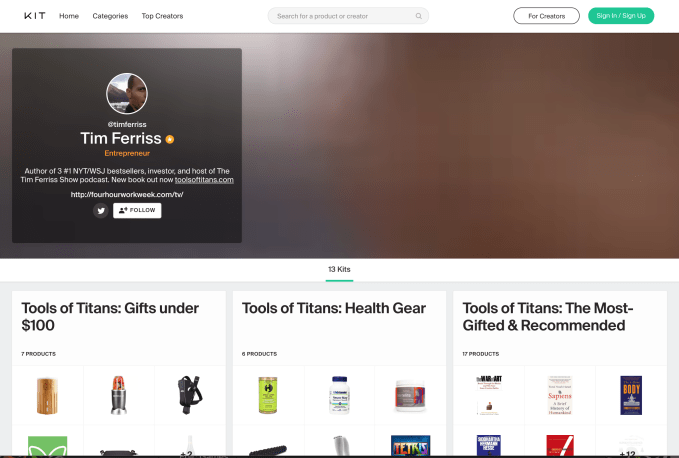
Among the most notable content creators on Kit, YouTuber Casey Neistat curated a kit featuring his favorite camera gear and author Tim Ferriss curated kits featuring his favorite podcasting equipment and the health products recommended by interviewees in his Tools for Titans book.

Screen Shot 2019 09 12 at 8.40.53 AM

Screenshot of Kit.com’s profile site for Tim Ferriss

Patreon acquired Kit in June 2018 in what Patreon’s SVP Product Wyatt Jenkins described to me during my in-depth series on the company as “close to an acqui-hire,” adding that “although Kit is a good revenue source for a lot of creators — so it’s not a shut-down of Kit — we’re maintaining it but not iterating on it.” 

Kit had previously raised $2.5 million in venture capital from backers like Social Capital, #Angels, Precursor Ventures, Expa, and Ellen Pao. While the Kit site remained active, the team behind it was reassigned to lead product development for Patreon’s merch offering

It is unsurprising that Patreon found a new home for the asset. While Kit is a tool for creators to monetize, it doesn’t enhance paid memberships for fans and that’s Patreon’s exclusive focus right now. Even Patreon’s merch product is only for offering merch as a benefit for membership tiers, not for managing an e-commerce store with one-time transactions.

In a blog post today announcing the acquisition, GeniusLink wrote that “The first order of business for Geniuslink is to migrate Kit to the Geniuslink infrastructure and work to improve speed and reliability while our operations team dives into user support. We look forward to adding additional functionality for creators to monetize their kits in the coming months.”

GeniusLink launched in 2009, originally branded as GeoRiot. The bootstrapped company has 13 employees headquartered in Seattle.

Social commerce is a popular trend right now, with other social platforms testing e-commerce integrations for users (particularly influencers) to feature products. YouTube now has a built-in merch section for a creator to sell products under their videos and Instagram lets influencers sell products directly in the app. These have the advantage of providing influencer-curated shopping experiences right where influencers and their fans already are.

Those features assume an influencer is selling their own products, however, or at least the products of a brand they’ve formally partnered with. For Kit and its affiliate link model, the focus is on influencers as trusted curators for their fans. The influencer can feature a much wider variety of products and do so immediately, without negotiating a deal with each brand. 

That’s also why the model likely doesn’t make sense for many popular influencers — they want more money for their endorsement of a product than a standard affiliate link fee, and recommending lots of products they don’t have formal deals to promote may undercut them in their negotiations with brands.

As GeniusLink adds more monetization features to Kit, perhaps it will make it a more lucrative business activity for small and large influencers alike. 

12 Sep 2019

Daily Crunch: Uber resists California gig worker bill

The Daily Crunch is TechCrunch’s roundup of our biggest and most important stories. If you’d like to get this delivered to your inbox every day at around 9am Pacific, you can subscribe here.

1. Uber plans to keep defending independent contractor model for drivers

Despite California lawmakers passing a bill designed to turn gig workers into regular employees, Uber has made it clear it plans to do whatever it takes to keep classifying its drivers as independent contractors.

“We will continue to advocate for a compromise agreement,” Uber Chief Legal Officer Tony West said. That agreement might include a guaranteed earnings minimum while on a trip, portable benefits and a “collective voice” for drivers.

2. Spotify acquires SoundBetter, a music production marketplace, for an undisclosed sum

This looks like another step for Spotify to diversify its business model.

3. Simbe raises a $26M Series A for its retail inventory robot

Simbe has been showcasing its inventory robot Tally since 2015. And earlier this year, U.S. supermarket chain Giant Eagle announced plans to begin a pilot program, deploying Tally in select stores.

4. Loot boxes in games are gambling and should be banned for kids, say UK MPs

U.K. MPs have called for the government to regulate the games industry’s use of loot boxes. They’re urging a blanket ban on the sale of loot boxes to players who are children, suggesting that kids should instead be able to earn in-game credits to unlock these boxes.

5. How Kobalt is simplifying the killer complexities of the music industry

The second part of our in-depth look at Kobalt focuses on the complex way royalties flow through the industry, and how Kobalt is restructuring that process. (Extra Crunch membership required.)

6. Yelp adds predictive wait times and a new way for restaurants to share updates

With Yelp Connect, restaurants will be able to post updates about things like recent additions to the menu, happy hour specials and upcoming events. These updates are then shown on the Yelp homepage, in a weekly email and on the restaurant’s profile page.

7. 5 reasons to attend Disrupt SF this October 2-4

If you haven’t bought a ticket to Disrupt yet, you’re probably a bad person who’s making bad decisions.

12 Sep 2019

Daily Crunch: Uber resists California gig worker bill

The Daily Crunch is TechCrunch’s roundup of our biggest and most important stories. If you’d like to get this delivered to your inbox every day at around 9am Pacific, you can subscribe here.

1. Uber plans to keep defending independent contractor model for drivers

Despite California lawmakers passing a bill designed to turn gig workers into regular employees, Uber has made it clear it plans to do whatever it takes to keep classifying its drivers as independent contractors.

“We will continue to advocate for a compromise agreement,” Uber Chief Legal Officer Tony West said. That agreement might include a guaranteed earnings minimum while on a trip, portable benefits and a “collective voice” for drivers.

2. Spotify acquires SoundBetter, a music production marketplace, for an undisclosed sum

This looks like another step for Spotify to diversify its business model.

3. Simbe raises a $26M Series A for its retail inventory robot

Simbe has been showcasing its inventory robot Tally since 2015. And earlier this year, U.S. supermarket chain Giant Eagle announced plans to begin a pilot program, deploying Tally in select stores.

4. Loot boxes in games are gambling and should be banned for kids, say UK MPs

U.K. MPs have called for the government to regulate the games industry’s use of loot boxes. They’re urging a blanket ban on the sale of loot boxes to players who are children, suggesting that kids should instead be able to earn in-game credits to unlock these boxes.

5. How Kobalt is simplifying the killer complexities of the music industry

The second part of our in-depth look at Kobalt focuses on the complex way royalties flow through the industry, and how Kobalt is restructuring that process. (Extra Crunch membership required.)

6. Yelp adds predictive wait times and a new way for restaurants to share updates

With Yelp Connect, restaurants will be able to post updates about things like recent additions to the menu, happy hour specials and upcoming events. These updates are then shown on the Yelp homepage, in a weekly email and on the restaurant’s profile page.

7. 5 reasons to attend Disrupt SF this October 2-4

If you haven’t bought a ticket to Disrupt yet, you’re probably a bad person who’s making bad decisions.

12 Sep 2019

SmileDirectClub makes its debut on the public market

SmileDirectClub rang the opening bell earlier today, marking its first day of trading as a public company. The teeth-straightening company is now trading on the NASDAQ under the symbol “SDC.”

Already, the stock is trading down 11% at $20.36 per share.

SmileDirectClub kicked off its IPO hoping to raise up to $1.3 billion at an offering price of $23 per share, with an expected market cap of around $10 billion. The company originally intended to set its price between $19 and $22 per share.

The company plans to use money raised from the IPO for international expansion and developing new dental products. SmileDirectClub filed to go public back in August amid concerns from national dental associations.

Prior to this, SmileDirectClub reached a $3.2 billion valuation following a $380 million funding round last October. Investors from Clayton, Dubilier & Rice led the round, which featured participation from Kleiner Perkins and Spark Capital. This funding came on top of Invisalign maker Align Technology’s $46.7 million investment in SmileDirectClub in 2016, and another $12.8 million investment in 2017 to own a total of 19% of the company.

In 2018, SmileDirectClub’s revenues came in at $432.2 million, a significant uptick from just $147 million the year prior.

The company ships invisible aligners directly to customers, and licensed dental professionals (either orthodontists or general dentists) remotely monitor the progress of the patient. Before shipping the aligners, patients either take their dental impressions at home and send them to SmileDirectClub or visit one of the company’s “SmileShops” to be scanned in person.

SmileDirectClub says it costs 60% less than other types of teeth-straightening treatments, with the length of treatments ranging from four to 14 months. Upfront, SmileDirectClub costs $1,895 with the average treatment lasting six months.

Though, members of the American Association of Orthodontists have taken issue with SmileDirectClub, previously asserting that SmileDirectClub violates the law because its methods of allowing people to skip in-person visits and X-rays is “illegal and creates medical risks.” The organization has also filed complaints against SmileDirectClub in 36 states, alleging violations of statutes and regulations governing the practice of dentistry. Those complaints were filed with the regulatory boards that oversee dentistry practices and with the attorneys general of each state.

SmileDirectClub explicitly calls out those issues in its S-1 as potential risk factors. Here’s a key nugget:

A number of dental and orthodontic professionals believe that clear aligners are appropriate for only a limited percentage of their patients. National and state dental associations have issued statements discouraging use of orthodontics using a teledentistry platform. Increased market acceptance of our remote clear aligner treatment may depend, in part, upon the recommendations of dental and orthodontic professionals and associations, as well as other factors including effectiveness, safety, ease of use, reliability, aesthetics, and price compared to competing products.

Furthermore, our ability to conduct business in each state is dependent, in part, upon that particular state’s treatment of remote healthcare and that state dental board’s regulation of the practice of dentistry, each which are subject to changing political, regulatory, and other influences. There is a risk that state authorities may find that our contractual relationships with our doctors violate laws and regulations prohibiting the corporate practice of dentistry, which generally bar the practice of dentistry by entities. Two state dental boards have established new rules or interpreted existing rules in a manner that purports to limit or restrict our ability to conduct our business as currently conducted.

Additionally, as the S-1 notes, a national dental association recently filed a petition with the U.S. Food and Drug Administration claiming that SmileDirectClub’s manufacturing violates “prescription only” requirements. While no regulations or laws have been passed that would affect SmileDirectClub to date, it’s a possible scenario that would greatly impact the company’s core business.

Developing…

12 Sep 2019

Pandora debuts a desktop app for Windows with support for music & podcasts

Pandora today is launching a desktop app for Windows users following its debut of a native Mac app earlier this year. On Mac, Pandora offers a variety of features for desktop users like on-screen notifications, keyboard controls, and a way to select listening “modes” and more. It didn’t, however, include support for streaming podcasts. The new Windows app includes a similar feature set, and adds support for podcast streaming.

Like its Mac counterpart, Pandora’s Windows app can be used by both free users and paid subscribers alike.

The free users will have access to Pandora’s ad-supported stations, while Pandora Plus subscribers get ad-free stations, unlimited skips, personalized stations, and up to four offline stations. Pandora Premium subscribers, meanwhile, get the same, plus the ability to make and share playlists, play albums and songs on-demand, and take advantage of unlimited offline listening.

Both of the paid subscription tiers can also stream podcasts via the Windows app.

Also like the Mac app, the Windows version supports keyboard controls for doing things like playing, pausing, replaying, shuffling, thumbs up and down, etc. And it supports the Pandora Modes feature which lets you refine your personalized stations by asking Pandora to focus more on certain types of songs — like crowd favorites, the discovery of new artists, deep cuts, songs from a select artist only, new releases, and more.

Desktop users often prefer to use a native app instead of leaving a service open in a browser tab as it allows them a more seamless and integrated experience. That said, Pandora’s Mac version didn’t have the best reviews from Apple users.

Still, Pandora’s rollout of native desktop apps helps the SiriusXM-owned company better compete with rivals like Apple Music and Spotify, both of which have long offered desktop applications. In Apple’s case, it actually built so much into iTunes, that the company decided to finally break it up into parts with the next version of macOS. Pandora doesn’t have the same problem because it doesn’t include a user library or marketplace.

Windows users can download the Pandora app from the Microsoft Store starting today.

The app works on Windows 10. (Pandora also supports streaming to Xbox via the Microsoft Store app.)

12 Sep 2019

Patch Homes locks in $5m Series A to give homeowners financial freedom without debt

Homeownership has long been touted as the American dream. But rising rates of mortgage debt, student loan debt, or otherwise are making the pursuit of homeownership a nightmare. Debt burdened individuals or those with inconsistent or tight cash flow can not only struggle to get credit loan approval when buying a home but also struggle to satisfy monthly mortgage payments even after purchase. 

Patch Homes is hoping to keep the proverbial American dream alive. Patch looks to provide homeowners with cash flow and liquidity by allowing them to monetize their homes without taking on debt, interest or burdensome monthly payments. 

Today, Patch took another big step in making its vision a far-reaching reality. The company has announced it’s raised a $5 million Series A round led by Union Square Ventures (USV)  with participation by from Tribe Capital and previous investors Techstars Ventures, Breega Capital, and Greg Schroy.

Patch Home looks to partner with homeowners by investing up to $250,000 (with an average investment of ~$100,000) for an equity stake in the home’s value, generally in the 5% to 20% range. Homeowners aren’t subject to any interest or recurring payments and have ten years to pay back Patch’s investment. Upon doing so, the only incremental money Patch receives is its portion of the change in the home’s value over the course of the ten year period. If the value of the home goes down in value, Patch willingly takes a loss on its investment.

According to Patch Homes CEO and cofounder Sahil Gupta, one of the major motivations behind the company’s model is to align Patch’s incentives with the homeowners, allowing both parties to think of each other as trusted partners even after financing. After Patch’s investment, the company provides a number of ancillary services to homeowners such as credit score monitoring, as well as home value and property tax tracking.

In one instance recounted by Gupta in an interview with TechCrunch, Patch even covered three months of an owner’s mortgage during a liquidity crunch for his small business, allowing him to maintain his home and credit score. Patch is incentivized to provide all services that can help ensure an increase in home value, benefitting both Patch and the homeowner, with the homeowner earning the majority of the asset’s appreciated value.  

Additionally, since Patch’s model isn’t focused on a homeowner’s ability to pay back a loan, interest or periodic payments, Patch is able to provide financing to more people. Patch is able to help those with more variable qualifications that struggle to get traditional loans — such as a 1099 contracted worker — monetize their illiquid assets with less harsh or restrictive terms and without increasing their debt burden. Gupta described this as solving the core problem of providing liquidity to asset-rich but cash-flow sensitive people. 

Patch is not only looking to provide easier liquidity to more homeowners, but they’re trying to do so faster than traditional lenders. Interested customers can first receive a free estimate of whether Patch will invest in their home or not, how much its willing to invest and what percentage equity it will take — primarily based on Patch’s machine learning models that focus on asset, market, and location level attributes. 

After the initial estimate, a Patch home advisor will educate the customer on the product and start a formal application process, which includes your standard income and credit score verification and otherwise, that takes 5-10 days. All-in, homeowners have the ability to get money in as little as 14 days, a significantly shorter timeline than your standard home credit process. Once the investment is made, owners have full freedom with how they use the money.

According to Patch, while its customers come from a diverse set of backgrounds, many either accumulated debt have to pay down the net or may struggle making monthly payments. The average Patch homeowner uses 40% of the investment to eliminate debt, adds 40% to their savings account or passive income, and invests 20% into home improvements.

To date, Patch has raised a total of $6 million and believes the latest round of funding will help scale its operations as they team up with advisors like USV that have experience scaling fintech companies (such as a Lending Club or Carta). The funds will be used to invest in product and Patch’s clearing technology in order to further speed up Patch’s lending process.

Patch also hopes to use the investment to help them gradually expand their footprint, with the goal of eventually having a presence all 50 states. (Patch is currently available in 11 regional markets within California and Washington and expects to be in 18 regional markets by the end of the year including those in Utah, Colorado and Oregon.)

Patch Homes Co Founders Sundeep Ambati L and Sahil Gupta R

Image via Patch Homes

What makes homeownership so galvanizing for the Patch team? Patch CEO Sahil Gupta spent years putting his Carnegie Mellon financial engineering degree to work in banking and finance, as well as in financial products and strategy positions at fintech startups backed by heavy hitters such as YC to Goldman Sachs.

After realizing the majority of the US population were homeowners, but were struggling to make monthly payments or save for the future, Sahil wanted to figure out how we could take an illiquid asset like a home and make it easily accessible. 

Around the same time, Sahil’s cofounder Sundeep Ambat was working as a contractor on a new business venture of his and was struggling to get a home equity loan. While these circumstances ultimately led Sahil and Sundeep to found Patch Homes in 2016 out of the TechStars New York accelerator program, the deeper motivation behind Patch can be traced back nearly 30 years when Sahil’s father made an equity sharing agreement with his brother as they were building his family’s home in India.

With a growing family and a pregnant wife, Sunil’s father was adamant about living debt-free and so his brother provided an investment in exchange for an equity stake in the house. According to Sahil, the home is still in the family and has appreciated substantially in value to the benefit of both Sahil’s father and his brother. Longer-term, Patch wants to be the preferred partner for homeownership, helping reduce cash tight owners’ financial anxiety without the debilitating weight of debt. 

“Some companies want to help people buy or sell homes, but homeownership really begins after that point. Patch is built to be inside the home with you and everything that comes thereafter,” Gupta told TechCrunch.

“Patch was created to partner with homeowners to help them unlock their home equity so they can achieve their financial goals along every step of their homeownership journey.

12 Sep 2019

Google says it will do more to prioritize original reporting in search

Google says it’s taking new steps to ensure that original reporting gets prioritized in its search results.

In other words, articles that kick off a major news cycle should have a prominent in search results for a longer time, rather than getting buried under more recent coverage (some of which may just summarize the original story).

“While we typically show the latest and most comprehensive version of a story in news results, we’ve made changes to our products globally to highlight articles that we identify as significant original reporting,” Google’s Vice President of News Richard Gingras wrote in a blog post. “Such articles may stay in a highly visible position longer. This prominence allows users to view the original reporting while also looking at more recent articles alongside it.”

But original reporting can be a tricky concept. On the one hand, you’ve got major scoops, and on the other stories that do no reporting at all. In between, you’ve got stories with real reporting that don’t exactly break major ground. And there are publications (like TechCrunch!) and even individual articles that can combine original reporting with news broken elsewhere.

How can you teach an algorithm to understand all these distinctions? Gingras said Google is doing so through its Quality Raters, a global network of more than 10,000 individuals who offer feedback on Google’s search results, which in turn is used to improve the company’s search algorithms.

Specifically, Google has changed its guidelines so that articles providing “information that would not otherwise have been known had the article not revealed it” are rated as highly as possible. The guidelines also ask raters to take into account a publication’s general reputation (based on “prestigious awards, such as the Pulitzer Prize award, or a history of high quality original reporting”).

Gingras added that we can expect these efforts to “constantly evolve as we work to understand the life cycle of a story.”

This is part of a broader effort at Google to find new ways to work with the news industry, most notably with a $300 million News Initiative announced last year.

12 Sep 2019

Incredible Health’s hiring platform for nurses gets $15M led by Andreessen Horowitz

Andreessen Horowitz has led a $15 million Series A in US-based job matching platform for nursing vacancies, Incredible Health. Other investors in the funding round include NFX, Obvious Ventures, Precursor Ventures and Gingerbread Capital. To date the recruitment startup has raised a total of $17M.

The California startup’s pitch to nursing professionals and hospitals is faster and more efficient hiring via proprietary matching algorithms which replace the need for hospitals to manually sift applications. Instead the platform matches job seekers to nursing vacancies based on criteria supplied by both sides of its network.

Why focus on nurses? The startup cites a statistical claim that by 2024 the US will have a shortage of a million nurses — which it argues poses a risk of financial loss to hospitals, as contractors cost more to employ, while also contending that a growing number of unfilled nursing vacancies risks the quality of care hospitals are able to offer patients.

It launched its recruitment platform in late 2017 and has so far limited its range to California, with 150+ hospitals in the region signed up and an undefined “thousands” of nurses on board.

The Series A funding will be going towards accelerating national scaling in the US.

As well as VC backers, Incredible Health’s Series A includes participation from a number of individual investors hailing from the hiring space — including Hired founder, Matt Mickiewicz; Steve Goodman, founder of Bright.com (acquired by LinkedIn); and Pete Kazanjy, founder of Talentbin (acquired by Monster) .

“We look at at least 40-50 different criteria, including location preferences, licenses and skills,” says co-founder and CEO Iman Abuzeid who has a background as a medical doctor. Her co-founder and CTO, Rome Portlock, who comes from a family of nurses, is an MIT alum — where he studied computer science.

“We work with each hospital individually to understand their key needs so we can customize their algorithms, enabling personalized matches that don’t waste the recruiter’s time,” Abuzeid adds. “We also find out the nurse’s preferences through automated methods.

“At the end of the day, a hospital recruiter or hiring executive does not want to see 200 candidates in their app, they want to see 12 that are the right fit. Same with the nurses — they don’t want to hear from 76 employers, they want to hear from three that are the right fit.”

Incredible Health’s claim for its approach is that it yields 3x faster recruitment vs the national average — saying hires via its platform take 30 days or less instead of up to 90 days on average.

It also makes a further claim of 25x “hiring efficiency” for hospitals as a consequence of its matching algorithms taking over much of the hiring admin. This is based on data from hospitals which, prior to using its platform, had to review an average of 500 applicants to fill a single position vs the matching tech cutting that to an average of just 20.

Nurses don’t apply to jobs on Incredible Health’s platform; it’s up to hospitals to apply to nursing professionals the algorithm deems a suitable match for a job vacancy.

Hospitals can’t browse all available nurses; they only see candidates the algorithm selects for them — so, as with nurses, they’re trading wider visibility of the job market for algorithmic matches based on non-disclosed “proprietary” criteria.

Incredible Health sells that reduction of agency as an efficiency saving to both sides of its network.

“Rather than completing an application for every potential employer — a process which takes an average of 45 minutes per application — nurses who use Incredible Health complete one profile — a process that takes less than 5 minutes. That profile is then used to screen and custom-match them to multiple great job opportunities,” says Abuzeid, adding when asked about criteria that nurses have to provide “data like their job preferences, experience and skill set, and also their education and licensing” as part of the onboarding profile-building process. 

For nurses this load-lightening switch from active jobseeker to passive platform lurker — i.e. once they’ve created their profile — is how Incredible Health hopes to woo healthcare workers away from traditional job boards (such as specialist nursing vacancies board Indeed).

Its marketing thus leans heavily on claims that nurses just need to spend a few minutes creating a profile and then watch as the great job offers to roll in.

It also claims nurses who find employment through its two-sided platform score on average a 17% salary increase and a 15% reduction in commute time.

Though all these figures are derived from an unknown number of nurses working across a subset of hospitals in a single US state — so it remains to be seen how claimed perks get squeezed as the platform scales its national range and necessarily opens up to a wider pipeline of nursing professionals.

For now, Incredible Health also says its focus is on building a career marketplace for nursing professionals to connect them with “permanent, well-paid hospital jobs”, rather than dealing with travel and temp nurses

Again, whether it’s able to maintain focus on what one investor calls “high value health care workers” and the claimed high quality permanent jobs as the business scales will also be one to watch.

Commenting on the Series A, Andreessen Horowitz managing partner Jeff Jordan told us: “Incredible Health’s mission is to help health care professionals live better lives and do their best work.  They’ve seen strong early success helping to match these health care professionals with hospitals throughout California, and are beginning to expand their solution nationally.  We look forward to supporting their efforts to building a game-changing health care employment marketplace.”

Part of the funding will go on expanding from a pure hiring platform — to what the startup bills as a “community for health care professionals as they advance their careers” — in a clear bid to nurture and expand its candidate pool so it can be responsive to platform needs.

“High caliber nurses are out there, but employers have a hard time hiring them through traditional methods like job boards and recruiting agencies because those methods rely almost exclusively on human engagement — not technology — to scour through applications, licenses and experience — and manually vet and qualify them for jobs,” Abuzeid tells TechCrunch, dubbing the job-board competition “outdated methods”.

As well as offering a “streamlined” hiring process for nursing roles, as she puts it, she notes the platform automates “entire parts of the screening and vetting process” — meaning “we’re able to deliver high-quality nurses at scale”. 

That said, there’s still manual work involved — with the startup noting on its website that staff may contact nurses to “make sure you’re presenting yourself in the best way possible to top hospitals”, as well as telling hospitals that candidates are pre-screened for “licenses, experience, responsiveness, and more” (though at least some, if not all, of that vetting is automated).

Like any platform startup, Incredible Health is hoping to channel network effects to its advantage — including by feeding data back in to improve matching algorithms.

“Our system gets more effective the more who use it,” Abuzeid tells us. “The first [effect] is a traditional marketplace network effect: More nurses has attracted more hospitals, and more hospitals has attracted more nurses. And then, there’s the data network effect: The more each side uses it, the ‘smarter’ our algorithms get, too.”

Each hospital onboarded onto the platform brings with it a range of needs “advancing our system’s performance abilities”, she adds.

While algorithmic recruitment can clearly speed up the business of matching candidates to relevant jobs — a factor evident in the sheer number of job matching startups now playing in different sectors — it inevitably entails a loss of control for both sides of the employer-applicant divide.

Depending on matching criteria used there could be potential for gender and/or racial bias to creep into automated selections — bias that would be difficult for hospitals to detect since they’re only able to view a subset of candidates deemed a match, rather than the entire available pool at the time.

However Abuzeid dismisses the idea that there’s any risk of bias in Incredible Health’s approach. 

“We operate successfully in a very regulated industry,” she says. “Because potential employees are assessed on their skills, experience and certifications, the technology weeds out biases typically found in processes which are largely human-powered.”

On the business model front, Incredible Health is charging hospitals what it bills as a “simple, flat fee pricing regardless of level, experience or location” — which it touts as “cheaper and more scalable than traditional recruiting agencies”.

“Traditional recruiting agencies are very expensive, because they don’t use technology in their screening and matching processes. It’s all people powered and can cost $20,000-$30,000 per single hire,” Abuzeid claims.

As for rival (lower fee) legacy job boards, she argues they offer “quantity, not quality and require lots of work for nurses and employers to find a good fit” — claiming this old school method results in “really low hiring rates at 0.2%”.