Year: 2019

12 Sep 2019

Google Photos adds a time-traveling version of Stories, plus more sharing and printing options

Google Photos is getting its own version of Stories. But instead of focusing on what you’re doing now, as Stories on other platforms like Instagram and Snapchat offer, Google Photos is adopting the format to help you take a trip down memory lane. The feature is one of several updates coming to the photo-sharing service that focuses on helping you reconnect with your old photos that often get forgotten after upload.

Its unique take on Stories is, perhaps, the most interesting update, as it’s the first time we’ve seen the format used as a way to rewind time.

In Google Photos, the feature is more appropriately called “Memories,” as is designed to help users relive their life in a more meaningful way.

Memories

The company said it came up with the idea by watching user behavior on its app.

“We see users browse their photos and scroll all the way down to look at pictures from five years ago,” explained Google Photos Lead, Shimrit Ben-Yair. “We see them searching for moments and having a good experience with that. But we thought, how can we make that even easier?”

The Memories feature, she continued, is meant to accomplish that by helping users “better reminisce digitally.”

Most users will already know how to use Google Photos Memories, given the broad adoption of Stories across various platforms, including Instagram, Snapchat, Facebook, Messenger, YouTube, and even surprising places like Netflix. As with some other implementations, the feature places small, rounded icons at the top of the Google Photos gallery, which you can tap to launch and advance through.

Except, in this case, each Story circle is taking you back in time — for example, a year ago, two years ago, three, and so on.

Memories


However, the feature isn’t just a variation on “Rediscover this Day,” because it’s not as tightly tied to a particular date. It’s more like a showcase of what you were doing around the same time as in years prior — like around the same week. It lets you look back without having to swipe through the badly shot photos and duplicates.

To help users from reliving more sensitive memories — like deaths they’re still grieving or breakups they’d rather forget, for example — you’ll also be able to block certain people or places from showing up in the Memories feature, to better personalize your highlight reel.

Another key difference is that Google Photos’ Memories are not put on public display.

“Even though it is the Stories format — which we lean into because we feel it creates a more immersive experience for reliving your life — this is only your library. It’s your private content,” noted Google Photos Engineering Lead, James Gallagher, when demoing the feature, pre-launch, to TechCrunch.

In a few months’ time, however, Google Photos plans to let you share these old photos — or any others you come across in your library  — in a more direct and more personal way. Through an enhancement to the sharing feature, you’ll be able to send a photo directly to friends or family, where it’s then adding to an ongoing and private conversation that will eventually become a stream of all your chats and shares.

Photo prints

And Google Photos is expanding its options for getting photos off your phone and into the real world.

It’s partnering with Walmart and CVS for 4×6 photo prints that can be picked up in about an hour at over 11,000 U.S. locations. These prints will cost the same as if you ordered through the retailers directly at $0.25 from Walmart and $0.33 from CVS. You’ll also be able to turn photos into wall art of various sizes, in the U.S. This follows Flickr’s recent expansion into the area of prints and wall art, which rolled out last month.

Photo prints

In Google Photos’ case, you’ll be able to select canvas prints in three different sizes, 8×8 ($19.99), 11×14 ($29.99), and 16×20 ($44.99), which can be customized with either black, white, or photo wrap borders. The canvases also come with a wire hanger on the back to make mounting easier.

This feature will generate revenue, though Google outsources the actual work to a network of printing partners across the U.S. It joins an existing feature that lets users turn photos into photo books in just a few steps.

Canvas prints

One final feature, though not necessarily related to reminiscing, is an improvement to search that will now help you find photos or screenshots with text — like a recipe.

This feature, prints, and the Memories feature are rolling out now. Direct sharing is coming in a few months.

The additions are part of many enhancements to Google Photos since its spin-out from Google+ just over four years ago. The company has rapidly improved its photo-hosting and sharing service with A.I. functionality to clean up users’ vast photo libraries and automatically create photo edits and mini-movies, among other things. And it continues to improve with features like support for Lens’ visual search and an expanded array of A.I.-powered photo fixes, for example.

Thanks to these features and its integration with the Android operating system, Google Photos now has over a billion monthly users.

 

12 Sep 2019

Google to pay $549 million fine and $510 million in back taxes in France

After years of back and forth with tax authorities in France, Google has settled a fiscal fraud probe, as the financial prosecutor’s office told Reuters and AFP. Overall, Google will pay a $549 million fine as well as $510 million in back taxes (€500 million and €465 million respectively).

This is a settlement, which means that French authorities are dropping charges against Google in France. It covers activities from 2005 to 2018.

According to previous reports, the company owed around $1.3 billion in taxes. In 2014, Google started putting aside some money for a potential fine.

This is a classic story of corporate tax optimization in Europe. For multiple years, Google allegedly issued advertising contracts from its European headquarters in Ireland. Profits generated from those contracts would be taxed in Ireland.

Separately, France has been working on a tax on tech giants. In order to avoid tax optimization schemes, big tech companies that generate significant revenue in France are taxed on their revenue generated in France.

If you’re running a marketplace or advertising company that generates more than €750 million in global revenue and €25 million in France, you have to pay 3% of your French revenue in taxes.

It has generated some drama with the U.S. — President Donald Trump first said that the U.S. would be placing tariffs on French wines.

France and the U.S. eventually reached an agreement at the Group of Seven summit. The French government now hopes that the OECD finds a way to properly tax tech companies in countries where they operate in order to scrap the French tax.

12 Sep 2019

Y Combinator’s Michael Seibel, Ali Rowghani to reveal new YC top 100 list, talk startups at Disrupt SF

Y Combinator has become its own economy since its founding in 2005, as the formative seed-stage venture fund has nurtured leading startups across industries. Today, you’ll often see newer YC startups get started by providing services to larger YC companies — and then become the larger companies themselves (Stripe and Gusto are two of the most widely known examples, to date).

With its second Demo Day of the year wrapped up last month, the firm has also launched its largest group of startups ever in 2019.

CEO Michael Seibel will be joining us on stage at Disrupt SF this year, along with Ali Rowghani, the CEO of its Continuity growth fund, to give us a closer look at what’s going on. They’ll be announcing the second-annual list of the top 100 YC companies as part of this, and tell me that while most people can predict Dropbox and Airbnb showing up, many of the other names are going to be surprising.

We’ll be asking them about what it takes to get in to YC in the first place these days, and what it takes to build a company that can make a list like this. Seibel and Rowghani will also be available for an extra-long question-and-answer portion of the talk with attendees, as a part of our Extra Crunch-themed stage at the conference.

While the full details of the list will be unveiled on October 2nd, they note that the ranking will be based on valuation like last year’s: “Why valuation? We have long said that valuation is a poor way to measure a company’s value in the short term. That said, it’s the most commonly available metric to compare companies in the startup world. Other metrics, like revenue, are more often kept private. It’s worth noting that we have a number of very impressive companies who would have made the top 100 list if it were sorted by revenue, token value, rev/employee ratio, or other methods of measuring value. This list does not represent these successes.” They add that it will show the number of jobs each company has created, and the industry sector that it is a part of.

To date, YC says it has backed more than 4,000 founders, who have created more than 2,000 companies that together are worth more than $100 billion. Among the top 100 companies who made the list last year, it says 93 were valued at more than $100 million and had between them created more than 28,000 jobs.

Don’t miss our recent coverage of Demo Day (including our favorites from both days) as well as our discussions with Seibel about the investment theses and trends that it is betting on.

Disrupt SF runs October 2 to October 4 at the Moscone Center in San Francisco. Tickets are available here.

*Disclosure: I went through YC myself (w07) but have no financial relationship with it today, cap table or otherwise. 

12 Sep 2019

Amazon’s crowdsourced Q&A community Alexa Answers goes live for all

In December, Amazon launched a crowdsourced Q&A platform into beta with the goal of improving Alexa’s ability to answer questions. That feature, Alexa Answers, is now live to all. Amazon says the feature was well-received by the early community of invite-only participants, who have since contributed hundreds of thousands of answers that have been shared with Alexa customers millions of times.

To differentiate these answers from other Alexa responses, they’re attributed to “an Amazon customer.”

As the company explained at launch, there are thousands of answers that had previously stumped Alexa, like “Where was Barbara Bush buried?,” “Who wrote the score for Lord of the Rings?,” “What’s cork made out of?,” and “Where do bats go in the winter?”

Though Alexa should have the ability to answer some of these sorts of questions thanks to its integrations with Bing, it falls short in many areas.

The ability to answer common questions like the above is currently one of Google Assistant’s stronger features, thanks to the years Google spend building up a Knowledge Graph that’s based on a web’s worth of data.

Meanwhile, Amazon’s decision to quickly ramp up its own database of answers by way of crowdsourcing opens itself up to many potential challenges, including most notably, abuse and inaccuracy.

As anyone who uses crowdsourced Q&A platforms like Yahoo Answers or Quora could tell you, the most upvoted answers aren’t always the best or most accurate. In some cases, they’re also profane. In addition, when users are incentivized to answer questions by way of some sort of rewards system, some will attempt to answer as many as possible in order to be designated as a “top contributor.” But they may not always be the best person to answer the questions they’re plowing through.

Amazon is attempting to address these problems with a platform that uses automatic filtering to catch the inappropriate and offensive content and language, along with a community platform where answered are rated and the best are then shared by Alexa, earning the person who answered the question some points.

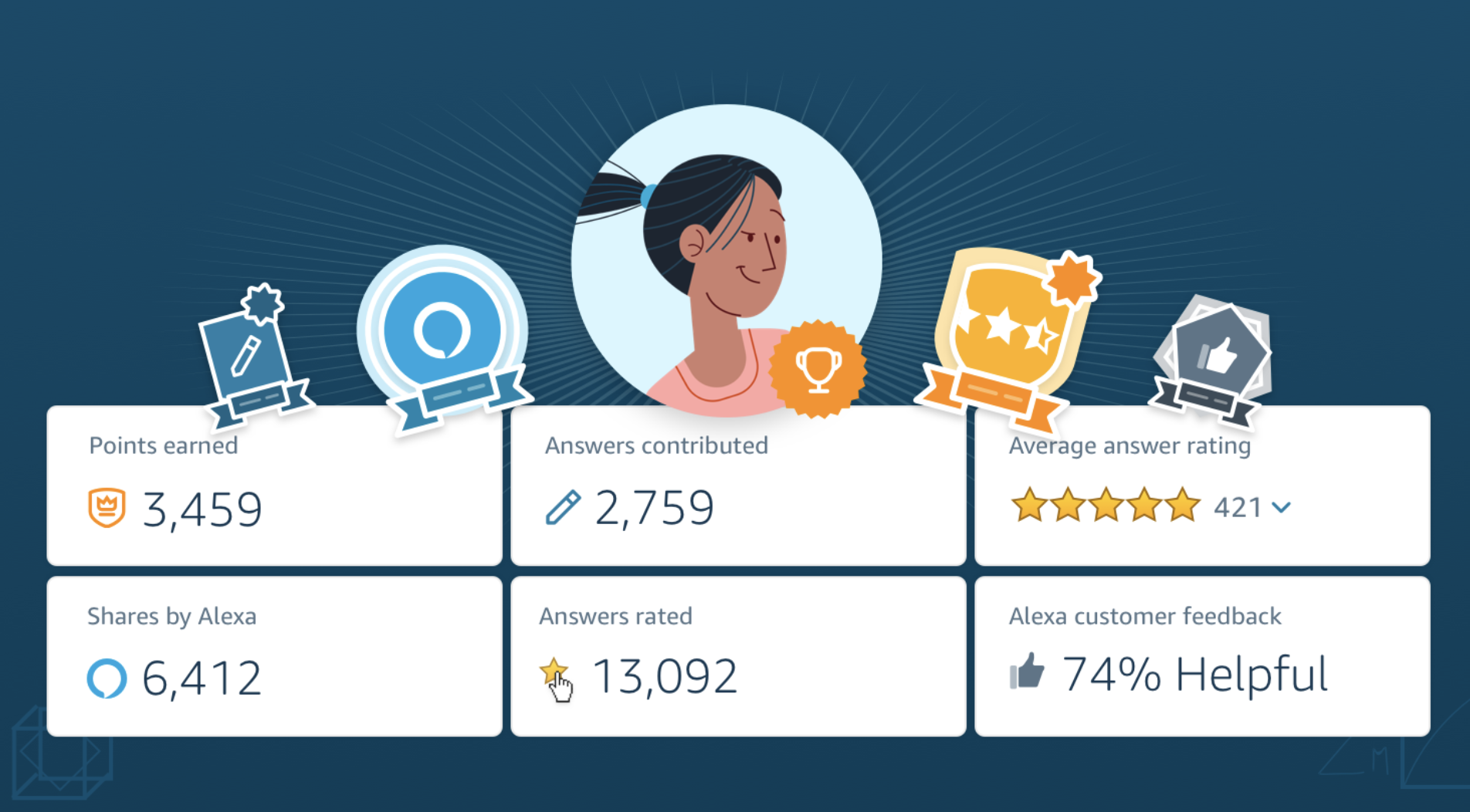
Screen Shot 2019 09 12 at 11.06.33 AM

Before, this community was limited to a smaller number of invitees.

Today, any Amazon account holder can sign in and begin contributing. You can then see a list of questions available and choose to filter them based on things like “most frequently asked,” or “newest” or by other topic areas. After you submit an answer, you earn points towards monthly and weekly leaderboards and badges based on how many questions you’ve answered, how many times it’s been shared with Alexa users, and more.

“This new feature is just one example of the many ways we’re continuously working to grow Alexa’s knowledge,” an Amazon spokesperson said. “As always, we’ll continue to evolve the experience based on customer feedback.”

There haven’t been any reports of abuse of this feature so far, but it hadn’t been so broadly available. It’s unclear, however, if Amazon has in place strong enough protections against those who like to disrupt online communities just for the sake of watching them burn.

While crowdsourcing isn’t necessarily a bad idea — Wikipedia turned out well, for example — it’s an area that requires a lot of oversight. In Wikipedia’s case, that comes down to an elite group of editors who handle much of the site’s content. Alexa Answers may not be able to create the same sort of self-policed system, given it pits community members against one another with its leaderboards. Gamification like this doesn’t always lead to collaboration and support.

A better model may have been that of Reddit’s with virtual currency and tiered rewards, and moderation by topical area from strong community leads. But growing a community organically takes time and effort. And today’s voice assistants are engaged in sprints, not marathons, when it comes to one-upping one another by feature set.

The Alexa Answers feature is open for everyone at alexaanswers.amazon.com/about.


12 Sep 2019

Apple tweaks App Store rule changes for children’s apps and sign in services

Originally announced in June, changes to Apple’s App Store policies on its Sign in with Apple service and the rules around children’s app categories are being tweaked. New apps must comply right away with the tweaked terms, but existing apps will have until early 2020 to comply with the new rules.

The changes announced at Apple’s developer conference in the summer were significant, and raised concerns among developers that the rules could handicap their ability to do business in a universe that, frankly, offers tough alternatives to ad-based revenue for children’s apps.

In a short interview with TechCrunch, Apple’s Phil Schiller said that they had spent time with developers, analytics companies and advertising services to hear what they had to say about the proposals and have made some updates.

The changes are garnering some strong statements of support from advocacy groups and advertising providers for children’s apps that were pre-briefed on the tweaks. The changes will show up as of this morning in Apple’s developer guidelines.

“As we got closer to implementation we spent more time with developers, analytics companies and advertising companies,” said Schiller. “Some of them are really forward thinking and have good ideas and are trying to be leaders in this space too.”

With their feedback, Schiller said, they’ve updated the guidelines to allow them to be more applicable to a broader number of scenarios. The goal, he said, was to make the guidelines easy enough for developers to adopt while being supportive of sensible policies that parents could buy into. These additional guidelines, especially around the Kids app category, says Schiller, outline scenarios that may not be addressed by the Children’s Online Privacy Protection Act (COPPA) or GDPR regulations.

There are two main updates.

Kids changes

The first area that is getting further tweaking is the Kids terms. Rule sections 1.3 and 5.1.4 specifically are being adjusted after Apple spoke with developers and providers of ad and analytics services about their concerns over the past few months.

Both of those rules are being updated to add more nuance to their language around third-party services like ads and analytics. In June, Apple announced a very hard-line version of these rule updates that essentially outlawed any third-party ads or analytics software and prohibited any data transmission to third-parties. The new rules offer some opportunities for developers to continue to integrate these into their apps, but also sets out explicit constraints for them.

The big changes come in section 1.3 surrounding data safety in the Kids category. Apple has removed the explicit restriction on including any third-party advertising or analytics. This was the huge hammer that developers saw heading towards their business models.

Instead, Apple has laid out a much more nuanced proposal for app developers. Specifically, it says these apps should not include analytics or ads from third parties, which implicitly acknowledging that there are ways to provide these services while also practicing data safety on the App Store.

Apple says that in limited cases, third-party analytics may be permitted as long as apps in the Kids category do not send personal identifiable information or any device fingerprinting information to third parties. This includes transmitting the IDFA (the device ID for advertisers), name, date of birth, email address, location or any other personally identifiable information.

Third-party contextual ads may be allowed but only if those companies providing the ads have publicly documented practices and policies and also offer human review of ad creatives. That certainly limits the options, including most offerings from programmatic services.

Rule 5.1.4 centers on data handling in kids apps. In addition to complying with COPPA, GDPR and other local regulations, Apple sets out some explicit guard rails.

First, the language on third-party ads and analytics has been changed from may not to should not. Apple is discouraging their use, but acknowledges that “in limited cases” third-party analytics and advertising may be permitted if it adheres to the new rules set out in guideline 1.3.

The explicit prohibition on transmitting any data to third parties from apps in the Kids category has been removed. Once again, this was the big bad bullet that every children’s app maker was paying attention to.

An additional clause reminds developers not to use terms like “for kids” and “for children” in app metadata for apps outside of the Kids category on the App Store.

SuperAwesome is a company that provides services like safe ad serving to kids apps. CEO Dylan Collins was initially critical of Apple’s proposed changes, noting that killing off all third-party apps could decimate the kids app category.

“Apple are clearly very serious about setting the standard for kids apps and digital services,” Collins said in a statement to TechCrunch after reviewing the new rules Apple is publishing. “They’ve spent a lot of time working with developers and kidtech providers to ensure that policies and tools are set to create great kids digital experiences while also ensuring their digital privacy and safety. This is the model for all other technology platforms to follow.”

All new apps must adhere to the guidelines. Existing apps have been given an additional six months to live in their current form but must comply by March 3, 2020.

“We commend Apple for taking real steps to protect children’s privacy and ensure that kids will not be targets for data-driven, personalized marketing,” said Josh Golin, Executive Director of Campaign for Commercial-Free Childhood. “Apple rightly recognizes that a child’s personal identifiable information should never be shared with marketers or other third parties. We also appreciate that Apple made these changes on its own accord, without being dragged to the table by regulators.”

The CCFC had a major win recently when the FTC announced a $170M fine against YouTube for violations of COPPA.

Sign in with Apple

The second set of updates has to do with Apple’s Sign in with Apple service.

Sign in with Apple is a sign-in service that can be offered by an app developer to instantly create an account that is handled by Apple with additional privacy for the user. We’ve gone over the offering extensively here, but there are some clarifications and policy additions in the new guidelines.

Sign in with Apple is being required to be offered by Apple if your app exclusively offers third-party or social log ins like those from Twitter, Google, LinkedIn, Amazon or Facebook. It is not required if users sign in with a unique account created in the app, with say an email and password.

But some additional clarifications have been added for additional scenarios. Sign in with Apple will not be required in the following conditions:

  • Your app exclusively uses your company’s own account setup and sign-in systems.
  • Your app is an education, enterprise or business app that requires the user to sign in with an existing education or enterprise account.
  • Your app uses a government or industry-backed citizen identification system or electronic ID to authenticate users.
  • Your app is a client for specific third-party service and users are required to sign in to their mail, social media or other third-party account directly to access their content.

Most of these were sort of assumed to be true but were not initially clear in June. The last one, especially, was one that I was interested in seeing play out. This scenario applies to, for instance, the Gmail app for iOS, as well as apps like Tweetbot, which log in via Twitter because all they do is display Twitter.

Starting today, new apps submitted to the store that don’t meet any of the above requirements must offer Sign in with Apple to users. Current apps and app updates have until April 2020 to comply.

Both of these tweaks come after developers and other app makers expressed concern and reports noted the abruptness and strictness of the changes in the context of the ever-swirling anti-trust debate surrounding big tech. Apple continues to walk a tightrope with the App Store where they flex muscles in an effort to enhance data protections for users while simultaneously trying to appear as egalitarian as possible in order to avoid regulatory scrutiny.

12 Sep 2019

Fair acquires Canvas from Ford to expand its on-demand vehicle subscription business

Fair, the $1.2 billion startup backed by SoftBank that has built a smartphone-based car leasing platform that lets people takes cars for as little as one month, is making another acquisition in the ongoing consolidation of the short-term car rental market. It’s picking up Canvas, another platform for leasing cars, from its owner Ford Motor Credit, a division of the car giant Ford Motor Company that provides leasing and financing to dealers and customers.

The price and other financial details were not disclosed, but we have confirmed with Fair’s co-founder Scott Painter that it will give Ford an equity stake in his startup, so there are at least some shares involved. Canvas is a similar kind of business to Fair’s but significantly smaller.

Fair has about 45,000 subscribers currently in the U.S., with 3.2 million downloads across 30 markets, while Canvas has only around one-tenth of that (3,800 to be exact: one possible reason that Ford decided not to hold on to it) across San Francisco, Los Angeles and Dallas. While Canvas offered leases starting at three months, Fair’s start at one month, although Painter said that the average they have found are that consumers take cars for about 18 months, while those leasing for ridesharing use them on average for 12.

The Canvas business will continue to operate, but it will gradually switch over to the Fair brand in the coming months. Those who are currently on Canvas contracts will be given the option to switch over to Fair as those deals come up for renewal.

We have confirmed that Ford is not investing further into Fair with this acquisition — not yet, at least. “This is an opportunity to build a relationship,” he said.

While equity funding is always something that Fair is looking at, he added, the company more immediately is planning to announced further debt funding next week, he said. Fair raised hundreds of millions in debt and equity to date to expand to new cities and buy in more vehicles.

Fair is picking Canvas’s employees, technology and business in the deal, Painter said. The team will stay in San Francisco, where they are currently based, to help Fair expand its operations in the Bay Area and continue hiring. “It’s an important market for us for engineers and developers,” he added. This is Fair’s third acquisition, following Xchange Leasing, the leasing business of Uber, for about $400 million; and of rental car service Skurt, for about $50 million.

The move to Fair will be Canvas’s third home under its third brand.

The company was originally founded as ZephyrCar to tap the opportunity of providing cars to Uber and Lyft drivers among other lease markets. It then rebranded as Breeze to double down on ridesharing. Then, as those rideshare companies explored other options for leasing (including Uber’s own unprofitable foray into Xchange Leasing), it shut down, at which point the team and other assets were picked up by Ford and rebranded as Canvas. At that point, the company shifted to a more specific consumer focus to lease Ford, Lincoln, and eventually other makes of cars.

Over that time, it’s amassed a lot of knowledge and data about car leasing and building that into more efficient, on-demand services, a contrast with many of the traditional leasing services in the market today.

“Canvas’ mission is to provide customers with flexible access to the vehicle of their choice for an affordable monthly payment,” said Ned Ryan, CEO of Canvas, in a statement. “Our strong synergies with Fair make this a natural fit.”

Ford’s move was part of the automaker’s efforts to explore the future of transportation: we’re in the middle of a tectonic shift in the automotive industry where new innovations like ridesharing and autonomous vehicles, along with changing consumer demands, have changed the game when it comes to simply making and selling vehicles.

As Painter characterizes it, Ford’s ownership of Canvas was partly about exploring all of that — something that it will now continue to do as a shareholder of Fair.

“Canvas built an impressive business and we learned a lot about subscription services, fleet management and the technology that underlies both,” said Sam Smith, executive vice president of strategy and future products at Ford Credit, in a statement. “We are proud of the work that was done in support of Canvas and we wish the entire team the best of luck.”

Ford’s competitors — including GM, Daimler and more — have also made big investments and acquisitions in an effort to better understand the shifts, and to hopefully keep a sizeable business alive in the future, a pattern that is likely to continue.

“I think if you’re a carmaker today, you have to think about how the world is changing and how to serve consumers given the rise of smartphones and the changing business models of the automotive industry,” said Painter.

12 Sep 2019

RYOT co-founder Bryn Mooser launches a new documentary studio called XTR

Bryn Mooser, co-founder of virtual and augmented reality studio RYOT, said he’s “hanging up my VR and AR hats to really focus on more, shall we say, traditional nonfiction storytelling.”

Back in 2016, Mooser sold RYOT to The Huffington Post and AOL (TechCrunch’s parent company, now known as Verizon Media), and he left RYOT at the end of last year. Today he’s announcing XTR, a production company focused on documentary films and nonfiction series.

The company’s name comes from the 16 millimeter camera that Mooser said was part of a “first wave” of tools making documentary filmmaking more accessible. With XTR, Mooser said he wants to continue that process.

“Technology is front-and-center of this revolution that’s happening,” he told me. “What’s happening in documentary films right now is a direct result of cameras getting cheaper,” making it easier for anyone to create a “beautiful, professional film.”

At the same time, he noted that documentary distribution was previously limited to art-house cinemas, HBO and “one row at your local Blockbuster.” Now, social media and streaming services like Netflix and Hulu have opened up new distribution channels that are bringing documentaries to broader audiences.

XTR studio

XTR studio

XTR will be based out of LA’s Echo Park neighborhood, in a warehouse that will serve as office, post-production facility and event space. And rather than operating like a traditional production company, Mooser said he wants XTR to take “more of a tech startup approach.”

He explained, “We have a vision to really scale it out: How do we work with a lot of new directors? How do we work with all the platforms? How do we think about audiences globally?”

That approach also involves outside capital. XTR said it’s already raised an undisclosed amount of funding from former AOL CEO Tim Armstrong, Airbnb co-founder Joe Gebbia, Franklin McLarty, Christina and David Arquette, Josh Kushner, Lyn and Norman Lear, Bryan Baum and Zem and James Joaquin.

While Mooser is officially unveiling the company today, he said it’s already developing eight documentaries (which will be announced later this year) with partners like Vice Studios, Futurism and Anonymous Content.

“There’s a real opportunity to have a new company in there, looking out for those new filmmakers, and [trying] to shift the power balance a little bit,” he said. “The way we do that is, we look for great talent and we empower them to do what they want to do … at every step of way.”

12 Sep 2019

India’s ride-hailing giant Ola makes serious bet on two-wheeler

Ola, the largest ride-hailing service in India, said today its two-wheeler service — Ola Bike — is now operational in 150 Indian cities and towns and it intends to grow this business by three times in the next one year.

The eight-year-old SoftBank -backed firm said Ola Bike is enabling it to reach the “hinterlands of India,” and bring affordable and convenient on-demand transportation to millions of people. The two-wheeler business, which like the cabs business sees someone drive a passenger around, was launched in 2016 and has created livelihoods for close to 300,000 people in India.

The aggressive expansion of Ola Bike, which until last year was in mostly pilot stages in a handful of cities in India including Bangalore, represents India’s growing appetite for picking bikes over cabs and other transportation mediums as they rush through busy traffic to get to work.

olabike

A ride in Ola Bike costs as little as Rs 5 (7 cents) per kilometre. Uber, Ola’s chief rival in India, also maintains a two-wheeler business in India called Uber Moto. Uber Moto is available in fewer than a dozen cities in India. Both Ola and Uber also offer three-wheeler auto services in India.

In recent years, a number of startups including Bounce, Vogo, and Yulu have emerged in India and their two-wheeler rental services are now being used by tens of thousands of people — if not more — each day.

In a recent interview with TechCrunch, Bounce executives said the startup was clocking about 80,000 rides each day in Bangalore. Bounce offers a mix of gasoline and electric bikes on its platform.

Ola itself has committed about $100 million in scooter rental startup Vogo. Uber earlier this year partnered with Yulu to conduct electric bike trials in Bangalore. In a statement to TechCrunch, an Uber spokesperson in India said earlier this month that the pilot was still operational but declined to share more.

In a statement, Arun Srinivas, head of sales and marketing at Ola, said Ola aims to “impact over a million Bike-partners in the coming year.” He added, “Ola Bike has enabled citizens from the smallest of towns such as Chapra in Bihar to large metropolitan areas such as Gurgaon with access to quick, reliable and affordable mobility.”

12 Sep 2019

The mainframe business is alive and well, as IBM announces new Z15

It’s easy to think about mainframes as some technology dinosaur, but the fact is these machines remain a key component of many large organization’s computing strategies. Today, IBM announced the latest in their line of mainframe computers, the Z15.

For starters, as you would probably expect, these are big and powerful machines capable of handling enormous workloads. For example, this baby can process up to 1 trillion web transactions a day and handle 2.4 million Docker containers, while offering unparalleled security to go with that performance. This includes the ability to encrypt data once, and it stays encrypted, even when it leaves the system, a huge advantage for companies with a hybrid strategy.

Speaking of which, you may recall that IBM bought Red Hat last year for $34 billion. That deal closed in July and the companies have been working to incorporate Red Hat technology across the IBM business including the z line of mainframes.

IBM announced last month that it was making OpenShift, Red Hat’s Kubernetes-based cloud-native tools, available on the mainframe running Linux. This should enable developers, who have been working on OpenShift on other systems to move seamlessly to the mainframe without special training.

IBM sees the mainframe as a bridge for hybrid computing environments, offering a highly secure place for data that when combined with Red Hat’s tools, can enable companies to have a single control plane for applications and data wherever it lives.

While it could be tough to justify the cost of these machines in the age of cloud computing, Ray Wang, founder and principal analyst at Constellation Research, says it could be more cost-effective than the cloud for certain customers. “If you are a new customer, and currently in the cloud and develop on Linux, then in the long run the economics are there to be cheaper than public cloud if you have a lot of IO, and need to get to a high degree of encryption and security” he said.

He added, “The main point is that if you are worried about being held hostage by public cloud vendors on pricing, in the long run the Z is a cost-effective and secure option for owning compute power and working in a multi-cloud, hybrid cloud world.”

Companies like airlines and financial services companies continue to use mainframes, and while they need the power these massive machines provide, they need to do so in a more modern context. The z15 is designed to provide that link to the future, while giving these companies the power they need.

12 Sep 2019

Veo raises $6M Series A to bring its ‘AI camera’ for soccer matches to the US

Veo, a Copenhagen, Norway-based startup that offers an “AI camera” to make it easier for amateur soccer clubs to video and stream matches, has raised $6 million in Series A funding.

Backing the round is U.S.-based Courtside Manager and France’s Ventech Capital. Veo says the new capital will be used to launch in the U.S.

Founded in 2015 by Henrik Teisbæk, Jesper Taxbøl and Keld Reinicke, Veo has set out to “democratise” the filming of soccers matches and training by negating the need for multiple camera operators and/or a vision mixer.

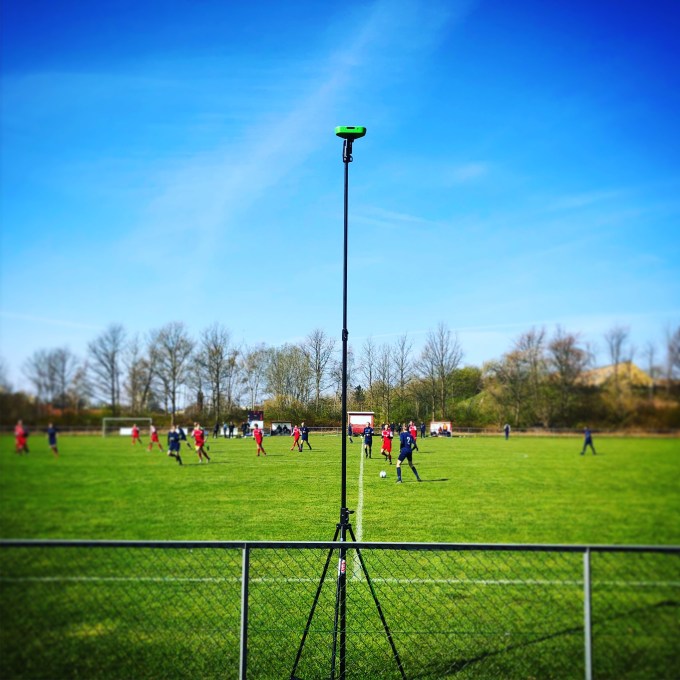
It does this by employing a 4K lens camera that records the entire pitch (it’s designed to be mounted on a 23 foot tripod for optimal view), coupled with its AI video technology that processes the resulting video. This sees Veo follow the action via virtual panning and zooming, to create a TV-like viewing experience.

Veo Måløv

As we’ve noted before, that does mean a portion of the image will often be cropped out, resulting in a loss of resolution overall. However, the idea is that by starting with 4K the video quality is more than sufficient for playback on smaller screens, such as smartphones and tablets.

“Our immediate goal is to establish a foothold for Veo on the U.S. market, and a lot of the investment will go towards achieving that,” Veo CEO Henrik Teisbæk tells TechCrunch with regards to the new funding round. “In the long term, we want to use our U.S. market presence as a stepping stone towards becoming a central player on the global football market, and to hopefully break into other sports”.

Teisbæk says the U.S. was chosen because one of the “biggest and most exciting” soccer markets, and North American soccer players, coaches, clubs and associations are very data driven and open to new technology. “That represents a huge potential for us,” he adds.

Meanwhile, Veo says that in the last year it has seen 25,000 games recorded by 1,000 clubs in 50 countries. The company now employs 35 people in its Copenhagen HQ, where it develops the Veo software and hardware.