Year: 2019

12 Sep 2019

Yelp adds predictive wait times and a new way for restaurants to share updates

With a new feature called Yelp Connect, Yelp is allowing users to go beyond customer reviews and see “what the restaurants have to say for themselves.”

That’s according to Devon Wright, Yelp’s general manager of restaurant marketplaces. He explained that with Yelp Connect, restaurants will be able to post updates about things like recent additions to the menu, happy hour specials and upcoming events. These updates are then shown on the Yelp homepage (which is already becoming more personalized), in a weekly email and on the restaurant’s profile page.

Consumers, meanwhile, can follow restaurants to see these updates, but Yelp also shows them to users who have indicated interest in a restaurant by making a reservation, joining its waitlist or bookmarking its profile.

Of course, restaurants are already posting this kind of information on social media, but Wright said Yelp allows them to reach “a high-intent audience” — people who aren’t just browsing for updates from their friends, but are actually looking to go out for a meal.

Guang Yang, the group product manager for Yelp Reservations and Waitlist, also noted that restaurants can set end dates for their Yelp posts, which could make them more comfortable sharing things like limited-time menus.

Yelp Connect will cost $199 per month for U.S. restaurants, but is available for a limited time at a price of $99 per month.

Wright described this is part of a broader evolution at Yelp, where “you don’t just want to discover a great restaurant, you want to transact [with] that restaurant.” So the company has added things like reservations, with Connect serving as “the final piece of that journey,” allowing restaurants to continue reaching out to consumers after their visit.

Yelp Waitlist Predictive

In addition to launching Connect, Yelp is also announcing an upgrade to its Waitlist feature, which allows consumers to see the current estimated wait time at a restaurant, and to join the queue directly from the Yelp app.

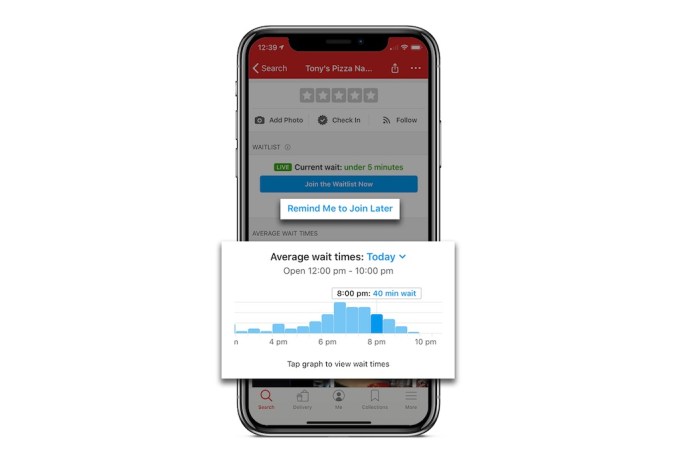
Yang said Yelp can now use real wait time data from a restaurant to predict the average wait at a given time — so if you want to get dinner tonight at 7pm, Yelp can tell how long you’ll probably have to wait. (These estimates are based on a party size of two; you’ll enter your real party size and get an updated estimate when you actually join the waitlist.)

Yelp is also using these predictions to power an additional feature called Notify Me. If you want to get seated a certain restaurant at a certain time, you can hit a button to get a notification that will prompt you to join the waitlist at right time — if you want to eat at 7pm, and the average wait time at 7 is an hour, then you’ll get a notification at 6.

Yang said the algorithm is “pretty sophisticated,” and even incorporates some of the common situations that can confound these estimates, like kitchen closing times, or popular restaurants that have long waitlist as soon as they open.

Still, he acknowledged that there will be times where the actual is different from what’s predicted, which may be challenging when you’ve told all your friends to meet you somewhere at a given time. But in those cases, he said most restaurants “acknowledge and understand, ‘Oh, something happened, wait time changed,'” and they’ll make accommodations if you show up later.

12 Sep 2019

Accel and Sequoia seed Middesk with $4M to background check businesses

For those of you that diligently follow the hot startups to graduate from Y Combinator’s accelerator program, you might recall Middesk.

The company was amongst an exclusive subset of startups in YC’s winter 2019 batch to walk into demo day term sheet in hand. Top VCs, like Accel and Sequoia Capital, couldn’t wait until the team’s public pitch was complete to seed the company.

Middesk performs background checks, but not of people; rather, the startup helps companies identify business and regulatory risk in their customer base. Today, it’s announcing its first round of capital, a $4 million financing led by Accel’s Rich Wong, with participation from Sequoia. Founded by two early employees of another YC graduate, Checkr, which automates the pre-employment background check process for companies, Middesk chief executive officer Kyle Mack and chief technology officer Kurt Ruppel wanted to apply their learnings to a business identity product.

“What we’ve built from the ground up is a product to help companies understand who their customers are and what those customers do for their business,” Mack explains.

Selling a product in a traditional and heavily regulated industry, Mack says having top-tier, established venture funds Accel and Sequoia on board has made a big difference for the company. This is particularly interesting, given the round comes at a time in which competition for early-stage deals is greater than ever. More and more billion-dollar funds, Accel and Sequoia included, are moving downstream to purchase stakes in promising companies as early as possible, beating out seed funds by providing better terms and brand recognition.

Accel was also an early investor in Checkr, which most recently raised a $100 million Series C at a $900 million valuation, and was familiar with the Middesk team prior to the company’s formation: “One of the nice things about this job is if you have a chance to do it right, you can build relationships with people and work with them across multiple companies,” Accel’s Wong tells TechCrunch.

San Francisco-based Middesk is working with customers, including Checkr and Plaid, a well-financed leader in fintech, as well as smaller entrants to the B2B market, like the even more recent YC-grad Vouch, which sells business insurance to startups. Mack says they are particularly focused on payments, lending, payroll, expenses and credit businesses, or those with regulatory risk requirements.

“Effectively anyone that’s touching money that’s a B2B business has regulatory requirements to do what we do,” Mack said. “There is a whole new wave of companies applying consumer-style experiences to business products, but the risks they deal with, they aren’t designed to manage those risks at scale.”

With the infusion of capital, Middesk has grown its team from two to seven, creating engineering and operations teams in the process. In the long term, Mack cites Plaid and its proven ability to rapidly become the go-to tool for connecting applications to consumer bank accounts, as inspiration.

“We talk about this idea of becoming a single source for all the external signals you might want to have about a business,” he said. “Plaid has built a single place to get a host of transaction data of people and businesses. We think about Middesk as a single place to find high-quality and trusted information for a single business.”

12 Sep 2019

Beamery announces platform to help HR recruit and retain talent

Almost every company has a talent problem. It’s hard to find good employees, and once you do, to keep them happy. Today, Beamery announced a fully integrated platform to help solve that problem.

Company co-founder and CEO Abakar Saidov says that while drawing and retaining talent can provide organizations with a key strategic advantage, there has been a dearth of digital tools to help. “What we found was that there is no fundamental kind of operating system or system of record to be able to run that part of the business,” he said.

While there are point solutions for different parts of the process, Beamery recognized an opportunity to deliver a more complete platform. “We essentially built what we’re calling a talent operating system, which encompasses the core primary business objectives of what a company is trying to do with talent,” Saidov explained.

That involves a suite of tools with the three key components around attracting, engaging and retaining talent, which Saidov says lines up in a way like a sales and marketing process. The problem as he sees it, is that the tools available for sales and marketing lack a set of features companies need when it comes to talent.

Each of the three components of the Beamery solution have been designed with helping companies move through the talent workflow process. Attracting involves setting up micro sites for recruiting on the company website that are linked to Beamery along with an event planning tool for setting up something like a campus recruitment day.

The Engage component involves a talent CRM database and marketing tools, while the Retain piece is about helping employees apply for internal jobs and survey tools to get feedback throughout the process.

The solution also involves linking to other enterprise systems, so there is a middleware piece that enables companies to connect to other tools. Saidov said that prior to today’s announcement, the company offered the CRM and middleware pieces, but it recognized all along that it needed a more complete solution. It just took some time and money to develop it.

If you’re wondering how this could work with LinkedIn, he says that it co-exists with it. Just as sales people might find prospects in LinkedIn, then manage the customer relationship in a CRM tool, recruiters can find candidates in LinkedIn and manage the recruitment process in Beamery. (One of the company’s investors includes Microsoft Ventures. Microsoft bought LinkedIn in 2016 for $26.2 billion.)

The company has raised $40 million so far, according to Saidov, and today it has 160 employees based in London with offices in San Francisco and Austen.

12 Sep 2019

Simbe raises a $26M Series A for its retail inventory robot

San Francisco-based robotics startup Simbe just announced a $26 million Series A. The round was led by Venrock and features Future Shape, Valo Ventures and Activant Capital. The company is one of several looking to automate the process of providing retail inventory.

Simbe says the funding will go toward growing its headcount, exploring new markets and accelerating the deployment oof its existing robots. The news also finds Nest’s Tony Fadell, Venrock’s David Pakman and Pathbreaker Venture’s Ryan Gembala joining the startup’s board.

Simbe Data Analytics Corporate

“Our investors, both previous and new, provide much more than financial support. They are advocates and trusted advisors who bring invaluable institutional knowledge to all facets of our business,” cofounder and CEO Brad Bogolea said in a release. “Both our equity financing partners and the SoftBank Robotics team are deeply aligned with Simbe’s vision to revitalize physical retail through data. We are at a pivotal time of growth and value their support as we continue to transform retail at a global scale.”

Simbe has been showcasing its inventory robot Tally since 2015. Soon after Lemnos made an investment in the company. Earlier this year, U.S. supermarket chain Giant Eagle announced plans to begin a pilot program, deploying Tally in select stores. That announcement came a week or so after Walmart announced its own plan to pilot robots from Pittsburgh-based competitor, Bossa Nova.

Simbe Data Analytics Employee

Other retailers using Simbe robots include Schnuck Markets,Decathlon Sporting Goods and Groupe Casino. Along with the Series A, Softbank Robotics is also providing an inventory financing agreement to help scale manufacturing for the company.

12 Sep 2019

SmartDrive snaps up $90M for in-truck video telematics solutions for safety and fuel efficiency

Trucks and other large commercial vehicles and the biggest whales on the road today — are they also, by virtue of that size, some of the most dangerous and inefficient if they are driven badly. Today, a startup that has built a platform aimed at improving both of those areas has raised a large round of funding to continue fuelling (so to speak) its own growth: SmartDrive, a San Diego-based provider of video-based telematics and transportation insights, has snapped up a round of $90 million.

The company is not disclosing its valuation but according to PitchBook, it was last valued (in 2017) at $290 million, which would put the valuation now around $380 million. But given that the company has been growing well — it says that in the first half of this year, its contracted units were up 48%, while sales were up by 44% — that figure may well be higher. (We are asking.)

The funding comes at an interesting time for fleet management and the trucking industry. A lot of the big stories about automotive technology at the moment seem to be focused on autonomous vehicles for private usage, but that leaves a large — and largely legacy — market in the form of fleet management and commercial vehicles. That’s not to say it’s been completely ignored, however. Bigger companies like Uber, Telsa and Volvo, and startups like Nikola and more are all building smarter vehicles, and just yesterday Samsara, which makes an industrial IoT platform that works, in part, to provide fleet management to the trucking industry, raised $300 million on a $6.3 billion valuation.

The telematics market was estimated to be worth $25.5 billion in 2018 and is forecast to grow to some $98 billion by 2026.

The round was led by TPG Sixth Street Partners, a division of investment giant TPG (which backs the likes of Spotify and many others), which earlier this year was raising a $2 billion fund for growth-stage investments. Unnamed existing investors also participated. The company prior to this had raised $230 million, with other backers including Founders Fund, NewView Capital, Oak Investment Partners, Michelin and more. (NEA had also been an investor but has more recently sold its stake.)

SmartDrive has been around since 2005 and focuses on a couple of key areas. Tapping data from the many sensors that you have today in commercial vehicles, it builds up a picture of how specific truckers are handling their vehicles, from their control on tricky roads to what gears and speed they are using as they go up inclines, and how long they idle their engines. The resulting data is used both to provide a better picture to fleet managers of that performance, and to highlight specific areas where the trucker can improve his performance, and how.

Analytics and data provided to customers include multi-camera 360-degree views, extended recording and U-turn triggering, along with diagnostics on specific driver performance. The company claims that the information has led to more satisfaction among drivers and customers, with driver retention rates of 70% or higher and improvements to 9 miles per gallon (mpg) on trips, versus industry averages of 20% driver retention and 6 mpg.

“This is an exciting time at SmartDrive and in the transportation sector overall as adoption of video-based telematics continues to accelerate,” stated Steve Mitgang, SmartDrive CEO, in a statement. “Building on our pioneering video-based safety program, our vision of an open platform powering best-of-breed video, compliance and telematics applications is garnering significant traction across a diverse range of fleets given the benefits of choice, flexibility and a lower total cost of ownership. The investment from TPG Sixth Street Partners and our existing investors will fuel continued innovation in areas such as computer vision and AI, while also enhancing sales and marketing initiatives and further international expansion.”

The focus for SmartDrive seems to be on how drivers are doing in specific circumstances: it doesn’t seem to focus on whether there could have been better routes, or if better fleet management could have resulted in improved performance.

“SmartDrive is a market leader in the large and expanding transportation safety and intelligence sector and we are pleased to be investing in a growing company led by such a talented team,” noted Bo Stanley, partner and co-head of the Capital Solutions business at TPG Sixth Street Partners, in a statement. “SmartDrive’s proprietary data analytics platform and strong subscriber base put it in a great position to continue to capitalize on its track record of innovation and the broader secular trend of higher demand for safer and smarter transportation.”

12 Sep 2019

ckbk pulls a ‘Spotify for recipes’ out of the beta oven

Cooking may be under sustained attack by a wave of on-demand food delivery startups, with names that can double as gluttonous calls to action (oh hey Just Eat!), but that hasn’t stopped London-based startup ckbk from pushing in the opposite direction — with a digital service that offers on-demand access to high quality recipes licensed from major publishers of best selling cookbooks.

Indeed, the ckbk platform serves up not just individual recipes but entire cookbooks for browsing in app form.

The ckbk platform, which launches out of beta today — after a Kickstarter campaign last year that raised just over $55k — is being touted by its creators as ‘Spotify for recipes’. Think ‘playlists’ of professionally programmed dishes to whip up in the kitchen.

At launch it offers access to a catalog of more than 350 cookbooks (80,000+ recipes) — a culinary library that’s slated to keep growing.

For $8.99/£8.99 per month the premium ckbk user gets to tuck in to unlimited access to this “curated collection of cookbooks” — with content selected using “recommendations from hundreds of chefs and food experts including Nigella Lawson and Yotam Ottolenghi”.

A freemium layer offers access gratis to three recipes per month.

Subscribers are essentially paying for someone else with (most likely) superior knowledge of cooking to sort the wheat from the chaff so you don’t have to do the legwork of figuring out what freebie Internet recipes are worth investing your time (and after it, teeth) in.

Not just any old recipes, editorially curated recipes is the ckbk promise.

Content partners at launch include “dozens” of major publishers — including Chronicle Books, Macmillan, Oxford University Press, Rodale, Simon & Schuster, Workman Publishing and Penguin Random House’s Rodale and Struik imprints.

Culinary content available via the platform is billed as spanning both contemporary authors like Molly Yeh and David Tanis, to award winning authorities and Michelin starred chefs, while also dipping into old  culinary classics, such as On Food & Cooking and the Oxford Companion to Food, and offering works penned by legendary French chef and restauranteur Escoffier.

Publishers participating in ckbk’s platform are being promised a new digital revenue stream (it’s not clear what the revenue share is) — sweetened with data in the form of “new insights into patterns of cookbook recipe usage” they can use to feed into future editorial output. So of course all ckbk users are having their foodie browsing extensively data-mined.

To push its ‘premium recipes’ proposition ckbk is trailing a bunch of forthcoming promotional partnerships with kitchenware brands, food-related ecommerce brands, food events, culinary schools and publishing channels — which it says will be launching in the next few months.

It also says recipes on the platform have been optimized for integration with connected kitchen appliances.

European company BSH (whose appliance brands include Bosch, Gaggenau, NEFF and Siemens) is named as the first strategic partner for ckbk. It will be offering premium membership of the service to UK buyers of its NEFF N90 connected oven.

A subset of ‘smart’ cookbook recipes on ckbk will automatically set the correct time and oven temperature via the N90’s Home Connect system — for anyone who can’t be bothered to twiddle the dials themselves.

ckbk adds that selected recipes will be further “optimized” to make the most of features and cooking modes of the smart oven. A tidbit which might make a seasoned chef raise an eyebrow and question whether that’s heading towards recipes for robots.

The licensing project has certainly been a slow burn. The company behind ckbk, 1000 Cookbooks, has been working on getting the concept to market since 2014, per Crunchbase.

It says it’s currently raising a $2M seed funding round — having previously raised a total of $750,000 in pre-seed funding via investors, the Techstars/BSH Future Home accelerator program, and its Kickstarter campaign.

12 Sep 2019

Spotify acquires SoundBetter, a music production marketplace, for an undisclosed sum

Spotify today took another step in its efforts to build out services for artists to help diversify itself away from a business model predicated on paying music streaming royalties to labels: it has acquired SoundBetter, a music production marketplace for artists, producers, and musicians to connect on specific projects; and for people who are looking to distribute music tracks to those who want to license them.

SoundBetter has about 180,000 registered users and has paid out more than $19 million to musicians and producers to date, averaging around $1 million per month currently, itself taking a cut by way of a commission (of an undisclosed percentage) on each deal secured through the platform.

Financial terms of the deal are not being disclosed, meaning it’s unlikely to be a significant sum for the $24 billion streaming giant, which now has 232 million users, including 108 million Spotify Premium subscribers. New York-based SoundBetter had raised an undisclosed amount of funding from investors including 500 Startups, Foundry Group, Eric Ries and Verizon Ventures when it was still called Nautilus under AOL (disclosure: TechCrunch is part of Verizon Media). Its last funding — convertible debt from Drummond Road and others — was back in 2015.

SoundBetter is not being shut down with the acquisition: a spokesperson confirmed to TechCrunch that it will be business as usual as Spotify and the startup work on integrating SoundBetter’s services with Spotify for Artists, which currently offers musicians and others analytics on Spotify tracks and other services to help market themselves.

SoundBetter was founded back in 2012 by Shachar Gilad (CEO) and Itamar Yunger (CTO) and operates two main services. Its main business is an online marketplace for musicians to source singers, sound engineers, producers and other music and audio professionals to put the finishing touches on tracks (think Fiverr or Behance, but specifically for music). In June this year, it launched a newer marketplace called Tracks for people to license finished music, competing with the likes of Epidemic Sound (which earlier this year raised money at a $370 million valuation).

Interestingly, Spotify had tried to launch a direct music distribution platform in the past — including with an investment in DistroKid, a music distribution service that supports cross-platform uploads — but the effort never left the beta phase and was then shut down this past July. That decision possibly make more sense now, since the move might have been made to pave the way for SoundBetter.

Indeed, for Spotify, the deal is a signal that the company is going to continue investing in more behind-the-scenes services for artists and others in the music ecosystem, particularly in building up services that bypass (or at least exist alongside) those of traditional labels, and take some pressure off that side of the business. Last quarter, Spotify faced some criticism (and a drop in its share price) for missing its own targets for subscription growth

“As we build out our tools for creators, we want to give them the resources they need to thrive. SoundBetter has the same vision,” said Beckwith Kloss, VP Product, Creator at Spotify, in a statement.  “We’re excited that creators can generate income through SoundBetter, as well as benefit from its network of top professionals – from instrumentalists to songwriters to producers – as they perfect their tracks.”

Spotify has over the years amassed a growing list of assets that take the platform beyond basic music streaming, with a lot of attention of late focused on spoken word content, providing cloud-based studio services by way of SoundTrap (acquired by Spotify in 2017), and podcast platform Anchor (acquired last year).

But with music continuing to be the beating drum of the platform, Spotify will continue to build up that area of its business, too, not least because competitors like Apple are also continuing to build up its own services for artists that bypass traditional labels. 

SoundBetter already has a decent, if relatively small, business, with its fair share of big names. It claims that “Kanye West’s Producer, Hoobastank’s Drummer, Jamiroquai’s Guitarist, Beyonce’s Songwriter, Joe Cocker’s Bass player, Herbie Hancock’s Engineer, Morrissey’s Guitarist, The Killers’ Mixing Engineer, and George Michael’s Mastering Engineer” are among those using its services. This will give it a big boost in exposure: Spotify for Artists currently has 400,000 registered users, but the platform itself has become a cornerstone of digital music distribution.

SoundBetter offers the most comprehensive global marketplace for music and audio production professionals for hire in the world along with a member community spanning 176 countries and 14,000 cities worldwide,” said SoundBetter Co-Founder and CEO Shachar Gilad. “We are excited to benefit from Spotify’s global scale, resources, and vision to expand our network and drive more economic opportunities for artists of all levels.”

12 Sep 2019

Stock content service Storyblocks evolves with new partner program

Storyblocks, the subscription-based stock audio, imagery and video service formerly known as Videoblocks, today announced the launch of its new Member Library Partner Program. The company has also shuttered its pay-per-download marketplace and is now fully invested in its all-inclusive subscription program.

The reason for this move, the company says, it to better align its offerings with the needs of both its subscribers and contributors. The company also says that less than 5% of its members every purchased anything from the old marketplace.

youtubergirl

With the new program, subscribers get access to a wide range of royalty free stock imagery without restrictions. That, of course, is not all that different from how the company’s program worked before. Unlimited access to the company’s video library starts at $39/month (though you get a 50% discount if you pre-pay for a year). At that price, the service is clearly going after YouTubers and others who need regular access to stock video. Access to its audio and image library is significantly cheaper.

Contributors get paid for every download, sharing in the pool of total revenue Storyblocks gains from its subscribers, and the service provides them with detailed analytics about how their content performs on the platform.

“For contributors, the Partner Program is uniquely designed to prioritize sustainable revenue growth alongside subscription growth: as the market grows, contributor earnings grow,” the company explains.

For now, the company will work with a targeted group of contributors to build the library and will add additional contributors over time. The company agues that this new program will triple contributors’ earnings, but that obviously remains to be seen.

“The Member Library Partner Program puts us in the unique position to provide diverse, high-quality stock media that the mass creative class demands while providing an earnings boost for our contributor community, and allowing them to better share in our success over the long run,” said Storyblocks CEO TJ Leonard. “We believe you cannot pivot an old approach to meet the needs of a new audience, and so we have created a fresh approach to stock media access that reflects the freedom, flexibility and choice required by today’s digital storytellers.”


12 Sep 2019

Walgreens joins Apple Card’s rewards program to offer 3% Daily Cash on purchases

Apple Card’s rewards program, Daily Cash, is expanding today with the addition of Walgreens. The retailer joins Uber and Uber Eats to become the latest merchant to offer 3% Daily Cash to Apple Card customers who use Apple Pay at checkout. This includes purchases made in both Walgreens and Duane Reade retail stores, as well as on the web at walgreens.com, and in the Walgreens mobile app.

Daily Cash is the Apple Card’s big incentive, as it offers a percentage back on every purchase when cardholders pay with Apple Pay, or when they pay with their titanium Apple Card when Apple Pay isn’t available.

Initially, only purchases made directly with Apple — including at Apple Stores, apple.com, the App Store, the iTunes Store and for Apple services — would qualify for the 3% Daily Cash. Apple Pay purchases earned 2% Daily Cash and those made with the physical card earned 1%.

This Daily Cash is paid out with every qualifying purchase and can be used right away for other Apple Pay purchases. It can also be put towards the Apple Card balance or sent to friends and family through iMessage.

But when the Apple Card launched in August to all customers in the U.S., Apple surprised users by expanding its 3% Daily Cash program to more merchants. Uber and Uber Eats were only the first of “many popular merchants” who would join the program in the months ahead, the company said at the time.

For the merchants, participation in the rewards program means better access to Apple’s sizable customer base, and a way to increase customer loyalty with their own businesses. After all, why not shop Walgreens over CVS, when there’s 3% Daily Cash to be had?

Apple hasn’t yet said what other merchants may be joining the program in the future, but an obvious place to look would be at the big list of Apple Pay merchants who accept Apple Pay in their stores already, as Walgreens does.


12 Sep 2019

Loot boxes in games are gambling and should be banned for kids, say UK MPs

UK MPs have called for the government to regulate the games industry’s use of loot boxes under current gambling legislation — urging a blanket ban on the sale of loot boxes to players who are children.

Kids should instead be able to earn in-game credits to unlock look boxes, MPs have suggested in a recommendation that won’t be music to the games industry’s ears.

Loot boxes refer to virtual items in games that can be bought with real-world money and do not reveal their contents in advance. The MPs argue the mechanic should be considered games of chance played for money’s worth and regulated by the UK Gambling Act.

The Department for Digital, Culture, Media and Sport’s (DCMS) parliamentary committee makes the recommendations in a report published today following an enquiry into immersive and addictive technologies that saw it take evidence from a number of tech companies including Fortnite maker Epic Games; Facebook-owned Instagram; and Snapchap.

The committee said it found representatives from the games industry to be “wilfully obtuse” in answering questions about typical patterns of play — data the report emphasizes is necessary for proper understanding of how players are engaging with games — as well as calling out some games and social media company representatives for demonstrating “a lack of honesty and transparency”, leading it to question what the companies have to hide.

“The potential harms outlined in this report can be considered the direct result of the way in which the ‘attention economy’ is driven by the objective of maximising user engagement,” the committee writes in a summary of the report which it says explores “how data-rich immersive technologies are driven by business models that combine people’s data with design practices to have powerful psychological effects”.

As well as trying to pry information about of games companies, MPs also took evidence from gamers during the course of the enquiry.

In one instance the committee heard that a gamer spent up to £1,000 per year on loot box mechanics in Electronic Arts’s Fifa series.

A member of the public also reported that their adult son had built up debts of more than £50,000 through spending on microtransactions in online game RuneScape. The maker of that game, Jagex, told the committee that players “can potentially spend up to £1,000 a week or £5,000 a month”.

In addition to calling for gambling law to be applied to the industry’s lucrative loot box mechanic, the report calls on games makers to face up to responsibilities to protect players from potential harms, saying research into possible negative psychosocial harms has been hampered by the industry’s unwillingness to share play data.

“Data on how long people play games for is essential to understand what normal and healthy — and, conversely, abnormal and potentially unhealthy — engagement with gaming looks like. Games companies collect this information for their own marketing and design purposes; however, in evidence to us, representatives from the games industry were wilfully obtuse in answering our questions about typical patterns of play,” it writes.

“Although the vast majority of people who play games find it a positive experience, the minority who struggle to maintain control over how much they are playing experience serious consequences for them and their loved ones. At present, the games industry has not sufficiently accepted responsibility for either understanding or preventing this harm. Moreover, both policy-making and potential industry interventions are being hindered by a lack of robust evidence, which in part stems from companies’ unwillingness to share data about patterns of play.”

The report recommends the government require games makers share aggregated player data with researchers, with the committee calling for a new regulator to oversee a levy on the industry to fund independent academic research — including into ‘Gaming disorder‘, an addictive condition formally designated by the World Health Organization — and to ensure that “the relevant data is made available from the industry to enable it to be effective”.

“Social media platforms and online games makers are locked in a relentless battle to capture ever more of people’s attention, time and money. Their business models are built on this, but it’s time for them to be more responsible in dealing with the harms these technologies can cause for some users,” said DCMS committee chair, Damian Collins, in a statement.

“Loot boxes are particularly lucrative for games companies but come at a high cost, particularly for problem gamblers, while exposing children to potential harm. Buying a loot box is playing a game of chance and it is high time the gambling laws caught up. We challenge the Government to explain why loot boxes should be exempt from the Gambling Act.

“Gaming contributes to a global industry that generates billions in revenue. It is unacceptable that some companies with millions of users and children among them should be so ill-equipped to talk to us about the potential harm of their products. Gaming disorder based on excessive and addictive game play has been recognised by the World Health Organisation. It’s time for games companies to use the huge quantities of data they gather about their players, to do more to proactively identify vulnerable gamers.”

The committee wants independent research to inform the development of a behavioural design code of practice for online services. “This should be developed within an adequate timeframe to inform the future online harms regulator’s work around ‘designed addiction’ and ‘excessive screen time’,” it writes, citing the government’s plan for a new Internet regulator for online harms.

MPs are also concerned about the lack of robust age verification to keep children off age-restricted platforms and games.

The report identifies inconsistencies in the games industry’s ‘age-ratings’ stemming from self-regulation around the distribution of games (such as online games not being subject to a legally enforceable age-rating system, meaning voluntary ratings are used instead).

“Games companies should not assume that the responsibility to enforce age-ratings applies exclusively to the main delivery platforms: All companies and platforms that are making games available online should uphold the highest standards of enforcing age-ratings,” the committee writes on that.

“Both games companies and the social media platforms need to establish effective age verification tools. They currently do not exist on any of the major platforms which rely on self-certification from children and adults,” Collins adds.

During the enquiry it emerged that the UK government is working with tech companies including Snap to try to devise a centralized system for age verification for online platforms.

A section of the report on Effective Age Verification cites testimony from deputy information commissioner Steve Wood raising concerns about any move towards “wide-spread age verification [by] collecting hard identifiers from people, like scans of passports”.

Wood instead pointed the committee towards technological alternatives, such as age estimation, which he said uses “algorithms running behind the scenes using different types of data linked to the self-declaration of the age to work out whether this person is the age they say they are when they are on the platform”.

Snapchat’s Will Scougal also told the committee that its platform is able to monitor user signals to ensure users are the appropriate age — by tracking behavior and activity; location; and connections between users to flag a user as potentially underage. 

The report also makes a recommendation on deepfake content, with the committee saying that malicious creation and distribution of deepfake videos should be regarded as harmful content.

“The release of content like this could try to influence the outcome of elections and undermine people’s public reputation,” it warns. “Social media platforms should have clear policies in place for the removal of deepfakes. In the UK, the Government should include action against deepfakes as part of the duty of care social media companies should exercise in the interests of their users, as set out in the Online Harms White Paper.”

“Social media firms need to take action against known deepfake films, particularly when they have been designed to distort the appearance of people in an attempt to maliciously damage their public reputation, as was seen with the recent film of the Speaker of the US House of Representatives, Nancy Pelosi,” adds Collins.