Year: 2019

11 Sep 2019

Apple’s HomePod set to gain some long overdue functionality this fall

It’s no secret that the HomePod’s software updates have been a bit sluggish, which made it all the more alarming that the device was barely touched on in yesterday’s Apple event.

Well, even as pre-launch promises are still getting ironed out, by the fall Apple says that its home smart speaker will be gaining new functionality including multi-user support, live radio and a relaxing “ambient sounds” mode, according to an updated product page on the company’s website. Some of this functionality was detailed at Apple’s June services event.

Multi-user support is “coming this fall” assumedly after the release of iOS13. This is one of the most egregious missing features from the device at the moment, something both Alexa and Google Home devices have pushed forward more quickly on.

The product page for the HomePod details that multi-user voice recognition will allow the device to recognize up to six individual voices. This feature will allow users to ask the device to play music catered to their interests while also asking the device to carry out commands related to personal data like recent iMessages or upcoming meetings.

The live radio features is part of iOS13’s functionality and will be arriving at the end of the month with support for iHeartRadio, Radio.com, and TuneIn. More than 100,000 radio stations will be available to users who ask Siri to pop on a station.

Alongside the new radio stations, in the fall Apple will be adding a relaxing Ambient Sounds mode “featuring the soothing sounds of ocean waves, forest birds, rainstorms, and more.”

Apple hasn’t proven the HomePod to be all that capable in meeting consumer-facing software update deadlines so we’ll see how that goes, but they’re saying all of these features will arrive by fall.

11 Sep 2019

Daily Crunch: Apple unveils new iPhones

The Daily Crunch is TechCrunch’s roundup of our biggest and most important stories. If you’d like to get this delivered to your inbox every day at around 9am Pacific, you can subscribe here.

1. Here’s everything Apple announced today at the iPhone 11 event

The biggest announcement was a new lineup of iPhones, including the iPhone 11, with a new dual-camera system, as well as two iPhone Pro models with three cameras each. Cameras galore!

In addition, the company announced new iPads and Apple Watches, as well as pricing and launch dates for Apple Arcade (launching September 19) and Apple TV+ (November 1).

2. California passes landmark bill that requires Uber and Lyft to treat their drivers as employees

The bill says that if a contractor’s work is part of a company’s regular business, then they must be designated as employees. And thus, these workers will get access to more protections such as minimum wage, the right to unionize and overtime.

3. Peloton plots $1.2B Nasdaq IPO

In an amended S-1 filing released Tuesday afternoon, the developer of internet-connected stationary bikes and treadmills announced a proposed price range of $26 to $29 per share, allowing the company to raise as much as $1.2 billion in its public offering.

4. Uber lays off 435 people across engineering and product teams

Speaking of Uber, the company laid off about 8% of the workforce, with 170 people leaving the product team and 265 people leaving the engineering team.

5. Mozilla launches a VPN, brings back the Firefox Test Pilot program

The Test Pilot program allows users to try out new features before they are ready for mainstream usage.

6. Aerospace Corp CEO Steve Isakowitz to talk how to raise non-dilutive capital at Disrupt SF

Aerospace Corp is not that widely known outside space circles, but its 59-year-old R&D legacy is remarkable. The nonprofit works with the U.S. Air Force and other government space programs to identify emerging technologies from the commercial sector that could apply to future space programs.

7. What the iPhone 11 says about Apple’s present — and future

Let’s wrap this up with some thoughts on what yesterday’s announcements mean for Apple’s strategy — particularly the company’s growing focus on content and services, and its new thinking on how to position the iPhone. (Extra Crunch membership required.)

11 Sep 2019

The weird things after closing a venture round, iPhone 11, AI ad errors, and Cloud Foundry

Annual Extra Crunch members get 100,000 Brex Rewards points upon credit card signup

We’re excited to announce an addition to the Extra Crunch community perks. Starting today, annual Extra Crunch members can get 100,000 Brex Rewards points after signing up for a Brex corporate credit card. This offer is worth about $1,000 in credit card points.

Brex’s corporate credit card is designed for startups, and Extra Crunch was built for the startup ecosystem. We understand that startups are trying to be as frugal as possible with spending, and we felt that the Brex corporate credit card was the perfect way to stretch those valuable dollars.

Brex gives startup founders and finance teams higher credit limits than what they would get with any other business credit card option, and it does so without requiring a personal credit check or security deposit during the application. There are some impressive reward multipliers across categories like rideshare, travel, and restaurants. It also comes with $50,000 worth of partner offers from AWS, Salesforce and many more.

Learn more here.

All the weird stuff that happens to you after you close your round

There is nothing like the excitement of closing a venture round, but what happens immediately after the money hits the bank? Well, apparently, nothing really good: a deluge of scams, requests, appointments, and more from every professional service and fly-by-night operation imaginable.

Matt Rodak, the founder and CEO of FundThatFlip, compiled the emails and other messages he got after closing his $11 million Series A financing, offering us a peek inside the world of a post-close founder:

11 Sep 2019

Despite Brexit, UK startups can compete with Silicon Valley to win tech talent

Brexit has taken over discourse in the UK and beyond. In the UK alone, it is mentioned over 500 million times a day, in 92 million conversations — and for good reason. While the UK has yet to leave the EU, the impact of Brexit has already rippled through industries all over the world. The UK’s technology sector is no exception. While innovation endures in the midst of Brexit, data reveals that innovative companies are losing the ability to attract people from all over the world and are suffering from a substantial talent leak. 

It is no secret that the UK was already experiencing a talent shortage, even without the added pressure created by today’s political landscape. Technology is developing rapidly and demand for tech workers continues to outpace supply, creating a fiercely competitive hiring landscape.

The shortage of available tech talent has already created a deficit that could cost the UK £141 billion in GDP growth by 2028, stifling innovation. Now, with Brexit threatening the UK’s cosmopolitan tech landscape — and the economy at large — we may soon see international tech talent moving elsewhere; in fact, 60% of London businesses think they’ll lose access to tech talent once the UK leaves the EU.

So, how can UK-based companies proactively attract and retain top tech talent to prevent a Brexit brain drain? UK businesses must ensure that their hiring funnels are a top priority and focus on understanding what matters most to tech talent beyond salary, so that they don’t lose out to US tech hubs. 

Brexit aside, why is San Francisco more appealing than the UK?

11 Sep 2019

Theresia Gouw and Ann Miura-Ko are coming to Disrupt

For a very long time, the venture industry was stubbornly resistant to change. The same people sat back in their chairs on Sand Hill Road while nervous founders made the rounds, hoping one of these firms would champion their cause.

No longer. Since roughly the advent of Y Combinator, the landscape has seemed to shift by the year, with more startups raising capital every year, more people becoming VCs, more Medium posts, more newsletters, more events, more great founders, more bad behavior, more congestion, and more money from all over the world finding its way to Silicon Valley and a growing number of smaller but fast-growing hubs.

How to make sense of it all? At Disrupt, we do our best to answer that question by sitting down each year with top venture capitalists who tell us what they are seeing. In 2015, for example, we talked with VCs about why you can start, but not always scale, a company from anywhere. In 2016, the discussion turned to why VCs were gathering up so much capital when the IPO market was (at the time) all but closed to new tech issuers. In 2017, we examined how then-new U.S. President Donald Trump might impact the venture and startup industry. By last year, we were talking about Softbank, mega rounds, and whether Silicon Valley is losing its gravitational pull.

This year, we’re again going to be taking stock of what trends have so far defined 2019, and what may be around the corner, and we’re thrilled to announce the VCs who will help us to answer some of these questions: Ann Miura-Ko, a cofounder of the seed- and early-stage venture firm Floodgate, and Theresia Gouw, a cofounder of the early-stage venture firm Aspect Ventures.

Both of these longtime investors bring a lot of deep insights to any venture discussion. Miura-Ko has been in the industry since before the last major tech boom, starting in the late ’90s. Then a McKinsey analyst who was focused on wireless technologies, she went on to become an analyst at the venture firm CRV before cofounding with partner Mike Maples the venture firm Floodgate in 2008. Since joining forces, Floodgate has backed a long list of powerful companies, including Twitch, Sonos, Chegg, AdRoll, BazaarVoice, and Lyft, where Miura-Ko remains on the board of directors. She has seen plenty of ups and downs, within both Floodgate’s portfolio and the broader startup industry.

Gouw, meanwhile, also has a perspective on the industry that many newer investors don’t enjoy, having worked as a VP at a Bay Area startup during the dot.com run-up, then joining the venture firm Accel in 1999, just a year before the industry imploded. It could have been a short-lived stint. Instead, she helping the firm sift through the wreckage and right itself before leaving in 2014 to start her own firm — Aspect —  with partner and former DFJ partner Jennifer Fonstad. Since then, the firm has backed a wide variety of companies, from The RealReal to Exabeam, HotelTonight to Forescout. Put another way, Gouw also knows what the deal is.

We can’t wait to sit down with both of these top investors to talk about the trends shaping the industry right now, from the growing secondary market to IPO trends, from what excites them the most to what their biggest concerns are for their firms and their portfolio companies as we sail toward 2020.

It’s a conversation you will not want to miss if you want a better understanding of what’s happening on the ground right now. Join us at Disrupt SF, which runs October 2 to 4 at the Moscone Center. Tickets are available here.

11 Sep 2019

AirDrop gets an upgrade in iOS 11

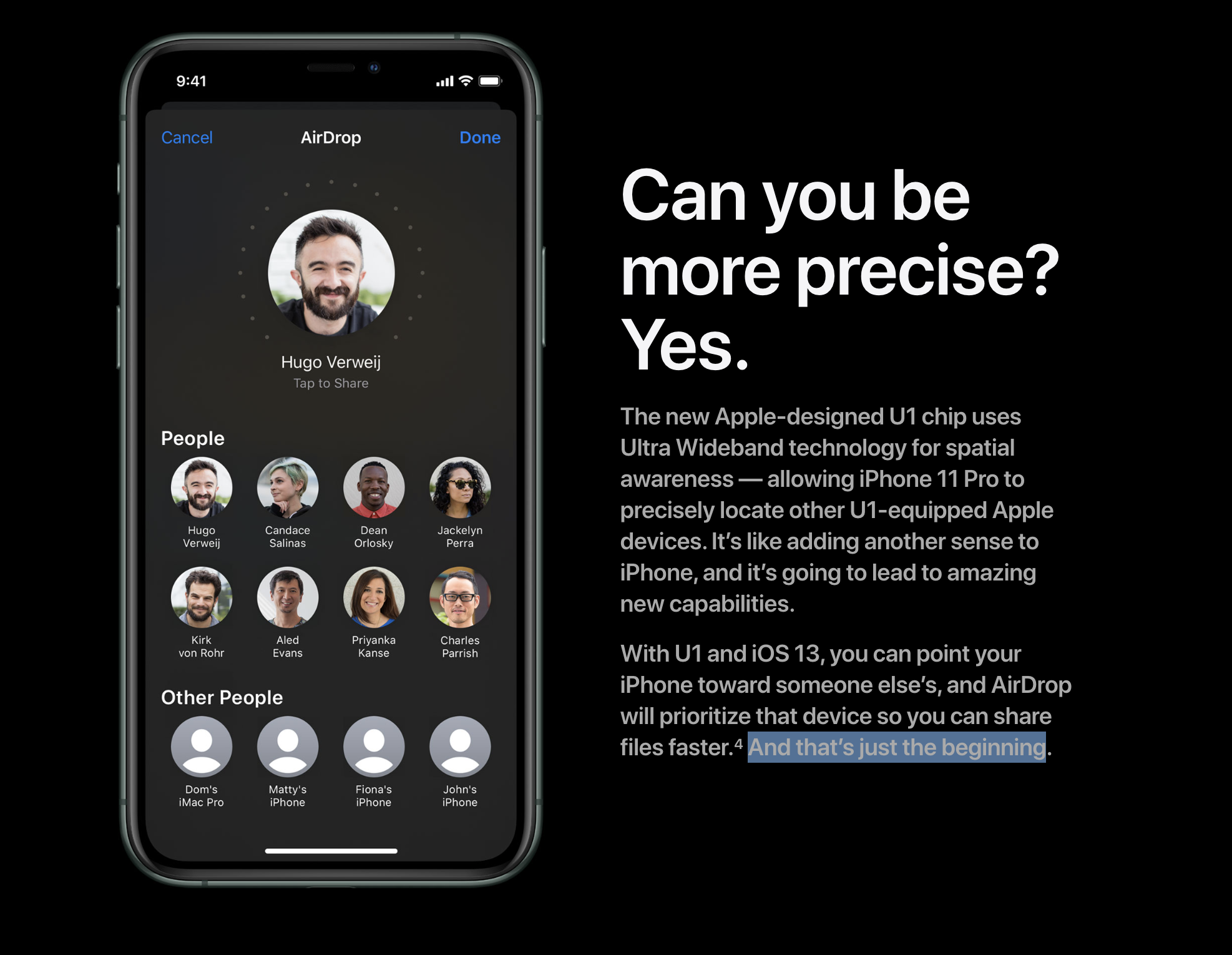
AirDrop, Apple’s proximity-based, built-in file sharing feature and home to teen meme exchanges, is getting an upgrade with the new iPhones. At Apple’s iPhone press event on Tuesday, the company introduced the iPhone 11 line of devices, which include a new Apple -designed U1 chip that uses Ultra Wideband technology for spatial awareness. This will offer a number of improvements to the iPhone’s capability, but Apple is starting with upgraded AirDrop functionality as a more practical use case.

With the U1 chip and iOS 13, you’ll be able to point your iPhone towards someone else’s and AirDrop will prioritize that device in the list of possible AirDrop recipients. This will help to speed up the AirDrop process, which today can still be uncumbersome at times — especially at places where there are a lot of people gathered, like a concert or business convention, for example.

Screen Shot 2019 09 11 at 11.22.22 AM

The additional capability was first spotted by MacRumors in the updates to Apple’s website that rolled out after the iPhone event.

What’s particularly interesting about the U1’s ultra wideband technology is that it’s also what’s rumored to power the forthcoming Apple Tag devices, which were not announced at yesterday’s event.

Apple Tag, it’s been reported, will be a competitor to the lost item tracker Tile which allows you to attach a small tag to items you need to keep up with — like your keys, wallet or bag, for example. Tile leverages Bluetooth and a crowdsourced network of Tile owners running its app on their device to help find missing items. Apple Tag is said to work similarly, via Apple’s Find My app, but will also feature ultra wideband tech.

More recently, references to Apple’s Tile competitor were also spotted in iOS 13 code by MacRumors.

Though Apple didn’t make any announcements about the product, it does seem to hint on the website that AirDrop upgrades are only the first of many enhancements that will come about thanks to the U1 chip, by saying: “And that’s just the beginning.” 

Presumably, whatever that statement is actually referring to will be released further down the road, perhaps as soon as its next big press event.


11 Sep 2019

iFixit gives Fairphone 3 a perfect 10 for repairability

Here’s something the hermetically sealed iPhone can’t do: Score a perfect 10 for repairability.

Smartphone startup and social enterprise Fairphone’s latest repairable-by-design smartphone has done just that, getting 10/10 in an iFixit Teardown vs scores of just 6/10 for recent iPhone models.

The Fairphone 3, which was released in Europe last week with an RRP of €450, gets thumbs up across the board in iFixit’s hardware Teardown. It found all the internal modules to be easily accessible and replaceable — with only basic tools required to get at them (Fairphone includes a teeny screwdriver in the box). iFixit also lauds visual cues that help with disassembly and reassembly, and notes that repair guides and spare parts are available on Fairphone’s website.

iFixit’s sole quibble is that while most of the components inside the Fairphone 3’s modules are individually replaceable “some” are soldered on. A tiny blip that doesn’t detract from the 10/10 repairability score

Safe to say, such a score is the smartphone exception. The industry continues to encourage buyers to replace an entire device, via yearly upgrade, instead of enabling them to carry out minor repairs themselves — so they can extend the lifespan of their device and thereby shrink environmental impact.

Dutch startup Fairphone was set up to respond to the abject lack of sustainability in the electronics industry. The tiny company has been pioneering modularity for repairability for several years now, flying in the face of smartphone giants that are still routinely pumping out sealed tablets of metal and glass which often don’t even let buyers get at the battery to replace it themselves.

To wit: An iFixit Teardown of the Google Pixel rates battery replacement as “difficult” with a full 20 steps and between 1-2 hours required. (Whereas the Fairphone 3 battery can be accessed in seconds, by putting a fingernail under the plastic back plate to pop it off and lifting the battery out.)

The Fairphone 3 goes much further than offering a removable backplate for getting at the battery, though. The entire device has been designed so that its components are accessible and repairable.

So it’s not surprising to see it score a perfect 10 (the startup’s first modular device, Fairphone 2, was also scored 10/10 by iFixit). But it is strong, continued external validation for the Fairphone’s designed-for-repairability claim.

It’s an odd situation in many respects. In years past replacement batteries were the norm for smartphones, before the cult of slimming touchscreen slabs arrived to glue phone innards together. Largely a consequence of hardware business models geared towards profiting from pushing for clockwork yearly upgrades cycle — and slimmer hardware is one way to get buyers coveting your next device.

But it’s getting harder and harder to flog the same old hardware horse because smartphones have got so similarly powerful and capable there’s precious little room for substantial annual enhancements.

Hence iPhone maker Apple’s increasing focus on services. A shift that’s sadly not been accompanied by a rethink of Cupertino’s baked in hostility towards hardware repairability. (It still prefers, for example, to encourage iPhone owners to trade in their device for a full upgrade.)

At Apple’s 2019 new product announcement event yesterday — where the company took the wraps off another clutch of user-sealed smartphones (aka: iPhone 11 and iPhone 11 Pro) — there was even a new financing offer to encourage iPhone users to trade in their old models and grab the new ones. ‘Look, we’re making it more affordable to upgrade!’ was the message.

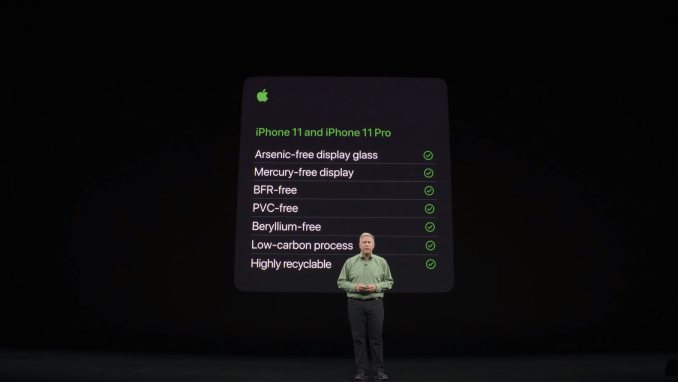
Meanwhile, the only attention paid to sustainability — during some 1.5 hours of keynotes — was a slide which passed briefly behind marketing chief Phil Schiller towards the end of his turn on stage puffing up the iPhone updates, encouraging him to pause for thought.
Apple 2019 event

“iPhone 11 Pro and iPhone 11 are made to be designed free from these harmful materials and of course to reduce their impact on the environment,” he said in front of a list of some toxic materials that are definitely not in the iPhones.

Stuck at the bottom of this list were a couple of detail-free claims that the iPhones are produced via a “low-carbon process” and are “highly recyclable”. (The latter presumably a reference to how Apple handles full device trade-ins. But as anyone who knows about sustainability will tell you, sustained use is far preferable to premature recycling…)

“This is so important to us. That’s why I bring it up every time. I want to keep pushing the boundaries of this,” Schiller added, before pressing the clicker to move on to the next piece of marketing fodder. Blink and you’d have missed it.

If Apple truly wants to push the boundaries on sustainability — and not just pay glossy lip-service to reducing environmental impact for marketing purposes while simultaneously encouraging annual upgrades — it has a very long way to go indeed.

As for repairability, the latest and greatest iPhones clearly won’t hold a candle to the Fairphone.


11 Sep 2019

Google Express to close in a few weeks, will become part of Google Shopping

Google’s failed online shopping service Google Express is closing in a few weeks, as its features will be merged into a revamped version of Google Shopping, Google says in an email sent to its customers this week. The company had already announced its plans to shutter the Google Express brand, as part of a wider redesign of how it approached online shopping. This included new advertising options for brands and online sellers, as well as a universal shopping cart across its platform of services, like Search, Shopping, Images, and even YouTube.

While Google is characterizing Google Express’s closure as an “integration,” it’s really more of a sunsetting of a failed product and brand.

Google Express was Google’s high-profile attempt to compete with Amazon for online shopping clicks and ad dollars buy creating a virtual mall on the web filled with top retailers’ products. Because Google is not a retailer itself, it did what it knows best — it organized information. At Google Express, you could find products from thousands of retailers — including big names like Walmart, Target, Walgreens, Best Buy, and others. And you could shop through a dedicated online storefront on the web, a Google Express mobile app, or even Google Assistant.

In the latter case, Google Express partnered with retailers like Walmart and Target for deep integrations for voice-enabled shopping. As direct competitors with Amazon, these retailers didn’t want to offer third-party skills for Echo users or others on Amazon’s Alexa platform. Google represented a safer third-party platform for their experiments with voice commands and personalized shopping.

But even several years after launch, Google Express had failed to offer any real threat to Amazon. Its retail partners, meanwhile, were building out their own fulfillment businesses for their customers’ online orders — like Walmart Grocery’s curbside pickup and delivery, for example, or Target’s Shipt, Drive Up, and Restock.

Not too much later, Target and Walmart were pulling out of Google Express.

Google has tried to downplay the news of Google Express’s demise by including it as just another part to the larger Google Shopping revamp. After all, it’s not a shutdown, the company implied. Its features were simply becoming a part of Google Shopping! Nothing to see here! Just a rebrand!

But clearly, Google Express had been unable to establish itself in consumers’ minds as its own dedicated shopping destination. If customers wanted an online mall, they already had one with either Amazon or Walmart and their vast third-party marketplaces where you could find just about anything you’d need. Nor had Google innovated (or acquired) across key areas like warehousing or logistics, while others like Amazon, Target and Walmart had been spending billions.

With Google Shopping, Google goes back to its search engine roots. It aims to simply capture consumers’ clicks, ad dollars and now conversions no matter where they are on Google’s sites — whether that’s shopping from Merch shelves under YouTube videos, browsing photos in a Pinterest-y manner on Google Images, or through more traditional Google searches for products where ads become shoppable, and shopping carts follow you around Google’s part of the web.

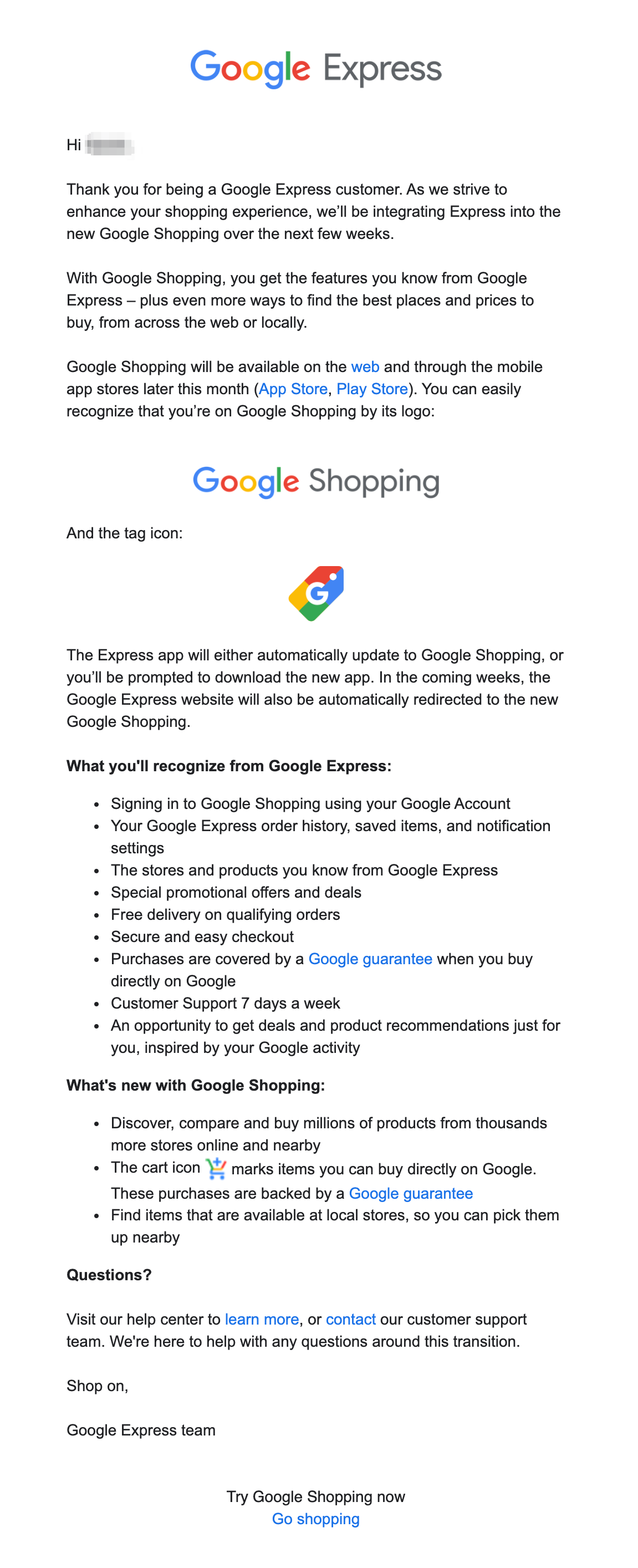
In an email to Google Express shoppers that was sent this week, Google says Google Express will be integrated with Shopping in a few weeks’ time.

The redesigned Google Shopping will then be available across the web and through apps for iOS and Android later this month. At that point, the Google Express apps will automatically update to become Google Shopping, if you already had them installed.

The full email about Google Express’ closure is below:

google express shutdown


11 Sep 2019

Google Express to close in a few weeks, will become part of Google Shopping

Google’s failed online shopping service Google Express is closing in a few weeks, as its features will be merged into a revamped version of Google Shopping, Google says in an email sent to its customers this week. The company had already announced its plans to shutter the Google Express brand, as part of a wider redesign of how it approached online shopping. This included new advertising options for brands and online sellers, as well as a universal shopping cart across its platform of services, like Search, Shopping, Images, and even YouTube.

While Google is characterizing Google Express’s closure as an “integration,” it’s really more of a sunsetting of a failed product and brand.

Google Express was Google’s high-profile attempt to compete with Amazon for online shopping clicks and ad dollars buy creating a virtual mall on the web filled with top retailers’ products. Because Google is not a retailer itself, it did what it knows best — it organized information. At Google Express, you could find products from thousands of retailers — including big names like Walmart, Target, Walgreens, Best Buy, and others. And you could shop through a dedicated online storefront on the web, a Google Express mobile app, or even Google Assistant.

In the latter case, Google Express partnered with retailers like Walmart and Target for deep integrations for voice-enabled shopping. As direct competitors with Amazon, these retailers didn’t want to offer third-party skills for Echo users or others on Amazon’s Alexa platform. Google represented a safer third-party platform for their experiments with voice commands and personalized shopping.

But even several years after launch, Google Express had failed to offer any real threat to Amazon. Its retail partners, meanwhile, were building out their own fulfillment businesses for their customers’ online orders — like Walmart Grocery’s curbside pickup and delivery, for example, or Target’s Shipt, Drive Up, and Restock.

Not too much later, Target and Walmart were pulling out of Google Express.

Google has tried to downplay the news of Google Express’s demise by including it as just another part to the larger Google Shopping revamp. After all, it’s not a shutdown, the company implied. Its features were simply becoming a part of Google Shopping! Nothing to see here! Just a rebrand!

But clearly, Google Express had been unable to establish itself in consumers’ minds as its own dedicated shopping destination. If customers wanted an online mall, they already had one with either Amazon or Walmart and their vast third-party marketplaces where you could find just about anything you’d need. Nor had Google innovated (or acquired) across key areas like warehousing or logistics, while others like Amazon, Target and Walmart had been spending billions.

With Google Shopping, Google goes back to its search engine roots. It aims to simply capture consumers’ clicks, ad dollars and now conversions no matter where they are on Google’s sites — whether that’s shopping from Merch shelves under YouTube videos, browsing photos in a Pinterest-y manner on Google Images, or through more traditional Google searches for products where ads become shoppable, and shopping carts follow you around Google’s part of the web.

In an email to Google Express shoppers that was sent this week, Google says Google Express will be integrated with Shopping in a few weeks’ time.

The redesigned Google Shopping will then be available across the web and through apps for iOS and Android later this month. At that point, the Google Express apps will automatically update to become Google Shopping, if you already had them installed.

The full email about Google Express’ closure is below:

google express shutdown


11 Sep 2019

Kubernetes co-founder Craig McLuckie is as tired of talking about Kubernetes as you are

“I’m so tired of talking about Kubernetes . I want to talk about something else,” joked Kubernetes co-founder and VP of R&D at VMware Craig McLuckie during a keynote interview at this week’s Cloud Foundry Summit in The Hague. “I feel like that 80s band that had like one hit song — Cherry Pie.”

He doesn’t quite mean it that way, of course (though it makes for a good headline, see above), but the underlying theme of the conversation he had with Cloud Foundry executive director Abby Kearns was that infrastructure should be boring and fade into the background, while enabling developers to do their best work. “We still have a lot of work to do as an industry to make the infrastructure technology fade into the background and bring forwards the technologies that developers interface with, that enable them to develop the code that drives the business, etc. […] Let’s make that infrastructure technology really, really boring. ”

IMG 20190911 115940

What McCluckie wants to talk about is developer experience and with VMware’s intend to acquire Pivotal, it’s placing a strong bet on Cloud Foundry as one of the premiere development platforms for cloud native applications. For the longest time, the Cloud Foundry and Kubernetes ecosystem, which both share an organizational parent in the Linux Foundation, have been getting closer, but that move has accelerated in recent months as the Cloud Foundry ecosystem has finished work on some of its Kubernetes integrations.

McLuckie argues that the Cloud Native Computing Foundation, the home of Kubernetes and other cloud-native open-source projects, was always meant to be a kind of open-ended organization that focuses on driving innovation. And that created a large set of technologies that vendors can choose from. “But when you start to assemble that, I tend to think about you building up this cake which is your development stack, you discover that some of those layers of the cake, like Kubernetes, have a really good bake. They are done to perfection,” said McLuckie, who is clearly a fan of the Great British Baking show. “And other layers, you look at it and you think, wow, that could use a little more bake, it’s not quite ready yet. […] And we haven’t done a great job of pulling it all together and providing a recipe that delivers an entirely consumable experience for everyday developers.”

EEK3PG1W4AAaasp

He argues that Cloud Foundry, on the other hand, has always focused on building that highly opinionated, consistent developer experience. “Bringing those two communities together, I think, is going to have incredibly powerful results for both communities as we start to bring these technologies together,” he said.

With the Pivotal acquisition still in the works, McLuckie didn’t really comment on what exactly this means for the path forward for Cloud Foundry and Kubernetes (which he still talked about with a lot of energy, despite being tired of it), but it’s clear that he’s looking to Cloud Foundry to enable that developer experience on top of Kubernetes that abstracts all of the infrastructure away for developers and makes deploying an application a matter of a single CLI command.

Bonus: Cherry Pie.