Year: 2019

11 Sep 2019

Explorium reveals $19.1M in total funding for machine learning data discovery platform

Explorium, a data discovery platform for machine learning models, received a couple of unannounced funding rounds over the last year — a $3.6 million seed round last September and a $15.5 million Series A round in March. Today, it made both of these rounds public.

The seed round was led by Emerge with participation of F2 Capital. The Series A was led by Zeev Ventures with participation from the seed investors. The total raised is $19.1 million.

The company founders, who have a data science background, found that it was problematic to find the right data to build a machine learning model. Like most good startup founders confronted with a problem, they decided to solve it themselves by building a data discovery platform for data scientists.

CEO and co-founder, Maor Shlomo says that the company wanted to focus on the quality of the data because not much work has been done there. “A lot of work has been invested on the algorithmic part of machine learning, but the algorithms themselves have very much become commodities. The challenge now is really finding the right data to feed into those algorithms,” Sholmo told TechCrunch.

It’s a hard problem to solve, so they built a kind of search engine that can go out and find the best data wherever it happens to live, whether it’s internally or in an open data set, public data or premium databases. The company has partnered with thousands of data sources, according to Schlomo, to help data scientist customers find the best data for their particular model.

“We developed a new type of search engine that’s capable of looking at the customers data, connecting and enriching it with literally thousands of data sources, while automatically selecting what are the best pieces of data, and what are the best variables or features, which could actually generate the best performing machine learning model,” he explained.

Shlomo sees a big role for partnerships, whether that involves data sources or consulting firms, who can help push Explorium into more companies.

Explorium has 63 employees spread across offices in Tel Aviv, Kiev and San Francisco. It’s still early days, but Sholmo reports “tens of customers.” As more customers try to bring data science to their companies, especially with a shortage of data scientists, having a tool like Explorium could help fill that gap.

11 Sep 2019

Web feature developers told to dial up attention on privacy and security

Web feature developers are being warned to step up attention to privacy and security as they design contributions.

Writing in a blog post about “evolving threats” to Internet users’ privacy and security, the W3C standards body’s technical architecture group (TAG) and Privacy Interest Group (PING) set out a series of revisions to the W3C’s Security and Privacy Questionnaire for web feature developers.

The questionnaire itself is not new. But the latest updates place greater emphasis on the need for contributors to assess and mitigate privacy impacts, with developers warned that “features may not be implemented if risks are found impossible or unsatisfactorily mitigated”.

In the blog post, independent researcher Lukasz Olejnik, currently serving as an invited expert at the W3C TAG; and Apple’s Jason Novak, representing the PING, write that the intent with the update is to make it “clear that feature developers should consider security and privacy early in the feature’s lifecycle” [emphasis theirs].

“The TAG will be carefully considering the security and privacy of a feature in their design reviews,” they further warn, adding: “A security and privacy considerations section of a specification is more than answers to the questionnaire.”

The revisions to the questionnaire include updates to the threat model and specific threats a specification author should consider — including a new high level type of threat dubbed “legitimate misuse“, where the document stipulates that: “When designing a specification with security and privacy in mind, all both use and misuse cases should be in scope.”

“Including this threat into the Security and Privacy Questionnaire is meant to highlight that just because a feature is possible does not mean that the feature should necessarily be developed, particularly if the benefitting audience is outnumbered by the adversely impacted audience, especially in the long term,” they write. “As a result, one mitigation for the privacy impact of a feature is for a user agent to drop the feature (or not implement it).”

Features should be secure and private by default and issues mitigated in their design,” they further emphasize. “User agents should not be afraid of undermining their users’ privacy by implementing new web standards or need to resort to breaking specifications in implementation to preserve user privacy.”

The pair also urge specification authors to avoid blanket treatment of first and third parties, suggesting: “Specification authors may want to consider first and third parties separately in their feature to protect user security and privacy.”

The revisions to the questionnaire come at a time when browser makers are dialling up their response to privacy threats — encouraged by rising public awareness of the risks posed by data leaks, as well as increased regulatory action on data protection.

Last month the open source WebKit browser engine (which underpins Apple’s Safari browser) announced a new tracking prevention policy that takes the strictest line yet on background and cross-site tracking, saying it would treat attempts to circumvent the policy as akin to hacking — essentially putting privacy protection on a par with security.

Earlier this month Mozilla also pushed out an update to its Firefox browser that enables an anti-tracking cookie feature across the board, for existing users too — demoting third party cookies to default junk.

Even Google’s Chrome browser has made some tentative steps towards enhancing privacy — announcing changes to how it handles cookies earlier this year. Though the adtech giant has studiously avoided flipping on privacy by default in Chrome where third party tracking cookies are concerned, leading to accusations that the move is mostly privacy-washing.

More recently Google announced a long term plan to involve its Chromium browser engine in developing a new open standard for privacy — sparking concerns it’s trying to both kick the can on privacy protection and muddy the waters by shaping and pushing self-interested definitions which align with its core data-mining business interests.

There’s more activity to consider too. Earlier this year another data-mining adtech giant, Facebook, made its first major API contribution to Google’s Chrome browser — which it also brought to the W3C Performance Working Group.

Facebook does not have its own browser, of course. Which means that authoring contributions to web technologies offers the company an alternative conduit to try to influence Internet architecture in its favor.

The W3C TAG’s latest move to focus minds on privacy and security by default is timely.

It chimes with a wider industry shift towards pro-actively defending user data, and should rule out any rubberstamping of tech giants contributions to Internet architecture which is obviously a good thing. Scrutiny remains the best defence against self-interest.

11 Sep 2019

Kenshō, ‘the antithesis of Goop,’ launches a research-based guide to natural medicine

Goop is cashing in on pseudoscience and, in the process, giving natural health practices a bad name. Krista Berlincourt, the co-founder and chief executive officer of a new startup, Kenshō Health, hopes she can take back the narrative.

“We’re the antithesis of Goop,” Berlincourt, a fintech veteran who previously led marketing and product at Simple Finance, tells TechCrunch. “What we are creating is less of a consumer magazine. We are a holistic health platform that approaches things as more of a holistic health medical journal — everything is backed by science.”

Kenshō, launching today, is an invite-only subscription-based platform for holistic healthcare providers to list their services and share knowledge. The startup has also collected information to construct a research-backed guide to holistic health, something the team believes has been missing from the natural health sector.

Berlincourt and Kenshō co-founder Danny Steiner, who previously worked at NBC Universal, Conde Nast and Hulu before pivoting to health and wellness, have raised $1.3 million in seed funding from Crosscut, a Los Angeles-based venture capital firm, and Female Founders Fund. The pair, based in the LA area, have both suffered from chronic illnesses that had them in and out of doctor’s offices for years.

“I had two years of working with a team of incredible Western physicians and then I had a crash that landed me in the ER. That’s when I realized, OK, this isn’t working,” Berlincourt said. “When you’re caring for yourself or someone you love, there are standards. I am focused on elevating and creating those standards in a way that can be better advised.”

The global wellness economy represented a $4.2 trillion market in 2017, according to The Global Wellness Institute, as subcategories like personalized medicine, healthy eating and fitness/mind-body accelerate growth.

Kenshō, nestled in the personalized and complementary medicine category, says it ensures all of the care providers featured on its platform are 100% validated. Before being allowed to list their services, providers complete a background check and their provider credentials are verified. Kenshō then affirms the providers use research-backed methods and that they have vetted peer references and clients who can provide positive feedback.

Kenshō’s launch features providers from Stanford University, Harvard University, Columbia University and more.

“When you look at health as a whole today in the U.S., we only treat the physical,” Berlincourt explains. “The reason that is destructive is 70% of death is premature and lifestyle related. We are dying faster and people are dying more quickly, generally speaking, as the world turns.”

Many, of course, are skeptical of natural care practices because they can be untested or dependent on unscientific principles. Additionally, holistic care often forces patients to pay out-of-pocket. Nonetheless, patients across the globe are turning to non-traditional methods.

”There’s been a massive shift in the zeitgeist in the way people look at health,” she adds. “One in three people have paid for supplemental care out of pocket from a holistic health provider.”

11 Sep 2019

ScyllaDB takes on Amazon with new DynamoDB migration tool

There are a lot of open source databases out there, and ScyllaDB, a NoSQL variety, is looking to differentiate itself by attracting none other than Amazon users. Today, it announced a DynamoDB migration tool to help Amazon customers move to its product.

It’s a bold move, but Scylla, which has a free open source product along with paid versions, has always had a penchant for going after bigger players. It has had a tool to help move Cassandra users to ScyllaDB for some time.

CEO Dor Laor says DynamoDB customers can now also migrate existing code with little modification. “If you’re using DynamoDB today, you will still be using the same drivers and the same client code. In fact, you don’t need to modify your client code one bit. You just need to redirect access to a different IP address running Scylla,” Laor told TechCrunch.

He says that the reason customers would want to switch to Scylla is because it offers a faster and cheaper experience by utilizing the hardware more efficiently. That means companies can run the same workloads on fewer machines, and do it faster, which ultimately should translate to lower costs.

The company also announced a $25 million Series C extension led by Eight Roads Ventures. Existing investors Bessemer Venture Partners, Magma Venture Partners, Qualcomm Ventures and TLV Partners also participated. Scylla has raised a total of $60 million, according to the company.

The startup has been around for 6 years and customers include Comcast, GE, IBM and Samsung. Laor says that Comcast went from running Cassandra on 400 machines to running the same workloads with Scylla on just 60.

Laor is playing the long game in the database market, and it’s not about taking on Cassandra, DynamoDB or any other individual product. “Our main goal is to be the default NoSQL database where if someone has big data, real-time workloads, they’ll think about us first, and we will become the default.”

11 Sep 2019

Relativity Space signs its the satellite transportation company Momentus as its first customer

Relativity Space, the startup developing manufacturing technologies for entirely 3D printed rockets and space equipment, has signed its latest paying customer, the orbital transportation startup, Momentus.

Relativity’s Terran 1 rocket will carry Momentus’ small and medium-sized satellite payloads on its rocket and Momentus will then move those satellites into geosynchronous orbit using its own in-space shuttle technology.

The deal between Momentus and Relativity covers the first Terran 1 launch scheduled for 2021, with the option for five additional Relativity launches, according to a statement from the company.

Carrying Momentus’ payloads enables the company to include more diverse ranges of orbits for Terran 1’s initial launch, including geostationary transfer orbit, Lunar and deep space orbits, lower inclinations and phasing multiple spacecraft in low Earth orbit, the company said.

The tie-up links two of Y Combinator’s space-focused alumni, with Momentus graduating in 2018 and Relativity launching from the accelerator in 2016.

In July, Momentus closed on a $25 million round of funding to move its business from simply providing a thruster for existing small-sats to becoming a full-service provider of orbital transportation services for payloads. The company’s key innovation was the development of a water-based plasma propulsion system for low-cost transportation in space. That’s what powers the company’s Vigoride orbital shuttle.

Meanwhile, Relativity Space is barreling ahead with its own technology development. 

With the goal of building a rocket that goes from raw materials to launch-ready in less than 60 days with a payload capacity of up to 1250 kilograms, the company is planning its first test launch in 2020 with a commercial payload ready for 2021.

So far the company has performed 200 engine tests to date across 14 different serial numbers and begun conducting turbo pump testing as well. Testing has also begun on the company’s initial avionics hardware, according to company co-founder Tim Ellis.

Relativity has also started printing and stress testing some second stage structures and is beginning to print its larger primary stage structures now.

“With Momentus’ innovations in sustainable in-space ‘last mile’ solutions, we look forward to working together to expand Terran 1’s flexibility and offering beyond LEO, offering small and medium satellite launch opportunities with industry-defining lead time, flexibility, and cost,” Ellis said in a statement. “This partnership will enable us to build the space economy faster, and accelerate the future of humanity in space.”

The company has dramatically expanded its production, testing and launch facilities to include 280,000 square feet of operations on facilities at Cape Canaveral in Florida and the NASA Stennis Space Center in Mississippi.

Relativity also has customer agreements with Telesat, to support their low Earth orbit constellation; the Thai satellite and space technology company, mu Space; and Spaceflight Industries to launch their smallsat ride-shares.


11 Sep 2019

Bux launches ‘BUX Zero’ to begin offering fee-free trading in Netherlands

Bux, the Amsterdam-based fintech that wants to make investing more accessible, is launching its fee-free trading app today.

Dubbed “BUX Zero,” the new offering is available first to users in the Netherlands who previously signed up to the wait-list. Further European launches are to follow, with Germany and Austria up next.

The BUX Zero app promises to demystify investing in public markets for people who perhaps haven’t done so before, and also make it cheaper.

“It will offer a unique combination of a simplified investing experience along with a vibrant community where they can follow, learn from fellow investors and explore new investing opportunities,” Nick Bortot, CEO and founder of Bux, told TechCrunch in June.

In addition, the idea is by removing fees it makes investing small sums more viable — a high fee per buy/sell can make it prohibitively expensive to do so.

At launch, both market orders and limit orders are commission-free until the end of this year, after which Bux will charge €1 and €2 per order, respectively.

A “market order” executes as quickly as possible at the market price, and a “limit order” sets the maximum/minimum price you are willing to buy or sell.

Once the special offer ends, BUX Zero will also introduce a third order type called a “basic order”, which will be commission-free “forever” and is executed at a fixed time, once per day.

A subscription plan is also being tested. This will give BUX Zero users the option of paying a fixed monthly fee to get access to unlimited commission-free market, limit and basic orders. “The subscription fee will be lower than the commission of a single transaction at a traditional online broker,” says Bux.

All of this is made possible because, like a number of competitors, such as Freetrade, Bux recently brought its brokering in-house.

Bortot has previously said this gives the company control over “the full value chain,” including a full brokerage license, back-end technology and operation — and, of course, lowers overheads per trade.

It’s a similar argument made by challenger banks that have built out their own banking stack.

11 Sep 2019

Nigerian online-only bank startup Kuda raises $1.6M

Nigerian fintech startup Kuda — a digital-only retail bank — has raised $1.6 million in pre-seed funding.

The Lagos and London-based company recently launched the beta version of its online mobile finance platform. Kuda also received its banking license from the Nigerian Central Bank, giving it a distinction compared to other fintech startups.

“Kuda is the first digital-only bank in Nigeria with a standalone license. We’re not a mobile wallet or simply a mobile app piggybacking on an existing bank,” Kuda bank founder Babs Ogundeyi told TechCrunch.

“We have built our own full-stack banking software from scratch. We can also take deposits and connect directly to the switch,” Ogundeyi added, referring to the Nigeria’s Central Switch — a SWIFT-like system that facilitates bank communication and settlements.

A representative for the Central Bank of Nigeria (speaking on background) confirmed Kuda’s banking license and status, telling TechCrunch, “As far as I’m aware there is no other digital bank [in Nigeria] that has a micro-finance license.”

 

Kuda Transaction Screen Card

Kuda offers checking accounts with no monthly-fees, a free debit card, and plans to offer consumer savings and P2P payments options on its platform in coming months.

“You can open a bank account within five minutes, do all the KYC in the app, and you get issued a new bank account number,” according to Ogundeyi. Kuda bank Founder CEO Babs OgundeyiOgundeyi — a repeat founder who exited classifieds site Motortradertrader.ng and worked in a finance advisory role to the Nigerian government — co-founded Kuda in 2018 with former Stanbic Bank software developer Musty Mustapha.
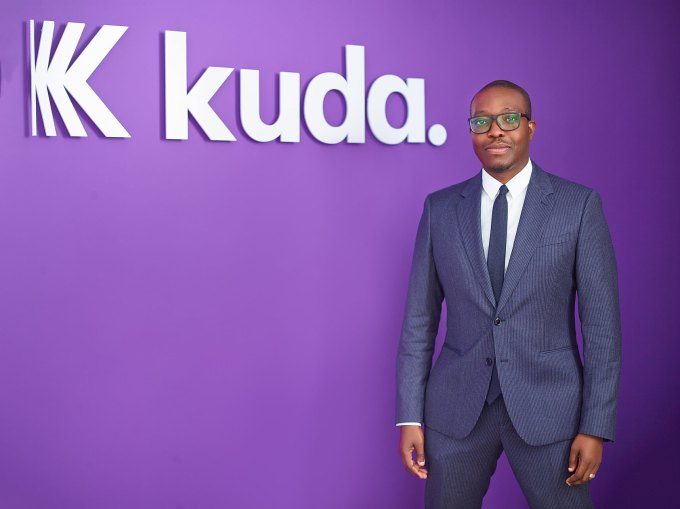
The two convinced investor Haresh Aswani to lead the $1.6 million pre-seed funding, along with Ragnar Meitern and other angel investors. Aswani confirmed his investment to TechCrunch and that he will take a position on Kuda’s board.

Kuda plans to use its seed funds to go from beta to live launch in Nigeria by fourth-quarter 2019. The startup will also build out the tech of its banking platform, including support for its developer team located in Lagos and Cape Town, according to Ogundeyi.

Kuda also intends to expand in the near future. “It’s Nigeria for right now, but the plan is build a Pan-African digital-only bank,” he said.

As of 2014, Nigeria has held the dual distinction as Africa’s largest economy and most populous country (with 190 million people).

To scale there, and add some physical infrastructure to its online model, Kuda has correspondent relationships with three of Nigeria’s largest financial institutions: GTBank, Access Bank and Zenith Bank.

He clarified the banks are partners and not investors. Kuda customers can use these banks’ branches and ATMs to put money into bank accounts or withdraw funds without a fee.

“Even though we don’t own a single branch, we actually have the largest branch network in the country,” Ogundeyi claimed.

Kuda’s plans to generate revenues focus largely around leveraging its bank balances. “We plan to match different liability classes to the different asset classes that we create. That’s how we make money, that’s how we get efficiency in terms of income,” Ogundeyi said.

In Nigeria, Kuda enters a potentially revenue-rich market, but its one that already hosts a crowded fintech field — as the country becomes ground zero for payments startups and tech investment in Africa.
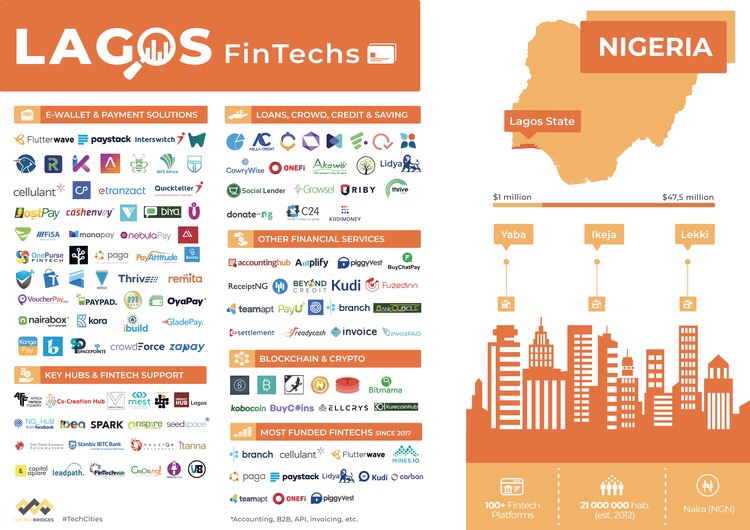
Briter Bridges Lagos Nigeria Fintech MapIn both raw and per capita numbers, Nigeria has been slower to convert to digital payments than leading African countries, such as Kenya, according to joint McKinsey Company and Gates Foundation analysis done several years ago. The same study estimated there could be nearly $1.3 billion in revenue up for grabs if Nigeria could reach the same digital-payments penetration as Kenya.

A number of startups — established and new — are going after that prize in the West African country — several with a strategy to scale in Nigeria first before expanding outward on the continent and globally.

San Francisco-based, no-fee payment venture Chipper Cash entered Nigeria this month.

Series B-stage Nigerian payments company Paga raised $10 million in 2018 to further grow its customer base (that now tallies 13 million) and expand to Asia and Latin America.

Kuda CEO Babs Ogundeyi believes the startup can scale and compete in Nigeria on a number of factors, one being financial safety. He names the company’s official bank status and the Nigeria Deposit Insurance Corporation security that brings as something that can attract cash-comfortable bank clients to digital finance.

Ogundeyi also points to offerings and price.”We look to be the next generation bank where you can do everything— savings, payments and transfers — and also the one that’s least expensive,” he said.


 

11 Sep 2019

Gig worker bill AB-5 passes in California

Assembly Bill 5, the gig worker bill opposed by the likes of Uber, Lyft and DoorDash, has passed in the California State Senate. This comes shortly after California Governor Gavin Newsom officially put his support behind AB 5 in an op-ed.

The bill needed 21 votes to pass in the State Senate. It passed in a 29 to 11 vote this evening.

The next step is for Governor Newsom to sign the bill into law, which he is expected to do. If he signs the bill, it will go into effect at the beginning of 2020.

“AB 5 is only the beginning,” Gig Workers Rising member and driver Edan Alva said in a statement. “I talk daily to other drivers who want a change but they are scared. They don’t want to lose their only source of income. But just because someone really needs to work does not mean that their rights as a worker should be stepped all over. That is why a union is critical. It simply won’t work without it.”

The bill, first introduced in December 2018, aims to codfiy the ruling established in Dynamex Operations West, Inc. v Superior Court of Los Angeles. In that case, the court applied the ABC test and decided Dynamex wrongfully classified its workers as independent contractors based on the presumption that “a worker who performs services for a hirer is an employee for purposes of claims for wages and benefits…”

Those who work as 1099 contractors can set their own schedules, and decide when, where and how much they want to work. For employers, bringing on 1099 contractors means they can avoid paying payroll taxes, overtime pay, benefits and workers’ compensation.

According to the ABC test, in order for a hiring entity to legally classify a worker as an independent contractor, it must prove the worker is free from the control and direction of the hiring entity, performs work outside the scope of the entity’s business and is regularly engaged in an “independently established trade, occupation, or business of the same nature as the work performed.”

In short, AB-5, which has already passed in the California State Assembly, would ensure gig economy workers are entitled to minimum wage, workers’ compensation and other benefits.

Uber and Lyft, two of the main targets of this legislation, are adamantly against it. Last month, Uber, Lyft and DoorDash amped up their efforts to do whatever they can to prevent it from happening. That’s in part due to the fact that the companies cost of operating would increase.

Uber, Lyft and DoorDash each put $30 million toward funding a 2020 ballot initiative that would enable them to keep their drivers as independent contractors.

Assuming Gov. Newsom signs the bill, it will go into effect Jan. 1, 2020.

11 Sep 2019

California passes landmark bill that requires Uber and Lyft to treat their drivers as employees

California legislators have passed a bill that would treat workers at so-called gig economy companies such as Uber and Lyft as employees, giving them access to improved wage and benefit protections.

The 29-11 vote passed on late Tuesday sends the bill back to the State Assembly for final approval. Democratic Governor Gavin Newsom, who has maintained his support for the bill, is expected to approve it.

The proposal, expected to go into effect January 1, had drawn sharp opposition from ridesharing companies and on-demand delivery firms. When Uber, which posted a record $5.2 billion in loss last quarter and laid off hundreds this week, filed to become a public company, it told the SEC that its business would be “adversely affected if drivers were classified as employees instead of independent contractors.”

The bill says that if a contractor’s work is part of a company’s regular business, then they must be designated as employees. And thus, these workers will get access to more protections such as minimum wage, the right to unionize, and overtime.

11 Sep 2019

SpaceX ‘getting ready’ to fly orbital Starship design with new FCC filing

SpaceX is taking the steps necessary to begin test flying the orbital-class version of its Starship spacecraft, with new documents filed by the company (via Teslarati) with the FCC seeking necessary permissions for it to communicate with the prototype while it’s in flight.

The company filed documents with the U.S. regulatory agency this week in advance of the flight, which lists a max altitude of 74,000 feet, which is a far cry from Earth orbit but still a much greater distance vs. the 500 or so feet achieved by the squat ‘Starhopper’ demonstration and test vehicle that SpaceX has been actively operating in preparation for Starship .

SpaceX CEO Elon Musk confirmed that prep was underway via tweet. Musk has previously said that he hoped to follow the Starhopper’s most recent and final successful test quickly with tests of the full-scale vehicle. Like with that low-altitude test, SpaceX will aim to launch and land the Starhopper, with touch down planned just a short distance away.

Assembly and construction of the Starship prototype looks to be well underway, and Musk recently teased a Starship update event for September 28, which is likely when we’ll see this prototype assembled and ready to go ahead of its planned October first test flight window.

Starship is the next generation of SpaceX spacecraft, designed for maximum reusability, and with the aim of creating one vehicle that can serve the needs of current and future customers, eventually replacing both Falcon 9 and Falcon Heavy. Starship is also a key ingredient in Musk’s ambitious plan to reach and establish a continuing human presence on Mars.