Year: 2019

10 Sep 2019

Mozilla launches a VPN, brings back the Firefox Test Pilot program

Mozilla today announced that it is bringing back the Firefox Test Pilot program to allow users to try out new features before they are ready for mainstream usage. While the name is familiar, though, the overall goals of the new program are a bit different from the last iteration and the focus is less on crazy experiments and more on beta testing products that are almost ready for public consumption.

The first new project in the Test Pilot program is the beta of the Firefox Private Network VPN service, which is now available in the U.S. for Firefox desktop users.

The Firefox Test Pilot program has gone through its share of iterations. First launched three years ago, it quickly became the incubation ground for a number of new features. In January of this year, though, the organization decided to shut it down.

Why bring it back now? Clearly, Mozilla was getting valuable feedback from the Test Pilot users, who were surely among the most dedicated Firefox fans.

The organization says that it wanted to take time to evolve the program and this new version is indeed somewhat different. “The difference with the newly relaunched Test Pilot program is that these products and services may be outside the Firefox browser, and we will be far more polished, and just one step shy of general public release,” the team explains.

The new Test Pilot program then is less about giving users the opportunity to test some of the Firefox team’s more eccentric ideas and more like a traditional public beta test program.

Screen Shot 2019 09 10 at 5.51.49 PM

The new VPN project, the team writes, is a good example of this approach. It’s a Test Pilot project because the team wants to fine-tune it a bit more before its public release.

The Firefox Private Network isn’t so much about trying to circumvent geo-restrictions and instead mostly focuses on giving users access to a private network when they are on public WiFi and helping them hide their locations from website and ad trackers (and indeed, a lot of the new Test Pilot projects will focus on privacy). That’s probably why Mozilla doesn’t refer to it as a VPN either, though that’s obviously what it is.

“One of the key learnings from recent events is that there is growing demand for privacy features,” Mozilla’s Marissa Wood writes today. “The Firefox Private Network is an extension which provides a secure, encrypted path to the web to protect your connection and your personal information anywhere and everywhere you use your Firefox browser.”

Mozilla is partnering with Cloudflare for this launch and Cloudflare is providing the proxy server for it. It’s available as a Firefox extension, but only in the U.S. and fore Firefox desktop users. For now, it’s available for free, though there have been some hints that Mozilla will at some point start charging for the service. Since it’s not a full VPN service, it remains to be seen how much the organization will be able to charge for it. Last year, Mozilla partnered with ProtonVPN and offered that service for $10 per month.

It’s worth noting that Opera, too, includes a free built-in VPN service, which includes the ability to set your location to either the Americas, Europe or Asia.

If you want to give the new service a try, you only need a Firefox account and sign up here.



10 Sep 2019

Watch JAXA’s HTV-8 mission launch aboard a Mitsubishi Heavy Industries H-IIB rocket live


Mitsubishi Heavy Industries’s Launch Services division is all set to send a crucial cargo payload to the International Space Station from JAXA today. The launch is scheduled for 6:33 AM Japan Standard Time (5:33 PM ET/2:33 PM PT), and will take off from Tanegashima Island, at JAXA’s Tanegashima Space Center.

The rocket used for this launch is the Mitsubishi Heavy Industries (MHI) H-IIB, and this is the eighth flight launch of the H-11 Transfer Vehicle (HTV) that MHI designed and built in Japan.

In the H-IIB configuration, the MHI-built rocket that will transport he HTV includes a liquid propellant central core, along with four solid propellant rocket boosters to give it additional life capacity. This particular mission will see the HTV loaded with 5.3 metric tons (just under six U.S. tons) of supplies for the ISS on board in both pressurized and unpressurized cargo containers which divvy up the total capacity.

MHI H IIB HTV8 10

One of the crucial pieces of cargo going up is a small satellite deployment device called ‘Kibo’ created by the Kyushu Institute of Technology and the National Authority for Remote Sensing and Space Science. It’ll be used to deploy a range of super compact ‘CubeSats’ also on board, including a propulsion tech demo create by the University of Tokyo and startup Space BD, which is the first company awarded a contract by JAXA to be the commercial operator for deploying smallsats from the ISS via Kibo.

NASA TV will be carrying the launch live via the stream above, with their coverage kicking off around 5 PM ET (2 PM PT/6 AM JST).

10 Sep 2019

Aerospace Corp CEO Steve Isakowitz to talk how to raise non-dilutive capital at Disrupt SF this Oct

The US government is awake to the remarkable innovation coming the startup scene in many deep tech categories, and the response has been diverse efforts across many government agencies and departments to support select startups with non-dilutive financial backing, technology sharing, fast-track procurement and even start-up competitions with cash prizes.

Space is one of those deep tech categories, and at we’re delighted to announce that Steve Isakowitz, CEO of Aerospace Corporation, is joining us on the Extra Crunch stage at Disrupt SF (Oct. 2-4) stage to discuss how Aerospace Corp sees the rapidly emerging space startup scene. Aerospace Corp is not all that widely known outside space circles, but its 59-year-old R&D legacy is remarkable. Based in El Segundo, California, the non-profit works with the US Air Force and other government space programs to identify emerging technologies from the commercial sector that could apply to future space programs. Examples of core space technologies include communications and spacecraft materials with an increased focus on cloud computing, data analytics, additive manufacturing, cyber security, and AI and robotics technologies.

Isakowitz was formerly CTO of Virgin, where he managed the company’s space launch program, and before that was CFO of the Department of Energy and an administrator at NASA, where he worked on space transportation and government-industry partnerships. He graduated from MIT, where he received his bachelors and masters in aerospace engineering.

We will talk on stage about how startups can take advantage of government funding initiatives, particularly in harder tech areas like space, satellites, defense, and health, as well as talk about what’s next in the space industry.

We’re amped for this conversation, and we can’t wait to see you there! Buy tickets to Disrupt SF here at an early-bird rate!

Did you know Extra Crunch annual members get 20% off all TechCrunch event tickets? Head over here to get your annual pass, and then email extracrunch@techcrunch.com to get your 20% discount. Please note that it can take up to 24 hours to issue the discount code.

10 Sep 2019

Google brings Cloud Dataproc to Kubernetes

Cloud Dataproc is probably one of the lesser-known products in Google Cloud’s portfolio, but it’s a powerful tool for data wranglers who are looking for a fully managed cloud service that lets them run Apache Spark and Hadoop clusters without having to worry about managing the underlying infrastructure. Today. Google announced that it is launching the alpha of Cloud Dataproc to Kubernetes — and while that, too, may not sound all that interesting at first, it’s an important step for Google Cloud as it works to adapt more of its products to a hybrid cloud model.

The general idea here is to give enterprise customers (and make no mistake, enterprise customers are the main focus of Google Cloud these days) the ability to run Apache Spark jobs on Google Kubernetes Engine (GKE) clusters. With products like Anthos now making GKE available virtually anywhere, this means customers can now also take Cloud Dataproc to their own data centers. Right now, the service only supports Apache Spark, but Google plans to support other open-source projects, too.

“Enterprises are increasingly looking for products and services that support data processing across multiple locations and platforms,” said Matt Aslett, Research Vice President at 451 Research. “The launch of Cloud Dataproc on Kubernetes is significant in that it provides customers with a single control plane for deploying and managing Apache Spark jobs on Google Kubernetes Engine in both public cloud and on-premises environments.”

Typically, Spark applications run on Hadoop YARN clusters. Google notes that the Cloud Dataproc on Kubernetes will free users from having to use two cluster management systems and will give them a single view across both YARN and Kubernetes clusters. “Supporting both YARN and Kubernetes can bring your enterprise the needed flexibility to modernize certain hybrid workloads while continuing to monitor YARN-based workloads,” the company writes in today’s announcement.

The new service is now available as an alpha. If you want to give it a try, you’ll have to apply for access by emailing Google.

10 Sep 2019

Nextdoor adds new funding from Mary Meeker’s Bond, closes growth round at $170M

Social networking platform for neighbors, Nextdoor, today announced it has secured additional funding to close out its $170 million growth round. The new financing includes the $123 million Nextdoor raised in May from new investor Riverwood Capital along with existing investors Benchmark, Tiger Global Management and Kleiner Perkins. The additional funding announced today comes from Mary Meeker’s tech investment firm, Bond.

As a result of the new investment, Meeker will join Nextdoor’s board.

Meeker had left Kleiner Perkins last year, where she was well-known for her popular Internet Trends Report, released annually. She has since founded Bond, taking Kleiner’s entire former growth team with her, and raised $1.25 billion for Bond’s debut growth fund. 

As of the May 2019 round, Nextdoor was valued at $2.1 billion for its neighborhood-level networking platform which today generates revenue from sponsored posts and its real estate vertical for local agents. The company had said it was on track to double its revenue in 2019.

We understand the valuation remains at $2.1 billion, even with the additional funding.

Since its 2010 founding, the Nextdoor platform has grown to over 247,000 neighborhoods across 10 countries. Its international growth potential appears to be of interest to Meeker, as does the verification process Nextdoor uses to ensure its users actually live in the neighborhoods they join.

This is not how Facebook’s Groups product works, where verification is left up to individual Group admins. That results in neighboorhood groups filled with people who are just looking to research the area, those who used to live there but have since moved, businesses looking to advertise to locals, people who live nearby but don’t have a neighborhood group of their own, and various other non-neighbors.

“Nextdoor has proven itself as the leader in local connectivity. Nextdoor is built on trust – verifying each members’ name, address, and neighborhood – which creates the transparency and accountability that is core to building communities,” Meeker said. “Nextdoor is connecting people to the information and services that matter most, and I am excited to work with this impressive team to help expand Nextdoor’s local utility as well as it’s growing global footprint,” she added.

In recent months, Nextdoor has also grown its team with new hires Antonio Silveira as its head of engineering; Tatyana Mamut, head of product; Bryan Power, head of people; and Craig Lisowski, head of data, information systems and trust.

“We could not be more thrilled to welcome Bond to our family of investors. Mary Meeker has been a strong supporter of Nextdoor for many years and is deeply knowledgeable about consumer technology,” stated Sarah Friar, CEO of Nextdoor, in a statement. “At Nextdoor, we believe that change starts with each of us opening our front doors and building deeper connections with the people nearest to us: our neighbors. We’re thrilled and honored to partner with all of our forward-looking investors to catalyze neighbors’ ability to connect with relevant local conversations, organizations, and businesses, engage in real-world interactions, and unlock the global power of local.”


10 Sep 2019

HashiCorp expands Terraform free version, adds paid tier for SMBs

HashiCorp has had a free tier for its Terraform product in the past, but it was basically for a single user. Today, the company announced it was expanding that free tier to allow up to five users, while also increasing the range of functions that are available before you have to pay.

“We’re announcing a pretty large expansion of the Terraform Cloud free tier. So many of the capabilities that used to be exclusively in our Terraform enterprise product, we’re now bringing down into the Terraform free tier. It allows you to do central actual execution of Terraform and apply the full lifecycle as part of the free tier,” HashiCorp co-founder and CTO Armon Dadgar explained.

In addition, the company announced a middle tier aimed at SMBs. Dadgar says the new pricing tier helped address some obvious gaps in the pricing catalogue for a large sets of users, who outgrew the free product, yet weren’t ready for the enterprise version.

“We were seeing was a lot of friction with our SMB customers trying to figure out how to go from one-user Terraform to a team of five people or a team of 20 people. And I think the challenge was that we had the enterprise product, which in terms of deployment and pricing, is really geared toward Global 2000 kinds of companies,” Dadgar told TechCrunch.

He said, this left a huge gap for smaller teams of between five and 100 user teams, which forced those teams to kludge together solutions to fit their requirements. The company thought it would make more sense to have a paid tier specifically geared for this group that would create a logical path for all users on the platform, while solving a known problem.

“It’s a logical path, but it also just answers the constant questions on forums and mailing lists regarding how to collaborate [with smaller teams]. Before, we didn’t have a prescriptive answer, and so there was a lot of DIY, and this is our attempt at a prescriptive answer of how you should do this,” he said.

Terraform is the company’s tool for defining, deploying and managing infrastructure as code. There is an open source product, an on prem version and a SaaS version.

10 Sep 2019

Clubhouse announces new collaboration tool and free version of its project management platform

Clubhouse — the software project management platform focused on team collaboration, workflow transparency and ease of integration — is taking another big step towards its goal of democratizing efficient software development.

Traditionally, legacy project management programs in software development can often appear like an engineer feeding frenzy around a clunky stack of to-dos. Engineers have limited clarity into the work being done by other members of their team or into project tasks that fall outside of their own silo.

Clubhouse has long been focused on easing the headaches of software development workflows by providing full visibility into the status of specific tasks, the work being done by all team members across a project, as well as higher-level project plans and goals. Clubhouse also offers easy integration with other development tools as well as its own API to better support the cross-functionality a new user may want.

Today, Clubhouse released a free version of its project management platform, that offers teams of up to 10 people unlimited access to the product’s full suite of features, as well as unlimited app integrations.

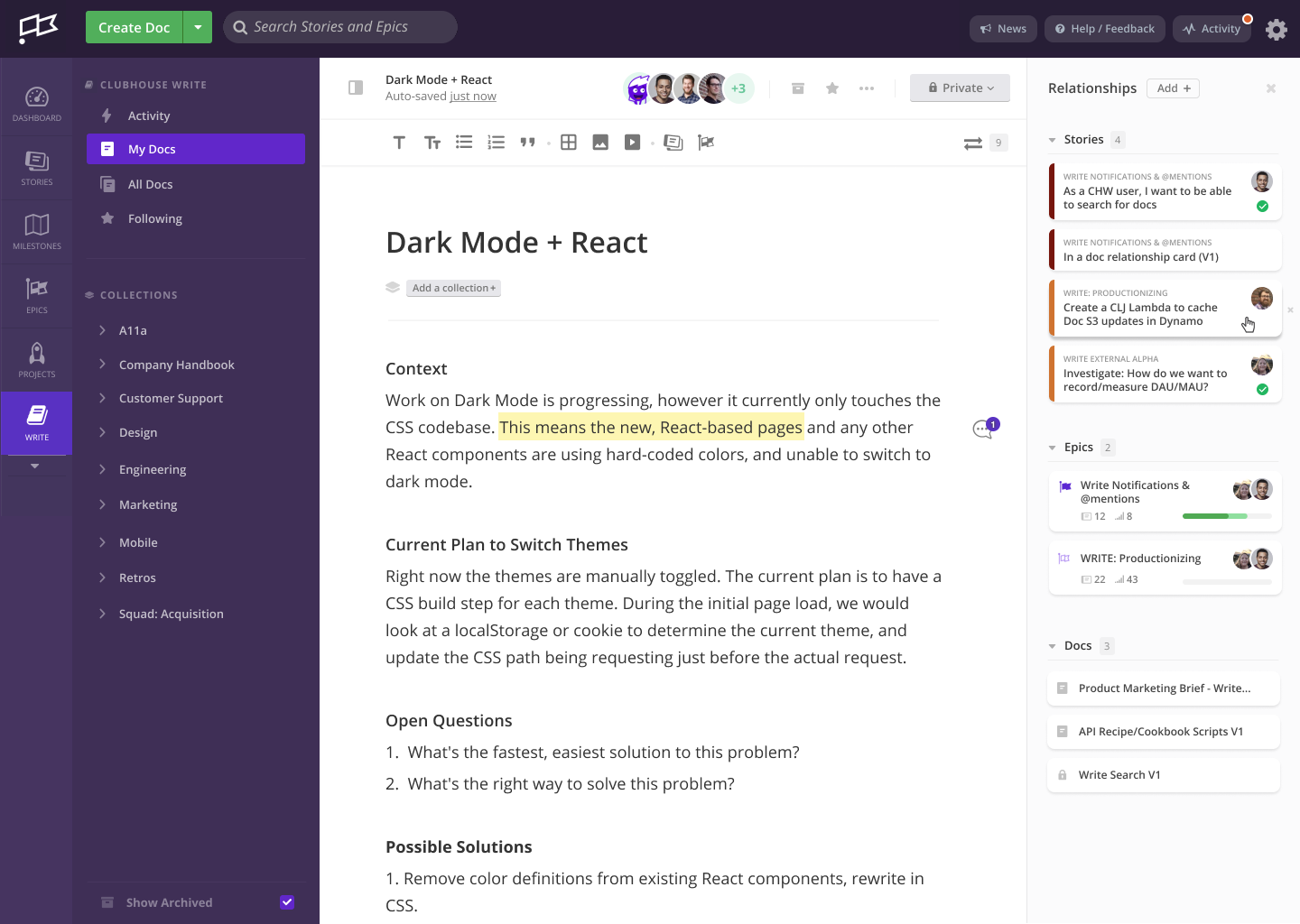
The company also announced it will be launching an engineer focused collaboration and documentation tool later this year, that will be fully integrated with the Clubhouse project management product. The new product dubbed “Clubhouse Write” is currently in beta, but will allow development teams to collaborate, organize and comment on project documentation in real-time, enabling further inter-team communication and a more open workflow.

The broader mission behind the Clubhouse Write tool and the core product’s free plan is to support more key functions in the development process for more people, ultimately making it easier for anyone to start dynamic and distributed software teams and ideate on projects.

write screenshot

“Clubhouse Write” Beta Version. Image via Clubhouse

In an interview with TechCrunch, Clubhouse also discussed how the offerings will provide key competitive positioning against larger incumbents in the software project management space. Clubhouse has long competed with Atlassian’s project management tool “Jira”, but now the company is doubling down by launching Clubhouse Write which will compete head-on with Atlassian’s team collaboration product Confluence.

According to recent Atlassian investor presentations, Jira and Confluence make up the lion’s share of the Atlassian’s business and revenues. And with Atlassian’s market capitalization of ~$30 billion, Clubhouse has its sights set on what it views as a significant market share opportunity.

According to Clubhouse, the company believes it’s in pole position to capture a serious chunk of Atlassian’s foothold given it designed its two products to have tighter integration than the legacy platforms, and since Clubhouse is essentially providing free versions of what many are already paying for to date.

And while Atlassian is far from the only competitor in the cluttered project management space, few if any competing platforms are offering a full project tool kit for free, according to the company. Clubhouse is also encouraged by the strong support it has received from the engineering community to date. In a previous interview with TechCrunch’s Danny Crichton, the company told TechCrunch it had reached at least 700 enterprise customers using the platform before hiring any sales reps, and users of the platform already include Nubank, Dataiku, and Atrium amongst thousands of others.

Clubhouse has ambitious plans to further expand its footprint, having raised $16 million to date through its Series A according to Crunchbase, with investments from a long list of Silicon Valley mainstays including Battery Ventures, Resolute Ventures, Lerer Hippeau, RRE Ventures, BoxGroup, and others.

A former CTO himself, Clubhouse cofounder and CEO Kurt Schrader is intimately familiar with the opacity in product development that frustrates engineers and complicates release schedules. Schrader and Clubhouse CMO Mitch Wainer believe Clubhouse can maintain its organic growth by that staying hyperfocused on designing for project managers and creating simple workflows that keep engineers happy. According to Schrader, the company ultimately wants to be the “default [destination] for modern software teams to plan and build software.”

“Clubhouse is the best software project management app in the world,” he said. “We want all teams to have access to a world-class tool from day one whether it’s a 5 or 5,000 person team.”

10 Sep 2019

Payments giant Stripe debuts a credit card in its latest step into the financing fray

Last week, when the popular payments startup Stripe made some waves with its first move into money lending through the launch of Stripe Capital, we reported that the company was also soon going to be launching a credit card. Now, that news is official. Today, the company is doubling down on financing with the launch of corporate cards for business customers.

Announced officially today to coincide with the company’s developer event Stripe Sessions, the Stripe Corporate Card — as the product is officially called — is a Visa that will be open to businesses that are incorporated in the US, although they can operate elsewhere.

Notably, users are expected to pay their balance in full each month, so for now there is no interest rate, or fee, to use the card, with Stripe making its money by way of the interchange fee that comes with every transaction using the card.

“We’re not freezing cards based on late or no payments,” Cristina Cordova, the business lead overseeing the launch, said in an interview. “A pretty common reason for non-payment is that a person switched bank accounts and forgot to update the information. But we think we’ll have fewer problems because we have banking information for accepting revenue, by way of our payments business.”

The move is another major step ahead for Stripe as it continues to diversify its business and bring on more financial products to become a one-stop shop for e-commerce and other companies for all the transactions they might need to make in the course of their lives. It is a little ironic that it’s taken years for credit cards to get added into the mix, considering Stripe’s earliest homepages and marketing efforts were built around the design of a credit card (a reference to taking payments online, not issuing credit, of course).

In any case, the list of products now offered by Stripe is long — longer, you might say, than it takes to incorporate a Stripe service into a developer workflow. In addition to its API-based flagship payments product — which is available as a direct service or, via Stripe Connect, for third parties via marketplaces and other platforms — it offers billing and invoicing, in-person payment services (via Terminal), business analytics, fraud prevention on transactions (Radar), company incorporation (Atlas), and a range of content around business strategy.

Some of these Stripe products are free to use, and some come at a price: the main point for offering them together is to build more engagement and loyalty from customers to keep them from migrating to other services. In that regard, credit cards are a cornerstone of how businesses operate, to handle day-to-day expenses in a more accountable way, and this is an area that is already well-served by others, including startups like Brex but also a plethora of challenger and traditional banks. So as much as anything else, this is a clear move to help stave off competition.

At the same time, it underscores how Stripe is leveraging the huge amount of data that it has amassed about its users and payments on the platform: it’s not just about enabling single services, but about using the byproducts of those services — data — to put fuel into new products.

Today, to underscore its global ambitions in that regard, Stripe is adding some expansions to several of its existing products. For example, it will now allow businesses to make payouts in local currencies in 45 countries (an important detail, for example, for marketplaces and network-based companies like ridesharing businesses).

The credit card product will follow a model similar to that of Stripe Capital. As with the lending product, there is a single bank issuing the credit and the card. Amber Feng, head of financial infrastructure for Stripe, confirmed to me that it is actually the same bank that’s providing the cash behind Stripe Capital. Stripe is still declining to name the bank itself, but hints that we may hear more about it soon, which leads me to wonder what news might be coming next.

(Funding perhaps would make sense? The company has raised a whopping $785 million to date and has a valuation of $22.5 billion at the moment. Given that Stripe has made indications that a public listing is not on the cards soon, that might imply, with the launch of these new financing products, that more capital might be raised soon.)

Also similar to Stripe Capital, the underwriting of the card is based on Stripe data. That is to say, business users are verified and approved based on turnover (revenues) as measured by the Stripe payments platform itself; and in cases where applicants are “pre-revenue”, they can be evaluated based on other data sources. For example, if they have used Stripe Atlas to incorporate their businesses, the paperwork supplied for that is used by Stripe to vet the customer’s suitability for a credit card.  

Notably, the cards will be delivered in the spirit of instant gratification: if you are applying and get approved, you can download a virtual card within minutes to your Apple Wallet as you await the physical card to arrive in the post.

Stripe is big on data in its own business, and it’s bringing some of that into this product with spending controls that can be set by person and by category; real-time expense reporting by way of texts; rewards of 2% back on spending in the business’s most-used categories; and integration with financial software like Quickbooks and Expensify.

10 Sep 2019

Rivian lands $350 million investment from Cox Automotive

Rivian, the adventure-minded electric automaker that plans to produce a pickup truck and SUV, has raised $350 million from global automotive services company Cox Automotive.

The two companies said Tuesday they will also “explore partnership opportunities in service operations, logistics, and digital retailing.” Further details weren’t provided. However, a statement from Rivian founder and CEO RJ Scaringe suggests the partnership will help the EV startup provide services to its customers.

“We are building a Rivian ownership experience that matches the care and consideration that go into our vehicles,” Scaringe said. “As part of this, we are excited to work with Cox Automotive in delivering a consistent customer experience across our various touchpoints. Cox Automotive’s global footprint, service and logistics capabilities, and retail technology platform make them a great partner for us.”

And Cox Automotive, as well as its parent company Cox Enterprises, has the reach Rivian is looking for. Cox Enterprises owns nearly 30 automotive brands, including Autotrader, Kelley Blue Book, Pivet, RideKleen and Manheim, which transports, services, and auctions vehicles across more than 150 global locations.

The Cox Automotive partnership follows two other eye-popping investments this year. In February, Rivian raised $700 million in a round led by Amazon. Two months later, the company announced a $500 million investment from Ford Motor.

Despite all of these big-name investors, Rivian says it will remain an independent company, a desire repeated to TechCrunch on several occasions over the past year by Scaringe. Cox Automotive will add a representative to Rivian’s board.

“With the electrification of vehicles set to play a significant role in the new mobility future, this partnership opens another channel of discovery and learning for Cox Automotive,” Joe George, president of Cox Automotive Mobility Group said in a statement. “Advancements in battery technology and the electrification of fleets are two of our primary focus areas, and we believe this relationship will prove to be mutually beneficial.”

Rivian spent the majority of its life in the shadows until November 2018 when it revealed its all-electric R1T pickup and R1S SUV at the LA Auto Show. Scaringe launched the company as Mainstream Motors in 2009. By 2011, the name changed to Rivian and moved out of Florida. Today, the company has more than 750 employees split between four development locations in the U.S. and an office in the U.K. The bulk of its employees are in Michigan to be close to an expansive automotive supply chain.

The company also has operations in San Jose and Irvine, Calif., where engineers are working on autonomous vehicle technology. Rivian also owns a factory in the Normal, Ill. that was once owned by Mitsubishi in a joint venture with Chrysler Corporation called Diamond-Star Motors.

Deliveries of these vehicles to customers in the U.S., which use a flexible skateboard platform, are expected to begin in late 2020.

10 Sep 2019

Twenty and Mappen merge to help users hang out IRL

Today, social networks Twenty and Mappen are joining together in a merger under the Twenty brand.

From the beginning, Twenty’s goal has been to get young people off of their phones and out in the real world with their friends. Twenty connects users with their friend groups and lets them browse fun experiences, from concerts to sports games to movies, with an easy UI for coordinating a group and making it happen. In fact, Twenty has forged relationships with orgs like Live Nation, Endeavor, Roc Nation, and Tao, which collectively produce 10,000+ events a year with an audience of over 100 million fans.

Mappen, on the other hand, is a location-based social network that let users share what they were doing (and where they were doing it) with their friends. For example, users could give a status update using a Fortnite emoji tagged to their house, inviting friends to come over and play a few games.

The two companies have been in talks, and collaborating, for the past nine months looking for ways to bring the experiences together. Where Twenty has relationships with experience providers, Mappen had the audience of young people looking to connect with each other.

The end result is an all-stock deal that unifies the user experience under the Twenty brand name.

twenty

Though the announcement of the merged app didn’t go down until today, the two apps have been combined for a while and CEO Diesel Peltz says the new app has seen 33 percent month over month growth in new users. Hangouts have increased 50 percent from July to August. Peltz will lead the combined company as CEO.

For now, the new Twenty does not have a business model in place. However, the plan is to use the event partnerships to generate revenue as opposed to ads, which relies on eyeballs on screens.

“If the model is solely based on ads, you want the users to spend as much time on the platform as possible,” said Peltz. “We’re looking to create a different opportunity for people to access these experiences.”

Thus far, the combined Twenty has raised approximately $40 million from partners including Accel, Maveron, 500 Startups, Sound Ventures, as well as Roc Nation, Live Nation and Endeavor.