Year: 2019

10 Sep 2019

Work Life Ventures raises $5M for debut enterprise SaaS seed fund

Brianne Kimmel had no trouble transitioning from angel investor to general partner.

Initially setting out to garner $3 million in capital commitments, Kimmel, in just two weeks’ time, closed on $5 million for her debut venture capital fund Work Life Ventures. The enterprise SaaS-focused vehicle boasts an impressive roster of limited partners, too, including the likes of Zoom chief executive officer Eric Yuan, InVision CEO Clark Valberg, Twitch co-founder Kevin Lin, Cameo CEO Steven Galanis, Andreessen Horowitz general partners’ Marc Andreessen and Chris Dixon, Initialized Capital GP Garry Tan and fund-of-funds Slow Ventures, Felicis Ventures and NFX.

At the helm of the new fund, Kimmel joins a small group of solo female general partners. Dream Machine’s Alexia Bonatsos is targeting $25 million for her first fund. Day One Ventures’ Masha Drokova raised an undisclosed amount for her debut effort last year. Sarah Cone launched Social Impact Capital, a fund specializing in impact investing, in 2016, among others.

Meanwhile, venture capital fundraising is poised to reach all-time highs in 2019. In the first half of the year, a total of $20.6 billion in new capital was introduced to the startup market across more than 100 funds.

For most, the process of raising a successful venture fund can be daunting and difficult. For well-connected and established investors in the Bay Area, like Kimmel, raising a fund can be relatively seamless. Given the speed and ease of fund one in Kimmel’s case, she plans to raise her second fund with a $25 million target in as little as 12 months.

“The desire for the fund is to take a step back and imagine how do we build great consumer experiences in the workplace,” Kimmel tells TechCrunch.

Kimmel has been an active angel investor for years, sourcing top enterprise deals via SaaS School, an invite-only workshop she created to educate early-stage SaaS founders on SaaS growth, monetization, sales and customer success. Prior to launching SaaS School, which will continue to run twice a year, Kimmel led go-to-market strategy at Zendesk, where she built the Zendesk for Startups program.


View this post on Instagram


✔ available offline #google #remote

A post shared by Work Life Ventures (@worklifevc) on

“You start by advising, then you start with very small angel checks,” Kimmel explains. “I reached this inflection point and it felt like a great moment to raise my own fund. I had friends like Ryan Hoover, who started Weekend Fund focused on consumer, and Alexia is one of my friends as well and I saw what she was doing with Dream Machine, which is also consumer. It felt like it was the right time to come out with a SaaS-focused fund.”

Emerging from stealth today, Work Life Ventures will invest up to $150,000 per company. To date, Kimmel has backed three companies with capital from the fund: Tandem, Dover and Command E. The first, Tandem, was amongst the most coveted deals in Y Combinator’s latest batch of companies. The startup graduated from the accelerator with millions from Andreessen Horowitz at a valuation north of $30 million.

Dover, another recent YC alum, provides recruitment software and is said to be backed by Founders Fund in addition to Work Life. Command E, currently in beta, is a tool that facilities search across multiple desktop applications. Kimmel is also an angel investor in Webflow, Girlboss, TechCrunch Disrupt 2018 Startup Battlefield winner Forethought, Voyage and others.

Work Life is betting on the consumerization of the enterprise, or the idea that the next best companies for modern workers will be consumer-friendly tools. In her pitch deck to LPs, she cites the success of Superhuman and Notion, a well-designed email tool and a note-taking app, respectively, as examples of the heightened demand for digestible, easy-to-use B2B products.

“The next generation of applications for the workplace sees people spinning out of Uber, Coinbase and Airbnb,” Kimmel said. “They’ve faced these challenges inside their highly efficient tech company so we are seeing more consumer product builders deeply passionate about the enterprise space.”

But Kimmel doesn’t want to bury her thesis in jargon, she says, so you won’t find any B2B lingo on Work Life’s website or Instagram.

She’s focusing her efforts on a more important issue often vacant from conversations surrounding investment in the future of work: diversity & inclusion.

Kimmel meets with every new female hire of her portfolio companies. Though it’s “increasingly non-scalable,” she admits, it’s part of a greater effort to ensure her companies are thoughtful about D&I from the beginning: “Because I have a very focused fund, it’s about maintaining this community and ensuring that people feel like their voices are heard,” she said.

“I want to be mindful that I am a female GP and I feel honored to have that title.”
10 Sep 2019

Smart grocery cart startup Caper bags $10 million

Caper wants to deliver a major update to the self checkout aisle without keeping its dreaded catchphrases, i.e. “Unknown item in the bagging area,” “Please place the item in the bag.”

The New York startup is tapping some of Silicon Valley’s more recognizable VC firms to fund their dreams for a shopping cart of the future that uses computer vision and other sensors to let shoppers quickly scan items as they drop them into their carts.

The company is announcing that they’ve closed a $10 million Series A led by Lux Capital. The round also saw participation from First Round Capital, Y Combinator, Hardware Club, FundersClub, Sidekick Fund and Red Apple Group.

Caper closed its $2.15 million seed round led by First Round earlier this year. The startup has now raised $13 million to date. The startup’s leadership plans to use the capital to bring their smart grocery carts to more locations.

The startup says its tech could help grocery store chains bring more seamless checkout processes to customers as the groups aim to keep pace with Amazon which has doubled down on physical retail automation with its Amazon Go convenience stores.

While Amazon’s small stores rely on a complex web of cameras and sensors tracking your purchase habits, Caper’s solution is more insular focusing only on what’s happening inside a shopper’s cart.

“Instead of monitoring an entire store, we’re monitoring this very small cart. Our computation is faster, our cameras are a lot closer and we’re able to scale much faster because we don’t need to implement any infrastructure inside the store,” Yang tells TechCrunch.

The company declined to detail exactly how pricey these carts were for a store. When asked whether rollouts would costs “thousands, tens of thousands or hundreds of thousands of dollars,” Yang told TechCrunch that a full rollout at a grocery store would “probably be within the hundreds of thousands range though it could be less.”

Alternatively, Bloomberg reported that the Seattle’s first Amazon Go store required $1 million worth of hardware.

Caper isn’t expecting physical retailers to go all-in and toss out their old-school grocery carts when they become customers. Part of Caper’s advantage is that it doesn’t alienate customers who don’t want to bring AI into their process, those people can just grab an old cart and check out the regular way if the don’t feel like pushing around a computer.

The credit card reader, barcode scanner and image recognition cameras are just a slice of the sell for investors backing Caper. It’s less about streamlining checkout than it is finding a new way to bring AI-driven online retail conventions into physical stores. Personalized recommendations, shopping lists and recipes could eventually find their way onto the built-in touchscreen, Yang says.

“Our vision is ultimately to build a platform layer on retail that never existed before.”

10 Sep 2019

Facebook tightens policies around self-harm and suicide

Timed with World Suicide Prevention Day, Facebook is tightening its policies around some difficult topics including self-harm, suicide, and eating disorder content after consulting with a series of experts on these topics. It’s also hiring a new Safety Policy Manager to advise on these areas going forward. This person will be specifically tasked with analyzing the impacts of Facebook’s policies and its apps on people’s health and well-being, and will explore new ways to improve support for the Facebook community.

The social network, like others in the space, has to walk a fine line when it comes to self-harm content. On the one hand, allowing people to openly discuss their mental health struggles with family, friends, and other online support groups can be beneficial. But on the other, science indicates that suicide can be contagious, and that clusters and outbreaks are real phenomena. Meanwhile, graphic imagery of self-harm can unintentionally promote the behavior.

With its updated policies, Facebook aims to prevent the spread of more harmful imagery and content.

It changed its policy around self-harm images to no longer allow graphic cutting images which can unintentionally promote or trigger self-harm. These images will not be allowed even if someone is seeking support or expressing themselves to aid their recovery, Facebook says.

The same content will also now be more difficult to find on Instagram through search and Explore.

And Facebook has tightened its policy regarding eating disorder content on its apps to prevent an expanded range of content that could contribute to eating disorders. This includes content that focuses on the depiction of ribs, collar bones, thigh gaps, concave stomach, or protruding spine or scapula, when shared with terms related to eating disorders. It will also ban content that includes instructions for drastic and unhealthy weight loss, when shared with those same sorts of terms.

It will also display a sensitivity screen over healed self-harm cuts going forward to help unintentionally promote self-harm.

Even when it takes content down, Facebook says it will now continue to send resources to people who posted self-harm or eating disorder content.

Facebook will additionally include Orygen’s #chatsafe guidelines to its Safety Center and in resources on Instagram. These guidelines are meant to help those who are responding to suicide-related content posted by others or are looking to express their own thoughts and feelings on the topic.

The changes came about over the course of the year, following Facebook’s consultations with a variety of the experts in the field, across a number of countries including the U.S., Canada, U.K. Australia, Brazil, Bulgaria, India, Mexico, Philippines, and Thailand. Several of the policies were updated prior to today, but Facebook is now publicly announcing the combined lot.

The company says it’s also looking into sharing the public data from its platform on how people talk about suicide with academic researchers by way of the CrowdTangle monitoring tool. Before, this was made available primarily to newsrooms and media publishers

Suicide helplines provide help to those in need. Contact a helpline if you need support yourself or need help supporting a friend. Click here for Facebook’s list of helplines around the world. 

10 Sep 2019

Europe’s antitrust chief, Margrethe Vestager, set for expanded role in next Commission

As the antitrust investigations stack up on US tech giants’ home turf there’s no sign of pressure letting up across the pond.

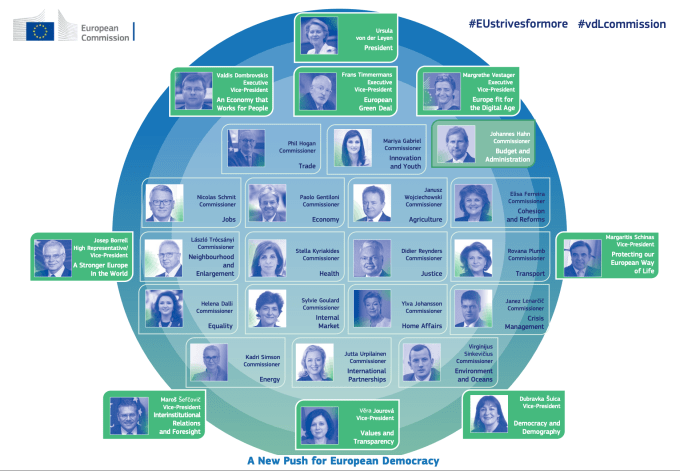
European Commission president-elect Ursula von der Leyen today unveiled her picks for the next team of commissioners who will take up their mandates on November 1 — giving an expanded role to competition commissioner Margrethe Vestager. The pick suggests the next Commission is preparing to dial up its scrutiny of big tech’s data monopolies.

Under the draft list of commissioners-designate, which still needs to be approved in full by the European Parliament, Vestager has been named executive VP overseeing a new portfolio called ‘Europe fit for the digital age’.

But, crucially, she will also retain the competition portfolio — which implies attention on growing Europe’s digital economy will go hand in glove with scrutiny of fairness in ecommerce and ensuring a level playing field vs US platform giants.

“Executive vice-president Margrethe Vestager will lead our work on a Europe fit for the digital age,” said von der Leyen at a press conference to announce her picks. “Digitalization has a huge impact on the way we live, we work, we communicate. In some fields Europe has to catch up — for example in the field of business to consumer but in other fields we’re excellent. Europe is the frontrunner, for example in business to business, when we talk about digital twins of products and procedures.

“We have to make more out of the field of artificial intelligence. We have to make our single market a digital single market. We have to use way more the big data that is out there but we don’t make enough out of it. What innovation and startups are concerned. It’s not only need to know but it’s need to share big data. We have to improve on cyber security. We have to work hard on our technological sovereignty just to name a few issues in these broad topics.

“Margrethe Vestager will co-ordinate the whole agenda. And be the commissioner for competition. She will work together with the commissioner for internal market, innovation and youth, transport, energy, jobs, health and justice.”

If tech giants were hoping for Europe’s next Commission to pay a little less attention to question marks hanging over the fairness of their practices they’re likely to be disappointed as Vestager is set to gain expanded powers and a broader canvas to paint on. The new role clearly positions her to act on the review of competition policy she instigated towards the end of her current mandate — which focused on the challenges posed by digital markets.

Since taking over as Europe’s competition chief back in 2014, Vestager has made a name for herself by blowing the dust off the brief and driving forward on a series of regulatory interventions targeting tech giants including Amazon, Apple and Google . In the latter case this has included opening a series of fresh probes as well as nailing the very long running Google Shopping saga inherited from her predecessor.

The activity of the department under her mandate has clearly catalyzed complainants — creating a pipeline of cases for her to tackle. And just last month Reuters reported she had been preparing an “intensive” handover of work looking into complaints against Google’s job search product to her successor — a handover that won’t now be necessary, assuming the EU parliament gives its backing to von der Leyen’s team.

While the competition commissioner has thus far generated the biggest headlines for the size of antitrust fines she’s handed down — including a record-breaking $5BN fine for Google last year for illegal restrictions attached to Android — her attention on big data holdings as a competition risk is most likely to worry tech giants going forward.

See, for example, the formal investigation of Amazon’s use of merchant data announced this summer for a sign of the direction of travel.

Vestager has also talked publicly about regulating data flows as being a more savvy route to control big tech versus swinging a break up hammer. And while — on the surface — regulating data might sound less radical a remedy than breaking giants like Google and Facebook up, placing hard limits on how data can be used has the potential to effect structural separation via a sort of regulatory keyhole surgery that’s likely to be quicker and implies a precision that may also make it more politically palatable.

That’s important given the ongoing EU-US trade friction kicked up by the Trump administration which is never shy of lashing out, especially at European interventions that seek to address some of the inequalities generated by tech giants — most recently Trump gave France’s digital tax plans a tongue-lashing.

von der Leyen was asked during the press conference whether Vestager might not been seen as a controversial choice given Trump’s views of her activity to date (Europe’s “tax lady” is one of the nicer things he’s said about Vestager). The EU president-elect dismissed the point saying the only thing that matters in assigning Commission portfolios is “quality and excellence”, adding that competition and digital is the perfect combination to make the most of Vestager’s talents.

“Vestager has done an outstanding job as a commissioner for competition,” she went on. “At competition and the issues she’s tackling there are closely linked to the digital sector too. So having her as an executive vice-president for the digital in Europe is absolutely a perfect combination.

“She’ll have this topic as a cross-cutting topic. She’ll have to work on the Digital Single Market. She will work on the fact that we want to use in a better way big data that is out there, that we collect every day — non-personalized data. That we should use way better, in the need for example to share with others for innovation, for startups, for new ideas.

“She will work on the whole topic of cyber security. Which is the more we’re digitalized, the more we’re vulnerable. So there’s a huge field in front of her. And as she’s shown excellence in the Commission portfolio she’ll keep that — the executive vice-presidents have with the DGs muscles to deal with their vast portfolios’ subject they have to deal with.”

In other choices announced today, the current commissioner for Digital Economy and Society, Mariya Gabriel, will be taking up a new portfolio called ‘Innovation and Youth’. And Sylvie Goulard was named as ‘Internal Market’ commissioner, leading on industrial policy and promoting the Digital Single Market, as well as getting responsibility for Defence Industry and Space.

Another executive VP choice, Valdis Dombrovskis, looks likely to be tackling thorny digital taxation issues — with responsibility for co-ordinating the Commission’s work on what’s been dubbed an “Economy that Works for People”, as well as also being commissioner for financial services. 

In prepared remarks on that role, von der Leyen said: We have a unique social market economy. It is the source of our prosperity and social fairness. This is all the more important when we face a twin transition: climate and digital. Valdis Dombrovskis will lead our work to bring together the social and the market in our economy.”

Frans Timmermans, who was previously in the running as a possible candidate for Commission president but lost out to von der Leyen, is another exec VP pick. He’s set to be focused on delivering a European Green Deal and managing climate action policy.

Another familiar face — current justice, consumer and gender affairs commissioner, Věra Jourová — has also been named as an exec VP, gaining responsibility for “Values and Transparency”, a portfolio title which suggests she’ll continue to be involved in EU efforts to combat online disinformation on platforms.

The rest of the Commission portfolio appointments can be found here.

There are 26 picks in all — 27 counting von der Leyen who has already been confirmed as president; one per EU country, with the UK having no representation in the next Commission given it is due to leave the bloc on October 31, the day before the new Commission takes up its mandate.

von der Leyen touted the team she presented today as balanced and diverse, including on gender lines as well as geographically to take account of the full span of European Union members.

“It draws on all the strength and talents, men and women, experienced and young, east and west, south and north, a team that is well balanced, a team that brings together diversity of experience and competence,” she said. “I want a Commission that is led with determination, that is clearly focused on the issues at hand — and that provides answers.”

Commissioners elect

“There’s one fundamental that connects this team: We want to bring new impetus to Europe’s democracy,” she added. “This is our joint responsibility. And democracy is more than voting in elections in every five years; it is about having your voice heard. It’s about having been able to participate in the way our society’s built. We gave to address some of the deeper issues in our society that have led to a loss of faith in democracy.”

In a signal of her intention that the new Commission should “walk the talk” on making Europe fit for the digital age she announced that college meetings will be paperless and digital.

On lawmaking, she added that there will be a one-in, one-out policy — with any new laws and regulation supplanting an existing rule in a bid to cut red tape.

10 Sep 2019

New investment firm wants to change the way we fund early stage companies — from New Hampshire

The three founders of York IE have a vision about how to change the way early stage startups get funding. They have experience shattering norms, having built a successful startup, Dyn, in Manchester, New Hampshire, which is not exactly a hot-bed of startup activity.

The founders want to take that same spirit and apply it to investing, while maintaining its headquarters in New Hampshire (and Boston). In fact, the three founders — Kyle York, Joe Raczka and Adam Coughlin — launched Dyn and built it to $30 million in ARR before taking a dime in venture funding. They went onto raise $88 million before being acquired by Oracle in 2016. They believe they can apply the lessons that they learned to other early stage startups.

“We think, especially in B2B and SaaS, there is a way to build a scalable, effective and efficient business without chasing massive fund raises, diluting your company, bringing on traditional venture investors and chasing those kind of on-paper vanity metrics,” company CEO and co-founder Kyle York told TechCrunch.

For the past five years, while working at Oracle after the acquisition, the founders have been testing their theories while advising startups and acting as angel investors. They believed it was time to take all of those learnings and apply it to their own firm.

“I started thinking about how to transition out of Oracle, and what I wanted to do from a career perspective and we wanted to build a modern investment firm less focused on how to deploy as much capital as possible for the limited partners, and more on working with the entrepreneurs to help coach them on a path to success,” York said.

The company still wants to act as investors, and to make money along the way, but they want to help build more solid, grounded companies. York says that they want the founders truly understand that they are selling a part of their company in exchange for those dollars, and that it makes sense to have a strong foundation before taking on money.

York wants to change this culture of fund raising for fund raising’s sake. He acknowledges that some companies with deep tech or deep infrastructure require that kind of substantial up-front investment to get off the ground, but SaaS companies are supposed to be able to take advantage of modern technology to build companies more easily, and he wants to see them build solid companies first and foremost.

“The goal shouldn’t be to raise more capital. The goal should be to build a healthy successful, scalable company,” he said.

To put their money where their mouth is, the new firm will not take management fees. “We are investing like a normal investor and coming through with equity position, but we are betting on the future. In essence, if the startup wins, then we win.”

10 Sep 2019

Snyk grabs $70M more to detect security vulnerabilities in open source code and containers

A growing number of IT breaches has led to security becoming a critical and central aspect of how computing systems are run and maintained. Today, a startup that focuses on one specific area — developing security tools aimed at developers and the work they do — has closed a major funding round that underscores the growth of that area.

Snyk — a London and Boston-based company that got its start identifying and developing security solutions for developers working on open source code — is today announcing that it has raised $70 million, funding that it will be using to continue expanding its capabilities and overall business. For example, the company has more recently expanded to building security solutions to help developers identify and fix vulnerabilities around containers, an increasingly standard unit of software used to package up and run code across different computing environments.

Open source — Snyk works as an integration into existing developer workflows, compatible with the likes of GitHub, Bitbucket and GitLab, as well as CI/CD pipelines — was an easy target to hit. It’s used in 95% of all enterprises, with up to 77% of open source components liable to have vulnerabilities, by Snyk’s estimates. Containers are a different issue.

“The security concerns around containers are almost more about ownership than technology,” Guy Podjarny, the president who co-founded the company with Assaf Hefetz and Danny Grander, explained in an interview. “They are in a twilight zone between infrastructure and code. They look like virtual machines and suffer many of same concerns such as being unpatched or having permissions that are too permissive.”

While containers are present in fewer than 30% of computing environments today, their growth is on the rise, according to Gartner, which forecasts that by 2022, over 75% of global organizations will run containerized applications. Snyk estimates that a full 44% of Docker image scans (Docker being one of the major container vendors) have known vulnerabilities.

This latest round is being led by Accel with participation from existing investors GV and Boldstart Ventures. These three, along with a fourth investor (Heavybit) also put $22 million into the company as recently as September 2018. That round was made at a valuation of $100 million, and from what we understand from a source close to the startup, it’s now in the “range” of $500 million.

“Accel has a long history in the security market and we believe Snyk is bringing a truly unique, developer-first approach to security in the enterprise,” said Matt Weigand of Accel said in a statement. “The strength of Snyk’s customer base, rapidly growing free user community, leadership team and innovative product development prove the company is ready for this next exciting phase of growth and execution.”

Indeed, the company has hit some big milestones in the last year that could explain that hike. It now has some 300,000 developers using it around the globe, with its customer base growing some 200 percent this year and including the likes of Google, Microsoft, Salesforce and ASOS (sidenote: you know that if developers at developer-centric places themselves working at the vanguard of computing, like Google and Microsoft, are using your product, that is a good sign). Notably, that has largely come by word of mouth — inbound interest.

The company in July of this year took on a new CEO, Peter McKay, who replaced Podjarny. McKay was the company’s first investor and has a track record in helping to grow large enterprise security businesses, a sign of the trajectory that Snyk is hoping to follow.

“Today, every business, from manufacturing to retail and finance, is becoming a software business,” said McKay. “There is an immediate and fast growing need for software security solutions that scale at the same pace as software development. This investment helps us continue to bring Snyk’s product-led and developer-focused solutions to more companies across the globe, helping them stay secure as they embrace digital innovation – without slowing down.”


10 Sep 2019

McDonald’s acquires Apprente to bring voice technology in drive-thrus

McDonald’s is increasingly looking at tech acquisitions as a way to reinvent the fast-food experience. Today, it’s announcing that it’s buying  Apprente, a startup building conversational agents that can automate voice-based ordering in multiple languages.

If that sounds like a good fit for fast-food drive thru, that’s exactly what McDonald’s leadership has in mind. In fact, the company has already been testing Apprente’s technology in select locations, creating voice-activated drive-thrus (along with robot fryers) that it said will offer “faster, simpler and more accurate order taking.”

McDonald’s said the technology could also be used in mobile and kiosk ordering. Presumably, besides lowering wait times, this could allow restaurants to operate with smaller staffs.

Earlier this year, McDonald’s acquired online personalization startup Dynamic Yield for more than $300 million, with the goal of creating a drive-thru experience that’s customized based on things like weather and restaurant traffic. It also invested in mobile app company Plexure.

Now the company is looking to double down on its tech investments by creating a new Silicon Valley-based group called McD Tech Labs, which the Apprente team becoming the the group’s founding members, and Apprente co-founder Itamar Arel becoming vice president of McD Tech Labs. McDonald’s said it will expand the team by hiring more engineers, data scientists and other tech experts.

“Building our technology infrastructure and digital capabilities are fundamental to our Velocity Growth Plan and enable us to meet rising expectations from our customers, while making it simpler and even more enjoyable for crew members to serve guests” said McDonald’s President and CEO Steve Easterbrook in a statement. “Apprente’s gifted team, and the technology they have developed, will form McD Tech Labs, a new group integrated in our Global Technology team that will take our culture of innovation one step further.”

Apprent was founded in 2017 and raised a total of $4.8 million from investors including AME Cloud Ventures, Morado Ventures, Pathbreaker Ventures, Point72 Ventures, Greylock Partners and StageOne Ventures, according to Crunchbase. The financial terms of the acquisition were not disclosed.

10 Sep 2019

Q-CTRL raises $15M for software that reduces error and noise in quantum computing hardware

As hardware makers continue to work on ways of making wide-scale quantum computing a reality, a startup out of Australia that is building software to help reduce noise and errors on quantum computing machines has raised a round of funding to fuel its U.S. expansion.

Q-CTRL is designing firmware for computers and other machines (such as quantum sensors) that perform quantum calculations to identify the potential for errors, making them more resistant and able to stay working for longer (the Q in its name is a reference to qubits, the basic building block of quantum computing). The startup is today announcing that it has raised $15 million, money that it plans to use to double its team (currently numbering 25) and set up shop on the West Coast, specifically Los Angeles.

This Series A is coming from a list of backers that speaks to the startup’s success to date in courting quantum hardware companies as customers. Led by Square Peg Capital — a prolific Australian VC that has backed homegrown startups like Bugcrowd and Canva, but also those further afield such as Stripe — it also includes new investor Sierra Ventures as well as Sequoia Capital, Main Sequence Ventures, and Horizons Ventures.

Q-CTRL’s customers are some of the bigger names in quantum computing and IT such as Rigetti, Bleximo and Accenture, among others. IBM — which earlier this year unveiled its first commercial quantum computer — singled it out last year for its work in advancing quantum technology.

The problem that Q-CTRL is aiming to address is basic but arguably critical to solving if quantum computing ever hopes to make the leap out of the lab and into wider use in the real world.

Quantum computers and other machines like quantum sensors, which are built on quantum physics architecture, are able to perform computations that go well beyond what can be done by normal computers today, with the applications for such technology including cryptography, biosciences, advanced geological exploration and much more. But quantum computing machines are known to be unstable, in part because of the fragility of the quantum state, which introduces a lot of noise and subsequent errors.

As Frederic pointed out recently, scientists are confident that this is ultimately a solvable issue. Q-CTRL is one of the hopefuls working on that, by providing a set of tools that runs on quantum machines, visualises noise and decoherence, and then deploys controls to “defeat” those errors.

Q-CTRL currently has four products it offers to the market, Black Opal, Boulder Opal, Open Controls and Devkit — aimed respectively at students/those exploring quantum computing, hardware makers, the research community, and end users/algorithm developers.

Q-CTRL was founded in 2017 by Michael Biercuk, a Professor of Quantum Physics & Quantum Technology at the University of Sydney and a Chief Investigator in the Australian Research Council Centre of Excellence for Engineered Quantum Systems, who studied in the U.S., with a PhD in physics from Harvard.

“Being at the vanguard of the birth of a new industry is extraordinary,” he said in a statement. “We’re also thrilled to be assembling one of the most impressive investor syndicates in quantum technology. Finding investors who understand and embrace both the promise and the challenge of building quantum computers is almost magical.”

Why choose Los Angeles for building out a U.S. presence, you might ask? Southern California, it turns out, has shaped up to be a key area for quantum research and development, with several of the universities in the region building out labs dedicated to the area, and companies like Lockheed Martin and Google also contributing to the ecosystem. This means a strong pipeline of talent and conversation in what is still a nascent area.

Given that it is still early days for quantum computing technology, that gives a lot of potential options to a company  like Q-CTRL longer-term: the company might continue to build a business as it does today, selling its technology to a plethora of hardware makers and researchers in the field; or it might get snapped up by a specific hardware company to integrate Q-CTRL’s solutions more closely onto its machines (and keep them away from competitors). Or, it could make like a quantum particle and follow both of those paths at the same time.

“Q-CTRL impressed us with their strategy; by providing infrastructure software to improve quantum computers for R&D teams and end-users, they’re able to be a central player in bringing this technology to reality,” said Tushar Roy, a partner at Square Peg. “Their technology also has applications beyond quantum computing, including in quantum-based sensing, which is a rapidly-growing market. In Q-CTRL we found a rare combination of world-leading technical expertise with an understanding of customers, products and what it takes to build an impactful business.”

10 Sep 2019

Live from Apple’s iPhone 11 event

The moment is finally here, Apple fans. This morning at 10AM PT/1PM ET, the company will unveil the latest version of the iPhone. You can read up on all of the latest rumors here (or watch this handy video). You can also watch the live stream right here.

The iPhone could well present a shift in the way the company positions its products amid slowing sales. The line is believed to include both a standard and “pro” version, the latter of which will include a fully revamped triple-camera system.

Also expected is a new version of the Apple Watch with sleep tracking, dates for the latest versions of iOS and macOS and a key update on content plays, including Apple TV+ and Arcade.

As always, we’ll be arriving in Cupertino bright and early to bring you all of the latest. Just bookmark this here post and we’ll see you soon.

10 Sep 2019

Latest Adobe tool helps marketers work directly with customer journey data

Adobe has a lot going on with Analytics and the Customer Experience Platform, a place to gather data to understand customers better. Today, it announced a new analytics tool that enables employees to work directly with customer journey data to help deliver a better customer experience.

The customer journey involves a lot of different systems from a company data lake to CRM to point of sale. This tool pulls all of that data together from across multiple systems and various channels and brings it into the data analysis workspace, announced in July.

Nate Smith, group manager for product marketing for Adobe Analytics, says the idea is to give access to this data in a standard way across the organization, whether it’s a data scientist, an analyst with SQL skills or a marketing pro simply looking for insight.

“When you think about organizations that are trying to do omni-channel analysis or trying to get that next channel of data in, they now have the platform to do that, where the data can come in and we standardize it on an academic model,” he said. They then layer this ability to continuously query the data in a visual way to get additional insight they might not have seen.

Adobe screenshot 1

Screenshot: Adobe

Adobe is trying to be as flexible as possible in every step of the process, and openness was a guiding principle here, Smith said. That means that data can come from any source, and users can visualize it using Adobe tools or an external tool like Tableau or Looker. What’s more, they can get data in or out as needed, or even use your their own models, Smith said.

“We recognize that as much as we’d love to have everyone go all in on the Adobe stack, we understand that there is existing significant investment in other tech and that integration and interoperability really needs to happen, as well,” he said.

Ultimately this is about giving marketers access to a full picture of the customer data to deliver the best experience possible based on what you know about them. “Being able to have insight and engagement points to help with the moments that matter and provide great experience is really what we’re aiming to do with this,” he said.

This product will be generally available next month.