
Year: 2019

10 Sep 2019

The Polaroid Lab uses the light from your phone’s screen to turn digital photos into Polaroids


When all of us are carrying phones that can snap a thousand photos a minute and are connected to cloud systems that can store millions, there’s an undeniable charm to physical photos. The ones deemed worthy; the ones so special that they must be transformed from bit to atom.

While photo printers are nothing new, Polaroid is twisting up the concept (and rebooting an idea from a few years back) with the “Polaroid Lab”. It’s a $129 tower that uses the light from your phone’s screen, bounced off a series of mirrors, to make a proper Polaroid from the photos you’ve already taken.

Open your photo in Polaroid’s companion app, place your phone (any iPhone after the 6S, and ‘current models of Samsung, Huawei, Google Pixel, and One Plus’ Android handsets) on top of the tower, and push the red button. A few seconds later, out pops a grey Polaroid. Did it work? You’ll have to wait a few minutes for it to develop, just like the good (?) ol’ days.

Is using light and mirrors better than just sending a picture to a printer over Bluetooth or WiFi and blasting the ink out from a cartridge? Maybe not. But it’s neat! It’s physical and sciencey and fun — and, arguably, as close as you can get to having a “true” Polaroid picture of a moment that’s already happened.

The company says that the Polaroid Lab works with its existing I-Type and 600 series films… which, as any enthusiast could tell you, doesn’t come cheap. Expect each photo printed here to cost you a buck or two. That’s a bit steeper than many at-home printers and definitely pricier than just blasting out some 4x6s at Costco, but this thing will almost certainly still find its audience amongst those going for a certain look.

There’s also a way to “blow up” one photo across a bunch of Polaroids, if you’ve got the film to spare. Here’s a demo video of what that looks like:

If the whole concept seems familiar, you might be remembering the Impossible Instant Lab — a product of a veeeery similar vein that raised over half a million dollars on Kickstarter back in 2012. The Impossible Instant Lab was discontinued in July of 2017… just a few months after the team behind it acquired the rights to the Polaroid brand. This seems to be a reboot of the concept, now with the added weight and officialness of the Polaroid name thrown behind it.

The team behind the Polaroid Lab says it should hit the shelves by October 10th.
10 Sep 2019

InMobi’s Glance raises $45M to expand outside of India

Glance, a subsidiary of Indian mobile ad business firm InMobi, said today it has raised $45 million as it prepares to scale its business outside of India and expand its product offerings.

The unnamed, maiden financing round for Glance was funded by Mithril Capital, a growth stage investment firm co-founded by Silicon Valley investors Peter Thiel and Ajay Royan.

In an interview with TechCrunch, Naveen Tewari, founder and CEO of InMobi Group, said the current round has not closed and could bag another $30 million to $55 million in the next two months.

Glance operates an eponymous service that shows media content in local languages on the lock screen of Android-powered smartphones. InMobi has partnered with a number of top smartphone vendors including Xaomi, Samsung, and Gionee to integrate Glance into their operating systems.

Glance, which was launched in September last year and supports English, Hindi, Tamil and Telugu, has amassed 50 million monthly active users in India, its primary market. Users are spending an average of 22 minutes with Glance each day, he said.

“All the new smartphone models launched by Samsung, Xiaomi, and a handful of other vendors have launched with Glance on them,” Tiwari said.

In a statement, Mithril Capital’s Rohan, said, “We share Glance’s global vision of breaking through the constraints of application architectures and linguistic markets to deliver rich, frictionless, and engaging experiences across a myriad of cultures and languages.” As part of the financing round, he is joining Glance’s board.

Glance does not show traditional ads, something it intends to never change, but shows a certain kind of content to drive engagement for brands.

In the months to come, Glance plans to expand the platform and bring short-form videos (Glance TV), and mini games (Glance Games) to the lock screen. It is also working on a feature dubbed Glance Location that will enable brands to court users in their vicinity, and Glance Shopping to explore ways to bring commerce around content.

As of today, InMobi Group is not monetizing Glance platform, but plans to explore ways to make money from it by early next year, Tiwari said.

The 12-year-old firm said it plans to expand footprints of Glance outside of India. The company plans to take Glance to some Southeast Asian markets like Malaysia, Indonesia, and Thailand. InMobi’s Tiwari said the Glance has already started to find users in these markets.

InMobi Group, which had raised $320 million prior to today’s financing round, has been profitable for several years. But the company decided to raise external funding to accelerate Glance’s growth, Tiwari said.

The firm, which has three subsidiaries including its marquee marketing cloud division, plans to go public in the next few years. But instead of taking the entire group public, Tiwari said the firm is thinking of publicly listing each division as they mature. The marketing cloud division, which brings in the vast majority of revenue for the firm, will go public first, he said.

“The IPO plans remain, and we will evaluate them as we go along. The reality, however, is that the market is so big and there is so much room that we can continue to be private for a few more years,” he said.

10 Sep 2019

Pento raises $2.8M seed round for its payroll SaaS

Pento, a Danish startup working on a better payroll experience for companies and employees, has raised $2.8 million in seed funding.

Leading the round is Point Nine Capital and Seedcamp, with participation from a number of smaller funds and angel investors, including departing Atomico Partner Mattias Ljungman. The company had previously raised $700,000 from the likes of Preseed Ventures, and Futuristic.vc.

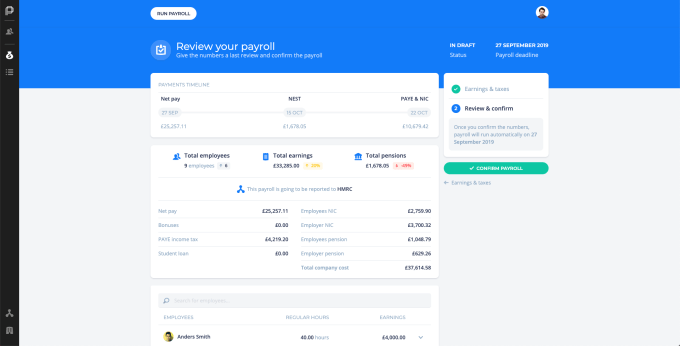
Founded by Jonas Bøgh Larsen (CEO) and Emil Hagbarth (CTO) in 2016, Pento offers a SaaS for companies wanting to automate their payroll and offer complementary features to employees, such as user-friendly access to pay history and personal pay-related data. The startup is live in Denmark with over 400 customers and says a U.K. launch is happening soon.

“Payroll is a very manual process for most companies, which causes errors and is super time-consuming,” Larsen tells me. “The process usually includes a lot of manual tasks like updating spreadsheets, sending emails with personal information, making manual bank transfers, manually keying in data from HR software, and much more. We have built a SaaS product that automates all of this”.

The current feature set of Pento include things like tax reporting, pension reporting, payslip generation, payouts to employees and tax authorities, and bookkeeping. “[This] means payroll admins can run the whole payroll process in one single product, usually in a matter of minutes rather than hours,” claims Larsen.

UK product run payroll confirm step unconfirmed

Typical Pento customers are companies with 1-150 employees, although the startup is also seeing quite a lot of demand from bigger companies too. It operates a classic SaaS model, charging a monthly subscription per seat.

“We currently charge £3 per employee per month for our basic plan, and charge £7 per employee per month for more support and more features,” explains the Pento CEO.

Meanwhile, competitors are said to fall into three camps: Traditional payroll outsourcing; older payroll software products like Sage, Brightpay and MoneySoft; and newer competitors like Payfit and Xero Payroll. (There’s also Duane Jackson’s latest upstart, Staffology Payroll, which looks to be similar to Pento on the pure SaaS side.)

“Contrary to other newer payroll products like Payfit and Xero, Pento has a 100% focus on payroll, not HR or accounting, and we will much rather integrate to other products in the ecosystem than try to build it all ourselves,” adds Larsen.

10 Sep 2019

SimShine raises $8 million for home security cameras that use edge computing

SimShine, a computer vision startup based in Shenzhen, has raised $8 million in pre-Series A funding for SimCam, its line of home security cameras that use edge computing to keep data on-device. The funding was led by Cheetah Mobile, with participation from Skychee, Skyview Fund and Oak Pacific Investment.

Earlier this year, SimShine raised $310,095 in a crowdfunding campaign on Kickstarter. It will use its pre-Series A round for product development and hiring.

SimShine’s team started off developing computer vision and edge computing software, spending five years working with enterprise clients before launching SimCam.

The company plans to release more smart home products that use edge computing with the ultimate goal of building a IoT platform to connect different devices, co-founder and chief marketing officer Joe Pham tells TechCrunch. SimCam currently integrates with Amazon Alexa and Google Assistant, with support for Apple Homekit in the works.

Pham says edge computing protects users’ privacy by keeping data, including face recognition data, on device, while also decreasing latency and false alarms, because calculations are performed continuously on the device (cameras connect to Wi-Fi so customers can watch surveillance video on their smartphones). It also means customers don’t have to sign up for the subscription plans that many cloud-based home security cameras require and reduces the price of each device since SimCam does not have to maintain cloud servers.

10 Sep 2019

Watch Apple unveil the new iPhone live right here

Apple is set to announce new iPhone models today. The company is holding a keynote on its campus at 10 AM PT (1 PM in New York, 6 PM in London, 7 PM in Paris). And you’ll be able to watch the event right here as the company is streaming it live.

Rumor has it that the company plans to unveil three new smartphones. The iPhone 11 should replace the iPhone XR in the lineup, while the iPhone 11 Pro and 11 Pro Max should replace the iPhone XS and XS Max respectively.

Apple could also update the Apple Watch with a new titanium version. You can also expect to get the release date of iOS 13, iPadOS 13, tvOS 13, macOS Catalina and watchOS 6. Let’s see if Apple announces the launch dates of Apple TV+ and Apple Arcade as well.

When it comes to less likely announcements that could still happen, Apple has been working on new MacBooks, a new Apple TV with a more powerful system-on-a-chip and new iPads. All eyes are on the new iPhone, but Apple could use today’s conference to announce those other products.

You can watch the live stream directly on this page. For the first time, Apple is streaming its conference on YouTube.

If you have an Apple TV, you can download the Apple Events app in the App Store. It lets you stream today’s event and rewatch old ones. The app icon was updated a few days ago for the event.

And if you don’t have an Apple TV and don’t want to use YouTube, the company also lets you live-stream the event from the Apple Events section on its website. This video feed now works in all major browsers — Safari, Microsoft Edge, Google Chrome and Mozilla Firefox.

Of course, you also can read TechCrunch’s live blog if you’re stuck at work and really need our entertaining commentary track to help you get through your day. We have a team in the room.

10 Sep 2019

Huawei drops lawsuit over equipment seized by the U.S. government

Huawei has dropped a lawsuit against the Commerce Department and other agencies after the U.S. government released telecommunications equipment seized in September 2017. The suit was filed by the Chinese company’s U.S. subsidiary, Huawei Technologies USA, in June. In a statement, Huawei said it considers the return of the equipment, including servers and Ethernet switches, “as a tacit admission that the seizure itself was unlawful and arbitrary.”

The equipment was confiscated by U.S. officials in Alaska as it was on its way back to China after testing in California. Huawei said the U.S. government determined after an investigation that no export license was needed for the shipment, but did not give the company an explanation for why it had been withheld for two years.

The dropped lawsuit is separate from the one Huawei filed against the U.S. government in March, claiming that a ban on the use of its products by federal agencies and contractors violated due process and is unconstitutional.

Huawei has been on the U.S. government’s entity list since May over concerns that it poses a threat to national security and its equipment may be used for espionage, allegations the company has denied. The trade blacklist prevents it from purchasing from U.S. suppliers without getting clearance from the government first.

Along with ZTE, Huawei has been on the U.S. government’s radar since the House Intelligence Committee identified the companies as potential security threats. Scrutiny has intensified since the U.S.-China trade war began last year, however, and the U.S. government has put more legal pressure on Huawei, which the company described earlier this month as a “malign, concerted effort by the U.S. government to discredit Huawei and curb its leadership position in the industry.”

10 Sep 2019

Huawei drops lawsuit over equipment seized by the U.S. government

Huawei has dropped a lawsuit against the Commerce Department and other agencies after the U.S. government released telecommunications equipment seized in September 2017. The suit was filed by the Chinese company’s U.S. subsidiary, Huawei Technologies USA, in June. In a statement, Huawei said it considers the return of the equipment, including servers and Ethernet switches, “as a tacit admission that the seizure itself was unlawful and arbitrary.”

The equipment was confiscated by U.S. officials in Alaska as it was on its way back to China after testing in California. Huawei said the U.S. government determined after an investigation that no export license was needed for the shipment, but did not give the company an explanation for why it had been withheld for two years.

The dropped lawsuit is separate from the one Huawei filed against the U.S. government in March, claiming that a ban on the use of its products by federal agencies and contractors violated due process and is unconstitutional.

Huawei has been on the U.S. government’s entity list since May over concerns that it poses a threat to national security and its equipment may be used for espionage, allegations the company has denied. The trade blacklist prevents it from purchasing from U.S. suppliers without getting clearance from the government first.

Along with ZTE, Huawei has been on the U.S. government’s radar since the House Intelligence Committee identified the companies as potential security threats. Scrutiny has intensified since the U.S.-China trade war began last year, however, and the U.S. government has put more legal pressure on Huawei, which the company described earlier this month as a “malign, concerted effort by the U.S. government to discredit Huawei and curb its leadership position in the industry.”

10 Sep 2019

Jack Ma officially retires as Alibaba’s chairman

Jack Ma stepped down as Alibaba’s chairman today, handing the role over to the company’s current CEO Daniel Zhang. The transition was announced a year ago.

Ma will continue serving on Alibaba’s board until its annual general shareholders’ meeting next year. He also remains a lifetime partner of Alibaba Partnership, a group drawn from the senior management ranks of Alibaba Group companies and affiliates that has the right to nominate (and in some situations, appoint) up to simple majority of its board.

Ma said in last year’s announcement that he plans for his departure from Alibaba Group to be very gradual: “The one thing I can promise everyone is this: Alibaba was never about Jack Ma, but Jack Ma will forever belong to Alibaba.”

Ma left Alibaba’s CEO position in 2013 and was succeeded first by Jonathan Lu. In 2015 Lu was replaced by Zhang, the company’s former COO. As its CEO and now its chairman, Zhang has taken Alibaba’s reins as it copes with a slowdown in China’s e-commerce market after a decade of explosive growth. The online retail landscape also now includes new players like Pinduoduo, which have gained an advantage by focusing on smaller cities, important growth markets for Internet companies.

One interesting fact about the day Ma chose for his retirement as chairman is that it is Teachers’ Day in China. Ma is a former English teacher who is still nicknamed “Teacher Ma” and has said that he plans to devote time to education philanthropy.

10 Sep 2019

Paytm’s annual loss doubles to $549M

Running a payments business in India is not cheap. Just ask Paytm . One of India’s largest payment companies reported a net loss of Rs 3959 crore ($549 million) for the financial year that ended in March, up 165% over 1490 crore ($206 million) in the same period last year.

During the same period, the company’s revenue rose to Rs 3232 crore ($448 million), compared to Rs 3052 crore ($423 million) in the year before. The firm’s debt also surged to Rs 695 crore ($96 million), One97 Communications, the parent firm of Paytm, told investors in its annual report.

One97 Communications also runs an e-commerce business, which recently raised money from eBay, and Paytm Money, that runs mutual funds business. On a consolidated basis, the 9-year-old firm reported an annual loss of Rs 4217.20 crore ($584 million), up from Rs 1604.34 crore ($222 million) from the year before.

Indian news outlet BloombergQuint first reported (paywalled) the financial performance of Paytm.

The loss should worry Paytm, whose CEO Vijay Shekhar Sharma said in a conference last week that the firm would begin to work on going public in the next 22 to 24 months. The level of competition that Paytm faces today is only about to increase in the coming future, and unlike earlier, the Indian firm is not facing off financially weaker local rivals.

Paytm, which has raised over $2 billion to date from a range of investors including SoftBank, Alibaba, and Berkshire Hathaway, continues to be the largest mobile wallet app provider in India, but increasingly users are moving to government-backed UPI payments infrastructure. In UPI land, Paytm competes with Flipkart’s PhonePe and Google Pay, both of which are heavily-backed.

As of July, both PhonePe and Google Pay commanded a bigger market share across UPI apps than Paytm.

Also in UPI land, you don’t make money on each transaction. So lately, every payments firm in India, including Paytm, has expanded it offering to include financial services such as a credit card, or loan, or insurance.

In many ways, this has created a level playing field for payment firms that did not dominate the wallet business.

In a statement, Paytm said it has been investing $1 billion per year for the last two years to “expand payments ecosystem in our country.” The company plans to invest a further $3 billion in the next two years.

“We believe India is at the inflection point of digital payments and Paytm’s sole focus is towards solving the merchant payments and offering them financial services. We will invest Rs 20,000 crore ($2.7 billion) in the next two years towards achieving this,” a company spokesperson said.

The biggest challenge for Paytm and other UPI payment apps has yet to emerge. Before the end of this year, WhatsApp, which has over 400 million users in India, plans to offer UPI payment option to all its years in the coming month.

10 Sep 2019

Paytm’s annual loss doubles to $549M

Running a payments business in India is not cheap. Just ask Paytm . One of India’s largest payment companies reported a net loss of Rs 3959 crore ($549 million) for the financial year that ended in March, up 165% over 1490 crore ($206 million) in the same period last year.

During the same period, the company’s revenue rose to Rs 3232 crore ($448 million), compared to Rs 3052 crore ($423 million) in the year before. The firm’s debt also surged to Rs 695 crore ($96 million), One97 Communications, the parent firm of Paytm, told investors in its annual report.

One97 Communications also runs an e-commerce business, which recently raised money from eBay, and Paytm Money, that runs mutual funds business. On a consolidated basis, the 9-year-old firm reported an annual loss of Rs 4217.20 crore ($584 million), up from Rs 1604.34 crore ($222 million) from the year before.

Indian news outlet BloombergQuint first reported (paywalled) the financial performance of Paytm.

The loss should worry Paytm, whose CEO Vijay Shekhar Sharma said in a conference last week that the firm would begin to work on going public in the next 22 to 24 months. The level of competition that Paytm faces today is only about to increase in the coming future, and unlike earlier, the Indian firm is not facing off financially weaker local rivals.

Paytm, which has raised over $2 billion to date from a range of investors including SoftBank, Alibaba, and Berkshire Hathaway, continues to be the largest mobile wallet app provider in India, but increasingly users are moving to government-backed UPI payments infrastructure. In UPI land, Paytm competes with Flipkart’s PhonePe and Google Pay, both of which are heavily-backed.

As of July, both PhonePe and Google Pay commanded a bigger market share across UPI apps than Paytm.

Also in UPI land, you don’t make money on each transaction. So lately, every payments firm in India, including Paytm, has expanded it offering to include financial services such as a credit card, or loan, or insurance.

In many ways, this has created a level playing field for payment firms that did not dominate the wallet business.

In a statement, Paytm said it has been investing $1 billion per year for the last two years to “expand payments ecosystem in our country.” The company plans to invest a further $3 billion in the next two years.

“We believe India is at the inflection point of digital payments and Paytm’s sole focus is towards solving the merchant payments and offering them financial services. We will invest Rs 20,000 crore ($2.7 billion) in the next two years towards achieving this,” a company spokesperson said.

The biggest challenge for Paytm and other UPI payment apps has yet to emerge. Before the end of this year, WhatsApp, which has over 400 million users in India, plans to offer UPI payment option to all its years in the coming month.
