Year: 2019

05 Sep 2019

Apple Music launches a public beta on the web

Apple Music is coming to the web. Apple today is launching a public beta of its popular music streaming service on the web, which will be available to all Apple Music subscribers worldwide. This the first time that Apple Music has been officially offered on the web, though an unofficial app over the past few months has gained attention after attracting hundreds of thousands of users.

Clearly, there was some pent-up demand for a web version of the service.

To use the new Apple Music web version, subscribers can visit the link: beta.music.apple.com and sign in with their Apple ID.

At launch, the service includes many core features, like searching and playing songs from the Apple Music catalog, searching and playing songs from your library (if Sync Library is enabled), accessing your playlists, and more.

All the main sections from the Apple Music app will also be available, including Library, Search, For You, Browse and Radio. Other features will roll out over time as the service is further developed.

During the beta testing period, Apple will be soliciting feedback from customers as it works on the product to help it streamline features and squash any bugs.

At a later date, new users will be able to sign up for Apple Music through the website. But for the time being, you’ll need to be an existing subscriber who signed up elsewhere.

The web version is now one of several ways Apple is making its music service more accessible across platforms.

The service is already available as an app for iPhone, iPad, Apple TV, Apple Watch, and Mac. And at this year’s WWDC 2019 event, Apple announced its plans to dismantle iTunes on the Mac, making Music a standalone app with access to both downloads, library content, and Apple Music’s streaming service.

Apple Music is also offered on non-Apple platforms, like Android, Windows, Sonos and Amazon Echo.

Cross-platform availability is essential in today’s streaming market, as Apple Music faces competition from Spotify, Pandora/SiriusXM, Amazon Music, YouTube Music, and other local players.

At last count, Spotify had 108 paying subscribers in the quarter ending in June and Apple Music topped 60 million subscribers in late June.

05 Sep 2019

Battlefield winner Forethought adds tool to automate support ticket routing

Last year at this time, Forethought won the TechCrunch Disrupt Battlefield competition. A  $9 million Series A investment followed last December. Today at TechCrunch Sessions: Enterprise in San Francisco, the company introduced the latest addition to its platform called Agatha Predictions.

Forethought CEO and co-founder, Deon Nicholas, said that after launching its original product, Agatha Answers to provide suggested answers to customer queries, customers were asking for help with the routing part of the process, as well. “We learned that there’s a there’s a whole front end of that problem before the ticket even gets to the agent,” he said. Forethought developed Agatha Predictions to help sort the tickets and get them to the most qualified agent to solve the problem.

“It’s effectively an entire tool that helps triage and route tickets. So when a ticket is coming in, it can predict whether it’s a high priority or low priority ticket and which agent is best qualified to handle this question. And this all happens before the agent even touches the ticket. This really helps drive efficiencies across the organization by helping to reduce triage time,” Nicholas explained.

The original product Agatha Answers is designed to help agents get answers more quickly and reduce the amount of time it takes to resolve an issue. “It’s a tool that integrates into your Help Desk software, indexes your past support tickets, knowledge base articles and other [related content]. Then we give agents suggested answers to help them close questions with reduced handle time,” Nicholas said.

He says that Agatha Predictions is based on the same underlying AI engine as Agatha Answers. Both use Natural Language Understanding (NLU) developed by the company. “We’ve been building out our product, and the Natural Language Understanding engine, the engine behind the system, works in a very similar manner [across our products]. So as a ticket comes in the AI reads it, understands what the customer is asking about, and understands the semantics, the words being used,” he explained. This enables them to automate the routing and supply a likely answer for the issue involved.

Nicholas maintains that winning Battlefield gave his company a jump start and a certain legitimacy it lacked as an early-stage startup. Lots of customers came knocking after the event, as did investors. The company has grown from 5 employees when it launched last year at TechCrunch Disrupt to 20 today.

05 Sep 2019

Google’s new feature will help you find something to watch

Google Search can now help you find your next binge. The company this morning announced a new feature which will make personalized recommendations of what to watch, including both TV shows and movies, and point you to services where the content is available.

The feature is an expansion of Google’s existing efforts in pointing web searchers to informative content about TV shows and films.

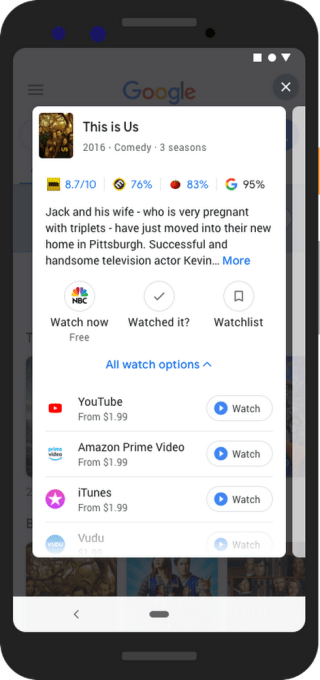
Already, a Google search for a TV show or movie title will include a “Knowledge Panel” box a the the top of the search results where you can read the overview, see the ratings and reviews, check out the cast, and as of spring 2017 find services where the show or movie can be streamed or purchased.

The new recommendations feature will instead appear to searchers who don’t have a particular title in mind, but are rather typing in queries like “what to watch” or “good shows to watch,” for example. From here, you can tap a Start button in the “Top picks for you” carousel to rate your favorite TV shows and movies in order to help Google better understand your tastes.

01 7.max 1000x1000

You can also select which subscriptions you have access to, in order to customize your recommendations further. This includes subscriptions services like Netflix, Hulu, HBO GO and HBO NOW, Prime Video, Showtime, and Showtime Anytime, CBS All Access, and Starz.

You can also indicate if you have a cable TV or satellite subscription. And it will list shows and movies available for rent, purchase or free streaming from online marketplaces like iTunes, Prime Video, Google Play Movies & TV, and Vudu, plus network apps like ABC, Freeform, Lifetime, CBS, Comedy Central, A&E, and History.

To get started, you’ll use a Tinder-like swiping mechanism to rate titles. Right swipes indicate a “like” and left swipes indicate a “dislike.” You can also “skip” titles you don’t know or have an opinion on.

After giving Google some starter data about your interests, future searches for things to watch will offer recommendations tailored to you.

02 7.max 1000x1000

The company notes that you can even get specific with your requests, by asking for things like “horror movies from the 80’s” or “adventure documentaries about climbing.” (This will help, too, when you can’t remember a movie’s title but do know what it’s about.)

Google’s search results will return a list of suggestions and when you pick one you want to watch, the service will — as before — let you know where it’s available.

The company already has a good understanding of consumer interest in movies and TV thanks to its data on popular searches. Now it aims to have a good understanding of what individual users may want to watch, as well.

The new recommendations feature is live today on mobile for users in the U.S.


05 Sep 2019

Daily Crunch: Facebook Dating comes to the U.S.

The Daily Crunch is TechCrunch’s roundup of our biggest and most important stories. If you’d like to get this delivered to your inbox every day at around 9am Pacific, you can subscribe here.

1. Facebook Dating launches in the US, adds Instagram integration

The integration means users will be able to add their Instagram accounts to their dating profiles and add Instagram followers to their “Secret Crush” lists.

If you’re wondering how this stacks up against other dating apps, the Secret Crush feature seems particularly interesting: While you won’t see your Facebook friends among your regular dating matches, you can list them as a crush that will only be revealed if the feeling is mutual.

2. Sonos gets portable

At six pounds, the Sonos Move is best positioned as augmenting a home setup. It’s a compelling device for barbecuing in the backyard, or taking out to the garage.

3. Federal judge rules that the ‘terrorist watchlist’ database violates US citizens’ rights

A federal judge appointed by President George W. Bush has ruled that the “terrorist watchlist” database compiled by federal agencies violates the rights of American citizens who are on it.

google search app ios

4. Google launches an open-source version of its differential privacy library

That means developers will be able to take this library and build their own tools that can work with aggregate data, without revealing personally identifiable information either inside or outside their companies.

5. A huge database of Facebook users’ phone numbers found online

The exposed server contained more than 419 million records over several databases on users across geographies, including 133 million records on users based in the United States.

6. Why Walmart’s Flipkart is betting heavily on Hindi

Flipkart’s major bet on Hindi — a language spoken by more than 500 million people in India — illustrates a growing push from local and international companies as they adapt their services and business models to go beyond India’s urban areas. (Extra Crunch membership required.)

7. Ashton Kutcher, Ann Miura-Ko and Mamoon Hamid are coming to Disrupt!

Specifically: They’re going to be judging the finals at the Startup Battlefield, hosted by yours truly.

05 Sep 2019

Adam Draper gives his oddball accelerator a makeover

Adam Draper, the son of that Draper, is changing things up a bit at his accelerator.

Boost VC has been living life on the fringe of Bay Area accelerators, chasing trends like VR and crypto (and sometimes a combo of the two) hard while courting outliers including a “robot fish platform” and a “cold metal fusion printer”.

While Boost VC’s investments have varied in feasibility, Draper says most of them fit into his particular vision of emerging tech that he calls “sci-fi tech,” something he says is more about finding technologies that give humans “superpowers,” a term he seems to be giving a pretty broad definition with a sci-fi portfolio that includes a jetpack startup and a hotel booking site.

Canvassing frothy sectors hasn’t always been a particularly strong recipe for sustained success; both VR/AR and blockchain startups have endured bear markets in the past couple years. Draper encourages his bets to stay lean and low-profile; the accelerator’s official slogan was, at one point, “be the cockroach.”

Adam Draper isn’t planning to shift away from long-shots, but he is turning the seven-year-old Boost VC into a more codified accelerator in an aim to provide a more compelling pitch to savvy entrepreneurs that need more money early-on.

The headline changes are that Boost VC is halving the number of companies in its accelerator classes to 7-10 companies, and is increasing the checks that it’s writing to $500k while taking a bigger slice of its portfolio startups (15 percent). The accelerator is still giving the same perks and is hoping to up the programming to make the smaller group more close-knit.

The numbers may be shifting, but the biggest change is that there are hard numbers to begin with. Boost VC has at times looked like a club for Draper’s early angel investments, largely because the check sizes and valuations varied so heavily — investments ranged from $50k to $500k.

“Standardizing everything just makes it all way, way better,” Draper told TechCrunch. “YC is awesome, and that’s why I forked their model. I think programming-based VC is the best model in venture capital.”

With this change towards deal uniformity, Draper may be stripping some of the volume but also focusing more on quality, rather than breadth. This is undoubtedly a necessary step as accelerator behemoth Y Combinator continues to surge in size, now betting on nearly 400 companies per year while sucking up a pretty sizable pool of accelerator applicants from other institutions.

Last year, Draper announced the close of Boost’s third fund, which clocked in at $38.6 million. The team is about to take applications for its 13th “tribe” of accelerator startups.

“If you are a consumer or enterprise-based business, YC is fantastic and they have repeated success. If you are in this ‘sci-fi’ category than I think specialization is very important and it’s also slightly more expensive,” he says.

A major question will be whether the higher valuations and check sizes will shift Boost away from some of the riskier and stranger “Hogwarts-inspired” VR and crypto investments that it’s been making. At the same time 15% is a pretty sizable portion of equity for founders to offload so early in their life cycle, though Draper believes plenty of teams will be interested in landing a $500k investment.

“Boost isn’t going to be for everyone, and I’m okay with that,” Draper says.

05 Sep 2019

Lenovo slims down its Google smart display

Before there was the Nest Home — heck, before there was even the Google Home Hub — there was the Lenovo Smart Display. The smart screen was far and away the nicest of the original Google Assistant screens, and the partnership between the two companies continues to be a fruitful, including the recent Smart Clock, a purpose-built bedside alarm clock.

With the Smart Display 7, announced today at IFA in Berlin, the company has slimmed down both the screen size and overall device footprint. At seven inches, it’s smaller than both of the original models (eight and 10 inches, for the record). It’s a rare step down in screen size for a new generation, but given the relative freshness of the category, there’s probably a fair amount of trial and error here.

The design language looks nice enough — perhaps a bit more generic than the first generation with its faux wood panel backing but the fabric speaker grille is a nice touch that fits in nicely with the rest of the Google Home line. Feature wise, you’re getting pretty much what you’ll get with the rest of the Assistant smart displays — Youtube, answers, smart home control.

Of course, Lenovo’s got more direct competition this time out from Google itself, in the form of the Nest Hub Max. And when it comes to products like these, it’s can be tough to compete with first parties. That said, at $130, it’s a full $100 cheaper than Google’s version, which is compelling in and of itself. The device ships next month.

05 Sep 2019

Shared inbox startup Front adds WhatsApp support

Front, the company that lets you manage your inboxes as a team, is adding one more channel, WhatsApp. Starting today, you can read and reply to people contacting you through WhatsApp.

This feature is specifically targeted at users of WhatsApp Business. You can get a business phone number through Twilio and then hand out that number to your customers.

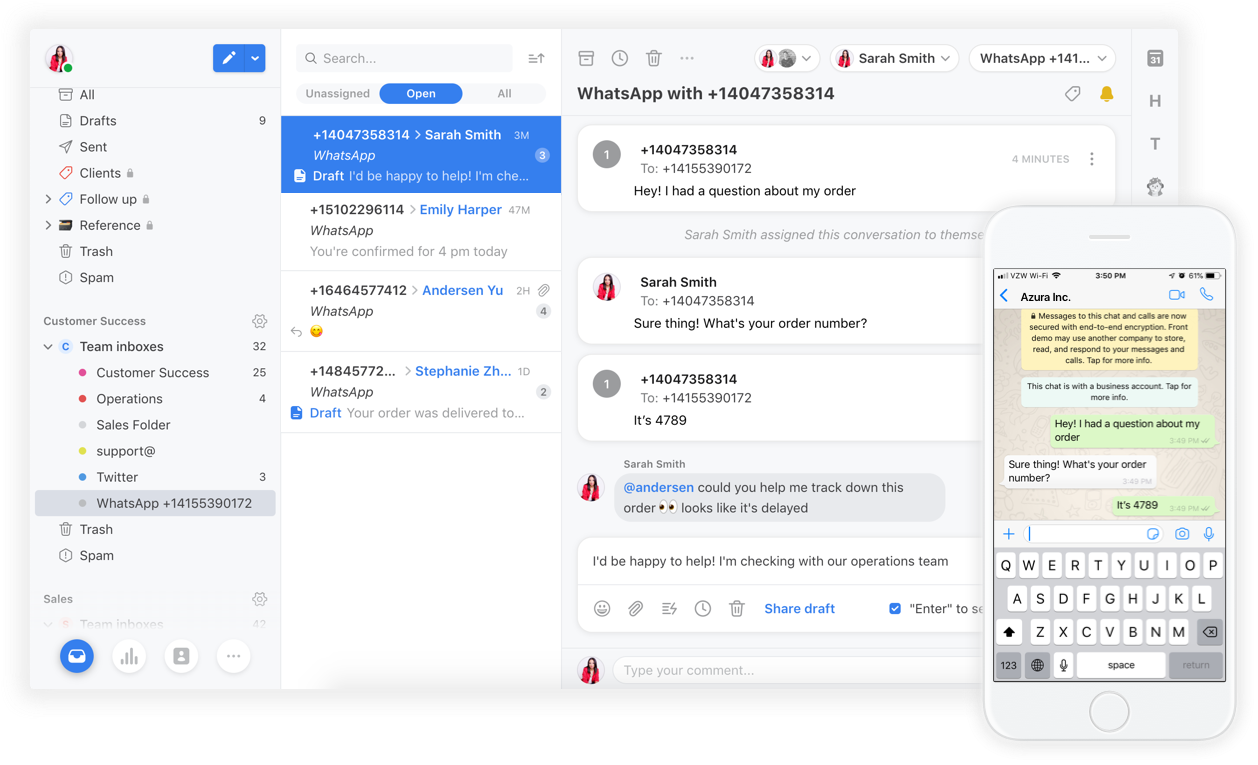
After that, you can see the messages coming in Front and treat them like any Front message. In particular, you can assign conversations to a specific team members so that your customers get a relevant answer as quickly as possible. If you need more information, Front integrates with popular CRMs, such as Salesforce, Pipedrive and HubSpot.

You can also discuss with other teammates before sending a reply to your customer. It works like any chat interface — you can at-mention your coworkers and start an in-line chat in the middle of a WhatsApp thread. When you’re ready to answer, you can hit reply and send a WhatsApp message.

Front started with generic email addresses, such as sales@yourcompany or jobs@yourcompany. But the company has added more channels over time, such as Facebook, Twitter, website chat and text messages.

If you’ve already been using Front with text messages, you can now easily add WhatsApp and use the same service for that new channel.

WhatsApp sync

05 Sep 2019

Porsche Taycan configurator: The 11 details that stood out

The Porsche Taycan is here — actually two flavors, the Turbo S and the Turbo — in case you haven’t seen the deluge of media coverage. The upshot: the “lower” priced Turbo starts at $150,900 while the Turbo S begins at $185,000.

While Porsche is promising cheaper variants of the Taycan next year, well-heeled drivers of the world will have to make do with these two options for now. But why limit yourself? It’s a Porsche, it’s a sports car,  it’s a status symbol and it’s electric. Let’s get to work on some dual vice and virtue signaling.

Luckily, the configurator is here, giving potential customers, Tesla fans and critics, or just regular folks dreaming of Porsche’s first electric car, a chance to design their very own Taycan. No strings attached.

TechCrunch dove into the configurator. What we found were lots of opportunity to customize the vehicle, right down to the headlights, wheels and even the badge. Some of them are even “free.” Here are the most interesting options.

For the purposes of this exercise, I’m going with the more frugal option, the Taycan Turbo. (And yes, the fact that an electric car has the word turbo attached to it, has not escaped me or TechCrunch. I’ll remind everyone we live in a world where a four-door car is called a coupe.)

And I’m looking for all of the opportunities to get the free stuff, unless it’s super cool, and then I’ll theoretically (because this is a game of pretend) spring for the add on.

1. Record scratch

Before I can even dive in, I am forced to choose a mobile charger for $1,120. There’s another more expensive charging option that includes a home energy manager for $1,660, but it’s not available yet.

And now, I see another option that I am forced to pay for. The fixed panoramic roof in glass is $1,490. For now, the Turbo S and Turbo come with the glass roof, but instead of making it standard, this is a required add on.

That $150,900 car now costs $153,510.

2. The free colors and the one you’ll pay for

Customers entering the configurator are given two options: Turbo or the pricier Turbo S. Regardless of which one a customer chooses, there are 10 colors to choose from. Nine of those are gratis, meaning there is no extra fee. These “free” colors include white, black, and six metallic colors such as Carrera White, Jet Black, Volcano Grey, Dolomite Silver, Gentian Blue, Frozen Blue and Mamba Green.

One color comes with a price. The Carmine Red, pictured below, costs another $3,150.

Porsche Taycan Carmine Red

The Carmine Red doesn’t fall into my subjective no-cost-unless it’s too cool category. (don’t @ me) So, instead I opt for the $0 added cost Gentian Blue Metallic.

Porsche Taycan Gentian Blue

Actually scratch that. I live in the desert. Let’s go with Carrera White Metallic.

Porsche Taycan Turbo white metallic

3. Wheels

I could spend as much as another $7,650 for 21-inch exclusive design wheels with carbon fiber aero blades. But not this time. Instead, I go with the one $0 option, 20-inch Turbo Aero wheels. (See even the wheels are called Turbo). All season tires are $0.

But wait, what is this? For the bargain price of $1,290, I can paint the wheels to match the exterior color or pick from a few other custom options including wheels are fully painted in Satin Aurum (a champagne, rose gold color), high-gloss black, jet black, or satin platinum.

I pick the exterior color and then I’m met with a terrible reality. To get the exterior color on the wheels I have to opt for the 21-inch Mission E or Taycan design wheels, which cost $3,570. I swallow hard, pick the Mission E design wheels and move on.

For those who are counting, that base Taycan Turbo is now $xxx,xxx, a price that includes the charger, the design wheels and the painted wheel option.

Here’s an example of the Carrera White Metallic with the Satin Aurum.

Screen Shot 2019 09 04 at 6.37.58 PM

And another example of the matching exterior wheels.

Screen Shot 2019 09 04 at 6.48.57 PM


4. Interior colors

Back in my frugal mindset, I scroll down to the configurator. There are three options for no additional cost, the all-black leather or two leather-free options, the race tex in black or graphite blue.

I pick the leather-free option of graphite blue. There six other options ranging between $570 and $3,070 of additional cost. I ignore these.

5. Seats

I have sat in the Turbo S. The seats are nice and snug and well made. In the configurator, the two options are standard and there is no extra cost. I can choose between power seats with 14 different functions and adaptive sport seats with 18-way operation. I go with the sporty option.

Screen Shot 2019 09 04 at 6.57.03 PM

6. Dozens of options

From here, it can get expensive. There are dozens of options for the exterior and performance. The first item is under the label “options.” There are two, both of which cost more money. The premium package of $4,340 includes the addition of a fixed panoramic glass roof (which I’m already paying for), park assist and “storage.” It’s unclear what storage means.

The performance package is $5,400 and is focused on the way the vehicle can be manipulated. This is a sports car after all. This option includes rear axle steering, the company’s  Porsche Dynamic Chassis Control Sport and something called “electric sport sound.”

I skip all of these and continue to scroll for the free options.

7. No badge, no problem

I continue to scroll down and there are so many places to spend more money, including the window trim and the logo. But two items stand out. For no additional cost, I can remove the Taycan turbo” logo on the rear and I can add/remove the “electric logo” on the front doors in high gloss silver.

I’m told Porsche has had a long standing policy of letting customers remove the badge. And so, it seems Porsche is continuing this with the Taycan.

This seems cool, or maybe it’s that $0 figure next to. I opt to remove the Turbo badge.

8. Performance

There are a number of different packages, but only one is “free.” That’s the two-speed transmission, which comes standard.

9. Lights

Sadly, there are no freebies here. But there is one fun item. One option, which costs $580, is the addition of LED lights in glacier blue.

This seems cool, but nah. Nothing flashy. Let’s keep this sports car under budget.

10. Smoking package?

I head into the interiors section, where I’m confronted with an array of choices to further customize the Turbo. I’m looking for the $0 options and come across the only one, a smoking package. This package includes a plug-in ashtray for the front cup holder.

I pass.

11. Final $0 items

There are dozens more options that could take the Taycan Turbo into the pricing stratosphere. But for this experiment, I’m looking for value. I spot one more item that can be added for no extra cost. Door-sill guards in black brushed aluminum.

The remaining $0 items including charging cables.

Final rundown: Porsche Taycan Turbo with the glass roof, in metallic Carrera white and the special Mission E design wheels and matching exterior color, plus the no cost add-ons are $159,720. Next time, we’ll shoot for how high we can get the price.

Screen Shot 2019 09 05 at 11.17.36 AM

05 Sep 2019

Upflow grabs $2.7 million to streamline payment processes

French startup Upflow has raised a $2.7 million funding round (€2.5 million) from Kima Ventures, eFounders and various business angels. The company tracks your outstanding invoices and makes sure you get paid on time.

If you’re running a small company, chances are you’re using Excel spreadsheets to enter invoice information, check your company’s bank account every day and manually tag invoices that have been paid.

Microsoft Excel has been such a powerful tool for so many different use cases that plenty of startups are trying to replace it — I call this phenomenon The Great Unbundling of Excel. And Upflow is one of those startups.

If you want to replace a system that works well, you need to make it radically better. In order to do that, Upflow has created a payment brick that sits between your bank account and your customers.

Every time you send an invoice, you can write an email from the Upflow interface so that the entire sales team is on the same page. Making this experience collaborative with a software-as-a-service approach is already a big improvement over Excel spreadsheets.

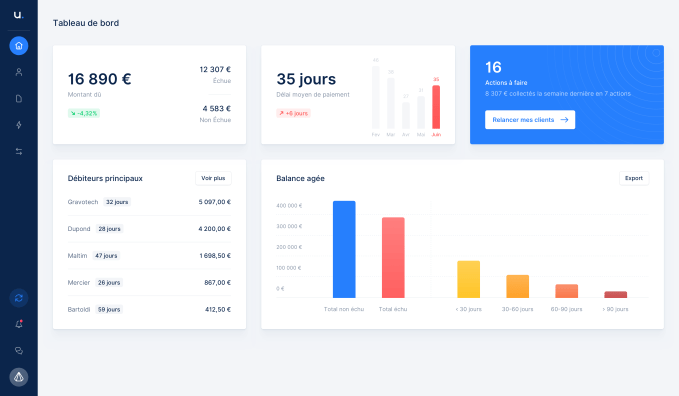
Your invoice features banking information for your Upflow account. When your customer transfers the money, Upflow can instantly mark an invoice as paid. The startup transfers money back to your company’s bank account every day.

Over time, you get insights about your recurring customers, you can see how much money your clients collectively owe you and you can send reminders to late clients.

If you want to read more about Upflow, you can read my profile of the company.

Upflow

05 Sep 2019

Facebook’s lead EU regulator is asking questions about its latest security fail

Facebook’s lead data protection regulator in Europe has confirmed it’s put questions to the company about a major security breach that we reported on yesterday.

“The DPC became aware of this issue through the recent media coverage and we immediately made contact with Facebook and we have asked them a series of questions. We are awaiting Facebook’s responses to those questions,” a spokeswoman for the Irish Data Protection Commission told us.

We’ve reached out to Facebook for a response.

As we reported earlier, a security research discovered an unsecured database of hundreds of millions of phone numbers linked to Facebook accounts.

The exposed server contained more than 419 million records over several databases on Facebook users from multiple countries, including 18 million records of users in the U.K.

We were able to verify a number of records in the database — including UK Facebook users’ data.

The presence of Europeans’ data in the scraped stash makes the breach a clear matter of interest to the region’s data watchdogs.

Europe’s General Data Protection Regulation (GDPR) imposes stiff penalties for compliance failures such as security breaches — with fines that can scale as high as 4% of a company’s annual turnover.

Ireland’s DPC is Facebook’s lead data protection regulator in Europe under GDPR’s one-stop shop mechanism — meaning it leads on cross-border actions, though other concerned DPAs can contribute to cases and may also chip in views on any formal outcomes that result.

The UK’s data protection watchdog, the ICO, told us it is aware of the Facebook security incident.

“We are in contact with the Irish Data Protection Commission (DPC), as they are the lead supervisory authority for Facebook Ireland Limited. The ICO will continue to liaise with the IDPC to establish the details of the incident and to determine if UK residents have been affected,” an ICO spokeswoman also told us.

It’s not yet clear whether the Irish DPC will open a formal investigation of the incident.

It does already have a large number of open investigations on its desk into Facebook and Facebook-owned businesses since GDPR’s one-stop mechanism came into force — including one into a major token security breach last year, and many, many more.

In the latest breach instance, it’s not clear exactly when Facebook users phone numbers were scraped from the platform.

In a response yesterday Facebook said the data-set is “old”, adding that it “appears to have information obtained before we made changes last year to remove people’s ability to find others using their phone numbers”.

If that’s correct, the data breach is likely to pre-date April 2018 — which was when Facebook announced it was making changes to its account search and recovery feature, after finding it had been abused by what it dubbed “malicious actors”.

“Given the scale and sophistication of the activity we’ve seen, we believe most people on Facebook could have had their public profile scraped in this way,” Facebook said at the time.

It would also therefore pre-date GDPR coming into force, in May 2018, so would likely fall under earlier EU data protection laws — which carry less stringent penalties.