Image and video manipulation powered by deep learning, or so-called “deepfakes,” represent a strange and horrifying facet of a promising new field. If we’re going to crack down on these creepy creations, we’ll need to fight fire with fire; Facebook, Microsoft, and many others are banding together to help make machine learning capable of detecting deepfakes — and they want you to help.
Though the phenomenon is still new, we are nevertheless in an arms race where the methods of detection vie with the methods of creation. Ever more convincing fakes appear regularly, and though while they are frequently benign, the possibility of having your face flawlessly grafted into a compromising position is very much there — and many a celebrity has already had it done to them.
Facebook, as part of a coalition with Microsoft, the Partnership for AI, and several universities including Oxford, Berkeley, and MIT, is working to empower the side of good with better detection techniques.
“The most interesting advances in AI have happened when there’s a clear benchmark on a dataset to write papers against,” said Facebook CTO Mike Schroepfer in a media call yesterday. The dataset for object recognition might be millions of images of ordinary objects, while the dataset for voice transcription would be hours of different kinds of speech. But there’s no such set for deepfakes.
We talked about this challenge at our Robotics and AI event earlier this year in what I thought was a very interesting discussion:
Fortunately Facebook is planning on dedicating around $10 million in resources to make this Deepfake Detection Challenge happen.
“Creation of these datasets can be challenging, because you want to make sure that everyone participating in it is clear and gives consent so they aren’t surprised by the usage of it,” Schroepfer continued. And since most deepfakes are made without any consent whatsoever, they’re not really permissible for usage in an academic context.
So Facebook and its partners are making the deepfake content out of whole cloth, he said. “You want a dataset of source video, and then a dataset of personalities you can map onto that. Then we’re spending engineering time implementing the latest most advanced deepfake techniques to generate altered videos as part of the dataset.”
And while you’re entirely justified in wondering, no, they aren’t using Facebook data to do this. They’ve got paid actors.
This dataset will be provided to interested parties, who will be able to build solutions and test them, putting the results on a leaderboard. At some point there will be cash prizes given out, though the details are a ways off. With luck this will spur serious competition among academics and researchers.
“We need the full involvement of the research community in an open environment to develop methods and systems that can detect and mitigate the ill-effects of manipulated multimedia,” said the University of Maryland’s Rama Chellappa in a news release. “By making available a large corpus of genuine and manipulated media, the proposed challenge will excite and enable the research community to collectively address this looming crisis.”
Initial tests of the dataset are planned for the International Conference on Computer Vision in October, with the full launch happening at NeurIPS in December.
A year ago we broke the news that payment giant Stripe was quietly making its first move into business finance by testing a service for advancing cash to existing customers. Now, nearly 12 months on to the day, the company is finally unveiling an official product: today, starting first in the US, it is launching Stripe Capital, a service for advancing cash to customers that in turn gets repaid out of their future sales made through Stripe’s payment platform, with loan amounts and repayments based on the customer’s transaction activity on Stripe itself.
The launch of Stripe Capital is coming at a key time for the company: we understand that Stripe is gearing up for a bigger push to diversify into other financial services, specifically with the launch of its first business credit card product (akin to Brex, from what we understand). The company is holding its Sessions user conference in San Francisco next week, which is likely to bring more product news.
Stripe Capital is being made available both to direct customers of Stripe’s, and to business customers of platforms and marketplaces that use Stripe Connect. (In other words, the platform and marketplace customers will have access to Stripe Capital themselves, and they in turn can also offer Stripe Capital-based cash advances to their customers.)
In an interview, Stripe co-founder and president John Collison noted that the financing for cash advances in both cases was coming via a single banking partner that the company was not making public at this time.
Although loans can potentially stretch into six-figures (no specific limit has been set), he added that Stripe expects the typical amount — based on financing issued so far — to be more in the region of $10,000-$20,000.
As with credit cards, the idea behind Stripe Capital is to give the company’s customers quick (next-day) access to funds to help both with daily liquidity as well as to invest in growth.
Cash advances more generally have been a lucrative area for competitors like PayPal and Square, which have used the service to complement their payments businesses, provide more touch points to customers and diversify revenue streams. (And more competitors are coming around the corner: Kabbage, which makes loans to small businesses, is moving into payments.)
Square in its last quarterly earnings report noted that Square Capital facilitated 78,000 loans totalling $528 million, up 36% over the year before, and that it had overall loaned more than $5 billion across 800,000 loans since the service launched in May 2014. (Indeed, it looks like Square Capital will stick around for a fair bit longer than other business forays, such as Square’s move into food delivery, with Caviar now sold off to DoorDash.)
Stripe is best known for its slick payments platform — by way of a simple API, e-commerce and other businesses can integrate the ability to take payments into a site or an app. That service has helped to catapult the startup from more modest beginnings to valuation of $22.5 billion earlier this year.
But as it continues to grow and possibly(?) inch closer to a potential public listing — zero comment on that front from Collison this week — it has gradually be diversifying its business, offering companies for example incorporation services, fraud management and more. Stripe Capital has something in common with the fraud protection: it’s building on Stripe’s big data analytics and algorithms to intelligently deduce who might be ripe to take a loan, and how much that customer might be able to pay back.
Stripe and companies like it — startups that are disrupting financial services — are also making this move for another reason. More traditional banks are apparently lending less and less money to small businesses, with Stripe claiming that the amount loaned in the last decade declining by half. Tapping into their trove of customer data and systems that are already tightly integrated with their customers’ finances, Stripe is not only stepping in to provide loans, but to do so in a more efficient way than the banks do.
“We use our data to underwrite the loans,” Collison said. “In the past you had to wait weeks or months while a loan officer reviewed an application, but we can see a customer’s historical performance on Stripe and apply our machine learning models to do the work, analysing with no human intervention.”
The new fall semester is upon us, and at elite private colleges and universities, it’s hard to find a trendier major than Computer Science. It’s also becoming more common for such institutions to prioritize integrating ethics into their CS studies, so students don’t just learn about how to build software, but whether or not they should build it in the first place. Of course, this begs questions about how much the ethics lessons such prestigious schools are teaching are actually making a positive impression on students.
But at a time when demand for qualified computer scientists is skyrocketing around the world and far exceeds supply, another kind of question might be even more important: Can computer science be transformed from a field largely led by elites into a profession that empowers vastly more working people, and one that trains them in a way that promotes ethics and an awareness of their impact on the world around them?
Enter Charles Isbell of Georgia Tech, a humble and unassuming star of inclusive and ethical computer science. Isbell, a longtime CS professor at Georgia Tech, enters this fall as the new Dean and John P. Imlay Chair of Georgia Tech’s rapidly expanding College of Computing.
Isbell’s role is especially given Georgia Tech’s approximately 9,000 online graduate students in Computer Science. This astronomical number of students in the CS field is the result of a philosophical decision made at the university to create an online CS master’s degree treated as completely equal to on-campus training.
Another counterintuitive philosophical decision made at Georgia Tech — for which Isbell proudly evangelized while speaking at conferences like the MIT Technology Review’s EmTech Next, where I met him in June — is to admit every student who has the potential to earn a degree, rather than making any attempt at “exclusivity” by rejecting worthy candidates. In the coming years all of this may lead, Isbell projected at EmTech Next, to a situation in which up to one in eight of all people in the US who hold a graduate degree in CS will have earned it at Georgia Tech.
Isbell speaks to Gideon Lichfield, Editor-in-chief of the MIT Technology Review, at its EmTech Next conference in June. Image via Charles Isbell.
“What they’ve done is pretty remarkable,” said Casey Feisler, a 3x recent graduate of Georgia Tech and a founding faculty member and CS professor at the University of Colorado’s College of Media, Communication, and Information.
And it’s promising that Feisler, who has become known in the tech ethics field for her comparative study of curricula and teaching approaches, told me, “ethics can be integrated into online [CS] courses just as easily as it can be into face to face courses,”
Still, it is as daunting as it is impressive to think about how one public school like Georgia Tech might be able to successfully and ethically educate such an enormous percentage of the students in arguably the most influential academic field in the world today. So I was glad to be able to speak to Isbell, an expert on statistical machine learning and artificial intelligence, for this TechCrunch series on the ethics of technology.
Our conversation below covers the difference between equality and equity; cultural issues around women in American CS, and what it would look like for ethics to be so integrated into the discussion of computing that students and practitioners wouldn’t even think of it as ethics.
Greg Epstein: Around 1/8 of Computer Science graduate degrees will be delivered by your school in the coming years; you’re thinking inclusively about providing a relatively huge number of opportunities for people who would not otherwise get the opportunity to become computer scientists. How have you achieved that?
Charles Isbell: There’s an old joke about organizations: don’t tell me what your values are, show me your budget and then I’ll tell you what your values are. Because you spend money on the things that you care about.
At our TC Sessions: Enterprise event, Atlassian co-CEO Scott Farquhar today announced a number of updates to how the company will sell its cloud-based services. These include the launch of new premium plans for more of its products, as well as the addition of a free tier for all of the company’s services that didn’t already offer one. Atlassian now also offers discounted cloud pricing for academic institutions and nonprofit organizations.
The company previously announced its premium plans for Jira Software Cloud and Confluence Cloud. Now, it is adding Jira Service Desk to this lineup, and chances are it’ll add more of its services over time. The premium plan adds a 99.9% update SLA, unlimited storage and additional support. Until now, Atlassian sold these products solely based on the number of users, but didn’t offer a specific enterprise plan.
As Harsh Jawharkar, the head of go-to-market for Cloud Platform at Atlassian, told me, many of its larger customers, who often ran the company’s products on their own servers before, are now looking to move to the cloud and hand over to Atlassian the day-to-day operations of these services. That’s in part because they are more comfortable with the idea of moving to the cloud at this point — and because Atlassian probably knows how to run its own services better than anybody else.
For these companies, Atlassian is also introducing a number of new features today. Those include soon-to-launch data residency controls for companies that need to ensure that their data stays in a certain geographic region, as well as the ability to run Jira and Confluence Cloud behind customized URLs that align with a company’s brand, which will launch in early access in 2020. Maybe more important, though, are features to Atlassian Access, the company’s command center that helps enterprises manage its cloud products. Access now supports single sign-on with Google Cloud Identity and Microsoft Active Directory Federation Services, for example. The company is also partnering with McAfee and Bitglass to offer additional advanced security features and launch a cross-product audit log. Enterprise admins will also soon get access to a new dashboard that will help them understand how Atlassian’s tools are being used across the organization.
But that’s not all. The company is also launching new tools to make customer migration to its cloud products easier, with initial support for Confluence and Jira support coming later this year. There’s also new extended cloud trial licenses, which a lot of customers have asked for, Jawharkar told me, because the relatively short trial periods the company previously offered weren’t quite long enough for companies to fully understand their needs.
This is a big slew of updates for Atlassian — maybe its biggest enterprise-centric release since the company’s launch. It has clearly reached a point where it had to start offering these enterprise features if it wanted to grow its market and bring more of these large companies on board. In its early days, Atlassian mostly grew by selling directly to teams within a company. These days, it has to focus a bit more on selling to executives as it tries to bring more enterprises on board — and those companies have very specific needs that the company didn’t have to address before. Today’s launches clearly show that it is now doing so — at least for its cloud-based products.
The company isn’t forgetting about other users either, though. It’ll still offer entry-level plans for smaller teams and it’s now adding free tiers to products like Jira Software, Confluence, Jira Service Desk and Jira Core. They’ll join Trello, Bitbucket and Opsgenie, which already feature free versions. Going forward, academic institutions will receive 50% off their cloud subscriptions and nonprofits will receive 75% off.
It’s obvious that Atlassian is putting a lot of emphasis on its cloud services. It’s not doing away with its self-hosted products anytime, but its focus is clearly elsewhere. The company itself started this process a few years ago and a lot of this work is now coming to fruition. As Anu Bharadwaj, the head of Cloud Platform at Atlassian, told me, this move to a fully cloud-native stack enabled many of today’s announcements, and she expects that it’ll bring a lot of new customers to its cloud-based services.
The good news: Samsung says it has addressed the early problems with the Galaxy Fold and finally has a release date (in Korea at least). The bad news: the company is canceling the first round of U.S. preorders. The gooder news: if you were among those early adopters, the it’s giving you a $250 in-house credit to keep you in its good graces.
Shortly after announcing that its first foldable handset is set to start shipping to customers in South Korea on September 6, Samsung sent out a note to customers stating that it would be “taking the time to rethink the customer experience.” That involves, among other things, canceling existing pre-orders. “While not an easy decision to make,” the company writes, “we believe that this is the right thing to do.”
So Samsung canceled my pre-order for the Samsung Galaxy Fold…at least they gave me a $250 credit for anything on their store. That is admittantly quite generous.
— M. Brandon Lee | THIS IS TECH TODAY (@thisistechtoday) September 5, 2019
TechCrunch has confirmed the news with Samsung, though the company is letting the email to customers speak for itself. The letter also notes that the company is launching a “new Galaxy Fold Premier Service” for those who opt to pick up the newly rejiggered version of the phone. After the first version of the handset ran into some…issues with reviews, Samsung no doubt wants to be the first line of defense should consumers run into any problems with the new $2,000 phone.
The company has yet to confirm a release date for the rest of the world, though it notes that the Fold will be coming to markets including the U.S. in “coming weeks,” which is on track with the earlier September timeframe.
Parallel Markets is a new startup aiming to make it as easy to buy and sell private company shares as it is for public company stock.
COO Nicholas Goss said this is becoming issue for startups as they stay private for longer, which means early employees can find their equity locked up for longer periods of time — and that’s assuming they can even afford to exercise their stock options.
“This is the type of thing that’s really change the game when it comes to attracting talent,” Goss said.
CTO Brian Muller added, “There’s a pent up demand, both for the ability to sell and the ability to buy … We’re bringing our platform into the mix to work directly with issuers to support that liquidity in a structured way.”
That idea of working with issuers (in other words, the companies whose stock is being sold) is a big of what the Parallel Markets team said distinguishes them from secondary marketplaces like SharesPost. Co-founder and CEO Tony Peccatiello said that while these sales usually happen without input from the company, Parallel Markets is taking a different approach, one that “puts the control over these transactions in the hands of a CFO.”
In other words, Parallel Markets will work with company executives to create what Peccatiello described as “structured liquidity events,” where employees can sell their stock to designated buyers at a given time. The platform also gives the companies additional controls, like a setting floors and ceilings on the price per share.
Meanwhile, all the employees get notified when there’s an opportunity to sell their stock. And the sales are handled by Parallel Markets’ subsidiary broker dealer, in a way that’s compliant with the various regulations.
Peccatiello said the startup — which has raised $1.4 million itself from friends and family — is already working with some initial partners, although it hasn’t actually powered any stock purchases yet: “We expect to be doing those in Q4 of this year.”
Goss (who previously worked as an IPO lawyer at Latham & Watkins, as well as on the investment banking team at Credit Suisse) predicted that over time, startups will make this a bigger part of their compensation packages, where it “almost mimics in reverse the vesting cliff,” where there’s not just a schedule for receiving stock, but also “when you can start selling into these liquidity events.”
Today, Parallel Markets is officially launching a new tool called Passport that Muller said was created for its own needs — namely, verifying accredited investors.
He explained that equity crowdfunding sites, plus other platforms that work with accredited investors, currently need to subject those investors to “a lengthy and arduous on-boarding process” that involves uploading a variety of documents to confirm their accredited status.
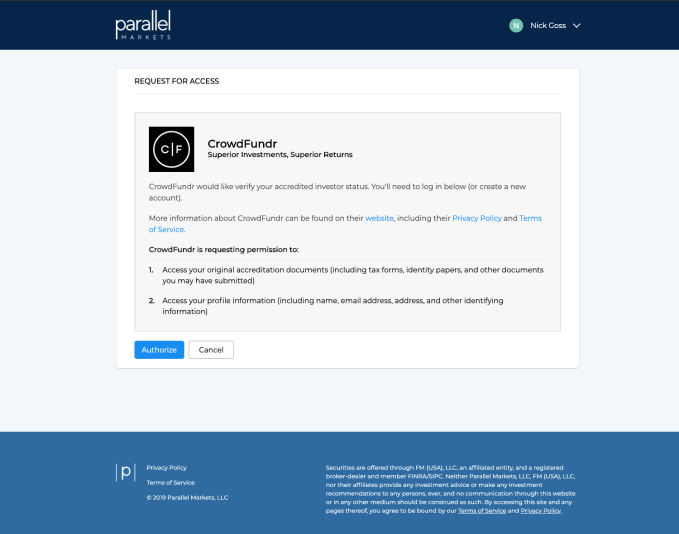
With Passport, on the other hand, investors can go through the verification process just one time. After that, when they’re looking to invest through a platform that uses Passport, they can simply click a button to give Passport permission to share their information.
“We looked for partners who could provide this, but we did not find anyone who could provide an ongoing identity verification tool that worked across multiple platforms,” Peccatiello told me in a follow-up email. “We want identity to be truly portable — not only on other third party websites but also places like the blockchain, which provides an interesting use case with smart contracts.”
Parallel Markets is a new startup aiming to make it as easy to buy and sell private company shares as it is for public company stock.
COO Nicholas Goss said this is becoming issue for startups as they stay private for longer, which means early employees can find their equity locked up for longer periods of time — and that’s assuming they can even afford to exercise their stock options.
“This is the type of thing that’s really change the game when it comes to attracting talent,” Goss said.
CTO Brian Muller added, “There’s a pent up demand, both for the ability to sell and the ability to buy … We’re bringing our platform into the mix to work directly with issuers to support that liquidity in a structured way.”
That idea of working with issuers (in other words, the companies whose stock is being sold) is a big of what the Parallel Markets team said distinguishes them from secondary marketplaces like SharesPost. Co-founder and CEO Tony Peccatiello said that while these sales usually happen without input from the company, Parallel Markets is taking a different approach, one that “puts the control over these transactions in the hands of a CFO.”
In other words, Parallel Markets will work with company executives to create what Peccatiello described as “structured liquidity events,” where employees can sell their stock to designated buyers at a given time. The platform also gives the companies additional controls, like a setting floors and ceilings on the price per share.
Meanwhile, all the employees get notified when there’s an opportunity to sell their stock. And the sales are handled by Parallel Markets’ subsidiary broker dealer, in a way that’s compliant with the various regulations.
Peccatiello said the startup — which has raised $1.4 million itself from friends and family — is already working with some initial partners, although it hasn’t actually powered any stock purchases yet: “We expect to be doing those in Q4 of this year.”
Goss (who previously worked as an IPO lawyer at Latham & Watkins, as well as on the investment banking team at Credit Suisse) predicted that over time, startups will make this a bigger part of their compensation packages, where it “almost mimics in reverse the vesting cliff,” where there’s not just a schedule for receiving stock, but also “when you can start selling into these liquidity events.”
Today, Parallel Markets is officially launching a new tool called Passport that Muller said was created for its own needs — namely, verifying accredited investors.
He explained that equity crowdfunding sites, plus other platforms that work with accredited investors, currently need to subject those investors to “a lengthy and arduous on-boarding process” that involves uploading a variety of documents to confirm their accredited status.
With Passport, on the other hand, investors can go through the verification process just one time. After that, when they’re looking to invest through a platform that uses Passport, they can simply click a button to give Passport permission to share their information.
“We looked for partners who could provide this, but we did not find anyone who could provide an ongoing identity verification tool that worked across multiple platforms,” Peccatiello told me in a follow-up email. “We want identity to be truly portable — not only on other third party websites but also places like the blockchain, which provides an interesting use case with smart contracts.”
The company, founded by marine biologist, Dominique Barnes, and chief technology officer, Michelle Wolf, who studied biomedical engineering at Carnegie Mellon, is helmed by longtime consumer goods executive Mary McGovern.
There’s a multi-billion dollar opportunity in the seafood market as consumers turn away from beef as a source of protein and several startups are out in the market pursuing either plant based or cultured protein alternatives to traditional seafood.
For Tyson, the investment is the latest foray into the increasingly competitive market for alternative meats.
The company was also an investor in Beyond Meat prior to its public offering and is backing the lab-grown meat company Memphis Meats as well.
“We’re excited about this investment in the fast-growing segment of the plant-based protein market,” said Amy Tu, president of Tyson Ventures, in a statement. “This continues our focus of identifying and investing in companies with disruptive products and breakthrough technologies related to our core business so we can continue to serve a growing global population.”
Culling together a development team of food scientists, academics and chefs under the direction of co-founder Michelle Wolf, the company has produced a seaweed and plant-protein alternative to shrimp that contains the 8 amino acids that are found in meat and seafood, the company says. New Wave Foods claims that its product is also lower in calories and salt than real shrimp and has zero colesterol and no allergens.
“Our product is a delicious, one-for-one direct swap for the real thing, and interchangeable in a wide range of recipes,” McGovern said in a statement. “It gives chefs and food service operators great menu options while addressing consumers’ growing demand for sustainable choices.”
Tyson already has a line of alternative protein products that it launched earlier this year under the Raised & Rooted brand.
The company, founded by marine biologist, Dominique Barnes, and chief technology officer, Michelle Wolf, who studied biomedical engineering at Carnegie Mellon, is helmed by longtime consumer goods executive Mary McGovern.
There’s a multi-billion dollar opportunity in the seafood market as consumers turn away from beef as a source of protein and several startups are out in the market pursuing either plant based or cultured protein alternatives to traditional seafood.
For Tyson, the investment is the latest foray into the increasingly competitive market for alternative meats.
The company was also an investor in Beyond Meat prior to its public offering and is backing the lab-grown meat company Memphis Meats as well.
“We’re excited about this investment in the fast-growing segment of the plant-based protein market,” said Amy Tu, president of Tyson Ventures, in a statement. “This continues our focus of identifying and investing in companies with disruptive products and breakthrough technologies related to our core business so we can continue to serve a growing global population.”
Culling together a development team of food scientists, academics and chefs under the direction of co-founder Michelle Wolf, the company has produced a seaweed and plant-protein alternative to shrimp that contains the 8 amino acids that are found in meat and seafood, the company says. New Wave Foods claims that its product is also lower in calories and salt than real shrimp and has zero colesterol and no allergens.
“Our product is a delicious, one-for-one direct swap for the real thing, and interchangeable in a wide range of recipes,” McGovern said in a statement. “It gives chefs and food service operators great menu options while addressing consumers’ growing demand for sustainable choices.”
Tyson already has a line of alternative protein products that it launched earlier this year under the Raised & Rooted brand.
TechCrunch is live from San Francisco’s YBCA’s Blue Shield of California Theater where we’re hosting our first event dedicated to the enterprise. Throughout the day, attendees and viewers can expect to hear from industry experts and partake in discussions about the potential of new technologies like quantum computing and AI, how to deal with the onslaught of security threats, investing in early-stage startups and plenty more.
We’ll be joined by some of the biggest names and the smartest and most prescient people in the industry, including Bill McDermott at SAP, Scott Farquhar at Atlassian, Julie Larson-Green at Qualtrics, Wendy Nather at Duo Security, Aaron Levie at Box and Andrew Ng at Landing AI.
Our agenda showcases some of the powerhouses in the space, but also plenty of smaller teams that are building and debunking fundamental technologies in the industry. We still have a few tricks up our sleeves and will be adding some new names to the agenda over the next month, so keep your eyes open.
In an ever-changing technological landscape, it’s not easy for VCs to know what’s coming next and how to place their bets. Yet, it’s the job of investors to peer around the corner and find the next big thing, whether that’s in AI, serverless, blockchain, edge computing or other emerging technologies. Our panel will look at the challenges of enterprise investing, what they look for in enterprise startups and how they decide where to put their money.
With tools like Jira, Bitbucket and Confluence, few companies influence how developers work as much as Atlassian. The company’s co-founder and co-CEO Scott Farquhar will join us to talk about growing his company, how it is bringing its tools to enterprises and what the future of software development in and for the enterprise will look like.
Q&A with Investors 10:10 AM – 10:40 AM
Your chance to ask questions of some of the greatest investors in enterprise.
For startups, the appeal of enterprise clients is not surprising — signing even one or two customers can make an entire business, and it can take just a few hundred to build a $1 billion unicorn company. But while corporate counterparts increasingly look to the startup community for partnership opportunities, making the jump to enterprise sales is far more complicated than scaling up the strategy startups already use to sell to SMBs or consumers. Hear from leaders who have experienced successes and pitfalls through the process as they address how startups can adapt their strategy with the needs of the enterprise in mind. Sponsored by SAP.
Apple’s Susan Prescott has been at the company since the early days of the iPhone, and she has seen the company make a strong push into the enterprise, whether through tooling or via strategic partnerships with companies like IBM, SAP and Cisco.
Box’s Enterprise Journey Aaron Levie (Box) 11:15 AM – 11:35 AM
Box started life as a consumer file-storage company and transformed early on into a successful enterprise SaaS company, focused on content management in the cloud. Levie will talk about what it’s like to travel the entire startup journey — and what the future holds for data platforms.
Bringing the Cloud to the Enterprise Mark Russinovich (Microsoft)
11:35 AM – 12:00 PM
Cloud computing may now seem like the default, but that’s far from true for most enterprises, which often still have tons of legacy software that runs in their own data centers. What does it mean to be all-in on the cloud, which is what Capital One recently accomplished. We’ll talk about how companies can make the move to the cloud easier, what not to do and how to develop a cloud strategy with an eye to the future.
Enterprises face a litany of threats from both inside and outside the firewall. Now more than ever, companies — especially startups — have to put security first. From preventing data from leaking to keeping bad actors out of your network, enterprises have it tough. How can you secure the enterprise without slowing growth? We’ll discuss the role of a modern CSO and how to move fast… without breaking things.
Keeping an Enterprise Behemoth on Course Bill McDermott (SAP) 1:25 PM – 1:45 PM
With over $166 billion is market cap, Germany-based SAP is one of the most valuable tech companies in the world today. Bill McDermott took the leadership in 2014, becoming the first American to hold this position. Since then, he has quickly grown the company, in part thanks to a number of $1 billion-plus acquisitions. We’ll talk to him about his approach to these acquisitions, his strategy for growing the company in a quickly changing market and the state of enterprise software in general.
You can’t go to an enterprise conference and not talk about Kubernetes, the incredibly popular open-source container orchestration project that was incubated at Google. For this panel, we brought together three of the founding members of the Kubernetes team and the current director of product management for the project at Google to talk about the past, present and future of the project and how it has changed how enterprises think about moving to the cloud and developing software.
Companies have historically competed by having data in their toolbox, and gleaning insights to make key business decisions. However, increased regulatory and societal scrutiny is requiring companies to rethink this approach. In this session, we explore the challenges and opportunities that businesses will experience as these conversations evolve. Sponsored by SAP.
AI is becoming table stakes for enterprise software as companies increasingly build AI into their tools to help process data faster or make more efficient use of resources. Our panel will talk about the growing role of AI in enterprise for companies big and small.
Q&A with Founders 3:00 PM – 3:30 PM
Your chance to ask questions of some of the greatest startup minds in enterprise technology.
As companies gather more data about their customers, it should theoretically improve the customer experience, buy myriad challenges face companies as they try to pull together information from a variety of vendors across disparate systems, both in the cloud and on prem. How do you pull together a coherent picture of your customers, while respecting their privacy and overcoming the technical challenges? We’ll ask a team of experts to find out.
Innovation Break: Identifying Overhyped Technology Trends
James Allworth (Cloudflare), George Mathew (Kespry) and Max Wessel (SAP) 3:40 PM – 4:00 PM
For innovation-focused businesses, deciding which technology trends are worth immediate investment, which trends are worth keeping on the radar and which are simply buzzworthy can be a challenging gray area to navigate and may ultimately make or break the future of a business. Hear from these innovation juggernauts as they provide their divergent perspectives on today’s hottest trends, including Blockchain, 5G, AI, VR and more. Sponsored by SAP.
Few technologists have been more central to the development of AI in the enterprise than Andrew Ng. With Landing AI and the backing of many top venture firms, Ng has the foundation to develop and launch the AI companies he thinks will be winners. We will talk about where Ng expects to see AI’s biggest impacts across the enterprise.
While we’re still a few years away from having quantum computers that will fulfill the full promise of this technology, many companies are already starting to experiment with what’s available today. We’ll talk about what startups and enterprises should know about quantum computing today to prepare for tomorrow.
There is certainly no shortage of data in the enterprise these days. The question is how do you process it and put it in shape to understand it and make better decisions? Our panel will discuss the challenges of data management and visualization in a shifting technological landscape where the term “big data” doesn’t begin to do the growing volume justice.