Year: 2019

05 Sep 2019

Lime stops working with freelancers in Paris

Scooter startup Lime is ending the juicer model in Paris. The company has announced that it will stop working with freelancers to recharge scooter batteries at night. Lime is switching to Amazon’s model by partnering with third-party companies.

Lime has often been criticized for relying on freelancers to take care of its scooters. As Libération reported back in May, the company used to pay freelancers €20 per scooter and slowly decreased that amount to €5 per scooter.

Juicers received a notification today telling them that their accounts will be deactivated in 45 days. The company probably doesn’t want to end the juicer program overnight so that freelancers have enough time to look for another job.

After that, Lime isn’t going to hire all juicers directly. The company is now looking for third-party companies that can help them manage the scooter fleet in Paris.

Lime says that those companies will have to comply with multiple quality and safety standards. For instance, the company will first select companies that use electric vehicles and renewable electricity. Based on wording, it seems like it doesn’t mean that all partners have to use electric vehicles and renewable electricity.

Finally, Lime says that former juicers will get some opportunities to become Lime employees. The company will also try to help some of them create a formal company to keep working with Lime.

This structure is quite reminiscent of Amazon in France. Amazon doesn’t hire delivery persons directly. They partner with third-party companies. Libération also reported that Amazon takes advantage of that relationship to foster productivity at all costs. If your company doesn’t perform well enough, Amazon just stops giving you packages to deliver.

Back in June, the City of Paris announced that it would clamp down on scooter startups. There are just too many of them currently operating in Paris. The city plans to select two or three companies and give them a license to operate.

It’s clear that Lime wants to improve its processes to get a license. Paris said that it would select companies based on how they pay workers charging scooters overnight and how they handle broken scooters.

05 Sep 2019

Google Assistant, navigation and apps coming to GM vehicles starting in 2021

GM is turning to Google to provide in-vehicle voice, navigation and other apps in its Buick, Cadillac, Chevrolet and GMC vehicles starting in 2021.

GM began shipping vehicles with Google Android Automotive OS in 2017, starting with the Cadillac CTS and expanding to other brands. Android Automotive OS shouldn’t be confused with Android Auto, which is a secondary interface that lies on top of an operating system. Android Automotive OS is modeled after its open-source mobile operating system that runs on Linux. But instead of running smartphones and tablets, Google modified it so it could be used in cars.

Now, GM is taking the additional step of embedding the Google services that so many people already use through their phones and smart speakers. GM was convinced by its own customer research to bring Google into its cars, Santiago Chamorro, GM’s vice president for global connected customer experience, told TechCrunch.

Google voice, navigation and apps found in the Google Play Store will be in compatible GM brands starting in 2021. Broad deployment across all GM brands is expected to occur in the years following.

Future GM infotainments, powered by Android, will have a built-in Google Assistant that drivers can use to make calls, text, play a radio station, change the climate in the car or close the garage door, if they have rhe requisite connected smart home device. The Google Assistant integration will continue to evolve over time, so that drivers in the future will be able to simply use their voice to engage with their vehicle, which could include renewing their
OnStar or Connected Services plans, checking on their tire pressure, scheduling service, according to GM and Google.

Google Maps will also be embedded in the vehicle to help drivers navigate with real-time traffic information, automatic re-routing and lane guidance. Google Assistant is tied into maps, allowing drivers to use voice to
navigate home, share their ETA or find the nearest gas station and EV charging stations.

The infotainment system will include in-vehicle apps from the Google Pay store.

GM isn’t ditching all of its own features for Google, Chamorro said, adding that the automaker will continue to offer its own infotainment features such as service recommendations, vehicle health status, in-vehicle commerce and more, with the Google applications and services complementing our offerings.

In May, Google announced that it was opening its Android  Automotive operating system up to third-party developers to bring music and other entertainment apps into vehicle infotainment systems. Media app developers are now able to create new entertainment experiences for Android Automotive OS.

Google has been pushing its way into the automotive world, first through Android Auto and then with its operating system, for several years now.

In 2017, Volvo announced plans to incorporate a version of its Android  operating system into its car infotainment systems. A year later, the company said it would embed voice-controlled Google Assistant, Google  Play Store, Google Maps and other Google services into its next-generation Sensus infotainment system.

Polestar  2, an all-electric vehicle developed by Volvo’s standalone electric performance brand, also has the Android OS. Renault-Nissan-Mitsubishi Alliance anf Fiat Chrysler Automobiles have also announced plans for Android Automotive OS.

“Cars are quickly transforming and opening up a lot of opportunity,” Patrick Brady, vice president of engineering at Google, said in a recent interview. “Its the beautiful thing about having a platform like this. There are services that we might not be thinking about today and that be here tomorrow.”

05 Sep 2019

We Company reportedly mulls slashing its valuation ahead of its initial public offering

The Wall Street Journal is reporting that the company formerly known as WeWork is considering slashing its valuation as it looks to woo public market investors.

The company is reportedly considering a valuation of somewhere in the $20 billion range for its initial public offering, a figure that’s far less than the $47 billion valuation it received when it raised its last round of private funding.

Since filing for its initial public offering earlier this summer, questions have swirled around the viability of The We Company (as it’s now known).

According to the Journal, the company’s chief executive officer and co-founder Adam Neumann flew to Tokyo last week to meet with SoftBank Group — one of the company’s largest investors.

Neumann went to see if SoftBank would make another investment into the company — reportedly coming in as an anchor investor for the public offering and taking a big bite of the $3 billion to $4 billion the company was looking to raise. Neumann also reportedly discussed using SoftBank cash to delay the public offering until 2020.

A few billion here and a few billion there, and soon you’re talking about real money.

SoftBank has already balked at putting more cash into the We Company ahead of the public offering, and it’s not clear whether the company will step in as a white knight now.  

What is clear is that We needs money and its long term viability as a business is contingent on the infusion of massive amounts of cash.

Indeed, the company has a $6 billion line of credit at stake, which would be pulled if the public offering underperforms.

If the company fails to hit the $3 billion mark in its public offering, then the credit line promised from the big banks that are underwriting the public offering goes away.  That would be a pretty devastating turn of events for a company that’s currently racking up losses in the billions of dollars.

All of this comes during a shuffling of deck chairs designed to make the company look somewhat better to institutional investors and the public. Stories like this, however, don’t instill confidence that the We Company can avoid the iceberg that is its own business model.

05 Sep 2019

TCL adopts Tempow’s multi-device bluetooth streaming tech

Here’s an interesting bit of news out of IFA today. TCL this morning announced a deal with Tempow that will bring the French company’s clever bluetooth streaming protocol to its forthcoming Plex flagship device.

TCL follows Motorola in adopting the Tempow Audio Profile (TAP) technology. The protocol, which Tempow showed off a few IFAs back, is software-based, allowing devices to stream to multiple bluetooth headphones and speakers simultaneously.

The company has clearly gained notice, tasing a $4 million funding round back in March of 2018. As Romain noted in his write up of that news, more than five million devices using Tempow’s stack, with the Moto X4 leading the way.

TCL and Tempow are making no bones about who they’re going after with this one. A press release touting the news mentions Apple several times, clearly targeting the chips that form the connections between its handsets and headphones/speakers. (Surely the news arriving a week before the new iPhones is a key part of that positioning.)

“There is a significant movement across mobile manufacturers to innovate and unlock the true potential of Bluetooth – the most recent example being Apple’s rumored Audio Sharing in iOS13.” said Tempow CEO Vincent Nallatamby said in a release. “What TCL built with Tempow far outstrips Apple’s sharing features, which are limited to two devices and only AirPods or Beats products.”

The Plex looks to be a solidly built mid-tier  6.53-inch handset, set for launch in parts of Europe and Australia. Meantime, I wouldn’t be too surprised to see Tempow’s tech hit an even wider adoption among Android handset makers in the coming year.

05 Sep 2019

Cooks Venture picks up $12 million to rethink agriculture from the ground up

“You are what what you’re eating eats,” says Matthew Wadiak, cofounder and CEO of Cooks Venture and former Blue Apron COO.

The company, which just received $12 million in funding, is looking to rethink the way we grow crops, feed our livestock, and ultimately take better care of our planet. The strategy is three-fold.

First, Cooks Venture partners with small farms to set up regenerative agricultural practices from its own IP, which it has also set up at its own 800-acre farm. This includes determining which types of plants will protect the soil itself and sequester carbon in the ground. It also includes measuring soil carbon, nutrition and other biological factors to promote biodiversity and stave off pest populations. According to the company, leading climate scientists believe that if this process was carried out for all farms across the globe, climate change could be reversed.

But regenerative agriculture as a product is just a small slice of what Cooks Ventures is all about. After all, what is Cooks Venture actually growing on its farm? The answer is chicken feed. But not the same old chicken feed that’s been around for generations.

Cooks Venture chicken feed is grown specifically for Cooks Venture chickens, which have been selected over many, many generations of Heritage chickens to have the best digestive health, and are given unrestricted access to the outdoors. All in all, it took more than a decade to isolate the genetic lines that have resulted in Cooks Venture chickens, called Heirloom chickens. These chickens are also more heat resistant, meaning that they can be raised in unusually hot places once the company looks to expand globally.

Because these chickens are able to eat a more diverse diet, with more fiber and protein than the chicken feed used on other chicken farms, they are higher in omegas, healthier and taste better, according to Wadiak. Moreover, Cooks Venture has managed to scale up its operations, including its own processing facility, to distribute upwards of 700,000 chickens per week.

Obviously, Cooks Venture’s main revenue model is selling chickens. The company is currently working with FreshDirect, Golden Gate Meat Company, and has more retail partnerships to announce soon, alongside sales of the chickens on its website.

But the funding will also go towards building out the upstream and downstream revenue models. Upstream, Cooks Venture wants to partner with farmers to not only build out regenerative agricultural practices, but to show them that they can actually grow more calories per acre (and thus make more money) by using these regenerative processes. The IP around how to do this — which crops to grow, which trees and ponds to leave in place, and how to rotate those crops — is a valuable product.

Downstream, the company wants to work with chicken farmers or companies who are interested in proliferating the Cooks Ventures genetic lines throughout the world.

In this way, Cooks Venture is the first vertically integrated agricultural company to operate solely on regenerative agriculture.

Wadiak says the greatest challenge to Cooks Venture is educating people around regenerative agtech and mobilizing those people to move the needle against old-school, economically unsound and environmentally unfriendly agricultural systems.

“97 percent of agriculture in America is crops and most of those crops are going to animal feed,” said Wadiak. “Unless we address the animal feed system in our country and the lobbying and political misrepresentation in those systems, it’s very challenging to change the food system and create regenerative systems.”

He added that America’s farmers make up two percent of the voting population, whereas billions of dollars are spent lobbying congressman to vote for proliferating subsidies in corn and soy.

The $12 million in financing was provided by AMERRA Capital Management.

05 Sep 2019

Facebook Dating launches in the U.S., adds Instagram integration

Are Americans ready to trust Facebook with their dating life? Barely more than a month has passed since the U.S. Federal Trade Commission fined Facebook a record $5 billion over its privacy lapses, and imposed a modified corporate structure to hold the company more accountable for its decisions over user privacy. In the wake of this historic action, Facebook’s brand-new dating product is today launching to all in the U.S., promising to leverage the company’s deep insight into people’s personal data to deliver better matches than rival dating apps like Tinder, Bumble, Match and others.

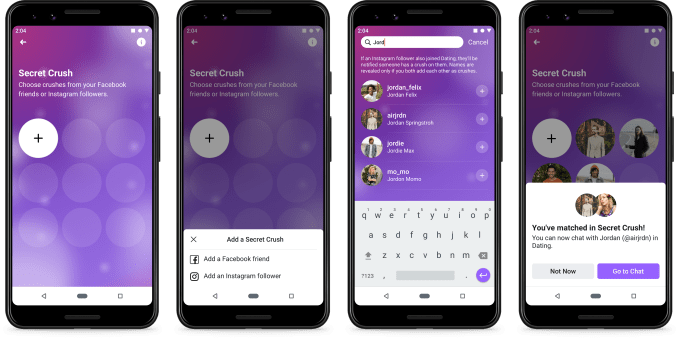
With its U.S. arrival, Facebook Dating will now also allow users to integrate their Instagram posts in their dating profile and add their Instagram followers to their “Secret Crush” list, in addition to Facebook friends.
Secret Crush DF

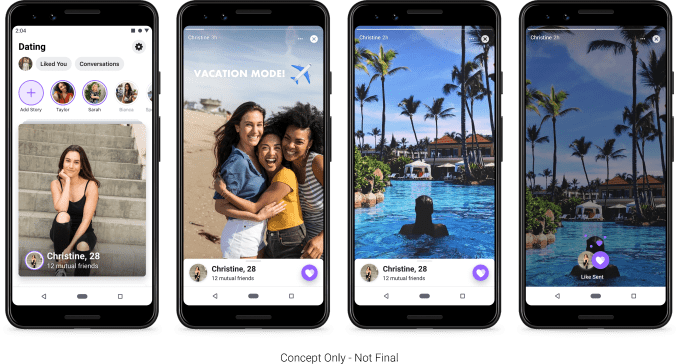
By year-end, Facebook Dating users will be able to select which Facebook or Instagram Stories they want to add to their dating profile.
FB and IG Stories

Trusting Facebook to find your match

Though the U.S. is the 20th market for Facebook Dating, it’s one of the most important for the product, which was first announced at the company’s F8 developer conference last year.

The new service represents a significant step toward making Facebook a tool for connecting with people who aren’t just friends or family.

This is an area where the company is now heavily invested. The Facebook Groups product, used by a billion people on a monthly basis, connects users by similar interests or by geographic location, as with its neighborhood groups. The company also launched Facebook at Work a few years ago to allow businesses to build their own networks on top of Facebook infrastructure.

Arguably, none of these efforts require as much trust as opening up your Facebook data — to a company known for its mishandling — in the hopes of finding love.
Entry Points 2 DF

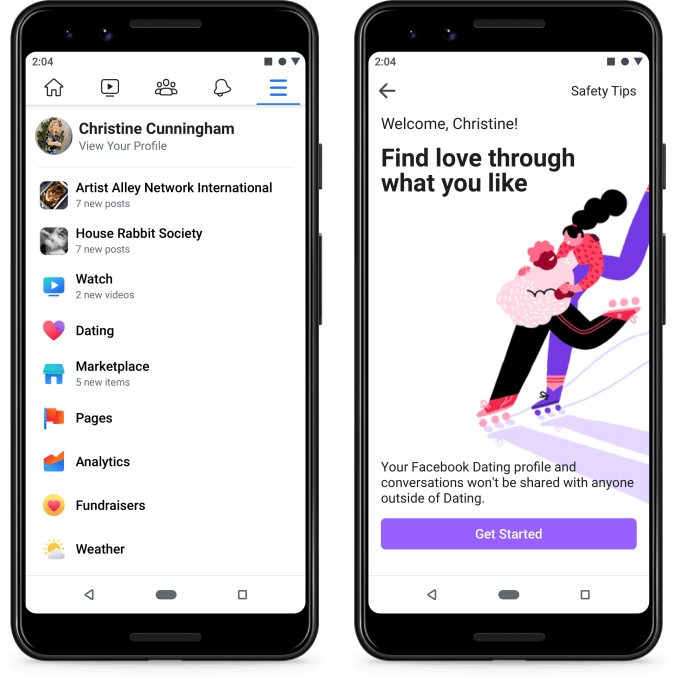
Facebook, well aware of the potential privacy pitfalls in such a product, has taken a number of steps to lock down the Facebook Dating experience so you’re not unwittingly outed to family or friends, or to work colleagues and other professional acquaintances. (Or, you know, to your spouse or significant other.)

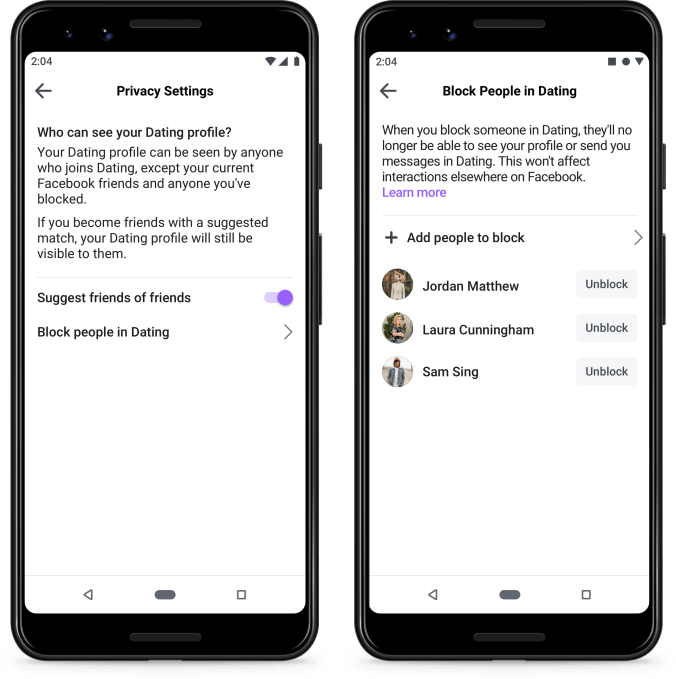
For starters, the people you’re shown on Facebook Dating will not include your Facebook Friends. You can also opt to have Facebook Dating only show you those people where you don’t have any friends in common, for another layer of protection. And you can pre-emptively block people from seeing your profile on Facebook Dating — which may work well as a way to ensure an ex’s profile never, ever comes up and to make sure they never see yours.

And of course, Dating is an opt-in experience.
Privacy DF

Your profile will never be visible to friends anywhere or to any people not on Facebook Dating, and it won’t appear in the News Feed. With the newly added Instagram integration, only your photos will be shown — not your Instagram handle.

However, there is still a way to add a Facebook friend as a “Secret Crush,” which will only be revealed if the interest is mutual. People are also limited to nine “crushes,” to prevent abuse of the feature. This now extends to Instagram followers, too, with the U.S. launch.
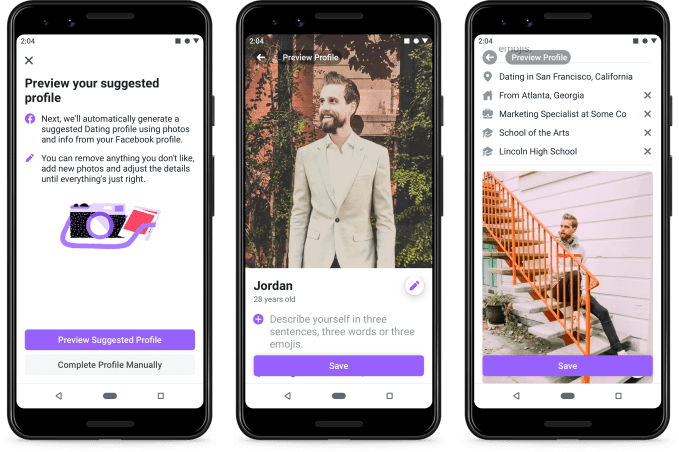
Profile Creation 1 DF

The product, which lives within the main Facebook app, also allows you to connect with people attending the same events or who participate in the same groups — though this is off by default and can be enabled on a one-by-one basis.

Beyond that, however, Facebook Dating will present you with a set of profiles based on other factors — mutual friends (if enabled), mutual groups (if enabled), mutual schools and other, unknown factors.
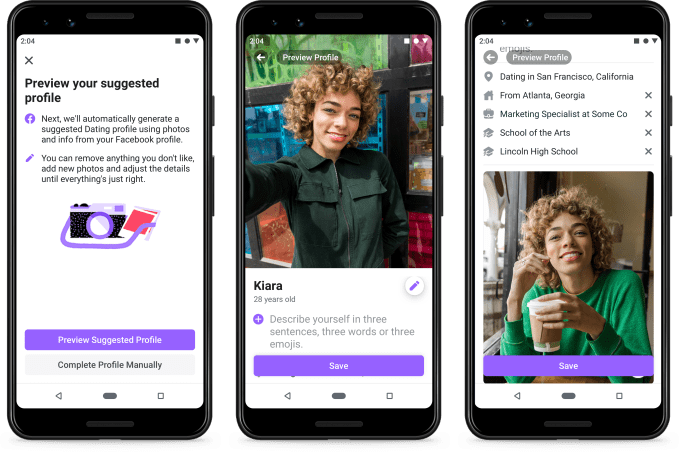
Profile Creation DF

This is where things get tricky.

Facebook, of course, has been known to be eerily accurate with its friend recommendations — so much so that some people believed it had to have been spying on them. (As it turned out, Facebook did know more about who you were connecting with than people had realized.)

In terms of Facebook Dating’s recommendations, it’s unclear what “other” data, specifically, Facebook will be using.

Officially, Facebook says that match suggestions are based on “your preferences, interests, and other things you do on Facebook.”

Asked how exactly Facebook will rank its profile suggestions, Nathan Sharp, the Product Lead for Facebook Dating, said he can’t discuss the details of the system.

What I can say is that, in terms of privacy, none of the people you would see or encounter would be divulging any sort of information,” he explains. “So, if you and Taylor, for example, had gone to the same college, but you’d never posted that on your dating profile, you may be up-ranked. But Taylor would never see what college you went to and you would never see what college Taylor went to,” says Sharp. 

Sharp notes that people may discover their mutualities — like sharing the same alma mater, for instance — naturally, through conversations had within Facebook Dating chat.
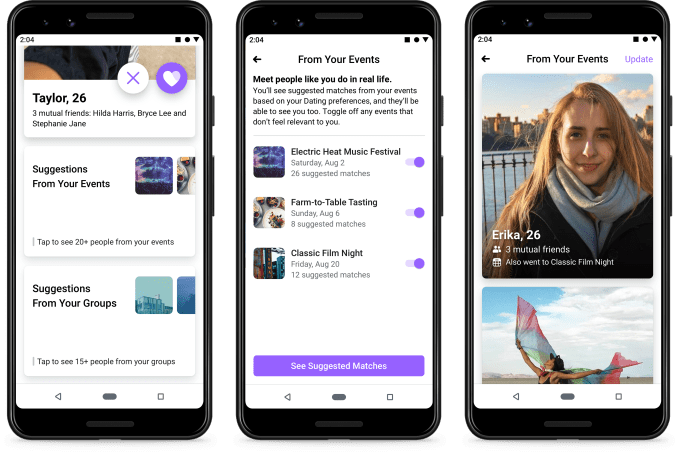
EventsandGroups multiple 1

Though it’s not unusual for a dating app maker to be tight-lipped about its secret sauce, the amount of data Facebook has to play with here is a competitive advantage and possibly a cause for concern as users are in control of what profile data Facebook is using behind-the-scenes.

On Tinder, you may write that you “love hiking,” but Facebook would know if you actually participated in hiking-related groups or events, and how often. It may know a lot more, too — like your check-ins to hiking trails, if there are mountains in your photos, if you posted updates with the keyword “hiking,” if you “Liked” Facebook Pages about hiking, etc. But Facebook won’t confirm if this sort of data is used or how.

If people can look past the uncertainty around Facebook’s use of their personal data — and that’s a huge unknown for the U.S. market — the product itself has several advantages.

Facebook Dating’s larger goal is to make matchmaking feel personal again. It aims to remind people there’s a real person behind these profiles. That dating is not meant to be a game. This could be a big differentiator from a market tired of but still committed to using dating apps.

The issue is that today’s dating apps aren’t incentivized to help people make long-lasting connections — after all, people who find a relationship abandon their dating service. That’s bad for the apps’ bottom line. What better, then, but to double down on the “single lifestyle,” as Tinder is now doing, to ensure users stick around?

Facebook, on the other hand, isn’t exactly worried about user churn. With the social network’s 2.4 billion monthly users, it has the bandwidth to make dating an additive feature. Its sheer numbers also mean the potential for a far larger pool of daters, including those who wouldn’t otherwise think to join a dating app.

Another advantage is that Facebook is a company that knows how to build a compelling user experience. It shines in the details on Facebook Dating — like how easily it flows you into a gender identification screen at setup, or how it gives you a way to quickly share your live location for first-date safety with a trusted friend on Messenger .

It’s cracking down on the sending of unsolicited photos and porn-bot spam that plague dating apps, by limiting chats to text and GIFs only. That means no links, photos, payments or videos can be shared in messages.

And when Story integration goes live by year-end, checking out daters’ less-polished updates may become a new favorite activity.
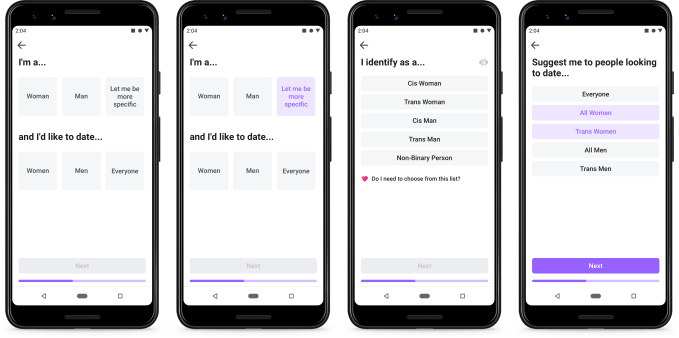
Gender Identity Flow

Finally, because its raison d’être is not (for now at least) direct monetization of core dating features — like messaging or returning to a profile you accidentally swiped past — Facebook can create a free product where you’re not limited by the app’s need to squeeze you for dollars.
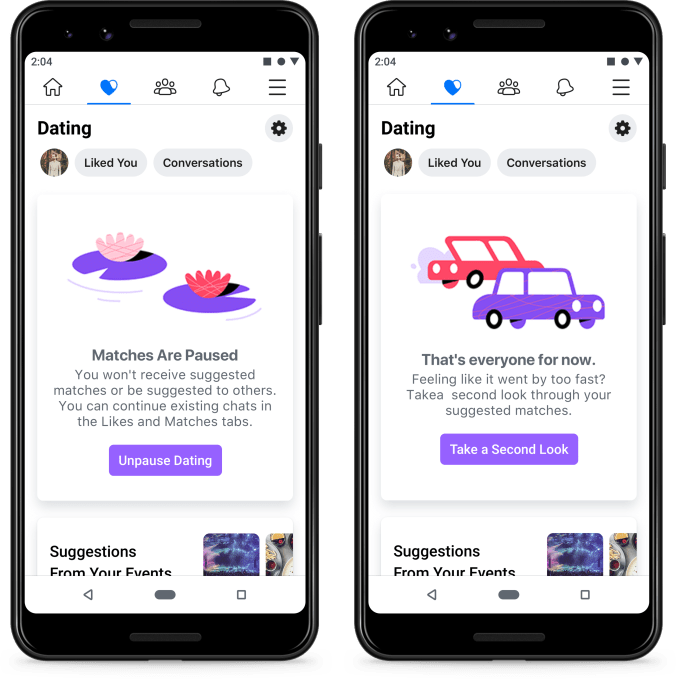
PauseMatch SecondLook DFThat said, the product can’t help but borrow from Tinder, with its set of rounded like/dislike buttons (why is there never a maybe?), photo-centric profiles that reward the genetically blessed, the integrated private chat and now Instagram integration, too.

Instagram Posts

In addition to the U.S., Facebook Dating is live already in Argentina, Bolivia, Brazil, Canada, Chile, Columbia, Ecuador, Guyana, Laos, Malaysia, Mexico, Paraguay, Peru, the Philippines, Singapore, Suriname, Thailand, Uruguay and Vietnam. It will be in Europe by early 2020. 

The company won’t say how many users are on the Dating product so far, but claims it’s “doing well.”

Facebook Dating is rolling out to users 18 and over in the U.S. starting today.

05 Sep 2019

Terramera raises $45 million for its technology to reduce the use of chemicals in agriculture

Terramera, a Canadian company selling bio-pesticides and seed treatments to reduce the use of chemicals in agriculture, has raised $45 million in its latest round of financing.

The round was led by strategic investor Ospraie Ag Science and the company’s previous backer, Seed2Growth Ventures.

Led by Carl Casale, a former Monsanto executive, Ospraie Ag Science has backed several manufacturers of bio-pesticides and organic crop management products including Marrone BioInnovations and Agrospheres.

Vancouver-based Terramera first came to prominence with a line of Neem-based pesticides that are sold in retailers across North America (including Target). That product targets bedbugs, mites and other household pests and funguses.

The company’s latest product is Actigate, and capital from its latest round will be used to boost research and development and sales and marketing, according to a statement.

“We are on the path to reduce global synthetic chemical loads in agriculture by 80% by 2030 with Actigate,” said Karn Manhas, Terramera founder and chief executive, in a statement.

According to the company, Actigate increases the efficacy of both biopesticides and traditional chemical pesticides to reduce the use of chemicals in . farming.

“Terramera’s Actigate platform shifts the paradigm, making biopesticides more effective and competitive,” said Casale in a statement. “There is also a huge opportunity to create value and reinvent conventional inputs to have greater impact, while reducing cost, waste and effects on the environment.”

The funding comes just a few months after Terramera’s acquisition of the technology and intellectual property portfolio of Exosect Limited.

That patent portfolio, which includes a range of compositions designed to improve delivery of organic and chemical seed treatments seems to have been a boon to Terramera’s own technology development.

“The acquisition of this IP portfolio will open up new opportunities and complement Terramera’s proprietary Actigate™ Targeted Performance technology,” Manhas, said at the time. “The IP portfolio enhances development of safer and more effective plant protection products, enabling our vision of creating a world with affordable, clean food for everyone.”
05 Sep 2019

Sonos took the mic out of its smart speaker for the $179 Sonos One SL

Sonos has a new entry-level connected speaker that will give you all of its multi-room, high-quality sound – without the onboard microphones and smart assistants of the Sonos One. The microphone-free Sonos One SL retails for $179.99 ($20 less than the existing Sonos One) and comes with AirPlay 2, delivering good functional upgrades over the Play:1 it replaces.

Visually, you’d be hard-pressed to tell the Sonos One from the Sonos One SL, especially at a distance. It has the exact same dimensions, and the same industrial design, featuring a matte black or white finish and controls on the top. Those controls are the one place you’ll notice an obvious difference, however – the Sonos One has an additional LED, microphone icon and capacitive touch surface above the playback controls for turning on and off the built-in smart assistant and microphone. The Sonos One SL, lacking a mic, has none of these.

Unlike the Play:1, Sonos One SL can stereo pair with a Sonos One, which is a nice feature because when using two of these in tandem in one room you actually only need one to have one with a mic for use with Alexa or Google Assistant. Two Sonos One SL speakers will also pair with one another, of course, and with combined savings of $40 vs. the Sonos One, these are naturally great candidates for use with the Sonos Beam for a home theater surround setup.

[gallery ids="1877509,1877510"]

Of course, you can also still use the Sonos One SL in combination with a smart assistant – just like you can with any other Sonos speaker, so you can specify to play music to them via voice control using any other Alexa or Google Assistant enabled device.

The $179 Sonos One SL is now the least expensive offering in Sonos’ own lineup – but the $149 Sonos x Ikea bookshelf speaker is the lowest-price Sonos-compatible offering overall. They’re a lot closer than you might think in terms of quality and other factors that would contribute to a buying decision, but the Sonos One probably has a slight edge in sound, where the Ikea bookshelf speaker is a bit more versatile in terms of mounting and installation options.

Sonos One SL is up for pre-order now, and will be shipping as of September 12.

05 Sep 2019

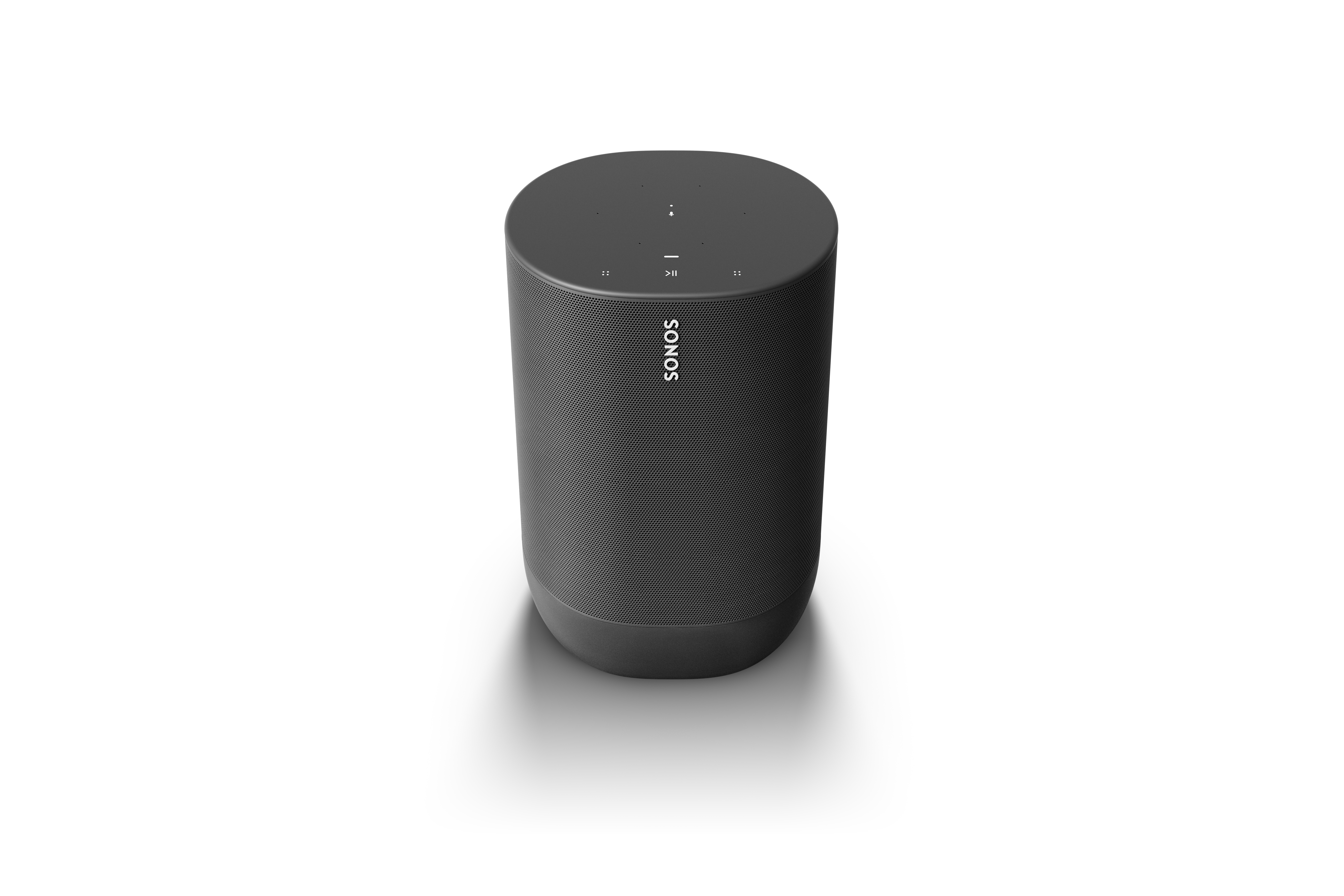
Sonos gets portable

This is the Sonos that many have no doubt been waiting for. With the Move, the premium audio company is finally getting into the portable bluetooth speaker market — but is doing so in a way that is decidedly Sonos.

There are, of course, already plenty of Bluetooth speakers to choose from. Many are cheaper, smaller and lighter weight. But none are, well, as Sonos as the Move. I got a glimpse of the speaker at a recent event in New York City, and was honestly a surprised by the size of the device at first. I’m not sure exactly what I was expecting from the various rumors that have have been floating around over the last few months, but the new speaker is definitely bigger than that.

Sonos Move 5

At six pounds, this isn’t a toss it in your backpack and head down to the beach speaker. Nor is it a shove it in your suitcase so you have something to listen to at the hotel during your work trip speaker. Instead, the speaker is best positioned as augmenting a home setup. It’s a compelling device for barbecuing in the backyard, or taking out to the garage.

Honestly, it was probably a savvy move on Sonos’s part. Again, there are billion cheaper, more portable bluetooth speakers on the market. Sonos clearly knows exactly where its audience is with this one. That means, among other things, not sacrificing sound quality. And, indeed, it sounds excellent.

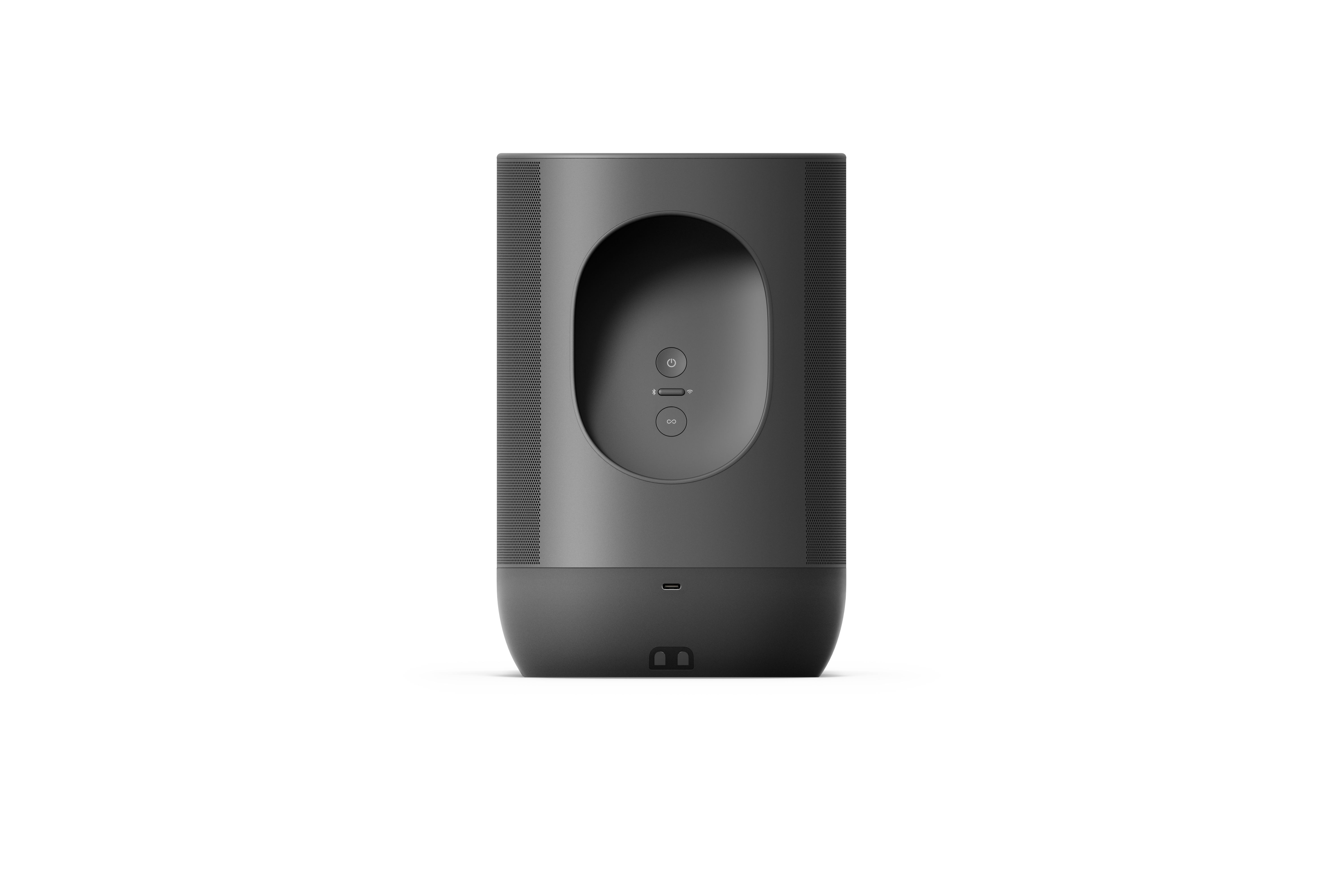
Sonos really wanted to share the specific engineering decisions behind the design choices here, but I’ll spare you the specifics and instead note that the Move has two class-d amplifiers, a downward fitting tweeter, a midwoofer and four far-field mics for noise cancellation and use with Amazon Alexa and Google Assistant.

Sonos Move 6

The most impressive bit of engineering onboard, however, is the inclusion of Trueplay, which uses microphones to determine the acoustic proper tuning for the speaker. The company demoed a fairly extreme scenario wherein the speaker was essentiality stuffed into a bookcase and surrounded on five sides by wood. It adjusted and performed admirably. The feature impressively also works outdoors.

[gallery ids="1877625,1877626,1877627,1877628,1877624,1877623"]

On that note, the Move is rated IP56 water resistant, which means a little outdoor moisture won’t hurt it. It can also take a pretty hearty drop — which isn’t something too many premium speakers can say. Also worth noting is the battery, which should get up to 10 hours on a charge. Flipping the speaker into Suspend mode, meanwhile, keeps the battery alive up to five days.

The Move arrives in stores September 24, priced at $399.

05 Sep 2019

The new Sonos Port connects your existing stereo setup to Sonos and AirPlay 2

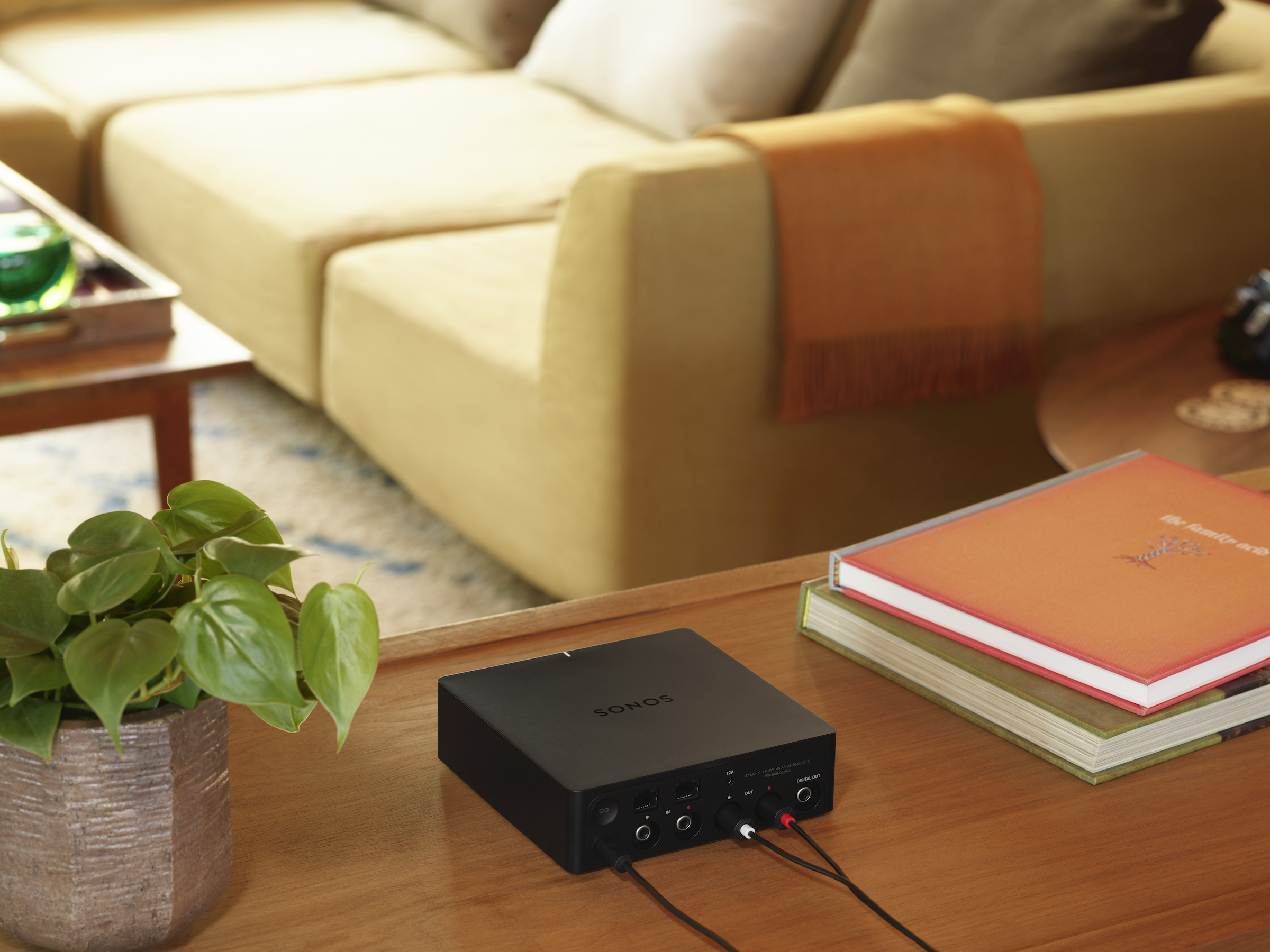
Sonos has a new addition to its ecosystem for connecting in your existing stereo and AV equipment, and for adding sound out and AirPlay 2 capabilities to existing speaker setups connected via an amplifier. It’s the $399 Sonos Port, and it replaces one of the older existing devices in the Sonos lineup, the Sonos Connect, with updated specs and a smaller footprint.

The Sonos Port is a small, matte black box, which has RCA and digital coaxial audio outputs for connecting to your existing home stereo or home theatre sound system, and an RCA audio in port for connecting audio sources, including things like a turntable, projector or other AV device that may not connect so easily to something like the Sonos Beam.

Sonos Port has a built-in digitial-to-analog converter (DAC), which makes it much more attractive as an option to sound quality buffs who want to add some connected and internet-capable media playback to their existing setup. Plus, if you connect it to your amplifier, any speakers you have connected to that automatically become AirPlay 2-compatible – and it’s works with Sonos’ existing Alexa and Google Assistant integration, meaning you can use voice commands to control playback (provided you also have a Sonos or Alexa device with a mic).

Sonos Port 4

The Sonos Port includes two built-in 10/100 Mbps Ethernet ports, so you can wire right into your router if you need a more reliable connection, and it has a 12V power trigger, which means it’ll automatically turn on stereo or receiver equipment when they’re connected and in standby mode.

A lot of the Port’s specs are similar to the outgoing Connect’s, but the more compact package, and its new matte black look seem much better in terms of integrated unobtrusively with your existing setup. The asking price may seem a bit steep for what is essentially a connectivity accessory, but the Sonos Connect basically replaces a DAC entirely, which can be quite expensive on its own, and uniquely provides Sonos connectivity and streaming capabilities as well.

Pre-orders for the Sonos Port begin today, and it’ll be available starting September 12 in the U.S., with a global rollout to follow early next year.
