Year: 2019

04 Sep 2019

We Company adds a director, ditches its $5.9 million naming deal with its CEO, remains a governance nightmare

The company formerly known as WeWork, in an amendment to the S-1 that launched dozens of critical headlines, says it has added a new director to its board and unwound the $5.9 million payout to chief executive Adam Neumann over the name “We.” 

The new board member is Frances Frei, a professor of technology and operations management at Harvard Business School and a consultant to the company since March 2019.

Frei’s previous claim to fame was rehabilitating the executive and managerial team at Uber Technologies in the wake of a series of fiascos that ultimately brought down the company’s chief executive, Travis Kalanick.

Frei becomes the first woman on the We Company’s board of directors — repairing an oversight which the company received criticism for when it first filed for its initial public offering. Shareholder advocacy groups have pressed for greater diversity on corporate boards as a means to improve company performance and offer a broader range of strategic guidance.

As part of the amended filing, The We Company also committed to add a director to the board that will increase the company’s gender and ethnic diversity.

In the same amendment, the company said that it was unwinding the $5.9 million transaction between itself and a holding company — WE Holdings LLC, which held the trademark for the “We” brand and was owned by We Company’s chief executive, Adam Neumann.

“[At] Adam’s direction, the issuance to WE Holdings LLC of the partnership interests was unwound and the partnership interests were returned to the We Company Partnership,” the company said in a statement.

To clarify: The chief executive officer of a company agreed to unwind an agreement with himself that paid him nearly $6 million so that the company he ran could use the trademark “We.” It also added a new “independent” director to its board who had been a paid consultant of the company for months before joining the board of directors.

All of this comes after the same chief executive cashed out of $700 million through company stock and loan agreements.

No wonder people are calling the company a “corporate governance nightmare.”

04 Sep 2019

Betaworks’ next startup camp is focused on audio

Startup studio Betaworks is putting out a call for audio-focused startups.

Specifically, it’s announcing Audiocamp, the latest in its “camp” programs, where it makes a pre-seed investment in a handful of early-stage startups, all around a specific theme. (The last one was focused on synthetic media.)

“When we make these calls for a camp around a theme, what we’re trying to do is see everything that’s out there in a short period of time,” said Danika Laszuk, the head of Betaworks Camp. “We use that to help us understand what are the more innovative things, and where are 57 companies trying to build essentially the same thing?”

The startups, meanwhile, get a “pre-seed” investment from Betaworks, as well as three months to work out of the firm’s office in New York City, where they can learn from and collaborate with each other.

Why focus on audio now? Laszuk said the firm has been interested in the industry for a long time — it was an early investor in podcasting startups Gimlet and Anchor, which Spotify acquired earlier this year. The current interest in audio isn’t just driven by the podcast boom, but also the opportunities around smart speakers and what Lazsuk said will be “the next wave of innovation,” building “audio-first” services for people who are wearing AirPods and other wireless headphones all the time.

She acknowledged that this “always-in” behavior isn’t necessarily a good thing, since it can lead people to become increasingly oblivious to the world around them, but she said that’s been an ongoing worry since the first iPod (and maybe even before that).

“I’m not sure we will singlehandedly break people of that addiction, but there’s so much more awareness around that, and maybe I could have this more thoughtful, context-aware, mobile appropriate experience,” she said.

And that’s just one of the several audio-related categories that Betaworks said it’s looking at for Audiocamp. The others are: Social audio experiences, synthetic/generative audio and music, audio utilities, natural language tools for audio, content discovery and monetization, augmented reality for audio and voice-first applications for smart speakers.

As a podcaster myself, I was particularly interested in Laszuk’s thoughts on discovery and monetization. On the discovery side, she predicted we’ll see AI-powered tools that “help us all find the gems in the long tail.”

As for monetization, she noted that some companies have already had success with subscriptions and listener-supported models. So while she isn’t sure what comes next, she’s “really interested in things that are not ad-based — or if they are ad-based, they’re more innovative and thoughtful than just new ad networks.”

The first application deadline will be October 15. Interested startups can read more in Laszuk’s blog post and apply here.

04 Sep 2019

The best mouse you can buy finally gets USB-C with Logitech’s new MX Master 3

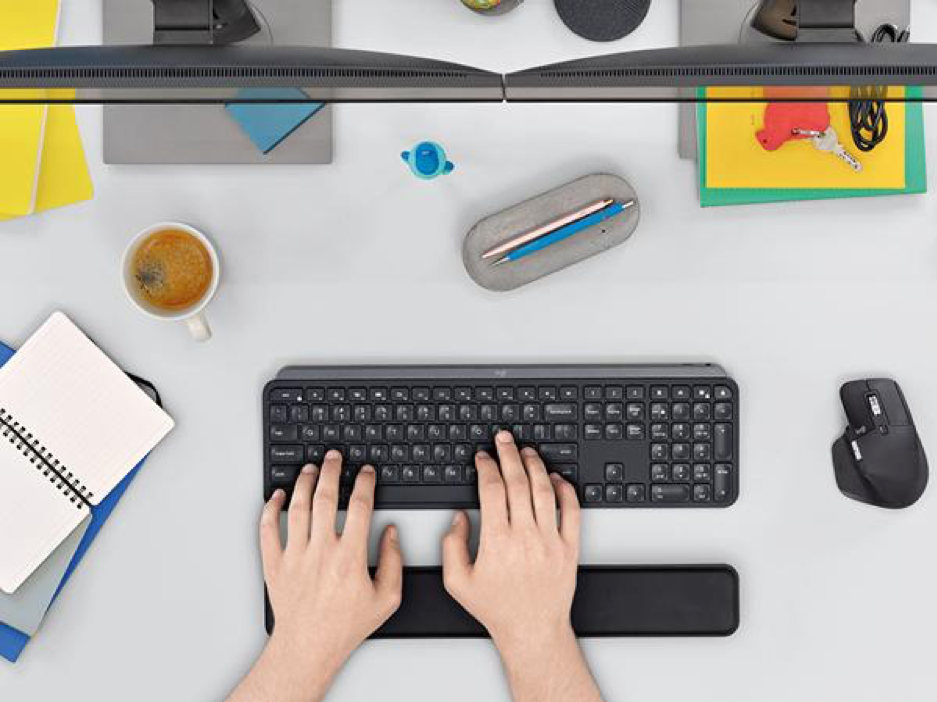
Logitech has delivered a new version of its popular MX Master mouse – the MX Master 3. This brand new iteration of the wireless mouse finally adds USB-C charging, which brings it in line with the charging standards used on most modern smartphones and computer accessories. Along with the MX Master 3, Logitech also debuted its new MX Keys wireless keyboard, which gives you a lot of what’s great about their fantastic Logitech Craft keyboard in a more affordable, slightly trimmed down package.

The MX Master 3 mouse isn’t just about adding USB-C (although that alone might be reason enough for me to upgrade, personally). It also packs new scroll wheel technology that is 90 percent faster, 8 percent more precise, and almost entirely silent, according to Logitech.

Along with its improvements, it comes with the same highly accurate 4,000 DPI tracking sensor, which uses Logitech’s ‘Darkfield’ technology that optimizes tracking on virtually every surface. The built-in battery is good for as many as 70 days on a full charge, and via the new USB-C quick charging, you’ll get a full day of use in just three minutes of charging.

MXMaster3MXKeys

The body is slightly redesigned on this mouse, too, but only slightly so it’s probably going to feel just as comfortable if you’re a fan of the existing Master series. The MX Master 3 retails for $99.99 and is on sale now via Logitech directly and Amazon.

The MX Keys keyboard, which is also on sale now with a retail price of $99.99. It has illuminated keys, with automatic hand detection, which you can turn off if you want for longer battery life. You an also get an optional add-on detachable palm rest for more ergonomic typing. This looks like a really promising piece of hardware based on the reputation of the excellent Logitech Craft, but a much better bargain.

04 Sep 2019

Only 3 days left on early-bird pricing to Disrupt SF 2019

The early-bird countdown clock just keeps spinning, folks, and once it ticks over to 11:59 p.m. (PST) on September 6, your chance to save up to $1,300 on passes to Disrupt SF 2019 disappears once and for all. Save your money to feather your nest; buy your early-bird passes right now.

Our flagship Disrupt kicks off in less than one month (on October 2), and we can’t wait. More than 10,000 people will descend on Moscone North to focus on anything and everything related to early-stage startups. This is prime networking territory people, and we have just the tool to help you save time and find only the people who can help move your business forward.

Disrupt attendees with Innovator, Founder or Investor passes can use CrunchMatch, our free business match-making platform. Powered by Brella, it’s a curated, automated way to search for suitable prospects — based on profiles each user submits. CrunchMatch suggests people to meet and lets you send, accept or decline meeting requests. And you can use the service to reserve dedicated meeting spaces.

You’ll be the model of networking efficiency as you work your way through hundreds of exhibiting startups in Startup Alley. Get a jump on researching who to meet by exploring our directory of exhibiting startups.

Startup Alley is also home to our TC Top Picks — a hand-picked cadre of 45 companies representing the best early-stage startups in these categories: AI/Machine Learning, Biotech/Healthtech, Blockchain, Fintech, Mobility, Privacy/Security, Retail/E-commerce, Robotics/IoT/Hardware, SaaS and Social Impact & Education.

Networking is a huge part of the Disrupt experience, but you’ll find plenty of other fascinating people and events. Like the always-epic Startup Battlefield pitch competition, where a $100,000 prize is on the line.

Take a good long look at the Disrupt SF agenda featuring top-notch speakers and presentations. You’ll find great programming across four distinct areas: the Main Stage, the Extra Crunch Stage, Q&A sessions and the Showcase Stage.

Check out (or compete in) the TC Hackathon, a high-pressure marathon where hundreds of skilled coders, UX designers and other innovative makers build working solutions to real-world challenges in less than 24 hours.

So much to do and so little time left to score early-bird pricing on your pass to Disrupt SF 2019. Don’t let the clock run out — the savings expire in just three days at 11:59 p.m. (PST) on September 6. Buy your early-bird passes… and save up to $1,300.

Is your company interested in sponsoring or exhibiting at Disrupt San Francisco 2019? Contact our sponsorship sales team by filling out this form.

04 Sep 2019

Fleet Space Technologies raises $7.35M for its space-based IoT tech

Australian satellite startup Fleet Space Technologies has raised a $7.35 million round of funding to help launch its next generation of nanosatellites, extremely small satellites it employs to delivery Internet of Things (IoT) connectivity to customers globally.

Fleet’s satellites are roughly the size of shoeboxes, which are much cheaper and easier to launch than traditional geocommnications satellite, and the company intends to use a globe-spanning constellation of these in order to serve needs like tracking construction equipment assets, monitoring pipelines and other utility infrastructure, and more.

Already, Fleet has launched four of its nanosatellites to orbit, on a number of different rockets including an Indian Space Research Organization (ISRO) rocket, a Rocket Lab launch, and via SpaceX . Its existing fleet is only a very small part of its planned constellation, but already the startup says it’s witnessed “unprecedented demand” from over three million compatible devices registered to join their network.

Connected IoT in industrial applications is a huge potential market, and could be made up of more than 14 billion low-power devices by 2025, Fleet Space says based on IDC estimates. That’s a lot of hardware that needs to be able to effectively connect to, and communicate with, central hubs that take. Edge computing is a huge trend right now, where a lot of these previously fairly rudimentary on-device sensors and monitors are able to do more processing on-site, but at some point the value of a network of IoT devices is that the resulted data can be collected, analyzed, turned into product improvements and redeployed.

Fleet Nanosatellite dog

Fleet’s Nanosatellite (dog for scale). Image courtesy of Fleet.

Fleet’s tech is the connective tissue that can bind all these devices, in a way that’s much more scalable and affordable for commercial and industrial clients large and small. Satellite-based network coverage works in tandem with ground-based networks, which helps ensure there aren’t any blind spots in industries where communication can be hard to come by, like agriculture, forestry and mining.

This round of funding includes investment from Momenta entries and Horizon Ventures, and adds to the previous $5 million AUD ($3.4 million USD) that Fleet raised previously from Blackbird Ventures, Grok Ventures, and with contribution from the South Australian government.

04 Sep 2019

Cowboy recruits Sunrise co-founder Jeremy Le Van as VP of Product

Electric bike maker Cowboy has recruited a well-known name when it comes to mobile app design. Jeremy Le Van co-founded Sunrise, a well-designed calendar app that was acquired by Microsoft back in 2015. Le Van will become VP of Product and lead the development of Cowboy’s mobile app.

Following Sunrise’s acquisition, Le Van has worked for Microsoft for a handful of years. Sunrise has been the foundation for the calendar feature of the Outlook mobile app.

“I am incredibly excited to join the Cowboy team and bring my insights into how we can transform the smart bicycle market to make it more appealing to the mobile-first generation,” he said in a statement.

Of course, Cowboy is a hardware company as it designs and sells an e-bike. The company wants to make e-bikes more efficient. It features an automatic transmission — motor assistance kicks in automatically when you need it the most, such as when you start pedaling, you accelerate or you go uphill.

Cowboy bikes also feature integrated lights with a rear light that flashes when you break, a rubber and glass fiber belt and a removable battery. Like VanMoof bikes, it has built-in GPS tracking and an integrated SIM card — you unlock the bike with your phone.

But the mobile app is also an essential part of the experience. You can configure the lights, check the battery and get stats from the app. Let’s see how it evolves with today’s appointment.

Cowboy is currently available in Belgium, France, Germany, the Netherlands and Austria. The startup has raised a €10 million Series A founding round from Tiger Global, Index Ventures, Hardware Club and others.

04 Sep 2019

Top EC articles in August, Apple privacy woes, autonomous delivery robotics Starship, and Zhihu

Top Articles in August

We are back from Labor Day (which an ironically somewhat unkind Canadian EC subscriber noted also takes place up north). August was the most successful month for Extra Crunch since our launch about six months ago — so thank you to the thousands of new and continuing members that help us sustain quality journalism and analysis.

For those who took extended vacations last month, here are the top five most popular articles among EC members we published last month:

Y Combinator Demo Day: We picked our favorites from day one and day two and our venture capital reporter Kate Clark wrote an analysis of what the 160+ startups in the batch seemed to indicate about YC’s investment theses these days. YC remains as popular as ever if EC members’ curiosity with these articles is any indication.

How a Swedish saxophonist built Kobalt, the world’s next music unicorn: Our Extra Crunch media columnist Eric Peckham traveled to Europe to report out this deep dive into Kobalt, which is upending traditional music rights management, and is closing in on unicorn status as well. This origin story here was one of my favorites, since it showed how tenacity against incredible adversity can lead to success in the long run. I am editing Eric’s next two parts of this EC-1 as I write this, so expect those shortly.

How Dropbox, Nike, Salesforce, MailChimp, Google and Pepsi welcome their new hires: This was a bit of a surprise one for me. Our guest writer Vladimir Polo has been collecting welcome kits from different companies for years, and he compiled all of them for this piece on how different companies think about welcoming employees.

WeWork’s S-1 misses these three key points: WeWork is the most polarizing startup I have seen in sometime. So I read through the S-1 (yes, all 200-300 pages of the damn thing) to find a couple of nuggets I thought the company was missing from the filing (which, in itself, was a follow up of my EC analysis of what we should expect to see in the S-1 in the first place).

How should B2B startups think about growth? Not like B2C: Finally, we had our guest writers Kevin Barry and Tyler Elliston discuss the differences between marketing and growing a B2B startup and how that compares with B2C startups. They give a detailed guide on the ways to think about growth in B2B and the tactical tools that these startups can use.

Apple still has work to do on privacy

Over the long weekend, our privacy and policy writer Natasha Lomas wrote an insightful analysis of what we know about Apple’s privacy promises given the news that the company was offering Siri recordings to contractors for grading. Lomas sees Apple’s privacy promises as quite cynical given the context, but also sees an opportunity for the company to right its past wrongs.

04 Sep 2019

Children’s privacy costs just $170 million for Google in settlement with the FTC

The Federal Trade Commission has set a price on children’s privacy online and the going rate is $170 million.

That’s how much Google will have to pay under the terms of a settlement agreement to end investigations by the Federal Trade Commission and the New York Attorney General into YouTube’s alleged collection of children’s personal information without the consent of their parents.

YouTube has long had a problem with the way it treats children and their private information online. The settlement, which is a pittance, follows a complaint brought by the Federal Trade Commission and the New York Attorney General which accused the companies of violating the Children’s Online Privacy Protection Act (COPPA) Rule.

As a result of the settlement, Google and YouTube will pay $136 million to the FTC and $34 million to New York. It’s the largest amount the FTC has ever collected under a COPPA case, the FTC notes. Google will make the money back in less than a day (in fact, the FTC redacted a portion of the dissent from its Democratic commissioner that disclosed how much money YouTube makes from children’s advertising).

Needless to say, the advocates who were behind the complaints brought by the regulators were not impressed. 

“We are pleased that our advocacy has compelled the FTC to finally address YouTube’s longstanding COPPA violations and that there will be considerably less behavioral advertising targeted to children on the number one kids’ site in the world,” said Campaign for a Commercial Free Childhood Executive Director, Josh Golin. “But it’s extremely disappointing that the FTC isn’t requiring more substantive changes or doing more to hold Google accountable for harming children through years of illegal data collection. A plethora of parental concerns about YouTube – from inappropriate content and recommendations to excessive screen time – can all be traced to Google’s business model of using data to maximize watch time and ad revenue.”

The settlement brings to an end a year-long investigation triggered by the CCFC and other advocacy groups.

The complaint from the FTC and New York AG hinged on Google’s use of cookies from viewers of kids channels on YouTube that tracked those viewers across the internet without receiving the permission of parents first. 

Under COPPA rules, websites and online services targeting children need to disclose their data collection practices and receive consent from parents or guardians before they hoover up information for kids under 13… including the use of cookies. Third party networks also have to abide by the COPPA rules if they know that they’re using personal information of kids under 13.

“YouTube touted its popularity with children to prospective corporate clients,” said FTC Chairman Joe Simons, in a statement. “Yet when it came to complying with COPPA, the company refused to acknowledge that portions of its platform were clearly directed to kids. There’s no excuse for YouTube’s violations of the law.”

YouTube was able to skirt the law by insisting that its users were not under 13 in its communications with advertisers despite pitching toymakers like Mattel and Hasbro that it was “today’s leader in reaching children age 6-11 against top TV channels”.

The settlement with YouTube and Google requires both companies to develop and maintain a system that lets channel owners identify the content that’s targeting children so it can ensure YouTube is complying with COPPA rules. The companies must also tell channel owners that any kids-focused content is subject to COPPA rules.

Google and YouTube aren’t the only companies to get popped with fines for targeting ads to kids and collecting information without consent. Oath (now Verizon Media Group and the once and future owner of TechCrunch), was forced to pay a $5 million settlement for similar violations.

04 Sep 2019

Porsche’s all-electric evolution: from sketch to Mission E concept to Porsche Taycan

The Porsche Taycan, the German automaker’s first all-electric sports car has arrived. After four years of development, the company lifted the veil Wednesday on the Porsche Taycan.

Here’s a look back at how this four-door electric vehicle developed from a few sketches to the Mission E concept, and then to the Taycan prototype and final production model.

September 2015: Porsche unveils the Mission E at the Frankfurt International Motor Show. Porsche says the concept has the first 800-volt drive system, will produce more than 600 horsepower (or 440 kilowatts in system power) and about a 310-mile battery range. Other concept-era stats include an all-wheel drive and all-wheel steering, the ability to go from zero to 100 km/h (62 miles per hour) in under 3.5 seconds and a charging time of around 15 minutes to reach an 80% charge of electrical energy.

The tech inside the concept includes instruments that are intuitively operated by eye-tracking and gesture control, some even via holograms – highly oriented toward the driver by automatically adjusting the displays to the driver’s position.

[gallery ids="1876793,1876794,1876798,1876808,1876811,1876966,1876967,1876968,1876974,1876975,1876970,1876971,1876972,1876973,1876977,1876978"]

December 2015: Porsche AG board funds Mission E. This means Porsche makes it official and announces plans to bring the all-electric four-door sports car into production by the end of the decade. The company says it won’t hit the road until at least 2020.

Porsche also says it will spend more than $760 million and add 1,000 new jobs at its Stuttgart-Zuffenhausen facility to produce the all-electric sports car.

January 2016: Porsche AG Chairman Oliver Blume reiterates the company’s commitment to plug-in hybrids and the all-electric Mission E concept car. Porsche will spend $1 billion to develop the Mission E, Blume says at the time. That’s a nearly 30% increase from what the company had previously shared about its investment.

September 2017: Blume indicates that the Mission E will go on sale at the end of 2019. The company is preparing to send its prototypes onto public roads.

Blume doesn’t provide details on the price. However, he tells CAR in an interview that the all-electric four-door sports car is designed to sit between the Panamera and the 911 in Porsche’s portfolio. And it will be priced like an entry-level Panamera, which is $85,000.

June 2018: Porsche gives electric sports car an official name. It will be called the Porsche Taycan, which is pronounced tai-kan. The automaker says Taycan is roughly translated as “lively, young horse” in a nod to its iconic emblem.

March 2019: Porsche’s Blume says during the 2019 Geneva International Motor Show that more than 20,000 people have registered to join a list of prospective buyers, which requires a down payment of 2,500 euros, for the Taycan.

The company had planned for an annual production of 20,000 Taycan. Due to higher than expected interest, Porsche decides to increase production capacity, Blume says in an interview with autogazette.de.

July 2019: Porsche Taycan reservations have hit 30,000 deposits, according to Bloomberg and Porsche HR head Andreas Haffner in an interview with German business publication Handelsblatt.

August 2019: Porsche announces that it will integrate Apple  Music into the Taycan sports car, the first time the music streaming service has been offered as a standalone app within a vehicle. The Apple Music integration will begin with the Taycan. However, the relationship between Apple and Porsche won’t end there, Porsche North America CEO Klaus Zellmer tells TechCrunch.

August 2019: Porsche Taycan sets a narrow, yet notable record lap time at the famous Nürburgring Nordschleife test track in Germany. The vehicle completes the 12.8-mile course in 7 minutes and 42 seconds. This is the fastest lap for a four-door electric vehicle. The record time was set in a pre-series Taycan driven by Lars Kern.

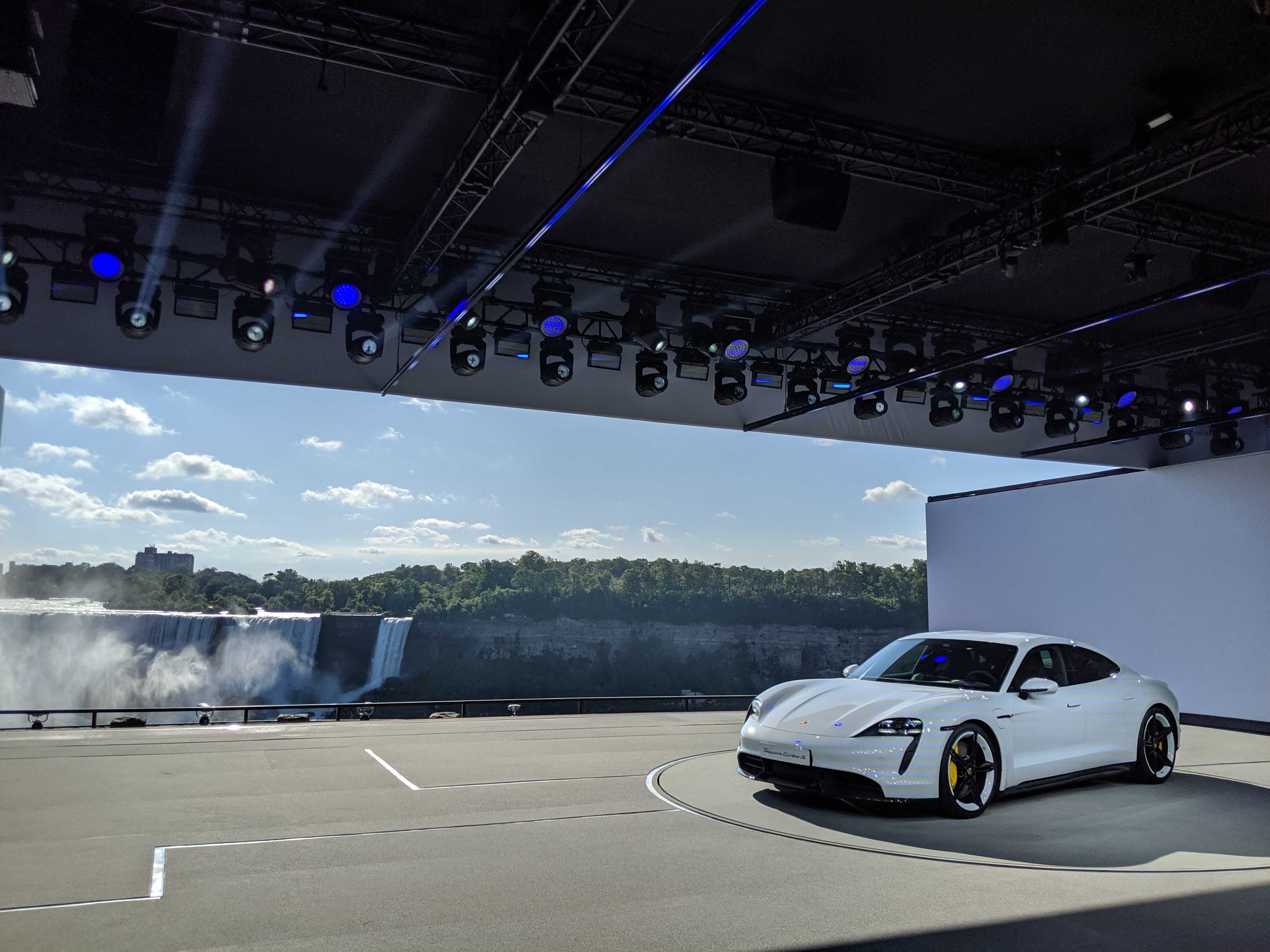
September 4: Porsche unveils the production version of its first all-electric vehicle. The company will launch with two variants, the Porsche Taycan Turbo S and the Porsche Taycan Turbo, Deliveries are expected to begin at before the end of the year.
Porsche Taycan reveal
04 Sep 2019

Amazon unveils a new Fire TV Cube, soundbar, and over a dozen Fire TV Edition products

At the big European tech trade show, IFA 2019, Amazon today announced over 20 new Fire TV-branded devices, including a next-generation Fire TV Cube, Fire TV Edition soundbar from Anker — its first foray into Fire TV Edition audio products — and 15 new Fire TV Edition products, including the first OLED Fire TV Edition smart TVs.

The announcement represents a significant expansion of Amazon’s Fire TV hardware line and integrations at a time when Roku has gained a lead over Amazon in the U.S., in terms of connected-TV market share, while Fire TV has been claiming the top spot in some European markets and an international lead over Roku.

The company today said its Fire TV devices now have over 37 million monthly active users globally, which is ahead of the 30.5 million Roku reported in Q2. Both companies offer products that may be used by more than one person in a household, of course, but each household only gets counted as one user (or account) as long as they’ve streamed through the platform in the past month. It’s a relatively fair comparison, in other words.

Of the new devices, the new Fire TV Cube is one of the more interesting additions to the lineup as it represents the second generation, and a big upgrade, over the existing product. The device offers a hands-free Fire TV experience, and has become the testing ground for many Fire TV software enhancements before they roll out to the wider product lineup.
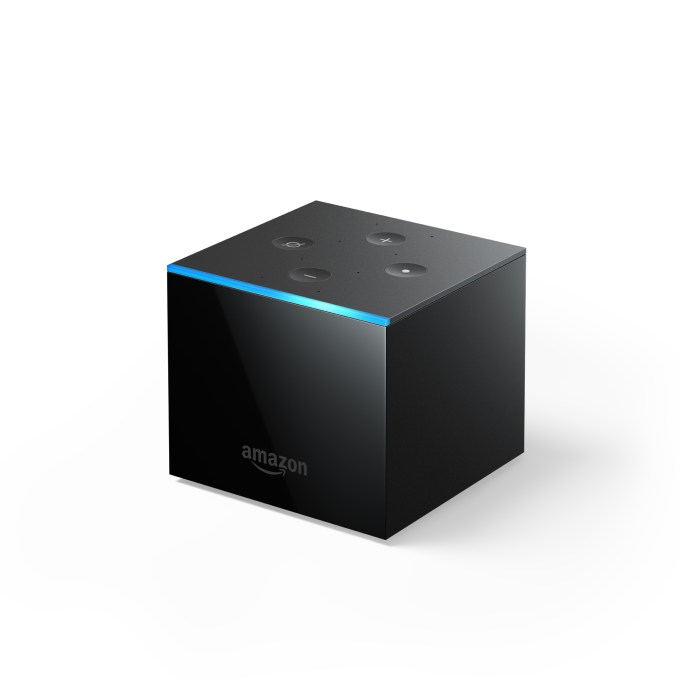
All new Fire TV Cube side

The updated Fire TV Cube now includes a faster, “hexa-core” processor that’s twice as powerful as the one that shipped in the first generation device. It provides “instant access” to Dolby Vision and 4K Ultra HD content, Amazon claims, at up to 60 frames per second. The new Cube also includes on-device processing with Local Voice Control, which lets you more quickly execute some of your common voice commands like “Alexa, go home,” or “Alexa, scroll right,” for example. These commands will now execute up to 4 times faster, says Amazon.

The Fire TV Cube will also ship with far-field voice recognition capabilities with 8 microphones and technology that helps to suppress noise, reverberation, content currently playing, and even competing speech so Alexa better hears your voice commands even when the TV is on in a room full of people.

Customers will be able to control their compatible TV, soundbar, A/V receiver, cable or satellite box, as well as other smart home devices by way of the device’s support of multi-directional infrared technology, cloud-based protocols, and HDMI CEC, combined with Alexa. 

“Fire TV Cube was the first hands-free streaming media player powered by Alexa, and since launching last year we have gathered a wealth of feedback from customers about how they use voice in the living room,” said Marc Whitten, Vice President of Amazon Fire TV, in a statement. “Over the past year, we have continued to expand and advance the Fire TV Cube experience based on this feedback with dozens of new features including Multi-Room Music, Follow-Up Mode, and Alexa Communications. These key learnings carried over and guided the development of the second-generation Fire TV Cube, and we are excited to introduce this new-and-improved experience to customers around the world,” he said.

The new Fire TV Cube is available for pre-order in the U.S. for $119.99, in Canada for $149.99, the United Kingdom for £109.99, Germany for €119.99, and Japan for ¥14980.  It ships on Oct. 10 in all markets except Japan, where it ships on Nov. 5, instead. And it will be sold in a package with Ring Video Doorbell 2 for $249.99 (or $69 off).
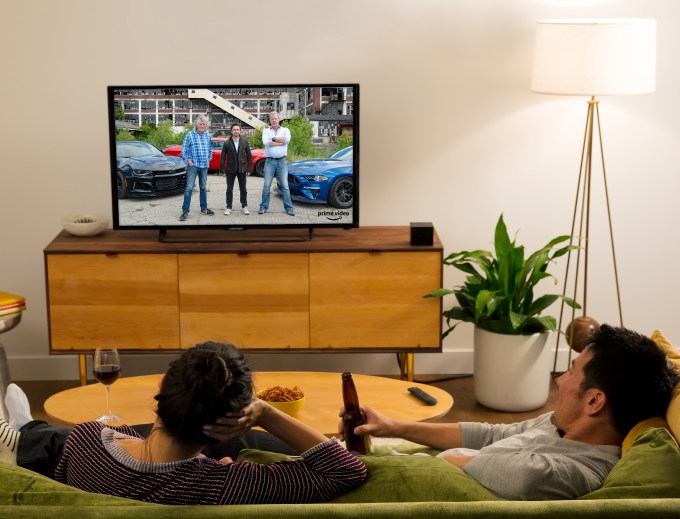
Fire TV Cube Couch

Amazon’s Fire TV Edition lineup is expanding, too. This is the licensed version of the Fire TV OS available to other manufacturers for use in their own products.

The company announced more than 15 new products from brands including Skyworth, Arcelik, TPV, Compal, and others.

In partnership with Dixons Carphone, Amazon is teaming up to launch JVC – Fire TV Edition Smart 4K Ultra HD HDR LED TVs, which are the first Fire TV Edition products in the U.K. They’ll be sold by Currys PC World and online at Amazon.co.uk and are priced at £349 and up.

With IMTRON, a company of MediaMarktSaturn Retail Group, Amazon is launching a lineup of Fire TV Edition smart TVs under the private label ok. These will be available in Germany and Austria, as will the 11 Fire TV Edition smart TVs from Grundig including the first OLED Fire TV Edition television ( available in 55” and 65” models, starting at €1,299.99 for hands-free; or starting at €1,199.99 if not; pictured below). 
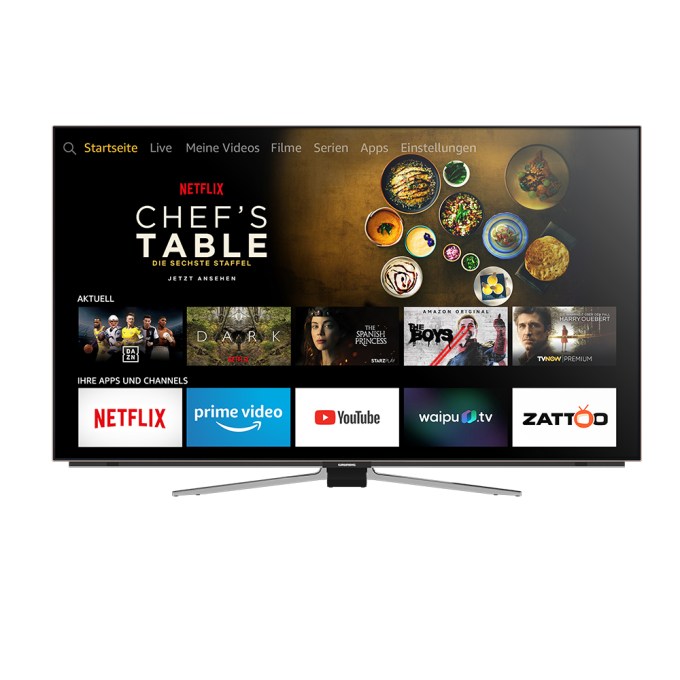
Grundig OLED Fire TV Edition display

Other more affordable Grundig Fire TV Edition products will be sold on Amazon.de in 32″, 40″, 43″, 49″, 55″, and 65″ variations, starting at €239.99. They’ll also come to retailers including MediaMarkt, Saturn, Euronics, Expert, EP:, Medimax, and others.

In the U.S., Amazon and Best Buy announced the first 65-inch Toshiba – Fire TV Edition smart TV with Dolby Vision, which will be available for customers in the United States next month for $599.

Finally, following Roku’s lead into home audio, Amazon also announced the first expansion of Fire TV Edition beyond the TV itself with the launch of the Nebula Soundbar from Anker. (Roku also today launched its own wireless soundbar).

The new device supports 4K Ultra HD, a unified smart TV user interface, near-field Alexa voice control, Dolby Vision pass-through, and more. It can also be added to a multi-room speaker group through the Alexa app, and comes with a 90-day trial to Amazon Music Unlimited. 
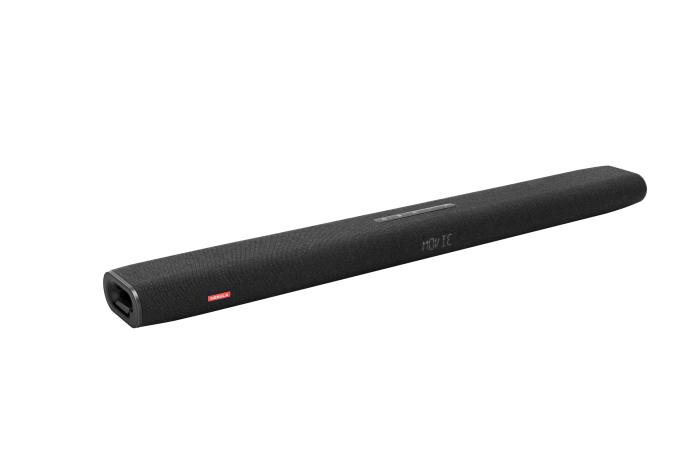
Nebula Soundbar – Fire TV Edition 4

It’s available for pre-order today for $229.99 in the United States, $269.99 in Canada, £179.99 in the United Kingdom, and €209.99 in Germany. It will begin shipping on November 21.

The expansion of Fire TV Edition-branded products is also meant to challenge Roku on the success of its Roku TV-branded television sets, which are similarly manufactured by partners but run the Roku OS.

In the U.S., Roku OS is the No. 1 licensed TV OS in the U.S. and now powers more than 1 in 3 smart TVs. Amazon is today is clearly answering that challenge by focusing on the international markets with a suite of new partners for Fire TV Edition.


[gallery ids="1876671,1876670,1876669,1876668,1876667,1876666,1876665,1876664,1876663,1876662,1876661,1876660"]