Year: 2019

04 Sep 2019

Porsche Taycan vs Tesla Model S: Spec for spec, price for price

The Porsche Taycan is a missile aimed straight at Tesla. The German electric sedan packs everything needed to give the Model S its first real fight. The Porsche is just as fast, is sleeker thanks to a lower drag coefficient, and packs several technical goodies missing from Tesla’s sedan.

Specs alone cannot properly illustrate a vehicle’s worth but they’re a good starting point. What follows are several key areas comparing the two trim levels of the Porsche Taycan against the two versions of the Model S currently available.

The chart here does not list self-driving features or capabilities, a key feature to the Tesla Model S. As of writing Porsche has yet to revel any self-driving capabilities of the Taycan besides the standard driver assistance features found on all Porsche vehicles.

Please note, the EPA has yet to release official range numbers for the Porsche Taycan. Currently, Porsche is only noting that the new European rating system, (WLTP), rates the sedan with the max range of 279 miles. The EPA says the Model S Long Range has a range of 370 miles.

04 Sep 2019

Porsche unveils the $150,900 Taycan Turbo electric sedan

Porsche has poured more than $1 billion into the development of its first all-electric vehicle, a sleek four-door specimen that marks the beginning of a new chapter for the German automaker and its biggest bet in more than a generation.

On Wednesday, in three simultaneous events in Canada, China and Germany, Porsche finally introduced the world to the vehicle that has been more than four years in the making. TechCrunch was on hand for the reveal in Canada, a splashy event, held in a building erected just for the occasion on the edge of Niagara Falls. It was here that Porsche showed off not one, but two flavors of the Taycan.

Behold, the Porsche Taycan Turbo S and Porsche Taycan Turbo, two electric machines with the styling, power and performance one would expect from the German automaker. Oh, and range between 250 and 280 miles, depending on the variant.

Both of these Taycans fall into the more expensive, more powerful category of its upcoming portfolio with base prices of $185,000 and $150,900, respectively.

IMG 20190904 093311

All three Porsche Taycan events were staged near renewable energy installments — hydropower at Niagara Falls in Canada, solar in Neuhardenberg near Berlin and a wind farm on Pingtan Island, less than a mile from the Chinese city of Fuzhou — a physical symbol of Porsche’s move to electrification. 

“The Taycan stands for the change necessary for Porsche to remain Porsche,” Detlev Von Platen, Porsche AG board member of sales and marketing said during the presentation.

And it’s not stopping at the Taycan. By 2025, half of all Porsche vehicles will be electrified, according to Von Platen.

Porsche Taycan reveal

Less powerful variants (and therefore less expensive) of these all-wheel drive vehicles will follow this year, and the first derivative to be added will be the Taycan Cross Turismo at the end of 2020.

The Taycan may represent a new direction for the automaker, but there’s still no mistaking this electric vehicle for a Porsche. The Taycan has a big and low stance with a body line that still looks and feels like a Porsche. Bigger than a 911 and smaller than a Panamera, the body of the Taycan is wide and flat with contoured wings and a sporty roof that slopes down to the sharply emphasized and classic Porsche rear.

Inside is the good stuff. Both the Porsche Taycan Turbo S and Porsche Taycan Turbo are outfitted with two electric motors, one on the front axle and one on the rear axle, a two-speed transmission installed on the rear axle, and an 800-volt architecture — the same technology that helped the company’s 919 Hybrid win the 24 Hours of Le Mans three times in a row.

The interior of the Taycan, which was revealed last month, includes a sleek all-digital dashboard clearly inspired by the 1963 Porsche 911.

Now to the power.  The flagship Turbo S version of the Taycan can generate up to 750 horsepower (560 kW) of power in combination with “launch control” and overboost features that translate into accelerating from zero to 60 miles per hour in 2.8 seconds. The Taycan Turbo can produce up to 670 horsepower (500 kW), allowing it to go from a standstill to 60 mph in 3 seconds. Both vehicles have a top track speed of 161 mph.

The Taycan is ready for the race track,” Stefan Weckbach, vice president of the Taycan and Porsche Battery Electric Vehicle Product Line said during the event Wednesday.

And then there’s the 800 volt system, double the more commonly used 400 volt architecture found in other electric vehicles. The 800-volt system allows the Taycan to charge from 5% to 80% in 22.5 minutes with a maximum charging power of up to 270 kw. The vehicle’s 800-volt system will allow the Taycan to add 62 miles of charge in a snappy 5 minutes, Weckbach said.

The overall capacity of the 800V high voltage battery is 93.4 kWh. Porsche is throwing in three years of free charging at hundreds of Electrify America public stations that will blanket the U.S. in the coming months.

The EPA range estimate for North American market is pending for both vehicles. Under Europe’s WLTP estimates, the Turbo S can travel 256 miles on a single charge, while the Turbo has a range of 280 miles.

04 Sep 2019

Spotify expands its new Premium Duo plan to Latin America

Spotify’s newest paid subscription, the Premium Duo plan designed for two people, first launched this spring as a pilot test in Ireland, Colombia, Chile, Denmark, and Poland. Today, Spotify says the plan is being more broadly rolled out to 14 more Latin American markets.

The new markets include: Argentina, Bolivia, Costa Rica, Dominican Republic, Ecuador, El Salvador, Guatemala, Honduras, Mexico, Nicaragua, Panama, Paraguay, Peru, and Uruguay.

The Duo plan is meant mainly for couples, though it could apply to roommates or any other two people who share the same home address.

In terms of pricing, it’s a step up from a single Premium subscription but more affordable than a Family Plan, as it’s limited to just two accounts. However, the Duo plan is discounted so it’s a better deal than buying two separate Premium accounts.

The benefits are similar to those on the Family Plan. Like the larger group plan, Duo keeps each user’s music preferences and recommendations separate from one another. And like the Family Plan, which recently added a custom mix composed of track everyone in the family enjoys, the Duo subscription also includes its own shared playlist, the Duo Mix. Members can easily share their playlist libraries with one another, too.

Despite now reaching 19 total markets, Spotify still refers to the Premium Duo plan as a “pilot,” which typically means the company hasn’t fully committed to bringing the service to all its users at some point. Instead, that terminology typically implies the company is continuing to evaluate the new service’s impact.

In Spotify’s case, Premium Duo’s launch in March hasn’t yet led to a massive subscription bump. When reporting its Q2 2019 earnings, the company said it added 8 million new subscribers in the quarter, which was below the estimated 8.5 million figure. It now has 232 million monthly users and 108 million paying subscribers.

That said, Duo hasn’t reached many of Spotify’s key markets where such a plan could have more of an impact to subscriber counts, including the U.S.

If you live in a supported market and already have a Premium plan you can visit your Account page on Spotify’s website to add a partner and upgrade. Both plan members will need to share the same home address.

04 Sep 2019

Ginger, an MIT spinout providing app-based mental health coaching to workers, raises $35M

Mental health issues are thought to impact one in every five people in the US, and the stress of working life can be an exacerbating factor. Now, one of the startups that’s using technology to build ways to support this population has raised a significant round of funding to expand its platform to aid in getting them the help they need.

Ginger, a startup that works with organizations and their healthcare providers to provide employees with an-app based way to connect with coaches to talk through their issues and suggest ways forward, is today announcing that it has raised $35 million in a Series C round of funding, money that it will use both to expand the data science behind its therapy programs and the variety of its clinical programs; as well in terms of its business opportunities. The plan is to grow its service internationally and to more touch points beyond the employer channel, including those who access healthcare through health plans (which might include, potentially, countries with nationalised health services).

The funding is a Series C being led by WP Global Partners (an investment firm that backs both companies — for example, it also is an investor in Postmates — as well as other funds) with participation from some of a number of other new and previous high-profile investors that include City Light Capital, Nimble Ventures, LinkedIn CEO Jeff Weiner, Khosla Ventures, Kaiser Permanente Ventures, and Kapor Capital.

“As the global mental health crisis intensifies and access challenges increase, employers are searching for solutions to address the shortage of affordable, available providers,” said Russell Glass, CEO of Ginger, in a statement. “In building the world’s first virtual behavioral health system, we are reinventing the approach with instant access to care. This latest round of funding accelerates our ability to expand high-quality care — any time of day or night — to millions of people around the world.”

It brings the total raised by Ginger to $63 million, and the company is not disclosing valuation (we’re asking), but it has been growing at a very steady clip and says that over 200,000 people are able to access the service by way of their employers’ Ginger plans. Ginger says that customers include CBS, Netflix, Pinterest, Sephora, Twilio, Yelp and BuzzFeed, and it’s now active in 25 countries outside the US, including major markets like the UK, Japan, Australia, Canada and India.

Founded nearly a decade ago as a spinout from the MIT Media Lab, Ginger started life initially with a platform that would monitor a user’s smartphone interactions to detect potential mental health issues and help connect that user with someone to talk to. This lean-forward approach appears to have been retired in favor of a service that relies on the users themselves making the first move.

That first move comes in the form of text message, which an employee can send 24/7 and receive an immediate response. That in itself is notable: the traditional way of going about speaking to a counsellor or therapist that you might get through your work’s health insurance can take up to 25 days for your first appointment, Ginger notes, by which point the problem that got you interested in speaking to someone in the first place may have become significantly worse.

While some users keep their coaching — this is the word used by Ginger itself, and I think the reason is because it helps to differentiate this from in-person, more classic therapy sessions, and because the people who are trained to work with you might not actually be doctors — to texts, others may get referred up the ladder to other mediums, such as video therapy and video psychiatry with licensed clinicians.

The latter is a route that applies to some 8% of Ginger’s users, the company says, with the rest resolving issues through the text-based coaching. Time with clinicians is guaranteed to be provided within a 72-hour window.

On the other side of the issue of getting to speak to someone, Ginger also offers options for people to reach out and book coaching and therapy sessions outside of work hours (which presumably is a bonus both to the employer as well as to employees who are less keen to disrupt work or keep their therapy to themselves).

The approach seems to work: Ginger says that some 70 percent of members surveyed that have used Ginger reported “a significant reduction in symptoms of depression within 12 weeks.”

Overall, app-based and other health services that do not require a person to physically be in the same room as his/her therapist still face a perennial problem that is a hallmark of many a mental health service: they still require a person to “turn up” so to speak — that is, a person at some point needs to make the proactive effort to reach out for help, and usually continue to work on resolving the problem on a persistent and regular basis.

Tele-therapy solutions have both an advantage and disadvantage: being something you can pick up wherever and whenever makes it something that maybe we are more likely to use; but the lack of physical presence may well make it much easier for problems to be less apparent. In a sense, the mandate is even more on the likely vulnerable patient to be even more proactive as a result.

But the cost to employers of rolling out wide-scale, physical programs with licensed clinicians, as well as of having too many people off work due to mental health issues, are the rock and hard place that will likely continue to fuel significantly more development of services like Ginger’s and those of its competitors.

And that list is a long one, with other startups like Lyra Health (founded by the former CFO of Facebook Dave Ebersman), Unmind, Pacifica, Huddle, Modern Health, and Eliza all also closing in on the challenge.

Ginger’s investors believe in the mission and that its horse is one that will run the course.

“We have significant experience investing in healthcare and believe that technology is the key to solving the global mental health crisis,” said Donald Phillips, Chairman and CEO of WP Global Partners, in a statement. “As we looked to expand our portfolio, it became clear to us that there is no other company in the world that provides emotional and mental health support as quickly and effectively as Ginger does.”

04 Sep 2019

Chime now has 5 million customers and introduces overdraft alternative

Challenger bank Chime has reached 5 million customers in the U.S. The San Francisco-based startup is creating an FDIC-insured mobile bank without any physical branch. The company also promises less fees.

Back in March, Chime said it had 3 million customers when it announced its $200 million Series D round. So that’s 2 million additional customers in roughly 5 months.

Chime says that it is the fastest growing challenger bank in the world. In other words, the company is throwing shade at European challenger banks, such as Monzo and N26, that have been doing really well too. N26 just entered the U.S. market.

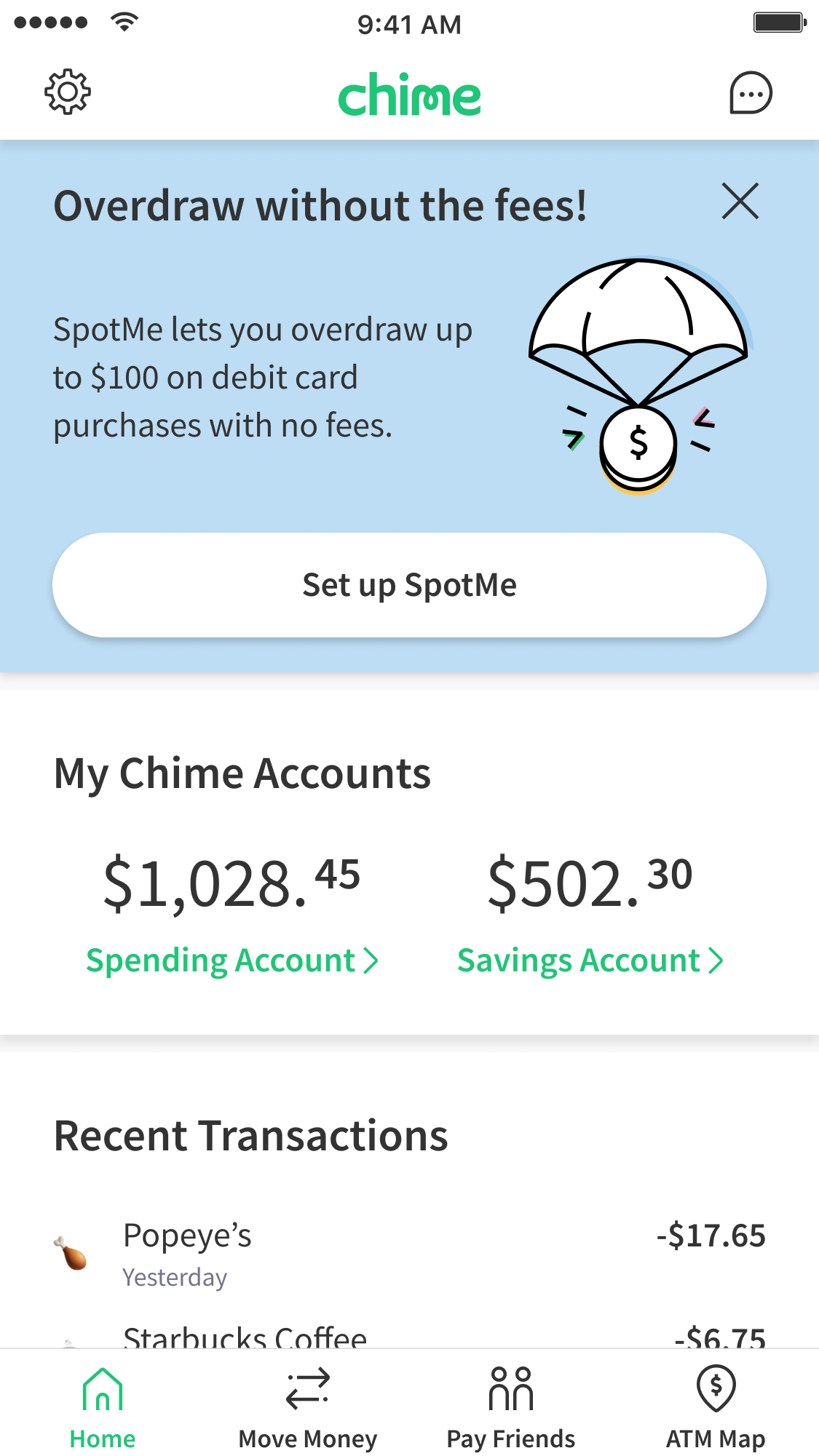
The company is also rolling out a new feature that it has been testing for a while. Chime SpotMe is an alternative to bank overdrafts. It is specifically targeted at people who deposit their paycheck into their Chime account but also live paycheck to paycheck.

Chime users who receive payroll direct deposit of at least $500 per month can sign up to Chime SpotMe. After that, you can keep spending with your debit card even if your balance goes below $0. Your overdraft limit will depend on multiple factors but some users will be able to overdraw their account by $100.

When you next paycheck arrives, your negative balance is paid back and you don’t pay any overdrafts fee. The company says that you can also optionally leave a tip to help other Chime users make both ends meet.

Chime SpotMe 100

04 Sep 2019

Misty starts shipping its programmable robot to backers

When we met with Misty back at CES, the Sphero spinoff had an April timeframe for its programmable robot, Misty II. But the best laid plans, et al. The startup announced this morning that it’s started shipping the robot to its around 500 or so crowdfunding backers over the coming weeks. It’s a few months late, but that’s just kind of the life of the robotics startup.

And as we’ve mentioned in previous posts, the company’s got a pretty long runway for its ambitious plans. They started last year with the modular, handmade Misty I. The Misty II is still more platform than product, with the intention of giving developers a place to create various robotics tasks.

Early gen two models have already been seeded to a handful of developers, who have begun to create a wide range of different functions for the plucky little robot, including property inspection, environmental monitoring, eldercare and autism therapy. The potential applications go well beyond that, leveraging the robot’s different on-board technologies, including locomotion, facial recognition and programmable personality traits.

“Delivering Misty II to our crowdfunding backers is a major milestone for the company as they will play a special role in helping us prepare Misty for her official market launch later this year,” founder Ian Bernstein said in a release tied to the news. “Our backers are investors in the vision of personal robots becoming a reality in our lives. We are very excited to see how hundreds of developers bring Misty to life.”

Five-hundred developers is a drop in the bucket, but it does prove that there’s some interest in the product. The company will continue to offer pre-orders on the robot for $2,399, with a full market launch set for later in the year.

04 Sep 2019

Period app Clue hopes to find out if you have PCOS

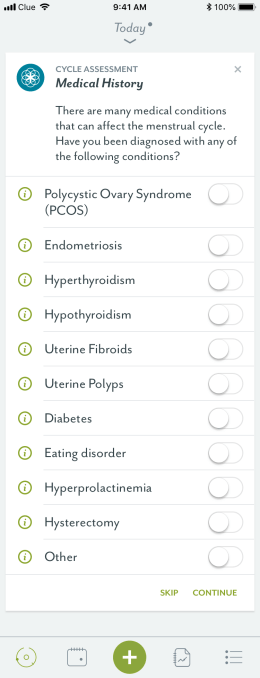
Clue, an app built on machine learning to track a woman’s monthly menstrual cycle, has been paying close attention lately to those with irregular periods. The Berlin-based company hopes to identify what may be causing those irregular cycles and then calculate a woman’s risk of polycystic ovarian syndrome (PCOS) in order to get her the help she needs from a medical provider.

For those who don’t know, PCOS is a sometimes painful disease that can put a woman at risk of infertility, diabetes, cardiovascular disease and endometriosis, among other issues. The most common indicator a woman has PCOS is an unpredictable cycle, showing up whenever it wants and making it difficult to plan around.

M5Those using the app will be able to get insight on what’s going on and why their period doesn’t always come on time using the newly launched ‘Irregular Cycles’ feature within the app.
A few other apps also have a built-in irregular cycles tracking feature. One (on the nose) app called Period Tracker, which can be found in both the App Store and Google Play is specifically designed to track irregular cycles. Another app from Planned Parenthood called Spot On is geared more towards teens and is intended to help them track how their period changes over time. But there doesn’t seem to be much in the way of identifying PCOS or gathering data on what may be causing these irregular cycles from these other apps.

According to Clue, its newly released tool uses a combination questionnaire and “dynamic Bayesian network” to come up with the most useful questions and then pinpoint whether users may be able to blame PCOS for their cycle woes.

But not just anyone can access this feature — it’s only for those Clue recognizes as having clinically irregular or unpredictable cycles and are not on birth control. So if you’re just curious but have a predictable as rain period, this is not the feature for you.

Clue already rolled out the feature to a test group of users with some success. “Of the users that received an assessment of potential PCOS, a significant portion reported visiting a healthcare professional for diagnosis within a month of the assessment,” Clue founder Ida Tin told TechCrunch. “Along with collaborator Dr. Shruthi Mahalingaiah, we plan to dive deeper into the data to see what additional patterns can be uncovered and where we can provide more benefit to our users.”

Often PCOS comes up as a cause of inability to conceive, with the majority (80%, according the the National Institute of Health) of infertility attributed to this disease. But even those with regular cycles aren’t necessarily ovulating (dropping an egg to be fertilized in the womb) each and every month.

Tin hopes the data she and her team gleans from the new in-app feature will help users better predict health issues affecting ovulation and their cycle in general.

“A change, particularly when sudden, in one’s own usual cycle length pattern may be indicative of a health matter deserving of attention,” she told TechCrunch. “For example, if a person typically has cycles 26-32 days in length and suddenly starts having cycles 20-25 days in length, then it is worth seeing a health care provider.”

04 Sep 2019

Roku launches two new audio devices: a Smart Soundbar & Wireless Subwoofer

Last year, Roku entered the speaker business with the debut of the Roku TV Wireless Speakers. Today, it’s expanding its portfolio of audio products with the launch of two new products: the Roku Smart Soundbar and Roku Wireless Subwoofer, both at $180 each. Like the wireless speakers, the soundbar and subwoofer are meant to give consumers a way to improve their overall streaming experience by upgrading their sound. But unlike last year’s speakers, the products will work with any TV — not just Roku’s own brand.

“We have these fantastic, new 4K giant TVs that don’t really have space for good speakers,” explained Roku VP of Product Management, Mark Ely, as to why Roku wanted to expand further into audio. “And that’s compounded by audio volume levels that have been all over the map, from loud commercials to really quiet dialog passages in movies. That has people constantly hitting the volume controls on the remote.”

Roku has been trying to address these issues by investing in smart audio solutions, like its easy-to-pair speakers offering premium sound and its Automatic Volume Leveling technology that lowers the sound for you in loud scenes and raises it when it gets too quiet.

With the Roku Smart Soundbar, the company is offering a similar feature set in a different form factor.

The new device itself is also powered by Roku OS, offers simple setup, and includes four premium drivers to provide better clarity and depth, and dynamic bass response, says Roku. With Night Mode, the soundbar lowers the volume for louder scenes and boosts it for quiet ones. Speech Clarity boosts the voice frequencies to make it easier to hear the dialog.

It also supports Dolby Audio and can connect by way of an HDMI ARC port or HDMI and optical audio input. And it offers a Bluetooth connection, so you can stream music, podcasts and other audio programs from a Bluetooth-compatible device.

The “smart” part of the speaker also has to do with its ability to listen and respond to voice commands, which lets you do things like launch channels or entertainment, turn on or off the captions, replay scenes, and more, when using the included Roku Voice Remote. It additionally supports connections with either the Google Assistant or Amazon Alexa, if you use their smart devices in your home.

This is either a perk of using Roku over Amazon Fire TV or a drawback, depending on your point of view.

On the one hand, the option to integrate with either of the top smart voice assistants is useful. But on the other, Roku’s own voice tech is not as advanced as Alexa or Google Assistant, as it’s focused more on the TV experience and related commands. That can lead to a wonky experience when you try to use Roku via Alexa, for instance, and the poor reviews for Roku’s Alexa skill demonstrate the downside of this sort of integration.

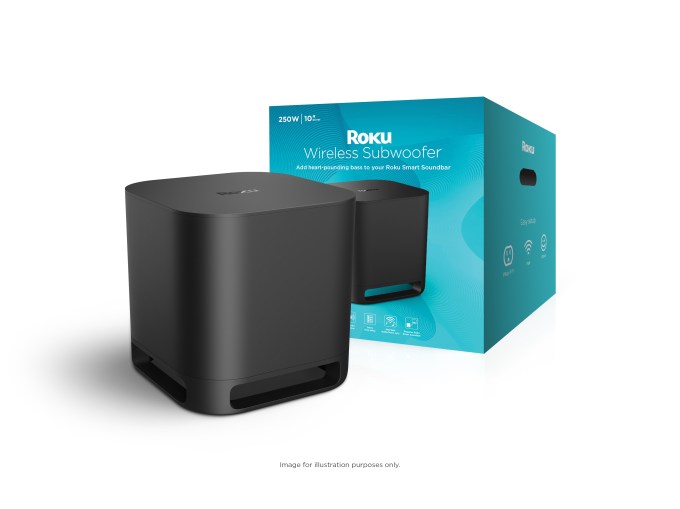
Roku Wireless Subwoofer

The second new product, the Roku Wireless Subwoofer, is designed for people who want a more theater-like experience at home.

The device can be placed anywhere within 30 feet of the new soundbar, and offers a digital amplifier with 250W peak power (125W RMS), 10″ driver, as low as 40Htz, and 802.11ac dual-band wireless.

Like the speakers, the setup is simple and involves just holding down the home button to pair the device and get up-and-running. Currently, it works with the brand-new Wireless Soundbar, but the Roku Wireless Speakers will get an update in the next few months to add compatibility with the subwoofer.

The company believes the soundbar will be a good alternative for non-Roku TV customers as well as those who don’t have space for the bookshelf-style wireless speakers it previously sold. Meanwhile, the subwoofer will better cater to those looking for a home theater-type experience at a reasonable price point.

More broadly, the new hardware significantly expands Roku’s entry into premium audio, and its investment in the hardware side of its business.

This is no longer the area that delivers the majority of the company’s revenue. Instead, Roku’s platform business, led by advertising, has out-earned hardware sales for the past five quarters. In Q2, Roku beat on earnings with $250.1 million in revenue, versus $224.4 million expected and it was advertising driving that rise.

That said, Roku’s hardware is performing well, in terms of consumer acceptance. Roku is now the top streaming platform in the U.S., and more than 1 in 3 smart TVs in the U.S. are Roku TVs.

Neither device of the new devices were offered for testing, but they are available for pre-order starting today from Roku.com with plans to ship by October. They’ll also be available for purchase at Best Buy at that time. Both are priced at $179.99 MSRP. (For comparison’s sake, the Wireless Speakers are $199.).

Full specs are below.

Soundbar:

  • 32” 2.0 soundbar with four 2.5” speakers
  • 4K Ultra HD, HDR, 1080p & 720p HD streaming up to 60fps
  • 802.11ac dual-band wireless
  • HDMI ARC
  • Optical audio input
  • Bluetooth
  • Dolby Audio
  • USB 2.0
  • Comes with:
    • Roku Smart Soundbar
    • Premium High-Speed HDMI Cable
    • Optical Cable
    • Voice remote
    • Two AAA batteries

Subwoofer:

  • Digital amplifier with 250W peak power (125W RMS)
  • As low as 40Htz
  • 802.11ac dual-band wireless
  • 10” driver
  • Comes with:
    • Roku Wireless Subwoofer
    • Power cable
04 Sep 2019

Neura, a mobile app engagement analytics startup, raises $16 million Series B

Neura, a startup that helps developers see how users interact with their apps, has raised a Series B of $16 million. The round was led by returning investors Pitango Venture Capital and Liberty Technology Venture. Other participants included Moneta Capital, Amdocs and AXA Ventures.

The San Francisco-headquartered startup’s last round of funding was an $11 million Series A announced in 2016. The new round brings its total funding to $32 million and will be used on hiring, growing its business in the United States and the European Union and launching new products.

Neura currently has more than 30 clients in sectors including travel and hospitality, transportation and ride-sharing, health, e-commerce, food delivery and insurance. Its SDK enables developers to analyze data about how users engage with their apps and also how they use their mobile devices.

For example, menstrual cycle tracker MyDays used Neura to analyze how users respond to push notifications. It saw that when the app used notifications sent at set times of the day, more than 30% of their users received them while they were asleep and 25% got them after they had begun their daily routines. MyDays created notifications customized to when its users are most likely to respond to them, helping it increase retention by 32%.

For years, Neura has said it prioritizes protecting the privacy of users, an issue that is now gaining more awareness among consumers thanks to high-profile scandals like Cambridge Analytica-Facebook.

In an email, CEO Amit Hammer said that “focused on customer experiences, rather than advertising, Neura does not collect any personally identifiable information (PII) or user id, and is compliant with the strictest privacy regulations, such as GDPR. Today’s consumers expect relevant and personalized digital experiences without compromising their privacy. We are glad to see more transparency in the mobile ecosystem.”

04 Sep 2019

Mental health websites in Europe found sharing user data for ads

Research by a privacy rights advocacy group has found popular mental health websites in the EU are sharing users’ sensitive personal data with advertisers.

Europeans going online to seek support with mental health issues are having sensitive health data tracked and passed to third parties, according to Privacy International’s findings — including depression websites passing answers and results of mental health check tests direct to third parties for ad targeting purposes.

The charity used the open source Webxray tool to analyze the data gathering habits of 136 popular mental health web pages in France, Germany and the UK, as well as looking at a small sub-set of online depression tests (the top three Google search results for the phrase per country).

It has compiled its findings into a report called Your mental health for sale.

“Our findings show that many mental health websites don’t take the privacy of their visitors as seriously as they should,” Privacy International writes. “This research also shows that some mental health websites treat the personal data of their visitors as a commodity, while failing to meet their obligations under European data protection and privacy laws.”

Under Europe’s General Data Protection Regulation (GDPR), there are strict rules governing the processing of health data — which is classified as special category personal data.

If consent is being used as the legal basis to gather this type of data the standard that must be obtained from the user is “explicit” consent.

In practice that might mean a pop-up before you take a depression test which asks whether you’d like to share your mental health with a laundry list of advertisers so they can use it to sell you stuff when you’re feeling low — also offering a clear ‘hell no’ penalty-free choice not to consent (but still get to take the test).

Safe to say, such unvarnished consent screens are as rare as hen’s teeth on the modern Internet.

But, in Europe, beefed up privacy laws are now being used to challenge the ‘data industrial complex’s systemic abuses and help individuals enforce their rights against a behavior-tracking adtech industry that regulators have warned is out of control.

Among Privacy International’s key findings are that —

  • 76.04% of the mental health web pages contained third-party trackers for marketing purposes
  • Google trackers are almost impossible to avoid, with 87.8% of the web pages in France having a Google tracker, 84.09% in Germany and 92.16% in the UK
  •  Facebook is the second most common third-party tracker after Google, with 48.78% of all French web pages analysed sharing data with Facebook; 22.73% for Germany; and 49.02 % for the UK.
  • Amazon Marketing Services were also used by many of the mental health web pages analysed (24.39% of analyzed web pages in France; 13.64 % in Germany; and 11.76% in the UK)
  • Depression-related web pages used a large number of third-party tracking cookies which were placed before users were able to express (or deny) consent. On average, PI found the mental health web pages placed 44.49 cookies in France; 7.82 for Germany; and 12.24 for the UK

European law around consent as a legal basis for processing (general) personal data — including for dropping tracking cookies — requires it to be informed, specific and freely given. This means websites that wish to gather user data must clearly state what data they intend to collect for what purpose, and do so before doing it, providing visitors with a free choice to accept or decline the tracking.

Dropping tracking cookies without even asking clearly falls foul of that legal standard. And very far foul when you consider the personal data being handled by these mental health websites is highly sensitive special category health data.

It is exceedingly difficult for people to seek mental health information and for example take a depression test without countless of third parties watching,” said Privacy International technologist Eliot Bendinelli in a statement. “All website providers have a responsibility to protect the privacy of their users and comply with existing laws, but this is particularly the case for websites that share unusually granular or sensitive data with third parties. Such is the case for mental health websites.”

Additionally, the group’s analysis found some of the trackers embedded on mental health websites are used to enable a programmatic advertising practice known as Real Time Bidding (RTB). 

This is important because RTB is subject to multiple complaints under GDPR.

These complaints argue that the systematic, high velocity trading of personal data is, by nature, inherently insecure — with no way for people’s information to be secured after it’s shared with hundreds or even thousands of entities involved in the programmatic chain, because there’s no way to control it once it’s been passed. And, therefore, that RTB fails to comply with the GDPR’s requirement that personal data be processed securely.

Complaints are being considered by regulators across multiple Member States. But this summer the UK’s data watchdog, the ICO, essentially signalled it is in agreement with the crux of the argument — putting the adtech industry on watch in an update report in which it warns that behavioral advertising is out of control and instructs the industry it must reform.

However the regulator also said it would give players “an appropriate period of time to adjust their practices”, rather than wade in with a decision and banhammers to enforce the law now.

The ICO’s decision to opt for an implied threat of future enforcement to push for reform of non-compliant adtech practices, rather than taking immediate action to end privacy breaches, drew criticism from privacy campaigners.

And it does look problematic now, given Privacy International’s findings suggest sensitive mental health data is being sucked up into bid requests and put about at insecure scale — where it could pose a serious risk to individuals’ rights and freedoms.

Privacy International says it found “numerous” mental health websites including trackers from known data brokers and AdTech companies — some of which engage in programmatic advertising. It also found some depression test websites (namely: netdoktor.de, passeportsante.net and doctissimo.fr, out of those it looked at) are using programmatic advertising with RTB.

“The findings of this study are part of a broader, much more systemic problem: The ways in which companies exploit people’s data to target ads with ever more precision is fundamentally broken,” adds Bendinelli. “We’re hopeful that the UK regulator is currently probing the AdTech industry and the many ways it uses special category data in ways that are neither transparent nor fair and often lack a clear legal basis.”

We’ve reached out to the ICO with questions.

We also asked the Internet Advertising Bureau Europe what steps it is taking to encourage reform of RTB to bring the system into compliance with EU privacy law. At the time of writing the industry association had not responded.

The IAB recently released a new version of what it refers to as a “transparency and consent management framework” intended for websites to embed to collect consent from visitors to processing their data including for ad targeting purposes — legally, the IAB contends.

However critics argue this is just another dose of business as usual ‘compliance theatre’ from the adtech industry — with users offered only phoney choices as there’s no real control over how their personal data gets used or where it ends up.

Earlier this year Google’s lead privacy regulator in Europe, the Irish DPC, opened a formal investigation into the company’s processing of personal data in the context of its online Ad Exchange — also as a result of a RTB complaint filed in Ireland.

The DPC said it will look at each stage of an ad transaction to establish whether the ad exchange is processing personal data in compliance with GDPR — including looking at the lawful basis for processing; the principles of transparency and data minimisation; and its data retention practices.

The outcome of that investigation remains to be seen. (Fresh fuel has just today been poured on with the complainant submitting new evidence of their personal data being shared in a way they allege infringes the GDPR.)

Increased regulatory attention on adtech practices is certainly highlighting plenty of legally questionable and ethically dubious stuff — like embedded tracking infrastructure that’s taking liberal notes on people’s mental health condition for ad targeting purposes. And it’s clear that EU regulators have a lot more work to do to deliver on the promise of GDPR.