Year: 2019

03 Sep 2019

Only 4 days left on super early bird pricing for Disrupt Berlin 2019

Our countdown to the super early-bird deadline and serious savings continues unabated, people! The best pricing for passes to Disrupt Berlin 2019 ends in four days. When the clock strikes 11:59 p.m. (CEST) on 6 September, your chance to save up to €600 evaporates. Save your euros for another day and buy your pass right now.

We expect more than 3,000 attendees from more than 50 countries including European Union members, Israel, Turkey, Russia, Egypt, India, China and South Korea, to name just a few. If you’re a founder, there’s no better place to introduce your early-stage startup to the European and international startup scene.

If you’re an investor, you’ll find hundreds of dynamic early-stage startups exhibiting a wide range of tech products, services and platforms — not to mention a ton of talent — in Startup Alley. Talk about networking on steroids — and a prime opportunity to add to your portfolio.

Don’t just take our word for it. Vlad Larin, co-founder of Zeroqode found tremendous value in his Disrupt Berlin experience.

“TechCrunch Disrupt was a massively positive experience,” said Larin. “It gave us the chance to show our technology to the world and have meaningful conversations with investors, accelerators, incubators, solo founders and developers.”

And Jana Rosenfelder, co-founder of Actijoy, has attended three — count ‘em, three — Disrupt conferences. She’s a true believer in the networking opportunities that await founders and investors alike.

“Every startup should attend TechCrunch Disrupt,” said Rosenfelder. “It’s absolutely worth the money, because you can network and make important connections.”

Rosenfelder exhibited as one of our TC Top Picks at Disrupt SF ’18 and called it a door-opening experience. We’re accepting applications to TC Top Picks at Disrupt Berlin right now. Apply right here for your chance to win a free Startup Alley Exhibitor Package, VIP treatment and tons of investor and media love.

That’s just a small sample of reasons to go to Disrupt Berlin. Don’t forget Startup Battlefield, the TC Hackathon and two full days of incredible speakers — leading founders, tech titans and top investors — boundary-pushers all. We’ll keep you posted on our growing roster in the coming weeks.

Disrupt Berlin 2019 takes place on 11-12 December, and you have just four days left to get super early bird prices on your passes to this epic conference. The deadline strikes at 11:59 p.m. (CEST) on 6 September. Keep up to €600 in your pocket — buy your pass today.

Is your company interested in sponsoring or exhibiting at Disrupt Berlin 2019? Contact our sponsorship sales team by filling out this form.

03 Sep 2019

Kabbage acquires Radius Intelligence, the marketing tech firm with a database of 20M small businesses

Data is the new oil, as the saying goes, and today Kabbage — a fintech startup backed by SoftBank that has built a business around lending up to $250,000 to small and medium enterprises, using AI-based algorithms to help determine the terms of the loan — is picking up an asset to expand its own data trove as it looks to expand into further SMB financial services. The company has acquired Radius Intelligence, the marketing technology firm that has built a database of information on some 20 million small and medium businesses in the US.

Terms of the deal are not being disclosed, but notably, it comes on the heels of a sightly tumultuous period for Radius. Last year, the company announced a merger with its big competitor Leadspace, only to quietly cancel the deal three months later. Then two months after that, it replaced its longtime CEO.

Radius — which is backed by some $120 million from investors that include Founders Fund, David Sacks, Salesforce Ventures, AME Cloud Ventures and the actor Jared Leto among others — last had a valuation of around $200 million according to PitchBook, but that was prior to these events. Kabbage, meanwhile, has raised hundreds of millions in equity and debt and is valued at over $1 billion. The deal will be financed off Kabbage’s own balance sheet and will not require the company to raise more funds, I understand.

Rob Frohwein, Kabbage’s co-founder and CEO, said in an interview that the plan is to integrate Radius’ tech and IP into the Kabbage platform — the task will be overseen by Radius’ current CEO, Joel Carusone — as well as Radius’ tech team of 20 engineers, who will work for the Atlanta-based startup out of its office in San Francisco.

He also added that Radius’ current products — which include market intelligence and contact information for employees at SMBs in the US, along with a host of related solutions, which up to now had been gathered both via public sources and the businesses updating the information themselves; as well as the technology for merging disparate sources of data and ferreting out the “valid” pieces that are worth retaining and throwing out what is out of date — will not be sold any longer via Radius. From now on, there will be only one customer for all that data: Kabbage itself.

To note: the company had already been a user of Radius’ data to help its own marketing team connect with new and and existing customers.

“We have known the company for a long time,” said Frohwein. Other customers that Radius lists on its site include Square, American Express, LendingTree, FirstData, MetLife, Sam’s Club, Yahoo and more.

This doesn’t mean that Kabbage might not offer the SMB intelligence in a format to businesses directly via its own platform at some point, but it also means that as Kabbage expands into services that might compete with some of Radius’ now-former customers — payments and merchant acquirer services, as well as tools to help SMBs grow their own customer funnels are some that are on the cards for the coming months — it will have an edge on them because of the data on users that it will now own.

The deal underscores two bigger trends among startups that focus on enterprise customers. First, it points to  ongoing consolidation in the world of marketing tech, in part as businesses look for ways to better compete against the likes of Microsoft and Salesforce, which are also continually building out their stacks of services. And we will likely see more activity from stronger fintech companies keen to expand their platforms to provide more touchpoints and revenue streams from existing customers, as well as more services to expand the customer base overall.

“We’re thrilled to join the Kabbage team. As a company dedicated to small business analytics and data management, we’ve always had a deep respect for Kabbage’s data-driven technology and focus,” Radius CEO Carusone said in a statement. “Our companies have complementary technical architectures and domain experience for decision making. With Kabbage, we can build a more sophisticated analytics solution to identify, reach and serve small businesses.”

Kabbage itself is not looking for new funding at the moment, Frohwein said, but he added also that it is on a fast trajectory at the moment but still a ways away from an IPO, so I wouldn’t discount more raises in the future. The company is currently on track to see revenues up 40% versus last year, with customers up 60%.

“We’re always looking to grow,” he said.

03 Sep 2019

India’s mobile payments firm MobiKwik reaches rare key profit milestone

Indian mobile payments firm MobiKwik has reached a milestone very few of its local rivals can even contemplate: not burning money. The 10-year-old Gurgaon-headquartered firm said Tuesday it is now generating a profit excluding interest, taxes, depreciation, and amortization.

“We have been in an ecosystem where we have seen a lot of high-growth and several regulatory changes in the payments domain. But what we realized was that payments alone is likely not going to be a very profitable business,” Bipin Singh, co-founder and CEO of MobiKwik, told TechCrunch in an interview.

To get to the path of profitability, MobiKwik has made a number of significant changes to its business in recent years. It stopped participating in the race of getting more and more users and fight with the likes of Paytm, which has raised more than $2 billion to date.

Paytm remains unprofitable and an analysis of its financial performance shows that this is not going to change anytime soon. Google, which also offers a payments service in India, has no shortage of cash either.

Upasana Taku, co-founder and COO of MobiKwik, recalled an offsite meeting where someone asked her why Kotak and ICICI banks, both of which have about 15 million to 20 million customers, are profitable but wallet apps with tens of millions of users are not. MobiKwik, which employs 400 people, has 110 million users, she said.

In last two and a half years, MobiKwik has cut down on cashback it bandies out to users — a practice followed by nearly every company offering a payments solution in India — and focused on building financial services on top of its wallet app to retain customers and find additional revenue sources.

The company continues to focus on its mobile wallet and payments processing businesses that account for about 65% of its revenue, but its growing suite of financial services such as providing credits and insurance to customers is already bringing rest of the revenue, she said.

That’s not surprising. Fewer than 50 million credit cards are in circulation in India currently, and for people with limited income, getting a loan remains a major challenge.

“Even the population that has access to smartphones and cheap internet data can’t get a credit card in India. We found it a good match for the growth of our payments app. We started serving these users who have the discipline to repay money, have certain kind of income,” the couple said, who are now also donning the role of angel investors.

MobiKwik works with banks and other lenders to finance loans worth Rs 5,000 ($69) to Rs 100,000 ($1380). In the 18 months the service has been live, MobiKwik has offered 800,000 loans and disbursed $100 million. Its health insurance starts at as little as $1.3 a month.

MobiKwik expects its revenue to hit $66 million in the financial year that ends in March next year, up from $28 million a year earlier. The company, which expects to turn profitable in the next two to three years, plans to go public soon afterwards.

MobiKwik competes with a number of players, many of which are increasingly adding financial services such as loans to their platforms. India’s overall retail credit demand is expected to grow 60% to $771 billion over the next four years, according to the Digital Lenders Association of India.

03 Sep 2019

OpenGov raises $51M to boost its cloud-based IT services for government and civic organizations

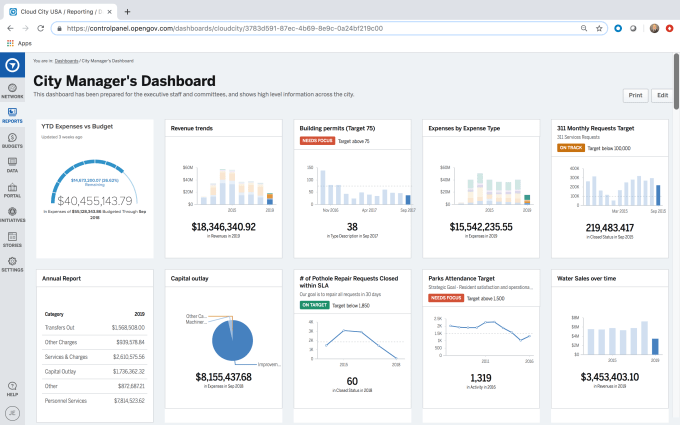
OpenGov, the firm co-founded by Panaltir’s Joe Lonsdale that helps government and other civic organizations organise, analyse and present financial and other data using cloud-based architecture, has raised another big round of funding to continue expanding its business. The startup has picked up an additional $51 million in a Series D round led by Weatherford Capital and 8VC (Lonsdale’s investment firm), with participation from existing investor Andreessen Horowitz.

The funding brings the total raised by the company to $140 million, with previous investors in the firm including JC2 Ventures, Emerson Collective, Founders Fund and a number of others. The company is not disclosing its valuation — although we are asking — but for some context, PitchBook noted it was around $190 million in its last disclosed round — although that was in 2017 and has likely increased in the interim, not least because of the startup’s links in high places, and its growth.

On the first of these, the company says that its board of directors includes, in addition to Lonsdale (who is now the chairman of the company); Katherine August-deWilde, Co-Founder and Vice-Chair of First Republic Bank; John Chambers, Founder and CEO of JC2 Ventures and Former Chairman and CEO of Cisco Systems; Marc Andreessen, Co-Founder and General Partner of Andreessen Horowitz; and Zac Bookman, Co-Founder and CEO of OpenGov .

And in terms of its growth, OpenGov says today it counts more than 2,000 governments as customers, with recent additions to the list including the State of West Virginia, the State of Oklahoma, the Idaho State Controller’s Office, the City of Minneapolis MN, and Suffolk County NY. For comparison, when we wrote in 2017 about the boost the company had seen since Trump’s election (which has apparently seen a push for more transparency and security of data), the company noted 1,400 government customers.

Government data is generally associated with legacy systems and cripplingly slow bureaucratic processes, and that has spelled opportunity to some startups, who are leveraging the growth of cloud services to present solutions tailored to the needs of civic organizations and the people who work in them, from city planners to finance specialists. In the case of OpenGov, it packages its services in a platform it calls the OpenGov Cloud.

“OpenGov’s mission to power more effective and accountable government is driving innovation and transformation for the public sector at high speed,” said OpenGov CEO Zac Bookman in a statement. “This new investment validates OpenGov’s position as the leader in enterprise cloud solutions for government, and it fuels our ability to build, sell, and deploy new mission-critical technology that is the safe and trusted choice for government executives.”

City Manager Dashboard Screen

It’s also, it seems, a trusted choice for government executives who have left public service and moved into investing, leveraging some of the links they still have into those who manage procurement for public services. Weatherford Capital, one of the lead investors, is led in part by managing partner Will Weatherford, who is the former Speaker of the House for the State of Florida.

“OpenGov’s innovative technology, accomplished personnel, market leadership, and mission-first approach precisely address the growing challenges inherent in public administration,” he said in a statement. “We are thrilled at the opportunity to partner with OpenGov to accelerate its growth and continue modernizing how this important sector operates.”

It will be interesting to see how and if the company uses the funding to consolidate in its particular area of enterprise technology. There are other firms like LiveStories that have also been building services to help better present civic data to the public that you could see as complementary to what OpenGov is doing. OpenGov has made acquisitions in the past, such as Ontodia to bring more open-source data and technology into its platform.

03 Sep 2019

Tom Hulme from GV is joining us at Disrupt Berlin

Based in London, Tom Hulme is a general partner for GV, the VC firm formerly known as Google Ventures. And Hulme isn’t your average VC as he likes to focus on hard problems instead of quick wins. He has become an important figure of the European VC landscape, that’s why I’m excited to announce that Glovo founder Oscar Pierre is joining us at TechCrunch Disrupt Berlin.

GV has had an interesting start in Europe. The firm originally announced a new, separate fund focused on European startups exclusively. A dedicated GV Europe team was supposed to lead the fund.

A few years later, GV has switched to a more global and unified strategy. The European team is now part of GV at large. But it doesn’t mean that GV stopped looking at European startups altogether.

Tom Hulme is evidence that GV is still very much active in London, the U.K. and Europe. A couple of years ago, TechCrunch’s Ingrid Lunden interviewed him. It is a fascinating read and I would recommend it to anyone interested in startup investment.

GV doesn’t want to stop at low-hanging fruits. The firm is looking at startups working around artificial intelligence and deep learning, virtual and augmented reality, the car of the future, life sciences and more.

For instance, Tom Hulme and his team looked at over 60 companies in Europe and Tel Aviv focused on AI. In other words, if you’re working on something big that requires a lot of capital, chances are you should meet up with GV.

Tom Hulme has invested in SpyBiotech, Lemonade, Currencycloud, Secret Escapes, Genomics Medicine Ireland, Cambridge Epigenetix and many other startups. And I can’t wait to hear what’s going to be his next investment.

Buy your ticket to Disrupt Berlin to listen to this discussion — and many others. The conference will take place on December 11-12.

In addition to panels and fireside chats, like this one, new startups will participate in the Startup Battlefield to compete for the highly coveted Battlefield Cup.


Tom is a general partner at Google Ventures. Previously, Tom was a design director at IDEO Europe, where he founded OpenIDEO, an open innovation platform that has over 150,000 users from more than 170 countries. Tom also launched OIEngine, an online platform for IDEO clients, including Harvard Business School and the Knight Foundation.

Before IDEO, Tom was managing director of Marcos, a British sports car manufacturer. As a serial entrepreneur, Tom also founded Magnom, a magnetic filter startup. Tom’s filter designs have been widely used in Formula One, Superbikes, JCB loaders, and central heating systems.

Tom has been recognized as a Young Global Leader by the World Economic Forum, and has been featured in WIRED UK’s Top 100 Digital Power Brokers list every year since the list has been published. He has also been included in the Evening Standard list of London’s 1000 Most Influential People.

Tom earned a first class bachelor’s degree in physics from the University of Bristol, and an MBA from Harvard Business School, where he received the Baker Scholar Award of high distinction. Tom has also received an honorary doctorate from University Arts London.

03 Sep 2019

European banking app Monese partners with deposits marketplace Raisin

Monese, the European banking app aimed at customers with a ‘thin’ credit file or those who have moved country, is launching “Monese Savings” in partnership with fintech Raisin.

The new feature sees Monese customers gain access to Raisin’s cross-border deposits marketplace so that they can shop around for a competitive interest rate via the various European banks signed up to Raisin. It will initially be available to Monese personal account customers in the U.K., Germany, Austria, France, the Netherlands, and Spain.

As an example of what’s on offer, Monese says its U.K. customers can access rates of up to 2.20% AER via Wyelands Bank’s 5 years Fixed Term Deposit product. Shorter terms with different rates are available from other Raisin marketplace-supported banks and products.

“With a broad choice of Raisin’s more than 500 competitive, transnational savings products, available from over 80 partner banks located across the entire European Economic Area, Monese users will be able to select their preferred deposit in a new streamlined process,” says Monese.

As Monese Savings gets further developed, the plans, says the London startup, is to offer “seamless” savings account access and management all within the Monese app. This will soon facilitate automated recurring payments to make saving regularly more convenient.

Monese Savings sit alongside “Pots,” Monese’s non-interest bearing savings accounts, which were introduced in May 2019. This is more of a budgeting tool, rather than long-term savings where you’d expect to earn interest.

Notably, Monese is disclosing that it now has over 1.4 million signups, claiming that customer growth tripled in 2018 and that over 100,000 people are joining Monese every month. Demand for Monese across mainland Europe surpassed that of the U.K. in November 2018, says the fintech, and in March 2019, two-thirds of all sign-ups to Monese were in mainland Europe.

A year ago, Monese raised $60 million in Series B funding. Leading the round was Kinnevik, with participation from PayPal, Augmentum Fintech, International Airlines Group via its loyalty and data business Avios Group Ltd., and Investec’s INVC Fund.

03 Sep 2019

Africa Roundup: Goldman backs Kobo360, Rwanda commits to EVs, Interswitch IPO update

Nigerian freight logistics startup Kobo360 raised a $20 million Series A round led by Goldman Sachs and $10 million in working capital financing from Nigerian commercial banks.

The company — with an Uber-like app that connects truckers and companies to delivery services — will use the funds to upgrade its platform and expand to 10 new countries beyond current operating markets of Nigeria, Togo, Ghana and Kenya.

Kobo360 looks to grow beyond its Nigeria roots to become a truly Pan-African company, co-founder Obi Ozor told TechCrunch .  He co-founded the venture in 2017 with fellow Nigerian Ife Oyedele II.

Since its launch in Lagos, the startup has continued to grow its product offerings, VC backing and customer base. Kobo360 claims a fleet of more than 10,000 drivers and trucks operating on its app. Top clients include Honeywell, Olam, Unilever, Dangote and DHL.

Kobo360’s latest round is also notable for Goldman Sachs’ involvement. Goldman’s participation tracks a growing list of African venture investments made by the U.S. based finance firm.

Chinese mobile-phone and device maker Transsion will list in an IPO on Shanghai’s STAR Market, Transsion confirmed to TechCrunch.

The company — which has a robust Africa sales network — could raise up to 3 billion yuan (or $426 million).

Transsion’s IPO prospectus is downloadable (in Chinese) and its STAR Market listing application available on the Shanghai Stock Exchange’s website.

STAR is the Shanghai Stock Exchange’s new Nasdaq-style board for tech stocks that also went live in July with some 25 companies going public.

Headquartered in Shenzhen — where African e-commerce unicorn Jumia also has a logistics supply-chain facility — Transsion is a top-seller of smartphones in Africa under its Tecno brand.

The company has a manufacturing facility in Ethiopia and recently expanded its presence in India.

Transsion plans to spend the bulk of its STAR Market raise (1.6 billion yuan or $227 million) on building more phone assembly hubs and around 430 million yuan ($62 million) on research and development, including a mobile phone R&D center in Shanghai, a company spokesperson said.

The government of Rwanda will soon issue national policy guidelines to eliminate gas motorcycles in its taxi sector in favor of e-motos, according to a preview of the plan by President Paul Kagame at a public-rally

The director general for the Rwanda Utilities Regulatory Authority, Patrick Nyirishema, confirmed Kagame’s comments were ahead of a national e-mobility plan in the works for the East African nation.

“The president’s announcement is exactly the policy direction we’re in…it’s about converting to electric motos…The policy is prepared, it’s yet to be passed…and is going through the approval process,” Nyirishema told TechCrunch on a call from Kigali.

Motorcycle taxis in Rwanda are a common mode of transit, with estimates of 20 to 30 thousand operating in the capital of Kigali.

Nyirishema explained that converting to e-motorcycles is part of a national strategy to move Rwanda’s entire mobility space to electric. The country will start with public transit operators, such as moto-taxis, and move to buses and automobiles.

Ampersand Africa e motorcycle

Ampersand, a Kigali-based e-moto startup, has already begun to pilot EVs and charging systems in Rwanda and will work with the country’s government on the moto-taxi conversion.

In an ExtraCrunch feature, TechCrunch delved into tech talent accelerator Andela — one of the most recognized and well funded startups operating in Africa.

In a byte, Andela is Series D stage startup ― backed by $180 million in VC ― that trains and connects African software developers to global companies for a fee.

CEO Jeremy Johnson dished on the company’s strategy toward profitability and responded to some of the criticism it receives ― namely a claim the startup is creating a second brain-drain when software developers leave Andela and Africa, to take positions with global companies.

Today Andela has offices in New York and five African countries: Nigeria, Kenya,  Rwanda, Uganda, and Egypt ― which largely align with the continent’s top tech VC markets.

Across this network the company recruits software developers, builds software engineers, and deploys teams of software engineers.

Johnson disclosed numbers on Andela’s expected new hires for the year, current developer staff, how many departures the company expects, and how many of those will likely leave their home countries―which actually amounts to a fairly small percentage.

TechCrunch checked in with Nigerian fintech company Interswitch for the latest on its anticipated dual-listing London and Lagos stock exchanges.

A Bloomberg News story (based on background sourcing) revived speculation the IPO could happen this year for the company — which provides much of Nigeria’s digital banking infrastructure and has expanded its operations presence and payments products across Africa and globally.

Reports that Interswitch could be one of the earliest big tech companies out of Africa to go public trace back to 2016, when CEO and founder Mitchell Elegbe told TechCrunch the company was considering a listing before the end of that year.

Last month, an Interswitch spokesperson would neither confirm or deny a pending IPO, per a TechCrunch inquiry. So, it’s still tough to say if or when the company could list. But there are still several reasons why the business (and its possible IPO) are worth keeping an eye on, which we detailed in the update story.


One could be an eventual increase in venture funding to African startups, that could come from Interswitch. Another could be an Interswitch IPO adding another benchmark for global investors to gauge Africa’s tech sector beyond Jumia — the e-commerce company that became the first big tech firm operating in Africa to launch on a major exchange, the NYSE in April.

More Africa-related stories @TechCrunch

African tech around the ‘net


03 Sep 2019

WeChat restricts controversial video face-swapping app Zao, citing “security risks”

Zao went viral in China this weekend for its realistic face-swapping videos, but after controversy about its policies, WeChat restricted access to the app on its messaging platform.

Developed by a unit of Momo, one of China’s most popular dating apps, Zao creates videos that replace the faces of celebrities in scenes from popular movies, shows and music videos with a selfie uploaded by the user.

The app, currently available only in China, went viral as users shared their videos through WeChat and other social media platforms in China. But concerns about the potential misuse of deepfake technology coupled with a clause (now deleted) in Zao’s terms of use that gave it full ownership and copyright to content uploaded or created on it, in addition to “completely free, irrevocable, perpetual, transferrable, and re-licensable rights,” caused controversy.

By going viral quickly and being very easy to use (Zao’s videos can be generated from a single selfie, though it suggests that users upload photos from several angles for better results), the app has also focused more attention on deepfake technology and how it can potentially be used to spread misinformation or harass people.

Users can still upload videos they created with Zao to WeChat, but if they try to download the app or send an invite link to another WeChat user, a message is displayed that says “this web page has been reported multiple times and contains security risks. To maintain a safe online environment, access to this page has been blocked.”23011567479434 .pic

Zao was released last Friday and quickly became the top free iOS app in China, according to App Annie. A statement posted on Sept. 1 to Zao’s Weibo account says “we completely understand everybody’s concerns about the privacy issue. We are aware of the issue and we are thinking about how to fix the problems, we need a little time.” Its terms and conditions now say user-generated content will only be used by the company to improve the app and that all deleted content will be removed from its servers.

TechCrunch has contacted Zao for comment.

02 Sep 2019

13 ways to screw over your internet provider

Internet providers are real bastards: they have captive audiences whom they squeeze for every last penny while they fight against regulation like net neutrality and donate immense amounts of money to keep on lawmakers’ good sides. So why not turn the tables? Here are 13 ways to make sure your ISP has a hard time taking advantage of you (and may even put it on the defensive).

Disclosure: Verizon, an internet provider guilty of all these infractions, owns TechCrunch, and I don’t care.

1. Buy a modem and router instead of renting

The practice of renting a device to users rather than selling it or providing it as part of the service is one of the telecommunications industry’s oldest and worst. People pay hundreds or even thousands of dollars over years for equipment worth $40 or $50. ISPs do this with various items, but the most common item is probably the modem.

This is the gadget that connects to the cable coming out of your wall, and then connects in turn (or may also function as) your wireless and wired router. ISPs often provide this equipment at the time of install, and then charge you $5 to $10 per month forever. What they don’t tell you is you can probably buy the exact same item for somewhere between $30 and $100.

The exact model you need will depend on your service, but it will be listed somewhere, and they should tell you what they’d provide if you ask. Look online, buy a new or lightly used one, and it will have paid for itself before the year is out. Not only that, but you can do stuff like upgrade or change the software on it all you want, because it’s yours. Bonus: The ISP is limited in what it can do to the router (like letting other people connect — yes, it’s a thing).

2. Avoid service calls, or if you can’t, insist they’re free

I had an issue with my Comcast internet a while back that took them several visits from a service tech to resolve. It wasn’t an issue on my end, which was why I was surprised to find they’d charged me $30 or so every time the person came.

If your ISP wants to send someone out, ask whether it’s free, and if it isn’t, tell them to make it free or ask if you can do it yourself (sometimes it’s for really simple stuff like swapping a cable). If they charge you for a visit, call them and ask them to take it off your bill. Say you weren’t informed and you’ll inform the Better Business Bureau about it, or take your business elsewhere, or something. They’ll fold.

When someone does come…

3. Get deals from the installer

If you do end up having someone come out, talk to them to see whether there are any off the record deals they can offer you. I don’t mean anything shady like splitting cables with the neighbor, just offers they know about that aren’t publicized because they’re too good to advertise.

A lot of these service techs are semi-independent contractors paid by the call, and their pay has nothing to do with which service you have or choose. They have no reason to upsell you and every reason to make you happy and get a good review. Sometimes that means giving you the special desperation rates ISPs withhold until you say you’re going to leave.

And as long as you’re asking…

4. Complain, complain, complain

This sounds bad, but it’s just a consequence of how these companies work: The squeaky wheels get the grease. There’s plenty of grease to go around, so get squeaking.

Usually this means calling up and doing one of several things. You can complain that service has been bad — outages and such — and ask that they compensate you for that. You can say that a competing ISP started offering service at your location and it costs $20 less, so can they match that. Or you can say your friend just got a promotional rate and you’d like to take advantage of it… otherwise you’ll leave to that phantom competitor. (After all, we know there’s often little or no real competition.)

What ISPs, and, more importantly, what their customer service representatives care about is keeping you on as a customer. They can always raise rates or upsell you later, but having you as a subscriber is the important thing.

Note that some reps are more game than others. Some will give you the runaround, while others will bend over backwards to help you out. Feel free to call a few times and do a bit of window shopping. (By the way, if you get someone nice, give them a good review if you get the chance, usually right after the call or chat. It helps them out a lot.) Obviously you can’t call every week with new demands, so wait until you think you can actually save some money.

Which reminds me…

5. Choose your service level wisely

ISPs offer a ton of choices, and make it confusing on purpose so you end up picking an expensive one just to be sure you have what you need. The truth is most people can probably do pretty much everything they need on the lowest tier they offer.

A 1080p Netflix stream will work fine on a 25 Mbps connection, which is what I have. I also work entirely online, stream high-def videos at a dozen sites all day, play games, download movies and do lots of other stuff, sometimes all at the same time. I think I pay $45 a month. But rates like mine might not be advertised prominently or at all. I only found out when I literally asked what the cheapest possible option was.

That said, if you have three kids who like to watch videos simultaneously, or you have a 4K streaming setup that you use a lot, you’ll want to bump that up a bit. But you’d be surprised how seldom the speed limit actually comes into play.

To be clear, it’s still important that higher tiers are available, and that internet providers upgrade their infrastructure, because competition and reliability need to go up and prices need to come down. The full promise of broadband should be accessible to everyone for a reasonable fee, and that’s still not the case.

6. Stream everything because broadcast TV is a joke

Cord-cutting is fun. Broadcast TV is annoying, and getting around ads and air times using a DVR is very 2005. Most shows are available on streaming services of some kind or another, and while those services are multiplying, you could probably join all of them for well under what you’re paying for the 150 cable channels you never watch.

Unless you really need to watch certain games or news shows as they’re broadcast, you can get by streaming everything. This has the side effect of starving networks of viewers and accelerating the demise of these 20th-century relics. Good ones will survive as producers and distributors of quality programming, and you can support them individually on their own merits. It’s a weird transitional time for TV, but we need to drop-kick them into the future so they’ll stop charging us for a media structure established 50 years ago.

Something isn’t available on a streaming service? 100 percent chance it’s because of some dumb exclusivity deal or licensing SNAFU. Go pirate it for now, then happily pay for it as soon as it’s made available. This method is simple for you and instructive for media companies. (They always see piracy rates drop when they make things easy to find and purchase.)

This also lets you avoid certain fees ISPs love tacking onto your bill. I had a “broadcast TV fee” on my bill despite not having any kind of broadcast service, and I managed to get it taken off and retroactively paid back.

On that note…

7. Watch your bill like a hawk

Telecoms just love putting things on your bill with no warning. It’s amazing how much a bill can swell from the quoted amount once they’ve added all the little fees, taxes and service charges. What are they, anyway? Why not call and ask?

You might find out, as I did, that your ISP had “mistakenly” been charging you for something — like equipment — that you never had nor asked for. Amazing how these lucrative little fees tend to fall through the cracks!

Small charges often increase and new ones get added as well, so download your bill when you get it and keep it somewhere (or just keep the paper copies). These are really handy to have when you’re on the phone with a rep. “Why wasn’t I informed my bill would increase this month by $50?” “Why is this fee more now than it was in July?” “Why do I pay a broadcast fee if I don’t pay for TV?” These are the types of questions that get you discounts.

Staying on top of these fees also means you’ll be more aware when there are things like mass refunds or class action lawsuits about them. Usually these have to be opted into — your ISP isn’t going to call you, apologize and send a check.

As long as you’re looking closely at your bill…

8. Go to your account and opt out of everything

When you sign up for broadband service, you’re going to get opted into a whole heap of things. They don’t tell you about these, like the ads they can inject, the way they’re selling this or that data or that your router might be used as a public Wi-Fi hotspot.

You’ll only find this out if you go to your account page at your ISP’s website and look at everything. Beyond the usual settings like your address and choice of whether to receive a paper bill, you’ll probably find a few categories like “privacy” and “communications preferences.”

Click through all of these and look for any options to opt out of stuff. You may find that your ISP has reserved the right to let partners email you, use your data in ways you wouldn’t expect and so on. It only takes a few minutes to get out of all this, and it deprives the ISP of a source of income while also providing a data point that subscribers don’t like these practices.

9. Share your passwords

Your friend’s internet provider gets him streaming services A, B and C, while yours gives you X, Y and Z. Again, this is not about creators struggling to get their content online, but rather all about big media and internet corporations striking deals that make them money and harm consumers.

Share your (unique, not reused!) passwords widely and with a clean conscience. No company objects when you invite your friends over to watch “Fleabag” at your house. This just saves everyone a drive!

10. Encrypt everything and block trackers

One of the internet companies’ many dirty little deals is collecting and selling information on their customers’ watching and browsing habits. Encrypting your internet traffic puts the kibosh on this creepy practice — as well as being good security.

This isn’t really something you can do too much to accomplish, since over the last few years encryption has become the rule rather than the exception, even at sites where you don’t log in or buy anything. If you want to be sure, download a browser plug-in like HTTPS everywhere, which opts you into a secure connection anywhere it’s available. You can tell it’s secure because the URL says “https://” instead of “http://” — and most browsers have other indicators or warnings as well.

You should also use an ad blocker, not necessarily to block ads that keep outlets like TechCrunch alive (please), but to block trackers seeded across the web by companies that use sophisticated techniques to record everything you do. ISPs are among these and/or do business with them, so everything you can do to hinder them is a little mud in their eye.

Incidentally there are lots of ways you can protect your privacy from those who would invade it — we’ve got a pretty thorough guide here.

11. Use a different DNS

Bryce Durbin / TechCrunch

On a similar note, most ISPs will usually be set up by default with their own “Domain Name Service,” which is the thing that your browser pings to convert a text web URL (like “techcrunch.com”) to its numerical IP address.

There are lots of these to choose from, and they all work, but if you use your ISP’s, it makes it much easier for them to track your internet activity. They also can block certain websites by refusing to provide the IP for content they don’t like.

TechCrunch doesn’t officially endorse one, but lots of companies offer free, fast DNS that’s easy to switch to. Here’s a good list; there are big ones (Google, Cloudflare), “open” ones (OpenDNS, OpenNIC) and others with some niche features. All you need to do is slot those two numbers into your internet configuration, following the instructions they provide. You can change it back at any time.

Setting up a VPN is another option for very privacy-conscious individuals, but it can be complicated. And speaking of complicated…

12. Run a home server

This is a bit advanced, but it’s definitely something ISPs hate. Setting up your home computer or a dedicated device to host a website, script or service seems like a natural use of an always-on internet connection, but just about everyone in the world would rather you sign up for their service, hosted on their hardware and their connection.

Well, you don’t have to! You can do it on your own. Of course, you’ll have to learn how to run and install a probably Unix-based server, handle registry stuff, install various packages and keep up to date so you don’t get owned by some worm or bot… but you’ll have defied the will of the ISP. That’s the important thing.

13. Talk to your local government

ISPs hate all the things above, but what they hate the most by far is regulation. And you, as a valued citizen of your state and municipality, are in a position to demand it. Senators, representatives, governors, mayors, city councils and everyone else actually love to hear from their constituency, not because they desire conversation but because they can use it to justify policy.

During the net neutrality fight, a constant refrain I heard from government officials was how much they’d heard from voters about the issue and how unanimous it was (in support, naturally). A call or email from you won’t sway national politics, but a few thousand calls or emails from people in your city just might sway a local law or election. These things add up, and they do matter. State net neutrality policies are now the subject of national attention, and local privacy laws like those in Illinois are the bane of many a shady company.

Tell your local government about your experience with ISPs — outages, fees, sneaky practices or even good stuff — and they’ll file it away for when that data is needed, such as renegotiating the contracts national companies sign with those governments in order to operate in their territories.

Internet providers only do what they do because they are permitted to, and even then they often step outside the bounds of what’s acceptable — which is why rules like net neutrality are needed. But first people have to speak out.


02 Sep 2019

Revolut ramps up customer support with plans to hire 400 people in Porto

Fintech startup Revolut has been growing like crazy and now has 6 million customers. The company has to scale its support team accordingly. That’s why Revolut just announced plans to open a customer operations centre in Porto, Portugal.

There are already 70 people working for Revolut in Porto. Eventually, Revolut plans to hire 400 people in the country. They’ll work on customer support, complaints, investigations and compliance.

And Revolut has been quite successful in Portugal so far. There are currently 250,000 Revolut customers in Portugal, and the company is adding 1,000 new customers per day in the country.

It should help when it comes to hiring local talent. The company is also hiring a growth manager, a communication and PR lead and a community manager in Portugal. Ricardo Macieira, the new growth manager, is the former country manager for Airbnb in Portugal. Rebeca Venâncio, the communication and PR lead, has worked for Microsoft in Portugal. And Miguel Costa, the community manager, has worked for Mog and Nomad Tech.

Earlier this summer, Revolut also announced plans to open a tech hub in Berlin. Originally founded in London, Revolut is slowly building multiple offices across the U.K. and Europe in order to attract local talent.